SSC CPO Paper I 2022 · Shift 2

SSC CPO Paper I 10 Nov 2022 Shift 2 – Question Paper

200 questions · 200 marks · 120 minutes · +1 for a correct answer, −0.25 for a wrong one. Free PDF with answer key.

Library – airGurukul

Paper pattern

SectionQuestionsMarks
General Intelligence and Reasoning5050
General Knowledge and General Awareness5050
Quantitative Aptitude5050
English Comprehension5050

Sample questions from this paper

Q1.
Six students are sitting around a circular table facing the centre. Sonal is sitting
second to the right of Lavanya. Rana is sitting second to the right of Sonal. Karishma is sitting third to the right of Rana. Mary is an immediate neighbour of both Rana and Sonal. Who is sitting immediate right of Kumari?
छह विद्यार्थी एक वृत्ताकार मेज़ के चारों ओर केंद्र की ओर मुख करके बैठे हैं। Sonal, Lavanya के दाईं ओर दूसरे स्थान पर
बैठी है। Rana, Sonal के दाईं ओर दूसरे स्थान पर बैठा है। Karishma, Rana के दाईं ओर तीसरे स्थान पर बैठी है। Mary, Rana और Sonal दोनों की निकटतम पड़ोसी है। Kumari के ठीक दाईं ओर कौन बैठा है?
  1. AMary
  2. BKarishma
  3. CRana
  4. DLavanya
Show answer

Concept: When people sit around a table facing the centre, their right is the anticlockwise direction.
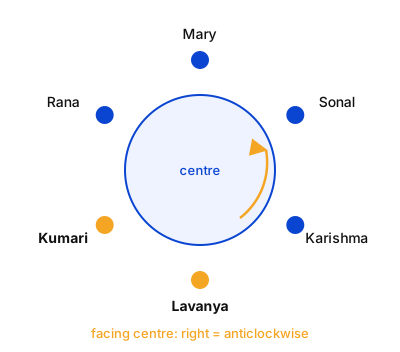
  1. Fix Lavanya. Sonal is 2nd to her right, Rana is 2nd to the right of Sonal.
  2. Karishma is 3rd to the right of Rana, i.e. exactly opposite him — she sits between Lavanya and Sonal.
  3. Mary is between Rana and Sonal; the only empty seat (between Rana and Lavanya) goes to Kumari.
  4. Moving one seat to the right (anticlockwise) from Kumari we reach Lavanya.

Trick: In a 6-seat circle, '3rd to the right' always means the person directly opposite.

Answer: (D) Lavanya

अवधारणा: केंद्र की ओर मुख करके बैठे लोगों के लिए दायाँ = वामावर्त (anticlockwise) दिशा।

  1. Lavanya को स्थिर करें। Sonal उसके दाएँ दूसरे स्थान पर, Rana, Sonal के दाएँ दूसरे स्थान पर।
  2. Karishma, Rana के दाएँ तीसरे स्थान पर = ठीक सामने, यानी Lavanya और Sonal के बीच।
  3. Mary, Rana और Sonal के बीच; बची हुई सीट (Rana और Lavanya के बीच) Kumari की।
  4. Kumari से एक सीट दाएँ (वामावर्त) जाने पर Lavanya मिलती है।

ट्रिक: 6 लोगों के वृत्त में 'दाएँ तीसरा' हमेशा ठीक सामने वाला व्यक्ति होता है।

उत्तर: (D) Lavanya

SSC CPO Paper IGeneral Intelligence and ReasoningCircular Seating Arrangement
Q51.
Capital adequacy ratio for a NBFC – MFI is ______.
NBFC – MFI के लिए पूंजी पर्याप्तता अनुपात (Capital adequacy ratio) ______ है।
  1. A15% of the aggregate depositsकुल जमाराशियों का 15%
  2. B8% of the aggregate depositsकुल जमाराशियों का 8%
  3. C15% of the aggregate risk weighted assetsकुल जोखिम भारित आस्तियों का 15%
  4. D11% of the aggregate risk weighted assetsकुल जोखिम भारित आस्तियों का 11%
Show answer

Concept: RBI prescribes a minimum capital adequacy ratio (CRAR) for NBFC-MFIs, measured against risk-weighted assets, not deposits.

  1. NBFC-MFIs must maintain a capital adequacy ratio of at least 15% of their aggregate risk-weighted assets.
  2. Tier-I capital must be at least 10% of this; Tier-II capital cannot exceed Tier-I.
  3. Capital adequacy is never calculated on deposits, so options (A) and (B) are wrong in principle; 11% is not the NBFC-MFI norm.

Yaad rakhein: CRAR = capital ÷ risk-weighted assets; NBFC-MFI → 15%.

Answer: (C) 15% of the aggregate risk weighted assets

अवधारणा: RBI ने NBFC-MFI के लिए न्यूनतम पूँजी पर्याप्तता अनुपात (CRAR) तय किया है, जो जोखिम-भारित परिसंपत्तियों (risk-weighted assets) पर आधारित होता है, जमा राशि पर नहीं।

  1. NBFC-MFI को कुल risk-weighted assets का कम से कम 15% पूँजी रखनी होती है।
  2. इसमें Tier-I पूँजी कम से कम 10% होनी चाहिए।
  3. पूँजी पर्याप्तता कभी deposits पर नहीं गिनी जाती, इसलिए (A), (B) गलत हैं; 11% NBFC-MFI का मानक नहीं है।

याद रखें: CRAR = पूँजी ÷ risk-weighted assets; NBFC-MFI → 15%।

उत्तर: (C) 15% of the aggregate risk weighted assets

SSC CPO Paper IGeneral Knowledge and General AwarenessNBFC-MFI regulation
Q101.
If cosA+cosB+cosC=3, then what is the value of sinA+sinB+sinC?
यदि cosA+cosB+cosC=3 है, तो sinA+sinB+sinC का मान क्या है?
  1. A1
  2. B2
  3. C0
  4. D−1
Show answer

Concept: cosθ≤1 for every angle, so a sum of three cosines can equal 3 only when each cosine equals 1.

  1. cosA+cosB+cosC=3⇒cosA=cosB=cosC=1.
  2. So A=B=C=0∘.
  3. sinA+sinB+sinC=0+0+0=0.

Trick: Sum of n cosines =n ⇒ every angle is 0∘, so every sine is 0.

Answer: (C) 0

अवधारणा: हर कोण के लिए cosθ≤1, इसलिए तीन cos का योग 3 तभी होगा जब प्रत्येक cos = 1 हो।

  1. cosA+cosB+cosC=3⇒cosA=cosB=cosC=1
  2. अतः A=B=C=0∘
  3. sinA+sinB+sinC=0+0+0=0

ट्रिक: n cos का योग =n ⇒ सभी कोण 0∘, इसलिए सभी sin = 0।

उत्तर: (C) 0

SSC CPO Paper IQuantitative AptitudeTrigonometry – maximum value of cos
Q151.
Identify the sentence that correctly uses the indefinite article.
  1. AIn an big city like Mumbai, we see lot of rubbish being thrown from households and factories.
  2. BIn big city like Mumbai, we see a lot of rubbish being thrown from households and factories.
  3. CIn a big city like Mumbai, we see a lot of rubbish being thrown from households and factories.
  4. DIn a big city like Mumbai, we see an lot of rubbish being thrown from households and factories.
Show answer

Concept: 'A' is used before a word beginning with a consonant sound and 'an' before a vowel sound; 'a lot of' is a fixed phrase.

  1. 'big' starts with a consonant sound, so it takes 'a': a big city.
  2. 'lot' also starts with a consonant sound: a lot of rubbish.
  3. (A) 'an big' and (D) 'an lot' are wrong; (B) drops the article before 'big city'.

Trick: Choose the article by the first sound, not the letter: a + consonant sound, an + vowel sound.

Answer: (C) In a big city like Mumbai, we see a lot of rubbish being thrown from households and factories.

अवधारणा: 'A' का प्रयोग consonant sound से शुरू होने वाले शब्द से पहले और 'an' का vowel sound से पहले होता है; 'a lot of' एक fixed phrase है।

  1. 'big' consonant sound से शुरू होता है, इसलिए a big city।
  2. 'lot' भी consonant sound है: a lot of rubbish।
  3. (A) 'an big', (D) 'an lot' गलत हैं; (B) में 'big city' से पहले article ही नहीं है।

ट्रिक: Article पहले अक्षर की ध्वनि (sound) से तय करें, अक्षर से नहीं।

उत्तर: (C) In a big city like Mumbai, we see a lot of rubbish being thrown from households and factories.

SSC CPO Paper IEnglish ComprehensionArticles

See all 200 solutions

More SSC CPO Paper I papers