SSC CPO Paper I 2024 · Shift 2

SSC CPO Paper I 27 Jun 2024 Shift 2 – Question Paper

200 questions · 200 marks · 120 minutes · +1 for a correct answer, −0.25 for a wrong one. Free PDF with answer key.

Library – airGurukul

Paper pattern

SectionQuestionsMarks
General Intelligence and Reasoning5050
General Knowledge and General Awareness5050
Quantitative Aptitude5050
English Comprehension5050

Sample questions from this paper

Q1.
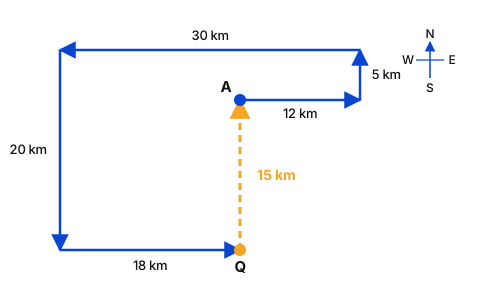
Manish starts from Point A and drives 12 km towards East. He then takes a left turn, drives 5 km, turns left and drives 30 km. He then takes a left turn and drives 20 km. He takes a final left turn, drives 18 km and stops at Point Q. How far (shortest distance) and towards which direction should he now drive to reach Point A again? (All turns are 90° turns only.)
मनीष बिंदु A से चलना शुरू करता है और पूर्व की ओर 12 km गाड़ी चलाता है। फिर वह बाएँ मुड़ता है, 5 km गाड़ी चलाता है, बाएँ मुड़ता है और 30 km गाड़ी चलाता है। फिर वह बाएँ मुड़ता है और 20 km गाड़ी चलाता है। वह अंतिम बार बाएँ मुड़ता है, 18 km गाड़ी चलाता है और बिंदु Q पर रुक जाता है। फिर से बिंदु A पर पहुँचने के लिए उसे अब कितनी दूरी (न्यूनतम दूरी) तक और किस दिशा में गाड़ी चलानी चाहिए? (सभी मोड़ केवल 90° के मोड़ हैं।)
  1. A10 km towards Southदक्षिण की ओर 10 km
  2. B15 km towards Northउत्तर की ओर 15 km
  3. C10 km towards Northउत्तर की ओर 10 km
  4. D15 km towards Southदक्षिण की ओर 15 km
Show answer

Concept: Plot every move on East–North axes taking A as the origin (0,0).

  1. East 12 km → (12,0); left (North) 5 km → (12,5).
  2. Left (West) 30 km → (12−30,5)=(−18,5); left (South) 20 km → (−18,−15).
  3. Left (East) 18 km → (−18+18,−15)=(0,−15) = Q.
  4. Q is exactly 15km below A on the same vertical line, so he must go North.

Trick: Net East–West =12−30+18=0, net North–South =5−20=−15 → Q is 15 km South of A.

Answer: (B) 15 km towards North

अवधारणा: A को मूल बिंदु (0,0) मानकर हर चाल को पूर्व–उत्तर अक्षों पर लिखें।

  1. पूर्व 12 km → (12,0); बाएँ (उत्तर) 5 km → (12,5)।
  2. बाएँ (पश्चिम) 30 km → (−18,5); बाएँ (दक्षिण) 20 km → (−18,−15)।
  3. बाएँ (पूर्व) 18 km → (0,−15) = Q।
  4. Q, A से ठीक 15km दक्षिण में है, अतः उसे उत्तर की ओर जाना होगा।

ट्रिक: शुद्ध पूर्व–पश्चिम =12−30+18=0, उत्तर–दक्षिण =5−20=−15 → Q, A से 15 km दक्षिण।

उत्तर: (B) 15 km towards North
SSC CPO Paper IGeneral Intelligence and ReasoningDirection and Distance
Q51.
Which Greek term was first used by Ernst Haeckel in 1866 to refer to ‘the relation of animals to both the organic as well as the inorganic environment’?
1866 में अर्नेस्ट हेकेल (Ernst Haeckel) द्वारा ‘जीवों का कार्बनिक और अकार्बनिक दोनों प्रकार के पर्यावरण से संबंध’ को संदर्भित करने के लिए सर्वप्रथम किस ग्रीक शब्द का प्रयोग किया गया था?
  1. AOekologie
  2. BEcophagie
  3. CEthnologie
  4. DOologie
Show answer

Concept: The word ‘ecology’ comes from the German/Greek-based term Oekologie, from Greek oikos (house) + logos (study).

  1. German zoologist Ernst Haeckel coined Oekologie in 1866 for the relation of animals to their organic and inorganic environment.
  2. Ethnology studies human cultures and races; oology studies bird eggs; ‘Ecophagie’ is not a scientific term.

Yaad rakhein: Haeckel – 1866 – Oekologie → Ecology (oikos = home).

Answer: (A) Oekologie

अवधारणा: ‘Ecology’ शब्द Oekologie से बना है – ग्रीक oikos (घर) + logos (अध्ययन)।

  1. जर्मन प्राणी-वैज्ञानिक अर्नस्ट हेकेल (Ernst Haeckel) ने 1866 में जीवों और उनके जैविक व अजैविक पर्यावरण के संबंध के लिए Oekologie शब्द दिया।
  2. Ethnology = मानव संस्कृतियों का अध्ययन; Oology = पक्षियों के अंडों का अध्ययन; ‘Ecophagie’ कोई वैज्ञानिक शब्द नहीं है।

याद रखें: हेकेल – 1866 – Oekologie → Ecology (oikos = घर)।

उत्तर: (A) Oekologie

SSC CPO Paper IGeneral Knowledge and General AwarenessEcology – origin of term
Q101.
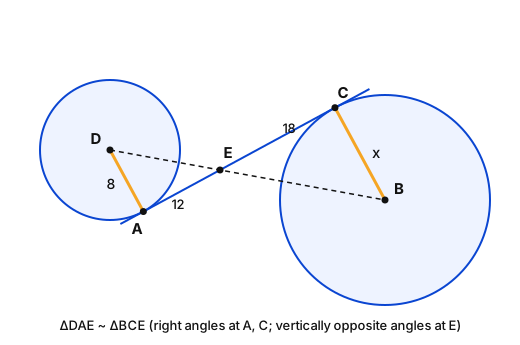
Two circles with centers B and D have radii DA = 8 cm and BC = x cm, respectively. AC is tangent to both circles. If DB and AC intersect the point E, AE = 12 cm and EC = 18 cm, then find the value of x (in cm).
केंद्र B और D वाले दो वृत्तों की त्रिज्याएँ क्रमशः DA = 8 cm और BC = x cm हैं। AC दोनों वृत्तों की स्पर्श रेखा है। यदि DB और AC बिंदु E पर प्रतिच्छेद करती हैं, AE = 12 cm और EC = 18 cm है, तो x का मान (cm में) ज्ञात कीजिए।
  1. A12
  2. B11
  3. C10
  4. D13
Show answer

Concept: A radius is perpendicular to the tangent at the point of contact; with vertically opposite angles at E, the two triangles are similar.

  1. DA⟂AC and BC⟂AC, so ∠DAE=∠BCE=90∘.
  2. ∠AED=∠CEB (vertically opposite), hence △DAE~△BCE.
  3. DAAE=BCEC⇒812=x18
  4. x=8×1812=12

Trick: Radii are in the same ratio as the tangent pieces: 8:x=12:18.

Answer: (A) 12

अवधारणा: स्पर्श बिंदु पर त्रिज्या स्पर्श रेखा पर लंब होती है; E पर शीर्षाभिमुख कोण बराबर होने से दोनों त्रिभुज समरूप हैं।

  1. DA⟂AC तथा BC⟂AC, अतः ∠DAE=∠BCE=90∘।
  2. ∠AED=∠CEB (शीर्षाभिमुख कोण), इसलिए △DAE~△BCE।
  3. DAAE=BCEC⇒812=x18
  4. x=8×1812=12

ट्रिक: त्रिज्याओं का अनुपात = स्पर्श रेखा के टुकड़ों का अनुपात: 8:x=12:18।

उत्तर: (A) 12

SSC CPO Paper IQuantitative AptitudeCommon Tangents & Similar Triangles
Q151.
Select the most appropriate meaning of the given idiom.
Go down in flames
  1. ATo fail spectacularly
  2. BTo destroy completely
  3. CTo crash and burn
  4. DTo burn down completely
Show answer

Concept: An idiom has a fixed figurative meaning; go down in flames means to fail suddenly, completely and in a very public, dramatic way.

  1. Picture a plane falling in flames – the failure is total and everyone sees it.
  2. E.g. His campaign went down in flames after the scandal. = it failed spectacularly.
  3. (B) and (D) describe literal burning/destruction; (C) crash and burn is just another idiom, not a meaning.

Yaad rakhein: Go down in flames = fail badly and visibly (spectacular failure).

Answer: (A) To fail spectacularly

अवधारणा: मुहावरे का अर्थ लाक्षणिक (figurative) होता है; go down in flames = अचानक, पूरी तरह और सबके सामने बुरी तरह असफल होना।

  1. आग में गिरते विमान की कल्पना करें – असफलता पूरी और सबको दिखने वाली।
  2. उदाहरण: His campaign went down in flames after the scandal. = अभियान बुरी तरह विफल हुआ।
  3. (B) व (D) शाब्दिक जलना/नष्ट होना बताते हैं; (C) crash and burn स्वयं एक दूसरा idiom है, अर्थ नहीं।

याद रखें: Go down in flames = शानदार/ज़बरदस्त तरीके से असफल होना।

उत्तर: (A) To fail spectacularly

SSC CPO Paper IEnglish ComprehensionIdioms

See all 200 solutions

More SSC CPO Paper I papers