Q201.A, B, C, D, E and F live on six different floors of the same building. The lowermost floor in the building is numbered 1, the floor above it is numbered 2 and so on till the topmost floor, which is numbered 6.
Only two people live below C. Only two people live between B and C. A lives above E but below C. F does not live above D.
Who lives immediately below B?
A, B, C, D, E और F एक ही इमारत की छह अलग-अलग मंज़िलों पर रहते हैं। इमारत की सबसे निचली मंज़िल की संख्या 1 है, उसके ऊपर की मंज़िल की संख्या 2 है और इसी प्रकार सबसे ऊपरी मंज़िल तक, जिसकी संख्या 6 है।
C के नीचे केवल दो व्यक्ति रहते हैं। B और C के बीच केवल दो व्यक्ति रहते हैं। A, E के ऊपर लेकिन C के नीचे रहता है। F, D के ऊपर नहीं रहता है।
B के ठीक नीचे कौन रहता है?
- AD
- BF
- CC
- DA
Show answer
Concept: Start from the clue that fixes a floor, then place the rest.
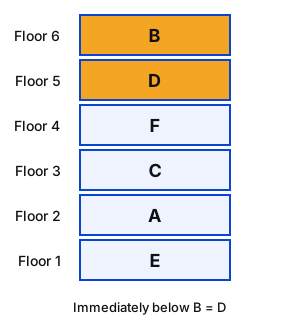
- Only two below C → C on floor 3. Only two between B and C → B on floor 6 (floor 0 does not exist).
- A above E but below C → A = 2, E = 1.
- Floors 4 and 5 remain for D and F; F not above D → D = 5, F = 4.
- Immediately below B (6) is D (5).
Trick: Draw a 6-row column and strike out impossible floors – 'only two between' with floor 3 leaves just floor 6.
Answer: (A) D
अवधारणा: जिस संकेत से मंज़िल निश्चित हो, वहाँ से शुरू करें।
- C के नीचे केवल दो → C मंज़िल 3 पर। B और C के बीच केवल दो → B मंज़िल 6 पर (मंज़िल 0 नहीं होती)।
- A, E के ऊपर पर C के नीचे → A = 2, E = 1।
- मंज़िल 4 व 5 D और F के लिए; F, D के ऊपर नहीं → D = 5, F = 4।
- B (6) के ठीक नीचे D (5)।
ट्रिक: 6 पंक्तियों का स्तंभ बनाकर असंभव मंज़िलें काटें – मंज़िल 3 से 'बीच में केवल दो' सिर्फ मंज़िल 6 छोड़ता है।
उत्तर: (A) D
RRB NTPC Graduate CBT 1General Intelligence and ReasoningFloor puzzleRRB NTPC Graduate CBT 1 2025 · 24 Mar Shift 3
Q202.In a certain code language,
A + B means ‘A is the mother of B’
A – B means ‘A is the brother of B’
A × B means ‘A is the wife of B’
A % B means ‘A is the father of B’
A # B means ‘A is the daughter of B’
Based on the above, how is G related to Q if ‘G – C + D # L % Q’?
एक निश्चित कूट भाषा में,
A + B का अर्थ है ‘A, B की माता है’
A – B का अर्थ है ‘A, B का भाई है’
A × B का अर्थ है ‘A, B की पत्नी है’
A % B का अर्थ है ‘A, B का पिता है’
A # B का अर्थ है ‘A, B की पुत्री है’
उपर्युक्त के आधार पर, यदि ‘G – C + D # L % Q’ है, तो G, Q से किस प्रकार संबंधित है?
- AMother’s brotherमाता का भाई
- BSister’s daughterबहन की पुत्री
- CSister’s husbandबहन का पति
- DWife’s brotherपत्नी का भाई
Show answer
Concept: Decode each symbol and build the family tree step by step.
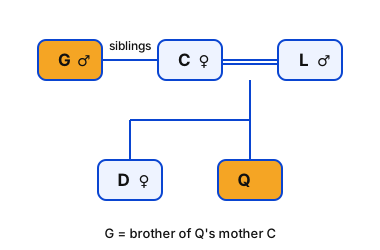
- G – C: G is the brother of C. C + D: C is the mother of D.
- D # L: D is the daughter of L, so L is C's husband. L % Q: L is the father of Q.
- Q is a child of L and C; G is C's brother → G is Q's mother's brother (maternal uncle).
Trick: Decode from the end towards the person asked (Q), then climb the tree to G.
Answer: (A) Mother's brother
अवधारणा: हर चिह्न को डिकोड कर क्रम से वंश-वृक्ष बनाएँ।
- G – C: G, C का भाई। C + D: C, D की माँ।
- D # L: D, L की पुत्री, अतः L, C का पति। L % Q: L, Q का पिता।
- Q, L और C की संतान; G, C का भाई → G, Q की माँ का भाई (मामा)।
ट्रिक: जिसके बारे में पूछा है (Q) उसकी ओर से डिकोड करें, फिर वृक्ष में ऊपर G तक जाएँ।
उत्तर: (A) Mother's brother
RRB NTPC Graduate CBT 1General Intelligence and ReasoningBlood relations – codingRRB NTPC Graduate CBT 1 2025 · 24 Mar Shift 3
Q203.In a certain code language, ‘NEAR’ is coded as ‘3519’ and ‘GROW’ is coded as ‘8645’. What is the code for ‘R’ in that language?
एक निश्चित कूट भाषा में, ‘NEAR’ को ‘3519’ के रूप में कूटबद्ध किया जाता है और ‘GROW’ को ‘8645’ के रूप में कूटबद्ध किया जाता है। उस भाषा में ‘R’ का कूट क्या है?
- A5
- B9
- C8
- D6
Show answer
Concept: In such codes each letter maps to one digit; a letter common to both words gets the digit common to both codes.
- NEAR → 3519 and GROW → 8645 share only the letter R.
- The codes share only the digit 5 → R = 5.
Trick: Match the common letter with the common digit – no need to find the order of coding.
Answer: (A) 5
अवधारणा: ऐसे कोड में हर अक्षर का एक अंक होता है; दोनों शब्दों में उभयनिष्ठ अक्षर को दोनों कोडों का उभयनिष्ठ अंक मिलता है।
- NEAR → 3519 और GROW → 8645 में केवल अक्षर R समान है।
- कोडों में केवल अंक 5 समान है → R = 5।
ट्रिक: समान अक्षर को समान अंक से मिलाएँ – कोडिंग का क्रम खोजने की ज़रूरत नहीं।
उत्तर: (A) 5
RRB NTPC Graduate CBT 1General Intelligence and ReasoningCoding – common letterRRB NTPC Graduate CBT 1 2025 · 24 Mar Shift 3
Q204.If 1 is added to each odd digit and 2 is subtracted from each even digit in the number 4528173, how many digits will appear more than once in the new number thus formed?
यदि संख्या 4528173 के प्रत्येक विषम अंक में 1 जोड़ा जाए और प्रत्येक सम अंक से 2 घटाया जाए, तो इस प्रकार बनी नई संख्या में कितने अंक एक से अधिक बार आएंगे?
- ANoneकोई नहीं
- BOneएक
- CTwoदो
- DThreeतीन
Show answer
Concept: Apply the rule digit by digit, then count repeated digits.
- 4528173: 4→2, 5→6, 2→0, 8→6, 1→2, 7→8, 3→4.
- New number: 2606284.
- Digit 2 appears twice and 6 appears twice → two digits repeat.
Trick: Write the new digits directly under the old ones in a line to avoid skipping any.
Answer: (C) Two
अवधारणा: नियम को हर अंक पर लगाएँ, फिर दोहराए गए अंक गिनें।
- 4528173: 4→2, 5→6, 2→0, 8→6, 1→2, 7→8, 3→4।
- नई संख्या: 2606284।
- अंक 2 दो बार और 6 दो बार → दो अंक दोहराए गए।
ट्रिक: नए अंकों को पुराने अंकों के ठीक नीचे एक पंक्ति में लिखें ताकि कोई छूटे नहीं।
उत्तर: (C) Two
RRB NTPC Graduate CBT 1General Intelligence and ReasoningNumber operationsRRB NTPC Graduate CBT 1 2025 · 24 Mar Shift 3
Q205.Refer to the following letter, number, symbol series and answer the question. (All numbers are single-digit numbers only) (Counting to be done from left to right only) (Left) Z Q Y 7 * 9 E D V Z R X 4 * N G T B 3 X A T 4 H (Right)
How many such symbols are there, each of which is immediately preceded by a number and also immediately followed by a letter?
निम्नलिखित अक्षर, संख्या, प्रतीक श्रृंखला को देखिए और प्रश्न का उत्तर दीजिए। (सभी संख्याएँ केवल एक अंक की संख्याएँ हैं) (गिनती केवल बाएँ से दाएँ की ओर की जानी है) (बाएँ) Z Q Y 7 * 9 E D V Z R X 4 * N G T B 3 X A T 4 H (दाएँ)
ऐसे कितने प्रतीक हैं, जिनमें से प्रत्येक के ठीक पहले एक संख्या है और ठीक बाद एक अक्षर है?
- ATwoदो
- BNoneकोई नहीं
- CThreeतीन
- DOneएक
Show answer
Concept: Check each symbol's immediate left (must be a number) and immediate right (must be a letter).
- Series: Z Q Y 7 * 9 E D V Z R X 4 * N G T B 3 X A T 4 H – only two symbols (*).
- First *: 7 * 9 → followed by a number, not a letter ✗.
- Second *: 4 * N → preceded by a number and followed by a letter ✓.
Trick: First circle every symbol, then look at its two neighbours – fastest way in such series.
Answer: (D) One
अवधारणा: हर चिह्न का ठीक बायाँ (संख्या होनी चाहिए) और ठीक दायाँ (अक्षर होना चाहिए) जाँचें।
- श्रृंखला: Z Q Y 7 * 9 E D V Z R X 4 * N G T B 3 X A T 4 H – केवल दो चिह्न (*)।
- पहला *: 7 * 9 → बाद में संख्या, अक्षर नहीं ✗।
- दूसरा *: 4 * N → पहले संख्या और बाद में अक्षर ✓।
ट्रिक: पहले हर चिह्न पर गोला लगाएँ, फिर उसके दोनों पड़ोसी देखें – ऐसी श्रृंखला में सबसे तेज़ तरीका।
उत्तर: (D) One
RRB NTPC Graduate CBT 1General Intelligence and ReasoningMixed series countingRRB NTPC Graduate CBT 1 2025 · 24 Mar Shift 3
Q206.C, D, N, O, P and Q live on six different floors of the same building. The lowermost floor in the building is numbered 1, the floor above it is numbered 2 and so on, till the topmost floor, which is numbered 6. O lives immediately above D. Only Q lives above P. Only two people live between C and N. C lives on an odd-numbered floor. Who lives on the bottommost floor?
C, D, N, O, P और Q एक ही इमारत की छह अलग-अलग मंज़िलों पर रहते हैं। इमारत की सबसे निचली मंज़िल की संख्या 1 है, उसके ऊपर की मंज़िल की संख्या 2 है और इसी प्रकार सबसे ऊपरी मंज़िल तक, जिसकी संख्या 6 है। O, D के ठीक ऊपर रहता है। P के ऊपर केवल Q रहता है। C और N के बीच केवल दो व्यक्ति रहते हैं। C एक विषम संख्या वाली मंज़िल पर रहता है। सबसे निचली मंज़िल पर कौन रहता है?
- AP
- BD
- CC
- DN
Show answer
Concept: Use the 'only' clues first to fix floors.
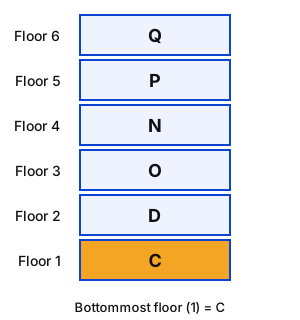
- Only Q above P → Q = 6, P = 5.
- Two between C and N using floors 1–4 → C and N on floors 1 and 4; C odd → C = 1, N = 4.
- O immediately above D → D = 2, O = 3.
- Bottommost floor: C.
Trick: Once the top two floors are fixed, a gap of two in four floors can only be 1 and 4.
Answer: (C) C
अवधारणा: पहले 'केवल' वाले संकेतों से मंज़िलें तय करें।
- P के ऊपर केवल Q → Q = 6, P = 5।
- मंज़िल 1–4 में C और N के बीच दो → C और N मंज़िल 1 व 4 पर; C विषम → C = 1, N = 4।
- O, D के ठीक ऊपर → D = 2, O = 3।
- सबसे नीचे की मंज़िल: C।
ट्रिक: ऊपर की दो मंज़िलें तय होने पर चार मंज़िलों में दो का अंतर केवल 1 और 4 पर संभव है।
उत्तर: (C) C
RRB NTPC Graduate CBT 1General Intelligence and ReasoningFloor puzzleRRB NTPC Graduate CBT 1 2025 · 24 Mar Shift 3
Q207.Based on the English alphabetical order, three of the following four letter cluster pairs are alike in a certain way and thus form a group. Which is the one that does not belong to that group?
(Note: The odd man out is not based on the number of consonants/vowels or their position in the letter cluster)
अंग्रेज़ी वर्णमाला क्रम के आधार पर, निम्नलिखित चार अक्षर-समूह युग्मों में से तीन एक निश्चित तरीके से समान हैं और इस प्रकार एक समूह बनाते हैं। वह कौन-सा है जो उस समूह से संबंधित नहीं है?
(नोट: असंगत का निर्धारण व्यंजनों/स्वरों की संख्या या अक्षर-समूह में उनकी स्थिति के आधार पर नहीं किया गया है)
- AAD-BE
- BEH-FI
- CLO-PS
- DRU-SV
Show answer
Concept: Compare how each letter of the first cluster changes to form the second.
- AD → BE: A+1 = B, D+1 = E. EH → FI: +1, +1. RU → SV: +1, +1.
- LO → PS: L+4 = P, O+4 = S → shift of +4, different from the rest.
Trick: Check the first letters only: A→B, E→F, R→S are +1 but L→P is +4.
Answer: (C) LO-PS
अवधारणा: पहले समूह के हर अक्षर से दूसरे समूह तक का परिवर्तन तुलना करें।
- AD → BE: A+1 = B, D+1 = E। EH → FI: +1, +1। RU → SV: +1, +1।
- LO → PS: L+4 = P, O+4 = S → +4 का अंतर, बाकी से अलग।
ट्रिक: केवल पहले अक्षर देखें: A→B, E→F, R→S में +1 पर L→P में +4।
उत्तर: (C) LO-PS
RRB NTPC Graduate CBT 1General Intelligence and ReasoningOdd one out – letter pairsRRB NTPC Graduate CBT 1 2025 · 24 Mar Shift 3
Q208.In a certain code language, ‘COOK’ is coded as ‘8245’ and ‘HOOK’ is coded as ‘5429’. What is the code for ‘H’ in that language?
एक निश्चित कूट भाषा में, 'COOK' को '8245' के रूप में कूटबद्ध किया जाता है और 'HOOK' को '5429' के रूप में कूटबद्ध किया जाता है। उस भाषा में 'H' का कूट क्या है?
- A8
- B9
- C4
- D5
Show answer
Concept: Compare two coded words: common letters get the common digits; the leftover letter gets the leftover digit.
- COOK → 8245 and HOOK → 5429 share the letters O, O, K.
- Common digits of 8245 and 5429 are 2, 4, 5 → these belong to O, O, K.
- Leftover: C → 8 (from COOK) and H → 9 (from HOOK).
Trick: In such codes the digits are usually jumbled, so match by elimination, not by position.
Answer: (B) 9
अवधारणा: दो कूट शब्दों की तुलना करें: समान अक्षरों को समान अंक मिलते हैं; बचे अक्षर को बचा अंक।
- COOK → 8245 और HOOK → 5429 में O, O, K अक्षर समान हैं।
- 8245 और 5429 में समान अंक 2, 4, 5 हैं → ये O, O, K के हैं।
- शेष: C → 8 (COOK से) और H → 9 (HOOK से)।
ट्रिक: ऐसे कूट में अंक प्रायः उलट-पुलट होते हैं, इसलिए स्थिति से नहीं, निराकरण (elimination) से मिलान करें।
उत्तर: (B) 9
RRB NTPC Graduate CBT 1General Intelligence and ReasoningCoding-DecodingRRB NTPC Graduate CBT 1 2025 · 24 Mar Shift 2
Q209.X, Y, Z, S, T and U live on six different floors of the same building. The lowermost floor in the building is numbered 1, the floor above it is numbered 2, and so on till the topmost floor is numbered 6. U lives on floor number 4. Only two people live between U and Z. Only T lives between U and Y. X lives immediately below U. Who lives on floor number 5?
X, Y, Z, S, T और U एक ही भवन की छह अलग-अलग मंज़िलों पर रहते हैं। भवन की सबसे निचली मंज़िल की संख्या 1 है, उसके ऊपर की मंज़िल की संख्या 2 है, और इसी प्रकार सबसे ऊपरी मंज़िल तक, जिसकी संख्या 6 है। U मंज़िल संख्या 4 पर रहता है। U और Z के बीच केवल दो व्यक्ति रहते हैं। U और Y के बीच केवल T रहता है। X, U के ठीक नीचे रहता है। मंज़िल संख्या 5 पर कौन रहता है?
- AS
- BY
- CX
- DT
Show answer
Concept: Fix the given floor first, then place people using the 'between' and 'immediately' clues.
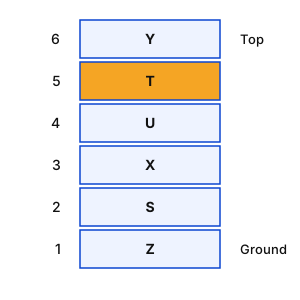
- U = floor 4. Two people between U and Z → Z = 1 (floor 7 does not exist).
- X lives immediately below U → X = 3.
- Only T between U and Y → T = 5, Y = 6 (T = 3 is taken by X). Remaining S = 2.
- Floor 5 is occupied by T.
Trick: Always begin with the definite clue (U = 4); 'immediately below' kills the other branch at once.
Answer: (D) T
अवधारणा: पहले दी गई मंज़िल तय करें, फिर 'बीच में' और 'ठीक नीचे' वाले संकेतों से लोगों को रखें।
- U = मंज़िल 4। U और Z के बीच दो लोग → Z = 1 (मंज़िल 7 नहीं है)।
- X, U के ठीक नीचे रहता है → X = 3।
- U और Y के बीच केवल T → T = 5, Y = 6 (T = 3 पर X है)। शेष S = 2।
- मंज़िल 5 पर T रहता है।
ट्रिक: हमेशा निश्चित संकेत (U = 4) से शुरू करें; 'ठीक नीचे' दूसरी शाखा को तुरंत खत्म कर देता है।
उत्तर: (D) T
RRB NTPC Graduate CBT 1General Intelligence and ReasoningFloor PuzzleRRB NTPC Graduate CBT 1 2025 · 24 Mar Shift 2
Q210.Based on the English alphabetical order, three of the following four letter-cluster pairs are alike in a certain way and thus form a group. Which letter-cluster pair DOES NOT belong to that group?
(Note: The odd one out is not based on the number of consonants/vowels or their position in the letter-cluster.)
अंग्रेज़ी वर्णमाला क्रम के आधार पर, निम्नलिखित चार अक्षर-समूह युग्मों में से तीन एक निश्चित प्रकार से समान हैं और इस प्रकार एक समूह बनाते हैं। कौन-सा अक्षर-समूह युग्म उस समूह से संबंधित नहीं है?
(नोट: विषम वाला व्यंजनों/स्वरों की संख्या या अक्षर-समूह में उनकी स्थिति पर आधारित नहीं है।)
- ARQ−PO
- BZY−XW
- CYX−WV
- DLK−IK
Show answer
Concept: Write the alphabet positions and look at the pattern inside each pair.
- RQ−PO: R(18) Q(17) P(16) O(15) – four consecutive letters in reverse order.
- ZY−XW: 26, 25, 24, 23 and YX−WV: 25, 24, 23, 22 – also four consecutive letters backwards.
- LK−IK: L(12) K(11) I(9) K(11) – the chain breaks (gap of 2, then K repeats).
Trick: Three options following 'consecutive descending' leave the odd one out immediately – look for the repeated letter.
Answer: (D) LK−IK
अवधारणा: अक्षरों के स्थान लिखें और हर जोड़े के भीतर पैटर्न देखें।
- RQ−PO: R(18) Q(17) P(16) O(15) – उल्टे क्रम में चार क्रमागत अक्षर।
- ZY−XW: 26, 25, 24, 23 और YX−WV: 25, 24, 23, 22 – ये भी उल्टे क्रम में चार क्रमागत अक्षर।
- LK−IK: L(12) K(11) I(9) K(11) – शृंखला टूटती है (2 का अंतर, फिर K दोहराया)।
ट्रिक: तीन विकल्प 'क्रमागत अवरोही' हैं, इससे विषम तुरंत दिखता है – दोहराया हुआ अक्षर पहचानें।
उत्तर: (D) LK−IK
RRB NTPC Graduate CBT 1General Intelligence and ReasoningLetter Cluster ClassificationRRB NTPC Graduate CBT 1 2025 · 24 Mar Shift 2
Q211.Each of the digits in the number 7814329 is arranged in ascending order from left to right. The position of how many digits will remain unchanged as compared to that in the original number?
संख्या 7814329 के प्रत्येक अंक को बाएँ से दाएँ आरोही क्रम में व्यवस्थित किया जाता है। मूल संख्या की तुलना में कितने अंकों की स्थिति अपरिवर्तित रहेगी?
- AFourचार
- BThreeतीन
- COneएक
- DTwoदो
Show answer
Concept: Write the original and the rearranged number one below the other and compare position by position.
- Original: 7 8 1 4 3 2 9.
- Ascending order: 1 2 3 4 7 8 9.
- Position 4 has 4 in both and position 7 has 9 in both; all other positions change.
- So the position of two digits remains unchanged.
Trick: Only the digit that is already the k-th smallest and sits at the k-th place stays – check each quickly.
Answer: (D) Two
अवधारणा: मूल और पुनर्व्यवस्थित संख्या को एक के नीचे एक लिखकर स्थान-दर-स्थान तुलना करें।
- मूल: 7 8 1 4 3 2 9।
- आरोही क्रम: 1 2 3 4 7 8 9।
- चौथे स्थान पर दोनों में 4 और सातवें स्थान पर दोनों में 9 है; बाकी सभी स्थान बदलते हैं।
- अतः दो अंकों का स्थान अपरिवर्तित रहता है।
ट्रिक: केवल वही अंक रुकता है जो पहले से k-वाँ सबसे छोटा है और k-वें स्थान पर बैठा है – हर स्थान तेज़ी से जाँचें।
उत्तर: (D) दो
RRB NTPC Graduate CBT 1General Intelligence and ReasoningNumber ArrangementRRB NTPC Graduate CBT 1 2025 · 24 Mar Shift 2
Q212.Seven people B, C, D, O, P, Q and R are sitting around a circular table facing the center of the table. Only four people sit between D and C when counted from the right of D. R sits third to the right of D. B sits third to the left of Q. P is an immediate neighbor of both C and R. How many people sit between O and P when counted from the left of O?
सात व्यक्ति B, C, D, O, P, Q और R एक वृत्ताकार मेज़ के चारों ओर मेज़ के केंद्र की ओर मुख करके बैठे हैं। D के दाएँ से गिनने पर D और C के बीच केवल चार व्यक्ति बैठे हैं। R, D के दाएँ तीसरे स्थान पर बैठा है। B, Q के बाएँ तीसरे स्थान पर बैठा है। P, C और R दोनों का निकटतम पड़ोसी है। O के बाएँ से गिनने पर O और P के बीच कितने व्यक्ति बैठे हैं?
- AOneएक
- BTwoदो
- CFourचार
- DThreeतीन
Show answer
Concept: Facing the centre, 'right' means anticlockwise. In 7 seats, 'four between D and C from D's right' = C is 5th to the right of D.
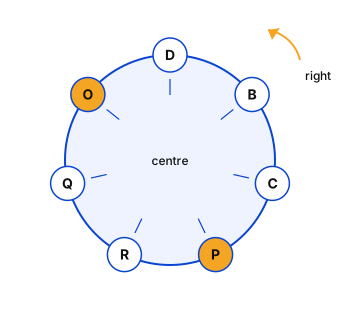
- Place D. Going right: R is 3rd to the right of D; C is 5th to the right of D.
- P is a neighbour of both C and R → P sits in the 4th seat (between R and C).
- Seats left: 1st, 2nd and 6th to the right of D. B is 3rd to the left of Q → Q at 2nd right, B at 6th right; O takes the 1st seat right of D.
- From O's left (clockwise): D, B, C, then P → three people between O and P.
Trick: Number the seats 0–6 anticlockwise from D; 'n-th to the right' = +n, 'n-th to the left' = −n (mod 7).
Answer: (D) Three
अवधारणा: केंद्र की ओर मुख होने पर 'दाएँ' = वामावर्त (anticlockwise)। 7 सीटों में 'D के दाएँ से D और C के बीच चार' = C, D के दाएँ 5वाँ।
- D रखें। दाएँ चलते हुए: R, D के दाएँ तीसरा; C, D के दाएँ पाँचवाँ।
- P, C और R दोनों का पड़ोसी → P चौथी सीट (R और C के बीच) पर।
- बची सीटें: D के दाएँ पहली, दूसरी और छठी। B, Q के बाएँ तीसरा → Q दूसरी दाएँ, B छठी दाएँ; O, D के दाएँ पहली सीट पर।
- O के बाएँ (दक्षिणावर्त) से: D, B, C, फिर P → O और P के बीच तीन लोग।
ट्रिक: D से वामावर्त सीटें 0–6 नंबर करें; 'दाएँ n-वाँ' = +n, 'बाएँ n-वाँ' = −n (mod 7)।
उत्तर: (D) तीन
RRB NTPC Graduate CBT 1General Intelligence and ReasoningCircular Seating ArrangementRRB NTPC Graduate CBT 1 2025 · 24 Mar Shift 2
Q213.Based on the alphabetical order, three of the following four are alike in a certain way and thus form a group. Which is the one that does not belong to that group?
(Note: The odd man out is not based on the number of consonants/vowels or their position in the letter cluster.)
वर्णमाला क्रम के आधार पर, निम्नलिखित चार में से तीन एक निश्चित प्रकार से समान हैं और इस प्रकार एक समूह बनाते हैं। वह कौन-सा है जो उस समूह से संबंधित नहीं है?
(नोट: विषम वाला व्यंजनों/स्वरों की संख्या या अक्षर-समूह में उनकी स्थिति पर आधारित नहीं है।)
- APLO
- BNJM
- CJFH
- DLHK
Show answer
Concept: Convert letters to positions and find the gap pattern between 1st→2nd and 2nd→3rd letters.
- PLO: 16, 12, 15 → .
- NJM: 14, 10, 13 → ; LHK: 12, 8, 11 → .
- JFH: 10, 6, 8 → – the second gap differs.
Trick: When three options share a pattern like , the one with a single different step is the answer.
Answer: (C) JFH
अवधारणा: अक्षरों को स्थान में बदलें और पहले→दूसरे तथा दूसरे→तीसरे अक्षर के अंतर का पैटर्न देखें।
- PLO: 16, 12, 15 → ।
- NJM: 14, 10, 13 → ; LHK: 12, 8, 11 → ।
- JFH: 10, 6, 8 → – दूसरा अंतर अलग है।
ट्रिक: जब तीन विकल्पों में जैसा समान पैटर्न हो, तो एक अलग कदम वाला विकल्प उत्तर है।
उत्तर: (C) JFH
RRB NTPC Graduate CBT 1General Intelligence and ReasoningLetter Cluster ClassificationRRB NTPC Graduate CBT 1 2025 · 24 Mar Shift 2
Q214.In a certain code language,
A + B means ‘A is the mother of B’
A – B means ‘A is the brother of B’
A × B means ‘A is the wife of B’
A % B means ‘A is the father of B’
A # B means ‘A is the daughter of B’
Based on the above, how is G related to D if ‘G # P – L # C + D’?
एक निश्चित कूट भाषा में,
A + B का अर्थ है 'A, B की माता है'
A – B का अर्थ है 'A, B का भाई है'
A × B का अर्थ है 'A, B की पत्नी है'
A % B का अर्थ है 'A, B का पिता है'
A # B का अर्थ है 'A, B की पुत्री है'
उपर्युक्त के आधार पर, यदि 'G # P – L # C + D' है, तो G, D से किस प्रकार संबंधित है?
- ABrother’s daughterभाई की पुत्री
- BFather’s sisterपिता की बहन
- CFather’s motherपिता की माता
- DSon’s daughterपुत्र की पुत्री
Show answer
Concept: Decode symbol by symbol and build the family tree from the top (oldest) generation.
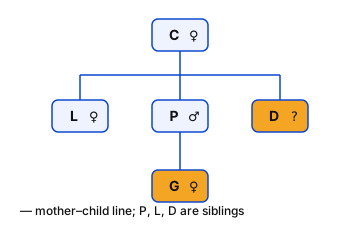
- C + D: C is the mother of D. L # C: L is the daughter of C → L and D are siblings.
- P − L: P is the brother of L → P is also a child of C, i.e. P is D's brother.
- G # P: G is the daughter of P.
- So G is the daughter of D's brother → brother's daughter (niece).
Trick: Start from the end of the chain (the mother C) – children of the same mother are siblings; then attach the first person.
Answer: (A) Brother's daughter
अवधारणा: प्रतीकों को एक-एक करके डिकोड करें और ऊपर (सबसे पुरानी) पीढ़ी से वंश-वृक्ष बनाएँ।
- C + D: C, D की माता है। L # C: L, C की पुत्री → L और D भाई-बहन हैं।
- P − L: P, L का भाई → P भी C की संतान, अर्थात P, D का भाई है।
- G # P: G, P की पुत्री है।
- अतः G, D के भाई की पुत्री → भाई की बेटी (भतीजी)।
ट्रिक: शृंखला के अंत (माता C) से शुरू करें – एक ही माता की संतानें भाई-बहन हैं; फिर पहले व्यक्ति को जोड़ें।
उत्तर: (A) भाई की बेटी
RRB NTPC Graduate CBT 1General Intelligence and ReasoningBlood RelationsRRB NTPC Graduate CBT 1 2025 · 24 Mar Shift 2
Q215.What will come in the place of ‘?’ in the following equation, if ‘+’ and ‘−’ are
interchanged and ‘×’ and ‘÷’ are interchanged?
25 ÷ 2 + 12 × 4 − 7 = ? + 13
यदि '+' और '−' को परस्पर बदल दिया जाए तथा '×' और '÷' को परस्पर बदल दिया जाए, तो निम्नलिखित समीकरण में '?' के स्थान पर क्या आएगा?
25 ÷ 2 + 12 × 4 − 7 = ? + 13
- A66
- B64
- C65
- D67
Show answer
Concept: Interchange the signs on both sides of the equation, then apply BODMAS.
- After interchange: .
- LHS: ; ; .
- .
Trick: The '+' on the right side also becomes '−' – forgetting this gives 41, which is not an option.
Answer: (D) 67
अवधारणा: समीकरण के दोनों पक्षों में चिह्न बदलें, फिर BODMAS लगाएँ।
- बदलने पर: ।
- LHS: ; ; ।
- ।
ट्रिक: दाएँ पक्ष का '+' भी '−' बनता है – इसे भूलने पर 41 आता है, जो विकल्प में नहीं है।
उत्तर: (D) 67
RRB NTPC Graduate CBT 1General Intelligence and ReasoningMathematical OperationsRRB NTPC Graduate CBT 1 2025 · 24 Mar Shift 2
Q216.Dinesh starts from Point A and drives 46 km towards West. He then takes a left turn, drives 25 km, turns left and drives 35 km. He then takes a left turn and drives 67 km. He takes a final right turn, drives 11 km and stops at Point P. How far (shortest distance) and towards which direction should he drive in order to reach Point A again? (All turns are 90 degrees turns only unless specified)
दिनेश बिंदु A से शुरू करता है और पश्चिम की ओर 46 km गाड़ी चलाता है। फिर वह बाएँ मुड़ता है, 25 km चलता है, बाएँ मुड़ता है और 35 km चलता है। फिर वह बाएँ मुड़ता है और 67 km चलता है। वह अंत में दाएँ मुड़ता है, 11 km चलता है और बिंदु P पर रुक जाता है। बिंदु A पर पुनः पहुँचने के लिए उसे कितनी दूर (न्यूनतम दूरी) और किस दिशा में गाड़ी चलानी चाहिए? (जब तक अन्यथा निर्दिष्ट न हो, सभी मोड़ केवल 90 डिग्री के मोड़ हैं)
- A40 km to the South40 km दक्षिण की ओर
- B40 km to the North40 km उत्तर की ओर
- C42 km to the South42 km दक्षिण की ओर
- D42 km to the North42 km उत्तर की ओर
Show answer
Concept: Track the facing direction after each turn: facing West, left = South; facing South, left = East; facing East, left = North; facing North, right = East.
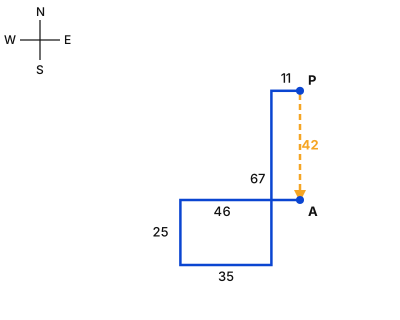
- Take A as origin. West 46 → ; left (South) 25 → ; left (East) 35 → .
- Left (North) 67 → ; right (East) 11 → .
- P is directly 42 km north of A, so he must drive 42 km towards the South.
Trick: Net East–West: ; net North–South: north – when one component is zero no Pythagoras is needed.
Answer: (C) 42 km to the South
अवधारणा: हर मोड़ के बाद मुख की दिशा नोट करें: पश्चिम मुख पर बायाँ = दक्षिण; दक्षिण मुख पर बायाँ = पूर्व; पूर्व मुख पर बायाँ = उत्तर; उत्तर मुख पर दायाँ = पूर्व।
- A को मूल बिंदु लें। पश्चिम 46 → ; बायाँ (दक्षिण) 25 → ; बायाँ (पूर्व) 35 → ।
- बायाँ (उत्तर) 67 → ; दायाँ (पूर्व) 11 → ।
- P, A के ठीक 42 km उत्तर में है, अतः उसे 42 km दक्षिण की ओर चलना होगा।
ट्रिक: शुद्ध पूर्व–पश्चिम: ; शुद्ध उत्तर–दक्षिण: उत्तर – एक घटक शून्य हो तो पाइथागोरस की ज़रूरत नहीं।
उत्तर: (C) 42 km दक्षिण की ओर
RRB NTPC Graduate CBT 1General Intelligence and ReasoningDirection and DistanceRRB NTPC Graduate CBT 1 2025 · 24 Mar Shift 2
Q217.Refer to the given letter, number, symbol series and answer the question that follows. Counting to be done from left to right. All numbers are single-digit numbers.
(Left) W 5 $ D % 9 R Q 2 8 @ F # 6 P 3 V & L 4 K ^ U (Right)
How many such symbols are there, each of which is immediately preceded by a letter and also immediately followed by a number?
दी गई अक्षर, संख्या, प्रतीक श्रेणी को देखिए और उसके बाद आने वाले प्रश्न का उत्तर दीजिए। गिनती बाएँ से दाएँ की जानी है। सभी संख्याएँ एक-अंकीय संख्याएँ हैं।
(बाएँ) W 5 $ D % 9 R Q 2 8 @ F # 6 P 3 V & L 4 K ^ U (दाएँ)
ऐसे कितने प्रतीक हैं, जिनमें से प्रत्येक के ठीक पहले एक अक्षर है और ठीक बाद एक संख्या है?
- ANoneकोई नहीं
- BThreeतीन
- COneएक
- DTwoदो
Show answer
Concept: Scan only the symbols and check the character just before (must be a letter) and just after (must be a number).
- Symbols in order: $ (W before, D after – fails), % (D before, 9 after – ✓), @ (8 before – fails).
- # (F before, 6 after – ✓), & (V before, L after – fails), ^ (K before, U after – fails).
- Required pattern Letter–Symbol–Number occurs twice.
Trick: Mark each symbol and look one step left and one step right only – do not scan the whole series repeatedly.
Answer: (D) Two
अवधारणा: केवल प्रतीकों को देखें और ठीक पहले वाला (अक्षर होना चाहिए) व ठीक बाद वाला (संख्या होनी चाहिए) जाँचें।
- क्रम में प्रतीक: $ (पहले W, बाद D – नहीं), % (पहले D, बाद 9 – ✓), @ (पहले 8 – नहीं)।
- # (पहले F, बाद 6 – ✓), & (पहले V, बाद L – नहीं), ^ (पहले K, बाद U – नहीं)।
- अक्षर–प्रतीक–संख्या पैटर्न दो बार आता है।
ट्रिक: हर प्रतीक पर निशान लगाकर केवल एक कदम बाएँ और एक कदम दाएँ देखें – पूरी शृंखला बार-बार न पढ़ें।
उत्तर: (D) दो
RRB NTPC Graduate CBT 1General Intelligence and ReasoningLetter-Number-Symbol SeriesRRB NTPC Graduate CBT 1 2025 · 24 Mar Shift 2
Q218.Select the pair which follows the same pattern as that followed by the two set of pairs given below. Both pairs follow the same pattern.
RUB : WSG
BQL : GOQ
उस युग्म का चयन कीजिए जो नीचे दिए गए दो युग्मों के समान पैटर्न का अनुसरण करता है। दोनों युग्म समान पैटर्न का अनुसरण करते हैं।
RUB : WSG
BQL : GOQ
- ALMV : QKA
- BBCG : GYL
- CKDH : NZK
- DMHV : OCX
Show answer
Concept: Find the shift applied to each letter position in the given pairs and apply the same to the options.
- RUB → WSG: R+5=W, U−2=S, B+5=G. BQL → GOQ: B+5=G, Q−2=O, L+5=Q. Pattern .
- LMV → QKA: L+5=Q, M−2=K, V+5=A (V=22, 22+5=27→1=A) ✓.
- BCG→GYL (C−4), KDH→NZK (+3,−4,+3), MHV→OCX (+2,−5,+2) do not match.
Trick: Write the three shifts once; check options letter by letter and stop at the first mismatch.
Answer: (A) LMV : QKA
अवधारणा: दिए गए जोड़ों में हर अक्षर-स्थान पर लगा अंतर निकालें और वही विकल्पों पर लगाएँ।
- RUB → WSG: R+5=W, U−2=S, B+5=G। BQL → GOQ: B+5=G, Q−2=O, L+5=Q। पैटर्न ।
- LMV → QKA: L+5=Q, M−2=K, V+5=A (V=22, 22+5=27→1=A) ✓।
- BCG→GYL (C−4), KDH→NZK (+3,−4,+3), MHV→OCX (+2,−5,+2) मेल नहीं खाते।
ट्रिक: तीनों अंतर एक बार लिखें; विकल्पों को अक्षर-दर-अक्षर जाँचें और पहली असंगति पर रुक जाएँ।
उत्तर: (A) LMV : QKA
RRB NTPC Graduate CBT 1General Intelligence and ReasoningLetter AnalogyRRB NTPC Graduate CBT 1 2025 · 24 Mar Shift 2
Q219.Which of the given letter-number clusters will replace the question mark (?) in the following series to make it logically complete?
HKS 13 NQY18 TWE 23 ZCK 28 ?
दिए गए अक्षर-संख्या समूहों में से कौन-सा निम्नलिखित श्रेणी में प्रश्नचिह्न (?) के स्थान पर आकर इसे तार्किक रूप से पूर्ण करेगा?
HKS 13 NQY18 TWE 23 ZCK 28 ?
- ALFT 36
- BFIQ 33
- CKSR 38
- DBSO 35
Show answer
Concept: Treat letters and numbers separately and find the step for each.
- Letters: H→N→T→Z, K→Q→W→C, S→Y→E→K; every letter moves .
- Numbers: 13, 18, 23, 28 move .
- Next: Z=F, C=I, K=Q and → FIQ 33.
Trick: Check only the first letter and the number: Z=F and 33 already pick option B.
Answer: (B) FIQ 33
अवधारणा: अक्षरों और संख्याओं को अलग-अलग देखकर हर एक का अंतर निकालें।
- अक्षर: H→N→T→Z, K→Q→W→C, S→Y→E→K; हर अक्षर बढ़ता है।
- संख्याएँ: 13, 18, 23, 28 में ।
- अगला: Z=F, C=I, K=Q और → FIQ 33।
ट्रिक: केवल पहला अक्षर और संख्या जाँचें: Z=F और 33 से विकल्प B तय हो जाता है।
उत्तर: (B) FIQ 33
RRB NTPC Graduate CBT 1General Intelligence and ReasoningAlphanumeric SeriesRRB NTPC Graduate CBT 1 2025 · 24 Mar Shift 2
Q220.Which of the following letter-number clusters will replace the question mark “?” in the given series to make it logically complete?
YIV 11, VGU 15, SET 19, PCS 23, ?
निम्नलिखित अक्षर-संख्या समूहों में से कौन-सा दी गई श्रेणी में प्रश्नचिह्न “?” के स्थान पर आकर इसे तार्किक रूप से पूर्ण करेगा?
YIV 11, VGU 15, SET 19, PCS 23, ?
- ANAQ 29
- BMYN 25
- CMAR 27
- DMZP 27
Show answer
Concept: Each letter position of the cluster follows its own step; the number follows a separate step.
- 1st letters Y→V→S→P: each time; 2nd letters I→G→E→C: ; 3rd letters V→U→T→S: .
- Numbers 11, 15, 19, 23: .
- Next: P=M, C=A, S=R, → MAR 27.
Trick: Steps stay the same in every term; the middle letter A (C) rules out options B and D.
Answer: (C) MAR 27
अवधारणा: समूह के हर अक्षर-स्थान का अपना अंतर होता है; संख्या का अलग अंतर।
- पहले अक्षर Y→V→S→P: हर बार ; दूसरे I→G→E→C: ; तीसरे V→U→T→S: ।
- संख्याएँ 11, 15, 19, 23: ।
- अगला: P=M, C=A, S=R, → MAR 27।
ट्रिक: अंतर हर पद में समान रहते हैं; बीच का अक्षर A (C) विकल्प B और D को हटा देता है।
उत्तर: (C) MAR 27
RRB NTPC Graduate CBT 1General Intelligence and ReasoningAlphanumeric SeriesRRB NTPC Graduate CBT 1 2025 · 24 Mar Shift 2

