Q201.The breadth of a rectangular field is of its length. Its area is 600 m2. Find the cost of fencing it all around at the cost of ₹200/m.
एक आयताकार खेत की चौड़ाई उसकी लंबाई की है। इसका क्षेत्रफल 600 m2 है। ₹200/m की दर से इसके चारों ओर बाड़ लगाने की लागत ज्ञात कीजिए।
- A₹30,000
- B₹20,000
- C₹32,000
- D₹26,000
Show answer
Concept: Area , fencing cost depends on the perimeter .
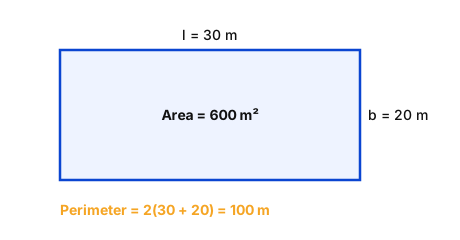
- m, m.
- Perimeter m.
- Cost ₹20,000.
Trick: Ratio with area 600 ⇒ , ⇒ sides 30 and 20.
Answer: (B) ₹20,000
अवधारणा: क्षेत्रफल , बाड़ लगाने की लागत परिमाप पर निर्भर करती है।
- m, m।
- परिमाप m।
- लागत ₹20,000।
ट्रिक: अनुपात और क्षेत्रफल 600 ⇒ , ⇒ भुजाएँ 30 और 20।
उत्तर: (B) ₹20,000
RRB NTPC Graduate CBT 1MathematicsMensuration – rectangleRRB NTPC Graduate CBT 1 2025 · 24 Mar Shift 3
Q202.Find the area of the rectangle with length 10 cm and width cm. (Round off the answer to 2 decimal places.)
10 cm लंबाई और cm चौड़ाई वाले आयत का क्षेत्रफल ज्ञात कीजिए। (उत्तर को 2 दशमलव स्थानों तक पूर्णांकित कीजिए।)
- A17.58 sq. cm.17.58 वर्ग cm
- B18.52 sq. cm.18.52 वर्ग cm
- C15.98 sq. cm.15.98 वर्ग cm
- D22.36 sq. cm.22.36 वर्ग cm
Show answer
Concept: Area of a rectangle .
- Area sq. cm.
- , so area sq. cm.
Yaad rakhein: – multiplying by 10 only shifts the decimal point.
Answer: (D) 22.36 sq. cm.
अवधारणा: आयत का क्षेत्रफल ।
- क्षेत्रफल वर्ग सेमी।
- , अतः क्षेत्रफल वर्ग सेमी।
याद रखें: – 10 से गुणा करने पर केवल दशमलव खिसकता है।
उत्तर: (D) 22.36 sq. cm.
RRB NTPC Graduate CBT 1MathematicsArea of rectangleRRB NTPC Graduate CBT 1 2025 · 24 Mar Shift 3
Q203.A car runs for 10 hours and Its speed during the ith hour is i3 km per hour, where i=1,2,3...,10. The average speed of the car for the journey is _____ km per hour.
एक कार 10 घंटे चलती है और iवें घंटे के दौरान इसकी गति i3 km प्रति घंटा है, जहाँ i=1,2,3...,10 है। यात्रा के लिए कार की औसत गति _____ km प्रति घंटा है।
- A350.2
- B305.2
- C302.5
- D320.5
Show answer
Concept: When each hour is of equal duration, average speed .
- Distance in the th hour km, so total distance .
- km.
- Average speed .
Trick: Sum of first cubes = (sum of first numbers); for that is .
Answer: (C) 302.5
अवधारणा: जब हर घंटा बराबर अवधि का हो, औसत चाल ।
- वें घंटे में दूरी km, अतः कुल दूरी ।
- km।
- औसत चाल ।
ट्रिक: पहले घनों का योग = (पहली संख्याओं का योग); के लिए ।
उत्तर: (C) 302.5
RRB NTPC Graduate CBT 1MathematicsAverage speedRRB NTPC Graduate CBT 1 2025 · 24 Mar Shift 3
Q204.The average marks of 17 students in a class is 40. If the marks of each student are doubled, find the new average.
एक कक्षा के 17 विद्यार्थियों के औसत अंक 40 हैं। यदि प्रत्येक विद्यार्थी के अंक दुगुने कर दिए जाएँ, तो नया औसत ज्ञात कीजिए।
- A80
- B17
- C40
- D34
Show answer
Concept: If every observation is multiplied by , the average is also multiplied by .
- Original average , each mark doubled → .
- New average (the number of students, 17, does not matter).
Trick: Add/subtract a constant → average shifts by it; multiply/divide → average scales by it.
Answer: (A) 80
अवधारणा: यदि हर प्रेक्षण को से गुणा करें तो औसत भी गुना हो जाता है।
- मूल औसत , हर अंक दोगुना → ।
- नया औसत (छात्रों की संख्या 17 का कोई असर नहीं)।
ट्रिक: स्थिरांक जोड़ें/घटाएँ → औसत उतना खिसकता है; गुणा/भाग करें → औसत उतने गुना बदलता है।
उत्तर: (A) 80
RRB NTPC Graduate CBT 1MathematicsAverage – scalingRRB NTPC Graduate CBT 1 2025 · 24 Mar Shift 3
Q205.A typist takes 40 minutes to type 2 pages. How long (in minutes) will he take to type 95 pages?
एक टाइपिस्ट 2 पृष्ठ टाइप करने में 40 मिनट लेता है। 95 पृष्ठ टाइप करने में उसे कितना समय (मिनटों में) लगेगा?
- A1905
- B1890
- C1910
- D1900
Show answer
Concept: Time is directly proportional to the number of pages at a constant typing rate.
- Time per page minutes.
- Time for 95 pages minutes.
Trick: .
Answer: (D) 1900
अवधारणा: टाइपिंग की दर स्थिर हो तो समय पृष्ठों की संख्या के समानुपाती होता है।
- प्रति पृष्ठ समय मिनट।
- 95 पृष्ठों का समय मिनट।
ट्रिक: ।
उत्तर: (D) 1900
RRB NTPC Graduate CBT 1MathematicsUnitary methodRRB NTPC Graduate CBT 1 2025 · 24 Mar Shift 3
Q206.If the ratio of the ages of A and B is 3 : 5, the ratio of the ages of B and C is 2 : 3, and the ratio of the ages of C and D is 3 : 4, what is the ratio of the ages of A and D?
यदि A और B की आयु का अनुपात 3 : 5, B और C की आयु का अनुपात 2 : 3 तथा C और D की आयु का अनुपात 3 : 4 है, तो A और D की आयु का अनुपात क्या है?
- A5 : 11
- B3 : 13
- C7 : 10
- D3 : 10
Show answer
Concept: To combine ratios, make the common term equal in both.
- and → make B : .
- → make C : , so .
- .
Trick: .
Answer: (D) 3 : 10
अवधारणा: अनुपात जोड़ने के लिए उभयनिष्ठ पद को दोनों में बराबर करें।
- और → B करें: ।
- → C करें: , अतः ।
- ।
ट्रिक: ।
उत्तर: (D) 3 : 10
RRB NTPC Graduate CBT 1MathematicsChain ratioRRB NTPC Graduate CBT 1 2025 · 24 Mar Shift 3
Q207.Find the mode of the following distribution.
| Class interval | 10–15 | 15–20 | 20–25 | 25–30 | 30–35 | 35–40 |
|---|
| Frequency | 30 | 48 | 72 | 36 | 24 | 18 |
|---|
निम्नलिखित बंटन का बहुलक ज्ञात कीजिए।
| वर्ग अंतराल | 10–15 | 15–20 | 20–25 | 25–30 | 30–35 | 35–40 |
|---|
| बारंबारता | 30 | 48 | 72 | 36 | 24 | 18 |
|---|
- A24.25
- B22
- C22.5
- D25
Show answer
Concept: Mode , where = lower limit of the modal class, its frequency, and the frequencies of the classes before and after, = class width.
- Highest frequency 72 → modal class 20–25: .
- Mode .
- .
Trick: The mode always lies inside the modal class (here 20–25) – options 24.25, 25 are out at once; a quick check between 22 and 22.5 decides.
Answer: (B) 22
अवधारणा: बहुलक (mode) , जहाँ = बहुलक वर्ग की निचली सीमा, उसकी बारंबारता, , पहले व बाद के वर्गों की बारंबारताएँ, = वर्ग-चौड़ाई।
- सबसे अधिक बारंबारता 72 → बहुलक वर्ग 20–25: ।
- बहुलक ।
- ।
ट्रिक: बहुलक हमेशा बहुलक वर्ग (यहाँ 20–25) के अंदर होता है – 24.25 और 25 तुरंत बाहर; 22 व 22.5 में गणना से निर्णय।
उत्तर: (B) 22
RRB NTPC Graduate CBT 1MathematicsMode of grouped dataRRB NTPC Graduate CBT 1 2025 · 24 Mar Shift 3
Q208.If , then find the value of .
यदि है, तो का मान ज्ञात कीजिए।
- A
- B
- C
- D
Show answer
Concept: and .
- .
- Required expression .
- .
Trick: ; products like always collapse to .
Answer: (B)
अवधारणा: तथा ।
- ।
- अभीष्ट व्यंजक ।
- ।
ट्रिक: ; जैसे गुणनफल हमेशा बन जाते हैं।
उत्तर: (B)
RRB NTPC Graduate CBT 1MathematicsTrigonometric identitiesRRB NTPC Graduate CBT 1 2025 · 24 Mar Shift 3
Q209.Priyanshi wants to solve the expression:
What is the value of the expression?
प्रियांशी निम्नलिखित व्यंजक को हल करना चाहती है:
व्यंजक का मान क्या है?
- A6.1
- B6.5
- C7.5
- D7.1
Show answer
Concept: BODMAS – do multiplication before addition and subtraction.
- .
- .
Trick: – cancel before multiplying.
Answer: (A) 6.1
अवधारणा: BODMAS – जोड़-घटाव से पहले गुणा करें।
- ।
- ।
ट्रिक: – गुणा से पहले काटें।
उत्तर: (A) 6.1
RRB NTPC Graduate CBT 1MathematicsBODMASRRB NTPC Graduate CBT 1 2025 · 24 Mar Shift 3
Q210.There are 45 members in group A, 31 members in group B and 48 members in group C. All the members of these groups went to a restaurant. The average amounts spent on each member of groups A, B and C are ₹295, ₹311 and ₹233, respectively. The overall average amount (in ₹) spent per member is:
समूह A में 45 सदस्य, समूह B में 31 सदस्य और समूह C में 48 सदस्य हैं। इन समूहों के सभी सदस्य एक रेस्तरां में गए। समूह A, B और C के प्रत्येक सदस्य पर खर्च की गई औसत राशि क्रमशः ₹295, ₹311 और ₹233 है। प्रति सदस्य खर्च की गई कुल औसत राशि (₹ में) है:
- A276
- B273
- C275
- D272
Show answer
Concept: Overall average .
- Totals: , , .
- Sum ; members .
- Average .
Trick: Take 275 as base: deviations , , → total , so the average is exactly 275.
Answer: (C) 275
अवधारणा: कुल औसत ।
- कुल: , , ।
- योग ; सदस्य ।
- औसत ।
ट्रिक: 275 को आधार मानें: विचलन , , → योग , अतः औसत ठीक 275।
उत्तर: (C) 275
RRB NTPC Graduate CBT 1MathematicsWeighted averageRRB NTPC Graduate CBT 1 2025 · 24 Mar Shift 3
Q211.Two parallel lines AB ∥ CD are cut by a transversal line PQ, as shown in the figure. If the angle ∠PMB=55° then find the angle ∠CNM.
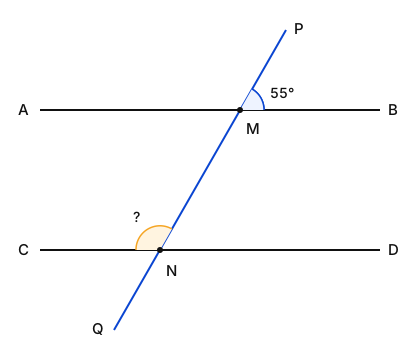
दो समांतर रेखाएँ AB ∥ CD एक तिर्यक रेखा PQ द्वारा काटी जाती हैं, जैसा कि चित्र में दिखाया गया है। यदि कोण ∠PMB=55° है, तो कोण ∠CNM ज्ञात कीजिए।
- A75°
- B125°
- C60°
- D55°
Show answer
Concept: When a transversal cuts parallel lines, co-interior (same-side interior) angles add up to ; vertically opposite angles are equal.
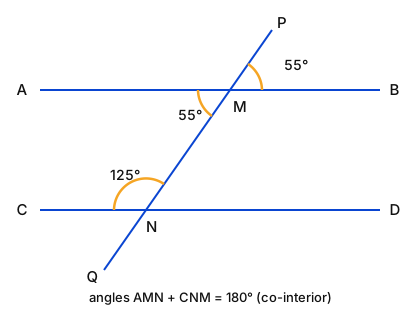
- is vertically opposite to , so .
- and lie between AB and CD on the same side of PQ → co-interior.
- .
Trick: With parallel lines every angle at the two crossings is either or ; is the obtuse one, so .
Answer: (B) 125°
अवधारणा: तिर्यक रेखा समांतर रेखाओं को काटे तो सह-अंतःकोण (co-interior) का योग होता है; शीर्षाभिमुख कोण बराबर होते हैं।
- , का शीर्षाभिमुख कोण है, अतः ।
- और AB व CD के बीच, PQ के एक ही ओर हैं → सह-अंतःकोण।
- ।
ट्रिक: समांतर रेखाओं में दोनों कटान बिंदुओं पर हर कोण या तो या होता है; अधिक कोण है, अतः ।
उत्तर: (B) 125°
RRB NTPC Graduate CBT 1MathematicsParallel lines – anglesRRB NTPC Graduate CBT 1 2025 · 24 Mar Shift 3
Q212.Ashish has ₹1404 with him. He divides this amount between his two sons, Arun and Mahesh, and asks them to invest their respective shares at a compound interest rate of 8% per annum, compounded annually. It is observed that Arun’s investment amounts to the same value after 17 years as Mahesh’s investment does after 18 years. How much (in ₹) did Ashish give to Mahesh?
आशीष के पास ₹1404 हैं। वह इस राशि को अपने दो पुत्रों, अरुण और महेश, के बीच बाँटता है और उन्हें अपने-अपने हिस्से को 8% वार्षिक चक्रवृद्धि ब्याज की दर पर, वार्षिक रूप से संयोजित, निवेश करने को कहता है। यह देखा गया कि अरुण का निवेश 17 वर्षों बाद उतनी ही राशि हो जाता है जितनी महेश का निवेश 18 वर्षों बाद होता है। आशीष ने महेश को कितनी राशि (₹ में) दी?
- A675
- B525
- C729
- D829
Show answer
Concept: If amounts become equal after different periods, the ratio of principals is the inverse ratio of the growth factors.
- .
- Total parts ; .
- Mahesh's share .
Trick: Periods differing by 1 year → shares are in the ratio ; for that is .
Answer: (A) 675
अवधारणा: यदि मिश्रधन अलग-अलग अवधि के बाद बराबर हों तो मूलधनों का अनुपात वृद्धि-गुणकों का व्युत्क्रम अनुपात होता है।
- ।
- कुल भाग ; ।
- महेश का हिस्सा ।
ट्रिक: अवधि में 1 वर्ष का अंतर → हिस्से में; पर ।
उत्तर: (A) 675
RRB NTPC Graduate CBT 1MathematicsCompound interest – divisionRRB NTPC Graduate CBT 1 2025 · 24 Mar Shift 3
Q213.Piyush bought an article for ₹331 and sold it to Payal at a loss of 5%. With this amount, Piyush bought another article and sold it at a gain of 60%. What is Piyush's overall gain percentage?
पीयूष ने ₹331 में एक वस्तु खरीदी और उसे 5% की हानि पर पायल को बेच दिया। इस राशि से पीयूष ने एक अन्य वस्तु खरीदी और उसे 60% के लाभ पर बेच दिया। पीयूष का कुल लाभ प्रतिशत क्या है?
- A50%
- B52%
- C47%
- D48%
Show answer
Concept: Successive changes multiply: overall factor .
- After 5% loss: ; this is reinvested.
- After 60% gain: .
- Overall gain .
Trick: → 52% gain directly; the ₹331 is irrelevant.
Answer: (B) 52%
अवधारणा: क्रमिक परिवर्तन गुणा होते हैं: कुल गुणक ।
- 5% हानि के बाद: ; यही फिर लगाया।
- 60% लाभ के बाद: ।
- कुल लाभ ।
ट्रिक: → सीधे 52% लाभ; ₹331 की ज़रूरत ही नहीं।
उत्तर: (B) 52%
RRB NTPC Graduate CBT 1MathematicsSuccessive profit/lossRRB NTPC Graduate CBT 1 2025 · 24 Mar Shift 3
Q214.A typist takes 40 minutes to type 2 pages. How long (in minutes) will he take to type 84 pages?
एक टाइपिस्ट 2 पृष्ठ टाइप करने में 40 मिनट लेता है। 84 पृष्ठ टाइप करने में वह कितना समय (मिनट में) लेगा?
- A1690
- B1670
- C1680
- D1685
Show answer
Concept: Time is directly proportional to the number of pages when the speed is constant.
- Time for 1 page minutes.
- Time for 84 pages minutes.
Trick: Find the rate per unit first ( min/page), then multiply – no need for cross-multiplication.
Answer: (C) 1680
अवधारणा: गति स्थिर हो तो समय पृष्ठों की संख्या के समानुपाती होता है।
- 1 पृष्ठ का समय मिनट।
- 84 पृष्ठों का समय मिनट।
ट्रिक: पहले प्रति इकाई दर ( मिनट/पृष्ठ) निकालें, फिर गुणा करें – वज्र-गुणन की ज़रूरत नहीं।
उत्तर: (C) 1680
RRB NTPC Graduate CBT 1MathematicsUnitary MethodRRB NTPC Graduate CBT 1 2025 · 24 Mar Shift 2
Q215.A quadratic polynomial f(x) gives a remainder of 5 when divided by (x - 2), and of -3 when divided by (x - 4). If f(x) is of the form ax2+ bx + c and the leading coefficient is 1, then which of the following is the correct quadratic equation f(x)=0?
एक द्विघात बहुपद f(x) को (x - 2) से विभाजित करने पर शेषफल 5 और (x - 4) से विभाजित करने पर शेषफल -3 प्राप्त होता है। यदि f(x), ax2+ bx + c के रूप का है और अग्रणी गुणांक (leading coefficient) 1 है, तो निम्नलिखित में से कौन-सा सही द्विघात समीकरण f(x)=0 है?
- Ax2−10x+21=0
- Bx2−6x+11=0
- Cx2−9x+20=0
- Dx2−8x+13=0
Show answer
Concept: By the remainder theorem, the remainder on dividing by is .
- Let (leading coefficient 1). Given and .
- ; .
- Subtracting: , so .
- , i.e. .
Trick: Faster: test the options – only option (A) gives and .
Answer: (A)
अवधारणा: शेषफल प्रमेय से, को से भाग देने पर शेषफल होता है।
- माना (अग्र गुणांक 1)। दिया है और ।
- ; ।
- घटाने पर: , अतः ।
- , अर्थात ।
ट्रिक: तेज़ तरीका: विकल्प जाँचें – केवल (A) में और आता है।
उत्तर: (A)
RRB NTPC Graduate CBT 1MathematicsRemainder TheoremRRB NTPC Graduate CBT 1 2025 · 24 Mar Shift 2
Q216.In an election between two candidates, 80% of the registered voters cast their votes and 3% of the votes polled were found invalid. Winning candidate got 52% of the valid votes and won the election by a margin of 291 votes. How many voters were registered?
दो उम्मीदवारों के बीच एक चुनाव में, पंजीकृत मतदाताओं में से 80% ने अपना मत डाला और डाले गए मतों में से 3% अवैध पाए गए। विजेता उम्मीदवार को वैध मतों का 52% प्राप्त हुआ और वह 291 मतों के अंतर से चुनाव जीता। कितने मतदाता पंजीकृत थे?
- A9373
- B9370
- C9378
- D9375
Show answer
Concept: Margin of victory = (winner% − loser%) of the valid votes.
- Let registered voters . Votes polled of .
- Valid votes of .
- Winner , loser → margin of valid votes .
- .
Trick: Chain the percentages: ; cancels neatly with 97.
Answer: (D) 9375
अवधारणा: जीत का अंतर = वैध मतों का (विजेता% − पराजित%)।
- माना पंजीकृत मतदाता । डाले गए मत का ।
- वैध मत का ।
- विजेता , पराजित → अंतर वैध मतों का ।
- ।
ट्रिक: प्रतिशतों को शृंखला में लिखें: ; से 97 सीधे कट जाता है।
उत्तर: (D) 9375
RRB NTPC Graduate CBT 1MathematicsPercentage – ElectionsRRB NTPC Graduate CBT 1 2025 · 24 Mar Shift 2
Q217.Evaluate: 16 + 20 ÷ 4 - 2 × 4
मान ज्ञात कीजिए: 16 + 20 ÷ 4 - 2 × 4
- A13
- B16
- C15
- D12
Show answer
Concept: Follow BODMAS: division and multiplication first (left to right), then addition and subtraction.
- and .
- .
Trick: Never add first – '16 + 20' before dividing gives a wrong answer.
Answer: (A) 13
अवधारणा: BODMAS का पालन करें: पहले भाग और गुणा (बाएँ से दाएँ), फिर जोड़ और घटाव।
- और ।
- ।
ट्रिक: पहले कभी न जोड़ें – भाग से पहले '16 + 20' करने पर गलत उत्तर आता है।
उत्तर: (A) 13
RRB NTPC Graduate CBT 1MathematicsBODMASRRB NTPC Graduate CBT 1 2025 · 24 Mar Shift 2
Q218.Which of the given ratios is the greatest?
3 : 17, 13 : 67, 10 : 37 and 5 : 9
दिए गए अनुपातों में से कौन-सा सबसे बड़ा है?
3 : 17, 13 : 67, 10 : 37 और 5 : 9
- A13 : 67
- B5 : 9
- C10 : 37
- D3 : 17
Show answer
Concept: Convert each ratio to a decimal (or compare with a benchmark such as ).
- ; .
- ; .
- Greatest is .
Trick: Only is more than (numerator more than half the denominator) – spot it without any division.
Answer: (B) 5 : 9
अवधारणा: हर अनुपात को दशमलव में बदलें (या जैसे मानक से तुलना करें)।
- ; ।
- ; ।
- सबसे बड़ा है।
ट्रिक: केवल ही से बड़ा है (अंश, हर के आधे से अधिक) – बिना भाग किए पहचानें।
उत्तर: (B) 5 : 9
RRB NTPC Graduate CBT 1MathematicsComparison of RatiosRRB NTPC Graduate CBT 1 2025 · 24 Mar Shift 2
Q219.In a right-angled triangle ABC, ∠C=90°, ∠A=45°, and the length of the adjacent side to ∠A (side AC) is 7 units.
Determine the length of the side AB (the hypotenuse).
एक समकोण त्रिभुज ABC में, ∠C=90°, ∠A=45°, और ∠A की आसन्न भुजा (भुजा AC) की लंबाई 7 इकाई है।
भुजा AB (कर्ण) की लंबाई ज्ञात कीजिए।
- A14 units14 इकाई
- B7 units7 इकाई
- C units इकाई
- D units इकाई
Show answer
Concept: In a right triangle with one acute angle , the other is also , so the two legs are equal and hypotenuse .
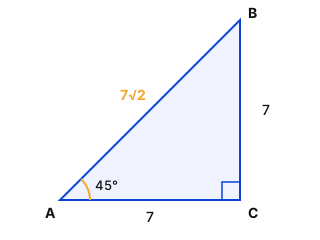
- , , so .
- units.
- Check with trigonometry: .
Trick: 45-45-90 triangle sides are in the ratio ; 30-60-90 are .
Answer: (C) units
अवधारणा: समकोण त्रिभुज में एक न्यून कोण हो तो दूसरा भी होता है, अतः दोनों भुजाएँ बराबर और कर्ण ।
- , , अतः ।
- इकाई।
- त्रिकोणमिति से जाँच: ।
ट्रिक: 45-45-90 त्रिभुज की भुजाएँ में; 30-60-90 की में।
उत्तर: (C) इकाई
RRB NTPC Graduate CBT 1MathematicsRight Triangle – 45°-45°-90°RRB NTPC Graduate CBT 1 2025 · 24 Mar Shift 2
Q220.Three positive integers, a, b, c, satisfy: gcd (a, b) = 8, gcd (b, c) = 12, gcd (c, a) = 4 and LCM (a, b, c) = 240. Then, the minimum value of a + b + c is:
तीन धनात्मक पूर्णांक a, b, c निम्न को संतुष्ट करते हैं: gcd (a, b) = 8, gcd (b, c) = 12, gcd (c, a) = 4 और LCM (a, b, c) = 240। तब a + b + c का न्यूनतम मान है:
- A100
- B84
- C96
- D80
Show answer
Concept: Work with prime powers: . Each HCF fixes the minimum power common to two numbers.
- gcd and gcd → is a multiple of ; gcd → and has no factor 3.
- LCM needs (in or ) and a factor (in any one). Smallest bases: .
- Options: → ; → ; → ; → .
- Check : gcds and LCM ✓. Minimum sum .
Trick: Put the 'expensive' extra factors ( and ) on different numbers and compare – and both give 100.
Answer: (A) 100
अवधारणा: अभाज्य घातों से काम करें: । हर HCF दो संख्याओं में न्यूनतम उभयनिष्ठ घात तय करता है।
- gcd और gcd → , का गुणज; gcd → और में गुणनखंड 3 नहीं।
- LCM के लिए ( या में) और गुणनखंड (किसी एक में) चाहिए। सबसे छोटे आधार: ।
- विकल्प: → ; → ; → ; → ।
- जाँच : gcd और LCM ✓। न्यूनतम योग ।
ट्रिक: 'महँगे' अतिरिक्त गुणनखंड ( और ) अलग-अलग संख्याओं पर रखकर तुलना करें – और दोनों 100 देते हैं।
उत्तर: (A) 100
RRB NTPC Graduate CBT 1MathematicsHCF and LCMRRB NTPC Graduate CBT 1 2025 · 24 Mar Shift 2

