Q221.In a certain code language,
M + K means ‘ M is the brother of K',
M % K means ‘ M is the mother of K',
M $ K means ‘ M is the father of K', and
M - K means ‘ M is the sister of K'.
Based on the above, how is C related to W if ‘ W % A $ C + J'?
एक निश्चित कूट भाषा में,
M + K का अर्थ है 'M, K का भाई है',
M % K का अर्थ है 'M, K की माता है',
M $ K का अर्थ है 'M, K का पिता है', और
M - K का अर्थ है 'M, K की बहन है'।
उपर्युक्त के आधार पर, यदि 'W % A $ C + J' है, तो C, W से किस प्रकार संबंधित है?
- ABrother's sonभाई का पुत्र
- BSonपुत्र
- CBrotherभाई
- DSon's sonपुत्र का पुत्र
Show answer
Concept: Decode each symbol from left to right and build the family tree.
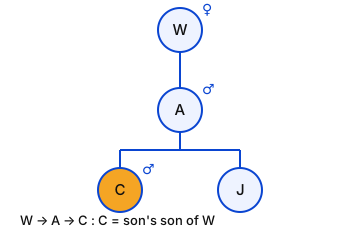
- W % A: W is the mother of A.
- A $ C: A is the father of C, so C is a son of A (C is male because C + J means C is J's brother).
- C + J: C is the brother of J. So C is the son of W's son → W's grandson (son's son).
Trick: Two downward steps from W (mother → father → child) always mean grandchild; "brother" fixes C as male, so son's son.
Answer: (D) Son's son
अवधारणा: हर प्रतीक को बाएँ से दाएँ डिकोड करके वंश-वृक्ष (family tree) बनाएँ।
- W % A: W, A की माँ है।
- A $ C: A, C का पिता है, अतः C, A का पुत्र है (C पुरुष है क्योंकि C + J का अर्थ C, J का भाई है)।
- C + J: C, J का भाई है। अतः C, W के पुत्र का पुत्र है → पोता (son's son)।
ट्रिक: W से नीचे दो पीढ़ी (माँ → पिता → संतान) = पोता/पोती; "भाई" से C पुरुष सिद्ध, अतः पोता।
उत्तर: (D) Son's son
RRB NTPC Graduate CBT 1General Intelligence and ReasoningBlood Relations (Coded)RRB NTPC Graduate CBT 1 2025 · 24 Mar Shift 2
Q222.107 is related to 158 following a certain logic. Following the same logic, 122 is related to 173. To which of the following is 154 related, following the same logic?
(NOTE : Operations should be performed on the whole numbers, without breaking down the numbers into its constituent digits. E.g. 13 – Operations on 13 such as adding /subtracting /multiplying etc. to 13 can be performed. Breaking down 13 into 1 and 3 and then performing mathematical operations on 1 and 3 is not allowed.)
107, एक निश्चित तर्क के अनुसार 158 से संबंधित है। उसी तर्क के अनुसार, 122, 173 से संबंधित है। उसी तर्क के अनुसार, 154 निम्नलिखित में से किससे संबंधित है?
(नोट: संक्रियाएँ पूर्ण संख्याओं पर की जानी चाहिए, संख्याओं को उनके घटक अंकों में तोड़े बिना। उदाहरण के लिए 13 – 13 पर संक्रियाएँ जैसे 13 में जोड़ना/घटाना/गुणा करना आदि की जा सकती हैं। 13 को 1 और 3 में तोड़कर फिर 1 और 3 पर गणितीय संक्रियाएँ करने की अनुमति नहीं है।)
- A205
- B218
- C198
- D213
Show answer
Concept: Find one operation that converts the first number into the second in both given pairs.
- and ; the rule is "add 51".
- .
Trick: When both pairs have the same difference, the rule is simply addition; no multiplication check needed.
Answer: (A) 205
अवधारणा: ऐसी एक संक्रिया खोजें जो दोनों दिए गए युग्मों में पहली संख्या को दूसरी में बदल दे।
- और ; नियम है "51 जोड़ो"।
- ।
ट्रिक: जब दोनों युग्मों का अंतर समान हो, तो नियम सीधा जोड़ है; गुणा जाँचने की ज़रूरत नहीं।
उत्तर: (A) 205
RRB NTPC Graduate CBT 1General Intelligence and ReasoningNumber AnalogyRRB NTPC Graduate CBT 1 2025 · 24 Mar Shift 2
Q223.In this question, a question is followed by two statements numbered (I) and (II). You have to decide whether the data provided in the statements are sufficient to answer the question. Read both the statements and decide the appropriate answer.
Q. Arjun, Kunal, Mohit, Prateek, and Saurav, each have different height. Who is the tallest?
(I) Mohit is taller than Arjun and Kunal but shorter than Prateek.
(II) Saurav is taller than Mohit but shorter than Prateek.
इस प्रश्न में, एक प्रश्न के बाद (I) और (II) क्रमांकित दो कथन दिए गए हैं। आपको यह निर्णय करना है कि कथनों में दिए गए आँकड़े प्रश्न का उत्तर देने के लिए पर्याप्त हैं या नहीं। दोनों कथनों को पढ़िए और उचित उत्तर का निर्णय कीजिए।
प्रश्न: अर्जुन, कुणाल, मोहित, प्रतीक और सौरव, प्रत्येक की लंबाई भिन्न है। सबसे लंबा कौन है?
(I) मोहित, अर्जुन और कुणाल से लंबा है लेकिन प्रतीक से छोटा है।
(II) सौरव, मोहित से लंबा है लेकिन प्रतीक से छोटा है।
- AData in Statement I alone is sufficient to answer the question while data in Statement II is notकथन I के आँकड़े अकेले प्रश्न का उत्तर देने के लिए पर्याप्त हैं, जबकि कथन II के आँकड़े पर्याप्त नहीं हैं
- BBoth statements I and II together are NOT sufficient to answer the questionकथन I और II दोनों मिलाकर भी प्रश्न का उत्तर देने के लिए पर्याप्त नहीं हैं
- CBoth statements I and II together (and not statement I alone or statement II alone) are sufficient to answer the questionकथन I और II दोनों मिलाकर (और न कि कथन I अकेले या कथन II अकेले) प्रश्न का उत्तर देने के लिए पर्याप्त हैं
- DData in Statement II alone is sufficient to answer the question while data in Statement I is notकथन II के आँकड़े अकेले प्रश्न का उत्तर देने के लिए पर्याप्त हैं, जबकि कथन I के आँकड़े पर्याप्त नहीं हैं
Show answer
Concept: Check each statement alone, then together, for whether the tallest person is fixed.
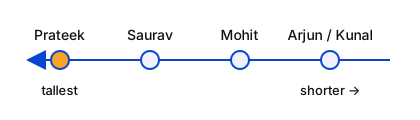
- Statement I: Prateek > Mohit > Arjun, Kunal. Saurav's position is unknown, so not sufficient alone.
- Statement II: Prateek > Saurav > Mohit. Arjun and Kunal are unknown, so not sufficient alone.
- Together: Prateek > Saurav > Mohit > Arjun, Kunal → Prateek is tallest.
Trick: In "who is tallest" questions, a statement fails if even one person is missing from it.
Answer: (C) Both statements I and II together are sufficient
अवधारणा: पहले हर कथन अकेले, फिर दोनों मिलाकर जाँचें कि सबसे लंबा व्यक्ति तय होता है या नहीं।
- कथन I: Prateek > Mohit > Arjun, Kunal। Saurav का स्थान अज्ञात, अतः अकेले पर्याप्त नहीं।
- कथन II: Prateek > Saurav > Mohit। Arjun और Kunal अज्ञात, अतः अकेले पर्याप्त नहीं।
- दोनों मिलाकर: Prateek > Saurav > Mohit > Arjun, Kunal → Prateek सबसे लंबा।
ट्रिक: "सबसे लंबा कौन" प्रश्न में यदि कथन में एक भी व्यक्ति छूट जाए तो वह कथन अकेले पर्याप्त नहीं होता।
उत्तर: (C) दोनों कथन I और II मिलाकर पर्याप्त हैं
RRB NTPC Graduate CBT 1General Intelligence and ReasoningData Sufficiency – OrderingRRB NTPC Graduate CBT 1 2025 · 24 Mar Shift 2
Q224.Refer to the following letter and symbol series and answer the question that follows. Counting to be done from left to right only.
(Left) M K L $ F % G & # @ S ! S + ? K > H V G (Right)
If all the letters are dropped from the series, which of the following will be seventh from the right?
निम्नलिखित अक्षर और प्रतीक श्रेणी को देखिए और उसके बाद आने वाले प्रश्न का उत्तर दीजिए। गिनती केवल बाएँ से दाएँ की जानी है।
(बाएँ) M K L $ F % G & # @ S ! S + ? K > H V G (दाएँ)
यदि श्रेणी से सभी अक्षर हटा दिए जाएँ, तो निम्नलिखित में से कौन-सा दाएँ से सातवाँ होगा?
- A#
- B@
- C&
- D+
Show answer
Concept: Remove the dropped elements, rewrite the series, then count from the required end.
- Series without letters: $ % & # @ ! + ? > (9 symbols).
- From the right: >(1), ?(2), +(3), !(4), @(5), #(6), &(7).
Trick: 7th from right of 9 items = 3rd from left → &.
Answer: (C) &
अवधारणा: हटाए जाने वाले तत्व निकालकर श्रृंखला दोबारा लिखें, फिर माँगे गए सिरे से गिनें।
- अक्षर हटाने पर: $ % & # @ ! + ? > (9 प्रतीक)।
- दाएँ से: >(1), ?(2), +(3), !(4), @(5), #(6), &(7)।
ट्रिक: 9 में से दाएँ से 7वाँ = बाएँ से 3रा → &।
उत्तर: (C) &
RRB NTPC Graduate CBT 1General Intelligence and ReasoningSymbol SeriesRRB NTPC Graduate CBT 1 2025 · 24 Mar Shift 2
Q225.Which of the following letter-clusters should replace # and % so that the pattern and relationship followed between the letter-cluster pair on the left side of :: is the same as that on the right side of :: ?
# : JOP :: YDE : %
निम्नलिखित में से किन अक्षर-समूहों को # और % के स्थान पर रखा जाना चाहिए ताकि :: के बाईं ओर के अक्षर-समूह युग्म के बीच का पैटर्न और संबंध :: के दाईं ओर के युग्म के समान हो?
# : JOP :: YDE : %
- A# = OTL % = TPZ
- B# = OTT % = TTZ
- C# = OTU % = TYZ
- D# = TOU % = TZY
Show answer
Concept: The same letter-shift must map # to JOP and YDE to %.
- Try option C: OTU → JOP: O=J, T=O, U=P. Rule: each letter .
- Apply to YDE: Y=T, D=Y, E=Z → TYZ, which matches % in option C.
- Other options break the uniform shift (e.g. option A: L=P, not ).
Trick: Work backwards from the known cluster: JOP = OTU; only option C starts with OTU.
Answer: (C) # = OTU, % = TYZ
अवधारणा: वही अक्षर-बदलाव # को JOP और YDE को % में बदलना चाहिए।
- विकल्प C लें: OTU → JOP: O=J, T=O, U=P। नियम: हर अक्षर ।
- YDE पर लगाएँ: Y=T, D=Y, E=Z → TYZ, जो विकल्प C के % से मेल खाता है।
- बाकी विकल्पों में समान बदलाव टूट जाता है (जैसे विकल्प A में L=P, नहीं)।
ट्रिक: ज्ञात समूह से उल्टा चलें: JOP = OTU; केवल विकल्प C में OTU है।
उत्तर: (C) # = OTU, % = TYZ
RRB NTPC Graduate CBT 1General Intelligence and ReasoningLetter-Cluster AnalogyRRB NTPC Graduate CBT 1 2025 · 24 Mar Shift 2
Q226.Which of the following letter-clusters should replace # and % so that the pattern and relationship followed between the letter-cluster pair on the left side of :: is the same as that on the right side of :: ?
# : PZH :: MWE : %
निम्नलिखित में से किन अक्षर-समूहों को # और % के स्थान पर रखा जाना चाहिए ताकि :: के बाईं ओर के अक्षर-समूह युग्म के बीच का पैटर्न और संबंध :: के दाईं ओर के युग्म के समान हो?
# : PZH :: MWE : %
- A# = FPX % = WGO
- B# = YPX % = WGO
- C# = FPX % = WGP
- D# = FPX % = WHO
Show answer
Concept: Find the uniform shift that turns # into PZH and apply it to MWE.
- Option A: FPX → PZH: F(6)=P(16), P(16)=Z(26), X(24)=34→3426=8=H. Rule: .
- MWE : M(13)→W(23), W(23)→3326=7=G, E(5)→O(15) → WGO.
- Option B uses Y as first letter (Y=I, not P); C and D change WGO.
Trick: Compute % first (MWE=WGO); then only A and B remain, and F=P picks A.
Answer: (A) # = FPX, % = WGO
अवधारणा: वह समान बदलाव खोजें जो # को PZH बनाता है और उसे MWE पर लगाएँ।
- विकल्प A: FPX → PZH: F(6)=P(16), P(16)=Z(26), X(24)=34→3426=8=H। नियम: ।
- MWE : M(13)→W(23), W(23)→3326=7=G, E(5)→O(15) → WGO।
- विकल्प B में पहला अक्षर Y है (Y=I, P नहीं); C और D में WGO बदल गया है।
ट्रिक: पहले % निकालें (MWE=WGO); फिर A और B बचते हैं, और F=P से A चुनें।
उत्तर: (A) # = FPX, % = WGO
RRB NTPC Graduate CBT 1General Intelligence and ReasoningLetter-Cluster AnalogyRRB NTPC Graduate CBT 1 2025 · 24 Mar Shift 2
Q227.In a certain code language, ‘OMIT’ is coded as ‘4295’ and ‘TIME’ is coded as ‘2458’. What is the code for ‘E’ in the given code language?
एक निश्चित कूट भाषा में, 'OMIT' को '4295' के रूप में कूटबद्ध किया जाता है और 'TIME' को '2458' के रूप में कूटबद्ध किया जाता है। दी गई कूट भाषा में 'E' का कूट क्या है?
- A4
- B8
- C5
- D2
Show answer
Concept: Letters common to both words get the digits common to both codes; the leftover letter gets the leftover digit.
- OMIT → 4295 and TIME → 2458 share the letters T, I, M and the digits 4, 2, 5.
- In OMIT the extra letter O takes the extra digit 9; in TIME the extra letter E takes the extra digit 8.
Trick: Cancel common letters and common digits; what remains in TIME is E ↔ 8.
Answer: (B) 8
अवधारणा: दोनों शब्दों में साझा अक्षरों को साझा अंक मिलते हैं; बचा हुआ अक्षर बचा हुआ अंक लेता है।
- OMIT → 4295 और TIME → 2458 में अक्षर T, I, M और अंक 4, 2, 5 साझा हैं।
- OMIT में अतिरिक्त अक्षर O को अतिरिक्त अंक 9 मिलता है; TIME में अतिरिक्त अक्षर E को अतिरिक्त अंक 8।
ट्रिक: साझा अक्षर और साझा अंक काट दें; TIME में बचता है E ↔ 8।
उत्तर: (B) 8
RRB NTPC Graduate CBT 1General Intelligence and ReasoningCoding-Decoding (Word to Number)RRB NTPC Graduate CBT 1 2025 · 24 Mar Shift 2
Q228.51 is related to 253 following a certain logic. Following the same logic, 38 is related to 188. To which of the following is 32 related, following the same logic?
(NOTE: Operations should be performed on the whole numbers, without breaking down the numbers into their constituent digits. E.g. 13 – Operations on 13 such as adding /subtracting /multiplying, etc. to 13 can be performed. Breaking down 13 into 1 and 3 and then performing mathematical operations on 1 and 3 is not allowed.)
51, एक निश्चित तर्क के अनुसार 253 से संबंधित है। उसी तर्क के अनुसार, 38, 188 से संबंधित है। उसी तर्क के अनुसार, 32 निम्नलिखित में से किससे संबंधित है?
(नोट: संक्रियाएँ पूर्ण संख्याओं पर की जानी चाहिए, संख्याओं को उनके घटक अंकों में तोड़े बिना। उदाहरण के लिए 13 – 13 पर संक्रियाएँ जैसे 13 में जोड़ना/घटाना/गुणा करना आदि की जा सकती हैं। 13 को 1 और 3 में तोड़कर फिर 1 और 3 पर गणितीय संक्रियाएँ करने की अनुमति नहीं है।)
- A156
- B158
- C152
- D154
Show answer
Concept: Test "multiply then add/subtract" when the second number is roughly a fixed multiple of the first.
- , ✓; , ✓. Rule: .
- .
Trick: and – the ratio tells you the multiplier at once.
Answer: (B) 158
अवधारणा: जब दूसरी संख्या पहली का लगभग एक निश्चित गुणज हो तो "गुणा फिर जोड़/घटा" जाँचें।
- , ✓; , ✓। नियम: ।
- ।
ट्रिक: और – अनुपात तुरंत गुणक बता देता है।
उत्तर: (B) 158
RRB NTPC Graduate CBT 1General Intelligence and ReasoningNumber AnalogyRRB NTPC Graduate CBT 1 2025 · 24 Mar Shift 2
Q229.Read the given statements and conclusions carefully. Assuming that the information given in the statements is true, even if it appears to be at variance with commonly known facts, decide which of the given conclusions logically follow(s) from the statements.
Statements:
Some beds are pillows.
All pillows are towels.
All towels are cushions.
Conclusions:
(I) All cushions are pillows.
(II) Some towels are beds.
दिए गए कथनों और निष्कर्षों को ध्यानपूर्वक पढ़िए। यह मानते हुए कि कथनों में दी गई जानकारी सत्य है, भले ही वह सामान्यतः ज्ञात तथ्यों से भिन्न प्रतीत होती हो, निर्णय कीजिए कि दिए गए निष्कर्षों में से कौन-सा/कौन-से कथनों का तार्किक रूप से अनुसरण करता है/करते हैं।
कथन:
कुछ बिस्तर तकिए हैं।
सभी तकिए तौलिए हैं।
सभी तौलिए गद्दियाँ हैं।
निष्कर्ष:
(I) सभी गद्दियाँ तकिए हैं।
(II) कुछ तौलिए बिस्तर हैं।
- AOnly conclusion (II) followsकेवल निष्कर्ष (II) अनुसरण करता है
- BNeither conclusion (I) nor (II) followsन तो निष्कर्ष (I) और न ही (II) अनुसरण करता है
- CBoth conclusions (I) and (II) followनिष्कर्ष (I) और (II) दोनों अनुसरण करते हैं
- DOnly conclusion (I) followsकेवल निष्कर्ष (I) अनुसरण करता है
Show answer
Concept: Draw the sets: pillows inside towels, towels inside cushions, beds overlapping pillows.
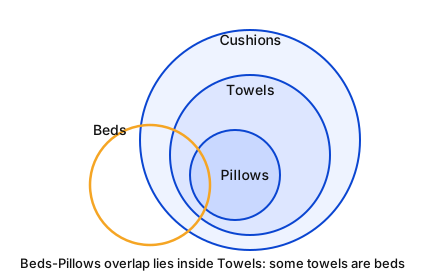
- Conclusion I "All cushions are pillows": cushions is the biggest set; it can contain things that are not pillows → does not follow.
- Conclusion II "Some towels are beds": the beds that are pillows are also towels, so some towels are definitely beds → follows.
Trick: Some A are B + All B are C ⇒ Some A are C (and its converse Some C are A). "All C are B" is never a valid reverse of "All B are C".
Answer: (A) Only conclusion (II) follows
अवधारणा: समुच्चय बनाएँ: pillows, towels के अंदर; towels, cushions के अंदर; beds, pillows को काटता हुआ।
- निष्कर्ष I "सभी cushions, pillows हैं": cushions सबसे बड़ा समुच्चय है; इसमें ऐसी चीज़ें हो सकती हैं जो pillows नहीं हैं → अनुसरण नहीं करता।
- निष्कर्ष II "कुछ towels, beds हैं": जो beds pillows हैं वे towels भी हैं, अतः कुछ towels निश्चित रूप से beds हैं → अनुसरण करता है।
ट्रिक: Some A are B + All B are C ⇒ Some A are C (और इसका विलोम Some C are A)। "All B are C" का उल्टा "All C are B" कभी वैध नहीं।
उत्तर: (A) केवल निष्कर्ष (II) अनुसरण करता है
RRB NTPC Graduate CBT 1General Intelligence and ReasoningSyllogismRRB NTPC Graduate CBT 1 2025 · 24 Mar Shift 2
Q230.Refer to the following letter, number and symbol series and answer the question. (All numbers are single digit numbers only)
(Left) E % Y & T 2 K 4 # 5 C * 6 S D $ 3 7 R @ G (Right)
If all the numbers are dropped from the series, which of the following will be seventh from the right?
निम्नलिखित अक्षर, संख्या और प्रतीक श्रेणी को देखिए और प्रश्न का उत्तर दीजिए। (सभी संख्याएँ केवल एक-अंकीय संख्याएँ हैं)
(बाएँ) E % Y & T 2 K 4 # 5 C * 6 S D $ 3 7 R @ G (दाएँ)
यदि श्रेणी से सभी संख्याएँ हटा दी जाएँ, तो निम्नलिखित में से कौन-सा दाएँ से सातवाँ होगा?
- AS
- B*
- CK
- DC
Show answer
Concept: Drop the numbers, rewrite the remaining series and count from the right.
- Without numbers: E % Y & T K # C * S D $ R @ G (15 elements).
- From the right: G(1), @(2), R(3), $(4), D(5), S(6), *(7).
Trick: 7th from right of 15 = 9th from left; counting E % Y & T K # C * gives * as well.
Answer: (B) *
अवधारणा: संख्याएँ हटाकर शेष श्रृंखला लिखें और दाएँ से गिनें।
- संख्याओं के बिना: E % Y & T K # C * S D $ R @ G (15 तत्व)।
- दाएँ से: G(1), @(2), R(3), $(4), D(5), S(6), *(7)।
ट्रिक: 15 में दाएँ से 7वाँ = बाएँ से 9वाँ; E % Y & T K # C * गिनने पर भी * ही मिलता है।
उत्तर: (B) *
RRB NTPC Graduate CBT 1General Intelligence and ReasoningSymbol SeriesRRB NTPC Graduate CBT 1 2025 · 24 Mar Shift 2
Q231.J, K, L, R, S and T live on six different floors of the same building. The lowermost floor in the building is numbered 1, the floor above it is numbered 2 and so on till the topmost floor is numbered 6. Only three people live between R and S, where R lives below S. J lives on an odd numbered floor and immediately above R. L lives on one of the floors below K and on one of the floors above T. Who lives on floor number 4?
J, K, L, R, S और T एक ही भवन की छह अलग-अलग मंज़िलों पर रहते हैं। भवन की सबसे निचली मंज़िल की संख्या 1 है, उसके ऊपर की मंज़िल की संख्या 2 है और इसी प्रकार सबसे ऊपरी मंज़िल तक, जिसकी संख्या 6 है। R और S के बीच केवल तीन व्यक्ति रहते हैं, जहाँ R, S के नीचे रहता है। J एक विषम संख्या वाली मंज़िल पर और R के ठीक ऊपर रहता है। L, K के नीचे की किसी एक मंज़िल पर और T के ऊपर की किसी एक मंज़िल पर रहता है। मंज़िल संख्या 4 पर कौन रहता है?
- AT
- BR
- CL
- DJ
Show answer
Concept: Fix the most restrictive pair first (R and S with three floors between), then use the odd/even clue.
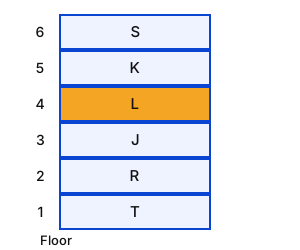
- Three people between R and S with R below S: (R, S) = (1, 5) or (2, 6).
- J is immediately above R on an odd floor → R must be even → R = 2, J = 3, S = 6.
- Remaining floors 1, 4, 5 for T, L, K with T < L < K → T = 1, L = 4, K = 5. Floor 4 → L.
Trick: "Immediately above on an odd floor" forces the lower person onto an even floor; that single clue kills the (1, 5) case.
Answer: (C) L
अवधारणा: सबसे कड़ी शर्त (R और S के बीच तीन मंज़िल) पहले लगाएँ, फिर सम/विषम संकेत का उपयोग करें।
- R और S के बीच तीन लोग, R नीचे: (R, S) = (1, 5) या (2, 6)।
- J, R के ठीक ऊपर विषम मंज़िल पर → R सम होना चाहिए → R = 2, J = 3, S = 6।
- शेष मंज़िल 1, 4, 5 पर T, L, K, जहाँ T < L < K → T = 1, L = 4, K = 5। मंज़िल 4 → L।
ट्रिक: "ठीक ऊपर, विषम मंज़िल पर" का मतलब नीचे वाला सम मंज़िल पर है; यही एक संकेत (1, 5) वाली स्थिति हटा देता है।
उत्तर: (C) L
RRB NTPC Graduate CBT 1General Intelligence and ReasoningFloor PuzzleRRB NTPC Graduate CBT 1 2025 · 24 Mar Shift 2
Q232.Select the set in which the numbers are related in the same way as are the numbers of the following sets.
(NOTE : Operations should be performed on the whole numbers, without breaking down the numbers into their constituent digits. E.g. 13 – Operations on 13 such as adding / subtracting / multiplying etc. to 13 can be performed. Breaking down 13 into 1 and 3 and then performing mathematical operations on 1 and 3 is not allowed.)
(34, 1088, 16)
(21, 420, 10)
उस समुच्चय का चयन कीजिए जिसमें संख्याएँ उसी प्रकार संबंधित हैं जिस प्रकार निम्नलिखित समुच्चयों की संख्याएँ संबंधित हैं।
(नोट: संक्रियाएँ पूर्ण संख्याओं पर की जानी चाहिए, संख्याओं को उनके घटक अंकों में तोड़े बिना। उदाहरण के लिए 13 – 13 पर संक्रियाएँ जैसे 13 में जोड़ना/घटाना/गुणा करना आदि की जा सकती हैं। 13 को 1 और 3 में तोड़कर फिर 1 और 3 पर गणितीय संक्रियाएँ करने की अनुमति नहीं है।)
(34, 1088, 16)
(21, 420, 10)
- A(28, 224, 4)
- B(8, 279, 17)
- C(4, 79, 9)
- D(23, 513, 11)
Show answer
Concept: Relate the middle number to the two outer numbers of each set.
- : , . : . Rule: middle first third .
- Option A: ✓.
- B: ; C: ; D: .
Trick: Wrong options are all exactly 7 more than product – spot the +7 and reject them.
Answer: (A) (28, 224, 4)
अवधारणा: हर समुच्चय में बीच की संख्या को दोनों बाहरी संख्याओं से जोड़ें।
- : , । : । नियम: बीच पहली तीसरी ।
- विकल्प A: ✓।
- B: ; C: ; D: ।
ट्रिक: गलत विकल्प सभी गुणनफल से ठीक 7 अधिक हैं – यह +7 देखकर उन्हें हटा दें।
उत्तर: (A) (28, 224, 4)
RRB NTPC Graduate CBT 1General Intelligence and ReasoningNumber Set AnalogyRRB NTPC Graduate CBT 1 2025 · 24 Mar Shift 2
Q233.X, Y, Z, S, T and U live on six different floors of the same building. The lowermost floor in the building is numbered 1, the floor above it, number 2 and so on till the topmost floor is numbered 6. Only two people live between T and Y. Only S lives above U. Z lives on an even numbered floor. T lives on the lowermost floor. How many people live between X and T?
X, Y, Z, S, T और U एक ही भवन की छह अलग-अलग मंज़िलों पर रहते हैं। भवन की सबसे निचली मंज़िल की संख्या 1 है, उसके ऊपर की मंज़िल की संख्या 2 है और इसी प्रकार सबसे ऊपरी मंज़िल तक, जिसकी संख्या 6 है। T और Y के बीच केवल दो व्यक्ति रहते हैं। U के ऊपर केवल S रहता है। Z एक सम संख्या वाली मंज़िल पर रहता है। T सबसे निचली मंज़िल पर रहता है। X और T के बीच कितने व्यक्ति रहते हैं?
- AOneएक
- BThreeतीन
- CTwoदो
- DFourचार
Show answer
Concept: Start from the definite clue (T on floor 1) and place the rest.
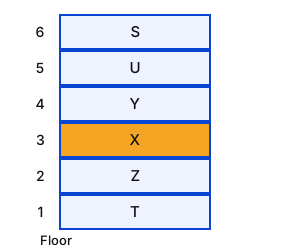
- T = 1. Two people between T and Y → Y = 4.
- Only S lives above U → U = 5, S = 6.
- Z is on an even floor; only floor 2 is left among even floors → Z = 2, so X = 3.
- Between X (3) and T (1) there is one person, Z.
Trick: "Only S lives above U" always means U is second from top and S is on top.
Answer: (A) One
अवधारणा: निश्चित संकेत (T मंज़िल 1 पर) से शुरू करके बाकी को रखें।
- T = 1। T और Y के बीच दो लोग → Y = 4।
- U के ऊपर केवल S → U = 5, S = 6।
- Z सम मंज़िल पर; सम मंज़िलों में केवल 2 बची → Z = 2, अतः X = 3।
- X (3) और T (1) के बीच एक व्यक्ति, Z।
ट्रिक: "U के ऊपर केवल S रहता है" का अर्थ हमेशा U ऊपर से दूसरी और S सबसे ऊपर।
उत्तर: (A) One
RRB NTPC Graduate CBT 1General Intelligence and ReasoningFloor PuzzleRRB NTPC Graduate CBT 1 2025 · 24 Mar Shift 2
Q234.A, B, C, D, E, F and G sit around a circular table, facing the centre.
Only two people sit between G and F when counted from the right of G. Only three people sit between D and E when counted from the right of E. F sits to the immediate right of E. A sits to the immediate right of B.
How many people sit between B and G when counted from the left of G?
A, B, C, D, E, F और G एक वृत्ताकार मेज़ के चारों ओर केंद्र की ओर मुख करके बैठे हैं।
G के दाएँ से गिनने पर G और F के बीच केवल दो व्यक्ति बैठे हैं। E के दाएँ से गिनने पर D और E के बीच केवल तीन व्यक्ति बैठे हैं। F, E के ठीक दाएँ बैठा है। A, B के ठीक दाएँ बैठा है।
G के बाएँ से गिनने पर B और G के बीच कितने व्यक्ति बैठे हैं?
- A4
- B2
- C1
- D3
Show answer
Concept: When everyone faces the centre, "right" means anticlockwise and "left" means clockwise.
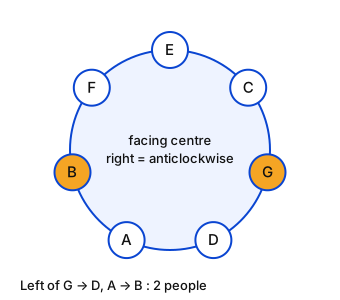
- Place E; F is immediate right (anticlockwise) of E. Three between D and E from the right of E: E → F → B/A/? … counting anticlockwise, D is the 4th seat from E.
- Two between G and F from the right of G: G is 3 seats clockwise from F, i.e. G sits two seats clockwise of E.
- Remaining three seats between F and D (anticlockwise) take B, A, with A immediate right of B; the seat between E and G goes to C. Order clockwise: E, C, G, D, A, B, F.
- From the left of G (clockwise): D, A, then B → 2 people.
Trick: Fix the direction rule first (right = anticlockwise) and place the pair with the most clues (E, F, D) before anything else.
Answer: (B) 2
अवधारणा: जब सभी केंद्र की ओर मुख किए हों, "दाएँ" = वामावर्त (anticlockwise) और "बाएँ" = दक्षिणावर्त (clockwise)।
- E रखें; F, E के ठीक दाएँ (वामावर्त)। E के दाएँ से D और E के बीच तीन लोग: वामावर्त गिनने पर D, E से चौथी सीट पर।
- G के दाएँ से G और F के बीच दो लोग: G, F से 3 सीट दक्षिणावर्त, यानी E से दो सीट दक्षिणावर्त।
- F और D के बीच (वामावर्त) बची तीन सीटों में B, A (A, B के ठीक दाएँ); E और G के बीच की सीट C को। दक्षिणावर्त क्रम: E, C, G, D, A, B, F।
- G के बाएँ से (दक्षिणावर्त): D, A, फिर B → 2 लोग।
ट्रिक: पहले दिशा नियम तय करें (दाएँ = वामावर्त) और सबसे अधिक संकेत वाले समूह (E, F, D) को सबसे पहले रखें।
उत्तर: (B) 2
RRB NTPC Graduate CBT 1General Intelligence and ReasoningCircular Seating ArrangementRRB NTPC Graduate CBT 1 2025 · 24 Mar Shift 2
Q235.Read the given statements and conclusions carefully. You have to take the given statements to be true even if they seem to be at variance from commonly known facts. You have to decide which conclusion/s logically follow/s from the given statements. Statements: Some lakes are oceans. All planets are oceans. All lakes are roads. Conclusion (I): Some oceans are roads.
Conclusion (II): Some planets are lakes.
दिए गए कथनों और निष्कर्षों को ध्यानपूर्वक पढ़िए। आपको दिए गए कथनों को सत्य मानना है, भले ही वे सामान्यतः ज्ञात तथ्यों से भिन्न प्रतीत होते हों। आपको यह निर्णय करना है कि दिए गए कथनों से कौन-सा/कौन-से निष्कर्ष तार्किक रूप से अनुसरण करता है/करते हैं। कथन: कुछ झीलें महासागर हैं। सभी ग्रह महासागर हैं। सभी झीलें सड़कें हैं। निष्कर्ष (I): कुछ महासागर सड़कें हैं।
निष्कर्ष (II): कुछ ग्रह झीलें हैं।
- AOnly conclusion (I) followsकेवल निष्कर्ष (I) अनुसरण करता है
- BNeither conclusion (I) nor (II) followsन तो निष्कर्ष (I) और न ही (II) अनुसरण करता है
- COnly conclusion (II) followsकेवल निष्कर्ष (II) अनुसरण करता है
- DBoth conclusions (I) and (II) followनिष्कर्ष (I) और (II) दोनों अनुसरण करते हैं
Show answer
Concept: Draw lakes inside roads, lakes overlapping oceans, and planets inside oceans.
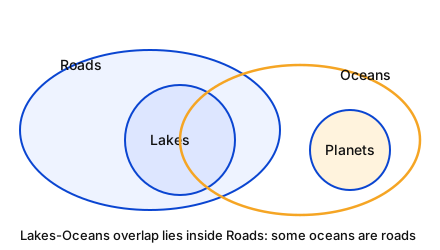
- Conclusion I "Some oceans are roads": the lakes that are oceans are also roads (all lakes are roads) → follows.
- Conclusion II "Some planets are lakes": planets and lakes are both inside oceans but need not touch each other → does not follow.
Trick: Some A are B + All A are C ⇒ Some B are C. Two subsets of the same set (planets, lakes in oceans) give no definite relation.
Answer: (A) Only conclusion (I) follows
अवधारणा: lakes को roads के अंदर, lakes को oceans से काटता हुआ, और planets को oceans के अंदर बनाएँ।
- निष्कर्ष I "कुछ oceans, roads हैं": जो lakes oceans हैं वे roads भी हैं (सभी lakes roads हैं) → अनुसरण करता है।
- निष्कर्ष II "कुछ planets, lakes हैं": planets और lakes दोनों oceans के अंदर हैं पर उनका एक-दूसरे को छूना ज़रूरी नहीं → अनुसरण नहीं करता।
ट्रिक: Some A are B + All A are C ⇒ Some B are C। एक ही समुच्चय के दो उपसमुच्चय (oceans में planets, lakes) कोई निश्चित संबंध नहीं देते।
उत्तर: (A) केवल निष्कर्ष (I) अनुसरण करता है
RRB NTPC Graduate CBT 1General Intelligence and ReasoningSyllogismRRB NTPC Graduate CBT 1 2025 · 24 Mar Shift 2
Q236.Seven boxes P, Q, R, S, T, U and V are kept one over the other but not necessarily in the same order.
No box is kept above U. Only three boxes are kept between U and P. Only one box is kept between R and T. T is kept immediately above P. Only four boxes are kept between R and V. Q is kept at some place above S.
How many boxes are kept between S and U?
सात बक्से P, Q, R, S, T, U और V एक के ऊपर एक रखे गए हैं, परंतु आवश्यक नहीं कि इसी क्रम में हों।
U के ऊपर कोई बक्सा नहीं रखा है। U और P के बीच केवल तीन बक्से रखे हैं। R और T के बीच केवल एक बक्सा रखा है। T, P के ठीक ऊपर रखा है। R और V के बीच केवल चार बक्से रखे हैं। Q, S के ऊपर किसी स्थान पर रखा है।
S और U के बीच कितने बक्से रखे हैं?
- A3
- B2
- C4
- D1
Show answer
Concept: Fix the box whose position is certain (U at the top), then place the others by counting gaps.
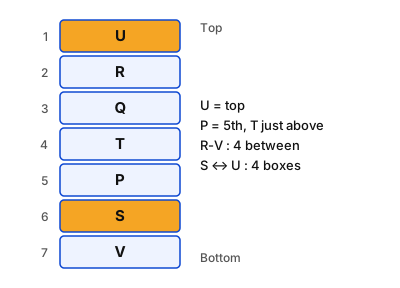
- No box above U → U is at position 1 (top). Three boxes between U and P → P is 5th.
- T is immediately above P → T is 4th. One box between R and T → R is 2nd or 6th.
- Four boxes between R and V → R = 2nd, V = 7th (R = 6th would need V at position 1, which is U).
- Q is above S, so Q = 3rd and S = 6th. Final stack (top to bottom): U, R, Q, T, P, S, V.
- Between S (6th) and U (1st) lie R, Q, T, P → 4 boxes.
Trick: "Only n boxes between X and Y" means the positions differ by n + 1; start from the box with a fixed end position.
Answer: (C) 4
अवधारणा: जिस बॉक्स की स्थिति निश्चित हो (U सबसे ऊपर) उसे पहले रखें, फिर बीच के बॉक्स गिनकर बाकी रखें।
- U के ऊपर कोई बॉक्स नहीं → U स्थान 1 (सबसे ऊपर)। U और P के बीच तीन बॉक्स → P 5वाँ।
- T, P के ठीक ऊपर → T 4था। R और T के बीच एक बॉक्स → R 2रा या 6ठा।
- R और V के बीच चार बॉक्स → R = 2रा, V = 7वाँ (R = 6ठा होने पर V को स्थान 1 चाहिए, जो U का है)।
- Q, S से ऊपर है, अतः Q = 3रा, S = 6ठा। अंतिम क्रम (ऊपर से नीचे): U, R, Q, T, P, S, V।
- S (6ठा) और U (1ला) के बीच R, Q, T, P → 4 बॉक्स।
ट्रिक: "X और Y के बीच केवल n बॉक्स" का अर्थ है स्थानों का अंतर n + 1; जिस बॉक्स का सिरा तय हो, वहीं से शुरू करें।
उत्तर: (C) 4
RRB NTPC Graduate CBT 1General Intelligence and ReasoningBox ArrangementRRB NTPC Graduate CBT 1 2025 · 24 Mar Shift 1
Q237.Seven boxes, A, B, C, D, E, F and G, are kept one over the other but not necessarily in the same order.
Only two boxes are kept below B. Only one box is kept above G. Only one box is kept between G and A. C is kept immediately above F. E is kept at some place below D. How many boxes are kept below E?
सात बक्से, A, B, C, D, E, F और G, एक के ऊपर एक रखे गए हैं, परंतु आवश्यक नहीं कि इसी क्रम में हों।
B के नीचे केवल दो बक्से रखे हैं। G के ऊपर केवल एक बक्सा रखा है। G और A के बीच केवल एक बक्सा रखा है। C, F के ठीक ऊपर रखा है। E, D के नीचे किसी स्थान पर रखा है। E के नीचे कितने बक्से रखे हैं?
- A5
- B2
- C4
- D3
Show answer
Concept: Count positions from the top (1 = top, 7 = bottom) and fill the fixed boxes first.
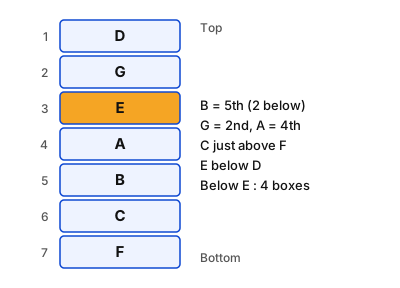
- Two boxes below B → B is 5th. One box above G → G is 2nd.
- One box between G and A → A is 4th (position 0 does not exist).
- Vacant places: 1, 3, 6, 7. C immediately above F needs two consecutive places → C = 6th, F = 7th.
- D and E take 1 and 3; E is below D → D = 1st, E = 3rd. Stack: D, G, E, A, B, C, F.
- Below E are A, B, C, F → 4 boxes.
Trick: After fixing the definite boxes, look for the only pair of adjacent empty slots – that is where the "immediately above" pair goes.
Answer: (C) 4
अवधारणा: ऊपर से स्थान गिनें (1 = सबसे ऊपर, 7 = सबसे नीचे) और पहले निश्चित बॉक्स भरें।
- B के नीचे दो बॉक्स → B 5वाँ। G के ऊपर एक बॉक्स → G 2रा।
- G और A के बीच एक बॉक्स → A 4था (स्थान 0 संभव नहीं)।
- खाली स्थान: 1, 3, 6, 7। C, F के ठीक ऊपर – इसके लिए दो लगातार स्थान चाहिए → C = 6ठा, F = 7वाँ।
- D और E स्थान 1 और 3 पर; E, D से नीचे → D = 1ला, E = 3रा। क्रम: D, G, E, A, B, C, F।
- E के नीचे A, B, C, F → 4 बॉक्स।
ट्रिक: निश्चित बॉक्स रखने के बाद लगातार दो खाली स्थानों की इकलौती जोड़ी ढूँढें – "ठीक ऊपर" वाली जोड़ी वहीं जाएगी।
उत्तर: (C) 4
RRB NTPC Graduate CBT 1General Intelligence and ReasoningBox ArrangementRRB NTPC Graduate CBT 1 2025 · 24 Mar Shift 1
Q238.Read the given statements and conclusions carefully. Assuming that the information given in the statements is true, even if it appears to be at variance with commonly known facts, decide which of the given conclusions logically follow(s) from the statements.
Statements:
All heaters are fans. Some heaters are lights. No heater is a bulb.
Conclusions:
(I) Some fans are lights.
(II) No bulb is a heater.
दिए गए कथनों और निष्कर्षों को ध्यानपूर्वक पढ़िए। यह मानते हुए कि कथनों में दी गई जानकारी सत्य है, भले ही वह सामान्यतः ज्ञात तथ्यों से भिन्न प्रतीत होती हो, निर्धारित कीजिए कि दिए गए निष्कर्षों में से कौन-सा/कौन-से निष्कर्ष कथनों का तार्किक रूप से अनुसरण करता है/करते हैं।
कथन:
सभी हीटर, फैन हैं। कुछ हीटर, लाइट हैं। कोई हीटर, बल्ब नहीं है।
निष्कर्ष:
(I) कुछ फैन, लाइट हैं।
(II) कोई बल्ब, हीटर नहीं है।
- ANeither conclusion (I) nor (II) followsन तो निष्कर्ष (I) और न ही (II) अनुसरण करता है
- BOnly conclusion (I) followsकेवल निष्कर्ष (I) अनुसरण करता है
- CBoth conclusions (I) and (II) followनिष्कर्ष (I) और (II) दोनों अनुसरण करते हैं
- DOnly conclusion (II) followsकेवल निष्कर्ष (II) अनुसरण करता है
Show answer
Concept: Draw the Venn diagram: "All heaters are fans" puts the Heater circle inside Fans; "Some heaters are lights" makes Lights overlap Heaters; "No heater is a bulb" keeps Bulbs apart from Heaters.
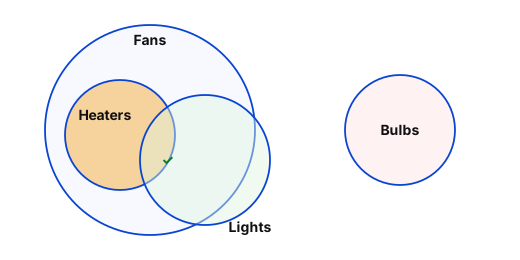
- Conclusion I: the heaters that are lights lie inside Fans too, so some fans are definitely lights → follows.
- Conclusion II: "No heater is a bulb" can always be reversed to "No bulb is a heater" → follows.
Yaad rakhein: All A are B + Some A are C ⇒ Some B are C (definite). "No A is B" ⇔ "No B is A".
Answer: (C) Both conclusions (I) and (II) follow
अवधारणा: वेन आरेख बनाएँ: "सभी heaters, fans हैं" → Heater का वृत्त Fans के अंदर; "कुछ heaters, lights हैं" → Lights, Heaters को काटता है; "कोई heater, bulb नहीं" → Bulbs, Heaters से अलग।
- निष्कर्ष I: जो heaters, lights हैं वे Fans के अंदर भी हैं, अतः कुछ fans निश्चित रूप से lights हैं → अनुसरण करता है।
- निष्कर्ष II: "कोई heater, bulb नहीं" को सदैव उलटा जा सकता है – "कोई bulb, heater नहीं" → अनुसरण करता है।
याद रखें: All A are B + Some A are C ⇒ Some B are C (निश्चित)। "No A is B" ⇔ "No B is A"।
उत्तर: (C) दोनों निष्कर्ष (I) और (II) अनुसरण करते हैं
RRB NTPC Graduate CBT 1General Intelligence and ReasoningSyllogismRRB NTPC Graduate CBT 1 2025 · 24 Mar Shift 1
Q239.A, B, C, D, E, F and G are sitting around a circular table facing the centre. Only one person sits between G and C when counted from the left of C. E sits third to the right of A. F sits third to the left of D. E sits to the
immediate right of F. B is not an immediate neighbour of F. Who sits third to the right of G?
A, B, C, D, E, F और G एक वृत्ताकार मेज़ के चारों ओर केंद्र की ओर मुख करके बैठे हैं। C के बाईं ओर से गिनने पर G और C के बीच केवल एक व्यक्ति बैठा है। E, A के दाईं ओर तीसरे स्थान पर बैठा है। F, D के बाईं ओर तीसरे स्थान पर बैठा है। E, F के
ठीक दाईं ओर बैठा है। B, F का निकटतम पड़ोसी नहीं है। G के दाईं ओर तीसरे स्थान पर कौन बैठा है?
- AF
- BB
- CD
- DE
Show answer
Concept: For people facing the centre, "left" is clockwise and "right" is anticlockwise. Start with the pair whose relative position is fixed.
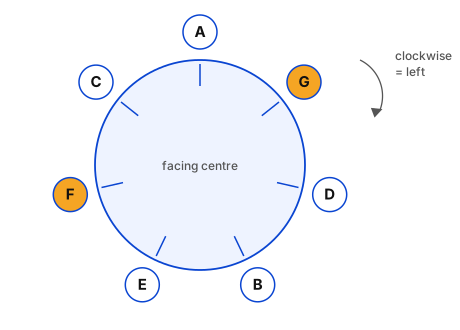
- E is immediately right of F, and F is third to the left of D → going clockwise: D … F with two seats between, E just anticlockwise of F.
- E is third to the right of A → A is third to the left (clockwise) of E; this places A two seats clockwise after F.
- Only one person between G and C counting from the left of C → G is 2nd clockwise from C. The only arrangement that fits all this (clockwise): A, G, D, B, E, F, C.
- Check: B's neighbours are D and E, not F ✓. Third to the right (anticlockwise) of G: A, C, F → F.
Trick: Facing centre → right = anticlockwise. Put the two "immediate" clues on the circle first, then test the "third to…" clues.
Answer: (A) F
अवधारणा: केंद्र की ओर मुख वाले लोगों के लिए "बायाँ" = दक्षिणावर्त (clockwise) और "दायाँ" = वामावर्त। जिस जोड़ी की सापेक्ष स्थिति तय हो, उससे शुरू करें।
- E, F के ठीक दाएँ है और F, D के बाएँ तीसरा → दक्षिणावर्त: D … F के बीच दो सीटें, E, F से ठीक वामावर्त।
- E, A के दाएँ तीसरा → A, E के बाएँ (दक्षिणावर्त) तीसरा; इससे A, F के बाद दो सीट दक्षिणावर्त आता है।
- C के बाएँ से गिनने पर G और C के बीच केवल एक व्यक्ति → G, C से दक्षिणावर्त दूसरा। सभी शर्तें पूरी करने वाला एकमात्र क्रम (दक्षिणावर्त): A, G, D, B, E, F, C।
- जाँच: B के पड़ोसी D और E हैं, F नहीं ✓। G के दाएँ (वामावर्त) तीसरा: A, C, F → F।
ट्रिक: केंद्र की ओर मुख → दायाँ = वामावर्त। पहले "ठीक बगल" वाले संकेत वृत्त पर रखें, फिर "तीसरा…" वाले संकेत जाँचें।
उत्तर: (A) F
RRB NTPC Graduate CBT 1General Intelligence and ReasoningCircular SeatingRRB NTPC Graduate CBT 1 2025 · 24 Mar Shift 1
Q240.Which of the following letter-clusters should replace # and % so that the pattern and relationship followed between the letter-cluster pair on the left side of :: is the same as that on the right side of :: ?
# : ZVT :: JFD : %
निम्नलिखित में से किन अक्षर-समूहों को # और % के स्थान पर रखा जाना चाहिए ताकि :: के बाईं ओर के अक्षर-समूह युग्म के बीच जो पैटर्न और संबंध है, वही :: के दाईं ओर भी हो?
# : ZVT :: JFD : %
- A# = WTR , % = LKH
- B# = XSR , % = LJG
- C# = XUR , % = MJL
- D# = WSQ , % = MIG
Show answer
Concept: Both unknowns must follow one rule; test each option's # against ZVT and apply the same rule to JFD.
- Option (D): # = WSQ. W + 3 = Z, S + 3 = V, Q + 3 = T → each letter moves +3 to give ZVT ✓.
- Apply +3 to JFD: J + 3 = M, F + 3 = I, D + 3 = G → MIG, which matches % in option (D).
- Other options fail: e.g. (A) WTR → +3, +2, +2 (not uniform); (B) XSR → +2, +3, +2.
Trick: Write place values (W=23, S=19, Q=17 → Z=26, V=22, T=20); a constant gap confirms the rule instantly.
Answer: (D) # = WSQ, % = MIG
अवधारणा: दोनों अज्ञात एक ही नियम से बनने चाहिए; हर विकल्प के # को ZVT से जाँचें और वही नियम JFD पर लगाएँ।
- विकल्प (D): # = WSQ। W + 3 = Z, S + 3 = V, Q + 3 = T → हर अक्षर +3 से ZVT बनता है ✓।
- JFD पर +3: J + 3 = M, F + 3 = I, D + 3 = G → MIG, जो विकल्प (D) के % से मेल खाता है।
- बाकी विकल्प असफल: जैसे (A) WTR → +3, +2, +2 (एकसमान नहीं); (B) XSR → +2, +3, +2।
ट्रिक: स्थान-मान लिखें (W=23, S=19, Q=17 → Z=26, V=22, T=20); समान अंतर से नियम तुरंत पक्का हो जाता है।
उत्तर: (D) # = WSQ, % = MIG
RRB NTPC Graduate CBT 1General Intelligence and ReasoningLetter AnalogyRRB NTPC Graduate CBT 1 2025 · 24 Mar Shift 1

