Q301.Line PQ is parallel to line RS and a transversal AB intersects PQ at C and RS at D. If , and , find the measure of .
रेखा PQ रेखा RS के समांतर है और एक तिर्यक रेखा AB, PQ को C पर तथा RS को D पर प्रतिच्छेद करती है। यदि , और है, तो का माप ज्ञात कीजिए।
- A
- B
- C
- D
Show answer
Concept: On a straight line, adjacent angles sum to ; with parallel lines, corresponding angles are equal.
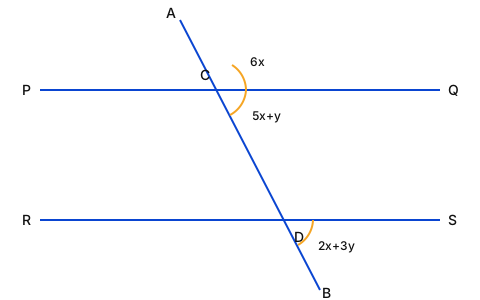
- (linear pair on AB): .
- (corresponding angles, PQ ∥ RS): .
- .
- .
Trick: Two equations, two unknowns: linear pair gives one, corresponding angles give the other – solve for , then add .
Answer: (A)
अवधारणा: सरल रेखा पर आसन्न कोणों का योग ; समांतर रेखाओं में संगत कोण (corresponding angles) बराबर।
- (AB पर रैखिक युग्म): ।
- (संगत कोण, PQ ∥ RS): ।
- ।
- ।
ट्रिक: दो समीकरण, दो अज्ञात: रैखिक युग्म से एक, संगत कोण से दूसरा – निकालें, फिर जोड़ें।
उत्तर: (A)
RRB NTPC Graduate CBT 1MathematicsLines and Angles – Parallel LinesRRB NTPC Graduate CBT 1 2025 · 22 Mar Shift 3
Q302.If and , then find the value of .
यदि और है, तो का मान ज्ञात कीजिए।
- A36
- B64
- C16
- D49
Show answer
Concept: .
- , .
- .
- Required value .
Trick: Whenever you see , read it as – the cancels and no expansion is needed.
Answer: (B) 64
अवधारणा: ।
- , ।
- ।
- अभीष्ट मान ।
ट्रिक: दिखे तो उसे पढ़ें – कट जाता है, विस्तार की ज़रूरत नहीं।
उत्तर: (B) 64
RRB NTPC Graduate CBT 1MathematicsAlgebra – IdentitiesRRB NTPC Graduate CBT 1 2025 · 22 Mar Shift 3
Q303.What is the mean of the following distribution?
| Marks | 16 | 21 | 47 | 80 | 99 |
|---|
| No. of Students | 24 | 38 | 26 | 32 | 13 |
|---|
निम्नलिखित बंटन का माध्य क्या है?
| अंक | 16 | 21 | 47 | 80 | 99 |
|---|
| छात्रों की संख्या | 24 | 38 | 26 | 32 | 13 |
|---|
- A67
- B47
- C74
- D71
Show answer
Concept: .
- .
- .
- .
Trick: Take assumed mean 47: deviations give → mean is exactly 47.
Answer: (B) 47
अवधारणा: ।
- ।
- ।
- ।
ट्रिक: कल्पित माध्य 47 लें: विचलन से → माध्य ठीक 47।
उत्तर: (B) 47
RRB NTPC Graduate CBT 1MathematicsStatistics – MeanRRB NTPC Graduate CBT 1 2025 · 22 Mar Shift 3
Q304.A and B start a business by investing capitals in the ratio 5:7. After 4 months, C joins the business with a capital equal to half of B’s capital. After 8 months from the start, A withdraws 40% of his capital, while B continues with the same investment. At the end of one year, the total profit is ₹27,675. The share of profit of B (in ₹) is:
A और B 5:7 के अनुपात में पूँजी निवेश करके एक व्यापार शुरू करते हैं। 4 महीने बाद, C, B की पूँजी के आधे के बराबर पूँजी के साथ व्यापार में शामिल होता है। शुरुआत से 8 महीने बाद, A अपनी पूँजी का 40% निकाल लेता है, जबकि B उसी निवेश के साथ बना रहता है। एक वर्ष के अंत में कुल लाभ ₹27,675 है। B के लाभ का हिस्सा (₹ में) है:
- A17,175
- B14,175
- C16,175
- D15,175
Show answer
Concept: Profit is shared in the ratio of (capital × time).
- Let A = 5, B = 7, C = 3.5 units.
- A: (after withdrawing 40%, 3 units remain); B: ; C: .
- Ratio 52 : 84 : 28 = 13 : 21 : 7 (total 41).
- B's share .
Trick: exactly – a clean division confirms the ratio is right.
Answer: (B) 14,175
अवधारणा: लाभ (पूँजी × समय) के अनुपात में बँटता है।
- A = 5, B = 7, C = 3.5 इकाई मानें।
- A: (40% निकालने पर 3 इकाई शेष); B: ; C: ।
- अनुपात 52 : 84 : 28 = 13 : 21 : 7 (योग 41)।
- B का हिस्सा ।
ट्रिक: पूरा-पूरा – साफ़ भाग अनुपात सही होने की पुष्टि है।
उत्तर: (B) 14,175
RRB NTPC Graduate CBT 1MathematicsPartnershipRRB NTPC Graduate CBT 1 2025 · 22 Mar Shift 3
Q305.Evaluate: (-9) - (-56) ÷ (-14) + (-3) × 7
मान ज्ञात कीजिए: (-9) - (-56) ÷ (-14) + (-3) × 7
- A-37
- B-36
- C-34
- D-33
Show answer
Concept: Division and multiplication before addition and subtraction; watch the signs.
- ; .
- .
Trick: Negative ÷ negative = positive; then "minus a positive" makes the total more negative.
Answer: (C)
अवधारणा: जोड़-घटाव से पहले भाग और गुणा; चिह्नों पर ध्यान।
- ; ।
- ।
ट्रिक: ऋण ÷ ऋण = धन; फिर "ऋण में धन घटाना" योग को और ऋणात्मक करता है।
उत्तर: (C)
RRB NTPC Graduate CBT 1MathematicsSimplification – BODMASRRB NTPC Graduate CBT 1 2025 · 22 Mar Shift 3
Q306.What should come in place of ‘?’ in the given series?
55 56 60 69 85 ?
दी गई श्रेणी में '?' के स्थान पर क्या आना चाहिए?
55 56 60 69 85 ?
- A108
- B110
- C104
- D112
Show answer
Concept: Look at the differences between consecutive terms.
- 56 − 55 = 1, 60 − 56 = 4, 69 − 60 = 9, 85 − 69 = 16 → perfect squares .
- Next difference → .
Trick: Differences 1, 4, 9, 16 – squares; next is always 25.
Answer: (B) 110
अवधारणा: क्रमागत पदों के अंतर देखें।
- 56 − 55 = 1, 60 − 56 = 4, 69 − 60 = 9, 85 − 69 = 16 → पूर्ण वर्ग ।
- अगला अंतर → ।
ट्रिक: अंतर 1, 4, 9, 16 – वर्ग; अगला हमेशा 25।
उत्तर: (B) 110
RRB NTPC Graduate CBT 1MathematicsNumber SeriesRRB NTPC Graduate CBT 1 2025 · 22 Mar Shift 3
Q307.The total surface area of a cube having side 91 cm is:
91 cm भुजा वाले एक घन का कुल पृष्ठीय क्षेत्रफल है:
- A49668 cm2
- B49716 cm2
- C49666 cm2
- D49686 cm2
Show answer
Concept: Total surface area of a cube .
- .
- TSA .
Trick: Unit digit keeps only B and D; then minus gives 49686.
Answer: (D)
अवधारणा: घन का कुल पृष्ठीय क्षेत्रफल ।
- ।
- TSA ।
ट्रिक: इकाई अंक – विकल्प B और D में 6; में से घटाएँ → 49686।
उत्तर: (D)
RRB NTPC Graduate CBT 1MathematicsMensuration – CubeRRB NTPC Graduate CBT 1 2025 · 22 Mar Shift 3
Q308.The HCF and LCM of two numbers are 5 and 180 respectively. If one number is 45, what is the other number?
दो संख्याओं का HCF और LCM क्रमशः 5 और 180 है। यदि एक संख्या 45 है, तो दूसरी संख्या क्या है?
- A36
- B40
- C20
- D25
Show answer
Concept: Product of two numbers .
- .
- .
- Check: HCF(45, 20) = 5, LCM = 180 ✓.
Trick: Other number – one line, no factorisation.
Answer: (C) 20
अवधारणा: दो संख्याओं का गुणनफल ।
- ।
- ।
- जाँच: HCF(45, 20) = 5, LCM = 180 ✓।
ट्रिक: दूसरी संख्या – एक पंक्ति, गुणनखंड की ज़रूरत नहीं।
उत्तर: (C) 20
RRB NTPC Graduate CBT 1MathematicsHCF and LCMRRB NTPC Graduate CBT 1 2025 · 22 Mar Shift 3
Q309.By selling an article at of its marked price, Aman incurs a loss of 25%. If he sells it at 69% of its actual marked price, then the profit percentage is
एक वस्तु को उसके अंकित मूल्य के पर बेचने से अमन को 25% की हानि होती है। यदि वह इसे इसके वास्तविक अंकित मूल्य के 69% पर बेचता है, तो लाभ प्रतिशत है
- A75.1%
- B74.1%
- C73.5%
- D72.5%
Show answer
Concept: Take MP ; find CP from the loss, then the profit at the new SP.
- SP gives loss → CP .
- New SP of 100 .
- Profit ; profit.
Trick: CP ; with MP all numbers stay small.
Answer: (D)
अवधारणा: MP लें; हानि से CP निकालें, फिर नए SP पर लाभ।
- SP पर हानि → CP ।
- नया SP का ।
- लाभ ; लाभ।
ट्रिक: CP ; MP लेने से संख्याएँ छोटी रहती हैं।
उत्तर: (D)
RRB NTPC Graduate CBT 1MathematicsProfit & Loss – Marked PriceRRB NTPC Graduate CBT 1 2025 · 22 Mar Shift 2
Q310.Three friends X, Y and Z started a business by investing a sum of money in the ratio of 9 : 5 : 2. After 6 months, X withdraws half of his capital. If the sum invested by Z is ₹83,000, then out of a total annual profit of ₹88,000, what is the difference between X's and Y's profit?
तीन मित्रों X, Y और Z ने 9 : 5 : 2 के अनुपात में धनराशि निवेश करके एक व्यापार शुरू किया। 6 महीने बाद, X अपनी पूँजी का आधा भाग निकाल लेता है। यदि Z द्वारा निवेश की गई राशि ₹83,000 है, तो ₹88,000 के कुल वार्षिक लाभ में से X और Y के लाभ का अंतर क्या है?
- A₹11,200
- B₹10,550
- C₹10,945
- D₹12,710
Show answer
Concept: Profit is shared in the ratio of (capital × time).
- X: ; Y: ; Z: . Ratio , total parts.
- One part .
- Difference X Y parts .
Trick: Z's ₹83,000 is a distraction – the ratio alone fixes the profit shares.
Answer: (A) ₹11,200
अवधारणा: लाभ (पूँजी × समय) के अनुपात में बँटता है।
- X: ; Y: ; Z: । अनुपात , कुल भाग।
- एक भाग ।
- अंतर X Y भाग ।
ट्रिक: Z के ₹83,000 केवल भटकाने के लिए हैं – अनुपात ही लाभ तय करता है।
उत्तर: (A) ₹11,200
RRB NTPC Graduate CBT 1MathematicsPartnershipRRB NTPC Graduate CBT 1 2025 · 22 Mar Shift 2
Q311.If , then the value of is:
यदि है, तो का मान है:
- A
- B
- C
- D
Show answer
Concept: If and are not all equal, then .
- Let . Then .
- RHS: – exactly the given form.
- So : → .
Trick: Whenever you see cubes equal to "3 × product", just add the three brackets and equate to zero.
Answer: (D)
अवधारणा: यदि और सब बराबर नहीं, तो ।
- लें। तब ।
- RHS: – ठीक प्रश्न जैसा।
- अतः : → ।
ट्रिक: घन = "3 × गुणनफल" दिखे तो तीनों कोष्ठक जोड़कर शून्य के बराबर रख दें।
उत्तर: (D)
RRB NTPC Graduate CBT 1MathematicsAlgebra – a³+b³+c³ IdentityRRB NTPC Graduate CBT 1 2025 · 22 Mar Shift 2
Q312.The total surface area of a solid hemisphere is 281 cm2. What is its radius (in cm)? (Take )
एक ठोस अर्धगोले का कुल पृष्ठीय क्षेत्रफल 281 cm2 है। इसकी त्रिज्या (cm में) क्या है? ( लीजिए)
- A
- B
- C
- D
Show answer
Concept: TSA of a solid hemisphere .
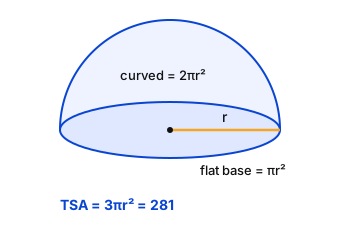
- .
- .
- .
Trick: Solid hemisphere → (with base); hollow bowl surface → . Here numerator must be .
Answer: (B)
अवधारणा: ठोस अर्धगोले का TSA ।
- ।
- ।
- ।
ट्रिक: ठोस अर्धगोला → (आधार सहित); खोखला कटोरा → । यहाँ अंश होना चाहिए।
उत्तर: (B)
RRB NTPC Graduate CBT 1MathematicsMensuration – HemisphereRRB NTPC Graduate CBT 1 2025 · 22 Mar Shift 2
Q313.Pipe P can fill part of a tank in 15 hours and pipe Q can fill part of the same tank in 21 hours. Both P and Q were kept open for 3 hours, then both were closed. Pipe R alone was then opened and it emptied the water in the tank in 4 hours. Pipes P, Q and R together can fill the empty tank in:
पाइप P एक टंकी के भाग को 15 घंटे में भर सकता है और पाइप Q उसी टंकी के भाग को 21 घंटे में भर सकता है। P और Q दोनों को 3 घंटे तक खुला रखा गया, फिर दोनों को बंद कर दिया गया। इसके बाद केवल पाइप R को खोला गया और उसने टंकी के पानी को 4 घंटे में खाली कर दिया। पाइप P, Q और R मिलकर खाली टंकी को कितने समय में भर सकते हैं:
- A57 hours57 घंटे
- B58 hours58 घंटे
- C42 hours42 घंटे
- D54 hours54 घंटे
Show answer
Concept: Convert each pipe to "full tank per hour", then add fillers and subtract the emptier.
- P fills in 15 h → full tank in h. Q fills in 21 h → h.
- P + Q in 3 h of tank. R empties in 4 h → R empties full tank in 18 h.
- Together: → 54 hours.
Trick: Take LCM units: P , Q , R per hour → net unit/h → h.
Answer: (D) 54 hours
अवधारणा: हर पाइप को "पूरी टंकी प्रति घंटा" में बदलें, भरने वाले जोड़ें और खाली करने वाला घटाएँ।
- P, 15 घंटे में भरता है → पूरी टंकी घंटे। Q, 21 घंटे में → घंटे।
- P + Q 3 घंटे में टंकी। R इसे 4 घंटे में खाली करता है → पूरी टंकी 18 घंटे में।
- तीनों साथ: → 54 घंटे।
ट्रिक: LCM इकाई लें: P , Q , R प्रति घंटा → शुद्ध इकाई/घंटा → घंटे।
उत्तर: (D) 54 घंटे
RRB NTPC Graduate CBT 1MathematicsPipes & CisternsRRB NTPC Graduate CBT 1 2025 · 22 Mar Shift 2
Q314.A and B complete a work in 20 days. If A alone can do it in 45 days, then B alone can do three-fourth of the same work in ______________days.
A और B एक कार्य को 20 दिनों में पूरा करते हैं। यदि A अकेले इसे 45 दिनों में कर सकता है, तो B अकेले उसी कार्य का तीन-चौथाई भाग ______________ दिनों में कर सकता है।
- A81
- B54
- C108
- D27
Show answer
Concept: B's one-day work (A+B)'s A's.
- → B alone takes 36 days.
- Three-fourth of the work: days.
Trick: LCM units: A+B /day, A /day, B /day → days.
Answer: (D) 27
अवधारणा: B का एक दिन का कार्य (A+B) का A का।
- → B अकेला 36 दिन।
- तीन-चौथाई कार्य: दिन।
ट्रिक: LCM इकाई: A+B /दिन, A /दिन, B /दिन → दिन।
उत्तर: (D) 27
RRB NTPC Graduate CBT 1MathematicsTime & WorkRRB NTPC Graduate CBT 1 2025 · 22 Mar Shift 2
Q315.The population of a village was 2,90,000. It increased by 15% in the first year and increased by 20% in the second year. Its population after two years is _______.
एक गाँव की जनसंख्या 2,90,000 थी। पहले वर्ष में इसमें 15% की वृद्धि हुई और दूसरे वर्ष में 20% की वृद्धि हुई। दो वर्ष बाद इसकी जनसंख्या _______ है।
- A3,33,500
- B4,00,200
- C3,48,000
- D3,91,500
Show answer
Concept: Successive increases multiply: .
- Net factor (same as ).
- Population .
Trick: for two successive changes – here of ; add it.
Answer: (B) 4,00,200
अवधारणा: क्रमिक वृद्धियाँ गुणा होती हैं: ।
- कुल गुणक (यानी )।
- जनसंख्या ।
ट्रिक: दो क्रमिक परिवर्तनों के लिए – यहाँ का जोड़ें।
उत्तर: (B) 4,00,200
RRB NTPC Graduate CBT 1MathematicsSuccessive Percentage ChangeRRB NTPC Graduate CBT 1 2025 · 22 Mar Shift 2
Q316.A man can row at 8 km/hr in still water. When the river flows at 2 km/hr, he takes 3 hours 12 minutes to row to a destination and back. Find the distance to the destination.
एक व्यक्ति शांत जल में 8 km/hr की चाल से नाव चला सकता है। जब नदी 2 km/hr की चाल से बहती है, तो उसे एक गंतव्य तक जाकर वापस आने में 3 घंटे 12 मिनट लगते हैं। गंतव्य की दूरी ज्ञात कीजिए।
- A10 km
- B8 km
- C15 km
- D12 km
Show answer
Concept: Downstream speed , upstream speed ; total time .
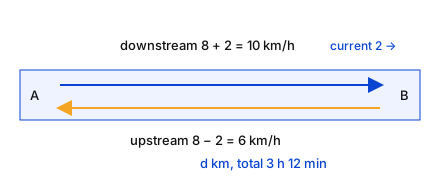
- Downstream , upstream ; time h.
- → .
- km.
Trick: .
Answer: (D) 12 km
अवधारणा: अनुप्रवाह चाल , प्रतिप्रवाह ; कुल समय ।
- अनुप्रवाह , प्रतिप्रवाह ; समय घंटे।
- → ।
- km।
ट्रिक: ।
उत्तर: (D) 12 km
RRB NTPC Graduate CBT 1MathematicsBoats & StreamsRRB NTPC Graduate CBT 1 2025 · 22 Mar Shift 2
Q317.Simplify: .
सरल कीजिए: ।
- A
- B
- C
- D
Show answer
Concept: Take LCM and use .
- .
- Numerator .
- Cancel : result .
Trick: Put : ; only matches.
Answer: (C)
अवधारणा: LCM लें और लगाएँ।
- ।
- अंश ।
- काटने पर ।
ट्रिक: रखें: ; केवल मिलता है।
उत्तर: (C)
RRB NTPC Graduate CBT 1MathematicsTrigonometric IdentitiesRRB NTPC Graduate CBT 1 2025 · 22 Mar Shift 2
Q318.At what rate (in percentage) per year will a sum of money double itself in 20 years on simple interest?
साधारण ब्याज पर प्रति वर्ष कितनी दर (प्रतिशत में) से कोई धनराशि 20 वर्षों में स्वयं की दोगुनी हो जाएगी?
- A10
- B5
- C7
- D3
Show answer
Concept: To double, SI must equal the principal: → .
- years → per annum.
Trick: Double → ; triple → ; times → .
Answer: (B) 5
अवधारणा: दोगुना होने के लिए SI = मूलधन: → ।
- वर्ष → वार्षिक।
ट्रिक: दोगुना → ; तिगुना → ; गुना → ।
उत्तर: (B) 5
RRB NTPC Graduate CBT 1MathematicsSimple InterestRRB NTPC Graduate CBT 1 2025 · 22 Mar Shift 2
Q319.If 2820 is divided into two parts such that one-fifth of the first part and one-eighth of the second part are in the ratio 3 : 4, what is the ratio of the first part to the second part?
यदि 2820 को दो भागों में इस प्रकार विभाजित किया जाता है कि पहले भाग का पाँचवाँ भाग और दूसरे भाग का आठवाँ भाग 3 : 4 के अनुपात में हैं, तो पहले भाग का दूसरे भाग से अनुपात क्या है?
- A18 : 19
- B15 : 32
- C15 : 37
- D17 : 36
Show answer
Concept: Set up the ratio of the fractional parts and simplify.
- → → .
- .
Trick: – multiply each ratio term by its own denominator. The total 2820 is not needed.
Answer: (B) 15 : 32
अवधारणा: भिन्नात्मक भागों का अनुपात लिखकर सरल करें।
- → → ।
- ।
ट्रिक: – हर अनुपात-पद को उसके हर से गुणा करें। कुल 2820 की ज़रूरत नहीं।
उत्तर: (B) 15 : 32
RRB NTPC Graduate CBT 1MathematicsRatio & ProportionRRB NTPC Graduate CBT 1 2025 · 22 Mar Shift 2
Q320.In a 150-meter race, R beats S by 6 meters. In a 250-meter race, R beats S by 2 seconds. As per this, in a race, if R runs for 30 seconds, then he beats S by ___ meters.
150 मीटर की दौड़ में, R, S को 6 मीटर से हराता है। 250 मीटर की दौड़ में, R, S को 2 सेकंड से हराता है। इसके अनुसार, एक दौड़ में यदि R 30 सेकंड तक दौड़ता है, तो वह S को ___ मीटर से हराता है।
- A5.75
- B7.25
- C6.75
- D6.25
Show answer
Concept: Find the speed ratio from the first race and S's actual speed from the second.
- 150 m race: R runs 150 while S runs 144 → speeds R : S .
- 250 m race: when R finishes 250, S has run 240 and needs 2 s for the last 10 m → S's speed ; R's speed .
- In 30 s: R m, S m → R beats S by m.
Trick: Lead in 30 s .
Answer: (D) 6.25
अवधारणा: पहली दौड़ से चाल का अनुपात और दूसरी से S की वास्तविक चाल निकालें।
- 150 m दौड़: R 150 दौड़ता है तो S 144 → चाल R : S ।
- 250 m दौड़: R के 250 पूरे करने पर S 240 पर; बचे 10 m में 2 s → S की चाल ; R की चाल ।
- 30 s में: R m, S m → R, S को m से हराता है।
ट्रिक: 30 s की बढ़त ।
उत्तर: (D) 6.25
RRB NTPC Graduate CBT 1MathematicsRacesRRB NTPC Graduate CBT 1 2025 · 22 Mar Shift 2

