Q321.Refer to the following letter, symbol series and answer the question.
(Left) L U £ P $ D A Ω F % * N Q & R # Y @ C K * & M (Right)
If all the letters are dropped from the series, which of the following will be seventh from the right?
निम्नलिखित अक्षर, प्रतीक श्रृंखला को देखिए और प्रश्न का उत्तर दीजिए।
(बाएँ) L U £ P $ D A Ω F % * N Q & R # Y @ C K * & M (दाएँ)
यदि श्रृंखला से सभी अक्षर हटा दिए जाएँ, तो निम्नलिखित में से कौन-सा दाएँ से सातवाँ होगा?
- A@
- B%
- C$
- DΩ
Show answer
Concept: Drop all letters, write the remaining symbols in order, then count from the right.
- Symbols in order: £, $, Ω, %, *, &, #, @, *, & (10 symbols).
- From the right: 1st &, 2nd *, 3rd @, 4th #, 5th &, 6th *, 7th %.
Trick: "-th from the right" in a list of items is the -th from the left: th → %.
Answer: (B) %
अवधारणा: सभी अक्षर हटाएँ, बचे प्रतीक क्रम से लिखें, फिर दाएँ से गिनें।
- क्रम में प्रतीक: £, $, Ω, %, *, &, #, @, *, & (10 प्रतीक)।
- दाएँ से: 1ला &, 2रा *, 3रा @, 4था #, 5वाँ &, 6ठा *, 7वाँ %।
ट्रिक: वस्तुओं में "दाएँ से वाँ" = बाएँ से वाँ: था → %।
उत्तर: (B) %
RRB NTPC Graduate CBT 1General Intelligence and ReasoningLetter-Symbol SeriesRRB NTPC Graduate CBT 1 2025 · 22 Mar Shift 2
Q322.8 is related to 41 following a certain logic. Following the same logic, 81 is related to 406. To which of the following is 13 related, following the same logic?
(NOTE: Operations should be performed on the whole numbers, without breaking down the numbers into their constituent digits. E.g. 13 – Operations on 13 such as
adding/subtracting/multiplying etc. to 13, can be performed. Breaking down 13 into 1 and 3 and then performing mathematical operations on 1 and 3 is not allowed.)
8 एक निश्चित तर्क के अनुसार 41 से संबंधित है। उसी तर्क के अनुसार, 81, 406 से संबंधित है। उसी तर्क के अनुसार, 13 निम्नलिखित में से किससे संबंधित है?
(नोट: संक्रियाएँ संख्याओं को उनके घटक अंकों में विभाजित किए बिना पूर्ण संख्याओं पर की जानी चाहिए। उदाहरण के लिए 13 – 13 पर संक्रियाएँ जैसे
13 में जोड़ना/घटाना/गुणा करना आदि की जा सकती हैं। 13 को 1 और 3 में विभाजित करके फिर 1 और 3 पर गणितीय संक्रियाएँ करने की अनुमति नहीं है।)
- A64
- B66
- C68
- D62
Show answer
Concept: Find one operation on the whole number that turns the first number into the second, and confirm it on the second pair.
- : .
- : ✓ (same rule).
- .
Trick: When the second number is roughly 5 times the first, try first; the pair settles .
Answer: (B) 66
अवधारणा: पूरी संख्या पर ऐसी एक संक्रिया खोजें जो पहली संख्या को दूसरी में बदले, और दूसरे युग्म पर पुष्टि करें।
- : ।
- : ✓ (वही नियम)।
- ।
ट्रिक: जब दूसरी संख्या पहली की लगभग 5 गुनी हो, पहले आज़माएँ; युग्म से तय होता है।
उत्तर: (B) 66
RRB NTPC Graduate CBT 1General Intelligence and ReasoningNumber AnalogyRRB NTPC Graduate CBT 1 2025 · 22 Mar Shift 2
Q323.If ‘A’ stands for ‘÷’, ‘B’ stands for ‘×’, ‘C’ stands for ‘+’ and ‘D’ stands for ‘−’, then what will come in place of the question mark (?) in the following equation?
13 B 2 C 6 D 8 A 4 = ?
यदि ‘A’ का अर्थ ‘÷’, ‘B’ का अर्थ ‘×’, ‘C’ का अर्थ ‘+’ और ‘D’ का अर्थ ‘−’ है, तो निम्नलिखित समीकरण में प्रश्नचिह्न (?) के स्थान पर क्या आएगा?
13 B 2 C 6 D 8 A 4 = ?
- A29
- B27
- C30
- D28
Show answer
Concept: Replace each letter by its symbol and then apply BODMAS (÷ and × before + and −).
- 13 B 2 C 6 D 8 A 4 becomes .
- Division first: ; multiplication: .
- .
Trick: Write the decoded expression fully before calculating – most mistakes come from solving left-to-right instead of BODMAS.
Answer: (C) 30
अवधारणा: हर अक्षर को उसके चिह्न से बदलें और फिर BODMAS लगाएँ (÷ और × पहले, + और − बाद में)।
- 13 B 2 C 6 D 8 A 4 बनता है ।
- पहले भाग: ; गुणा: ।
- ।
ट्रिक: पहले पूरा decoded व्यंजक लिखें, फिर हल करें – अधिकतर गलती बाएँ-से-दाएँ हल करने से होती है, BODMAS से नहीं।
उत्तर: (C) 30
RRB NTPC Graduate CBT 1General Intelligence and ReasoningMathematical OperationsRRB NTPC Graduate CBT 1 2025 · 22 Mar Shift 1
Q324.Based on the English alphabetical order, three of the following four letter-cluster pairs are alike in a certain way and thus form a group. Which letter-cluster pair DOES NOT belong to that group?
(Note: The odd one out is not based on the number of consonants/vowels or their position in the letter-cluster.)
अंग्रेज़ी वर्णमाला क्रम के आधार पर, निम्नलिखित चार अक्षर-समूह युग्मों में से तीन एक निश्चित प्रकार से समान हैं और इस प्रकार एक समूह बनाते हैं। कौन-सा अक्षर-समूह युग्म उस समूह से संबंधित नहीं है?
(नोट: असंगत युग्म व्यंजनों/स्वरों की संख्या या अक्षर-समूह में उनकी स्थिति पर आधारित नहीं है।)
- AZC−AD
- BOR−OU
- CDG−EH
- DRU−SV
Show answer
Concept: Compare the two letters of each pair position-wise using alphabet positions.
- ZC−AD: Z→A (+1, cyclic), C→D (+1).
- DG−EH: D→E (+1), G→H (+1). RU−SV: R→S (+1), U→V (+1).
- OR−OU: O→O (0), R→U (+3) – breaks the +1,+1 pattern.
Trick: Z→A counts as +1 (alphabet wraps around) – don't pick ZC−AD as odd just because it crosses Z.
Answer: (B) OR−OU
अवधारणा: प्रत्येक जोड़े के अक्षरों की स्थिति-वार तुलना वर्णमाला क्रमांक से करें।
- ZC−AD: Z→A (+1, चक्रीय), C→D (+1)।
- DG−EH: D→E (+1), G→H (+1)। RU−SV: R→S (+1), U→V (+1)।
- OR−OU: O→O (0), R→U (+3) – +1,+1 पैटर्न टूटता है।
ट्रिक: Z→A को +1 ही गिनें (वर्णमाला घूमकर A पर आती है) – Z पार करने भर से ZC−AD को विषम न मानें।
उत्तर: (B) OR−OU
RRB NTPC Graduate CBT 1General Intelligence and ReasoningLetter Cluster ClassificationRRB NTPC Graduate CBT 1 2025 · 22 Mar Shift 1
Q325.This question is based on the five, three-digit numbers given below. (Left) 442 405 297 384 316 (Right)
(Example- 697 – First digit = 6, second digit = 9 and third digit = 7) NOTE - All operations to be done from left to right.
What will be the resultant if third digit of the highest number is added to the second digit of lowest number ?
यह प्रश्न नीचे दी गई पाँच, तीन-अंकीय संख्याओं पर आधारित है। (बाएँ) 442 405 297 384 316 (दाएँ)
(उदाहरण- 697 – पहला अंक = 6, दूसरा अंक = 9 और तीसरा अंक = 7) नोट - सभी संक्रियाएँ बाएँ से दाएँ की जानी हैं।
यदि सबसे बड़ी संख्या के तीसरे अंक को सबसे छोटी संख्या के दूसरे अंक में जोड़ा जाए, तो परिणाम क्या होगा?
- A12
- B11
- C10
- D9
Show answer
Concept: Identify the required numbers first, then pick the asked digits.
- Numbers: 442, 405, 297, 384, 316. Highest = 442, lowest = 297.
- Third digit of 442 = 2; second digit of 297 = 9.
- Sum .
Trick: Underline the highest and lowest numbers as soon as you read the list – it saves re-scanning for every sub-question of this set.
Answer: (B) 11
अवधारणा: पहले अपेक्षित संख्याएँ पहचानें, फिर पूछे गए अंक चुनें।
- संख्याएँ: 442, 405, 297, 384, 316। सबसे बड़ी = 442, सबसे छोटी = 297।
- 442 का तीसरा अंक = 2; 297 का दूसरा अंक = 9।
- योग ।
ट्रिक: सूची पढ़ते ही सबसे बड़ी और छोटी संख्या पर निशान लगा लें – इस सेट के हर प्रश्न में दोबारा खोजने से बचेंगे।
उत्तर: (B) 11
RRB NTPC Graduate CBT 1General Intelligence and ReasoningNumber Based OperationsRRB NTPC Graduate CBT 1 2025 · 22 Mar Shift 1
Q326.22 is related to 60 following a certain logic. Following the same logic, 27 is related to 75. To which of the following is 33 related, following the same logic?
(NOTE: Operations should be performed on the whole numbers, without breaking down the numbers into their constituent digits. E.g. 13 – Operations on 13 such as adding/ subtracting /multiplying to 13 can be performed. Breaking down 13 into 1 and 3 and then performing mathematical operations on 1 and 3 is not allowed.)
22, एक निश्चित तर्क के अनुसार 60 से संबंधित है। उसी तर्क के अनुसार, 27, 75 से संबंधित है। उसी तर्क के अनुसार, 33 निम्नलिखित में से किससे संबंधित है?
(नोट: संक्रियाएँ पूर्ण संख्याओं पर की जानी चाहिए, संख्याओं को उनके घटक अंकों में तोड़े बिना। उदाहरण के लिए 13 – 13 पर संक्रियाएँ जैसे 13 में जोड़ना/घटाना/गुणा करना की जा सकती हैं। 13 को 1 और 3 में तोड़कर फिर 1 और 3 पर गणितीय संक्रियाएँ करने की अनुमति नहीं है।)
- A86
- B97
- C103
- D93
Show answer
Concept: Find one operation on the whole number that works for both given pairs.
- ✓
- ✓
- .
Trick: The second number is a little less than the first (66→60, 81→75, both −6) – test "×3 then −6" immediately.
Answer: (D) 93
अवधारणा: पूरी संख्या पर ऐसी एक संक्रिया खोजें जो दोनों दिए गए जोड़ों पर लागू हो।
- ✓
- ✓
- ।
ट्रिक: दूसरी संख्या पहली के गुने से थोड़ी कम है (66→60, 81→75, दोनों में −6) – तुरंत "×3 फिर −6" जाँचें।
उत्तर: (D) 93
RRB NTPC Graduate CBT 1General Intelligence and ReasoningNumber AnalogyRRB NTPC Graduate CBT 1 2025 · 22 Mar Shift 1
Q327.Read the given statements and conclusions carefully. Assuming that the information given in the statements is true, even if it appears to be at variance with commonly known facts, decide which of the given conclusions logically follow(s) from the statements.
Statements:
All hands are legs. Some hands are faces. Some faces are arms.
Conclusions:
(I) Some legs are faces.
(II) Some hands are arms.
दिए गए कथनों और निष्कर्षों को ध्यानपूर्वक पढ़िए। कथनों में दी गई जानकारी को सत्य मानते हुए, भले ही वह सामान्यतः ज्ञात तथ्यों से भिन्न प्रतीत होती हो, निर्णय कीजिए कि दिए गए निष्कर्षों में से कौन-सा/कौन-से निष्कर्ष कथनों का तार्किक रूप से अनुसरण करता है/करते हैं।
कथन:
सभी हाथ, टाँगें हैं। कुछ हाथ, चेहरे हैं। कुछ चेहरे, बाँहें हैं।
निष्कर्ष:
(I) कुछ टाँगें, चेहरे हैं।
(II) कुछ हाथ, बाँहें हैं।
- ABoth conclusions (I) and (II) followनिष्कर्ष (I) और (II) दोनों अनुसरण करते हैं
- BOnly conclusion (I) followsकेवल निष्कर्ष (I) अनुसरण करता है
- COnly conclusion (II) followsकेवल निष्कर्ष (II) अनुसरण करता है
- DNeither conclusion (I) nor (II) followsन तो निष्कर्ष (I) और न ही (II) अनुसरण करता है
Show answer
Concept: Draw the Venn diagram with the minimum overlap allowed by the statements and test each conclusion.
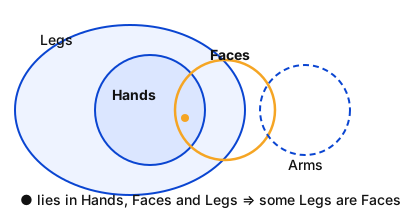
- All hands are legs → the "hands" circle lies inside "legs". Some hands are faces → the hands–faces overlap is non-empty, and it also lies inside legs. So some legs are faces – conclusion (I) follows.
- Some faces are arms – the arms can overlap faces outside hands, so "some hands are arms" is not necessary. Conclusion (II) does not follow.
Trick: Two "Some" statements in a chain (Some hands are faces, Some faces are arms) never give a definite conclusion between the end terms.
Answer: (B) Only conclusion (I) follows
अवधारणा: कथनों के अनुसार न्यूनतम ओवरलैप वाला वेन आरेख बनाएँ और हर निष्कर्ष जाँचें।
- All hands are legs → "hands" वृत्त "legs" के अंदर। Some hands are faces → hands–faces का ओवरलैप खाली नहीं है और वह legs के अंदर है। अतः some legs are faces – निष्कर्ष (I) सही।
- Some faces are arms – arms, faces से hands के बाहर भी मिल सकते हैं, इसलिए "some hands are arms" निश्चित नहीं। निष्कर्ष (II) नहीं निकलता।
ट्रिक: श्रृंखला में दो "Some" कथन (Some hands are faces, Some faces are arms) सिरे के पदों के बीच कभी निश्चित निष्कर्ष नहीं देते।
उत्तर: (B) Only conclusion (I) follows
RRB NTPC Graduate CBT 1General Intelligence and ReasoningSyllogismRRB NTPC Graduate CBT 1 2025 · 22 Mar Shift 1
Q328.Which of the following letter-number clusters will replace the question mark (?) in the given series to make it logically complete?
DHG 42 CGF 38 BFE 34 AED 30 ?
निम्नलिखित में से कौन-सा अक्षर-संख्या समूह दी गई शृंखला में प्रश्नचिह्न (?) के स्थान पर आकर उसे तार्किक रूप से पूर्ण करेगा?
DHG 42 CGF 38 BFE 34 AED 30 ?
- AZDC 26
- BZDI 25
- CZEB 26
- DZCB 25
Show answer
Concept: Treat letters and numbers as separate series.
- Letters: DHG → CGF → BFE → AED – every letter moves back by 1. Next: A→Z, E→D, D→C = ZDC.
- Numbers: 42, 38, 34, 30 – decreasing by 4. Next .
- Combined: ZDC 26.
Trick: A −1 = Z (cyclic). Only option (A) starts with ZD and has 26.
Answer: (A) ZDC 26
अवधारणा: अक्षरों और संख्याओं को अलग-अलग श्रृंखला मानें।
- अक्षर: DHG → CGF → BFE → AED – हर अक्षर 1 पीछे। अगला: A→Z, E→D, D→C = ZDC।
- संख्याएँ: 42, 38, 34, 30 – हर बार 4 कम। अगली ।
- मिलाकर: ZDC 26।
ट्रिक: A −1 = Z (चक्रीय)। केवल विकल्प (A) में ZD से शुरुआत और 26 है।
उत्तर: (A) ZDC 26
RRB NTPC Graduate CBT 1General Intelligence and ReasoningLetter-Number SeriesRRB NTPC Graduate CBT 1 2025 · 22 Mar Shift 1
Q329.Seven people, A, B, C, D, E, F and G, are sitting in a row, facing north.
Only two people sit to the left of C. Only three people sit between C and F. B sits second to the right of C. Only two people sit between B and D. E sits at some place to the right of G but at some place to the left of A.
How many people sit to the left of D?
सात व्यक्ति, A, B, C, D, E, F और G, एक पंक्ति में उत्तर की ओर मुख करके बैठे हैं।
C के बाईं ओर केवल दो व्यक्ति बैठे हैं। C और F के बीच केवल तीन व्यक्ति बैठे हैं। B, C के दाईं ओर दूसरे स्थान पर बैठा है। B और D के बीच केवल दो व्यक्ति बैठे हैं। E, G के दाईं ओर किसी स्थान पर परंतु A के बाईं ओर किसी स्थान पर बैठा है।
D के बाईं ओर कितने व्यक्ति बैठे हैं?
- A1
- B3
- C4
- D2
Show answer
Concept: Number the 7 seats 1–7 from left to right (all face north, so left/right are the usual).
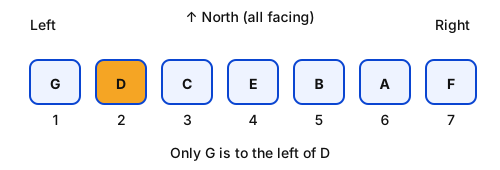
- Only two people left of C → C at seat 3. Three between C and F → F at seat 7.
- B second to the right of C → B at seat 5. Two between B and D → D at seat 2 (seat 8 does not exist).
- Seats 1, 4, 6 remain for G, E, A with G left of E left of A → G 1, E 4, A 6.
- Left of D (seat 2): only G → 1 person.
Trick: Start with the clue that fixes a seat ("only two to the left of C") – it anchors the whole row.
Answer: (A) 1
अवधारणा: 7 सीटों को बाएँ से दाएँ 1–7 क्रमांक दें (सभी उत्तर की ओर, इसलिए बाएँ/दाएँ सामान्य)।
- C के बाएँ केवल दो → C सीट 3 पर। C और F के बीच तीन → F सीट 7 पर।
- B, C के दाएँ दूसरा → B सीट 5 पर। B और D के बीच दो → D सीट 2 पर (सीट 8 नहीं है)।
- सीट 1, 4, 6 बची G, E, A के लिए; G, E के बाएँ और E, A के बाएँ → G 1, E 4, A 6।
- D (सीट 2) के बाएँ: केवल G → 1 व्यक्ति।
ट्रिक: उस सूचना से शुरू करें जो सीट तय कर दे ("C के बाएँ केवल दो") – इससे पूरी पंक्ति जम जाती है।
उत्तर: (A) 1
RRB NTPC Graduate CBT 1General Intelligence and ReasoningLinear Seating ArrangementRRB NTPC Graduate CBT 1 2025 · 22 Mar Shift 1
Q330.Which of the given letter-number clusters will replace the question mark (?) in the following series to make it logically complete?
NVA 7 KSX 14 HPU 21 EMR 28 ?
दिए गए अक्षर-संख्या समूहों में से कौन-सा निम्नलिखित शृंखला में प्रश्नचिह्न (?) के स्थान पर आकर उसे तार्किक रूप से पूर्ण करेगा?
NVA 7 KSX 14 HPU 21 EMR 28 ?
- ALST 40
- BWPF 37
- CBJO 35
- DNDP 35
Show answer
Concept: Handle letters and numbers separately.
- Letters: N(14)→K(11)→H(8)→E(5): each −3 → next B(2). V→S→P→M: −3 → J. A→X→U→R: −3 → O. Cluster = BJO.
- Numbers: 7, 14, 21, 28 → +7 → 35.
- Answer: BJO 35.
Trick: Check only the first letter and the number first: E −3 = B and 28 + 7 = 35 → option (C) is the only match.
Answer: (C) BJO 35
अवधारणा: अक्षरों और संख्याओं को अलग-अलग देखें।
- अक्षर: N(14)→K(11)→H(8)→E(5): हर बार −3 → अगला B(2)। V→S→P→M: −3 → J। A→X→U→R: −3 → O। समूह = BJO।
- संख्याएँ: 7, 14, 21, 28 → +7 → 35।
- उत्तर: BJO 35।
ट्रिक: पहले केवल पहला अक्षर और संख्या जाँचें: E −3 = B और 28 + 7 = 35 → केवल विकल्प (C) मेल खाता है।
उत्तर: (C) BJO 35
RRB NTPC Graduate CBT 1General Intelligence and ReasoningLetter-Number SeriesRRB NTPC Graduate CBT 1 2025 · 22 Mar Shift 1
Q331.Seven boxes M, A, R, K, E, T and S are kept one over the other but not necessarily in the same order. Only S is kept between E and T. Only K is kept below R. Only A is kept above E. How many boxes are kept between M and K?
सात बक्से M, A, R, K, E, T और S एक के ऊपर एक रखे गए हैं, परंतु आवश्यक नहीं कि इसी क्रम में हों। E और T के बीच केवल S रखा है। R के नीचे केवल K रखा है। E के ऊपर केवल A रखा है। M और K के बीच कितने बक्से रखे हैं?
- ATwoदो
- BZeroशून्य
- COneएक
- DThreeतीन
Show answer
Concept: Number positions 1 (bottom) to 7 (top) and place the fixed blocks first.
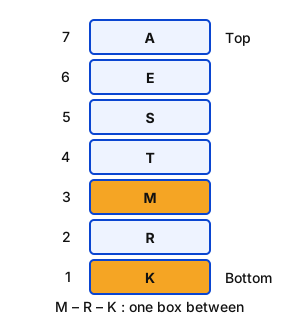
- Only K below R → K at 1, R at 2.
- Only A above E → E at 6, A at 7.
- Only S between E and T → S at 5, T at 4.
- Remaining M at 3. Between M (3) and K (1): only R → one box.
Trick: "Only X below/above Y" fixes Y at the second position from that end – use such clues first.
Answer: (C) One
अवधारणा: स्थान 1 (नीचे) से 7 (ऊपर) क्रमांकित करें और पहले निश्चित ब्लॉक रखें।
- R के नीचे केवल K → K स्थान 1, R स्थान 2।
- E के ऊपर केवल A → E स्थान 6, A स्थान 7।
- E और T के बीच केवल S → S स्थान 5, T स्थान 4।
- बचा M स्थान 3 पर। M (3) और K (1) के बीच: केवल R → एक बक्सा।
ट्रिक: "Y के नीचे/ऊपर केवल X" Y को उस सिरे से दूसरे स्थान पर तय कर देता है – ऐसे सुराग पहले लगाएँ।
उत्तर: (C) One
RRB NTPC Graduate CBT 1General Intelligence and ReasoningBox Arrangement (Stacking)RRB NTPC Graduate CBT 1 2025 · 22 Mar Shift 1
Q332.Dhruv starts from Point A and drives 38 km towards the East. He then takes a left turn, drives 35 km, turns left and drives 39 km. He then takes a left turn and drives 37 km. He takes a final left turn, drives 1 km and stops at Point P. How far (shortest distance) and towards which direction should he drive in order to reach Point A again? (All turns are 90-degree turns only unless specified.)
ध्रुव बिंदु A से चलना शुरू करता है और पूर्व की ओर 38 km गाड़ी चलाता है। फिर वह बाएँ मुड़ता है, 35 km गाड़ी चलाता है, बाएँ मुड़ता है और 39 km गाड़ी चलाता है। फिर वह बाएँ मुड़ता है और 37 km गाड़ी चलाता है। अंत में वह बाएँ मुड़ता है, 1 km गाड़ी चलाता है और बिंदु P पर रुक जाता है। पुनः बिंदु A पर पहुँचने के लिए उसे कितनी दूर (न्यूनतम दूरी) और किस दिशा में गाड़ी चलानी चाहिए? (जब तक अन्यथा निर्दिष्ट न हो, सभी मोड़ केवल 90-डिग्री के मोड़ हैं।)
- A4 km to the Northउत्तर की ओर 4 km
- B3 km to the Northउत्तर की ओर 3 km
- C1 km to the Northउत्तर की ओर 1 km
- D2 km to the Northउत्तर की ओर 2 km
Show answer
Concept: Put A at the origin, East = +x, North = +y, and track the position after each leg (every left turn rotates the direction anticlockwise).
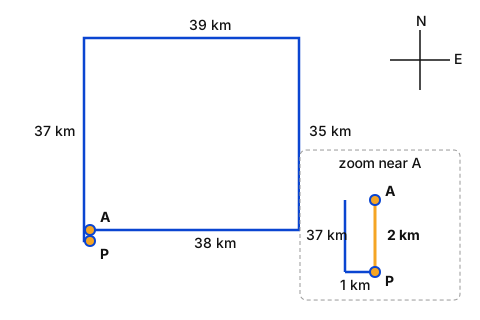
- East 38 → (38, 0); left = North 35 → (38, 35); left = West 39 → (−1, 35).
- Left = South 37 → (−1, −2); left = East 1 → P = (0, −2).
- P is directly 2 km south of A, so he must drive 2 km to the North.
Trick: Net East–West: ; net North–South: → 2 km south of A.
Answer: (D) 2 km to the North
अवधारणा: A को मूल बिंदु मानें, पूर्व = +x, उत्तर = +y, और हर चरण के बाद स्थिति लिखें (हर बायाँ मोड़ दिशा को वामावर्त घुमाता है)।
- पूर्व 38 → (38, 0); बाएँ = उत्तर 35 → (38, 35); बाएँ = पश्चिम 39 → (−1, 35)।
- बाएँ = दक्षिण 37 → (−1, −2); बाएँ = पूर्व 1 → P = (0, −2)।
- P, A से ठीक 2 km दक्षिण में है, अतः उसे 2 km उत्तर चलना होगा।
ट्रिक: शुद्ध पूर्व–पश्चिम: ; शुद्ध उत्तर–दक्षिण: → A से 2 km दक्षिण।
उत्तर: (D) 2 km to the North
RRB NTPC Graduate CBT 1General Intelligence and ReasoningDirection and DistanceRRB NTPC Graduate CBT 1 2025 · 22 Mar Shift 1
Q333.What should come in place of ‘?’ in the given series?
111 110 106 97 81 ?
दी गई शृंखला में ‘?’ के स्थान पर क्या आना चाहिए?
111 110 106 97 81 ?
- A56
- B74
- C57
- D73
Show answer
Concept: Look at the differences between consecutive terms.
- : −1; : −4; : −9; : −16.
- Differences are → next difference .
- .
Trick: Differences 1, 4, 9, 16 → perfect squares; subtract 25 next.
Answer: (A) 56
अवधारणा: क्रमागत पदों के अंतर देखें।
- : −1; : −4; : −9; : −16।
- अंतर → अगला अंतर ।
- ।
ट्रिक: अंतर 1, 4, 9, 16 → पूर्ण वर्ग; अगला 25 घटाएँ।
उत्तर: (A) 56
RRB NTPC Graduate CBT 1General Intelligence and ReasoningNumber SeriesRRB NTPC Graduate CBT 1 2025 · 22 Mar Shift 1
Q334.Which of the following letter-clusters should replace # and % so that the pattern and relationship followed between the letter-cluster pair on the left side of :: is the same as that on the right side of :: ?
# : POM :: LKI : %
निम्नलिखित में से कौन-से अक्षर-समूह # और % के स्थान पर आने चाहिए ताकि :: के बाईं ओर के अक्षर-समूह युग्म के बीच का पैटर्न और संबंध :: के दाईं ओर के युग्म के समान हो?
# : POM :: LKI : %
- A# = TJQ , % = HFL
- B# = SRP , % = GFE
- C# = RTP , % = GFM
- D# = TSQ , % = HGE
Show answer
Concept: The same letter shift must relate # to POM and LKI to %.
- Test option (D): TSQ → POM: T(20)→P(16), S(19)→O(15), Q(17)→M(13) – each −4.
- LKI → HGE: L(12)→H(8), K(11)→G(7), I(9)→E(5) – each −4 ✓.
- Other options: SRP→POM is −3,−3,−3 but GFE from LKI is −5,−5,−4; TJQ, RTP do not give a uniform shift.
Trick: Use the fully known pair LKI : % first – only HGE (option D) is a uniform −4 from LKI; then confirm # = TSQ.
Answer: (D) # = TSQ , % = HGE
अवधारणा: # से POM और LKI से % तक एक ही अक्षर-शिफ्ट होना चाहिए।
- विकल्प (D) जाँचें: TSQ → POM: T(20)→P(16), S(19)→O(15), Q(17)→M(13) – हर अक्षर −4।
- LKI → HGE: L(12)→H(8), K(11)→G(7), I(9)→E(5) – हर अक्षर −4 ✓।
- अन्य विकल्प: SRP→POM −3,−3,−3 है पर LKI से GFE −5,−5,−4; TJQ, RTP में समान शिफ्ट नहीं।
ट्रिक: पहले LKI : % जोड़ा देखें – LKI से समान −4 केवल HGE (विकल्प D) है; फिर # = TSQ की पुष्टि करें।
उत्तर: (D) # = TSQ , % = HGE
RRB NTPC Graduate CBT 1General Intelligence and ReasoningLetter Cluster AnalogyRRB NTPC Graduate CBT 1 2025 · 22 Mar Shift 1
Q335.23 is related to 139 following a certain logic. Following the same logic, 28 is related to 169. To which of the following is 25 related, following the same logic?
(NOTE: Operations should be performed on the whole numbers, without breaking down the numbers into their constituent digits. E.g. 13 – Operations on 13 such as adding /subtracting /multiplying, etc. to 13 can be performed. Breaking down 13 into 1 and 3 and then performing mathematical operations on 1 and 3 is not allowed.)
23, एक निश्चित तर्क के अनुसार 139 से संबंधित है। उसी तर्क के अनुसार, 28, 169 से संबंधित है। उसी तर्क के अनुसार, 25 निम्नलिखित में से किससे संबंधित है?
(नोट: संक्रियाएँ पूर्ण संख्याओं पर की जानी चाहिए, संख्याओं को उनके घटक अंकों में तोड़े बिना। उदाहरण के लिए 13 – 13 पर संक्रियाएँ जैसे 13 में जोड़ना/घटाना/गुणा करना आदि की जा सकती हैं। 13 को 1 और 3 में तोड़कर फिर 1 और 3 पर गणितीय संक्रियाएँ करने की अनुमति नहीं है।)
- A151
- B146
- C155
- D141
Show answer
Concept: Find one rule on the whole number that fits both pairs.
- ✓
- ✓
- .
Trick: and – both just above 6, so try "×6 + 1".
Answer: (A) 151
अवधारणा: पूरी संख्या पर ऐसा एक नियम खोजें जो दोनों जोड़ों पर लागू हो।
- ✓
- ✓
- ।
ट्रिक: और – दोनों 6 से थोड़ा ऊपर, अतः "×6 + 1" आज़माएँ।
उत्तर: (A) 151
RRB NTPC Graduate CBT 1General Intelligence and ReasoningNumber AnalogyRRB NTPC Graduate CBT 1 2025 · 22 Mar Shift 1
Q336.In a certain code language,
A + B means ‘A is the sister of B’
A - B means ‘A is the husband of B’
A × B means ‘A is the son of B’
A ÷ B means ‘A is the daughter of B’.
Based on the above, how is T related to S if ‘T + P × M - V ÷ S’?
एक निश्चित कूट भाषा में,
A + B का अर्थ है ‘A, B की बहन है’
A - B का अर्थ है ‘A, B का पति है’
A × B का अर्थ है ‘A, B का पुत्र है’
A ÷ B का अर्थ है ‘A, B की पुत्री है’।
उपर्युक्त के आधार पर, यदि ‘T + P × M - V ÷ S’ है, तो T, S से किस प्रकार संबंधित है?
- ABrother’s daughterभाई की पुत्री
- BSon’s daughterपुत्र की पुत्री
- CDaughter’s daughterपुत्री की पुत्री
- DSister’s daughterबहन की पुत्री
Show answer
Concept: Decode the chain from left to right and build the family tree.
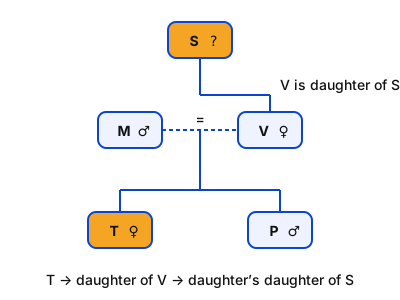
- T + P: T is the sister of P. P × M: P is the son of M → T is the daughter of M.
- M − V: M is the husband of V → V is the mother of T.
- V ÷ S: V is the daughter of S.
- So T is the daughter of V, and V is the daughter of S → T is S's daughter's daughter (granddaughter).
Trick: T's gender is fixed by "sister" (female), so options with "son" or "brother" as the link are eliminated at once.
Answer: (C) Daughter’s daughter
अवधारणा: श्रृंखला को बाएँ से दाएँ डिकोड करें और वंश-वृक्ष बनाएँ।
- T + P: T, P की बहन। P × M: P, M का बेटा → T, M की बेटी।
- M − V: M, V का पति → V, T की माँ।
- V ÷ S: V, S की बेटी।
- अतः T, V की बेटी और V, S की बेटी → T, S की बेटी की बेटी (नातिन)।
ट्रिक: "sister" से T का लिंग स्त्री तय है, अतः "son" या "brother" की कड़ी वाले विकल्प तुरंत कट जाते हैं।
उत्तर: (C) Daughter’s daughter
RRB NTPC Graduate CBT 1General Intelligence and ReasoningBlood Relations (Coded)RRB NTPC Graduate CBT 1 2025 · 22 Mar Shift 1
Q337.Each of L, M, N, O, A, B and C has an exam on a different day of a week starting from Monday and ending on Sunday of the same week. No one has exam before N. Only three people have exams between N and O. Only one person has exam between O and M. L has exam on Wednesday. B has exam on one of the days after C but on one of the days before A. On which day of the week does B have exam?
L, M, N, O, A, B और C में से प्रत्येक की परीक्षा एक ही सप्ताह के सोमवार से रविवार तक के अलग-अलग दिनों में है। N से पहले किसी की परीक्षा नहीं है। N और O के बीच केवल तीन व्यक्तियों की परीक्षा है। O और M के बीच केवल एक व्यक्ति की परीक्षा है। L की परीक्षा बुधवार को है। B की परीक्षा C के बाद के किसी दिन परंतु A से पहले के किसी दिन है। B की परीक्षा सप्ताह के किस दिन है?
- ASaturdayशनिवार
- BMondayसोमवार
- CThursdayगुरुवार
- DTuesdayमंगलवार
Show answer
Concept: Fix the definite days first, then fit the ordered group into the gaps.
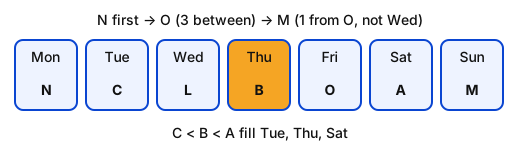
- No one before N → N on Monday. Three between N and O → O on Friday.
- One person between O and M → M on Wednesday or Sunday; Wednesday is L's → M on Sunday.
- Tuesday, Thursday, Saturday remain for C, B, A in the order C → B → A.
- B gets Thursday.
Trick: "No one has exam before N" = N is on the first day; such absolute clues anchor the whole schedule.
Answer: (C) Thursday
अवधारणा: पहले निश्चित दिन तय करें, फिर क्रम वाले समूह को खाली दिनों में बिठाएँ।
- N से पहले कोई नहीं → N सोमवार। N और O के बीच तीन → O शुक्रवार।
- O और M के बीच एक → M बुधवार या रविवार; बुधवार L का है → M रविवार।
- मंगल, गुरु, शनि बचे C, B, A के लिए, क्रम C → B → A।
- B को गुरुवार मिला।
ट्रिक: "N से पहले किसी की परीक्षा नहीं" = N पहले दिन; ऐसे निरपेक्ष सुराग पूरी सारणी को जमा देते हैं।
उत्तर: (C) Thursday
RRB NTPC Graduate CBT 1General Intelligence and ReasoningScheduling (Days of the Week)RRB NTPC Graduate CBT 1 2025 · 22 Mar Shift 1
Q338.Based on the English alphabetical order, three of the following four letter-cluster pairs are alike in a certain way and thus form a group. Which is the one that does not belong to that group?
(Note: The odd man out is not based on the number of consonants/vowels or their position in the letter-cluster.)
अंग्रेज़ी वर्णमाला क्रम के आधार पर, निम्नलिखित चार अक्षर-समूह युग्मों में से तीन एक निश्चित प्रकार से समान हैं और इस प्रकार एक समूह बनाते हैं। वह कौन-सा है जो उस समूह से संबंधित नहीं है?
(नोट: असंगत युग्म व्यंजनों/स्वरों की संख्या या अक्षर-समूह में उनकी स्थिति पर आधारित नहीं है।)
- AAB - DE
- BXY - YZ
- CTU - WX
- DKL - NO
Show answer
Concept: Check the alphabetical gap from the first cluster to the second.
- AB → DE: A(+3)D, B(+3)E.
- TU → WX: T(+3)W, U(+3)X.
- KL → NO: K(+3)N, L(+3)O.
- XY → YZ: X(+1)Y, Y(+1)Z – gap is +1, not +3.
Trick: Write the place numbers (A=1 … Z=26) and subtract – the pair with a different gap is the odd one.
Answer: (B) XY - YZ
अवधारणा: पहले समूह से दूसरे समूह तक वर्णमाला का अंतर (gap) देखें।
- AB → DE: A(+3)D, B(+3)E.
- TU → WX: T(+3)W, U(+3)X.
- KL → NO: K(+3)N, L(+3)O.
- XY → YZ: X(+1)Y, Y(+1)Z – यहाँ अंतर +1 है, +3 नहीं।
ट्रिक: अक्षरों के स्थान-मान (A=1 … Z=26) लिखकर घटाएँ – जिस युग्म का अंतर अलग हो, वही विषम है।
उत्तर: (B) XY - YZ
RRB NTPC Graduate CBT 1General Intelligence and ReasoningOdd one out (letter pairs)RRB NTPC Graduate CBT 1 2025 · 22 Mar Shift 1
Q339.Refer to the following number, symbol series and answer the question.
(Left) 5 # % 8 * $ % @ 1 3 @ $ 4 6 9 7 # $ 2 % 5 4 (Right)
If all the numbers are dropped from the series, which of the following will be fourth from the left?
निम्नलिखित संख्या, प्रतीक शृंखला को देखिए और प्रश्न का उत्तर दीजिए।
(बाएँ) 5 # % 8 * $ % @ 1 3 @ $ 4 6 9 7 # $ 2 % 5 4 (दाएँ)
यदि शृंखला से सभी संख्याएँ हटा दी जाएँ, तो निम्नलिखित में से कौन-सा बाएँ से चौथा होगा?
- A$
- B#
- C%
- D*
Show answer
Concept: Remove every digit and then count from the left in the remaining series.
- Series: 5 # % 8 * $ % @ 1 3 @ $ 4 6 9 7 # $ 2 % 5 4.
- After dropping numbers: # % * $ % @ @ $ # $ %.
- Fourth from the left = $.
Trick: Strike the digits with a pencil first; never try to count and skip at the same time.
Answer: (A) $
अवधारणा: सभी अंक हटाकर बची हुई श्रृंखला में बाएँ से गिनें।
- श्रृंखला: 5 # % 8 * $ % @ 1 3 @ $ 4 6 9 7 # $ 2 % 5 4.
- अंक हटाने पर: # % * $ % @ @ $ # $ %.
- बाएँ से चौथा = $.
ट्रिक: पहले अंकों को पेंसिल से काट दें; गिनते समय छोड़ने की कोशिश न करें।
उत्तर: (A) $
RRB NTPC Graduate CBT 1General Intelligence and ReasoningNumber–symbol seriesRRB NTPC Graduate CBT 1 2025 · 22 Mar Shift 1
Q340.If ‘+’ means ‘−’, ‘−’ means ‘×’, ‘×’ means ‘÷’, ‘÷’ means ‘+’, then what will come in place of the question mark (?) in the following equation?
79 − 8 ÷ 55 + 423 × 3 = ?
यदि ‘+’ का अर्थ ‘−’, ‘−’ का अर्थ ‘×’, ‘×’ का अर्थ ‘÷’, ‘÷’ का अर्थ ‘+’ है, तो निम्नलिखित समीकरण में प्रश्नचिह्न (?) के स्थान पर क्या आएगा?
79 − 8 ÷ 55 + 423 × 3 = ?
- A546
- B519
- C525
- D584
Show answer
Concept: Replace each symbol by its given meaning and then apply BODMAS.
- 79 − 8 ÷ 55 + 423 × 3 becomes .
- , .
- .
Trick: Rewrite the whole expression with new symbols first, then solve – do not substitute and calculate in the same step.
Answer: (A) 546
अवधारणा: हर प्रतीक को उसके दिए गए अर्थ से बदलें, फिर BODMAS लगाएँ।
- 79 − 8 ÷ 55 + 423 × 3 बन जाता है .
- , .
- .
ट्रिक: पहले पूरा व्यंजक नए प्रतीकों में लिखें, फिर हल करें – बदलना और गणना एक साथ न करें।
उत्तर: (A) 546
RRB NTPC Graduate CBT 1General Intelligence and ReasoningMathematical operations (symbol substitution)RRB NTPC Graduate CBT 1 2025 · 22 Mar Shift 1

