Q361.The areas of two similar triangles are 841 cm2 and 676 cm2, respectively. What is the ratio of their corresponding altitudes?
दो समरूप त्रिभुजों के क्षेत्रफल क्रमशः 841 cm2 और 676 cm2 हैं। उनके संगत शीर्षलंबों (altitudes) का अनुपात क्या है?
- A38 : 27
- B29 : 26
- C24 : 28
- D27 : 24
Show answer
Concept: For similar triangles, (ratio of areas = square of ratio of corresponding altitudes/sides).
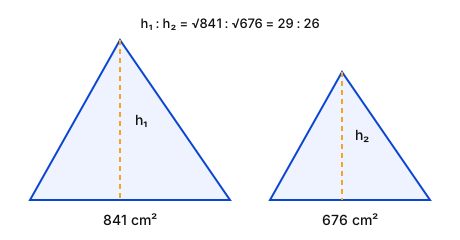
- .
- , .
- Ratio .
Trick: Areas → take square root for any length ratio (side, altitude, median, perimeter).
Answer: (B) 29 : 26
अवधारणा: समरूप त्रिभुजों में (क्षेत्रफलों का अनुपात = संगत शीर्षलंबों/भुजाओं के अनुपात का वर्ग)।
- .
- , .
- अनुपात .
ट्रिक: क्षेत्रफल दिया हो → किसी भी लंबाई (भुजा, शीर्षलंब, माध्यिका, परिमाप) के अनुपात के लिए वर्गमूल लें।
उत्तर: (B) 29 : 26
RRB NTPC Graduate CBT 1MathematicsSimilar triangles – area ratioRRB NTPC Graduate CBT 1 2025 · 22 Mar Shift 1
Q362.Evaluate: 16 + 18 ÷ 6 - 3 × 3
मान ज्ञात कीजिए: 16 + 18 ÷ 6 - 3 × 3
- A13
- B9
- C10
- D12
Show answer
Concept: Division and multiplication before addition and subtraction.
- , .
- .
Trick: Underline every ÷ and × pair first, solve them, then move left to right with + and −.
Answer: (C) 10
अवधारणा: भाग और गुणा पहले, फिर जोड़ और घटाव।
- , .
- .
ट्रिक: पहले हर ÷ और × जोड़े को रेखांकित कर हल करें, फिर बाएँ से दाएँ + और − करें।
उत्तर: (C) 10
RRB NTPC Graduate CBT 1MathematicsBODMASRRB NTPC Graduate CBT 1 2025 · 22 Mar Shift 1
Q363.P sells an item to Q at 77% profit. Q sells the same item to R at 50% loss. If R paid ₹ 2655 for the item, then at what price (in ₹) is the item purchased by P?
P एक वस्तु Q को 77% लाभ पर बेचता है। Q वही वस्तु R को 50% हानि पर बेचता है। यदि R ने उस वस्तु के लिए ₹ 2655 का भुगतान किया, तो P ने वह वस्तु किस मूल्य (₹ में) पर खरीदी थी?
- A3000
- B3001
- C3002
- D3003
Show answer
Concept: Work backwards: each selling price = cost price × multiplier.
- R paid ₹2655 = Q’s SP .
- Q’s CP = P’s SP .
Trick: Final price ; .
Answer: (A) 3000
अवधारणा: उल्टा चलें: हर विक्रय मूल्य = क्रय मूल्य × गुणक।
- R ने ₹2655 दिए = Q का SP .
- Q का CP = P का SP .
ट्रिक: अंतिम मूल्य ; .
उत्तर: (A) 3000
RRB NTPC Graduate CBT 1MathematicsSuccessive profit and lossRRB NTPC Graduate CBT 1 2025 · 22 Mar Shift 1
Q364.Find the area of an equilateral triangle with side 8 cm (correct to 2 decimal places).
8 cm भुजा वाले एक समबाहु त्रिभुज का क्षेत्रफल ज्ञात कीजिए (2 दशमलव स्थानों तक सही)।
- A29.91 sq. cm.29.91 वर्ग cm
- B27.71 sq. cm.27.71 वर्ग cm
- C26.61 sq. cm.26.61 वर्ग cm
- D24.41 sq. cm.24.41 वर्ग cm
Show answer
Concept: Area of an equilateral triangle .
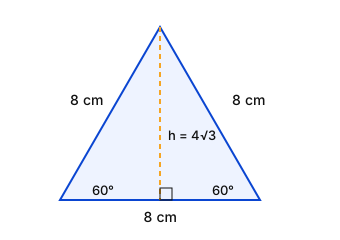
- .
- .
- Correct to 2 decimals: .
Trick: Memorise ; , appear often.
Answer: (B) 27.71 sq. cm.
अवधारणा: समबाहु त्रिभुज का क्षेत्रफल .
- .
- .
- दो दशमलव तक: .
ट्रिक: याद रखें; , बार-बार आते हैं।
उत्तर: (B) 27.71 sq. cm.
RRB NTPC Graduate CBT 1MathematicsArea of equilateral triangleRRB NTPC Graduate CBT 1 2025 · 22 Mar Shift 1
Q365.Find the value of , satisfying
का वह मान ज्ञात कीजिए, जो को संतुष्ट करता है
- A1345
- B1348
- C1340
- D1335
Show answer
Concept: Simplify the square root first, then work left to right with × and ÷.
- .
- .
- .
Trick: Cancel before multiplying: , then .
Answer: (A) 1345
अवधारणा: पहले वर्गमूल सरल करें, फिर बाएँ से दाएँ × और ÷ करें।
- .
- .
- .
ट्रिक: गुणा से पहले काटें: , फिर .
उत्तर: (A) 1345
RRB NTPC Graduate CBT 1MathematicsSimplificationRRB NTPC Graduate CBT 1 2025 · 22 Mar Shift 1
Q366.Amit invested equal amounts at simple interest and compound interest, compounded annually, for 2 years at the same rate of 4% per annum. In the end, he noticed a difference of ₹52 between the two interests earned. What was the amount (in ₹) invested in each case?
अमित ने समान धनराशियाँ साधारण ब्याज और वार्षिक रूप से संयोजित चक्रवृद्धि ब्याज पर 2 वर्षों के लिए 4% वार्षिक की समान दर से निवेश कीं। अंत में उसने देखा कि अर्जित दोनों ब्याजों के बीच ₹52 का अंतर है। प्रत्येक स्थिति में निवेश की गई राशि (₹ में) क्या थी?
- A31600
- B32500
- C31750
- D32850
Show answer
Concept: For 2 years, .
- .
- .
Trick: Difference for 2 years = SI on the first year’s interest: of of = of .
Answer: (B) 32500
अवधारणा: 2 वर्षों के लिए .
- .
- .
ट्रिक: 2 वर्ष का अंतर = पहले वर्ष के ब्याज पर ब्याज: का का = का .
उत्तर: (B) 32500
RRB NTPC Graduate CBT 1MathematicsCI – SI difference (2 years)RRB NTPC Graduate CBT 1 2025 · 22 Mar Shift 1
Q367.By selling an article at of its marked price, Hitesh incurs a loss of 16%. If he sells it at 69% of its marked price, then the profit percentage is
किसी वस्तु को उसके अंकित मूल्य के पर बेचने से हितेश को 16% की हानि होती है। यदि वह इसे अंकित मूल्य के 69% पर बेचता है, तो लाभ प्रतिशत है
- A95.7%
- B93.8%
- C94.8%
- D93.2%
Show answer
Concept: Express CP in terms of MP from the first sale, then compare with the second SP.
- Let MP . First SP ; loss .
- Second SP . Profit .
- Profit.
Trick: New SP is times the old SP, so new multiplier profit.
Answer: (D) 93.2%
अवधारणा: पहली बिक्री से CP को MP के रूप में निकालें, फिर दूसरे SP से तुलना करें।
- MP मानें। पहला SP ; हानि .
- दूसरा SP . लाभ .
- लाभ.
ट्रिक: नया SP पुराने का गुना है, अतः नया गुणक लाभ।
उत्तर: (D) 93.2%
RRB NTPC Graduate CBT 1MathematicsProfit & loss – marked priceRRB NTPC Graduate CBT 1 2025 · 22 Mar Shift 1
Q368.The length, breadth and height of a room are 20m, 10m and 6m, respectively. If the rate of painting the four walls and the ceiling of the room is ₹15/square metre, then find the total cost.
एक कमरे की लंबाई, चौड़ाई और ऊँचाई क्रमशः 20m, 10m और 6m है। यदि कमरे की चार दीवारों और छत की पुताई की दर ₹15/वर्ग मीटर है, तो कुल लागत ज्ञात कीजिए।
- A₹6500
- B₹8400
- C₹7200
- D₹9200
Show answer
Concept: Area of 4 walls ; ceiling .
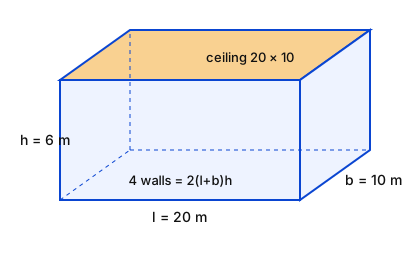
- Walls .
- Ceiling .
- Total ; cost ₹8400.
Trick: ‘Four walls and ceiling’ = total surface area minus floor: .
Answer: (B) ₹8400
अवधारणा: 4 दीवारों का क्षेत्रफल ; छत .
- दीवारें .
- छत .
- कुल ; लागत ₹8400.
ट्रिक: ‘चार दीवारें और छत’ = कुल पृष्ठीय क्षेत्रफल − फर्श: .
उत्तर: (B) ₹8400
RRB NTPC Graduate CBT 1MathematicsMensuration – painting walls & ceilingRRB NTPC Graduate CBT 1 2025 · 22 Mar Shift 1
Q369.The population of a village was 2,90,000. It increased by 5% in the first year and increased by 30% in the second year. Its population after two years is _______.
एक गाँव की जनसंख्या 2,90,000 थी। पहले वर्ष में इसमें 5% की वृद्धि हुई और दूसरे वर्ष में 30% की वृद्धि हुई। दो वर्ष बाद इसकी जनसंख्या _______ है।
- A3,95,850
- B3,91,500
- C3,04,500
- D3,77,000
Show answer
Concept: Successive increases multiply: final .
- After year 1: .
- After year 2: .
Trick: Net single change ; .
Answer: (A) 3,95,850
अवधारणा: क्रमिक वृद्धियाँ गुणा होती हैं: अंतिम ।
- पहले वर्ष बाद: ।
- दूसरे वर्ष बाद: ।
ट्रिक: कुल एक-बार परिवर्तन ; ।
उत्तर: (A) 3,95,850
RRB NTPC Graduate CBT 1MathematicsSuccessive Percentage ChangeRRB NTPC Graduate CBT 1 2025 · 19 Mar Shift 3
Q370.Calculate the mode for the following frequency distribution of marks obtained by students in an exam. (Rounded off to two decimal places)
| Marks | 0-10 | 10-20 | 20-30 | 30-40 | 40-50 |
|---|
| Number of Students | 8 | 16 | 36 | 34 | 16 |
|---|
एक परीक्षा में छात्रों द्वारा प्राप्त अंकों के निम्नलिखित बारंबारता बंटन के लिए बहुलक (mode) की गणना कीजिए। (दो दशमलव स्थानों तक पूर्णांकित)
अंक: 0-10, 10-20, 20-30, 30-40, 40-50
छात्रों की संख्या: 8, 16, 36, 34, 16
- A28.45
- B30.15
- C31.25
- D29.09
Show answer
Concept: Mode , where = lower limit of the modal class (highest frequency), its frequency, , the frequencies before and after, = class width.
- Highest frequency 36 → modal class 20–30: , , , , .
- Mode .
- .
Trick: The mode always lies inside the modal class (20–30) – options 30.15 and 31.25 are out at once.
Answer: (D) 29.09
अवधारणा: बहुलक , जहाँ = बहुलक वर्ग (सर्वाधिक बारंबारता) की निचली सीमा, उसकी बारंबारता, , पहले-बाद की बारंबारताएँ, = वर्ग-चौड़ाई।
- सर्वाधिक बारंबारता 36 → बहुलक वर्ग 20–30: , , , , ।
- बहुलक ।
- ।
ट्रिक: बहुलक सदैव बहुलक वर्ग (20–30) के भीतर होता है – 30.15 और 31.25 तुरंत कटते हैं।
उत्तर: (D) 29.09
RRB NTPC Graduate CBT 1MathematicsMode of Grouped DataRRB NTPC Graduate CBT 1 2025 · 19 Mar Shift 3
Q371.A boat travels 120 km downstream in 6 hours and 120 km upstream in 10 hours. The speed of the current is 4 km/hr. What is the speed of the boat in still water?
एक नाव धारा के अनुकूल 120 km की दूरी 6 घंटे में और धारा के प्रतिकूल 120 km की दूरी 10 घंटे में तय करती है। धारा की चाल 4 km/hr है। शांत जल में नाव की चाल क्या है?
- A14 km/hr
- B8 km/hr
- C16 km/hr
- D10 km/hr
Show answer
Concept: Speed of boat in still water .
- Downstream speed ; upstream speed .
- Boat speed (current , matching the data).
Trick: Boat = average of the two speeds; current = half their difference.
Answer: (C) 16 km/hr
अवधारणा: शांत जल में नाव की चाल ।
- अनुप्रवाह चाल ; प्रतिप्रवाह चाल ।
- नाव की चाल (धारा , दिए आँकड़े से मेल)।
ट्रिक: नाव = दोनों चालों का औसत; धारा = अंतर का आधा।
उत्तर: (C) 16 km/hr
RRB NTPC Graduate CBT 1MathematicsBoats and StreamsRRB NTPC Graduate CBT 1 2025 · 19 Mar Shift 3
Q372.Two parallel lines L1 and L2 are cut by a transversal. If one of the alternate interior angles is 65°, what is the measure of the corresponding alternate interior angle?
दो समांतर रेखाएँ L1 और L2 एक तिर्यक रेखा (transversal) द्वारा काटी जाती हैं। यदि एकांतर अंतः कोणों में से एक 65° है, तो संगत एकांतर अंतः कोण का माप क्या है?
- A180°
- B65°
- C110°
- D90°
Show answer
Concept: When a transversal cuts two parallel lines, each pair of alternate interior angles is equal.
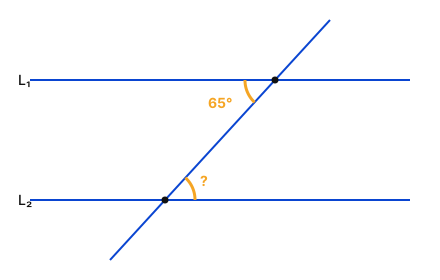
- The two alternate interior angles lie on opposite sides of the transversal, between the parallel lines, forming a "Z".
- Given one of them , the other alternate interior angle is also .
- would be the co-interior (same-side) angle (), not the alternate one.
Trick: Z-angles (alternate) equal, F-angles (corresponding) equal, C-angles (co-interior) add to .
Answer: (B) 65°
अवधारणा: जब एक तिर्यक रेखा दो समांतर रेखाओं को काटती है, तो एकांतर अंतःकोणों का प्रत्येक युग्म बराबर होता है।
- दोनों एकांतर अंतःकोण तिर्यक रेखा के विपरीत ओर, समांतर रेखाओं के बीच "Z" बनाते हैं।
- एक कोण दिया है, अतः दूसरा एकांतर अंतःकोण भी ।
- तो सह-अंतःकोण () होता, एकांतर नहीं।
ट्रिक: Z-कोण (एकांतर) बराबर, F-कोण (संगत) बराबर, C-कोण (सह-अंतः) का योग ।
उत्तर: (B) 65°
RRB NTPC Graduate CBT 1MathematicsParallel Lines and TransversalRRB NTPC Graduate CBT 1 2025 · 19 Mar Shift 3
Q373.Two lines AB and CD are parallel. Let PQ be the transversal intersecting AB at M and CD at N. If , find .
दो रेखाएँ AB और CD समांतर हैं। मान लीजिए PQ एक तिर्यक रेखा है जो AB को M पर और CD को N पर काटती है। यदि है, तो ज्ञात कीजिए।
- A
- B
- C
- D
Show answer
Concept: Alternate interior angles made by a transversal with two parallel lines are equal.
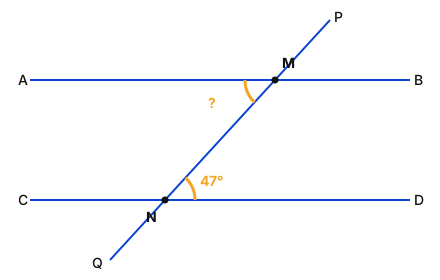
- Transversal PQ meets AB at M and CD at N. (at M, towards A) and (at N, towards D) lie between the parallels on opposite sides of MN – alternate interior angles.
- Hence .
- is the adjacent angle ( or ), not the one asked.
Trick: A and D are on opposite sides of the transversal → the "Z" pair → equal.
Answer: (C) 47°
अवधारणा: दो समांतर रेखाओं के साथ तिर्यक रेखा से बने एकांतर अंतःकोण बराबर होते हैं।
- तिर्यक PQ, AB को M पर और CD को N पर काटती है। (M पर, A की ओर) और (N पर, D की ओर) समांतर रेखाओं के बीच MN के विपरीत ओर हैं – एकांतर अंतःकोण।
- अतः ।
- संलग्न कोण ( या ) है, पूछा गया कोण नहीं।
ट्रिक: A और D तिर्यक रेखा के विपरीत ओर → "Z" युग्म → बराबर।
उत्तर: (C) 47°
RRB NTPC Graduate CBT 1MathematicsParallel Lines and TransversalRRB NTPC Graduate CBT 1 2025 · 19 Mar Shift 3
Q374.Ankur jogs on a circular track X at m/s and Mahima jogs on track Y at m/s. The total length of Tracks X and Y is 0.325 km. Ankur makes 9 rounds of track X in the same time Mahima makes 5 rounds of track Y. The time taken (in seconds) by Mahima to complete one round of track X is:
अंकुर एक वृत्ताकार ट्रैक X पर m/s की चाल से और महिमा ट्रैक Y पर m/s की चाल से जॉगिंग करती है। ट्रैक X और Y की कुल लंबाई 0.325 km है। अंकुर ट्रैक X के 9 चक्कर उतने ही समय में लगाता है जितने समय में महिमा ट्रैक Y के 5 चक्कर लगाती है। महिमा द्वारा ट्रैक X का एक चक्कर पूरा करने में लिया गया समय (सेकंड में) है:
- A35
- B48
- C42
- D39
Show answer
Concept: Equal time ⇒ . Use it to find each track length.
- Speeds: Ankur m/s, Mahima m/s. Let track X m, track Y m, .
- Same time: .
- m (so m).
- Mahima on track X: time s.
Trick: Convert 0.325 km to 325 m at once and keep speeds as fractions – the numbers cancel neatly.
Answer: (B) 48
अवधारणा: समान समय ⇒ । इससे प्रत्येक ट्रैक की लंबाई निकालें।
- चालें: अंकुर m/s, महिमा m/s। माना ट्रैक X m, ट्रैक Y m, ।
- समान समय: ।
- m (अतः m)।
- महिमा ट्रैक X पर: समय s।
ट्रिक: 0.325 km को तुरंत 325 m करें और चालें भिन्न में रखें – संख्याएँ साफ़ कटती हैं।
उत्तर: (B) 48
RRB NTPC Graduate CBT 1MathematicsSpeed, Time and Distance – Circular TracksRRB NTPC Graduate CBT 1 2025 · 19 Mar Shift 3
Q375.What is the mode of the data given below? [Give your answer correct to 2 decimal places.]
| Age in years | 15-25 | 25-35 | 35-45 | 45-55 | 55-65 | 65-75 | 75-85 |
|---|
| No. of patients | 18 | 10 | 15 | 14 | 30 | 40 | 34 |
|---|
नीचे दिए गए आँकड़ों का बहुलक (mode) क्या है? [अपना उत्तर 2 दशमलव स्थानों तक सही दीजिए।]
आयु (वर्षों में): 15-25, 25-35, 35-45, 45-55, 55-65, 65-75, 75-85
रोगियों की संख्या: 18, 10, 15, 14, 30, 40, 34
- A70.25
- B72.25
- C71.25
- D69.25
Show answer
Concept: Mode with = lower limit of the modal class, its frequency, and the neighbouring frequencies, = class width.
- Highest frequency 40 → modal class 65–75: , , , , .
- Mode .
- .
Trick: ; the decimal part ".25" of the answer comes straight from .
Answer: (C) 71.25
अवधारणा: बहुलक , जहाँ = बहुलक वर्ग की निचली सीमा, उसकी बारंबारता, व पड़ोसी बारंबारताएँ, = वर्ग-चौड़ाई।
- सर्वाधिक बारंबारता 40 → बहुलक वर्ग 65–75: , , , , ।
- बहुलक ।
- ।
ट्रिक: ; उत्तर का दशमलव भाग ".25" सीधे से आता है।
उत्तर: (C) 71.25
RRB NTPC Graduate CBT 1MathematicsMode of Grouped DataRRB NTPC Graduate CBT 1 2025 · 19 Mar Shift 3
Q376.There are ₹5, ₹2, and ₹1 coins amounting to a total of ₹212. The total number of coins is 112. The number of ₹2 coins is 50 more than the number of ₹5 coins. Find the number of ₹1 coins.
₹5, ₹2 और ₹1 के सिक्के हैं जिनकी कुल राशि ₹212 है। सिक्कों की कुल संख्या 112 है। ₹2 के सिक्कों की संख्या ₹5 के सिक्कों की संख्या से 50 अधिक है। ₹1 के सिक्कों की संख्या ज्ञात कीजिए।
- A42
- B50
- C10
- D25
Show answer
Concept: Form equations from the count of coins and their total value.
- Let ₹5 coins , ₹2 coins , ₹1 coins . Count: .
- Value: .
- Subtracting: , so .
- Check: coins; ₹ ✓.
Trick: Subtract the count equation from the value equation – the ₹1 coins vanish, leaving only .
Answer: (A) 42
अवधारणा: सिक्कों की संख्या और कुल मूल्य से समीकरण बनाएँ।
- माना ₹5 के सिक्के , ₹2 के , ₹1 के । संख्या: ।
- मूल्य: ।
- घटाने पर: , अतः ।
- जाँच: सिक्के; ₹ ✓।
ट्रिक: मूल्य समीकरण से संख्या समीकरण घटाएँ – ₹1 के सिक्के कट जाते हैं, केवल बचता है।
उत्तर: (A) 42
RRB NTPC Graduate CBT 1MathematicsLinear Equations – CoinsRRB NTPC Graduate CBT 1 2025 · 19 Mar Shift 3
Q377.Two pipes can fill a tank in 4 hours and 24 hours, respectively. A third pipe can empty the tank in 6 hours. If all three pipes are opened together, how long (in hours) will it take to fill half of the empty tank?
दो पाइप एक टंकी को क्रमशः 4 घंटे और 24 घंटे में भर सकते हैं। एक तीसरा पाइप टंकी को 6 घंटे में खाली कर सकता है। यदि तीनों पाइप एक साथ खोल दिए जाएँ, तो खाली टंकी का आधा भाग भरने में कितना समय (घंटों में) लगेगा?
- A2 hours2 घंटे
- B6 hours6 घंटे
- C3 hours3 घंटे
- D4 hours4 घंटे
Show answer
Concept: Take the tank capacity as the LCM of the times; each pipe's work per hour is then a whole number of units.
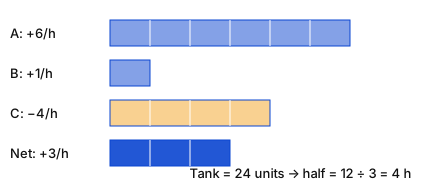
- LCM(4, 24, 6) units. Pipe A fills /h, pipe B fills /h, pipe C empties /h.
- Net per hour units.
- Half tank units → time hours.
Trick: Fraction method: → full in 8 h, half in 4 h.
Answer: (D) 4 hours
अवधारणा: टंकी की क्षमता समयों का LCM लें; तब हर पाइप का प्रति घंटा काम पूर्ण इकाइयों में आता है।
- LCM(4, 24, 6) इकाई। पाइप A भरता है /h, पाइप B /h, पाइप C खाली करता है /h।
- प्रति घंटा शुद्ध इकाई।
- आधी टंकी इकाई → समय घंटे।
ट्रिक: भिन्न विधि: → पूरी 8 h में, आधी 4 h में।
उत्तर: (D) 4 घंटे (4 hours)
RRB NTPC Graduate CBT 1MathematicsPipes and CisternsRRB NTPC Graduate CBT 1 2025 · 19 Mar Shift 3
Q378.Find the volume of largest possible sphere that can be inscribed in a cone whose base radius is cm and slant height equal to the diameter of the base. (Use )
उस सबसे बड़े संभव गोले का आयतन ज्ञात कीजिए जो एक ऐसे शंकु के अंतर्गत बनाया जा सकता है जिसके आधार की त्रिज्या cm है और तिर्यक ऊँचाई आधार के व्यास के बराबर है। ( का प्रयोग कीजिए)
- A314046 cm3
- B301644 cm3
- C314064 cm3
- D310464 cm3
Show answer
Concept: For a cone with base radius , height and slant height , the radius of the largest inscribed sphere is .
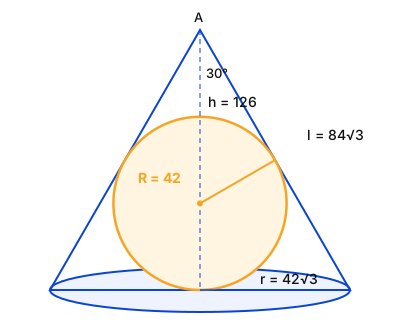
- , ⇒ cm.
- cm.
- Volume .
Trick: Slant height = diameter means the cone is equilateral (semi-vertical angle ); then the inscribed sphere has directly.
Answer: (D)
अवधारणा: आधार त्रिज्या , ऊँचाई और तिर्यक ऊँचाई वाले शंकु में सबसे बड़े अंतर्वृत्त गोले की त्रिज्या होती है।
- , ⇒ cm।
- cm।
- आयतन ।
ट्रिक: तिर्यक ऊँचाई = व्यास का मतलब समबाहु शंकु (अर्ध-शीर्ष कोण ); तब अंतर्वृत्त गोले की त्रिज्या सीधे होती है।
उत्तर: (D)
RRB NTPC Graduate CBT 1MathematicsMensuration – sphere in coneRRB NTPC Graduate CBT 1 2025 · 19 Mar Shift 3
Q379.What is the average of all the natural numbers from 1 to 60?
1 से 60 तक की सभी प्राकृत संख्याओं का औसत क्या है?
- A31
- B31.5
- C30
- D30.5
Show answer
Concept: Numbers to form an AP, so their average is .
- Average of to .
- Check: sum , .
Yaad rakhein: Average of first natural numbers — no need to add anything.
Answer: (D) 30.5
अवधारणा: से तक की संख्याएँ समांतर श्रेढ़ी (AP) हैं, इसलिए औसत ।
- से का औसत ।
- जाँच: योग , ।
याद रखें: पहली प्राकृत संख्याओं का औसत — जोड़ने की ज़रूरत नहीं।
उत्तर: (D) 30.5
RRB NTPC Graduate CBT 1MathematicsAverage of natural numbersRRB NTPC Graduate CBT 1 2025 · 19 Mar Shift 3
Q380.There are 39 members in group A, 33 members in group B and 52 members in group C. All the members of these groups went to a restaurant. The average amounts spent on each member of groups A, B and C are ₹377, ₹401 and ₹233, respectively. The overall average amount (in ₹) spent per member is:
समूह A में 39 सदस्य, समूह B में 33 सदस्य और समूह C में 52 सदस्य हैं। इन समूहों के सभी सदस्य एक रेस्तरां में गए। समूह A, B और C के प्रत्येक सदस्य पर खर्च की गई औसत राशि क्रमशः ₹377, ₹401 और ₹233 है। प्रति सदस्य खर्च की गई कुल औसत राशि (₹ में) है:
- A324
- B328
- C323
- D325
Show answer
Concept: Overall average (weighted mean).
- Totals: , , .
- Sum ; members .
- Average .
Trick: Take 323 as base: deviations , , ; they sum to , so the average is exactly 323.
Answer: (C) 323
अवधारणा: कुल औसत (भारित औसत)।
- कुल: , , ।
- योग ; सदस्य ।
- औसत ।
ट्रिक: 323 को आधार मानें: विचलन , , — योग , अतः औसत ठीक 323।
उत्तर: (C) 323
RRB NTPC Graduate CBT 1MathematicsWeighted averageRRB NTPC Graduate CBT 1 2025 · 19 Mar Shift 3

