Q381.If , then find the value of .
यदि है, तो का मान ज्ञात कीजिए।
- A85
- B95
- C80
- D90
Show answer
Concept: Write every base as a power of the same prime, then add/subtract exponents: , .
- , .
- ⇒ .
- .
Trick: , — just multiply the decimal exponents by 3 and 2 mentally.
Answer: (A) 85
अवधारणा: हर आधार को एक ही अभाज्य की घात में लिखें, फिर घातांक जोड़ें/घटाएँ: , ।
- , ।
- ⇒ ।
- ।
ट्रिक: , — दशमलव घातांकों को मन में 3 और 2 से गुणा कर लें।
उत्तर: (A) 85
RRB NTPC Graduate CBT 1MathematicsIndicesRRB NTPC Graduate CBT 1 2025 · 19 Mar Shift 3
Q382.If a : b = 1 : 3, b : c = 5 : 7 and c : d = 9 : 5, then the value of a : b : c : d is:
यदि a : b = 1 : 3, b : c = 5 : 7 और c : d = 9 : 5 है, तो a : b : c : d का मान है:
- A15 : 75 : 105 : 35
- B5 : 75 : 105 : 35
- C15 : 45 : 63 : 35
- D25 : 75 : 105 : 45
Show answer
Concept: To join ratios, make the common term equal by cross-multiplying step by step.
- , ⇒ .
- with : multiply first by 9 and second by 21 ⇒ .
- Divide by 3: .
Trick: — one line.
Answer: (C) 15 : 45 : 63 : 35
अवधारणा: अनुपात जोड़ने के लिए उभयनिष्ठ पद को क्रॉस-गुणा से बराबर करें।
- , ⇒ ।
- , : पहले को 9 से, दूसरे को 21 से गुणा ⇒ ।
- 3 से भाग: ।
ट्रिक: — एक लाइन में।
उत्तर: (C) 15 : 45 : 63 : 35
RRB NTPC Graduate CBT 1MathematicsCompound ratioRRB NTPC Graduate CBT 1 2025 · 19 Mar Shift 3
Q383.Find the volume (in cm3) of a sphere having a diameter of 37.8 cm, giving your answer correct to two places of decimal. (take )
37.8 cm व्यास वाले एक गोले का आयतन (cm3 में) ज्ञात कीजिए, अपना उत्तर दो दशमलव स्थानों तक सही दीजिए। ( लीजिए)
- A28281.03
- B28291.03
- C28311.03
- D28301.03
Show answer
Concept: with .
- cm; .
- .
- .
Trick: , so the 7 cancels with : .
Answer: (B) 28291.03
अवधारणा: , जहाँ ।
- cm; ।
- ।
- ।
ट्रिक: , अतः 7, से कट जाता है: ।
उत्तर: (B) 28291.03
RRB NTPC Graduate CBT 1MathematicsVolume of sphereRRB NTPC Graduate CBT 1 2025 · 19 Mar Shift 3
Q384.A shopkeeper fixes the marked price of an item 150% above its cost price. What percentage of discount on marked price should be allowed to gain 60%?
एक दुकानदार किसी वस्तु का अंकित मूल्य उसके क्रय मूल्य से 150% अधिक निर्धारित करता है। 60% लाभ प्राप्त करने के लिए अंकित मूल्य पर कितने प्रतिशत छूट दी जानी चाहिए?
- A36%
- B34%
- C33%
- D39%
Show answer
Concept: Discount is on MP, profit is on CP: .
- Let CP . MP .
- Required SP for 60% gain .
- Discount ⇒ .
Trick: ⇒ discount .
Answer: (A)
अवधारणा: छूट अंकित मूल्य (MP) पर, लाभ क्रय मूल्य (CP) पर: ।
- CP मानें। MP ।
- 60% लाभ के लिए SP ।
- छूट ⇒ ।
ट्रिक: ⇒ छूट ।
उत्तर: (A)
RRB NTPC Graduate CBT 1MathematicsDiscount and profitRRB NTPC Graduate CBT 1 2025 · 19 Mar Shift 3
Q385.The minimum value of the expression max {p2 − 2p + 4, −p2 + 2p − 4} in the range 0 ≤ p ≤ 1 is:
0 ≤ p ≤ 1 के परिसर में व्यंजक max {p2 − 2p + 4, −p2 + 2p − 4} का न्यूनतम मान है:
- A2
- B4
- C1
- D3
Show answer
Concept: Complete the square: and .
- The first expression is always and the second always , so is always the first one.
- Minimum of on occurs at : value .
Trick: The two expressions are negatives of each other, so the max is simply the positive one, .
Answer: (D) 3
अवधारणा: पूर्ण वर्ग बनाएँ: और ।
- पहला व्यंजक सदैव , दूसरा सदैव , अतः हमेशा पहला ही है।
- में का न्यूनतम पर: मान ।
ट्रिक: दोनों व्यंजक एक-दूसरे के ऋणात्मक हैं, अतः max बस धनात्मक वाला है।
उत्तर: (D) 3
RRB NTPC Graduate CBT 1MathematicsQuadratic – max/minRRB NTPC Graduate CBT 1 2025 · 19 Mar Shift 3
Q386.At what rate (in percentage, rounded off to two decimal place) per year will a sum of money 5 times itself in 12 years on simple interest?
साधारण ब्याज पर कोई धनराशि 12 वर्षों में स्वयं की 5 गुनी किस वार्षिक दर (प्रतिशत में, दो दशमलव स्थानों तक पूर्णांकित) पर हो जाएगी?
- A35.33
- B31.33
- C33.33
- D66.66
Show answer
Concept: If a sum becomes times in years at SI, interest and .
- 5 times ⇒ SI in 12 years.
- per annum.
Trick: " times in years" ⇒ — plug and go.
Answer: (C) 33.33
अवधारणा: साधारण ब्याज पर राशि वर्ष में गुना हो तो ब्याज और ।
- 5 गुना ⇒ SI , 12 वर्ष में।
- वार्षिक।
ट्रिक: " वर्ष में गुना" ⇒ — सीधे रखें।
उत्तर: (C) 33.33
RRB NTPC Graduate CBT 1MathematicsSimple interest – rateRRB NTPC Graduate CBT 1 2025 · 19 Mar Shift 3
Q387.Chetan’s salary is ₹18000 per month. He spends ₹5000 on house rent, ₹2000 on bills and the rest of the amount is his monthly savings. Find his savings (in ₹) in a year, if in the month of his birthday, he spent his complete monthly saving for birthday
celebration.
चेतन का वेतन ₹18000 प्रति माह है। वह ₹5000 मकान किराए पर, ₹2000 बिलों पर खर्च करता है और शेष राशि उसकी मासिक बचत है। एक वर्ष में उसकी बचत (₹ में) ज्ञात कीजिए, यदि अपने जन्मदिन के महीने में उसने अपनी पूरी मासिक बचत जन्मदिन समारोह पर खर्च कर दी।
- A132000
- B121000
- C110000
- D99000
Show answer
Concept: Monthly saving = salary − expenses; yearly saving = saving × number of months actually saved.
- Monthly saving .
- In the birthday month the whole saving is spent, so only 11 months count.
- Yearly saving .
Trick: Read the twist — "12 months" gives 132000 (option A), the trap answer.
Answer: (B) 121000
अवधारणा: मासिक बचत = वेतन − खर्च; वार्षिक बचत = बचत × जितने महीने वास्तव में बचत हुई।
- मासिक बचत ।
- जन्मदिन के महीने में पूरी बचत खर्च, अतः केवल 11 महीने गिनें।
- वार्षिक बचत ।
ट्रिक: मोड़ ध्यान से पढ़ें — "12 महीने" से 132000 (विकल्प A) आता है, जो जाल है।
उत्तर: (B) 121000
RRB NTPC Graduate CBT 1MathematicsSavings calculationRRB NTPC Graduate CBT 1 2025 · 19 Mar Shift 3
Q388.The least common multiple of , , and is:
, और का लघुत्तम समापवर्त्य (LCM) है:
- A
- B
- C
- D
Show answer
Concept: LCM of monomials = each variable raised to its highest power among the terms.
- Rewrite: ; ; .
- Highest powers: and ⇒ LCM .
- .
Trick: A negative power in the denominator jumps to the numerator with a positive sign: .
Answer: (A)
अवधारणा: एकपदियों का LCM = हर चर की सबसे बड़ी घात।
- पुनर्लेखन: ; ; ।
- सबसे बड़ी घातें: , ⇒ LCM ।
- ।
ट्रिक: हर में ऋणात्मक घात अंश में धनात्मक बन जाती है: ।
उत्तर: (A)
RRB NTPC Graduate CBT 1MathematicsLCM of algebraic expressionsRRB NTPC Graduate CBT 1 2025 · 19 Mar Shift 3
Q389.Simplify:
सरल कीजिए:
- A1000
- B10
- C100
- D1
Show answer
Concept: .
- Take , : and .
- Numerator .
- Denominator ⇒ .
Trick: Spot and — the sign pattern screams .
Answer: (C) 100
अवधारणा: ।
- , लें: , ।
- अंश ।
- हर ⇒ ।
ट्रिक: और पहचानें — चिह्न का पैटर्न बताता है।
उत्तर: (C) 100
RRB NTPC Graduate CBT 1MathematicsAlgebraic identity (a−b)³RRB NTPC Graduate CBT 1 2025 · 19 Mar Shift 3
Q390.A chemical research laboratory uses three compounds A, B, and C in the cost ratio 3 : 5 : 7. When a fourth compound D is added to the mixture, the total cost increases by 40%. If the new ratio becomes A : B : C : D = 3 : 5 : 7 : x, what is the value of x?
एक रासायनिक अनुसंधान प्रयोगशाला तीन यौगिकों A, B और C का उपयोग 3 : 5 : 7 के लागत अनुपात में करती है। जब मिश्रण में एक चौथा यौगिक D मिलाया जाता है, तो कुल लागत 40% बढ़ जाती है। यदि नया अनुपात A : B : C : D = 3 : 5 : 7 : x हो जाता है, तो x का मान क्या है?
- A9
- B8
- C4
- D6
Show answer
Concept: When D is added, A, B, C keep their shares; the new total is 140% of the old total.
- Old total parts.
- New total parts.
- .
Trick: of 15 — the increase itself is D's share.
Answer: (D) 6
अवधारणा: D जोड़ने पर A, B, C के हिस्से वही रहते हैं; नया योग पुराने का 140% है।
- पुराना योग भाग।
- नया योग भाग।
- ।
ट्रिक: 15 का — वृद्धि ही D का हिस्सा है।
उत्तर: (D) 6
RRB NTPC Graduate CBT 1MathematicsRatio and percentageRRB NTPC Graduate CBT 1 2025 · 19 Mar Shift 3
Q391.Four classes have a ratio of boys to girls as 4 : 5, 3 : 2, 6 : 5 and 5 : 6, respectively. Which class has a higher proportion of boys?
चार कक्षाओं में लड़कों और लड़कियों का अनुपात क्रमशः 4 : 5, 3 : 2, 6 : 5 और 5 : 6 है। किस कक्षा में लड़कों का अनुपात अधिक है?
- ASecond class (3 : 2)दूसरी कक्षा (3 : 2)
- BThird class (6 : 5)तीसरी कक्षा (6 : 5)
- CFirst class (4 : 5)पहली कक्षा (4 : 5)
- DFourth class (5 : 6)चौथी कक्षा (5 : 6)
Show answer
Concept: Proportion of boys ; compare these fractions.
- First ; Second ; Third ; Fourth .
- Highest is — the second class.
Trick: Only and have more boys than girls; boys per girl beats .
Answer: (A) Second class (3 : 2)
अवधारणा: लड़कों का अनुपात ; इन भिन्नों की तुलना करें।
- पहली ; दूसरी ; तीसरी ; चौथी ।
- सबसे अधिक — दूसरी कक्षा।
ट्रिक: केवल और में लड़के अधिक हैं; लड़के प्रति लड़की, से बड़ा।
उत्तर: (A) दूसरी कक्षा (3 : 2)
RRB NTPC Graduate CBT 1MathematicsComparing ratiosRRB NTPC Graduate CBT 1 2025 · 19 Mar Shift 3
Q392. - A8
- B4
- C2
- D16
Show answer
Concept: (since ) and (since ).
- Expression .
- , ⇒ .
Trick: Cancel before multiplying: 13 with 39, 5 with 10 — the answer drops out as .
Answer: (A) 8
अवधारणा: () और ()।
- व्यंजक ।
- , ⇒ ।
ट्रिक: गुणा से पहले काटें: 13 को 39 से, 5 को 10 से — उत्तर निकल आता है।
उत्तर: (A) 8
RRB NTPC Graduate CBT 1MathematicsRoots simplificationRRB NTPC Graduate CBT 1 2025 · 19 Mar Shift 3
Q393.A shopkeeper buys 45 identical calculators for ₹54,000. He sells 30 of them at a profit of 25% and the remaining at a loss of 20%. What is the overall profit or loss percentage?
एक दुकानदार ₹54,000 में 45 एक जैसे कैलकुलेटर खरीदता है। वह उनमें से 30 को 25% लाभ पर और शेष को 20% हानि पर बेचता है। कुल लाभ या हानि प्रतिशत क्या है?
- A5% profit5% लाभ
- B10% profit10% लाभ
- C5% loss5% हानि
- D10% loss10% हानि
Show answer
Concept: Overall % .
- CP each .
- 30 at 25% profit: ; 15 at 20% loss: .
- Total SP ; profit ⇒ profit.
Trick: Weighted: — CP per item is not even needed.
Answer: (B) 10% profit
अवधारणा: कुल % ।
- प्रति कैलकुलेटर CP ।
- 30 पर 25% लाभ: ; 15 पर 20% हानि: ।
- कुल SP ; लाभ ⇒ लाभ।
ट्रिक: भारित: — प्रति वस्तु CP की ज़रूरत ही नहीं।
उत्तर: (B) 10% लाभ
RRB NTPC Graduate CBT 1MathematicsProfit and loss – overallRRB NTPC Graduate CBT 1 2025 · 19 Mar Shift 3
Q394.Let ABC be a right-angled triangle such that ∠B = 90°, AB = 12 cm and AC = 13 cm. Find the value of tan A - cot C.
मान लीजिए ABC एक समकोण त्रिभुज है जिसमें ∠B = 90°, AB = 12 cm और AC = 13 cm है। tan A − cot C का मान ज्ञात कीजिए।
- A2
- B6
- C0
- D5
Show answer
Concept: In a right triangle, when (complementary angles).
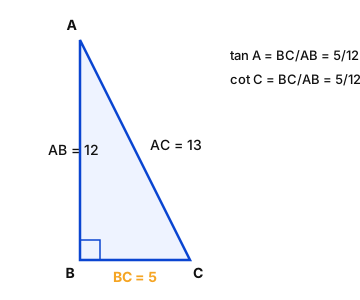
- cm.
- ; (adjacent of C is BC, opposite is AB).
- .
Trick: ⇒ — the difference is 0 without finding BC.
Answer: (C) 0
अवधारणा: समकोण त्रिभुज में (पूरक कोण) होने पर ।
- cm।
- ; ।
- ।
ट्रिक: ⇒ — BC निकाले बिना ही अंतर 0।
उत्तर: (C) 0
RRB NTPC Graduate CBT 1MathematicsTrigonometric ratiosRRB NTPC Graduate CBT 1 2025 · 19 Mar Shift 3
Q395.A shopkeeper professes to sell his goods at a 20% loss but uses a false balance and gains 40%. The actual weight (rounded off to one decimal place) he uses for 1 kg is:
एक दुकानदार अपना माल 20% हानि पर बेचने का दावा करता है, परंतु गलत तराजू का उपयोग करके 40% लाभ कमाता है। 1 kg के लिए वह जो वास्तविक बाट (एक दशमलव स्थान तक पूर्णांकित) उपयोग करता है, वह है:
- A568.8 gm
- B576.7 gm
- C571.4 gm
- D575.4 gm
Show answer
Concept: If he uses g instead of 1000 g and sells at of the price of 1000 g, then .
- Gain 40% ⇒ .
- g.
Trick: ⇒ false weight g.
Answer: (C) 571.4 gm
अवधारणा: यदि वह 1000 g की जगह g देता है और 1000 g के मूल्य का लेता है, तो ।
- 40% लाभ ⇒ ।
- g।
ट्रिक: ⇒ झूठा बाट g।
उत्तर: (C) 571.4 gm
RRB NTPC Graduate CBT 1MathematicsFalse weight – dishonest dealerRRB NTPC Graduate CBT 1 2025 · 19 Mar Shift 3
Q396.What is the maximum value that must be assigned to A so that the 8-digit number 445A0208 is divisible by 3?
A को अधिकतम कौन-सा मान दिया जाना चाहिए ताकि 8-अंकीय संख्या 445A0208, 3 से विभाज्य हो?
- A9
- B5
- C2
- D7
Show answer
Concept: A number is divisible by 3 if its digit sum is divisible by 3.
- Digit sum of 445A0208 .
- divisible by 3 ⇒ .
- Maximum ().
Trick: , so : 1, 4, 7 — pick the largest digit.
Answer: (D) 7
अवधारणा: कोई संख्या 3 से विभाज्य है यदि उसके अंकों का योग 3 से विभाज्य हो।
- 445A0208 का अंक-योग ।
- , 3 से विभाज्य ⇒ ।
- अधिकतम ()।
ट्रिक: , अतः : 1, 4, 7 — सबसे बड़ा अंक लें।
उत्तर: (D) 7
RRB NTPC Graduate CBT 1MathematicsDivisibility by 3RRB NTPC Graduate CBT 1 2025 · 19 Mar Shift 3
Q397.Two taps can fill a cistern in 4 hours and 32 hours respectively. A third tap can empty it in 32 hours. How long (in hours) will it take to fill one-fourth of the empty cistern, if all of them are opened together?
दो नल एक हौज को क्रमशः 4 घंटे और 32 घंटे में भर सकते हैं। एक तीसरा नल इसे 32 घंटे में खाली कर सकता है। यदि सभी नल एक साथ खोल दिए जाएँ, तो खाली हौज का एक-चौथाई भाग भरने में कितना समय (घंटों में) लगेगा?
- A4
- B1
- C2
- D3
Show answer
Concept: Add the per-hour rates (filling positive, emptying negative).
- Net rate cistern per hour.
- Full cistern in 4 hours ⇒ one-fourth in hour.
Trick: The 32-hour filler and 32-hour emptier cancel exactly — only the 4-hour tap matters.
Answer: (B) 1
अवधारणा: प्रति घंटा दरें जोड़ें (भरने वाली धनात्मक, खाली करने वाली ऋणात्मक)।
- शुद्ध दर टंकी प्रति घंटा।
- पूरी टंकी 4 घंटे में ⇒ एक-चौथाई घंटे में।
ट्रिक: 32 घंटे वाला भरने वाला और 32 घंटे वाला खाली करने वाला नल एक-दूसरे को काट देते हैं — केवल 4 घंटे वाला नल मायने रखता है।
उत्तर: (B) 1
RRB NTPC Graduate CBT 1MathematicsPipes and cisternsRRB NTPC Graduate CBT 1 2025 · 19 Mar Shift 3
Q398.Amit invested equal amounts at simple interest and compound interest, compounded annually, for 2 years at the same rate of 4% per annum. In the end, he found a difference of ₹53 between the two interests earned. What was the amount (in ₹) invested in each case?
अमित ने समान राशियाँ साधारण ब्याज पर और वार्षिक रूप से संयोजित चक्रवृद्धि ब्याज पर, 2 वर्षों के लिए 4% वार्षिक की समान दर से निवेश कीं। अंत में उसने पाया कि अर्जित दोनों ब्याजों के बीच ₹53 का अंतर है। प्रत्येक मामले में निवेश की गई राशि (₹ में) क्या थी?
- A33475
- B33125
- C32375
- D32225
Show answer
Concept: For 2 years, .
- ⇒ .
- .
Trick: Difference for 2 years = SI on the first year's interest; .
Answer: (B) 33125
अवधारणा: 2 वर्ष के लिए ।
- ⇒ ।
- ।
ट्रिक: 2 वर्ष का अंतर = पहले वर्ष के ब्याज पर ब्याज; ।
उत्तर: (B) 33125
RRB NTPC Graduate CBT 1MathematicsCI – SI differenceRRB NTPC Graduate CBT 1 2025 · 19 Mar Shift 3
Q399.At what rate (in percentage, rounded off to two decimal place) per year will a sum of money 5 times itself in 18 years on simple interest?
साधारण ब्याज पर कोई धनराशि 18 वर्षों में स्वयं की 5 गुनी हो जाती है। प्रति वर्ष ब्याज की दर (प्रतिशत में, दो दशमलव स्थानों तक पूर्णांकित) क्या होगी?
- A44.44
- B20.22
- C22.22
- D24.22
Show answer
Concept: If a sum becomes times itself on simple interest, the interest earned is times the principal, so .
- Amount , so .
- .
- (to two decimal places).
Trick: " times in years" on SI . Here .
Answer: (C) 22.22
अवधारणा: साधारण ब्याज पर यदि धन गुना हो जाए तो ब्याज मूलधन का गुना होता है, अतः ।
- मिश्रधन , इसलिए ।
- ।
- (दो दशमलव तक)।
ट्रिक: SI में " वर्ष में गुना" । यहाँ ।
उत्तर: (C) 22.22
RRB NTPC Graduate CBT 1MathematicsSimple InterestRRB NTPC Graduate CBT 1 2025 · 19 Mar Shift 2
Q400.Three friends X, Y and Z started a business by investing a sum of money in the ratio of 6 : 3 : 5. After 6 months, X withdraws half of his capital. If the sum invested by Z is ₹12,000, then out of a total annual profit of ₹69,000, what is the difference between X's and Y's profit?
तीन मित्रों X, Y और Z ने 6 : 3 : 5 के अनुपात में धनराशि निवेश करके एक व्यवसाय शुरू किया। 6 महीने बाद X अपनी पूँजी का आधा भाग निकाल लेता है। यदि Z द्वारा निवेश की गई राशि ₹12,000 है, तो ₹69,000 के कुल वार्षिक लाभ में से X और Y के लाभ का अंतर कितना है?
- A₹8120
- B₹9910
- C₹7290
- D₹8280
Show answer
Concept: Profit is shared in the ratio of (capital time). When capital changes mid-year, add the products for each period.
- Ratio and Z ₹12,000 1 unit ₹2,400. So X ₹14,400, Y ₹7,200 (we only need the ratio units).
- X: ; Y: ; Z: . Total units.
- 1 unit of profit ₹460.
- X Y ₹8,280.
Trick: Z's actual amount is a distraction – only the ratio units matter. Difference units straight away.
Answer: (D) ₹8280
अवधारणा: लाभ (पूँजी समय) के अनुपात में बँटता है। बीच में पूँजी बदलने पर हर अवधि के गुणनफल जोड़ें।
- अनुपात और Z ₹12,000 1 इकाई ₹2,400। (केवल अनुपात की इकाइयाँ चाहिए।)
- X: ; Y: ; Z: । कुल इकाई।
- लाभ की 1 इकाई ₹460।
- X Y ₹8,280।
ट्रिक: Z की वास्तविक राशि केवल भटकाने के लिए है – अनुपात की इकाइयों से ही काम चल जाता है; अंतर सीधे इकाई।
उत्तर: (D) ₹8280
RRB NTPC Graduate CBT 1MathematicsPartnershipRRB NTPC Graduate CBT 1 2025 · 19 Mar Shift 2

