Q421.Read the given statements and conclusions carefully. Assuming that the information given in the statements is true, even if it appears to be at variance with commonly known facts, decide which of the given conclusion(s) logically follow(s) from the statements.
Statements:
All gorillas are monkeys. Some monkeys are baboons. All baboons are chimpanzees. Conclusions:
(I) All chimpanzees are monkeys.
(II) Some chimpanzees are gorillas.
दिए गए कथनों और निष्कर्षों को ध्यानपूर्वक पढ़ें। कथनों में दी गई जानकारी को सत्य मानते हुए, भले ही वह सामान्य रूप से ज्ञात तथ्यों से भिन्न प्रतीत होती हो, निर्णय करें कि दिए गए निष्कर्षों में से कौन-सा/से निष्कर्ष कथनों का तार्किक रूप से अनुसरण करता है/करते हैं।
कथन:
सभी गोरिल्ला बंदर हैं। कुछ बंदर बबून हैं। सभी बबून चिंपैंजी हैं। निष्कर्ष:
(I) सभी चिंपैंजी बंदर हैं।
(II) कुछ चिंपैंजी गोरिल्ला हैं।
- ANeither conclusion (I) nor (II) follows.न तो निष्कर्ष (I) और न ही (II) अनुसरण करता है।
- BOnly conclusion (II) follows.केवल निष्कर्ष (II) अनुसरण करता है।
- COnly conclusion (I) follows.केवल निष्कर्ष (I) अनुसरण करता है।
- DBoth conclusions (I) and (II) follow.निष्कर्ष (I) और (II) दोनों अनुसरण करते हैं।
Show answer
Concept: Draw the Venn diagram with the least possible overlap and test each conclusion.
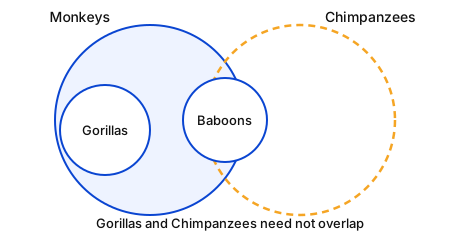
- Gorillas lie inside Monkeys; Baboons partly overlap Monkeys; Baboons lie inside Chimpanzees.
- (I) 'All chimpanzees are monkeys' – only baboons are forced inside Chimpanzees; other chimpanzees can be outside Monkeys. Does not follow.
- (II) 'Some chimpanzees are gorillas' – Gorillas and Chimpanzees need not touch at all. Does not follow.
Trick: 'All A are B' never gives 'All B are A'; and a 'Some' link in the chain breaks any definite conclusion.
Answer: (A) Neither conclusion (I) nor (II) follows.
अवधारणा: न्यूनतम ओवरलैप वाला वेन आरेख बनाएँ और हर निष्कर्ष जाँचें।
- Gorillas, Monkeys के अंदर; Baboons का Monkeys से आंशिक ओवरलैप; Baboons, Chimpanzees के अंदर।
- (I) 'सभी chimpanzees monkeys हैं' – केवल baboons का Chimpanzees में होना तय है; बाकी chimpanzees Monkeys के बाहर हो सकते हैं। नहीं निकलता।
- (II) 'कुछ chimpanzees gorillas हैं' – Gorillas और Chimpanzees का मिलना ज़रूरी नहीं। नहीं निकलता।
ट्रिक: 'All A are B' से कभी 'All B are A' नहीं निकलता; श्रृंखला में 'Some' आते ही निश्चित निष्कर्ष टूट जाता है।
उत्तर: (A) Neither conclusion (I) nor (II) follows.
RRB NTPC Graduate CBT 1General Intelligence and ReasoningSyllogismRRB NTPC Graduate CBT 1 2025 · 19 Mar Shift 1
Q422.What should come in place of ‘?’ in the given series?
35 37 40 45 52 ?
दी गई श्रेणी में ‘?’ के स्थान पर क्या आना चाहिए?
35 37 40 45 52 ?
- A65
- B66
- C62
- D63
Show answer
Concept: Look at the differences between consecutive terms.
- 37−35 = 2, 40−37 = 3, 45−40 = 5, 52−45 = 7.
- Differences are consecutive primes 2, 3, 5, 7 → next prime 11.
- .
Trick: When differences are 2, 3, 5, 7 – think primes, not +1 steps.
Answer: (D) 63
अवधारणा: क्रमागत पदों के अंतर देखें।
- 37−35 = 2, 40−37 = 3, 45−40 = 5, 52−45 = 7।
- अंतर क्रमागत अभाज्य 2, 3, 5, 7 हैं → अगला अभाज्य 11।
- ।
ट्रिक: अंतर 2, 3, 5, 7 दिखें तो अभाज्य संख्याएँ सोचें।
उत्तर: (D) 63
RRB NTPC Graduate CBT 1General Intelligence and ReasoningNumber SeriesRRB NTPC Graduate CBT 1 2025 · 19 Mar Shift 1
Q423.Which of the following letter-clusters should replace # and % so that the pattern and relationship followed between the letter-cluster pair on the left side of :: is the same as that on the right side of :: ?
# : KQM :: OUQ : %
निम्नलिखित में से किन अक्षर-समूहों को # और % के स्थान पर रखा जाना चाहिए ताकि :: के बाईं ओर के अक्षर-समूह युग्म के बीच अनुसरण किया गया पैटर्न और संबंध वही हो जो :: के दाईं ओर है?
# : KQM :: OUQ : %
- A# = LRM , % = NTP
- B# = LRN , % = NTP
- C# = LRN , % = NSP
- D# = LRN , % = NTO
Show answer
Concept: Find a rule that turns # into KQM and apply the same rule to OUQ.
- Try option (B): LRN → KQM: L−1 = K, R−1 = Q, N−1 = M. Rule: each letter −1.
- OUQ → %: O−1 = N, U−1 = T, Q−1 = P → NTP ✓ matches option (B).
- Options (A), (C), (D) break the rule in one letter each (LRM, NSP, NTO).
Trick: Test the pair that must satisfy the rule twice; only (B) is consistent on both sides.
Answer: (B) # = LRN, % = NTP
अवधारणा: ऐसा नियम खोजें जो # को KQM बनाए और वही OUQ पर लगाएँ।
- विकल्प (B): LRN → KQM: L−1 = K, R−1 = Q, N−1 = M। नियम: हर अक्षर −1।
- OUQ → %: O−1 = N, U−1 = T, Q−1 = P → NTP ✓ विकल्प (B) से मेल।
- विकल्प (A), (C), (D) में एक-एक अक्षर नियम तोड़ता है (LRM, NSP, NTO)।
ट्रिक: नियम दोनों ओर लागू होना चाहिए; केवल (B) दोनों ओर सही है।
उत्तर: (B) # = LRN, % = NTP
RRB NTPC Graduate CBT 1General Intelligence and ReasoningLetter Cluster AnalogyRRB NTPC Graduate CBT 1 2025 · 19 Mar Shift 1
Q424.Which of the following letter-number clusters will replace the question mark “?” in the given series to make it logically complete?
AIW 8, YGU 14, WES 20, UCQ 26, ?
निम्नलिखित में से कौन-सा अक्षर-संख्या समूह दी गई श्रेणी में प्रश्नचिह्न “?” के स्थान पर आकर उसे तार्किक रूप से पूर्ण करेगा?
AIW 8, YGU 14, WES 20, UCQ 26, ?
- ATAN 33
- BSAO 32
- CRZN 32
- DSZM 32
Show answer
Concept: Separate the letter pattern and the number pattern.
- Letters: A→Y→W→U (−2 each), I→G→E→C (−2), W→U→S→Q (−2). Next: U−2 = S, C−2 = A, Q−2 = O → SAO.
- Numbers: 8, 14, 20, 26 (+6 each) → 32.
Trick: A−2 wraps around to Y; count backwards through the alphabet circle.
Answer: (B) SAO 32
अवधारणा: अक्षर पैटर्न और संख्या पैटर्न अलग-अलग देखें।
- अक्षर: A→Y→W→U (हर बार −2), I→G→E→C (−2), W→U→S→Q (−2)। अगला: U−2 = S, C−2 = A, Q−2 = O → SAO।
- संख्याएँ: 8, 14, 20, 26 (+6) → 32।
ट्रिक: A−2 घूमकर Y बनता है; वर्णमाला को वृत्त की तरह पीछे गिनें।
उत्तर: (B) SAO 32
RRB NTPC Graduate CBT 1General Intelligence and ReasoningAlphanumeric SeriesRRB NTPC Graduate CBT 1 2025 · 19 Mar Shift 1
Q425.In a certain code language, ‘NICE’ is coded as ‘8246’ and ‘COST’ is coded as ‘3851’. What is the code for 'C’ in the given code language?
एक निश्चित कूट भाषा में, ‘NICE’ को ‘8246’ के रूप में कूटबद्ध किया जाता है और ‘COST’ को ‘3851’ के रूप में कूटबद्ध किया जाता है। दी गई कूट भाषा में 'C’ का कूट क्या है?
- A4
- B8
- C5
- D3
Show answer
Concept: The letter common to both words takes the digit common to both codes.
- NICE → 8 2 4 6 and COST → 3 8 5 1.
- Only letter common to both words is C; only digit common to both codes is 8.
- So C = 8.
Trick: One common letter ↔ one common digit – no need to decode the rest.
Answer: (B) 8
अवधारणा: दोनों शब्दों का उभयनिष्ठ अक्षर दोनों कोड के उभयनिष्ठ अंक को दर्शाता है।
- NICE → 8 2 4 6 और COST → 3 8 5 1।
- दोनों शब्दों में केवल C उभयनिष्ठ है; दोनों कोड में केवल 8 उभयनिष्ठ है।
- अतः C = 8।
ट्रिक: एक उभयनिष्ठ अक्षर ↔ एक उभयनिष्ठ अंक – बाकी डिकोड करने की ज़रूरत नहीं।
उत्तर: (B) 8
RRB NTPC Graduate CBT 1General Intelligence and ReasoningCoding–DecodingRRB NTPC Graduate CBT 1 2025 · 19 Mar Shift 1
Q426.Select the triad which follows the same pattern as that followed by the two pairs given below. Both pairs follow the same pattern.
CLUB-CUBL-ULCB
HANG-HNGA-NAHG
उस त्रिक (triad) का चयन करें जो नीचे दिए गए दो युग्मों द्वारा अनुसरण किए गए पैटर्न का ही अनुसरण करता है। दोनों युग्म एक ही पैटर्न का अनुसरण करते हैं।
CLUB-CUBL-ULCB
HANG-HNGA-NAHG
- AMASK-MSKA-SAMK
- BEARN-ARNE-ENRA
- CNEST-ETNS-TNSE
- DBALD-DLAB-LADB
Show answer
Concept: Track the position of each letter. In CLUB → CUBL the letters move as 1-2-3-4 → 1-3-4-2; in CUBL → ULCB they move as 1-2-3-4 → 2-4-1-3. HANG → HNGA → NAHG follows exactly the same two shuffles.
- Apply 1-3-4-2 to MASK: M, S, K, A → MSKA.
- Apply 2-4-1-3 to MSKA: S, A, M, K → SAMK.
- So MASK-MSKA-SAMK matches. In option B, EARN → ARNE is 2-3-4-1, a different shuffle; C and D also break the pattern at the first step.
Trick: Write the position numbers under the first pair, then just test the first step of each option — most options fail there.
Answer: (A) MASK-MSKA-SAMK
अवधारणा: हर अक्षर की स्थिति (position) देखें। CLUB → CUBL में अक्षर 1-2-3-4 → 1-3-4-2 के क्रम में जाते हैं; CUBL → ULCB में 1-2-3-4 → 2-4-1-3। HANG → HNGA → NAHG में भी यही दो बदलाव हैं।
- MASK पर 1-3-4-2 लगाएँ: M, S, K, A → MSKA।
- MSKA पर 2-4-1-3 लगाएँ: S, A, M, K → SAMK।
- अतः MASK-MSKA-SAMK सही है। विकल्प B में EARN → ARNE 2-3-4-1 है, जो अलग है; C और D पहले ही चरण में टूट जाते हैं।
ट्रिक: पहले जोड़े के नीचे स्थिति-संख्या लिखें, फिर हर विकल्प का केवल पहला चरण जाँचें — ज़्यादातर विकल्प वहीं गलत हो जाते हैं।
उत्तर: (A) MASK-MSKA-SAMK
RRB NTPC Graduate CBT 1General Intelligence and ReasoningLetter-cluster analogyRRB NTPC Graduate CBT 1 2025 · 19 Mar Shift 1
Q427.Golu starts from Point A and drives 53 km towards West. He then takes a left turn, drives 50 km, turns left and drives 54 km. He then takes a left turn and drives 60 km. He takes a final left turn, drives 1 km and stops at Point P. How far (shortest distance) and towards which direction should he drive in order to reach Point A again? (All turns are 90-degree turns only, unless specified.)
गोलू बिंदु A से चलना प्रारंभ करता है और पश्चिम की ओर 53 km गाड़ी चलाता है। फिर वह बाएँ मुड़ता है, 50 km गाड़ी चलाता है, बाएँ मुड़ता है और 54 km गाड़ी चलाता है। फिर वह बाएँ मुड़ता है और 60 km गाड़ी चलाता है। वह अंतिम बार बाएँ मुड़ता है, 1 km गाड़ी चलाता है और बिंदु P पर रुकता है। बिंदु A पर पुनः पहुँचने के लिए उसे कितनी दूर (न्यूनतम दूरी) और किस दिशा में गाड़ी चलानी चाहिए? (जब तक अन्यथा निर्दिष्ट न हो, सभी मोड़ केवल 90 डिग्री के मोड़ हैं।)
- A8 km to the South8 km दक्षिण की ओर
- B12 km to the North12 km उत्तर की ओर
- C11 km to the North11 km उत्तर की ओर
- D10 km to the South10 km दक्षिण की ओर
Show answer
Concept: Take A as origin, East = , North = , and track the position after each leg (every left turn rotates the heading anticlockwise).
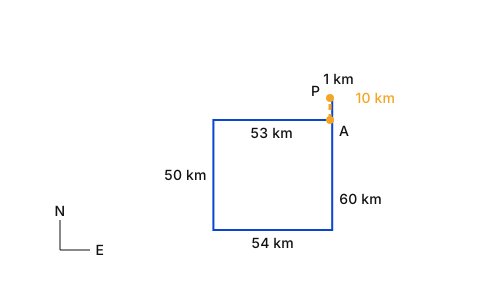
- West 53: . Left → South 50: .
- Left → East 54: . Left → North 60: .
- Left → West 1: = P. So P is exactly 10 km north of A.
- To return to A he must drive km towards the South.
Trick: Net East–West: ; net North–South: . No Pythagoras needed when one of them is zero.
Answer: (D) 10 km to the South
अवधारणा: A को मूल बिंदु (origin) मानें, पूर्व = , उत्तर = , और हर चरण के बाद स्थिति लिखें (हर बायाँ मोड़ दिशा को वामावर्त घुमाता है)।
- पश्चिम 53: । बाएँ → दक्षिण 50: ।
- बाएँ → पूर्व 54: । बाएँ → उत्तर 60: ।
- बाएँ → पश्चिम 1: = P। अतः P, A से ठीक 10 km उत्तर में है।
- A पर लौटने के लिए उसे km दक्षिण की ओर चलना होगा।
ट्रिक: पूर्व–पश्चिम का नेट: ; उत्तर–दक्षिण का नेट: । एक शून्य हो तो पाइथागोरस की ज़रूरत ही नहीं।
उत्तर: (D) 10 km दक्षिण की ओर
RRB NTPC Graduate CBT 1General Intelligence and ReasoningDirection & distanceRRB NTPC Graduate CBT 1 2025 · 19 Mar Shift 1
Q428.What will come in place of ‘?’ in the following equation, if ‘+’ and ‘-‘ are interchanged and ‘×’ and ‘÷’ are interchanged?
95 ÷ 5 + 378 × 3 - 161 = ?
यदि ‘+’ और ‘-‘ को परस्पर बदल दिया जाए तथा ‘×’ और ‘÷’ को परस्पर बदल दिया जाए, तो निम्नलिखित समीकरण में ‘?’ के स्थान पर क्या आएगा?
95 ÷ 5 + 378 × 3 - 161 = ?
- A680
- B590
- C510
- D620
Show answer
Concept: Replace the signs as told, then apply BODMAS: division and multiplication before addition and subtraction.
- Swap: becomes .
- and .
- .
Trick: Rewrite the whole expression with new signs first, then solve — never swap and solve in the same breath.
Answer: (C) 510
अवधारणा: बताए अनुसार चिह्न बदलें, फिर BODMAS लगाएँ: भाग और गुणा पहले, जोड़-घटाव बाद में।
- बदलने पर: बन जाता है ।
- और ।
- ।
ट्रिक: पहले पूरा व्यंजक नए चिह्नों के साथ लिख लें, फिर हल करें — बदलना और हल करना एक साथ न करें।
उत्तर: (C) 510
RRB NTPC Graduate CBT 1General Intelligence and ReasoningMathematical operationsRRB NTPC Graduate CBT 1 2025 · 19 Mar Shift 1
Q429.Select the pair which follows the same pattern as that followed by the two set of pairs given below. Both pairs follow the same pattern.
DRU : BWS
ZBQ : XGO
उस युग्म का चयन करें जो नीचे दिए गए युग्मों के दो समुच्चयों द्वारा अनुसरण किए गए पैटर्न का ही अनुसरण करता है। दोनों युग्म एक ही पैटर्न का अनुसरण करते हैं।
DRU : BWS
ZBQ : XGO
- AVLM : TQK
- BBCG : WGB
- CCLU : AOS
- DHKD : DNZ
Show answer
Concept: Compare letter positions place by place: DRU → BWS is (D→B, R→W, U→S). ZBQ → XGO is also .
- Apply to VLM: V = T, L = Q, M = K → TQK.
- Check others: BCG → WGB is ; CLU → AOS is ; HKD → DNZ is . None match.
Trick: Write the pattern as a signed triple like and test only the middle letter of each option first — it eliminates fastest.
Answer: (A) VLM : TQK
अवधारणा: अक्षरों की स्थिति स्थान-दर-स्थान तुलना करें: DRU → BWS में (D→B, R→W, U→S)। ZBQ → XGO में भी ।
- VLM पर लगाएँ: V = T, L = Q, M = K → TQK।
- बाकी जाँचें: BCG → WGB है ; CLU → AOS है ; HKD → DNZ है । कोई मेल नहीं।
ट्रिक: पैटर्न को जैसे चिह्न-सहित त्रिक में लिखें और हर विकल्प का सिर्फ़ बीच वाला अक्षर पहले जाँचें — सबसे जल्दी छँटाई होती है।
उत्तर: (A) VLM : TQK
RRB NTPC Graduate CBT 1General Intelligence and ReasoningLetter-cluster analogyRRB NTPC Graduate CBT 1 2025 · 19 Mar Shift 1
Q430.Each of P, Q, R, S, T, U and V has an exam on a different day of a week starting from Monday and ending on Sunday of the same week. V has an exam on Thursday. T has an exam on one of the days after P and on one of the days before U. Q has an exam on one of the days after R but on one of the days before S. R has an exam on one of the days after V. Who has an exam on Sunday?
P, Q, R, S, T, U और V में से प्रत्येक की परीक्षा एक ही सप्ताह के सोमवार से प्रारंभ होकर रविवार को समाप्त होने वाले सप्ताह के अलग-अलग दिन है। V की परीक्षा गुरुवार को है। T की परीक्षा P के बाद के किसी एक दिन और U से पहले के किसी एक दिन है। Q की परीक्षा R के बाद के किसी एक दिन परंतु S से पहले के किसी एक दिन है। R की परीक्षा V के बाद के किसी एक दिन है। रविवार को किसकी परीक्षा है?
- AP
- BR
- CS
- DV
Show answer
Concept: Fix the definite clue first (V = Thursday), then chain the 'after/before' clues from it.
- R is after V, Q after R, S after Q: that needs three days after Thursday → R = Fri, Q = Sat, S = Sun.
- Remaining Mon–Wed go to P, T, U with P before T before U: P = Mon, T = Tue, U = Wed.
- Sunday → S.
Trick: Count how many people must come after the fixed person; if it equals the days left, the order is forced.
Answer: (C) S
अवधारणा: पहले निश्चित सूचना रखें (V = गुरुवार), फिर 'बाद/पहले' वाली शर्तें उससे जोड़ें।
- R, V के बाद; Q, R के बाद; S, Q के बाद — गुरुवार के बाद तीन दिन चाहिए → R = शुक्र, Q = शनि, S = रवि।
- बचे सोम–बुध P, T, U के लिए, जहाँ P, T से पहले और T, U से पहले: P = सोम, T = मंगल, U = बुध।
- रविवार → S।
ट्रिक: गिनें कि निश्चित व्यक्ति के बाद कितने लोग आने ज़रूरी हैं; यदि यह बचे दिनों के बराबर है तो क्रम तय हो जाता है।
उत्तर: (C) S
RRB NTPC Graduate CBT 1General Intelligence and ReasoningScheduling puzzle (days)RRB NTPC Graduate CBT 1 2025 · 19 Mar Shift 1
Q431.Below are given two sets of numbers. In each set of numbers, a certain mathematical operation on the first number results in the second number. Similarly, certain
mathematical operations on the second number result in the third number and so on. Which of the given options follows the same set of operations as in question? (NOTE – A two/three-digit number cannot be broken into individual digits for operations, e.g., if 37 is followed by 10, the operation cannot be 3+7 as a two-digit number cannot be broken into individual digits.)
12 – 26 – 46 – 70; 20 – 34 – 54 – 78
नीचे संख्याओं के दो समुच्चय दिए गए हैं। संख्याओं के प्रत्येक समुच्चय में, पहली संख्या पर एक निश्चित गणितीय संक्रिया करने से दूसरी संख्या प्राप्त होती है। इसी प्रकार, दूसरी संख्या पर कुछ
गणितीय संक्रियाएँ करने से तीसरी संख्या प्राप्त होती है और इसी प्रकार आगे भी। दिए गए विकल्पों में से कौन-सा प्रश्न में दी गई संक्रियाओं के समुच्चय का ही अनुसरण करता है? (नोट – संक्रियाओं के लिए दो/तीन अंकों की संख्या को अलग-अलग अंकों में नहीं तोड़ा जा सकता, उदाहरण के लिए, यदि 37 के बाद 10 आता है, तो संक्रिया 3+7 नहीं हो सकती क्योंकि दो अंकों की संख्या को अलग-अलग अंकों में नहीं तोड़ा जा सकता।)
12 – 26 – 46 – 70; 20 – 34 – 54 – 78
- A25 – 39 – 59 – 83
- B28 – 42 – 52 – 76
- C34 – 48 – 78 – 102
- D15 – 30 – 50 – 74
Show answer
Concept: Find the differences between consecutive terms; both given sets must share them.
- 12 → 26 → 46 → 70: . 20 → 34 → 54 → 78: .
- Option A: 25 → 39 () → 59 () → 83 (). Matches.
- B: ; C: ; D: – all fail.
Trick: When the first differences are the same in both sets, just check the same differences in options – no need to hunt for a formula.
Answer: (A) 25 – 39 – 59 – 83
अवधारणा: क्रमागत पदों के अंतर निकालें; दोनों दिए गए सेटों में वही अंतर होने चाहिए।
- 12 → 26 → 46 → 70: । 20 → 34 → 54 → 78: ।
- विकल्प A: 25 → 39 () → 59 () → 83 ()। मेल खाता है।
- B: ; C: ; D: – सब गलत।
ट्रिक: जब दोनों सेटों में पहले अंतर समान हों, तो विकल्पों में बस वही अंतर जाँचें – सूत्र खोजने की ज़रूरत नहीं।
उत्तर: (A) 25 – 39 – 59 – 83
RRB NTPC Graduate CBT 1General Intelligence and ReasoningNumber series analogyRRB NTPC Graduate CBT 1 2025 · 19 Mar Shift 1
Q432.A, B, C, D, E and F live on six different floors of the same building. The lowermost floor in the building is numbered 1, the floor above it is numbered 2 and so on, till the topmost floor, which is numbered 6. The product of the floors on which D and B live is 15. A lives immediately above F. The sum of the floors on which C and B live is 7. What is the sum of the floors on which B and F live?
A, B, C, D, E और F एक ही भवन की छह अलग-अलग मंजिलों पर रहते हैं। भवन की सबसे निचली मंजिल की संख्या 1 है, उसके ऊपर की मंजिल की संख्या 2 है और इसी प्रकार सबसे ऊपरी मंजिल तक, जिसकी संख्या 6 है। D और B जिन मंजिलों पर रहते हैं उनकी संख्याओं का गुणनफल 15 है। A, F के ठीक ऊपर रहता है। C और B जिन मंजिलों पर रहते हैं उनकी संख्याओं का योग 7 है। B और F जिन मंजिलों पर रहते हैं उनकी संख्याओं का योग क्या है?
- A6
- B4
- C3
- D5
Show answer
Concept: Use the product and sum clues to limit the choices, then test each case against the 'immediately above' clue.
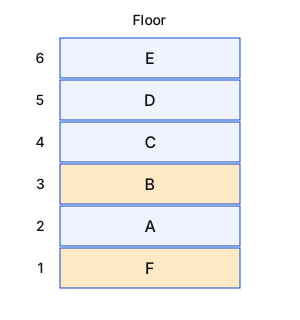
- D × B = 15 → {D, B} = {3, 5}. C + B = 7 → if B = 3, C = 4; if B = 5, C = 2.
- Case B = 5, D = 3, C = 2: floors left 1, 4, 6 – A cannot be immediately above F. Rejected.
- Case B = 3, D = 5, C = 4: floors left 1, 2, 6 → F = 1, A = 2, E = 6. Works.
- B + F = 3 + 1 = 4.
Trick: With 6 floors, a product of 15 can only be – start from the most restrictive clue.
Answer: (B) 4
अवधारणा: गुणनफल और योग वाली शर्तों से विकल्प सीमित करें, फिर हर स्थिति को 'ठीक ऊपर' वाली शर्त से जाँचें।
- D × B = 15 → {D, B} = {3, 5}। C + B = 7 → B = 3 तो C = 4; B = 5 तो C = 2।
- स्थिति B = 5, D = 3, C = 2: बची मंज़िलें 1, 4, 6 – A, F के ठीक ऊपर नहीं हो सकता। अस्वीकृत।
- स्थिति B = 3, D = 5, C = 4: बची मंज़िलें 1, 2, 6 → F = 1, A = 2, E = 6। सही।
- B + F = 3 + 1 = 4।
ट्रिक: 6 मंज़िलों में 15 का गुणनफल केवल से बनता है – सबसे कसी हुई शर्त से शुरू करें।
उत्तर: (B) 4
RRB NTPC Graduate CBT 1General Intelligence and ReasoningFloor puzzleRRB NTPC Graduate CBT 1 2025 · 19 Mar Shift 1
Q433.Below are given two sets of numbers. In each set of numbers, a certain mathematical operation on the first number results in the second number. Similarly, a certain mathematical operation on the second number results in the third number and so on. Which of the given options follows the same set of operations as in the question? (NOTE – A two/three-digit number cannot be broken into individual digits for operations. E.g. if 37 is followed by 10, the operation cannot be 3+7 as a two-digit number cannot be broken into individual digits.)
5 – 20 – 60 – 120
8 – 32 – 96 – 192
नीचे संख्याओं के दो समुच्चय दिए गए हैं। संख्याओं के प्रत्येक समुच्चय में, पहली संख्या पर एक निश्चित गणितीय संक्रिया करने से दूसरी संख्या प्राप्त होती है। इसी प्रकार, दूसरी संख्या पर एक निश्चित गणितीय संक्रिया करने से तीसरी संख्या प्राप्त होती है और इसी प्रकार आगे भी। दिए गए विकल्पों में से कौन-सा प्रश्न में दी गई संक्रियाओं के समुच्चय का ही अनुसरण करता है? (नोट – संक्रियाओं के लिए दो/तीन अंकों की संख्या को अलग-अलग अंकों में नहीं तोड़ा जा सकता। उदाहरण के लिए, यदि 37 के बाद 10 आता है, तो संक्रिया 3+7 नहीं हो सकती क्योंकि दो अंकों की संख्या को अलग-अलग अंकों में नहीं तोड़ा जा सकता।)
5 – 20 – 60 – 120
8 – 32 – 96 – 192
- A24 – 48 – 96 – 120
- B10 – 40 – 120 – 240
- C60 – 240 – 80 – 160
- D12 – 48 – 144 – 248
Show answer
Concept: Look for a multiplying pattern when the numbers grow fast.
- 5 → 20 → 60 → 120: . 8 → 32 → 96 → 192: .
- Option B: , , . Matches.
- A: (not ); C: 60 → 240 → 80 breaks; D: .
Trick: Ratios falling by one each step – once seen in the first set, verify only the last step of each option.
Answer: (B) 10 – 40 – 120 – 240
अवधारणा: जब संख्याएँ तेज़ी से बढ़ें तो गुणा का पैटर्न देखें।
- 5 → 20 → 60 → 120: । 8 → 32 → 96 → 192: ।
- विकल्प B: , , । मेल खाता है।
- A: ( नहीं); C: 60 → 240 → 80 टूटता है; D: ।
ट्रिक: अनुपात हर चरण में एक घटता है – पहले सेट में दिखते ही हर विकल्प का केवल अंतिम चरण जाँचें।
उत्तर: (B) 10 – 40 – 120 – 240
RRB NTPC Graduate CBT 1General Intelligence and ReasoningNumber series analogyRRB NTPC Graduate CBT 1 2025 · 19 Mar Shift 1
Q434.Refer to the following letter, number, symbol series and answer the question.
(Left) 5 C £ T R 6 B $ D © 9 6 * 9 # Z 7 2 R $ O K (Right)
If all the symbols are dropped from the series, which of the following will be fourth from the left?
निम्नलिखित अक्षर, संख्या, प्रतीक श्रेणी को देखें और प्रश्न का उत्तर दें।
(बाएँ) 5 C £ T R 6 B $ D © 9 6 * 9 # Z 7 2 R $ O K (दाएँ)
यदि श्रेणी से सभी प्रतीकों को हटा दिया जाए, तो निम्नलिखित में से कौन-सा बाएँ से चौथा होगा?
- A6
- BB
- CD
- DR
Show answer
Concept: Drop every symbol (non-letter, non-digit), then count from the left in the new series.
- Symbols in the series: £, .
- New series: 5 C T R 6 B D 9 6 9 Z 7 2 R O K.
- Fourth from the left: 5, C, T, R.
Trick: Strike the symbols with a pencil stroke and count the survivors – don't rewrite the whole series.
Answer: (D) R
अवधारणा: सभी प्रतीक (जो न अक्षर हैं न अंक) हटाएँ, फिर नई श्रृंखला में बाएँ से गिनें।
- श्रृंखला के प्रतीक: £, ।
- नई श्रृंखला: 5 C T R 6 B D 9 6 9 Z 7 2 R O K।
- बाएँ से चौथा: 5, C, T, R।
ट्रिक: प्रतीकों को पेंसिल से काटें और बचे हुओं को गिनें – पूरी श्रृंखला दोबारा लिखने की ज़रूरत नहीं।
उत्तर: (D) R
RRB NTPC Graduate CBT 1General Intelligence and ReasoningAlphanumeric seriesRRB NTPC Graduate CBT 1 2025 · 19 Mar Shift 1
Q435.Based on the English alphabetical order, three of the following four letter-cluster pairs are alike in a certain way and thus form a group. Which letter-cluster pair DOES NOT belong to that group?
(Note: The odd one out is not based on the number of consonants/vowels or their position in the letter-cluster.)
अंग्रेज़ी वर्णमाला क्रम के आधार पर, निम्नलिखित चार अक्षर-समूह युग्मों में से तीन एक निश्चित प्रकार से समान हैं और इस प्रकार एक समूह बनाते हैं। कौन-सा अक्षर-समूह युग्म उस समूह से संबंधित नहीं है?
(नोट: विषम का चयन व्यंजनों/स्वरों की संख्या या अक्षर-समूह में उनकी स्थिति के आधार पर नहीं किया गया है।)
- AGI–JL
- BMO–PR
- CJL–MO
- DBD–FH
Show answer
Concept: Check the gap between corresponding letters of the two clusters in each pair.
- GI–JL: G→J , I→L . MO–PR: . JL–MO: .
- BD–FH: B→F , D→H – the odd one.
Trick: Only the first letters need checking: G→J, M→P, J→M are all ; B→F is .
Answer: (D) BD–FH
अवधारणा: हर जोड़े में दोनों समूहों के संगत अक्षरों का अंतर देखें।
- GI–JL: G→J , I→L । MO–PR: । JL–MO: ।
- BD–FH: B→F , D→H – यही अलग है।
ट्रिक: केवल पहले अक्षर जाँचें: G→J, M→P, J→M सब ; B→F है ।
उत्तर: (D) BD–FH
RRB NTPC Graduate CBT 1General Intelligence and ReasoningLetter-cluster classificationRRB NTPC Graduate CBT 1 2025 · 19 Mar Shift 1
Q436.Refer to the following number and symbol series and answer the question that follows. Counting to be done from left to right only. All numbers are single-digit numbers only. (Left) % 1 7 3 < $ 3 7 4 ^ < & # 5 < 3 ^ % > \ & (Right)
How many such symbols are there, each of which is immediately preceded by a number and also immediately followed by a number?
निम्नलिखित संख्या और प्रतीक श्रेणी को देखें और उसके बाद दिए गए प्रश्न का उत्तर दें। गिनती केवल बाएँ से दाएँ की जानी है। सभी संख्याएँ केवल एक अंक की संख्याएँ हैं। (बाएँ) % 1 7 3 < $ 3 7 4 ^ < & # 5 < 3 ^ % > \ & (दाएँ)
ऐसे कितने प्रतीक हैं, जिनमें से प्रत्येक के ठीक पहले एक संख्या है और ठीक बाद भी एक संख्या है?
- ATwoदो
- BNoneकोई नहीं
- CThreeतीन
- DOneएक
Show answer
Concept: Scan each symbol and look at its immediate left and right neighbours; we need number–symbol–number.
- Symbols with their neighbours: % (start), 3 < 3, 4 ^ <, ^ < &, < & #, & # 5, 5 < 3, 3 ^ %, ^ % >, % > \, > \ &, \ & (end).
- Only '5 < 3' has a number on both sides.
- Count = one.
Trick: Underline every number first; a qualifying symbol must sit squeezed between two underlined items.
Answer: (D) One
अवधारणा: हर प्रतीक के ठीक बाएँ और दाएँ पड़ोसी देखें; हमें अंक–प्रतीक–अंक चाहिए।
- प्रतीक व पड़ोसी: % (शुरू), 3 < 3, 4 ^ <, ^ < &, < & #, & # 5, 5 < 3, 3 ^ %, ^ % >, % > \, > \ &, \ & (अंत)।
- केवल '5 < 3' में दोनों ओर अंक हैं।
- गिनती = एक।
ट्रिक: पहले हर अंक को रेखांकित करें; योग्य प्रतीक दो रेखांकित चीज़ों के बीच दबा होना चाहिए।
उत्तर: (D) एक
RRB NTPC Graduate CBT 1General Intelligence and ReasoningNumber–symbol seriesRRB NTPC Graduate CBT 1 2025 · 19 Mar Shift 1
Q437.Read the given statements and conclusions carefully. You have to take the given statements to be true even if they seem to be at variance from commonly known facts. You have to decide which conclusion/s logically follow/s from the given statements. Statements:
All hands are legs. Some hands are ears. Some ears are arms.
Conclusions:
(I) Some legs are ears.
(II) Some hands are arms.
दिए गए कथनों और निष्कर्षों को ध्यानपूर्वक पढ़ें। आपको दिए गए कथनों को सत्य मानना है, भले ही वे सामान्य रूप से ज्ञात तथ्यों से भिन्न प्रतीत होते हों। आपको निर्णय करना है कि दिए गए कथनों से कौन-सा/से निष्कर्ष तार्किक रूप से अनुसरण करता है/करते हैं। कथन:
सभी हाथ टाँगें हैं। कुछ हाथ कान हैं। कुछ कान बाँहें हैं।
निष्कर्ष:
(I) कुछ टाँगें कान हैं।
(II) कुछ हाथ बाँहें हैं।
- AOnly conclusion II follows.केवल निष्कर्ष II अनुसरण करता है।
- BOnly conclusion I follows.केवल निष्कर्ष I अनुसरण करता है।
- CBoth conclusions I and II follow.निष्कर्ष I और II दोनों अनुसरण करते हैं।
- DNeither conclusion I nor II follows.न तो निष्कर्ष I और न ही II अनुसरण करता है।
Show answer
Concept: Draw the Venn diagram from the statements and test each conclusion against every possible drawing.
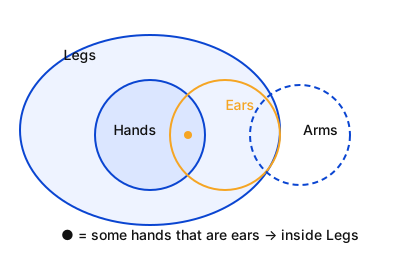
- All hands are legs + some hands are ears → the hands that are ears lie inside legs, so some legs are ears. Conclusion I follows.
- Some ears are arms: these arms may be ears that are not hands at all, so 'some hands are arms' is not certain. Conclusion II does not follow.
Trick: Two 'some' statements in a chain (hands–ears, ears–arms) never give a definite 'some' conclusion.
Answer: (B) Only conclusion I follows.
अवधारणा: कथनों से वेन आरेख बनाएँ और हर निष्कर्ष को सभी संभव आकृतियों पर जाँचें।
- सभी हाथ पैर हैं + कुछ हाथ कान हैं → जो हाथ कान हैं वे पैर के अंदर हैं, अतः कुछ पैर कान हैं। निष्कर्ष I सही।
- कुछ कान बाँह हैं: ये बाँहें ऐसे कान हो सकते हैं जो हाथ नहीं हैं, इसलिए 'कुछ हाथ बाँह हैं' निश्चित नहीं। निष्कर्ष II नहीं निकलता।
ट्रिक: श्रृंखला में दो 'कुछ' कथन (हाथ–कान, कान–बाँह) कभी निश्चित 'कुछ' निष्कर्ष नहीं देते।
उत्तर: (B) केवल निष्कर्ष I अनुसरण करता है।
RRB NTPC Graduate CBT 1General Intelligence and ReasoningSyllogismRRB NTPC Graduate CBT 1 2025 · 19 Mar Shift 1
Q438.Seven people F, G, H, I, U, V, and W are sitting around a circular table facing the centre of the table. G sits third to the right of U. Only three people sit between F and H when counted from the right of H. G sits to the immediate right of H. V sits to the immediate right of W. Who sits second to the right of I?
सात व्यक्ति F, G, H, I, U, V और W एक वृत्ताकार मेज के चारों ओर मेज के केंद्र की ओर मुख करके बैठे हैं। G, U के दाएँ तीसरे स्थान पर बैठा है। H के दाएँ से गिनने पर F और H के बीच केवल तीन व्यक्ति बैठे हैं। G, H के ठीक दाएँ बैठा है। V, W के ठीक दाएँ बैठा है। I के दाएँ दूसरे स्थान पर कौन बैठा है?
- AW
- BG
- CU
- DF
Show answer
Concept: Facing the centre, 'right' means anticlockwise. Fix one person and place the rest from the definite clues.
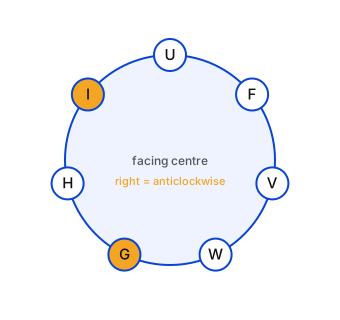
- Put U at the top. G is third to the right of U; H is to the immediate left of G (since G is to H's immediate right).
- Counting from H's right, three people sit between F and H → F is the fifth seat to H's right, which lands F just to the left of U.
- Remaining seats: W with V to his immediate right fills two of them, I takes the last one (between U and H).
- Second to the right of I is G.
Trick: Draw 7 dots, mark arrows for 'right', and place the pair with a fixed gap (U–G) first.
Answer: (B) G
अवधारणा: केंद्र की ओर मुख होने पर 'दाएँ' = वामावर्त (anticlockwise)। एक व्यक्ति को स्थिर रखें और निश्चित शर्तों से बाकी बैठाएँ।
- U को ऊपर रखें। G, U के दाएँ तीसरा; H, G के ठीक बाएँ (क्योंकि G, H के ठीक दाएँ है)।
- H के दाएँ से गिनने पर F और H के बीच तीन लोग → F, H के दाएँ पाँचवीं सीट पर, यानी U के ठीक बाएँ।
- बची सीटें: W और उसके ठीक दाएँ V दो सीटें लेते हैं, I अंतिम सीट (U और H के बीच) पर।
- I के दाएँ दूसरा G है।
ट्रिक: 7 बिंदु बनाएँ, 'दाएँ' का तीर लगाएँ, और निश्चित अंतर वाले जोड़े (U–G) को पहले रखें।
उत्तर: (B) G
RRB NTPC Graduate CBT 1General Intelligence and ReasoningCircular seatingRRB NTPC Graduate CBT 1 2025 · 19 Mar Shift 1
Q439.In a certain code language,
A@ B means ‘A is the son of B’
A % B means ‘A is the brother of B’
A + B means ‘A is the wife of B’
A & B means ‘ A is the father of B’
Based on the above, how is T related to K if ‘T@S%G+H&K’?
एक निश्चित कूट भाषा में,
A@ B का अर्थ है ‘A, B का पुत्र है’
A % B का अर्थ है ‘A, B का भाई है’
A + B का अर्थ है ‘A, B की पत्नी है’
A & B का अर्थ है ‘A, B का पिता है’
उपर्युक्त के आधार पर, यदि ‘T@S%G+H&K’ है, तो T, K से किस प्रकार संबंधित है?
- AMother's brotherमाता का भाई
- BMother's fatherमाता का पिता
- CSonपुत्र
- DMother's brother's sonमाता के भाई का पुत्र
Show answer
Concept: Decode the chain from left to right and build the family tree.
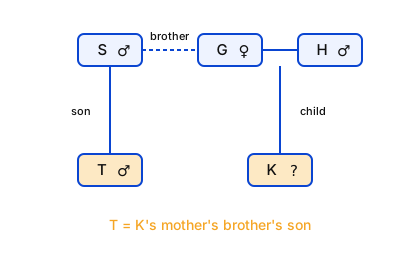
- T @ S: T is the son of S. S % G: S is the brother of G.
- G + H: G is the wife of H. H & K: H is the father of K → G is K's mother.
- S is K's mother's brother (maternal uncle); T, the son of S, is K's mother's brother's son.
Trick: Decode the symbols nearest the target (K) first, then walk back along the chain.
Answer: (D) Mother's brother's son
अवधारणा: श्रृंखला को बाएँ से दाएँ डिकोड करें और वंश-वृक्ष बनाएँ।
- T @ S: T, S का पुत्र। S % G: S, G का भाई।
- G + H: G, H की पत्नी। H & K: H, K का पिता → G, K की माँ।
- S, K की माँ का भाई (मामा); T, S का पुत्र = K की माँ के भाई का पुत्र।
ट्रिक: लक्ष्य (K) के सबसे पास के प्रतीक पहले डिकोड करें, फिर श्रृंखला में पीछे चलें।
उत्तर: (D) माँ के भाई का पुत्र
RRB NTPC Graduate CBT 1General Intelligence and ReasoningBlood relations (coded)RRB NTPC Graduate CBT 1 2025 · 19 Mar Shift 1
Q440.In this question, a question is followed by two statements numbered (I) and (II). You have to decide whether the data provided in the statements are sufficient to answer the question. Read both the statements and decide the appropriate answer.
Q. Harsh, Ketan, Mayank, Rohit, and Sidharth, each have different height. Who is the shortest?
(I) Mayank is taller than Harsh but shorter than Ketan.
(II) Rohit is taller than Harsh but shorter than Mayank.
इस प्रश्न में, एक प्रश्न के बाद (I) और (II) संख्या वाले दो कथन दिए गए हैं। आपको यह निर्णय करना है कि कथनों में दिए गए डेटा प्रश्न का उत्तर देने के लिए पर्याप्त हैं या नहीं। दोनों कथनों को पढ़ें और उचित उत्तर का निर्णय करें।
प्रश्न. हर्ष, केतन, मयंक, रोहित और सिद्धार्थ में से प्रत्येक की ऊँचाई अलग-अलग है। सबसे छोटा (कम ऊँचाई वाला) कौन है?
(I) मयंक, हर्ष से लंबा है परंतु केतन से छोटा है।
(II) रोहित, हर्ष से लंबा है परंतु मयंक से छोटा है।
- AData in Statement II alone is sufficient to answer the question while data in Statement I is notकथन II में दिया गया डेटा अकेले प्रश्न का उत्तर देने के लिए पर्याप्त है, जबकि कथन I में दिया गया डेटा पर्याप्त नहीं है
- BBoth statements I and II together are NOT sufficient to answer the questionकथन I और II दोनों मिलकर भी प्रश्न का उत्तर देने के लिए पर्याप्त नहीं हैं
- CData in Statement I alone is sufficient to answer the question while data in Statement II is notकथन I में दिया गया डेटा अकेले प्रश्न का उत्तर देने के लिए पर्याप्त है, जबकि कथन II में दिया गया डेटा पर्याप्त नहीं है
- DBoth statements I and II together (and not statement I alone or statement II alone) are sufficient to answer the questionकथन I और II दोनों मिलकर (न कि केवल कथन I अथवा केवल कथन II) प्रश्न का उत्तर देने के लिए पर्याप्त हैं
Show answer
Concept: The question asks for the shortest of five people; all five must be placed, or at least the bottom position must be certain.
- Statement I: Ketan > Mayank > Harsh. Rohit and Sidharth unknown – not sufficient.
- Statement II: Mayank > Rohit > Harsh. Ketan and Sidharth unknown – not sufficient.
- Together: Ketan > Mayank > Rohit > Harsh, but Sidharth is never mentioned – he could be shortest. Still not sufficient.
Trick: Count the names in the statements; if one person is missing from both, the shortest/tallest can't be fixed.
Answer: (B) Both statements I and II together are NOT sufficient to answer the question
अवधारणा: प्रश्न पाँच लोगों में सबसे छोटा पूछता है; पाँचों की स्थिति या कम से कम सबसे नीचे की स्थिति निश्चित होनी चाहिए।
- कथन I: केतन > मयंक > हर्ष। रोहित और सिद्धार्थ अज्ञात – पर्याप्त नहीं।
- कथन II: मयंक > रोहित > हर्ष। केतन और सिद्धार्थ अज्ञात – पर्याप्त नहीं।
- दोनों मिलाकर: केतन > मयंक > रोहित > हर्ष, पर सिद्धार्थ का कहीं ज़िक्र नहीं – वह सबसे छोटा हो सकता है। फिर भी पर्याप्त नहीं।
ट्रिक: कथनों में नाम गिनें; यदि कोई व्यक्ति दोनों से गायब है तो सबसे छोटा/लंबा तय नहीं हो सकता।
उत्तर: (B) दोनों कथन I और II मिलकर भी प्रश्न का उत्तर देने के लिए पर्याप्त नहीं हैं
RRB NTPC Graduate CBT 1General Intelligence and ReasoningData sufficiencyRRB NTPC Graduate CBT 1 2025 · 19 Mar Shift 1

