Q421.If x = ∛(31 + 14√3) and y = ∛(31 - 14√3), then the value of x³ + y³ + 3x³y³ is
यदि x = ∛(31 + 14√3) और y = ∛(31 - 14√3) है, तो x³ + y³ + 3x³y³ का मान है
- A1181
- B1143
- C1198
- D1157
Show answer
Concept: Cube both expressions directly: , .
- .
- .
- .
Trick: Conjugate surds multiply to – no need to simplify the cube roots.
Answer: (A) 1181
अवधारणा: दोनों का सीधे घन लें: , ।
- ।
- ।
- ।
ट्रिक: संयुग्मी करणियों का गुणनफल – घनमूल सरल करने की ज़रूरत नहीं।
उत्तर: (A) 1181
RRB NTPC Graduate CBT 1MathematicsAlgebra – CubesRRB NTPC Graduate CBT 1 2025 · 19 Mar Shift 2
Q422.If x is inversely proportional to y, and y = 30 when x = 28, find the value of x, when y = 20.
यदि x, y के व्युत्क्रमानुपाती है, और x = 28 होने पर y = 30 है, तो y = 20 होने पर x का मान ज्ञात कीजिए।
- A33
- B42
- C52
- D38
Show answer
Concept: Inverse proportion ⇒ constant.
- .
- When : .
Trick: falls from 30 to 20 (ratio ), so rises in ratio : .
Answer: (B) 42
अवधारणा: व्युत्क्रम अनुपात ⇒ नियतांक।
- ।
- पर: ।
ट्रिक: 30 से 20 (अनुपात ) घटा, तो अनुपात में बढ़ेगा: ।
उत्तर: (B) 42
RRB NTPC Graduate CBT 1MathematicsInverse VariationRRB NTPC Graduate CBT 1 2025 · 19 Mar Shift 2
Q423.If , then the value of is:
यदि है, तो का मान है:
- A−3
- B−1
- C0
- D2
Show answer
Concept: with , .
- .
- Match with : , , , , .
- .
Trick: Watch the sign in front of – the identity has , so , not .
Answer: (C) 0
अवधारणा: , यहाँ , ।
- ।
- से मिलाएँ: , , , , ।
- ।
ट्रिक: के आगे का चिह्न देखें – सर्वसमिका में है, अतः , नहीं।
उत्तर: (C) 0
RRB NTPC Graduate CBT 1MathematicsAlgebra – FactorisationRRB NTPC Graduate CBT 1 2025 · 19 Mar Shift 2
Q424.A dealer buys two articles X and Y for ₹1,000 each. He marks each of them at the same price. He sells X by giving two successive discounts of 15% and 30% and still earns ₹337 as profit. If he sells Y at a single discount of 49%, then what is the profit
percentage on Y?
एक व्यापारी दो वस्तुएँ X और Y, प्रत्येक ₹1,000 में खरीदता है। वह दोनों पर समान अंकित मूल्य लगाता है। वह X को 15% और 30% की दो क्रमिक छूटें देकर बेचता है और फिर भी ₹337 का लाभ कमाता है। यदि वह Y को 49% की एकल छूट पर बेचता है, तो Y पर लाभ
प्रतिशत कितना है?
- A14.6%
- B13.6%
- C13%
- D14%
Show answer
Concept: Same marked price for both; use X to find , then apply the single discount to Y.
- X: SP .
- Y: SP .
- Profit on Y .
Trick: – skip finding .
Answer: (A) 14.6%
अवधारणा: दोनों का अंकित मूल्य समान; X से निकालें, फिर Y पर एकल छूट लगाएँ।
- X: SP ।
- Y: SP ।
- Y पर लाभ ।
ट्रिक: – निकालने की ज़रूरत नहीं।
उत्तर: (A) 14.6%
RRB NTPC Graduate CBT 1MathematicsProfit & Loss – DiscountsRRB NTPC Graduate CBT 1 2025 · 19 Mar Shift 2
Q425.The sum of two numbers a and b, where a b, is 129. The HCF and LCM of a and b are 3 and 1350, respectively. Find the value of .
दो संख्याओं a और b, जहाँ a b है, का योग 129 है। a और b का HCF और LCM क्रमशः 3 और 1350 हैं। का मान ज्ञात कीजिए।
- A
- B
- C
- D
Show answer
Concept: and .
- . Let , (co-prime): , .
- So , ( ✓), .
- .
Trick: – no need to find separately.
Answer: (A)
अवधारणा: और ।
- । , (सह-अभाज्य) लें: , ।
- अतः , ( ✓), ।
- ।
ट्रिक: – अलग-अलग निकालने की ज़रूरत नहीं।
उत्तर: (A)
RRB NTPC Graduate CBT 1MathematicsHCF and LCMRRB NTPC Graduate CBT 1 2025 · 19 Mar Shift 2
Q426.The area of a square is 3969 cm2. Its perimeter is equal to the perimeter of a regular hexagon. What is the area (in cm2) of the hexagon?
एक वर्ग का क्षेत्रफल 3969 cm2 है। इसका परिमाप एक समषट्भुज के परिमाप के बराबर है। षट्भुज का क्षेत्रफल (cm2 में) क्या है?
- A2600
- B2608
- C
- D
Show answer
Concept: Area of a regular hexagon ; equal perimeters link the square and hexagon.
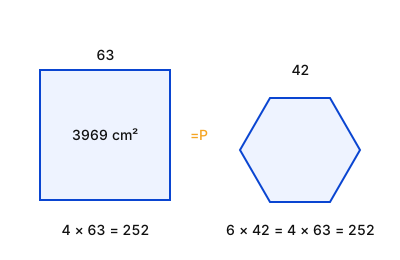
- Square side cm, perimeter cm.
- Hexagon side cm.
- Area .
Trick: (since ); hexagon side of square side when perimeters are equal.
Answer: (D)
अवधारणा: सम षट्भुज का क्षेत्रफल ; बराबर परिमाप से वर्ग और षट्भुज जुड़ते हैं।
- वर्ग की भुजा cm, परिमाप cm।
- षट्भुज की भुजा cm।
- क्षेत्रफल ।
ट्रिक: (); परिमाप बराबर हों तो षट्भुज की भुजा = वर्ग की भुजा का ।
उत्तर: (D)
RRB NTPC Graduate CBT 1MathematicsMensuration – Regular HexagonRRB NTPC Graduate CBT 1 2025 · 19 Mar Shift 2
Q427.If 4 lines of a print, in a column of a book, contain 36 words, how many words will a column of 93 lines contain?
यदि किसी पुस्तक के एक कॉलम में छपी 4 पंक्तियों में 36 शब्द हैं, तो 93 पंक्तियों वाले कॉलम में कितने शब्द होंगे?
- A833
- B841
- C837
- D847
Show answer
Concept: Words are directly proportional to the number of lines.
- 4 lines → 36 words ⇒ 1 line → words.
- 93 lines → words.
Trick: .
Answer: (C) 837
अवधारणा: शब्द, पंक्तियों की संख्या के सीधे अनुपात में हैं।
- 4 पंक्तियाँ → 36 शब्द ⇒ 1 पंक्ति → शब्द।
- 93 पंक्तियाँ → शब्द।
ट्रिक: ।
उत्तर: (C) 837
RRB NTPC Graduate CBT 1MathematicsUnitary MethodRRB NTPC Graduate CBT 1 2025 · 19 Mar Shift 2
Q428.P and Q are two stations. A train travels from P to Q at a speed of 144 km/h and returns to P at a slower speed. If the average speed for the entire journey is 126 km/h, find the speed at which the train returns.
P और Q दो स्टेशन हैं। एक रेलगाड़ी P से Q तक 144 km/h की चाल से जाती है और धीमी चाल से P लौटती है। यदि पूरी यात्रा की औसत चाल 126 km/h है, तो रेलगाड़ी की लौटते समय की चाल ज्ञात कीजिए।
- A124 km/h
- B128 km/h
- C121 km/h
- D112 km/h
Show answer
Concept: For equal distances, average speed .
- .
- .
- .
Trick: .
Answer: (D) 112 km/h
अवधारणा: समान दूरी के लिए औसत चाल ।
- ।
- ।
- ।
ट्रिक: ।
उत्तर: (D) 112 km/h
RRB NTPC Graduate CBT 1MathematicsAverage SpeedRRB NTPC Graduate CBT 1 2025 · 19 Mar Shift 2
Q429.A and B complete a work in 21 days. If A alone can do it in 28 days, then B alone can do three-fourth of the same work in ______________days.
A और B एक काम को 21 दिनों में पूरा करते हैं। यदि A अकेला इसे 28 दिनों में कर सकता है, तो B अकेला उसी काम का तीन-चौथाई ______________ दिनों में कर सकता है।
- A35
- B56
- C63
- D49
Show answer
Concept: Take total work = LCM of the days; work per day = total ÷ days.
- Total work = LCM(21, 28) = 84 units.
- (A+B) per day = , A per day = , so B per day = unit.
- B alone finishes the whole work in 84 days; three-fourth of it in days.
Trick: B alone = days; then take of it.
Answer: (C) 63
अवधारणा: कुल कार्य = दिनों का LCM; प्रतिदिन कार्य = कुल कार्य ÷ दिन।
- कुल कार्य = LCM(21, 28) = 84 इकाई।
- (A+B) प्रतिदिन = , A प्रतिदिन = , अतः B प्रतिदिन = इकाई।
- B अकेला पूरा कार्य 84 दिन में करेगा; तीन-चौथाई कार्य दिन में।
ट्रिक: B अकेला = दिन; फिर इसका लें।
उत्तर: (C) 63
RRB NTPC Graduate CBT 1MathematicsTime and WorkRRB NTPC Graduate CBT 1 2025 · 19 Mar Shift 1
Q430.Girish scored 441 marks in an examination and was 75 marks short of 30% of maximum marks. In the same examination, his friend scored 688 marks. What is the percentage of marks scored by his friend?
गिरीश ने एक परीक्षा में 441 अंक प्राप्त किए और वह अधिकतम अंकों के 30% से 75 अंक कम रहा। उसी परीक्षा में उसके मित्र ने 688 अंक प्राप्त किए। उसके मित्र द्वारा प्राप्त अंकों का प्रतिशत क्या है?
- A38%
- B42%
- C44%
- D40%
Show answer
Concept: First find the maximum marks from the given percentage condition.
- 30% of maximum = .
- Maximum marks = .
- Friend's percentage = .
Trick: , so 40% directly.
Answer: (D) 40%
अवधारणा: पहले दी गई प्रतिशत शर्त से अधिकतम अंक निकालें।
- अधिकतम अंकों का 30% = ।
- अधिकतम अंक = ।
- मित्र का प्रतिशत = ।
ट्रिक: , अतः सीधे 40%।
उत्तर: (D) 40%
RRB NTPC Graduate CBT 1MathematicsPercentageRRB NTPC Graduate CBT 1 2025 · 19 Mar Shift 1
Q431.The common root of the equations x2 − 21x + 110 = 0 and 110 + x − x2 = 0, is:
समीकरणों x2 − 21x + 110 = 0 और 110 + x − x2 = 0 का उभयनिष्ठ मूल (common root) है:
- A11
- B10
- C–11
- D–10
Show answer
Concept: Factorise both equations and pick the common root.
- .
- .
- Common root = 11.
Trick: Subtracting the two equations: at once.
Answer: (A) 11
अवधारणा: दोनों समीकरणों के गुणनखंड करके उभयनिष्ठ (common) मूल चुनें।
- ।
- ।
- उभयनिष्ठ मूल = 11।
ट्रिक: दोनों समीकरण घटाने पर तुरंत।
उत्तर: (A) 11
RRB NTPC Graduate CBT 1MathematicsQuadratic EquationsRRB NTPC Graduate CBT 1 2025 · 19 Mar Shift 1
Q432.The distance between two points on a map is 4 cm. The scale of the map is 1 : 829483. The actual distance between the two points (in km) is:
(Round off your answer to two decimal places.)
एक मानचित्र पर दो बिंदुओं के बीच की दूरी 4 cm है। मानचित्र का पैमाना 1 : 829483 है। दोनों बिंदुओं के बीच की वास्तविक दूरी (km में) है:
(अपने उत्तर को दो दशमलव स्थानों तक पूर्णांकित करें।)
- A38.85
- B33.63
- C30.25
- D33.18
Show answer
Concept: Scale 1 : 829483 means 1 cm on the map = 829483 cm on the ground.
- Actual distance = cm.
- Convert: 1 km = 100000 cm, so km.
- Rounded to two decimals: 33.18 km.
Trick: ; .
Answer: (D) 33.18
अवधारणा: पैमाना 1 : 829483 का अर्थ – मानचित्र का 1 cm = ज़मीन पर 829483 cm।
- वास्तविक दूरी = cm।
- 1 km = 100000 cm, अतः km।
- दो दशमलव तक: 33.18 km।
ट्रिक: ; ।
उत्तर: (D) 33.18
RRB NTPC Graduate CBT 1MathematicsRatio – Map ScaleRRB NTPC Graduate CBT 1 2025 · 19 Mar Shift 1
Q433.Solve the following system of linear equations:
रैखिक समीकरणों के निम्नलिखित निकाय को हल करें:
- Ap = −1, q = 3, r = 2
- Bp = 1, q = −1, r = 2
- Cp = 1, q = 1, r = −2
- Dp = −1, q = −1, r = 3
Show answer
Concept: Add equations to eliminate one variable, or simply verify the options.
- Adding (1) and (2): .
- (2)×2 − (3): .
- Subtracting: , ; from (2): .
- Check (1): ✓.
Trick: Put each option in the easiest equation : only (B) gives .
Answer: (B)
अवधारणा: समीकरण जोड़कर एक चर हटाएँ, या विकल्पों की जाँच करें।
- (1)+(2): ।
- (2)×2 − (3): ।
- घटाने पर , ; (2) से ।
- जाँच (1): ✓।
ट्रिक: हर विकल्प को सबसे सरल समीकरण में रखें: केवल (B) से ।
उत्तर: (B)
RRB NTPC Graduate CBT 1MathematicsLinear Equations in Three VariablesRRB NTPC Graduate CBT 1 2025 · 19 Mar Shift 1
Q434.Evaluate: (-9) - (-56) ÷ (-14) + (-4) × 8
मान ज्ञात करें: (-9) - (-56) ÷ (-14) + (-4) × 8
- A-48
- B-47
- C-44
- D-45
Show answer
Concept: Division and multiplication first, then addition/subtraction from left to right.
- and .
- Expression = .
Trick: Negative ÷ negative = positive; watch the minus sign before the division result.
Answer: (D) −45
अवधारणा: पहले भाग और गुणा, फिर बाएँ से दाएँ जोड़/घटाव।
- तथा ।
- व्यंजक = ।
ट्रिक: ऋण ÷ ऋण = धन; भाग के परिणाम से पहले लगे ऋण चिह्न का ध्यान रखें।
उत्तर: (D) −45
RRB NTPC Graduate CBT 1MathematicsSimplification – BODMASRRB NTPC Graduate CBT 1 2025 · 19 Mar Shift 1
Q435.What is the median if the mode of distribution is 48 and the mean is 72?
यदि किसी बंटन का बहुलक (mode) 48 और माध्य (mean) 72 है, तो माध्यिका (median) क्या है?
- A62
- B64
- C54
- D60
Show answer
Concept: For a moderately skewed distribution, .
- .
- .
Trick: Median always lies between mode and mean, one-third of the way from the mean: .
Answer: (B) 64
अवधारणा: मध्यम विषम बंटन के लिए ।
- ।
- ।
ट्रिक: माध्यिका (median) सदैव बहुलक और माध्य के बीच, माध्य से एक-तिहाई दूरी पर: ।
उत्तर: (B) 64
RRB NTPC Graduate CBT 1MathematicsStatistics – Empirical RelationRRB NTPC Graduate CBT 1 2025 · 19 Mar Shift 1
Q436.A, B and C together can complete a certain work in 36 days. B and C together can complete the same work in 48 days. B is 75% more efficient than A. A, B and C work together for 15 days. B alone will complete the remaining work in:
A, B और C मिलकर एक निश्चित काम को 36 दिनों में पूरा कर सकते हैं। B और C मिलकर उसी काम को 48 दिनों में पूरा कर सकते हैं। B, A से 75% अधिक कार्यकुशल है। A, B और C 15 दिनों तक मिलकर काम करते हैं। B अकेला शेष काम को कितने समय में पूरा करेगा:
- A48 days48 दिन
- B51 days51 दिन
- C53 days53 दिन
- D44 days44 दिन
Show answer
Concept: Take total work = LCM; efficiency ratio converts to units per day.
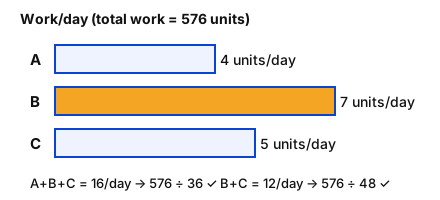
- Total work = LCM(36, 48) = 144 units. (A+B+C) = 4/day, (B+C) = 3/day → A = 1/day.
- B is 75% more efficient than A → B = /day; C = /day. To avoid decimals multiply by 4: work = 576, A = 4, B = 7, C = 5, total 16/day.
- Work done in 15 days = ; remaining = .
- B alone: days.
Trick: 15 of 36 days done → of work left; B does per day → .
Answer: (A) 48 days
अवधारणा: कुल कार्य = LCM; दक्षता-अनुपात को प्रतिदिन इकाइयों में बदलें।
- कुल कार्य = LCM(36, 48) = 144 इकाई। (A+B+C) = 4/दिन, (B+C) = 3/दिन → A = 1/दिन।
- B, A से 75% अधिक दक्ष → B = /दिन; C = /दिन। दशमलव हटाने के लिए 4 से गुणा: कार्य = 576, A = 4, B = 7, C = 5, कुल 16/दिन।
- 15 दिन में कार्य = ; शेष = ।
- B अकेला: दिन।
ट्रिक: 36 में से 15 दिन हो गए → कार्य शेष; B प्रतिदिन करता है → ।
उत्तर: (A) 48 days
RRB NTPC Graduate CBT 1MathematicsTime and Work – EfficiencyRRB NTPC Graduate CBT 1 2025 · 19 Mar Shift 1
Q437.The number of ordered pair of positive integral solutions (a, b) such that the HCF of a and b is 28 and a + b = 868 is
धनात्मक पूर्णांक हलों के क्रमित युग्मों (ordered pairs) (a, b) की संख्या, जिनके लिए a और b का HCF 28 है तथा a + b = 868 है, है
- A20
- B25
- C15
- D30
Show answer
Concept: If HCF(a, b) = 28, write , with HCF(x, y) = 1.
- .
- 31 is prime, so any pair with is automatically co-prime (a common factor of x and y would divide 31).
- x can be 1, 2, …, 30 → 30 ordered pairs (a, b).
Trick: Number of co-prime ordered pairs with sum n = ; for prime 31 it is 30.
Answer: (D) 30
अवधारणा: HCF(a, b) = 28 हो तो , जहाँ HCF(x, y) = 1।
- ।
- 31 अभाज्य है, अतः वाला हर युग्म स्वतः सह-अभाज्य है (x, y का उभयनिष्ठ गुणनखंड 31 को विभाजित करता)।
- x = 1, 2, …, 30 → 30 क्रमित युग्म (a, b)।
ट्रिक: योग n वाले सह-अभाज्य क्रमित युग्मों की संख्या = ; अभाज्य 31 के लिए 30।
उत्तर: (D) 30
RRB NTPC Graduate CBT 1MathematicsHCF – Co-prime PairsRRB NTPC Graduate CBT 1 2025 · 19 Mar Shift 1
Q438.The volume of a cylindrical tank is 1584 cubic meters. If the height of the tank is 14 m, then find the diameter of the tank.
एक बेलनाकार टंकी का आयतन 1584 घन मीटर है। यदि टंकी की ऊँचाई 14 m है, तो टंकी का व्यास ज्ञात करें।
- A6 m
- B12 m
- C18 m
- D9 m
Show answer
Concept: Volume of a cylinder .
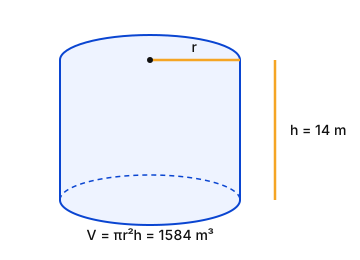
- .
- m.
- Diameter m.
Trick: ; so .
Answer: (B) 12 m
अवधारणा: बेलन का आयतन ।
- ।
- m।
- व्यास m।
ट्रिक: ; अतः ।
उत्तर: (B) 12 m
RRB NTPC Graduate CBT 1MathematicsMensuration – CylinderRRB NTPC Graduate CBT 1 2025 · 19 Mar Shift 1
Q439.There are 46 members in group A, 15 members in group B and 11 members in group C. All the members of these groups went to a restaurant. The average amounts spent on each member of groups A, B and C are ₹496, ₹106 and ₹406, respectively. The overall average amount (in ₹) spent per member is:
समूह A में 46 सदस्य, समूह B में 15 सदस्य और समूह C में 11 सदस्य हैं। इन समूहों के सभी सदस्य एक रेस्तरां में गए। समूह A, B और C के प्रत्येक सदस्य पर खर्च की गई औसत राशि क्रमशः ₹496, ₹106 और ₹406 है। प्रति सदस्य खर्च की गई समग्र औसत राशि (₹ में) है:
- A403
- B396
- C399
- D401
Show answer
Concept: Overall average = total amount ÷ total members.
- Total = .
- Members = .
- Average = .
Trick: Deviations from 400: ; → 401.
Answer: (D) 401
अवधारणा: कुल औसत = कुल राशि ÷ कुल सदस्य।
- कुल = ।
- सदस्य = ।
- औसत = ।
ट्रिक: 400 से विचलन: ; → 401।
उत्तर: (D) 401
RRB NTPC Graduate CBT 1MathematicsWeighted AverageRRB NTPC Graduate CBT 1 2025 · 19 Mar Shift 1
Q440.If , , and , then what is the value of ?
यदि , , और है, तो का मान क्या है?
- A520
- B320
- C260
- D160
Show answer
Concept: .
- .
- .
- .
Trick: Check consistency: ✓, so the data fits.
Answer: (B) 320
अवधारणा: ।
- ।
- ।
- ।
ट्रिक: जाँच: ✓, अतः आँकड़े सही हैं।
उत्तर: (B) 320
RRB NTPC Graduate CBT 1MathematicsAlgebraic IdentitiesRRB NTPC Graduate CBT 1 2025 · 19 Mar Shift 1

