Q501.In an election between two candidates, 86% of the registered voters cast their vote and 20% of the votes polled were found invalid. Winning candidate got 55% of the valid votes and won the election by a margin of 3010 votes. How many voters were registered?
दो उम्मीदवारों के बीच हुए एक चुनाव में, पंजीकृत मतदाताओं के 86% ने अपना मत डाला और डाले गए मतों के 20% अवैध पाए गए। विजेता उम्मीदवार को वैध मतों के 55% मत मिले और उसने 3010 मतों के अंतर से चुनाव जीता। कितने मतदाता पंजीकृत थे?
- A43750
- B43740
- C43760
- D43770
Show answer
Concept: Margin (winner's loser's ) of valid votes.
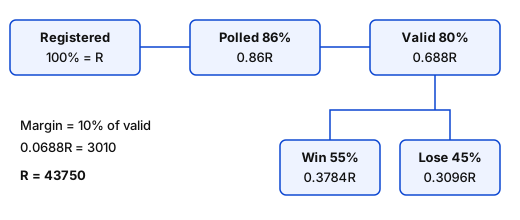
- Let registered voters . Polled ; valid of polled .
- Winner , loser → margin of valid .
- .
Trick: Chain the percentages: .
Answer: (A) 43750
अवधारणा: जीत का अंतर वैध मतों का (विजेता पराजित )।
- पंजीकृत मतदाता मानें। डाले गए ; वैध डाले गए का ।
- विजेता , पराजित → अंतर वैध का ।
- ।
ट्रिक: प्रतिशतों की श्रृंखला बनाएँ: ।
उत्तर: (A) 43750
RRB NTPC Graduate CBT 1MathematicsPercentage – ElectionsRRB NTPC Graduate CBT 1 2025 · 18 Mar Shift 2
Q502.9 : 81 :: 2.5 : x and 3 : 6 :: 5 : y. What is the ratio of x to y?
9 : 81 :: 2.5 : x और 3 : 6 :: 5 : y। x और y का अनुपात क्या है?
- A10 : 2
- B13 : 14
- C9 : 4
- D5 : 3
Show answer
Concept: In , .
- .
- .
- .
Trick: is , is ; apply the same multipliers to and .
Answer: (C)
अवधारणा: में ।
- ।
- ।
- ।
ट्रिक: में , में ; वही गुणक और पर लगाएँ।
उत्तर: (C)
RRB NTPC Graduate CBT 1MathematicsProportionRRB NTPC Graduate CBT 1 2025 · 18 Mar Shift 2
Q503.At present, Vanraj is three times as old as his son, and his daughter is 3 years younger than the son. If the sum of the ages of these three people 3 years ago was 73 years, then Vanraj's present age (in years) is:
वर्तमान में, वनराज की आयु अपने पुत्र की आयु की तीन गुनी है, और उसकी पुत्री पुत्र से 3 वर्ष छोटी है। यदि 3 वर्ष पहले इन तीनों व्यक्तियों की आयु का योग 73 वर्ष था, तो वनराज की वर्तमान आयु (वर्षों में) है:
- A51
- B60
- C53
- D57
Show answer
Concept: Express all present ages in one variable, then go back 3 years for each person.
- Son , Vanraj , daughter .
- 3 years ago: .
- ; Vanraj .
Trick: Present sum .
Answer: (A) 51
अवधारणा: सभी वर्तमान आयु एक चर में लिखें, फिर हर व्यक्ति से 3 वर्ष घटाएँ।
- पुत्र , वनराज , पुत्री ।
- 3 वर्ष पहले: ।
- ; वनराज ।
ट्रिक: वर्तमान योग ।
उत्तर: (A) 51
RRB NTPC Graduate CBT 1MathematicsAgesRRB NTPC Graduate CBT 1 2025 · 18 Mar Shift 2
Q504.The mean proportion of 15 and 72.6 is:
15 और 72.6 का मध्यानुपाती (mean proportion) है:
- A33
- B36
- C32
- D28
Show answer
Concept: Mean proportion of and .
- .
- (since ).
Trick: and → ; remember .
Answer: (A) 33
अवधारणा: और का मध्यानुपाती ।
- ।
- (क्योंकि )।
ट्रिक: और → ; याद रखें।
उत्तर: (A) 33
RRB NTPC Graduate CBT 1MathematicsMean ProportionRRB NTPC Graduate CBT 1 2025 · 18 Mar Shift 2
Q505.A and B complete a work in 21 days. If A alone can do it in 24 days, then B alone can do three-fourth of the same work in ______________days.
A और B एक काम को 21 दिनों में पूरा करते हैं। यदि A अकेला इसे 24 दिनों में कर सकता है, तो B अकेला उसी काम का तीन-चौथाई भाग ______________ दिनों में कर सकता है।
- A140
- B126
- C132
- D168
Show answer
Concept: Take total work units.
- (A+B) per day units; A per day units.
- B per day unit → B alone finishes in days.
- Three-fourth of the work: days.
Trick: B's time ; then take .
Answer: (B) 126
अवधारणा: कुल कार्य इकाई लें।
- (A+B) प्रतिदिन इकाई; A प्रतिदिन इकाई।
- B प्रतिदिन इकाई → B अकेला दिन में पूरा करेगा।
- तीन-चौथाई कार्य: दिन।
ट्रिक: B का समय ; फिर लें।
उत्तर: (B) 126
RRB NTPC Graduate CBT 1MathematicsTime and WorkRRB NTPC Graduate CBT 1 2025 · 18 Mar Shift 2
Q506.The highest common factor (HCF) of two numbers is one-fifth of the first number and one-third of the second number. The HCF is a two-digit prime number. The HCF of three times the first number and five times the second number is a number which is the product of ________.
दो संख्याओं का महत्तम समापवर्तक (HCF) पहली संख्या का एक-पाँचवाँ और दूसरी संख्या का एक-तिहाई है। HCF एक दो-अंकीय अभाज्य संख्या है। पहली संख्या के तीन गुने और दूसरी संख्या के पाँच गुने का HCF एक ऐसी संख्या है जो ________ का गुणनफल है।
- Afive prime numbersपाँच अभाज्य संख्याओं
- Bfour prime numbersचार अभाज्य संख्याओं
- Ctwo prime numbersदो अभाज्य संख्याओं
- Dthree prime numbersतीन अभाज्य संख्याओं
Show answer
Concept: If HCF , write the numbers as multiples of with coprime cofactors.
- First number , second ( and are coprime, so HCF is indeed ).
- first and second → their HCF .
- , where is a two-digit prime → product of three prime numbers.
Trick: Test with : numbers 55 and 33 → and → HCF .
Answer: (D) three prime numbers
अवधारणा: HCF हो तो संख्याओं को के गुणज लिखें जिनके सह-गुणनखंड सह-अभाज्य हों।
- पहली संख्या , दूसरी ( और सह-अभाज्य हैं, अतः HCF वास्तव में )।
- पहली और दूसरी → HCF ।
- , जहाँ दो-अंकीय अभाज्य → तीन अभाज्य संख्याओं का गुणनफल।
ट्रिक: लेकर जाँचें: संख्याएँ 55 और 33 → और → HCF ।
उत्तर: (D) three prime numbers (तीन अभाज्य संख्याएँ)
RRB NTPC Graduate CBT 1MathematicsHCFRRB NTPC Graduate CBT 1 2025 · 18 Mar Shift 2
Q507.By selling an article at of its marked price, Aman incurs a loss of 21%. If he sells it at 56% of its marked price, then the profit percentage is
किसी वस्तु को उसके अंकित मूल्य के पर बेचने से अमन को 21% की हानि होती है। यदि वह इसे अंकित मूल्य के 56% पर बेचता है, तो लाभ प्रतिशत है
- A11.6%
- B12.1%
- C10.6%
- D12.8%
Show answer
Concept: Take the marked price (MP) as a convenient number; find the cost price from the loss case, then apply it to the new selling price.
- Let MP . First SP , which gives a loss, so .
- New SP of .
- .
Trick: ; so the new multiplier on CP is , i.e. profit – no need to find CP at all.
Answer: (C) 10.6%
अवधारणा: अंकित मूल्य (MP) को सुविधाजनक संख्या मानें; हानि वाली स्थिति से क्रय मूल्य निकालें, फिर नए विक्रय मूल्य पर लगाएँ।
- माना MP । पहला SP , जिस पर हानि है, अतः ।
- नया SP का ।
- ।
ट्रिक: ; अतः CP पर नया गुणक , यानी लाभ – CP निकालने की ज़रूरत ही नहीं।
उत्तर: (C) 10.6%
RRB NTPC Graduate CBT 1MathematicsProfit and LossRRB NTPC Graduate CBT 1 2025 · 18 Mar Shift 2
Q508.In a cricket match, a team needs 300 runs in 50 overs to win. In the first 15 overs, the team scores at an average rate of 5 runs per over. In the next 15 overs, the scoring rate improves to 8 runs per over. In the following 10 overs, the rate drops to 4 runs per over. What should be the run rate per over required in the remaining overs to win the match?
एक क्रिकेट मैच में, एक टीम को जीतने के लिए 50 ओवरों में 300 रन चाहिए। पहले 15 ओवरों में टीम 5 रन प्रति ओवर की औसत दर से रन बनाती है। अगले 15 ओवरों में रन बनाने की दर बढ़कर 8 रन प्रति ओवर हो जाती है। उसके बाद के 10 ओवरों में दर घटकर 4 रन प्रति ओवर हो जाती है। मैच जीतने के लिए शेष ओवरों में प्रति ओवर आवश्यक रन दर क्या होनी चाहिए?
- A6.75 runs per over6.75 रन प्रति ओवर
- B7.5 runs per over7.5 रन प्रति ओवर
- C6.5 runs per over6.5 रन प्रति ओवर
- D6.95 runs per over6.95 रन प्रति ओवर
Show answer
Concept: Runs scored run rate overs. Find the runs already scored, subtract from the target and divide by the remaining overs.
- Runs so far: .
- Overs used , so overs remain.
- Runs still needed ; required rate runs per over.
Trick: Always total the overs first – here of are gone, so the whole question reduces to "65 in 10".
Answer: (C) 6.5 runs per over
अवधारणा: बनाए गए रन रन रेट ओवर। अब तक के रन निकालें, लक्ष्य से घटाएँ और बचे ओवरों से भाग दें।
- अब तक के रन: ।
- खेले गए ओवर , अतः ओवर शेष।
- आवश्यक रन ; आवश्यक रेट रन प्रति ओवर।
ट्रिक: पहले ओवर जोड़ लें – में से निकल चुके हैं, तो पूरा सवाल "10 ओवर में 65" रह जाता है।
उत्तर: (C) 6.5 रन प्रति ओवर
RRB NTPC Graduate CBT 1MathematicsAverage / Run RateRRB NTPC Graduate CBT 1 2025 · 18 Mar Shift 2
Q509.In the given figure, lines l, m, and n are parallel to one another. Find the value of x + y.
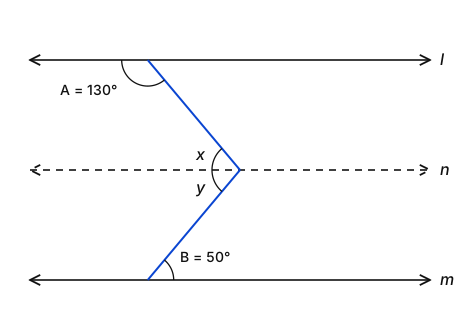
दी गई आकृति में, रेखाएँ l, m और n एक-दूसरे के समांतर हैं। x + y का मान ज्ञात कीजिए।
- A110°
- B100°
- C80°
- D130°
Show answer
Concept: For parallel lines cut by a transversal, alternate interior angles are equal and angles on a straight line add to .
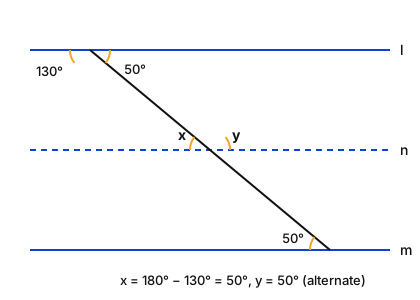
- At line the given angle is , so the interior angle made with the transversal is .
- , so (alternate interior angle at ) .
- and the angle at is , so (alternate interior).
- .
Trick: With a "bent" transversal through a middle parallel line, the angle at the bend always splits into the two alternate angles from the outer lines.
Answer: (B)
अवधारणा: समांतर रेखाओं को एक तिर्यक रेखा काटे तो एकांतर अंतः कोण बराबर होते हैं और सरल रेखा पर कोणों का योग होता है।
- रेखा पर दिया कोण है, अतः तिर्यक रेखा से बना अंतः कोण ।
- , अतः ( पर एकांतर अंतः कोण) ।
- और पर कोण है, अतः ।
- ।
ट्रिक: बीच की समांतर रेखा पर "मुड़ी" तिर्यक रेखा हो तो मोड़ वाला कोण हमेशा बाहरी रेखाओं के दो एकांतर कोणों में बँटता है।
उत्तर: (B)
RRB NTPC Graduate CBT 1MathematicsLines and AnglesRRB NTPC Graduate CBT 1 2025 · 18 Mar Shift 2
Q510.A typist takes 40 minutes to type 2 pages. How long (in minutes) will he take to type 83 pages?
एक टाइपिस्ट 2 पृष्ठ टाइप करने में 40 मिनट लेता है। 83 पृष्ठ टाइप करने में उसे कितना समय (मिनटों में) लगेगा?
- A1650
- B1665
- C1660
- D1670
Show answer
Concept: Time is directly proportional to the number of pages – find the time for one page first.
- Time per page minutes.
- Time for pages minutes.
Trick: – just double and add a zero: .
Answer: (C) 1660
अवधारणा: समय पृष्ठों की संख्या के समानुपाती है – पहले एक पृष्ठ का समय निकालें।
- प्रति पृष्ठ समय मिनट।
- पृष्ठों का समय मिनट।
ट्रिक: – का दोगुना कर शून्य लगाएँ: ।
उत्तर: (C) 1660
RRB NTPC Graduate CBT 1MathematicsUnitary MethodRRB NTPC Graduate CBT 1 2025 · 18 Mar Shift 2
Q511.Simplify:
सरल कीजिए:
- A50.8
- B50.4
- C50.6
- D50.2
Show answer
Concept: Count decimal places in numerator and denominator, cancel them, then multiply the remaining integers.
- .
- and , so the fraction becomes .
- Net decimal shift : .
Trick: Numerator has decimal places, denominator ; the answer therefore has decimal place.
Answer: (B) 50.4
अवधारणा: अंश और हर में दशमलव स्थान गिनें, उन्हें काटें, फिर बचे पूर्णांकों का गुणा करें।
- ।
- और , अतः भिन्न ।
- कुल दशमलव खिसकाव : ।
ट्रिक: अंश में दशमलव स्थान, हर में ; अतः उत्तर में दशमलव स्थान होगा।
उत्तर: (B) 50.4
RRB NTPC Graduate CBT 1MathematicsSimplification – DecimalsRRB NTPC Graduate CBT 1 2025 · 18 Mar Shift 2
Q512.Evaluate: (-9) - (-56) ÷ (-14) + (-2) × 7
मान ज्ञात कीजिए: (-9) - (-56) ÷ (-14) + (-2) × 7
- A-26
- B-30
- C-29
- D-27
Show answer
Concept: Do division and multiplication first (left to right), then addition and subtraction. Watch the signs of negative numbers.
- and .
- Expression becomes .
- .
Trick: Negative negative is positive, but here it is being subtracted, so it ends up as – the most common slip.
Answer: (D)
अवधारणा: पहले भाग और गुणा (बाएँ से दाएँ), फिर जोड़ और घटाव करें। ऋणात्मक संख्याओं के चिह्नों पर ध्यान दें।
- और ।
- व्यंजक बनता है ।
- ।
ट्रिक: ऋण ऋण धन होता है, पर यहाँ उसे घटाया जा रहा है, इसलिए वह बनता है – यही सबसे आम ग़लती है।
उत्तर: (D)
RRB NTPC Graduate CBT 1MathematicsBODMAS with IntegersRRB NTPC Graduate CBT 1 2025 · 18 Mar Shift 2
Q513.A hemispherical tank filled with water is being emptied through a pipe at a rate of 115.5 litres per second. If the tank has an internal radius of 31.5 m, determine the time required to drain 50% of the tank's water. (Use )
पानी से भरी एक अर्धगोलाकार टंकी को एक पाइप द्वारा 115.5 लीटर प्रति सेकंड की दर से खाली किया जा रहा है। यदि टंकी की आंतरिक त्रिज्या 31.5 m है, तो टंकी के 50% पानी को निकालने में लगने वाला समय ज्ञात कीजिए। ( का प्रयोग कीजिए)
- A75 hours 48 minutes75 घंटे 48 मिनट
- B78 hours 75 minutes78 घंटे 75 मिनट
- C78 hours 45 minutes78 घंटे 45 मिनट
- D78 hours 15 minutes78 घंटे 15 मिनट
Show answer
Concept: Volume of a hemisphere ; litres. Time .
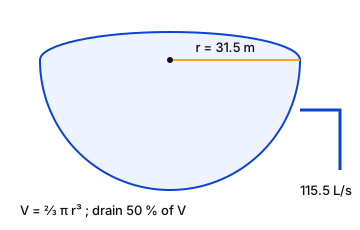
- .
- Half the water litres.
- Time seconds hours hours minutes.
Trick: , and is divisible by and – cancel before multiplying: .
Answer: (C) 78 hours 45 minutes
अवधारणा: अर्धगोले का आयतन ; लीटर। समय ।
- ।
- आधा पानी लीटर।
- समय सेकंड घंटे घंटे मिनट।
ट्रिक: , और , व से विभाज्य है – गुणा से पहले काटें: ।
उत्तर: (C) 78 घंटे 45 मिनट
RRB NTPC Graduate CBT 1MathematicsMensuration – HemisphereRRB NTPC Graduate CBT 1 2025 · 18 Mar Shift 2
Q514.Two trains are moving in opposite directions at speeds of 140 km/hr and 70 km/hr. The length of one train is 350 m. The time taken by them to cross each other is 11 seconds. The length (in m, rounded off to 2 decimal places) of the other train is:
दो रेलगाड़ियाँ 140 km/hr और 70 km/hr की चाल से विपरीत दिशाओं में चल रही हैं। एक रेलगाड़ी की लंबाई 350 m है। उन्हें एक-दूसरे को पार करने में 11 सेकंड लगते हैं। दूसरी रेलगाड़ी की लंबाई (m में, दो दशमलव स्थानों तक पूर्णांकित) है:
- A293.51
- B291.67
- C288.08
- D289.34
Show answer
Concept: Trains moving in opposite directions cross each other at their relative speed (sum of speeds), covering the sum of their lengths.
- Relative speed .
- Total length covered in s m.
- Other train m.
Trick: : , then gives – do the km/h→m/s conversion last.
Answer: (B) 291.67
अवधारणा: विपरीत दिशा में चलती रेलगाड़ियाँ सापेक्ष चाल (चालों का योग) से एक-दूसरे को पार करती हैं और लंबाइयों का योग तय करती हैं।
- सापेक्ष चाल ।
- s में तय कुल लंबाई m।
- दूसरी रेलगाड़ी m।
ट्रिक: : , फिर से – km/h→m/s रूपांतरण अंत में करें।
उत्तर: (B) 291.67
RRB NTPC Graduate CBT 1MathematicsTrainsRRB NTPC Graduate CBT 1 2025 · 18 Mar Shift 2
Q515.A car leaves place Z at 2 PM and moves towards place T which is at a distance of D km at a uniform speed. A bus leaves place T at 3 PM and moves towards place Z at a uniform speed. The speed of car is half of bus. If they meet 04:40 PM at a point which is 184 km away from Z. The value of D is:
एक कार स्थान Z से दोपहर 2 बजे निकलती है और एकसमान चाल से स्थान T की ओर चलती है, जो D km की दूरी पर है। एक बस स्थान T से दोपहर 3 बजे निकलती है और एकसमान चाल से स्थान Z की ओर चलती है। कार की चाल बस की चाल की आधी है। यदि वे Z से 184 km दूर एक बिंदु पर 04:40 PM पर मिलती हैं, तो D का मान है:
- A414
- B423
- C420
- D405
Show answer
Concept: Distance speed time. Each vehicle travels for a different time before they meet; the two distances add up to .
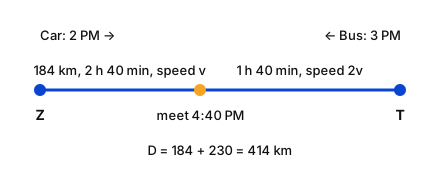
- Car travels from 2 PM to 4:40 PM h and covers km, so its speed .
- Bus speed ; it travels from 3 PM to 4:40 PM h → km.
- km.
Trick: Bus is twice as fast but travels of the car's time, so bus distance – no need to find speeds.
Answer: (A) 414
अवधारणा: दूरी चाल समय। मिलने से पहले दोनों वाहन अलग-अलग समय चलते हैं; दोनों दूरियों का योग है।
- कार 2 PM से 4:40 PM h चलकर km तय करती है, अतः चाल ।
- बस की चाल ; वह 3 PM से 4:40 PM h चलती है → km।
- km।
ट्रिक: बस दोगुनी तेज़ है पर कार के समय का चलती है, अतः बस की दूरी – चाल निकालने की ज़रूरत नहीं।
उत्तर: (A) 414
RRB NTPC Graduate CBT 1MathematicsTime, Speed and DistanceRRB NTPC Graduate CBT 1 2025 · 18 Mar Shift 2
Q516.A vendor bought oranges at the rate of 40 oranges for ₹220, and sold them at ₹98 per dozen. Find his profit or loss percent. (Round off to two decimal places.)
एक विक्रेता ने ₹220 में 40 संतरे की दर से संतरे खरीदे और उन्हें ₹98 प्रति दर्जन की दर से बेच दिया। उसका लाभ या हानि प्रतिशत ज्ञात कीजिए। (दो दशमलव स्थानों तक पूर्णांकित कीजिए।)
- AProfit 48.48%लाभ 48.48%
- BLoss 28.56%हानि 28.56%
- CLoss 48.48%हानि 48.48%
- DProfit 28.56%लाभ 28.56%
Show answer
Concept: Compare cost and selling price of the same number of oranges, then .
- CP of 1 orange ; SP of 1 orange .
- SP CP, so there is a profit of per orange.
- .
Trick: Take LCM of 40 and 12 oranges: CP , SP ; profit .
Answer: (A) Profit 48.48%
अवधारणा: समान संख्या में संतरों का क्रय और विक्रय मूल्य तुलना करें, फिर ।
- 1 संतरे का CP ; 1 संतरे का SP ।
- SP CP, अतः प्रति संतरा लाभ ।
- ।
ट्रिक: 40 और 12 का LCM संतरे लें: CP , SP ; लाभ ।
उत्तर: (A) लाभ 48.48%
RRB NTPC Graduate CBT 1MathematicsProfit and LossRRB NTPC Graduate CBT 1 2025 · 18 Mar Shift 2
Q517.In what duration (in years) will ₹6,000 fetch a simple interest of ₹1,080 at 6% per annum rate of interest?
कितनी अवधि (वर्षों में) में ₹6,000 पर 6% वार्षिक ब्याज दर से ₹1,080 का साधारण ब्याज प्राप्त होगा?
- A6
- B4
- C3
- D2
Show answer
Concept: , so .
- years.
- Check: per year; ✓.
Trick: Interest per year of ; just see how many 360s make 1080.
Answer: (C) 3
अवधारणा: , अतः ।
- वर्ष।
- जाँच: का प्रति वर्ष; ✓।
ट्रिक: प्रति वर्ष ब्याज का ; बस देखें 1080 में कितने 360 हैं।
उत्तर: (C) 3
RRB NTPC Graduate CBT 1MathematicsSimple InterestRRB NTPC Graduate CBT 1 2025 · 18 Mar Shift 2
Q518.Let ABC be a right-angled triangle such that ∠B = 90°. If tan A = 1, then find the value of cosec A sec A.
मान लीजिए ABC एक समकोण त्रिभुज है जिसमें ∠B = 90° है। यदि tan A = 1 है, तो cosec A sec A का मान ज्ञात कीजिए।
- A4
- B2
- C1
- D3
Show answer
Concept: means ; also .
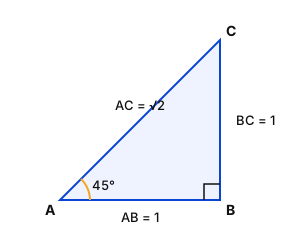
- , so and – an isosceles right triangle with .
- and .
- .
Trick: – works for any angle.
Answer: (B) 2
अवधारणा: का अर्थ ; साथ ही ।
- , अतः और – समद्विबाहु समकोण त्रिभुज जिसमें ।
- और ।
- ।
ट्रिक: – किसी भी कोण के लिए काम करता है।
उत्तर: (B) 2
RRB NTPC Graduate CBT 1MathematicsTrigonometryRRB NTPC Graduate CBT 1 2025 · 18 Mar Shift 2
Q519.The price of each article of type P, Q, and R is ₹280, ₹180 and ₹115, respectively. Rohit buys articles of each type in the ratio 4 : 2 : 7 for ₹6,855. How many articles of type Q did he purchase?
P, Q और R प्रकार की प्रत्येक वस्तु का मूल्य क्रमशः ₹280, ₹180 और ₹115 है। रोहित प्रत्येक प्रकार की वस्तुएँ 4 : 2 : 7 के अनुपात में ₹6,855 में खरीदता है। उसने Q प्रकार की कितनी वस्तुएँ खरीदीं?
- A12
- B6
- C14
- D3
Show answer
Concept: Write the quantities as and equate the total cost to the amount paid.
- Total cost .
- .
- Articles of type Q .
Trick: : exactly – spot that ends in 5 and is just under 7000.
Answer: (B) 6
अवधारणा: मात्राओं को लिखें और कुल लागत को चुकाई गई राशि के बराबर रखें।
- कुल लागत ।
- ।
- Q प्रकार की वस्तुएँ ।
ट्रिक: : ठीक-ठीक – देखें कि का अंत 5 पर है और 7000 से ज़रा कम।
उत्तर: (B) 6
RRB NTPC Graduate CBT 1MathematicsRatio and Linear EquationsRRB NTPC Graduate CBT 1 2025 · 18 Mar Shift 2
Q520.Evaluate: 16 + 20 ÷ 5 - 3 × 3
मान ज्ञात कीजिए: 16 + 20 ÷ 5 - 3 × 3
- A13
- B10
- C14
- D11
Show answer
Concept: Division and multiplication come before addition and subtraction.
- and .
- .
Trick: Circle every and group first, replace it by its value, then add/subtract in one line.
Answer: (D) 11
अवधारणा: भाग और गुणा, जोड़ और घटाव से पहले होते हैं।
- और ।
- ।
ट्रिक: पहले हर और समूह को घेरें, उसका मान रखें, फिर एक पंक्ति में जोड़/घटाव करें।
उत्तर: (D) 11
RRB NTPC Graduate CBT 1MathematicsBODMASRRB NTPC Graduate CBT 1 2025 · 18 Mar Shift 2

