Q521.Read the given statements and conclusions carefully. You have to take the given statements to be true even if they seem to be at variance from commonly known facts. You have to decide which conclusion/s logically follow/s from the given statements. Statements:
All vultures are sparrows. Some sparrows are crows. No crow is a pigeon.
Conclusions:
(I) Some vultures are crows.
(II) No sparrow is a pigeon.
दिए गए कथनों और निष्कर्षों को ध्यानपूर्वक पढ़िए। आपको दिए गए कथनों को सत्य मानना है, भले ही वे सामान्यतः ज्ञात तथ्यों से भिन्न प्रतीत होते हों। आपको निर्णय करना है कि कौन-सा/कौन-से निष्कर्ष दिए गए कथनों का तार्किक रूप से अनुसरण करता है/करते हैं। कथन:
सभी गिद्ध गौरैया हैं। कुछ गौरैया कौए हैं। कोई कौआ कबूतर नहीं है।
निष्कर्ष:
(I) कुछ गिद्ध कौए हैं।
(II) कोई गौरैया कबूतर नहीं है।
- AOnly conclusion II follows.केवल निष्कर्ष II अनुसरण करता है।
- BOnly conclusion I follows.केवल निष्कर्ष I अनुसरण करता है।
- CNeither conclusion I nor II follows.न तो निष्कर्ष I और न ही II अनुसरण करता है।
- DBoth conclusions I and II follow.निष्कर्ष I और II दोनों अनुसरण करते हैं।
Show answer
Concept: A conclusion follows only if it is true in every possible Venn diagram of the statements.
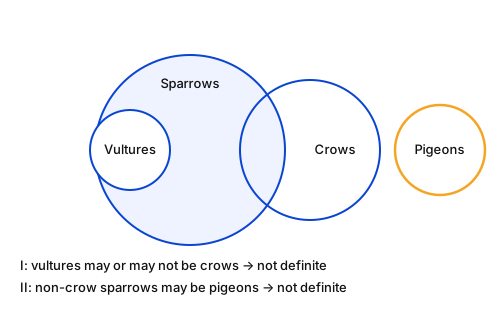
- All vultures are sparrows; some sparrows are crows – the crow-part of sparrows may lie entirely outside vultures, so "Some vultures are crows" is not definite.
- No crow is a pigeon tells us nothing about non-crow sparrows – they may be pigeons, so "No sparrow is a pigeon" is not definite.
- Neither conclusion follows.
Trick: "Some B are C" plus "No C is D" never gives a definite statement about all of B – only "Some B are not D".
Answer: (C) Neither conclusion I nor II follows.
अवधारणा: निष्कर्ष तभी अनुसरण करता है जब वह कथनों के हर संभव Venn आरेख में सत्य हो।
- सभी गिद्ध गौरैया हैं; कुछ गौरैया कौवे हैं – गौरैया का कौवा-भाग गिद्धों से पूरी तरह बाहर हो सकता है, अतः "कुछ गिद्ध कौवे हैं" निश्चित नहीं।
- "कोई कौवा कबूतर नहीं" गैर-कौवा गौरैयों के बारे में कुछ नहीं कहता – वे कबूतर हो सकती हैं, अतः "कोई गौरैया कबूतर नहीं" निश्चित नहीं।
- कोई निष्कर्ष अनुसरण नहीं करता।
ट्रिक: "कुछ B, C हैं" + "कोई C, D नहीं" से पूरे B के बारे में निश्चित कथन कभी नहीं मिलता – केवल "कुछ B, D नहीं हैं"।
उत्तर: (C) न तो निष्कर्ष I न II अनुसरण करता है।
RRB NTPC Graduate CBT 1General Intelligence and ReasoningSyllogismRRB NTPC Graduate CBT 1 2025 · 18 Mar Shift 1
Q522.What should come in place of the question mark (?) in the given series?
23 24 28 37 53 ?
दी गई शृंखला में प्रश्नचिह्न (?) के स्थान पर क्या आना चाहिए?
23 24 28 37 53 ?
- A82
- B76
- C78
- D80
Show answer
Concept: Differences between consecutive terms often form squares.
- , , , .
- Differences are ; next difference .
- .
Trick: Differences 1, 4, 9, 16 → perfect squares; add 25 next.
Answer: (C) 78
अवधारणा: क्रमागत पदों के अंतर प्रायः वर्ग संख्याएँ बनाते हैं।
- , , , ।
- अंतर हैं; अगला अंतर ।
- ।
ट्रिक: अंतर 1, 4, 9, 16 → पूर्ण वर्ग; आगे 25 जोड़ें।
उत्तर: (C) 78
RRB NTPC Graduate CBT 1General Intelligence and ReasoningNumber seriesRRB NTPC Graduate CBT 1 2025 · 18 Mar Shift 1
Q523.Below are given two sets of numbers. In each set of numbers, a certain mathematical operation on the first number results in the second number. Similarly, certain
mathematical operations on the second number results in the third number and so on. Which of the given options follows the same set of operations as in question? (NOTE – A two/three-digit number cannot be broken into individual digits for operations, e.g., if 37 is followed by 10, the operation cannot be 3+7 as a two-digit number cannot be broken into individual digits.)
12 – 36 – 51 – 63; 20 – 60 – 75 – 87
नीचे संख्याओं के दो समुच्चय दिए गए हैं। संख्याओं के प्रत्येक समुच्चय में, पहली संख्या पर एक निश्चित गणितीय संक्रिया करने से दूसरी संख्या प्राप्त होती है। इसी प्रकार, दूसरी संख्या पर कुछ
गणितीय संक्रियाएँ करने से तीसरी संख्या प्राप्त होती है, और इसी प्रकार आगे। दिए गए विकल्पों में से कौन-सा प्रश्न के समान संक्रियाओं के समुच्चय का अनुसरण करता है? (नोट – संक्रियाओं के लिए दो/तीन-अंकीय संख्या को अलग-अलग अंकों में नहीं तोड़ा जा सकता, उदाहरण के लिए, यदि 37 के बाद 10 आता है, तो संक्रिया 3+7 नहीं हो सकती क्योंकि दो-अंकीय संख्या को अलग-अलग अंकों में नहीं तोड़ा जा सकता।)
12 – 36 – 51 – 63; 20 – 60 – 75 – 87
- A14 – 42 – 57 – 79
- B25 – 75 – 90 – 102
- C16 – 48 – 63 – 85
- D10 – 30 – 55 – 67
Show answer
Concept: Find the operation between each pair of consecutive numbers and apply the same chain to the options.
- 12 → 36: ; 36 → 51: ; 51 → 63: .
- 20 → 60: ; 60 → 75: ; 75 → 87: . Chain: .
- Option B: , , ✓.
- A: ; C: ; D: .
Trick: Check the last step first – only option B ends with "+12".
Answer: (B) 25 – 75 – 90 – 102
अवधारणा: हर क्रमागत जोड़ी के बीच की संक्रिया निकालें और वही श्रृंखला विकल्पों पर लगाएँ।
- 12 → 36: ; 36 → 51: ; 51 → 63: ।
- 20 → 60: ; 60 → 75: ; 75 → 87: । श्रृंखला: ।
- विकल्प B: , , ✓।
- A: ; C: ; D: ।
ट्रिक: पहले अंतिम चरण जाँचें – केवल विकल्प B "+12" पर समाप्त होता है।
उत्तर: (B) 25 – 75 – 90 – 102
RRB NTPC Graduate CBT 1General Intelligence and ReasoningNumber operations analogyRRB NTPC Graduate CBT 1 2025 · 18 Mar Shift 1
Q524.Each of M, N, O, P, Q, R and S has an flight on a different day of a week starting from Monday and ending on Sunday of the same week. S has flight on third last day of the week. Only two people have flight between R and S. Only four people have flight between R and Q. P has flight immediately after N. M doesn’t have flight on Monday. On which day does M have a flight?
M, N, O, P, Q, R और S में से प्रत्येक की एक ही सप्ताह में सोमवार से शुरू होकर रविवार को समाप्त होने वाले सप्ताह के अलग-अलग दिन उड़ान (flight) है। S की उड़ान सप्ताह के अंत से तीसरे दिन है। R और S के बीच केवल दो व्यक्तियों की उड़ान है। R और Q के बीच केवल चार व्यक्तियों की उड़ान है। P की उड़ान N के ठीक बाद है। M की उड़ान सोमवार को नहीं है। M की उड़ान किस दिन है?
- AWednesdayबुधवार
- BSundayरविवार
- CSaturdayशनिवार
- DFridayशुक्रवार
Show answer
Concept: Number the days Mon = 1 … Sun = 7 and place the fixed person first.
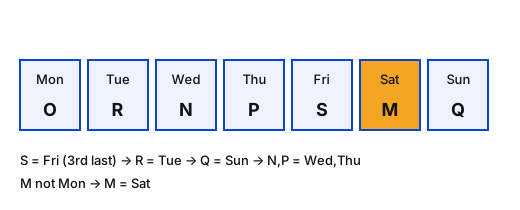
- S is on the third last day → Friday (5).
- Two people between R and S → R is on Tuesday (2) (Monday-side of 8 does not exist).
- Four between R and Q → Q on Sunday (7).
- P is immediately after N: the free consecutive pair is Wed–Thu → N = Wed, P = Thu. Left: Mon and Sat; M is not on Monday → M = Saturday, O = Monday.
Trick: "Third last day" of Mon–Sun is Friday; check the two-sided possibilities but one side always falls outside the week.
Answer: (C) Saturday
अवधारणा: दिनों को Mon = 1 … Sun = 7 क्रमांक दें और पहले निश्चित व्यक्ति को रखें।
- S अंतिम से तीसरे दिन → शुक्रवार (5)।
- R और S के बीच दो लोग → R मंगलवार (2) को (दूसरी ओर दिन 8 नहीं होता)।
- R और Q के बीच चार → Q रविवार (7) को।
- P, N के तुरंत बाद: खाली लगातार जोड़ी Wed–Thu → N = Wed, P = Thu। बचे Mon और Sat; M सोमवार को नहीं → M = शनिवार, O = सोमवार।
ट्रिक: Mon–Sun में "अंतिम से तीसरा दिन" शुक्रवार; दोनों ओर की संभावनाएँ जाँचें, एक ओर हमेशा सप्ताह से बाहर पड़ती है।
उत्तर: (C) Saturday (शनिवार)
RRB NTPC Graduate CBT 1General Intelligence and ReasoningDay-wise schedulingRRB NTPC Graduate CBT 1 2025 · 18 Mar Shift 1
Q525.Select the set in which the numbers are related in the same way as are the numbers of the following sets.
(NOTE : Operations should be performed on the whole numbers, without breaking down the numbers into their constituent digits. E.g. 13 – Operations on 13 such as adding / subtracting / multiplying etc. to 13 can be performed. Breaking down 13 into 1 and 3 and then performing mathematical operations on 1 and 3 is not allowed.)
(7,18,39)
(3,19,28)
उस समुच्चय का चयन कीजिए जिसमें संख्याएँ उसी प्रकार संबंधित हैं जिस प्रकार निम्नलिखित समुच्चयों की संख्याएँ संबंधित हैं।
(नोट : संक्रियाएँ पूर्ण संख्याओं पर की जानी चाहिए, संख्याओं को उनके घटक अंकों में तोड़े बिना। उदाहरण के लिए 13 – 13 पर संक्रियाएँ जैसे 13 में जोड़ना / घटाना / गुणा करना आदि की जा सकती हैं। 13 को 1 और 3 में तोड़कर फिर 1 और 3 पर गणितीय संक्रियाएँ करने की अनुमति नहीं है।)
(7,18,39)
(3,19,28)
- A(16,3,61)
- B(23,4,73)
- C(4,28,20)
- D(10,5,55)
Show answer
Concept: Find one rule linking the three numbers of each given set, then test the options.
- (7, 18, 39): ✓
- (3, 19, 28): ✓ Rule: .
- (23, 4, 73): ✓
- A: ; C: ; D: .
Trick: Third − second gives 21 and 9 → both are the first number.
Answer: (B) (23,4,73)
अवधारणा: दिए गए समुच्चयों की तीनों संख्याओं को जोड़ने वाला नियम निकालें, फिर विकल्प जाँचें।
- (7, 18, 39): ✓
- (3, 19, 28): ✓ नियम: ।
- (23, 4, 73): ✓
- A: ; C: ; D: ।
ट्रिक: तीसरी − दूसरी = 21 और 9 → दोनों पहली संख्या के गुना हैं।
उत्तर: (B) (23,4,73)
RRB NTPC Graduate CBT 1General Intelligence and ReasoningNumber set analogyRRB NTPC Graduate CBT 1 2025 · 18 Mar Shift 1
Q526.This question is based on the five, three-digit numbers given below.
(Left) 564 487 769 478 546 (Right)
(Example- 697 – First digit = 6, second digit = 9 and third digit = 7)
NOTE - All operations to be done from left to right.
What will be the resultant if the second digit of the second highest number is added to the third digit of the lowest number?
यह प्रश्न नीचे दी गई पाँच तीन-अंकीय संख्याओं पर आधारित है।
(बाएँ) 564 487 769 478 546 (दाएँ)
(उदाहरण- 697 – पहला अंक = 6, दूसरा अंक = 9 और तीसरा अंक = 7)
नोट - सभी संक्रियाएँ बाएँ से दाएँ की जानी हैं।
यदि दूसरी सबसे बड़ी संख्या के दूसरे अंक को सबसे छोटी संख्या के तीसरे अंक में जोड़ा जाए, तो परिणाम क्या होगा?
- A10
- B11
- C12
- D14
Show answer
Concept: Rank the numbers first, then pick the required digits.
- Numbers: 564, 487, 769, 478, 546. Descending: 769 > 564 > 546 > 487 > 478.
- Second highest = 564 → second digit = 6.
- Lowest = 478 → third digit = 8.
- .
Trick: 487 vs 478 – compare the tens digit; 478 is the lowest, a deliberate near-miss pair.
Answer: (D) 14
अवधारणा: पहले संख्याओं को क्रम दें, फिर आवश्यक अंक चुनें।
- संख्याएँ: 564, 487, 769, 478, 546। अवरोही: 769 > 564 > 546 > 487 > 478।
- दूसरी सबसे बड़ी = 564 → दूसरा अंक = 6।
- सबसे छोटी = 478 → तीसरा अंक = 8।
- ।
ट्रिक: 487 बनाम 478 – दहाई का अंक देखें; 478 सबसे छोटी है, जानबूझकर रखी गई मिलती-जुलती जोड़ी।
उत्तर: (D) 14
RRB NTPC Graduate CBT 1General Intelligence and ReasoningNumber arrangementRRB NTPC Graduate CBT 1 2025 · 18 Mar Shift 1
Q527.Based on the English alphabetical order, three of the following four are alike in a certain way and thus form a group. Which is the one that does not belong to that group? (Note: The odd one out is not based on the number of consonants/vowels or their position in the letter cluster)
अंग्रेज़ी वर्णमाला क्रम के आधार पर, निम्नलिखित चार में से तीन एक निश्चित प्रकार से समान हैं और इस प्रकार एक समूह बनाते हैं। वह कौन-सा है जो उस समूह से संबंधित नहीं है? (नोट: असंगत का चयन व्यंजनों/स्वरों की संख्या या अक्षर-समूह में उनकी स्थिति के आधार पर नहीं किया गया है)
- APMJ
- BLIF
- CURQ
- DZWT
Show answer
Concept: Check the gaps between consecutive letters in each cluster.
- PMJ: P(16) → M(13) → J(10): −3, −3.
- LIF: L(12) → I(9) → F(6): −3, −3.
- ZWT: Z(26) → W(23) → T(20): −3, −3.
- URQ: U(21) → R(18) → Q(17): −3, −1 → does not follow.
Trick: R to Q is just one step back – a "−3, −3" pattern needs U → R → O, not Q.
Answer: (C) URQ
अवधारणा: हर समूह में क्रमागत अक्षरों के बीच का अंतर जाँचें।
- PMJ: P(16) → M(13) → J(10): −3, −3।
- LIF: L(12) → I(9) → F(6): −3, −3।
- ZWT: Z(26) → W(23) → T(20): −3, −3।
- URQ: U(21) → R(18) → Q(17): −3, −1 → पैटर्न नहीं।
ट्रिक: R से Q सिर्फ़ एक कदम पीछे है – "−3, −3" पैटर्न में U → R → O होना चाहिए, Q नहीं।
उत्तर: (C) URQ
RRB NTPC Graduate CBT 1General Intelligence and ReasoningLetter cluster odd one outRRB NTPC Graduate CBT 1 2025 · 18 Mar Shift 1
Q528.This question is based on the five, three-digit numbers given below. (Left) 412 368 457 283 396 (Right)
(Example- 697 – First digit = 6, second digit = 9 and third digit = 7) NOTE - All operations to be done from left to right.
What will be the resultant if third digit of the highest number is added to the second digit of lowest number ?
यह प्रश्न नीचे दी गई पाँच तीन-अंकीय संख्याओं पर आधारित है। (बाएँ) 412 368 457 283 396 (दाएँ)
(उदाहरण- 697 – पहला अंक = 6, दूसरा अंक = 9 और तीसरा अंक = 7) नोट - सभी संक्रियाएँ बाएँ से दाएँ की जानी हैं।
यदि सबसे बड़ी संख्या के तीसरे अंक को सबसे छोटी संख्या के दूसरे अंक में जोड़ा जाए, तो परिणाम क्या होगा?
- A11
- B15
- C13
- D9
Show answer
Concept: Identify the highest and lowest numbers, then pick the asked digits.
- Numbers: 412, 368, 457, 283, 396. Highest = 457, lowest = 283.
- Third digit of 457 = 7; second digit of 283 = 8.
- .
Trick: Compare hundreds digits first – only 4xx numbers can be highest (457 > 412) and only 283 starts with 2.
Answer: (B) 15
अवधारणा: सबसे बड़ी और सबसे छोटी संख्या पहचानें, फिर पूछे गए अंक चुनें।
- संख्याएँ: 412, 368, 457, 283, 396। सबसे बड़ी = 457, सबसे छोटी = 283।
- 457 का तीसरा अंक = 7; 283 का दूसरा अंक = 8।
- ।
ट्रिक: पहले सैकड़े का अंक देखें – केवल 4xx संख्याएँ सबसे बड़ी हो सकती हैं (457 > 412) और केवल 283, 2 से शुरू होती है।
उत्तर: (B) 15
RRB NTPC Graduate CBT 1General Intelligence and ReasoningNumber arrangementRRB NTPC Graduate CBT 1 2025 · 18 Mar Shift 1
Q529.In this question, a question is followed by two statements numbered (I) and (II). You have to decide whether the data provided in the statements are sufficient to answer the question. Read both the statements and decide the appropriate answer.
Q. Anita, Bhavna, Charu, Deepa, and Esha, each scored different marks. Who scored the lowest marks?
(I) Bhavna scored more than Anita but less than Charu.
(II) Deepa scored more than Anita but less than Bhavna.
इस प्रश्न में, एक प्रश्न के बाद (I) और (II) क्रमांकित दो कथन दिए गए हैं। आपको यह निर्णय करना है कि कथनों में दिए गए आँकड़े प्रश्न का उत्तर देने के लिए पर्याप्त हैं या नहीं। दोनों कथनों को पढ़िए और उचित उत्तर का चयन कीजिए।
प्रश्न. अनीता, भावना, चारु, दीपा और ईशा, प्रत्येक ने अलग-अलग अंक प्राप्त किए। सबसे कम अंक किसने प्राप्त किए?
(I) भावना ने अनीता से अधिक लेकिन चारु से कम अंक प्राप्त किए।
(II) दीपा ने अनीता से अधिक लेकिन भावना से कम अंक प्राप्त किए।
- ABoth statements I and II together (and not statement I alone or statement II alone) are sufficient to answer the questionकथन I और II दोनों मिलकर (और न अकेला कथन I या अकेला कथन II) प्रश्न का उत्तर देने के लिए पर्याप्त हैं
- BBoth statements I and II together are NOT sufficient to answer the questionकथन I और II दोनों मिलकर भी प्रश्न का उत्तर देने के लिए पर्याप्त नहीं हैं
- CData in Statement II alone is sufficient to answer the question while data in Statement I is notअकेले कथन II के आँकड़े प्रश्न का उत्तर देने के लिए पर्याप्त हैं जबकि कथन I के आँकड़े पर्याप्त नहीं हैं
- DData in Statement I alone is sufficient to answer the question while data in Statement II is notअकेले कथन I के आँकड़े प्रश्न का उत्तर देने के लिए पर्याप्त हैं जबकि कथन II के आँकड़े पर्याप्त नहीं हैं
Show answer
Concept: A statement set is sufficient only if it pins down a unique answer.
- Statement I: Charu > Bhavna > Anita – nothing about Deepa or Esha; not sufficient.
- Statement II: Bhavna > Deepa > Anita – nothing about Charu or Esha; not sufficient.
- Together: Charu > Bhavna > Deepa > Anita, but Esha's position is still unknown – she could be below Anita. So even both together are not sufficient.
Trick: Count the names – five people, but Esha appears in neither statement, so the lowest can never be fixed.
Answer: (B) Both statements I and II together are NOT sufficient to answer the question
अवधारणा: कथन तभी पर्याप्त हैं जब वे एक अद्वितीय उत्तर तय करें।
- कथन I: चारु > भावना > अनीता – दीपा या ईशा के बारे में कुछ नहीं; अपर्याप्त।
- कथन II: भावना > दीपा > अनीता – चारु या ईशा के बारे में कुछ नहीं; अपर्याप्त।
- दोनों मिलाकर: चारु > भावना > दीपा > अनीता, पर ईशा की स्थिति अब भी अज्ञात – वह अनीता से नीचे हो सकती है। अतः दोनों मिलकर भी अपर्याप्त।
ट्रिक: नाम गिनें – पाँच लोग, पर ईशा किसी कथन में नहीं है, इसलिए सबसे कम अंक वाला कभी तय नहीं हो सकता।
उत्तर: (B) कथन I और II दोनों मिलकर भी प्रश्न का उत्तर देने के लिए पर्याप्त नहीं हैं
RRB NTPC Graduate CBT 1General Intelligence and ReasoningData sufficiencyRRB NTPC Graduate CBT 1 2025 · 18 Mar Shift 1
Q530.Which of the given letter-number clusters will replace the question mark (?) in the following series to make it logically complete?
LEF 11 ATU 22 PIJ 33 EXY 44 ?
दिए गए अक्षर-संख्या समूहों में से कौन-सा निम्नलिखित शृंखला में प्रश्नचिह्न (?) के स्थान पर आकर उसे तार्किक रूप से पूर्ण करेगा?
LEF 11 ATU 22 PIJ 33 EXY 44 ?
- ATMN 55
- BJDY 56
- CLIE 55
- DKGO 66
Show answer
Concept: Treat letters and numbers separately; use alphabet positions with wrap-around after Z.
- Numbers: 11, 22, 33, 44 → next 55. This leaves options A and C.
- First letters L(12) → A(1) → P(16) → E(5): each is +15 (wrapping past 26: 12+15=27→1, 16+15=31→5). Next: 5+15=20 → T.
- Second letters E(5) → T(20) → I(9) → X(24): also +15; next 24+15=39→13 → M. Third letter is always second +1 → N.
- Required cluster: TMN 55.
Trick: +15 forward = −11 backward; and in every term the last two letters are consecutive (EF, TU, IJ, XY) – only "TMN" and "LIE" are left, and LIE breaks that.
Answer: (A) TMN 55
अवधारणा: अक्षर और संख्या अलग-अलग देखें; Z के बाद वापस A से गिनते हुए वर्णमाला स्थान लें।
- संख्याएँ: 11, 22, 33, 44 → अगली 55। विकल्प A और C बचे।
- पहले अक्षर L(12) → A(1) → P(16) → E(5): हर बार +15 (26 के बाद घूमकर: 12+15=27→1, 16+15=31→5)। अगला: 5+15=20 → T।
- दूसरे अक्षर E(5) → T(20) → I(9) → X(24): भी +15; अगला 24+15=39→13 → M। तीसरा अक्षर हमेशा दूसरा +1 → N।
- अपेक्षित समूह: TMN 55।
ट्रिक: +15 आगे = −11 पीछे; और हर पद में अंतिम दो अक्षर क्रमागत हैं (EF, TU, IJ, XY) – केवल "TMN" और "LIE" बचते हैं, और LIE यह नियम तोड़ता है।
उत्तर: (A) TMN 55
RRB NTPC Graduate CBT 1General Intelligence and ReasoningLetter-number seriesRRB NTPC Graduate CBT 1 2025 · 18 Mar Shift 1
Q531.FKEP is related to EIBL in a certain way based on the English alphabetical order. In the same way, JMHT is related to IKEP. To which of the following is PQNW related, following the same logic?
अंग्रेज़ी वर्णमाला क्रम के आधार पर FKEP, EIBL से एक निश्चित प्रकार से संबंधित है। उसी प्रकार, JMHT, IKEP से संबंधित है। उसी तर्क का अनुसरण करते हुए, PQNW निम्नलिखित में से किससे संबंधित है?
- AOOLS
- BOQKT
- COPJS
- DOOKS
Show answer
Concept: Compare each letter of the first cluster with the matching letter of the second and note the shift.
- FKEP → EIBL: F=E, K=I, E=B, P=L. Pattern .
- Check: JMHT → J=I, M=K, H=E, T=P = IKEP ✓.
- Apply to PQNW: P=O, Q=O, N=K, W=S → OOKS.
Trick: Write the shifts under the letters; a sequence like is the commonest NTPC pattern.
Answer: (D) OOKS
अवधारणा: पहले समूह के हर अक्षर की तुलना दूसरे समूह के उसी स्थान के अक्षर से करें और shift देखें।
- FKEP → EIBL: F=E, K=I, E=B, P=L। पैटर्न ।
- जाँच: JMHT → I, K, E, P = IKEP ✓।
- PQNW: P=O, Q=O, N=K, W=S → OOKS।
ट्रिक: अक्षरों के नीचे shift लिखें; जैसा क्रम NTPC में सबसे आम पैटर्न है।
उत्तर: (D) OOKS
RRB NTPC Graduate CBT 1General Intelligence and ReasoningLetter Cluster AnalogyRRB NTPC Graduate CBT 1 2025 · 17 Mar Shift 3
Q532.In a certain code language, ‘LIME’ is coded as ‘4839’ and ‘TIME’ is coded as ‘9324’. What is the code for ‘T’ in the given code language?
एक निश्चित कूट भाषा में, ‘LIME’ को ‘4839’ के रूप में कूटबद्ध किया जाता है और ‘TIME’ को ‘9324’ के रूप में कूटबद्ध किया जाता है। दी गई कूट भाषा में ‘T’ का कूट क्या है?
- A4
- B9
- C3
- D2
Show answer
Concept: Letters common to both words get the common digits; the letter that is left over gets the digit that is left over.
- LIME → 4839 and TIME → 9324 share I, M, E.
- Common digits of the two codes: → these belong to I, M, E.
- So L = 8 (the digit only in LIME) and T = 2 (the digit only in TIME).
Trick: Don’t try to match letter positions – just find the digit that appears in only one code.
Answer: (D) 2
अवधारणा: दोनों शब्दों में समान अक्षरों को समान अंक मिलते हैं; जो अक्षर बचता है उसे बचा हुआ अंक।
- LIME → 4839 और TIME → 9324 में I, M, E समान हैं।
- दोनों कोड के समान अंक: → ये I, M, E के हैं।
- अतः L = 8 और T = 2 (जो अंक सिर्फ़ TIME के कोड में है)।
ट्रिक: अक्षरों की स्थिति मिलाने की कोशिश न करें – बस वह अंक ढूँढें जो केवल एक कोड में है।
उत्तर: (D) 2
RRB NTPC Graduate CBT 1General Intelligence and ReasoningCoding–Decoding (Common Letters)RRB NTPC Graduate CBT 1 2025 · 17 Mar Shift 3
Q533.What should come in place of ‘?’ in the given series?
7 11 19 31 47 ?
दी गई श्रेणी में ‘?’ के स्थान पर क्या आना चाहिए?
7 11 19 31 47 ?
- A67
- B69
- C63
- D65
Show answer
Concept: Find the differences between consecutive terms; they often form a simple pattern.
- Differences: , , , .
- Differences increase by each time → next difference .
- .
Trick: Differences are multiples of – the series is type, but differences are faster.
Answer: (A) 67
अवधारणा: क्रमागत पदों के अंतर निकालें; वे प्रायः सरल पैटर्न बनाते हैं।
- अंतर: , , , ।
- अंतर हर बार बढ़ रहा है → अगला अंतर ।
- ।
ट्रिक: अंतर – के गुणज; अंतर निकालना सबसे तेज़ तरीका है।
उत्तर: (A) 67
RRB NTPC Graduate CBT 1General Intelligence and ReasoningNumber SeriesRRB NTPC Graduate CBT 1 2025 · 17 Mar Shift 3
Q534.Pawan starts from Point A and drives 25 km towards North. He then takes a right turn, drives 15 km, turns right and drives 32 km. He then takes a right turn and drives 26 km. He takes a final right turn, drives 7 km and stops at Point P. How far (shortest distance) and towards which direction should he drive in order to reach Point A again? (All turns are 90 degrees turns only unless specified)
पवन बिंदु A से शुरू करके उत्तर की ओर 25 km गाड़ी चलाता है। फिर वह दाएँ मुड़ता है, 15 km चलता है, दाएँ मुड़ता है और 32 km चलता है। फिर वह दाएँ मुड़कर 26 km चलता है। वह अंतिम बार दाएँ मुड़ता है, 7 km चलता है और बिंदु P पर रुक जाता है। बिंदु A पर पुनः पहुँचने के लिए उसे कितनी दूर (न्यूनतम दूरी) और किस दिशा में गाड़ी चलानी चाहिए? (जब तक अन्यथा निर्दिष्ट न हो, सभी मोड़ केवल 90 डिग्री के मोड़ हैं)
- A10 km to the eastपूर्व की ओर 10 km
- B11 km to the westपश्चिम की ओर 11 km
- C11 km to the eastपूर्व की ओर 11 km
- D10 km to the westपश्चिम की ओर 10 km
Show answer
Concept: Take A as origin; North = , East = . Every right turn rotates clockwise: N → E → S → W → N.
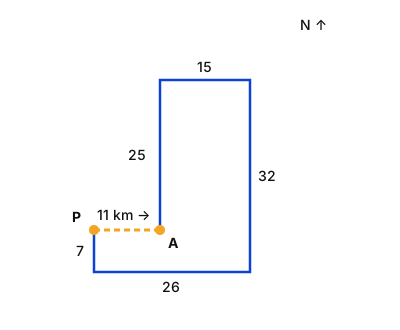
- A(0,0) → 25 km North → (0,25) → right (East) 15 km → (15,25).
- Right (South) 32 km → (15,) → right (West) 26 km → (,) → right (North) 7 km → P(,0).
- P is 11 km west of A on the same horizontal line, so he must drive km towards the East.
Trick: Net North–South: ; net East–West: → 11 km west of A, so go East.
Answer: (C) 11 km to the east
अवधारणा: A को मूल बिंदु मानें; उत्तर = , पूर्व = । हर दायाँ मोड़ दक्षिणावर्त घूमता है: N → E → S → W → N।
- A(0,0) → 25 km उत्तर → (0,25) → दाएँ (पूर्व) 15 km → (15,25)।
- दाएँ (दक्षिण) 32 km → (15,) → दाएँ (पश्चिम) 26 km → (,) → दाएँ (उत्तर) 7 km → P(,0)।
- P, A से 11 km पश्चिम में उसी रेखा पर है, अतः A पहुँचने के लिए km पूर्व की ओर चलना होगा।
ट्रिक: शुद्ध उत्तर–दक्षिण: ; शुद्ध पूर्व–पश्चिम: → A से 11 km पश्चिम, इसलिए पूर्व चलें।
उत्तर: (C) 11 km to the east
RRB NTPC Graduate CBT 1General Intelligence and ReasoningDirection and DistanceRRB NTPC Graduate CBT 1 2025 · 17 Mar Shift 3
Q535.Refer to the following number, symbol series and answer the question. Counting to be done from left to right only. All numbers are single digit numbers only.
(Left) ^ 5 % 5 \ 6 # + # + 1 6 ? # 6 & 7 & 9 < % (Right)
How many such numbers are there, each of which is immediately preceded by a symbol and also immediately followed by a symbol?
निम्नलिखित संख्या, प्रतीक श्रेणी को देखिए और प्रश्न का उत्तर दीजिए। गिनती केवल बाएँ से दाएँ की जानी है। सभी संख्याएँ केवल एक-अंकीय संख्याएँ हैं।
(बाएँ) ^ 5 % 5 \ 6 # + # + 1 6 ? # 6 & 7 & 9 < % (दाएँ)
ऐसी कितनी संख्याएँ हैं, जिनमें से प्रत्येक के ठीक पहले एक प्रतीक है और ठीक बाद भी एक प्रतीक है?
- AFiveपाँच
- BFourचार
- CSixछह
- DSevenसात
Show answer
Concept: Scan the series left to right and test every number: is the element before it a symbol AND the element after it a symbol?
- Series: ^ 5 % 5 \ 6 # + # + 1 6 ? # 6 & 7 & 9 < %
- Qualifying numbers: 5 (^…%), 5 (%…\), 6 (\…#), 6 (#…&), 7 (&…&), 9 (&…<).
- Rejected: “1” (followed by 6) and the second “6” (preceded by 1). Total = 6.
Trick: Underline every “symbol–number–symbol” triplet as you read; overlapping triplets are allowed.
Answer: (C) Six
अवधारणा: श्रृंखला को बाएँ से दाएँ पढ़ें और हर संख्या जाँचें: उससे पहले प्रतीक है और बाद में भी प्रतीक है?
- श्रृंखला: ^ 5 % 5 \ 6 # + # + 1 6 ? # 6 & 7 & 9 < %
- योग्य संख्याएँ: 5 (^…%), 5 (%…\), 6 (\…#), 6 (#…&), 7 (&…&), 9 (&…<)।
- अस्वीकृत: “1” (बाद में 6) और दूसरा “6” (पहले 1)। कुल = 6।
ट्रिक: पढ़ते समय हर “प्रतीक–संख्या–प्रतीक” त्रिक को रेखांकित करें; overlapping त्रिक मान्य हैं।
उत्तर: (C) Six
RRB NTPC Graduate CBT 1General Intelligence and ReasoningSymbol–Number Series CountingRRB NTPC Graduate CBT 1 2025 · 17 Mar Shift 3
Q536.Based on the English alphabetical order, three of the following four letter cluster pairs are alike in a certain way and thus form a group. Which is the one that does not belong to that group?
(Note: The odd man out is not based on the number of consonants/vowels or their position in the letter cluster)
अंग्रेज़ी वर्णमाला क्रम के आधार पर, निम्नलिखित चार अक्षर-समूह युग्मों में से तीन एक निश्चित प्रकार से समान हैं और इस प्रकार एक समूह बनाते हैं। वह कौन-सा है जो उस समूह से संबंधित नहीं है?
(नोट: विषम युग्म व्यंजनों/स्वरों की संख्या या अक्षर-समूह में उनकी स्थिति पर आधारित नहीं है)
- AEG-IK
- BJL-NP
- CTU-WX
- DCE-GI
Show answer
Concept: Find the gap inside each cluster and between the two clusters of a pair.
- EG–IK: E=G, G=I, I=K → every gap is .
- JL–NP: J=L, L=N, N=P ✓; CE–GI: C=E, E=G, G=I ✓.
- TU–WX: T=U, U=W, W=X → gaps – different, so odd one out.
Trick: Three pairs are chains of alternate letters (E G I K); TU–WX uses consecutive letters.
Answer: (C) TU-WX
अवधारणा: हर समूह के अंदर और युग्म के दोनों समूहों के बीच का अंतर देखें।
- EG–IK: E=G, G=I, I=K → हर अंतर ।
- JL–NP: J=L, L=N, N=P ✓; CE–GI: C=E, E=G, G=I ✓।
- TU–WX: T=U, U=W, W=X → अंतर – भिन्न, अतः यही अलग है।
ट्रिक: तीन युग्म एक-एक अक्षर छोड़कर बनी शृंखलाएँ हैं (E G I K); TU–WX में लगातार अक्षर हैं।
उत्तर: (C) TU-WX
RRB NTPC Graduate CBT 1General Intelligence and ReasoningLetter Cluster ClassificationRRB NTPC Graduate CBT 1 2025 · 17 Mar Shift 3
Q537.MUNI is related to OSPG in a certain way based on the English alphabetical order. In the same way, SDIK is related to UBKI. To which of the following is BZMP related, following the same logic?
अंग्रेज़ी वर्णमाला क्रम के आधार पर MUNI, OSPG से एक निश्चित प्रकार से संबंधित है। उसी प्रकार, SDIK, UBKI से संबंधित है। उसी तर्क का अनुसरण करते हुए, BZMP निम्नलिखित में से किससे संबंधित है?
- ADXNQ
- BEYPO
- CDXON
- DCWNM
Show answer
Concept: Compare position-wise; here the shifts alternate in sign.
- MUNI → OSPG: M=O, U=S, N=P, I=G. Pattern .
- Check: SDIK → S=U, D=B, I=K, K=I = UBKI ✓.
- BZMP: B=D, Z=X, M=O, P=N → DXON.
Trick: Alternate – note Z = X (no wrap-around needed).
Answer: (C) DXON
अवधारणा: स्थान-वार तुलना करें; यहाँ shift के चिह्न बारी-बारी बदलते हैं।
- MUNI → OSPG: M=O, U=S, N=P, I=G। पैटर्न ।
- जाँच: SDIK → U, B, K, I = UBKI ✓।
- BZMP: B=D, Z=X, M=O, P=N → DXON।
ट्रिक: बारी-बारी – Z = X (wrap-around की ज़रूरत नहीं)।
उत्तर: (C) DXON
RRB NTPC Graduate CBT 1General Intelligence and ReasoningLetter Cluster AnalogyRRB NTPC Graduate CBT 1 2025 · 17 Mar Shift 3
Q538.In a certain code language,
A + B means ‘A is the sister of B’
A - B means ‘A is the husband of B’
A × B means ‘A is the mother of B’
A ÷ B means ‘A is the father of B’.
Based on the above, how is P related to M if ‘P - R × S + T ÷ M’?
एक निश्चित कूट भाषा में,
A + B का अर्थ है ‘A, B की बहन है’
A - B का अर्थ है ‘A, B का पति है’
A × B का अर्थ है ‘A, B की माता है’
A ÷ B का अर्थ है ‘A, B का पिता है’।
उपर्युक्त के आधार पर, यदि ‘P - R × S + T ÷ M’ है, तो P, M से किस प्रकार संबंधित है?
- AMother’s fatherमाता का पिता
- BFather’s brotherपिता का भाई
- CSister’s husbandबहन का पति
- DFather’s fatherपिता का पिता
Show answer
Concept: Decode each symbol step by step and build the family tree.
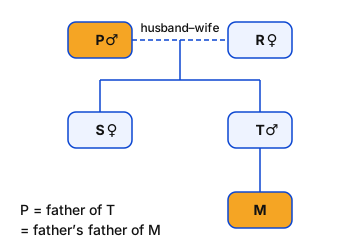
- P − R: P is the husband of R. R × S: R is the mother of S → P is S’s father.
- S + T: S is the sister of T → T is also a child of P and R.
- T ÷ M: T is the father of M → P is the father of M’s father, i.e. M’s father’s father (paternal grandfather).
Trick: Husband of the mother = father; father of the father = paternal grandfather (dada).
Answer: (D) Father’s father
अवधारणा: हर प्रतीक को क्रम से डिकोड कर वंश-वृक्ष बनाएँ।
- P − R: P, R का पति। R × S: R, S की माँ → P, S का पिता।
- S + T: S, T की बहन → T भी P और R की संतान।
- T ÷ M: T, M का पिता → P, M के पिता का पिता (दादा)।
ट्रिक: माँ का पति = पिता; पिता का पिता = दादा।
उत्तर: (D) Father’s father
RRB NTPC Graduate CBT 1General Intelligence and ReasoningBlood Relations (Coded)RRB NTPC Graduate CBT 1 2025 · 17 Mar Shift 3
Q539.If ‘A’ stands for ‘÷’, ‘B’ stands for ‘×’, ‘C’ stands for ‘+’, and ‘D’ stands for ‘−’, what will come in place of the question mark (?) in the following equation?
18 A 2 B 5 C 7 D 9 = ?
यदि ‘A’ का अर्थ ‘÷’, ‘B’ का अर्थ ‘×’, ‘C’ का अर्थ ‘+’ और ‘D’ का अर्थ ‘−’ है, तो निम्नलिखित समीकरण में प्रश्नचिह्न (?) के स्थान पर क्या आएगा?
18 A 2 B 5 C 7 D 9 = ?
- A40
- B43
- C42
- D41
Show answer
Concept: Replace the letters by the given operators and apply BODMAS.
- 18 A 2 B 5 C 7 D 9 → .
- Division/multiplication first: , .
- Then .
Trick: Do ÷ and × from left to right before + and −.
Answer: (B) 43
अवधारणा: अक्षरों की जगह दिए गए चिह्न रखें और BODMAS लागू करें।
- 18 A 2 B 5 C 7 D 9 → ।
- पहले भाग/गुणा: , ।
- फिर ।
ट्रिक: + और − से पहले ÷ और × बाएँ से दाएँ करें।
उत्तर: (B) 43
RRB NTPC Graduate CBT 1General Intelligence and ReasoningMathematical Operations (Substitution)RRB NTPC Graduate CBT 1 2025 · 17 Mar Shift 3
Q540.B, C, N, V, X and Z live on six different floors of the same building. The lowermost floor in the building is numbered 1, the floor above it, number 2 and so on till the topmost floor is numbered 6.
N lives on an odd numbered floor but not 5. The sum of floors on which N and Z live is 5. Only 3 people live between Z and X. C lives immediately above V. How many people live below Z?
B, C, N, V, X और Z एक ही भवन की छह अलग-अलग मंज़िलों पर रहते हैं। भवन की सबसे निचली मंज़िल की संख्या 1 है, उसके ऊपर की मंज़िल की संख्या 2 है और इसी प्रकार सबसे ऊपरी मंज़िल की संख्या 6 है।
N एक विषम संख्या वाली मंज़िल पर रहता है, परंतु 5 पर नहीं। N और Z जिन मंज़िलों पर रहते हैं, उनकी संख्याओं का योग 5 है। Z और X के बीच केवल 3 व्यक्ति रहते हैं। C, V के ठीक ऊपर रहता है। Z के नीचे कितने व्यक्ति रहते हैं?
- A1
- B4
- C2
- D3
Show answer
Concept: Start from the most restrictive clue (N’s floor and the sum with Z) and place the rest.
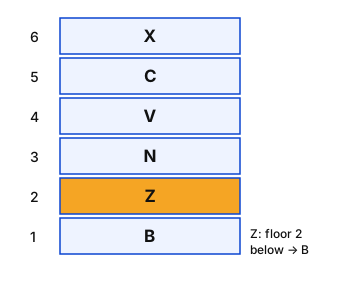
- N is on an odd floor but not 5 → N = 1 or 3. N + Z = 5 → (N, Z) = (1, 4) or (3, 2).
- Exactly 3 people between Z and X → Z and X are on floors (1, 5) or (2, 6). Z = 4 is impossible, so Z = 2, N = 3, X = 6.
- Floors 1, 4, 5 remain for B, C, V; C immediately above V → V = 4, C = 5, B = 1. Below Z (floor 2) lives only B → 1 person.
Trick: “Sum of floors = 5” plus “3 between” fixes Z in one step; always test the pair options against both clues.
Answer: (A) 1
अवधारणा: सबसे कठोर संकेत (N की मंज़िल और Z के साथ योग) से शुरू कर बाकी को रखें।
- N विषम मंज़िल पर, पर 5 नहीं → N = 1 या 3। N + Z = 5 → (N, Z) = (1, 4) या (3, 2)।
- Z और X के बीच ठीक 3 लोग → Z, X मंज़िल (1, 5) या (2, 6) पर। Z = 4 संभव नहीं, अतः Z = 2, N = 3, X = 6।
- B, C, V के लिए 1, 4, 5 बचे; C, V के ठीक ऊपर → V = 4, C = 5, B = 1। Z (मंज़िल 2) के नीचे केवल B → 1 व्यक्ति।
ट्रिक: “मंज़िलों का योग 5” और “बीच में 3” मिलकर Z को एक कदम में तय कर देते हैं; युग्म-विकल्पों को दोनों संकेतों पर परखें।
उत्तर: (A) 1
RRB NTPC Graduate CBT 1General Intelligence and ReasoningFloor PuzzleRRB NTPC Graduate CBT 1 2025 · 17 Mar Shift 3

