Q541.The following table shows the distribution of marks obtained by students in a test. Find the mode. (Round off to two decimal places.)
| Marks Range | 0-10 | 10-20 | 20-30 | 30-40 | 40-50 |
|---|
| Number of Students | 5 | 12 | 18 | 25 | 10 |
|---|
निम्नलिखित तालिका एक परीक्षा में विद्यार्थियों द्वारा प्राप्त अंकों का बंटन दर्शाती है। बहुलक ज्ञात कीजिए। (दो दशमलव स्थानों तक पूर्णांकित कीजिए।)
अंक सीमा: 0-10, 10-20, 20-30, 30-40, 40-50
विद्यार्थियों की संख्या: 5, 12, 18, 25, 10
- A32.56
- B33.65
- C33.18
- D32.84
Show answer
Concept: for grouped data.
- Modal class = 30–40 (highest frequency ); , , , .
- .
Trick: The mode always lies inside the modal class – only option (C) and (D) are between 30 and 40 and close; compute to settle it.
Answer: (C)
अवधारणा: वर्गीकृत आँकड़ों के लिए ।
- बहुलक वर्ग = 30–40 (सबसे अधिक बारंबारता ); , , , ।
- ।
ट्रिक: बहुलक हमेशा बहुलक वर्ग के भीतर होता है; निकालते ही उत्तर तय।
उत्तर: (C)
RRB NTPC Graduate CBT 1MathematicsStatistics – modeRRB NTPC Graduate CBT 1 2025 · 18 Mar Shift 1
Q542.Find the value of m, satisfying equation:
समीकरण को संतुष्ट करने वाले m का मान ज्ञात कीजिए:
- A
- B
- C
- D
Show answer
Concept: and ; write every term with the same base.
- , so LHS .
- .
- Equate powers: .
Trick: Flipping the fraction flips the sign of the exponent – convert everything to base : .
Answer: (B)
अवधारणा: और ; हर पद को एक ही आधार में लिखें।
- , अतः LHS ।
- ।
- घातें बराबर करें: ।
ट्रिक: भिन्न उलटने से घात का चिह्न उलट जाता है – सब कुछ आधार में लाएँ: ।
उत्तर: (B)
RRB NTPC Graduate CBT 1MathematicsLaws of indicesRRB NTPC Graduate CBT 1 2025 · 18 Mar Shift 1
Q543.By selling an article at of its actual selling price, Akash incurs a loss of 24%. If he sells it at 84% of its actual selling price, then the profit percentage is
किसी वस्तु को उसके वास्तविक विक्रय मूल्य के पर बेचने पर, आकाश को 24% की हानि होती है। यदि वह इसे इसके वास्तविक विक्रय मूल्य के 84% पर बेचता है, तो लाभ प्रतिशत है
- A59.6%
- B58.3%
- C57.8%
- D61.6%
Show answer
Concept: Express both selling prices as fractions of the cost price.
- Let actual SP and CP . .
- New SP .
- Profit% .
Trick: Take CP = 100: ; of 190 = 159.6 → profit 59.6%.
Answer: (A)
अवधारणा: दोनों विक्रय मूल्यों को क्रय मूल्य के भिन्न के रूप में लिखें।
- वास्तविक SP और CP लें। ।
- नया SP ।
- लाभ% ।
ट्रिक: CP = 100 लें: ; 190 का = 159.6 → लाभ 59.6%।
उत्तर: (A)
RRB NTPC Graduate CBT 1MathematicsProfit and lossRRB NTPC Graduate CBT 1 2025 · 18 Mar Shift 1
Q544.At what rate (in percentage, rounded off to two decimal place) per year will a sum of money 5 times itself in 22 years on simple interest?
साधारण ब्याज पर कोई धनराशि 22 वर्षों में स्वयं की 5 गुनी किस वार्षिक दर (प्रतिशत में, दो दशमलव स्थानों तक पूर्णांकित) पर हो जाएगी?
- A20.18
- B18.18
- C16.18
- D36.36
Show answer
Concept: If a sum becomes times in years at SI, interest , so .
- Sum becomes 5 times → SI in 22 years.
- per year.
Trick: "5 times" means 4 times the principal as interest – never use 5; is the trap value.
Answer: (B)
अवधारणा: SI पर राशि वर्ष में गुना हो तो ब्याज , अतः ।
- राशि 5 गुना → SI , 22 वर्ष में।
- प्रति वर्ष।
ट्रिक: "5 गुना" का अर्थ है ब्याज = मूलधन का 4 गुना – 5 का प्रयोग कभी न करें; जाल है।
उत्तर: (B)
RRB NTPC Graduate CBT 1MathematicsSimple interestRRB NTPC Graduate CBT 1 2025 · 18 Mar Shift 1
Q545.If the median of a data is 77.74 less than its mode, then the median of the data exceeds its mean by _____. (Use the empirical formula to find the answer)
यदि किसी आँकड़े की माध्यिका उसके बहुलक से 77.74 कम है, तो आँकड़े की माध्यिका उसके माध्य से _____ अधिक है। (उत्तर ज्ञात करने के लिए आनुभविक सूत्र का प्रयोग कीजिए)
- A37.09
- B44.11
- C35.13
- D38.87
Show answer
Concept: Empirical formula: .
- Rearrange: .
- Given .
- .
Trick: Mode, Median, Mean lie in ratio gaps – (Mode − Median) is always twice (Median − Mean). Just halve.
Answer: (D)
अवधारणा: आनुभविक सूत्र: ।
- पुनर्व्यवस्थित करें: ।
- दिया है ।
- ।
ट्रिक: (बहुलक − माध्यिका) हमेशा (माध्यिका − माध्य) का दोगुना होता है। बस आधा करें।
उत्तर: (D)
RRB NTPC Graduate CBT 1MathematicsStatistics – empirical relationRRB NTPC Graduate CBT 1 2025 · 18 Mar Shift 1
Q546.How many solutions for given three unknowns are possible to satisfy all these equations?
दिए गए तीन अज्ञातों के लिए इन सभी समीकरणों को संतुष्ट करने वाले कितने हल संभव हैं?
- AUnique solutionअद्वितीय हल
- BInfinite solutionsअनंत हल
- CNo solutionकोई हल नहीं
- DTwo solutionsदो हल
Show answer
Concept: If one equation is a combination of the other two (dependent system with same RHS), the system has infinitely many solutions.
- Equations: (1) , (2) , (3) .
- Add (2) and (3): , i.e. gives – exactly equation (1).
- Determinant of coefficients and the equations are consistent → infinitely many solutions.
Trick: Before computing determinants, try adding/subtracting equations – (2) + (3) is the negative of (1), which immediately shows dependence.
Answer: (B) Infinite solutions
अवधारणा: यदि एक समीकरण अन्य दो का संयोजन हो (समान RHS वाला आश्रित निकाय), तो निकाय के अनंत हल होते हैं।
- समीकरण: (1) , (2) , (3) ।
- (2) + (3): , अर्थात देता है – ठीक समीकरण (1)।
- गुणांकों का सारणिक और समीकरण संगत हैं → अनंत हल।
ट्रिक: सारणिक से पहले समीकरणों को जोड़ने/घटाने की कोशिश करें – (2) + (3), (1) का ऋणात्मक है, जो तुरंत आश्रितता दिखा देता है।
उत्तर: (B) Infinite solutions (अनंत हल)
RRB NTPC Graduate CBT 1MathematicsLinear equations – consistencyRRB NTPC Graduate CBT 1 2025 · 18 Mar Shift 1
Q547.If and , then find the relation between , and .
यदि और है, तो , और के बीच संबंध ज्ञात कीजिए।
- A
- B
- C
- D
Show answer
Concept: Eliminate using .
- , .
- .
Trick: Whenever two quantities are and , their squares add to – it is the equation of a circle of radius .
Answer: (D)
अवधारणा: से हटाएँ।
- , ।
- ।
ट्रिक: जब दो राशियाँ और हों, उनके वर्गों का योग होता है – यह त्रिज्या के वृत्त का समीकरण है।
उत्तर: (D)
RRB NTPC Graduate CBT 1MathematicsTrigonometric identityRRB NTPC Graduate CBT 1 2025 · 18 Mar Shift 1
Q548.Four years ago from now, the average age of Amit, Bharat and Chitra was 36 years. Six years ago from now, the average age of Amit and Bharat was 30 years. What was the age of Chitra three years ago from now?
आज से चार वर्ष पहले, अमित, भरत और चित्रा की औसत आयु 36 वर्ष थी। आज से छह वर्ष पहले, अमित और भरत की औसत आयु 30 वर्ष थी। आज से तीन वर्ष पहले चित्रा की आयु क्या थी?
- A45 years45 वर्ष
- B42 years42 वर्ष
- C40 years40 वर्ष
- D43 years43 वर्ष
Show answer
Concept: Average × number = total; shifting every age by the same years shifts the total by (years × number).
- Four years ago, A + B + C → today .
- Six years ago, A + B → today .
- Chitra today ; three years ago years.
Trick: Bring every statement to "today" first (add years × persons), then subtract.
Answer: (A) 45 years
अवधारणा: औसत × संख्या = योग; हर आयु को समान वर्ष खिसकाने पर योग (वर्ष × संख्या) से खिसकता है।
- चार वर्ष पहले A + B + C → आज ।
- छह वर्ष पहले A + B → आज ।
- चित्रा आज ; तीन वर्ष पहले वर्ष।
ट्रिक: हर कथन को पहले "आज" पर लाएँ (वर्ष × व्यक्ति जोड़ें), फिर घटाएँ।
उत्तर: (A) 45 वर्ष
RRB NTPC Graduate CBT 1MathematicsAverage – agesRRB NTPC Graduate CBT 1 2025 · 18 Mar Shift 1
Q549.What is the maximum value that must be assigned to A so that the 8-digit number 588A9792 is divisible by 4?
A को अधिकतम कौन-सा मान दिया जाना चाहिए ताकि 8-अंकीय संख्या 588A9792, 4 से विभाज्य हो?
- A5
- B7
- C6
- D9
Show answer
Concept: A number is divisible by 4 when the number formed by its last two digits is divisible by 4.
- Last two digits of 588A9792 are 92, and – divisible for any value of A.
- So A can be any digit 0–9; the maximum value is 9.
Trick: For divisibility by 4 (or 8), only the last 2 (or 3) digits matter – a digit in the middle never changes the result.
Answer: (D) 9
अवधारणा: कोई संख्या 4 से विभाज्य होती है जब उसके अंतिम दो अंकों से बनी संख्या 4 से विभाज्य हो।
- 588A9792 के अंतिम दो अंक 92 हैं, और – A के किसी भी मान पर विभाज्य।
- अतः A कोई भी अंक 0–9 हो सकता है; अधिकतम मान 9।
ट्रिक: 4 (या 8) की विभाज्यता में केवल अंतिम 2 (या 3) अंक मायने रखते हैं – बीच का अंक परिणाम कभी नहीं बदलता।
उत्तर: (D) 9
RRB NTPC Graduate CBT 1MathematicsDivisibilityRRB NTPC Graduate CBT 1 2025 · 18 Mar Shift 1
Q550.If 6 machines can manufacture 480 components in 8 hours, how many components can 10 machines manufacture in 12 hours, assuming all machines work at the same constant rate?
यदि 6 मशीनें 8 घंटे में 480 पुर्जे बना सकती हैं, तो 10 मशीनें 12 घंटे में कितने पुर्जे बना सकती हैं, यह मानते हुए कि सभी मशीनें समान स्थिर दर से कार्य करती हैं?
- A1200
- B1000
- C1440
- D900
Show answer
Concept: Output is proportional to (machines × hours): .
- Rate per machine-hour components.
- 10 machines × 12 hours = 120 machine-hours → components.
Trick: Machines and hours → .
Answer: (A) 1200
अवधारणा: उत्पादन (मशीनें × घंटे) के समानुपाती है: ।
- प्रति मशीन-घंटा दर पुर्ज़े।
- 10 मशीनें × 12 घंटे = 120 मशीन-घंटे → पुर्ज़े।
ट्रिक: मशीनें और घंटे → ।
उत्तर: (A) 1200
RRB NTPC Graduate CBT 1MathematicsWork – chain ruleRRB NTPC Graduate CBT 1 2025 · 18 Mar Shift 1
Q551.The marks scored by 100 students in Mathematics examination are given by the following table. Find the mode of this data (up to 2 decimal places).
| Marks scored | 35 - 44 | 45 - 54 | 55 - 64 | 65 - 74 | 75 - 84 | 85 - 94 |
|---|
| No. of students | 10 | 20 | 30 | 25 | 10 | 5 |
|---|
गणित की परीक्षा में 100 विद्यार्थियों द्वारा प्राप्त अंक निम्नलिखित तालिका में दिए गए हैं। इन आँकड़ों का बहुलक (mode) ज्ञात कीजिए (2 दशमलव स्थानों तक)।
प्राप्त अंक: 35 - 44, 45 - 54, 55 - 64, 65 - 74, 75 - 84, 85 - 94
विद्यार्थियों की संख्या: 10, 20, 30, 25, 10, 5
- A61.17
- B61.67
- C60.56
- D55.44
Show answer
Concept: Classes are inclusive (35–44, 45–54 …), so first make them continuous by adjusting ; then .
- Highest frequency (class 55–64) → modal class –, , .
- (previous class), (next class).
- .
Trick: Inclusive classes → subtract from the lower limit; forgetting this gives (option B), the trap.
Answer: (A) 61.17
अवधारणा: वर्ग समावेशी (35–44, 45–54 …) हैं, इसलिए पहले घटाकर/जोड़कर उन्हें सतत बनाएँ; फिर ।
- अधिकतम बारंबारता (वर्ग 55–64) → बहुलक वर्ग –, , ।
- , ।
- ।
ट्रिक: समावेशी वर्ग → निचली सीमा से घटाएँ; यह भूलने पर (विकल्प B) आता है – यही जाल है।
उत्तर: (A) 61.17
RRB NTPC Graduate CBT 1MathematicsStatistics – Mode of Grouped DataRRB NTPC Graduate CBT 1 2025 · 17 Mar Shift 3
Q552.Mr. Q travelled 336 km, 925 km and 432 km at a speed of 24 km/hr, 5 km/hr and 12 km/hr, respectively. Find his average speed in km/hr.
श्री Q ने 336 km, 925 km और 432 km की दूरी क्रमशः 24 km/hr, 5 km/hr और 12 km/hr की चाल से तय की। उनकी औसत चाल km/hr में ज्ञात कीजिए।
- A
- B
- C
- D
Show answer
Concept: – never the average of the three speeds.
- Total distance .
- Times: , , → total .
- Average speed (since , remainder ).
Trick: All options have denominator = total time; only the remainder decides the answer.
Answer: (C)
अवधारणा: – तीनों चालों का औसत कभी नहीं।
- कुल दूरी ।
- समय: , , → कुल ।
- औसत चाल (, शेष )।
ट्रिक: सभी विकल्पों का हर = कुल समय है; केवल शेष से उत्तर तय होता है।
उत्तर: (C)
RRB NTPC Graduate CBT 1MathematicsAverage SpeedRRB NTPC Graduate CBT 1 2025 · 17 Mar Shift 3
Q553.If the central angle of a sector of a circle with radius 8 units is , then find the length (in units) of the arc forming the sector. (Use )
यदि 8 इकाई त्रिज्या वाले वृत्त के एक त्रिज्यखंड (sector) का केंद्रीय कोण है, तो त्रिज्यखंड बनाने वाले चाप की लंबाई (इकाई में) ज्ञात कीजिए। ( का उपयोग कीजिए)
- A
- B
- C
- D
Show answer
Concept: Length of an arc .
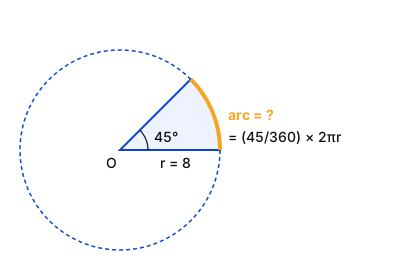
- , → fraction of circle .
- Circumference .
- Arc units.
Trick: is one-eighth of a turn; .
Answer: (B)
अवधारणा: चाप की लंबाई ।
- , → वृत्त का भाग ।
- परिधि ।
- चाप इकाई।
ट्रिक: = पूरे चक्कर का आठवाँ भाग; ।
उत्तर: (B)
RRB NTPC Graduate CBT 1MathematicsMensuration – Arc LengthRRB NTPC Graduate CBT 1 2025 · 17 Mar Shift 3
Q554.20% of a number is more than 20% of 620 by 220. The number is:
किसी संख्या का 20%, 620 के 20% से 220 अधिक है। वह संख्या है:
- A1570
- B1770
- C1720
- D1820
Show answer
Concept: Translate the sentence directly into an equation: of of .
- of .
- .
- .
Trick: , so ; or note the number exceeds by .
Answer: (C) 1720
अवधारणा: वाक्य को सीधे समीकरण में बदलें: का का ।
- का ।
- ।
- ।
ट्रिक: , अतः ; या संख्या से अधिक है।
उत्तर: (C) 1720
RRB NTPC Graduate CBT 1MathematicsPercentageRRB NTPC Graduate CBT 1 2025 · 17 Mar Shift 3
Q555.A man bought two types of chocolates, one at ₹8 for 9 chocolates and the other at ₹8 per chocolate. He purchased an equal number of each type and sold all the chocolates at ₹8 per piece. Find his percentage profit.
एक व्यक्ति ने दो प्रकार की चॉकलेट खरीदीं, एक ₹8 में 9 चॉकलेट की दर से और दूसरी ₹8 प्रति चॉकलेट की दर से। उसने प्रत्येक प्रकार की समान संख्या में चॉकलेट खरीदीं और सभी चॉकलेट ₹8 प्रति नग की दर से बेच दीं। उसका प्रतिशत लाभ ज्ञात कीजिए।
- A78%
- B84%
- C82%
- D80%
Show answer
Concept: Take a convenient equal number of each type (LCM of 9 and 1 = 9), find total CP and SP, then .
- Buy 9 of each: first type costs ₹8 for all 9; second type costs ₹72. Total CP ₹80.
- Sold 18 chocolates at ₹8 each: SP ₹144.
- Profit ; Profit.
Trick: Second type is sold at cost (no gain); the whole profit comes from the cheap type: ₹8 → ₹72. Overall .
Answer: (D) 80%
अवधारणा: दोनों प्रकार की समान सुविधाजनक संख्या लें (9 और 1 का LCM = 9), कुल CP और SP निकालें, फिर ।
- प्रत्येक के 9 खरीदे: पहले प्रकार के 9 = ₹8; दूसरे प्रकार के 9 ₹72। कुल CP ।
- 18 चॉकलेट ₹8 प्रति के भाव से: SP ₹144।
- लाभ ; लाभ।
ट्रिक: दूसरा प्रकार लागत पर बिका (लाभ शून्य); पूरा लाभ सस्ते प्रकार से: ₹8 → ₹72। कुल ।
उत्तर: (D) 80%
RRB NTPC Graduate CBT 1MathematicsProfit and LossRRB NTPC Graduate CBT 1 2025 · 17 Mar Shift 3
Q556.Two taps can fill a cistern in 4 hours and 31 hours respectively. A third tap can empty it in 31 hours. How long (in hours) will it take to fill one-fourth of the empty cistern, if all of them are opened together?
दो नल एक टंकी को क्रमशः 4 घंटे और 31 घंटे में भर सकते हैं। एक तीसरा नल इसे 31 घंटे में खाली कर सकता है। यदि सभी नल एक साथ खोल दिए जाएँ, तो खाली टंकी का एक-चौथाई भाग भरने में कितना समय (घंटों में) लगेगा?
- A2
- B4
- C3
- D1
Show answer
Concept: Add the filling rates and subtract the emptying rate (work per hour).
- Rates: of the cistern per hour.
- The second tap and the emptying tap cancel each other exactly.
- One-fourth of the cistern at per hour → hour.
Trick: Same time to fill and to empty ( h) → the pair does nothing; only the -hour tap counts.
Answer: (D) 1
अवधारणा: भरने की दरें जोड़ें और खाली करने की दर घटाएँ (प्रति घंटा कार्य)।
- दरें: टंकी प्रति घंटा।
- दूसरा नल और खाली करने वाला नल एक-दूसरे को पूरी तरह काट देते हैं।
- एक-चौथाई टंकी, प्रति घंटा की दर से → घंटा।
ट्रिक: भरने और खाली करने का समय समान ( h) → यह जोड़ी निष्प्रभावी; केवल घंटे वाला नल गिनें।
उत्तर: (D) 1
RRB NTPC Graduate CBT 1MathematicsPipes and CisternsRRB NTPC Graduate CBT 1 2025 · 17 Mar Shift 3
Q557.Three positive integers a, b, and c satisfy: gcd(a, b)=12, gcd(b, c)=18, gcd(c, a)=6. If a+b+c=6k for some positive integer k, then the minimum possible value of k is:
तीन धनात्मक पूर्णांक a, b और c इस प्रकार हैं कि: gcd(a, b)=12, gcd(b, c)=18, gcd(c, a)=6। यदि किसी धनात्मक पूर्णांक k के लिए a+b+c=6k है, तो k का न्यूनतम संभव मान है:
- A11
- B10
- C12
- D9
Show answer
Concept: Each number must be a multiple of every gcd it is part of; choose the smallest such numbers and verify the gcds.
- is a multiple of and → multiple of ; is a multiple of and → of ; is a multiple of and → of .
- Smallest choice: . Check: , , ✓.
- → minimum .
Trick: Minimum sum ; any smaller would violate a gcd, so .
Answer: (A) 11
अवधारणा: हर संख्या उन सभी gcd की गुणज होनी चाहिए जिनमें वह शामिल है; सबसे छोटी ऐसी संख्याएँ चुनकर gcd जाँचें।
- , और का गुणज → का गुणज; → का; → का गुणज।
- सबसे छोटा चयन: । जाँच: , , ✓।
- → न्यूनतम ।
ट्रिक: न्यूनतम योग ; इससे छोटे कोई gcd तोड़ देंगे, अतः ।
उत्तर: (A) 11
RRB NTPC Graduate CBT 1MathematicsHCF – Minimum SumRRB NTPC Graduate CBT 1 2025 · 17 Mar Shift 3
Q558.The average of 5 numbers is 20. If one number is excluded, the average of the remaining numbers is 18. What is the excluded number?
5 संख्याओं का औसत 20 है। यदि एक संख्या को हटा दिया जाए, तो शेष संख्याओं का औसत 18 हो जाता है। हटाई गई संख्या क्या है?
- A32
- B25
- C28
- D30
Show answer
Concept: Sum average count; the excluded number is the difference of the two sums.
- Sum of 5 numbers .
- Sum of remaining 4 numbers .
- Excluded number .
Trick: Excluded new average (old count) (drop in average) .
Answer: (C) 28
अवधारणा: योग औसत संख्या; निकाली गई संख्या दोनों योगों का अंतर है।
- 5 संख्याओं का योग ।
- शेष 4 का योग ।
- निकाली गई संख्या ।
ट्रिक: निकाली गई नया औसत (पुरानी गिनती) (औसत में गिरावट) ।
उत्तर: (C) 28
RRB NTPC Graduate CBT 1MathematicsAverageRRB NTPC Graduate CBT 1 2025 · 17 Mar Shift 3
Q559.A data scientist finds that the mean proportional between two experimental values 18 and 32 needs to be increased by 25% for optimal model performance. If this new increased value becomes the mean proportional between 18 and another value y, what is y?
एक डेटा वैज्ञानिक पाता है कि दो प्रायोगिक मानों 18 और 32 के बीच के मध्यानुपाती (mean proportional) को इष्टतम मॉडल प्रदर्शन के लिए 25% बढ़ाने की आवश्यकता है। यदि यह नया बढ़ा हुआ मान 18 और किसी अन्य मान y के बीच का मध्यानुपाती बन जाता है, तो y क्या है?
- A45
- B50
- C54
- D48
Show answer
Concept: Mean proportional between and is ; if is the mean proportional between and , then .
- .
- Increase by : .
- .
Trick: – spot it as ; then .
Answer: (B) 50
अवधारणा: और का मध्यानुपाती ; यदि , और का मध्यानुपाती है तो ।
- ।
- वृद्धि: ।
- ।
ट्रिक: पहचानें; फिर ।
उत्तर: (B) 50
RRB NTPC Graduate CBT 1MathematicsMean ProportionalRRB NTPC Graduate CBT 1 2025 · 17 Mar Shift 3
Q560.Which of the following is not a quadratic equation?
निम्नलिखित में से कौन-सा द्विघात समीकरण नहीं है?
- A(x – 1)(x + 2) = x² + 3
- Bx² + 2x + 1 = 0
- Cx(x – 3) = 2
- D3x² – 5x + 2 = 0
Show answer
Concept: An equation is quadratic only if, after simplification, the highest power of is exactly (coefficient of ).
- (A) – the terms cancel → linear, not quadratic.
- (B) and (D) are already in the form .
- (C) – quadratic.
Trick: Whenever appears on both sides, expand and check whether it cancels.
Answer: (A) (x – 1)(x + 2) = x2 + 3
अवधारणा: समीकरण द्विघात तभी है जब सरलीकरण के बाद की उच्चतम घात ठीक हो ( का गुणांक )।
- (A) – कट गया → रैखिक, द्विघात नहीं।
- (B) और (D) पहले से रूप में हैं।
- (C) – द्विघात।
ट्रिक: जब दोनों ओर हो, तो फैलाकर देखें कि वह कटता है या नहीं।
उत्तर: (A) (x – 1)(x + 2) = x2 + 3
RRB NTPC Graduate CBT 1MathematicsQuadratic EquationsRRB NTPC Graduate CBT 1 2025 · 17 Mar Shift 3

