Q561.Evaluate: (-9) - (-56) ÷ (-14) + (-4) × 6
मान ज्ञात कीजिए: (-9) - (-56) ÷ (-14) + (-4) × 6
- A-40
- B-37
- C-36
- D-39
Show answer
Concept: Do division and multiplication first, then addition and subtraction; watch the signs.
- and .
- Expression becomes .
- .
Trick: Negative ÷ negative = positive; the minus sign before it then makes it .
Answer: (B) -37
अवधारणा: पहले भाग और गुणा, फिर जोड़ और घटाव; चिह्नों पर ध्यान दें।
- और ।
- व्यंजक बनता है ।
- ।
ट्रिक: ऋण ÷ ऋण = धन; उसके आगे का ऋण चिह्न उसे बना देता है।
उत्तर: (B) -37
RRB NTPC Graduate CBT 1MathematicsSimplification (BODMAS with Integers)RRB NTPC Graduate CBT 1 2025 · 17 Mar Shift 3
Q562.There are 42 members in group A, 14 members in group B and 21 members in group C. All the members of these groups went to a restaurant. The average amounts spent on each member of groups A, B and C are ₹275, ₹430 and ₹498, respectively. The overall average amount (in ₹) spent per member is:
समूह A में 42 सदस्य, समूह B में 14 सदस्य और समूह C में 21 सदस्य हैं। इन समूहों के सभी सदस्य एक रेस्तरां में गए। समूह A, B और C के प्रत्येक सदस्य पर खर्च की गई औसत राशि क्रमशः ₹275, ₹430 और ₹498 है। प्रति सदस्य खर्च की गई समग्र औसत राशि (₹ में) है:
- A366
- B369
- C364
- D365
Show answer
Concept: .
- Totals: , , .
- Grand total ; members .
- .
Trick: Members are in ratio (÷7): .
Answer: (C) 364
अवधारणा: ।
- कुल राशि: , , ।
- महायोग ; सदस्य ।
- ।
ट्रिक: सदस्य अनुपात (÷7): ।
उत्तर: (C) 364
RRB NTPC Graduate CBT 1MathematicsWeighted AverageRRB NTPC Graduate CBT 1 2025 · 17 Mar Shift 3
Q563.The monthly incomes of A and B are in the ratio 4 : 5, and their monthly expenditures are in the ratio 3 : 4. A saves ₹10,000 while B saves ₹12,000, find the monthly income of A (in ₹)
A और B की मासिक आय का अनुपात 4 : 5 है, और उनके मासिक व्यय का अनुपात 3 : 4 है। A ₹10,000 की बचत करता है जबकि B ₹12,000 की बचत करता है, A की मासिक आय (₹ में) ज्ञात कीजिए।
- A14,000
- B16,000
- C15,000
- D13,000
Show answer
Concept: Income − Expenditure = Savings. Let incomes be and expenditures , then solve two equations.
- … (i) and … (ii).
- (i): ; (ii): . Subtract: .
- Income of A ₹ (check: , B saves ✓).
Trick: Eliminate by making its coefficients equal (); then comes out in one subtraction.
Answer: (B) 16,000
अवधारणा: आय − व्यय = बचत। आय और व्यय मानकर दो समीकरण हल करें।
- … (i) और … (ii)।
- (i): ; (ii): । घटाने पर ।
- A की आय ₹ (जाँच: , B की बचत ✓)।
ट्रिक: के गुणांक बराबर () करके उसे हटाएँ; एक घटाव में मिल जाता है।
उत्तर: (B) 16,000
RRB NTPC Graduate CBT 1MathematicsRatio – Income and ExpenditureRRB NTPC Graduate CBT 1 2025 · 17 Mar Shift 3
Q564.The value of is:
का मान है:
- A0.65
- B1
- C2
- D1.5
Show answer
Concept: Use instead of squaring decimals.
- .
- .
Trick: When the denominator equals , the answer is simply – no decimal multiplication needed.
Answer: (B) 1
अवधारणा: दशमलवों का वर्ग करने के बजाय का प्रयोग करें।
- ।
- ।
ट्रिक: जब हर के बराबर हो, उत्तर सीधे – दशमलव गुणा की ज़रूरत नहीं।
उत्तर: (B) 1
RRB NTPC Graduate CBT 1MathematicsSimplification – Difference of SquaresRRB NTPC Graduate CBT 1 2025 · 17 Mar Shift 3
Q565.P sells an item to Q at 30% profit. Q sells the same item to R at 52% loss. If R paid ₹ 3900 for the item, then at what price (in ₹) is the item purchased by P?
P एक वस्तु Q को 30% लाभ पर बेचता है। Q वही वस्तु R को 52% हानि पर बेचता है। यदि R ने उस वस्तु के लिए ₹ 3900 का भुगतान किया, तो P ने वह वस्तु किस मूल्य (₹ में) पर खरीदी थी?
- A6250
- B6252
- C6253
- D6248
Show answer
Concept: Work backwards: each sale multiplies the price by , so divide to go back.
- R paid ₹3900 after Q's 52% loss, so Q's cost .
- Q's cost is P's selling price at 30% profit: P's cost .
- Check: , ✓.
Trick: Combined multiplier ; in one step.
Answer: (A) 6250
अवधारणा: पीछे से चलें: हर बिक्री कीमत को से गुणा करती है, इसलिए वापस जाने के लिए भाग दें।
- R ने Q की 52% हानि के बाद ₹3900 दिए, अतः Q की लागत ।
- Q की लागत = P का 30% लाभ वाला विक्रय मूल्य: P की लागत ।
- जाँच: , ✓।
ट्रिक: संयुक्त गुणक ; एक ही चरण में ।
उत्तर: (A) 6250
RRB NTPC Graduate CBT 1MathematicsProfit and loss – successive transactionsRRB NTPC Graduate CBT 1 2025 · 17 Mar Shift 3
Q566.The arithmetic mean of 10 observations is 6 and the sum of nine of the observations is 49. Find the tenth observation.
10 प्रेक्षणों का समांतर माध्य 6 है और उनमें से नौ प्रेक्षणों का योग 49 है। दसवाँ प्रेक्षण ज्ञात कीजिए।
- A9
- B10
- C13
- D11
Show answer
Concept: .
- Total of 10 observations .
- Sum of nine of them .
- Tenth observation .
Trick: Mean questions almost always start with 'total = mean × n'.
Answer: (D) 11
अवधारणा: ।
- 10 प्रेक्षणों का योग ।
- नौ प्रेक्षणों का योग ।
- दसवाँ प्रेक्षण ।
ट्रिक: माध्य के प्रश्न लगभग हमेशा 'योग = माध्य × n' से शुरू होते हैं।
उत्तर: (D) 11
RRB NTPC Graduate CBT 1MathematicsStatistics – arithmetic meanRRB NTPC Graduate CBT 1 2025 · 17 Mar Shift 3
Q567.A, B and C together can complete a certain work in 40 days. B and C together can complete the same work in 72 days. B is 50% more efficient than A. A, B and C work together for 16 days. B alone will complete the remaining work in:
A, B और C मिलकर एक निश्चित कार्य को 40 दिनों में पूरा कर सकते हैं। B और C मिलकर उसी कार्य को 72 दिनों में पूरा कर सकते हैं। B, A से 50% अधिक कार्यकुशल है। A, B और C 16 दिनों तक एक साथ कार्य करते हैं। B अकेला शेष कार्य को पूरा करेगा:
- A36 days36 दिनों में
- B34 days34 दिनों में
- C38 days38 दिनों में
- D35 days35 दिनों में
Show answer
Concept: Work per day is additive: . Efficiency ratio gives individual rates.
- A's one-day work .
- B is 50% more efficient: B's one-day work , so B alone takes 60 days.
- In 16 days all three do ; remaining .
- B needs days.
Trick: Take total work units (LCM of 40, 72): all three 9/day, B+C 5/day, A 4/day, B 6/day; left ; .
Answer: (A) 36 days
अवधारणा: प्रतिदिन कार्य जोड़े-घटाए जा सकते हैं: । दक्षता अनुपात से व्यक्तिगत दर मिलती है।
- A का एक दिन का कार्य ।
- B 50% अधिक दक्ष: B का एक दिन का कार्य , अतः B अकेले 60 दिन लेगा।
- 16 दिनों में तीनों ने किया; शेष ।
- B को दिन लगेंगे।
ट्रिक: कुल कार्य इकाई (40, 72 का LCM) लें: तीनों 9/दिन, B+C 5/दिन, A 4/दिन, B 6/दिन; शेष ; ।
उत्तर: (A) 36 days
RRB NTPC Graduate CBT 1MathematicsTime and work – efficiencyRRB NTPC Graduate CBT 1 2025 · 17 Mar Shift 3
Q568.Simplify:
सरल कीजिए:
- A
- B
- C
- D
Show answer
Concept: and .
- Numerator ; denominator .
- Ratio .
- , so the ratio .
Trick: Put : numerator , denominator ; ratio ✓.
Answer: (B)
अवधारणा: तथा ।
- अंश ; हर ।
- अनुपात ।
- , अतः अनुपात ।
ट्रिक: रखें: अंश , हर ; अनुपात ✓।
उत्तर: (B)
RRB NTPC Graduate CBT 1MathematicsTrigonometry – identitiesRRB NTPC Graduate CBT 1 2025 · 17 Mar Shift 3
Q569.The speeds of two vehicles are 20 km/h and 45 km/h. Find the mean proportional between the two speeds.
दो वाहनों की चाल 20 km/h और 45 km/h है। दोनों चालों के बीच का मध्यानुपाती (mean proportional) ज्ञात कीजिए।
- A30 km/h
- B25 km/h
- C32 km/h
- D35 km/h
Show answer
Concept: Mean proportional between and is (since ).
- .
- km/h.
Trick: – spot perfect squares quickly.
Answer: (A) 30 km/h
अवधारणा: और के बीच मध्यानुपाती (क्योंकि )।
- ।
- km/h।
ट्रिक: – पूर्ण वर्ग तुरंत पहचानें।
उत्तर: (A) 30 km/h
RRB NTPC Graduate CBT 1MathematicsRatio – mean proportionalRRB NTPC Graduate CBT 1 2025 · 17 Mar Shift 3
Q570.Girish scored 831 marks in an examination and was 72 marks short of 35% of maximum marks. In the same examination, his friend scored 774 marks. What is the percentage of marks scored by his friend?
गिरीश ने एक परीक्षा में 831 अंक प्राप्त किए और वह अधिकतम अंकों के 35% से 72 अंक कम रहा। उसी परीक्षा में उसके मित्र ने 774 अंक प्राप्त किए। उसके मित्र द्वारा प्राप्त अंकों का प्रतिशत क्या है?
- A28%
- B34%
- C30%
- D32%
Show answer
Concept: First find the maximum marks from the given shortfall, then compute the friend's percentage.
- 35% of maximum , so maximum .
- Friend's percentage .
Trick: – check options by multiplying rather than dividing.
Answer: (C) 30%
अवधारणा: दी गई कमी से पहले अधिकतम अंक निकालें, फिर मित्र का प्रतिशत।
- अधिकतम का 35% , अतः अधिकतम ।
- मित्र का प्रतिशत ।
ट्रिक: – भाग देने के बजाय विकल्पों को गुणा करके जाँचें।
उत्तर: (C) 30%
RRB NTPC Graduate CBT 1MathematicsPercentageRRB NTPC Graduate CBT 1 2025 · 17 Mar Shift 3
Q571.A circle has a radius of 7 cm. Calculate the length of an arc that subtends a central angle of 240°. (Give your answer in cm, rounded up to two decimal places; Use π = 22/7)
एक वृत्त की त्रिज्या 7 cm है। उस चाप की लंबाई की गणना कीजिए जो 240° का केंद्रीय कोण अंतरित करता है। (अपना उत्तर cm में, दो दशमलव स्थानों तक पूर्णांकित करके दीजिए; π = 22/7 का उपयोग कीजिए)
- A27.33 cm
- B28.67 cm
- C29.33 cm
- D31.33 cm
Show answer
Concept: Arc length .
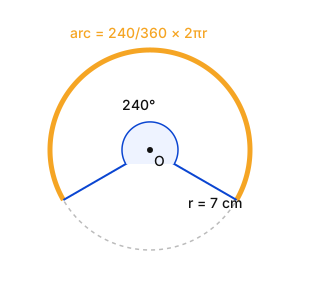
- .
- Circumference cm.
- Arc cm.
Trick: is two-thirds of a full turn, so take two-thirds of the circumference.
Answer: (C) 29.33 cm
अवधारणा: चाप की लंबाई ।
- ।
- परिधि cm।
- चाप cm।
ट्रिक: पूरे चक्कर का दो-तिहाई है, इसलिए परिधि का दो-तिहाई लें।
उत्तर: (C) 29.33 cm
RRB NTPC Graduate CBT 1MathematicsCircle – arc lengthRRB NTPC Graduate CBT 1 2025 · 17 Mar Shift 3
Q572.What should come in place of ‘?’ in the given series?
81 79 76 71 64 ?
दी गई श्रेणी में ‘?’ के स्थान पर क्या आना चाहिए?
81 79 76 71 64 ?
- A54
- B53
- C55
- D51
Show answer
Concept: Look at the differences between consecutive terms.
- – differences are prime numbers.
- Next prime is 11, so .
Trick: Differences 2, 3, 5, 7, 11, 13… (primes) is a favourite pattern.
Answer: (B) 53
अवधारणा: क्रमागत पदों के अंतर देखें।
- – अंतर अभाज्य संख्याएँ हैं।
- अगली अभाज्य 11, अतः ।
ट्रिक: अंतर 2, 3, 5, 7, 11, 13… (अभाज्य) एक पसंदीदा पैटर्न है।
उत्तर: (B) 53
RRB NTPC Graduate CBT 1MathematicsNumber seriesRRB NTPC Graduate CBT 1 2025 · 17 Mar Shift 3
Q573.At what rate (in percentage, rounded off to two decimal place) per year will a sum of money 5 times itself in 24 years on simple interest?
साधारण ब्याज पर प्रति वर्ष किस दर (प्रतिशत में, दो दशमलव स्थानों तक पूर्णांकित) से कोई धनराशि 24 वर्षों में स्वयं की 5 गुनी हो जाएगी?
- A16.67
- B14.67
- C33.34
- D18.67
Show answer
Concept: If a sum becomes times at SI, interest and .
- Amount , so SI in 24 years.
- .
Trick: ' times in years' → ; here .
Answer: (A) 16.67
अवधारणा: यदि राशि SI पर गुनी हो, तो ब्याज और ।
- मिश्रधन , अतः SI (24 वर्ष में)।
- ।
ट्रिक: ' वर्ष में गुना' → ; यहाँ ।
उत्तर: (A) 16.67
RRB NTPC Graduate CBT 1MathematicsSimple interestRRB NTPC Graduate CBT 1 2025 · 17 Mar Shift 3
Q574.A chemical engineer designs a cylindrical reaction vessel with inner radius 15 cm and height 40 cm. Inside this vessel, three identical cylindrical cooling tubes (each with radius 4 cm and same height as the vessel) are installed vertically. If the remaining space is filled to 75% capacity with reactive solution, what volume of solution (in liters) does the vessel contain? (Use π = 3.14) (Round your answer off to two decimal places.)
एक रासायनिक इंजीनियर 15 cm आंतरिक त्रिज्या और 40 cm ऊँचाई वाला एक बेलनाकार अभिक्रिया पात्र डिज़ाइन करता है। इस पात्र के अंदर तीन समरूप बेलनाकार शीतलन नलिकाएँ (प्रत्येक की त्रिज्या 4 cm और ऊँचाई पात्र के समान) ऊर्ध्वाधर रूप से लगाई गई हैं। यदि शेष स्थान को अभिक्रियाशील विलयन से 75% क्षमता तक भरा जाता है, तो पात्र में विलयन का आयतन (लीटर में) कितना है? (π = 3.14 का उपयोग कीजिए) (अपने उत्तर को दो दशमलव स्थानों तक पूर्णांकित कीजिए।)
- A16.67 liters16.67 लीटर
- B18.15 liters18.15 लीटर
- C19.33 liters19.33 लीटर
- D17.42 liters17.42 लीटर
Show answer
Concept: Volume of cylinder ; free space = vessel volume − volume of tubes; 1 litre cm³.
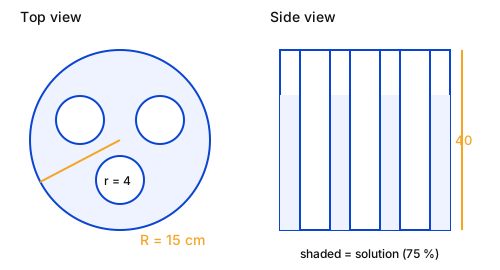
- Vessel: cm³.
- Three tubes: cm³.
- Free space cm³.
- Solution of it cm³ litres.
Trick: Keep till the end: , then multiply by 3.14 once.
Answer: (A) 16.67 liters
अवधारणा: बेलन का आयतन ; खाली स्थान = बर्तन का आयतन − नलियों का आयतन; 1 लीटर cm³।
- बर्तन: cm³।
- तीन नलियाँ: cm³।
- खाली स्थान cm³।
- घोल इसका cm³ लीटर।
ट्रिक: अंत तक रखें: , फिर एक बार 3.14 से गुणा करें।
उत्तर: (A) 16.67 liters
RRB NTPC Graduate CBT 1MathematicsMensuration – cylinderRRB NTPC Graduate CBT 1 2025 · 17 Mar Shift 3
Q575.A shopkeeper fixes the marked price of an item 180% above its cost price. What percentage of discount on marked price should be allowed to gain 152%?
एक दुकानदार किसी वस्तु का अंकित मूल्य उसके क्रय मूल्य से 180% अधिक निर्धारित करता है। 152% लाभ प्राप्त करने के लिए अंकित मूल्य पर कितने प्रतिशत छूट दी जानी चाहिए?
- A8%
- B9%
- C7%
- D10%
Show answer
Concept: Take CP ; , , discount is on MP.
- MP ; required SP .
- Discount .
- Discount% .
Trick: : .
Answer: (D) 10%
अवधारणा: CP लें; , , छूट MP पर होती है।
- MP ; अभीष्ट SP ।
- छूट ।
- छूट% ।
ट्रिक: : ।
उत्तर: (D) 10%
RRB NTPC Graduate CBT 1MathematicsProfit and loss – discountRRB NTPC Graduate CBT 1 2025 · 17 Mar Shift 3
Q576.Amit invested the same sum at simple and compound interest (compounded annually) for 2 years at 4% per annum. The difference between the compound interest and the simple interest is ₹47. Find the sum (in ₹) invested in each case.
अमित ने समान धनराशि 2 वर्षों के लिए 4% वार्षिक दर से साधारण ब्याज और चक्रवृद्धि ब्याज (वार्षिक रूप से संयोजित) पर निवेश की। चक्रवृद्धि ब्याज और साधारण ब्याज के बीच का अंतर ₹47 है। प्रत्येक स्थिति में निवेश की गई धनराशि (₹ में) ज्ञात कीजिए।
- A29,725
- B29,375
- C28,625
- D28,475
Show answer
Concept: For 2 years, .
- .
- .
Trick: 2-year difference ; 3-year difference .
Answer: (B) 29,375
अवधारणा: 2 वर्ष के लिए, ।
- ।
- ।
ट्रिक: 2 वर्ष का अंतर ; 3 वर्ष का अंतर ।
उत्तर: (B) 29,375
RRB NTPC Graduate CBT 1MathematicsCI – SI differenceRRB NTPC Graduate CBT 1 2025 · 17 Mar Shift 3
Q577.Walking at of his normal speed from his home, Lakshya is 15 minutes late in reaching his office. The usual time taken by him to cover the distance between his home and his office is
अपने घर से अपनी सामान्य चाल के से चलते हुए, लक्ष्य अपने कार्यालय पहुँचने में 15 मिनट देर हो जाता है। अपने घर और कार्यालय के बीच की दूरी तय करने में उसे सामान्यतः लगने वाला समय है
- A20 minutes20 मिनट
- B29 minutes29 मिनट
- C23 minutes23 मिनट
- D16 minutes16 मिनट
Show answer
Concept: For a fixed distance, time is inversely proportional to speed.
- Speed becomes of usual ⇒ time becomes of usual time .
- Extra time minutes.
- minutes.
Trick: Speed ratio ⇒ time ratio ; the difference of 3 parts min ⇒ 1 part , usual .
Answer: (A) 20 minutes
अवधारणा: निश्चित दूरी के लिए समय, चाल के व्युत्क्रमानुपाती होता है।
- चाल सामान्य की ⇒ समय सामान्य समय का ।
- अतिरिक्त समय मिनट।
- मिनट।
ट्रिक: चाल अनुपात ⇒ समय अनुपात ; 3 भागों का अंतर मिनट ⇒ 1 भाग , सामान्य ।
उत्तर: (A) 20 minutes
RRB NTPC Graduate CBT 1MathematicsSpeed and time – late/earlyRRB NTPC Graduate CBT 1 2025 · 17 Mar Shift 3
Q578.Evaluate: 16 + 18 ÷ 6 - 2 × 4
मान ज्ञात कीजिए: 16 + 18 ÷ 6 - 2 × 4
- A13
- B11
- C14
- D10
Show answer
Concept: Do division and multiplication before addition and subtraction (BODMAS).
- and .
- .
Trick: Underline all ÷ and × first, solve them, then run left to right.
Answer: (B) 11
अवधारणा: जोड़-घटाव से पहले भाग और गुणा करें (BODMAS)।
- और ।
- ।
ट्रिक: पहले सभी ÷ और × रेखांकित करके हल करें, फिर बाएँ से दाएँ चलें।
उत्तर: (B) 11
RRB NTPC Graduate CBT 1MathematicsSimplification – BODMASRRB NTPC Graduate CBT 1 2025 · 17 Mar Shift 3
Q579.The radius of a solid cylinder is 12 cm, and its height is 25 cm. A three- dimensional sector with a sector angle of 45o is removed from it, all along the height of the cylinder. What is the volume (in cm3) of the larger piece of the cylinder?
एक ठोस बेलन की त्रिज्या 12 cm है और इसकी ऊँचाई 25 cm है। इससे 45o त्रिज्यखंड कोण वाला एक त्रि-विमीय त्रिज्यखंड बेलन की पूरी ऊँचाई के अनुदिश निकाल दिया जाता है। बेलन के बड़े टुकड़े का आयतन (cm3 में) क्या है?
- A
- B
- C
- D
Show answer
Concept: A sector of angle cut along the height takes of the cylinder's volume .
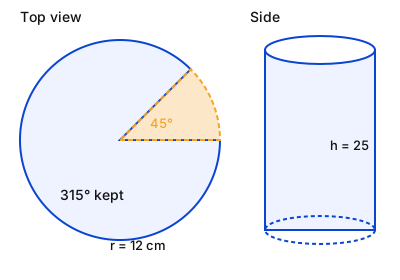
- Full volume cm³.
- Removed piece of it; larger piece .
- Larger piece cm³.
Trick: is one-eighth of a turn – keep , remove .
Answer: (A)
अवधारणा: ऊँचाई के साथ काटा गया कोण का त्रिज्यखंड बेलन के आयतन का भाग लेता है।
- पूरा आयतन cm³।
- हटाया भाग ; बड़ा टुकड़ा ।
- बड़ा टुकड़ा cm³।
ट्रिक: पूरे चक्कर का आठवाँ भाग – रखें, हटाएँ।
उत्तर: (A)
RRB NTPC Graduate CBT 1MathematicsMensuration – cylinder sectorRRB NTPC Graduate CBT 1 2025 · 17 Mar Shift 3
Q580.At present, Vanraj is three times as old as his son, and his daughter is 3 years younger than the son. If the sum of the ages of these three people 3 years ago was 58 years, then Vanraj's present age (in years) is:
वर्तमान में, वनराज की आयु अपने पुत्र की आयु की तीन गुनी है, और उसकी पुत्री पुत्र से 3 वर्ष छोटी है। यदि 3 वर्ष पहले इन तीनों की आयु का योग 58 वर्ष था, तो वनराज की वर्तमान आयु (वर्षों में) है:
- A42
- B36
- C33
- D45
Show answer
Concept: Let the son's present age be ; express every age in and shift all three back by 3 years.
- Son , daughter , Vanraj ; present sum .
- Three years ago the sum is 9 less: .
- Vanraj years.
Trick: For people ' years ago', subtract from the present total – here .
Answer: (A) 42
अवधारणा: पुत्र की वर्तमान आयु लें; हर आयु में लिखें और तीनों को 3 वर्ष पीछे ले जाएँ।
- पुत्र , पुत्री , वनराज ; वर्तमान योग ।
- तीन वर्ष पहले योग 9 कम: ।
- वनराज वर्ष।
ट्रिक: लोगों के लिए ' वर्ष पहले', वर्तमान योग से घटाएँ – यहाँ ।
उत्तर: (A) 42
RRB NTPC Graduate CBT 1MathematicsAgesRRB NTPC Graduate CBT 1 2025 · 17 Mar Shift 3

