Q41.Eight years ago from now, the average age of A and B was 24 years. The average age of A, B and C today is 32 years. How old will C be after 16 years from now?
आज से आठ वर्ष पहले A और B की औसत आयु 24 वर्ष थी। आज A, B और C की औसत आयु 32 वर्ष है। आज से 16 वर्ष बाद C की आयु कितनी होगी?
- A80 years80 वर्ष
- B56 years56 वर्ष
- C48 years48 वर्ष
- D40 years40 वर्ष
Show answer
Concept: Sum = average × number; each person ages 1 year per year.
- 8 years ago A + B → today A + B .
- Today A + B + C → C .
- After 16 years C .
Trick: When moving a group's sum forward n years, add n for each member (here ).
Answer: (C) 48 years
अवधारणा: योग = औसत × संख्या; हर व्यक्ति की आयु प्रति वर्ष 1 वर्ष बढ़ती है।
- 8 वर्ष पहले A + B → आज A + B ।
- आज A + B + C → C ।
- 16 वर्ष बाद C ।
ट्रिक: समूह का योग n वर्ष आगे ले जाने पर हर सदस्य के लिए n जोड़ें (यहाँ )।
उत्तर: (C) 48 वर्ष
RRB NTPC Graduate CBT 1MathematicsAverage – agesRRB NTPC Graduate CBT 1 2025 · 27 Mar Shift 2
Q42.The ratio of the sum of odd positive integers from 1 to 100 to the sum of even positive integers from 150 to 200 is:
1 से 100 तक के विषम धनात्मक पूर्णांकों के योग का, 150 से 200 तक के सम धनात्मक पूर्णांकों के योग से अनुपात है:
- A50:71
- B50:81
- C50:91
- D50:101
Show answer
Concept: Sum of first odd numbers ; sum of an AP .
- Odd numbers 1 to 100: 50 terms → sum .
- Even numbers 150 to 200: ; sum .
- Ratio .
Trick: All options start with 50 – so only compute .
Answer: (C) 50:91
अवधारणा: पहली विषम संख्याओं का योग ; AP का योग ।
- 1 से 100 तक विषम: 50 पद → योग ।
- 150 से 200 तक सम: ; योग ।
- अनुपात ।
ट्रिक: सभी विकल्प 50 से शुरू होते हैं – बस निकालें।
उत्तर: (C) 50:91
RRB NTPC Graduate CBT 1MathematicsSum of APRRB NTPC Graduate CBT 1 2025 · 27 Mar Shift 2
Q43.The monthly incomes of two friends Ajay and Amit, are in the ratio 6 : 7 respectively and each of them saves ₹63,000 every month. If the ratio of their monthly expenditure is 2 : 4, find the monthly income of Ajay (in ₹).
दो मित्रों Ajay और Amit की मासिक आय क्रमशः 6 : 7 के अनुपात में है और उनमें से प्रत्येक प्रति माह ₹63,000 की बचत करता है। यदि उनके मासिक व्यय का अनुपात 2 : 4 है, तो Ajay की मासिक आय (₹ में) ज्ञात कीजिए।
- A74,600
- B1,05,840
- C76,600
- D75,600
Show answer
Concept: Expenditure = Income − Saving. Put incomes as and and use the expenditure ratio.
- Expenditures: and in ratio .
- .
- .
- Ajay's income .
Trick: When savings are equal, check options: 75,600 and 88,200 (ratio 6:7) minus 63,000 give 12,600 and 25,200 = 1 : 2 ✓.
Answer: (D) 75,600
अवधारणा: व्यय = आय − बचत। आय को और मानकर व्यय का अनुपात लगाएँ।
- व्यय: और , अनुपात ।
- ।
- ।
- अजय की आय ।
ट्रिक: बचत समान हो तो विकल्प जाँचें: 75,600 और 88,200 (6:7) में से 63,000 घटाने पर 12,600 और 25,200 = 1 : 2 ✓।
उत्तर: (D) 75,600
RRB NTPC Graduate CBT 1MathematicsRatio – income & expenditureRRB NTPC Graduate CBT 1 2025 · 27 Mar Shift 2
Q44.If and , then find the positive value of .
यदि और है, तो का धनात्मक मान ज्ञात कीजिए।
- A9
- B15
- C11
- D13
Show answer
Concept: with , .
- .
- Substitute: .
- Positive value: .
Trick: Whenever you see and , think of – the cross term is .
Answer: (C) 11
अवधारणा: , जहाँ , ।
- ।
- मान रखें: ।
- धनात्मक मान: ।
ट्रिक: और दिखे तो सोचें – बीच का पद होता है।
उत्तर: (C) 11
RRB NTPC Graduate CBT 1MathematicsAlgebraic identitiesRRB NTPC Graduate CBT 1 2025 · 27 Mar Shift 2
Q45.If a 7-digit number 65770A4 is completely divisible by 4, what is the minimum value of A?
यदि 7 अंकों की संख्या 65770A4, 4 से पूर्णतः विभाज्य है, तो A का न्यूनतम मान क्या है?
- A3
- B0
- C4
- D2
Show answer
Concept: A number is divisible by 4 if the number formed by its last two digits is divisible by 4.
- Last two digits of 65770A4 are "A4".
- Two-digit numbers ending in 4 divisible by 4: 04, 24, 44, 64, 84 → A = 0, 2, 4, 6, 8.
- Minimum value of A = 0 (the number 6577004 ends in 04, which is divisible by 4).
Trick: Units digit 4 ⇒ tens digit must be even for divisibility by 4; smallest even digit is 0.
Answer: (B) 0
अवधारणा: कोई संख्या 4 से विभाज्य है यदि उसके अंतिम दो अंकों से बनी संख्या 4 से विभाज्य हो।
- 65770A4 के अंतिम दो अंक "A4" हैं।
- 4 पर समाप्त होने वाली 4 से विभाज्य दो-अंकीय संख्याएँ: 04, 24, 44, 64, 84 → A = 0, 2, 4, 6, 8।
- A का न्यूनतम मान = 0 (6577004 का अंत 04 है, जो 4 से विभाज्य है)।
ट्रिक: इकाई अंक 4 हो तो दहाई अंक सम होना चाहिए; सबसे छोटा सम अंक 0 है।
उत्तर: (B) 0
RRB NTPC Graduate CBT 1MathematicsDivisibility rulesRRB NTPC Graduate CBT 1 2025 · 27 Mar Shift 2
Q46.Evaluate: 16 + 20 ÷ 4 - 3 × 3
मान ज्ञात कीजिए: 16 + 20 ÷ 4 - 3 × 3
- A14
- B12
- C11
- D15
Show answer
Concept: BODMAS – do Division and Multiplication before Addition and Subtraction.
- and .
- Expression becomes .
- .
Trick: Never work left to right blindly – circle the ÷ and × parts first.
Answer: (B) 12
अवधारणा: BODMAS – भाग और गुणा पहले, जोड़-घटाव बाद में।
- और ।
- व्यंजक बना ।
- ।
ट्रिक: बाएँ से दाएँ सीधे हल न करें – पहले ÷ और × वाले भाग घेरें।
उत्तर: (B) 12
RRB NTPC Graduate CBT 1MathematicsBODMASRRB NTPC Graduate CBT 1 2025 · 27 Mar Shift 2
Q47.A right circular cone has a radius of 7 cm. Its slant height is 25 cm. What is the total surface area of the cone? (Use π = 22/7)
एक लंब वृत्तीय शंकु की त्रिज्या 7 cm है। इसकी तिर्यक ऊँचाई 25 cm है। शंकु का कुल पृष्ठीय क्षेत्रफल क्या है? (π = 22/7 का प्रयोग कीजिए)
- A
- B
- C
- D
Show answer
Concept: Total surface area of a cone .
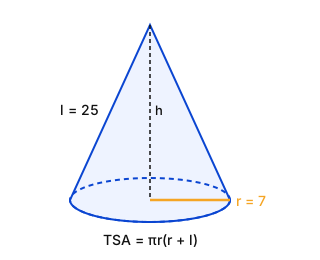
- cm, cm, so .
- TSA .
- .
Trick: With and , the 7 cancels – TSA is simply .
Answer: (B)
अवधारणा: शंकु का कुल पृष्ठीय क्षेत्रफल ।
- cm, cm, अतः ।
- TSA ।
- ।
ट्रिक: और हो तो 7 कट जाता है – TSA बस ।
उत्तर: (B)
RRB NTPC Graduate CBT 1MathematicsMensuration – coneRRB NTPC Graduate CBT 1 2025 · 27 Mar Shift 2
Q48.Meenakshi and Meena invest in a business in the ratio 12 : 32. If total profit is ₹2,904, then what is difference between the profit (in ₹) of Meenakshi and Meena?
Meenakshi और Meena एक व्यापार में 12 : 32 के अनुपात में निवेश करती हैं। यदि कुल लाभ ₹2,904 है, तो Meenakshi और Meena के लाभ (₹ में) का अंतर क्या है?
- A₹1,320
- B₹1,470
- C₹1,220
- D₹1,270
Show answer
Concept: For equal time, profit is shared in the ratio of investments.
- , total parts.
- 1 part .
- Difference .
Trick: Difference of profits .
Answer: (A) ₹1,320
अवधारणा: समान समय के लिए लाभ निवेश के अनुपात में बँटता है।
- , कुल भाग।
- 1 भाग ।
- अंतर ।
ट्रिक: लाभ का अंतर ।
उत्तर: (A) ₹1,320
RRB NTPC Graduate CBT 1MathematicsPartnershipRRB NTPC Graduate CBT 1 2025 · 27 Mar Shift 2
Q49.Three solid cubes whose edges measure 1 cm, 6 cm, and 8 cm, respectively, are melted and recast into a single cube. What is the length (in cm) of the diagonal of the cube?
तीन ठोस घनों, जिनके किनारे क्रमशः 1 cm, 6 cm और 8 cm हैं, को पिघलाकर एक एकल घन बनाया जाता है। इस घन के विकर्ण की लंबाई (cm में) क्या है?
- A
- B
- C
- D
Show answer
Concept: Melting preserves volume. Diagonal of a cube .
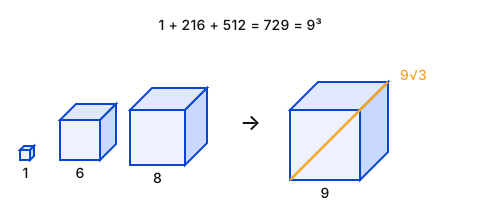
- Total volume .
- New edge cm.
- Diagonal cm.
Trick: is a famous cube triplet (), like .
Answer: (A)
अवधारणा: पिघलाने पर आयतन समान रहता है। घन का विकर्ण ।
- कुल आयतन ।
- नई भुजा cm।
- विकर्ण cm।
ट्रिक: प्रसिद्ध घन-त्रिक है (), जैसे ।
उत्तर: (A)
RRB NTPC Graduate CBT 1MathematicsMensuration – cubeRRB NTPC Graduate CBT 1 2025 · 27 Mar Shift 2
Q50.Two taps can fill a cistern in 4 hours and 26 hours respectively. A third tap can empty it in 26 hours. How long (in hours) will it take to fill one-fourth of the empty cistern, if all of them are opened together?
दो नल एक टंकी को क्रमशः 4 घंटे और 26 घंटे में भर सकते हैं। एक तीसरा नल इसे 26 घंटे में खाली कर सकता है। यदि इन सभी को एक साथ खोल दिया जाए, तो खाली टंकी के एक-चौथाई भाग को भरने में कितना समय (घंटों में) लगेगा?
- A2
- B1
- C4
- D3
Show answer
Concept: Add the per-hour work of filling taps and subtract the emptying tap.
- Net part filled in 1 hour .
- So the full cistern fills in 4 hours.
- One-fourth of the cistern hour.
Trick: The 26-hour filler and 26-hour emptier cancel exactly – only the 4-hour tap matters.
Answer: (B) 1
अवधारणा: भरने वाले नलों का प्रति घंटा कार्य जोड़ें और खाली करने वाले का घटाएँ।
- 1 घंटे में भरा भाग ।
- अतः पूरी टंकी 4 घंटे में भरती है।
- एक-चौथाई टंकी घंटा।
ट्रिक: 26 घंटे वाला भरने वाला और 26 घंटे वाला खाली करने वाला नल एक-दूसरे को काट देते हैं – केवल 4 घंटे वाला नल मायने रखता है।
उत्तर: (B) 1
RRB NTPC Graduate CBT 1MathematicsPipes and cisternsRRB NTPC Graduate CBT 1 2025 · 27 Mar Shift 2
Q51.The least common multiple of 64, 128 and A is 4480. The difference between the maximum and minimum possible values of A is:
64, 128 और A का लघुत्तम समापवर्त्य 4480 है। A के अधिकतम और न्यूनतम संभव मानों का अंतर है:
- A5444
- B4454
- C4544
- D4445
Show answer
Concept: Factorise the LCM; A must supply every prime factor that 64 and 128 cannot.
- ; , .
- Since 128 already gives , A must contain and may have with .
- Minimum A , maximum A .
- Difference .
Trick: Max A is always the LCM itself; Min A = LCM with the powers of 2 already covered by 128 removed.
Answer: (D) 4445
अवधारणा: LCM का गुणनखंड करें; A को वे अभाज्य गुणनखंड देने होंगे जो 64 और 128 नहीं दे सकते।
- ; , ।
- 128 पहले ही देता है, अतः A में होना चाहिए और () हो सकता है।
- न्यूनतम A , अधिकतम A ।
- अंतर ।
ट्रिक: अधिकतम A हमेशा LCM ही होता है; न्यूनतम A = LCM में से 128 द्वारा दी गई 2 की घातें हटाकर।
उत्तर: (D) 4445
RRB NTPC Graduate CBT 1MathematicsLCMRRB NTPC Graduate CBT 1 2025 · 27 Mar Shift 2
Q52.At what rate per annum will a sum of money become five times itself in 9 years under simple interest?
साधारण ब्याज पर कोई धनराशि 9 वर्षों में स्वयं की पाँच गुनी किस वार्षिक दर पर हो जाएगी?
- A
- B
- C
- D
Show answer
Concept: If the sum becomes times, SI and .
- Five times ⇒ SI in 9 years.
- .
- per annum.
Trick: " times in years" ⇒ .
Answer: (C)
अवधारणा: धन गुना हो तो SI और ।
- पाँच गुना ⇒ SI , 9 वर्षों में।
- ।
- वार्षिक।
ट्रिक: " वर्षों में गुना" ⇒ ।
उत्तर: (C)
RRB NTPC Graduate CBT 1MathematicsSimple interestRRB NTPC Graduate CBT 1 2025 · 27 Mar Shift 2
Q53.If the quadratic equation has identical roots, then what are the possible values of ?
यदि द्विघात समीकरण के मूल समान (identical) हैं, तो के संभव मान क्या हैं?
- A
- B
- C
- D
Show answer
Concept: has identical (equal) roots when the discriminant .
- Here , , .
- .
- .
- or .
Trick: Check quickly: gives ✓.
Answer: (C)
अवधारणा: के मूल समान होते हैं जब विविक्तकर (discriminant) ।
- यहाँ , , ।
- ।
- ।
- या ।
ट्रिक: जल्दी जाँच: पर ✓।
उत्तर: (C)
RRB NTPC Graduate CBT 1MathematicsQuadratic equations – equal rootsRRB NTPC Graduate CBT 1 2025 · 27 Mar Shift 2
Q54.There are 25 members in group A, 32 members in group B and 31 members in group C. All the members of these groups went to a restaurant. The average amounts spent on each member of groups A, B and C are ₹101, ₹249 and ₹269, respectively. The overall average amount (in ₹) spent per member is:
समूह A में 25 सदस्य, समूह B में 32 सदस्य और समूह C में 31 सदस्य हैं। इन समूहों के सभी सदस्य एक रेस्तरां में गए। समूह A, B और C के प्रत्येक सदस्य पर खर्च की गई औसत राशि क्रमशः ₹101, ₹249 और ₹269 है। प्रति सदस्य खर्च की गई समग्र औसत राशि (₹ में) है:
- A216
- B219
- C214
- D215
Show answer
Concept: Overall average .
- Group totals: , , .
- Total amount ; total members .
- Average .
Trick: Take 214 as base: deviations ✓.
Answer: (C) 214
अवधारणा: कुल औसत ।
- समूह योग: , , ।
- कुल राशि ; कुल सदस्य ।
- औसत ।
ट्रिक: 214 को आधार मानें: विचलन ✓।
उत्तर: (C) 214
RRB NTPC Graduate CBT 1MathematicsWeighted averageRRB NTPC Graduate CBT 1 2025 · 27 Mar Shift 2
Q55.The selling price of 25 books is equal to the cost price of 19 books. Find the loss or gain percentage.
25 पुस्तकों का विक्रय मूल्य 19 पुस्तकों के क्रय मूल्य के बराबर है। हानि या लाभ प्रतिशत ज्ञात कीजिए।
- A24% gain24% लाभ
- B gain लाभ
- C24% loss24% हानि
- D loss हानि
Show answer
Concept: If SP of articles = CP of articles, then gain/loss.
- SP of 25 books = CP of 19 books ⇒ per book.
- SP is less than CP, so it is a loss.
- Loss.
Trick: Divide by the number attached to SP (25). More articles sold for the cost of fewer ⇒ loss.
Answer: (C) 24% loss
अवधारणा: यदि वस्तुओं का SP = वस्तुओं का CP, तो लाभ/हानि।
- 25 पुस्तकों का SP = 19 पुस्तकों का CP ⇒ प्रति पुस्तक ।
- SP, CP से कम है, अतः हानि।
- हानि।
ट्रिक: SP वाली संख्या (25) से भाग दें। ज़्यादा वस्तुएँ कम वस्तुओं की लागत में बिकें ⇒ हानि।
उत्तर: (C) 24% हानि
RRB NTPC Graduate CBT 1MathematicsProfit and lossRRB NTPC Graduate CBT 1 2025 · 27 Mar Shift 2
Q56.The average of first 13 multiples of 9 is:
9 के प्रथम 13 गुणजों का औसत है:
- A13
- B58.5
- C9
- D63
Show answer
Concept: Average of the first multiples of .
- Here , .
- Average .
- Check: the multiples 9, 18, …, 117 form an AP; the middle (7th) term .
Trick: For an odd count of terms in AP, the average is simply the middle term.
Answer: (D) 63
अवधारणा: के पहले गुणजों का औसत ।
- यहाँ , ।
- औसत ।
- जाँच: 9, 18, …, 117 समांतर श्रेढ़ी है; बीच का (7वाँ) पद ।
ट्रिक: AP में पदों की संख्या विषम हो तो औसत = बीच का पद।
उत्तर: (D) 63
RRB NTPC Graduate CBT 1MathematicsAverage of multiplesRRB NTPC Graduate CBT 1 2025 · 27 Mar Shift 2
Q57.If A's salary is 143% more than that of B, then how much percent is B's salary less than that of A (correct to 2 decimal places)?
यदि A का वेतन B के वेतन से 143% अधिक है, तो B का वेतन A के वेतन से कितने प्रतिशत कम है (दशमलव के 2 स्थानों तक सही)?
- A61.92%
- B59.64%
- C56.62%
- D58.85%
Show answer
Concept: If A is more than B, then B is less than A.
- Let B = 100, so A = 243.
- B is less than A by .
- .
Trick: "More" → divide by ; "less" → divide by . Here , a little under 60%.
Answer: (D) 58.85%
अवधारणा: यदि A, B से अधिक है, तो B, A से कम है।
- B = 100 मानें, तो A = 243।
- B, A से कम।
- ।
ट्रिक: "अधिक" → से भाग; "कम" → से भाग। यहाँ , 60% से थोड़ा कम।
उत्तर: (D) 58.85%
RRB NTPC Graduate CBT 1MathematicsPercentage comparisonRRB NTPC Graduate CBT 1 2025 · 27 Mar Shift 2
Q58.What is the mode of the data given below? [Give your answer correct to 2 decimal places.]
| Age in years | 20-30 | 30-40 | 40-50 | 50-60 | 60-70 | 70-80 | 80-90 |
|---|
| No. of patients | 24 | 29 | 26 | 35 | 20 | 23 | 10 |
|---|
नीचे दिए गए आँकड़ों का बहुलक (mode) क्या है? [अपना उत्तर दशमलव के 2 स्थानों तक सही दीजिए।]
| आयु (वर्षों में) | 20-30 | 30-40 | 40-50 | 50-60 | 60-70 | 70-80 | 80-90 |
|---|
| रोगियों की संख्या | 24 | 29 | 26 | 35 | 20 | 23 | 10 |
|---|
- A53.75
- B55.75
- C51.75
- D57.75
Show answer
Concept: Mode , where is the highest frequency.
- Highest frequency 35 → modal class 50–60; , , , , .
- Mode .
- .
Trick: = frequency just before, = just after the modal class; the answer always lies inside the modal class (50–60).
Answer: (A) 53.75
अवधारणा: बहुलक , जहाँ सबसे बड़ी बारंबारता है।
- सबसे बड़ी बारंबारता 35 → बहुलक वर्ग 50–60; , , , , ।
- बहुलक ।
- ।
ट्रिक: = बहुलक वर्ग से ठीक पहले की, = ठीक बाद की बारंबारता; उत्तर हमेशा बहुलक वर्ग (50–60) के अंदर होता है।
उत्तर: (A) 53.75
RRB NTPC Graduate CBT 1MathematicsStatistics – mode of grouped dataRRB NTPC Graduate CBT 1 2025 · 27 Mar Shift 2
Q59.A boat takes 8 hours to row 72 km downstream and 12 hours to row the same distance upstream. Find the boat's rate in still water and the rate of current, respectively.
एक नाव धारा की दिशा में 72 km चलने में 8 घंटे और धारा के विपरीत उतनी ही दूरी चलने में 12 घंटे लेती है। शांत जल में नाव की चाल और धारा की चाल क्रमशः ज्ञात कीजिए।
- A7.5 km/hr and 1.5 km/hr7.5 km/hr और 1.5 km/hr
- B8.5 km/hr and 2.5 km/hr8.5 km/hr और 2.5 km/hr
- C6.5 km/hr and 0.5 km/hr6.5 km/hr और 0.5 km/hr
- D9.5 km/hr and 3.5 km/hr9.5 km/hr और 3.5 km/hr
Show answer
Concept: Boat speed , current .
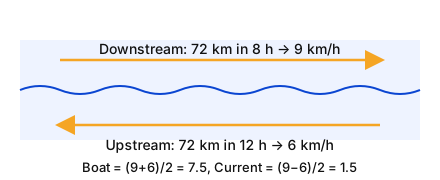
- Downstream speed km/h.
- Upstream speed km/h.
- Boat km/h; current km/h.
Trick: Downstream is always the faster one; average of the two = boat, half the gap = stream.
Answer: (A) 7.5 km/hr and 1.5 km/hr
अवधारणा: नाव की चाल , धारा ।
- अनुकूल चाल km/h।
- प्रतिकूल चाल km/h।
- नाव km/h; धारा km/h।
ट्रिक: अनुकूल चाल हमेशा बड़ी होती है; दोनों का औसत = नाव, अंतर का आधा = धारा।
उत्तर: (A) 7.5 km/hr और 1.5 km/hr
RRB NTPC Graduate CBT 1MathematicsBoats and streamsRRB NTPC Graduate CBT 1 2025 · 27 Mar Shift 2
Q60.A dealer buys two articles X and Y for ₹2300 each. He marks each of them at the same price. He sells X by giving two successive discounts of 46% and 68% and still earns ₹460 as profit. If he sells Y at a single discount of 73%, then what is the profit
percentage on Y?
एक व्यापारी दो वस्तुएँ X और Y प्रत्येक ₹2300 में खरीदता है। वह दोनों पर समान मूल्य अंकित करता है। वह X को 46% और 68% की दो क्रमागत छूट देकर बेचता है और फिर भी ₹460 का लाभ अर्जित करता है। यदि वह Y को 73% की एकल छूट पर बेचता है, तो Y पर लाभ
प्रतिशत क्या है?
- A87.5%
- B87%
- C86.5%
- D86%
Show answer
Concept: Two successive discounts leave of the marked price.
- SP of X .
- SP of Y . Ratio: .
- ; profit .
- Profit.
Trick: Same MP for both – work with the ratio of net multipliers () instead of finding MP.
Answer: (A) 87.5%
अवधारणा: दो क्रमिक छूट के बाद अंकित मूल्य का भाग बचता है।
- X का SP ।
- Y का SP । अनुपात: ।
- ; लाभ ।
- लाभ।
ट्रिक: दोनों का MP समान – MP निकालने के बजाय शुद्ध गुणकों का अनुपात () लें।
उत्तर: (A) 87.5%
RRB NTPC Graduate CBT 1MathematicsSuccessive discounts & profitRRB NTPC Graduate CBT 1 2025 · 27 Mar Shift 2

