Q641.X, Y, Z, S, T and U live on six different floors of the same building. The lowermost floor in the building is numbered 1, the floor above it is numbered 2 and so on till the topmost floor is numbered 6. S lives on floor number 5. X lives on a floor above S. Only U lives below Y. Z lives on an even numbered floor. How many people live below Z?
X, Y, Z, S, T और U एक ही भवन की छह अलग-अलग मंज़िलों पर रहते हैं। भवन की सबसे निचली मंज़िल की संख्या 1 है, उसके ऊपर की मंज़िल की संख्या 2 है, और इसी प्रकार सबसे ऊपरी मंज़िल तक, जिसकी संख्या 6 है। S मंज़िल संख्या 5 पर रहता है। X, S के ऊपर की किसी मंज़िल पर रहता है। Y के नीचे केवल U रहता है। Z सम संख्या वाली मंज़िल पर रहता है। Z के नीचे कितने व्यक्ति रहते हैं?
- AThreeतीन
- BFourचार
- CTwoदो
- DOneएक
Show answer
Concept: Fix definite positions first, then use parity (odd/even) clues.
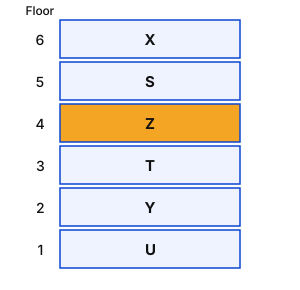
- S on 5; X above S → X on 6.
- Only U below Y → U on 1, Y on 2.
- Z on an even floor: only 4 is left even → Z on 4; T on 3.
- Below Z: T, Y, U = three people.
Trick: People below floor = ; Z on 4 → 3 people.
Answer: (A) Three
अवधारणा: पहले निश्चित स्थान तय करें, फिर सम/विषम सुराग लगाएँ।
- S मंज़िल 5; X, S के ऊपर → X मंज़िल 6।
- Y के नीचे केवल U → U मंज़िल 1, Y मंज़िल 2।
- Z सम मंज़िल पर: केवल 4 बची सम मंज़िल → Z मंज़िल 4; T मंज़िल 3।
- Z के नीचे: T, Y, U = तीन लोग।
ट्रिक: मंज़िल के नीचे लोग = ; Z मंज़िल 4 → 3 लोग।
उत्तर: (A) Three
RRB NTPC Graduate CBT 1General Intelligence and ReasoningFloor PuzzleRRB NTPC Graduate CBT 1 2025 · 16 Mar Shift 3
Q642.Refer to the following letter, number, symbol series and answer the question. (All numbers are single digit numbers only.)
(Left) R % C * E 3 K 6 $ 7 D @ 2 T Y # 4 5 G & S (Right)
If all the letters are dropped from the series, which of the following will be fourth from the right?
निम्नलिखित अक्षर, संख्या और प्रतीक श्रेणी को देखिए और प्रश्न का उत्तर दीजिए। (सभी संख्याएँ केवल एक अंक की संख्याएँ हैं।)
(बाएँ) R % C * E 3 K 6 $ 7 D @ 2 T Y # 4 5 G & S (दाएँ)
यदि श्रेणी से सभी अक्षर हटा दिए जाएँ, तो निम्नलिखित में से कौन-सा दाएँ से चौथा होगा?
- A@
- B4
- C#
- D2
Show answer
Concept: Remove the letters, rewrite the series and count from the right.
- Without letters: % * 3 6 $ 7 @ 2 # 4 5 &.
- From the right: & (1st), 5 (2nd), 4 (3rd), # (4th).
- Fourth from the right = #.
Trick: Cross out letters on paper in one pass – never try to count mentally in the mixed series.
Answer: (C) #
अवधारणा: अक्षर हटाकर शृंखला दोबारा लिखें और दाएँ से गिनें।
- अक्षरों के बिना: % * 3 6 $ 7 @ 2 # 4 5 &।
- दाएँ से: & (पहला), 5 (दूसरा), 4 (तीसरा), # (चौथा)।
- दाएँ से चौथा = #।
ट्रिक: काग़ज़ पर एक बार में अक्षर काट दें – मिश्रित शृंखला में मन में गिनने की कोशिश न करें।
उत्तर: (C) #
RRB NTPC Graduate CBT 1General Intelligence and ReasoningLetter–Symbol SeriesRRB NTPC Graduate CBT 1 2025 · 16 Mar Shift 3
Q643.52 is related to 144 following a certain logic. Following the same logic, 81 is related to 173. To which of the following is 63 related, following the same logic?
(NOTE: Operations should be performed on the whole numbers, without breaking down the numbers into their constituent digits. E.g. 13 – Operations on 13 such as adding/ subtracting /multiplying to 13 can be performed. Breaking down 13 into 1 and 3 and then performing mathematical operations on 1 and 3 is not allowed.)
एक निश्चित तर्क के अनुसार 52, 144 से संबंधित है। उसी तर्क के अनुसार 81, 173 से संबंधित है। उसी तर्क का अनुसरण करते हुए, 63 निम्नलिखित में से किससे संबंधित है?
(नोट: संक्रियाएँ पूर्ण संख्याओं पर की जानी चाहिए, संख्याओं को उनके घटक अंकों में तोड़े बिना। उदाहरण के लिए 13 – 13 पर संक्रियाएँ जैसे 13 में जोड़ना/घटाना/गुणा करना किया जा सकता है। 13 को 1 और 3 में तोड़कर फिर 1 और 3 पर गणितीय संक्रियाएँ करने की अनुमति नहीं है।)
- A165
- B175
- C145
- D155
Show answer
Concept: Find one operation that converts both given first numbers to their partners.
- and – the same number is added each time.
- So the rule is .
- .
Trick: Always check the plain difference first; if it is equal in both pairs, the rule is addition.
Answer: (D) 155
अवधारणा: ऐसी एक संक्रिया खोजें जो दोनों दी गई पहली संख्याओं को उनके जोड़ीदार में बदले।
- और – हर बार वही संख्या जुड़ी है।
- अतः नियम ।
- ।
ट्रिक: पहले सीधा अंतर देखें; दोनों जोड़ों में बराबर हो तो नियम जोड़ है।
उत्तर: (D) 155
RRB NTPC Graduate CBT 1General Intelligence and ReasoningNumber AnalogyRRB NTPC Graduate CBT 1 2025 · 16 Mar Shift 3
Q644.Seven people B, C, O, P, Q, R and S are sitting around a circular table facing the center of the table. B sits second to the right of S. Q sits third to the left of S. Only two people sit between P and R when counted from the right of R. C is an immediate neighbor of P. Who sits to the immediate left and right of O, respectively?
सात व्यक्ति B, C, O, P, Q, R और S एक वृत्ताकार मेज़ के चारों ओर मेज़ के केंद्र की ओर मुख करके बैठे हैं। B, S के दाएँ दूसरे स्थान पर बैठा है। Q, S के बाएँ तीसरे स्थान पर बैठा है। R के दाएँ से गिनने पर P और R के बीच केवल दो व्यक्ति बैठे हैं। C, P का निकटतम पड़ोसी है। O के ठीक बाएँ और ठीक दाएँ क्रमशः कौन बैठे हैं?
- AS and BS और B
- BC and BC और B
- CS and PS और P
- DC and SC और S
Show answer
Concept: Facing the centre, left = clockwise, right = anticlockwise. Fix S and place others.
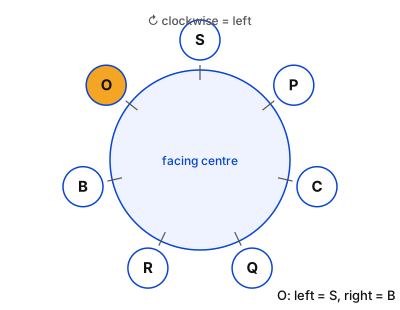
- B is 2nd to the right of S; Q is 3rd to the left of S.
- Two people between P and R from R's right: of the free seats, only R at 2nd left of S and P immediately left of S satisfy this (the other choice puts P on B's seat).
- C is P's neighbour → C between P and Q; the last seat, between B and S, is O.
- Immediate left of O is S, immediate right of O is B.
Trick: Number seats clockwise 0–6 with S = 0: right = −, left = +; then B = 5, Q = 3, R = 4, P = 1, C = 2, O = 6.
Answer: (A) S and B
अवधारणा: केंद्र की ओर मुख होने पर बायाँ = दक्षिणावर्त, दायाँ = वामावर्त। S को स्थिर कर बाकी बैठाएँ।
- B, S के दाएँ दूसरा; Q, S के बाएँ तीसरा।
- R के दाएँ से गिनने पर P और R के बीच दो लोग: खाली सीटों में केवल R = S के बाएँ दूसरा और P = S के ठीक बाएँ यह शर्त पूरी करते हैं (दूसरा विकल्प P को B की सीट पर रखता है)।
- C, P का पड़ोसी → C, P और Q के बीच; अंतिम सीट, B और S के बीच, O की।
- O के ठीक बाएँ S, ठीक दाएँ B।
ट्रिक: सीटें दक्षिणावर्त 0–6 लिखें, S = 0: दायाँ = −, बायाँ = +; तब B = 5, Q = 3, R = 4, P = 1, C = 2, O = 6।
उत्तर: (A) S and B
RRB NTPC Graduate CBT 1General Intelligence and ReasoningCircular SeatingRRB NTPC Graduate CBT 1 2025 · 16 Mar Shift 3
Q645.Each of the digits in the number 52697148 is arranged in descending order from left to right. What will be the product of the digits which are third from the left and second from the right in the number thus formed?
संख्या 52697148 के प्रत्येक अंक को बाएँ से दाएँ अवरोही क्रम में व्यवस्थित किया जाता है। इस प्रकार बनी संख्या में बाएँ से तीसरे और दाएँ से दूसरे अंकों का गुणनफल क्या होगा?
- A14
- B12
- C16
- D28
Show answer
Concept: Rearrange the digits as asked, then pick the required positions.
- Digits of 52697148: 5, 2, 6, 9, 7, 1, 4, 8.
- Descending: 9 8 7 6 5 4 2 1.
- Third from left = 7; second from right = 2; product .
Trick: Digits 0–9 with only 3 missing (0, 3) – write 9 to 1 and skip 3.
Answer: (A) 14
अवधारणा: अंकों को कहे अनुसार जमाएँ, फिर माँगे गए स्थान चुनें।
- 52697148 के अंक: 5, 2, 6, 9, 7, 1, 4, 8।
- अवरोही क्रम: 9 8 7 6 5 4 2 1।
- बाएँ से तीसरा = 7; दाएँ से दूसरा = 2; गुणनफल ।
ट्रिक: 0–9 में केवल 0 और 3 नहीं हैं – 9 से 1 लिखें और 3 छोड़ दें।
उत्तर: (A) 14
RRB NTPC Graduate CBT 1General Intelligence and ReasoningDigit ArrangementRRB NTPC Graduate CBT 1 2025 · 16 Mar Shift 3
Q646.In a certain code language,
E + F means ‘E is the brother of F’,
E – F means ‘E is the father of F’,
E x F means ‘E is the husband of F’ and
E ÷ F means ‘E is the mother of F’.
How is P related to T if ‘P + Q – R x S ÷ T’?
एक निश्चित कूट भाषा में,
E + F का अर्थ है ‘E, F का भाई है’,
E – F का अर्थ है ‘E, F का पिता है’,
E x F का अर्थ है ‘E, F का पति है’ और
E ÷ F का अर्थ है ‘E, F की माता है’।
यदि ‘P + Q – R x S ÷ T’ है, तो P, T से किस प्रकार संबंधित है?
- AFather's Father's Brotherपिता के पिता का भाई
- BFather's Brotherपिता का भाई
- CFatherपिता
- DBrotherभाई
Show answer
Concept: Decode left to right and climb the generations.
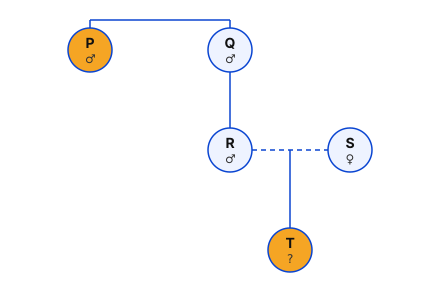
- P + Q: P is Q's brother. Q − R: Q is R's father. R × S: R is S's husband. S ÷ T: S is T's mother.
- So T's father is R, R's father is Q, and Q's brother is P.
- P is the brother of T's father's father.
Trick: Count the '−' and '÷' (parent links): two generations up from T, then 'brother' → father's father's brother.
Answer: (A) Father's Father's Brother
अवधारणा: बाएँ से दाएँ डिकोड करें और पीढ़ियाँ ऊपर चढ़ें।
- P + Q: P, Q का भाई। Q − R: Q, R का पिता। R × S: R, S का पति। S ÷ T: S, T की माँ।
- अतः T का पिता R, R का पिता Q, और Q का भाई P।
- P, T के पिता के पिता (दादा) का भाई है।
ट्रिक: '−' और '÷' (माता-पिता संबंध) गिनें: T से दो पीढ़ी ऊपर, फिर 'भाई' → दादा का भाई।
उत्तर: (A) Father's Father's Brother
RRB NTPC Graduate CBT 1General Intelligence and ReasoningBlood RelationsRRB NTPC Graduate CBT 1 2025 · 16 Mar Shift 3
Q647.Select the set in which the numbers are related in the same way as are the numbers of the following sets.
(NOTE : Operations should be performed on the whole numbers, without breaking down the numbers into their constituent digits. E.g. 13 – Operations on 13 such as adding / subtracting / multiplying etc. to 13 can be performed. Breaking down 13 into 1 and 3 and then performing mathematical operations on 1 and 3 is not allowed.)
(19,21,55)
(8,9,23)
उस समुच्चय का चयन कीजिए जिसमें संख्याएँ उसी प्रकार संबंधित हैं जिस प्रकार निम्नलिखित समुच्चयों की संख्याएँ संबंधित हैं।
(नोट : संक्रियाएँ पूर्ण संख्याओं पर की जानी चाहिए, संख्याओं को उनके घटक अंकों में तोड़े बिना। उदाहरण के लिए 13 – 13 पर संक्रियाएँ जैसे 13 में जोड़ना / घटाना / गुणा करना आदि की जा सकती हैं। 13 को 1 और 3 में तोड़कर फिर 1 और 3 पर गणितीय संक्रियाएँ करने की अनुमति नहीं है।)
(19,21,55)
(8,9,23)
- A(22,21,67)
- B(1,21,19)
- C(7,5,3)
- D(20,12,79)
Show answer
Concept: Find one rule linking the three numbers of each given set and test the options with it.
- Try the form : : ✓
- : ✓
- Option A : ✓
- Others fail: gives ; gives ; gives .
Trick: When sums/products fail, try with small (2, 3, 4) – both sets must obey the same .
Answer: (A) (22,21,67)
अवधारणा: दिए गए दोनों सेटों में तीनों संख्याओं को जोड़ने वाला एक नियम खोजें और विकल्पों पर जाँचें।
- आज़माएँ: : ✓
- : ✓
- विकल्प A : ✓
- बाकी असफल: से ; से ; से ।
ट्रिक: जब योग/गुणनफल काम न करे तो () आज़माएँ – दोनों सेटों में एक ही चलना चाहिए।
उत्तर: (A) (22,21,67)
RRB NTPC Graduate CBT 1General Intelligence and ReasoningNumber Analogy (Sets)RRB NTPC Graduate CBT 1 2025 · 16 Mar Shift 2
Q648.X, Y, Z, S, T and U live on six different floors of the same building. The lowermost floor in the building is numbered 1, the floor above it, number 2 and so on till the topmost floor is numbered 6. Only Z lives above U. T lives immediately below U. Only Y lives below S. Who lives on floor numbered 4?
X, Y, Z, S, T और U एक ही भवन की छह अलग-अलग मंज़िलों पर रहते हैं। भवन की सबसे निचली मंज़िल की संख्या 1 है, उसके ऊपर की मंज़िल की संख्या 2 है और इसी प्रकार सबसे ऊपरी मंज़िल की संख्या 6 है। केवल Z, U से ऊपर रहता है। T, U के ठीक नीचे रहता है। केवल Y, S से नीचे रहता है। मंज़िल संख्या 4 पर कौन रहता है?
- AZ
- BT
- CS
- DU
Show answer
Concept: Fix the extreme clues first ("only one above/below"), then fill the rest.
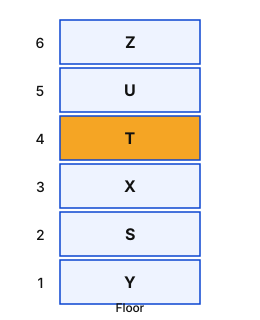
- Only Z lives above U → Z = 6, U = 5.
- T lives immediately below U → T = 4.
- Only Y lives below S → Y = 1, S = 2; the remaining X = 3.
- Floor 4 → T.
Trick: "Only X lives above Y" pins two floors at once – the top two. Start there.
Answer: (B) T
अवधारणा: पहले "केवल एक ऊपर/नीचे" वाले संकेतों से किनारे की मंज़िलें तय करें, फिर बाकी भरें।
- U के ऊपर केवल Z → Z = 6, U = 5.
- T, U के ठीक नीचे → T = 4.
- S के नीचे केवल Y → Y = 1, S = 2; बचा X = 3.
- मंज़िल 4 → T.
ट्रिक: "Y के ऊपर केवल X" एक साथ दो मंज़िलें (सबसे ऊपर की) तय कर देता है – वहीं से शुरू करें।
उत्तर: (B) T
RRB NTPC Graduate CBT 1General Intelligence and ReasoningFloor PuzzleRRB NTPC Graduate CBT 1 2025 · 16 Mar Shift 2
Q649.In this question, a question is followed by two statements numbered (I) and (II). You have to decide whether the data provided in the statements are sufficient to answer the question. Read both the statements and decide the appropriate answer.
Q. Five friends – Gaurav, Himanshu, Ishan, Lokesh, and Mukul – are of different ages. Who is the third oldest?
(I) Ishan is older than Gaurav but younger than Lokesh.
(II) Mukul is older than Ishan but younger than Lokesh.
इस प्रश्न में, एक प्रश्न के बाद (I) और (II) क्रमांकित दो कथन दिए गए हैं। आपको यह निर्णय करना है कि कथनों में दिए गए आँकड़े प्रश्न का उत्तर देने के लिए पर्याप्त हैं या नहीं। दोनों कथनों को पढ़िए और उचित उत्तर का निर्णय कीजिए।
प्रश्न. पाँच मित्र – गौरव, हिमांशु, ईशान, लोकेश और मुकुल – अलग-अलग आयु के हैं। तीसरा सबसे बड़ा कौन है?
(I) ईशान, गौरव से बड़ा है परंतु लोकेश से छोटा है।
(II) मुकुल, ईशान से बड़ा है परंतु लोकेश से छोटा है।
- AData in Statement II alone is sufficient to answer the question while data in Statement I is notकथन II के आँकड़े अकेले प्रश्न का उत्तर देने के लिए पर्याप्त हैं, जबकि कथन I के आँकड़े पर्याप्त नहीं हैं
- BBoth statements I and II together (and not statement I alone or statement II alone) are sufficient to answer the questionकथन I और II दोनों मिलकर (न कि केवल कथन I अकेले या केवल कथन II अकेले) प्रश्न का उत्तर देने के लिए पर्याप्त हैं
- CData in Statement I alone is sufficient to answer the question while data in Statement II is notकथन I के आँकड़े अकेले प्रश्न का उत्तर देने के लिए पर्याप्त हैं, जबकि कथन II के आँकड़े पर्याप्त नहीं हैं
- DBoth statements I and II together are NOT sufficient to answer the questionकथन I और II दोनों मिलकर भी प्रश्न का उत्तर देने के लिए पर्याप्त नहीं हैं
Show answer
Concept: To name the third oldest of five, the full order (at least the top three) must be fixed.
- Statement I: Lokesh > Ishan > Gaurav – Himanshu and Mukul unplaced → insufficient.
- Statement II: Lokesh > Mukul > Ishan – two people unplaced → insufficient.
- Together: Lokesh > Mukul > Ishan > Gaurav, but Himanshu can be anywhere, so the third oldest may be Ishan, Mukul or Himanshu.
Trick: If even one person is never mentioned in any statement, a "who is at position k" question is usually not answerable.
Answer: (D) Both statements I and II together are NOT sufficient to answer the question
अवधारणा: पाँच में से तीसरा सबसे बड़ा बताने के लिए (कम से कम ऊपर के तीन का) पूरा क्रम तय होना चाहिए।
- कथन I: Lokesh > Ishan > Gaurav – Himanshu व Mukul का स्थान नहीं → अपर्याप्त।
- कथन II: Lokesh > Mukul > Ishan – दो लोग छूटे → अपर्याप्त।
- दोनों मिलाकर: Lokesh > Mukul > Ishan > Gaurav, पर Himanshu कहीं भी हो सकता है, अतः तीसरा Ishan, Mukul या Himanshu हो सकता है।
ट्रिक: यदि कोई व्यक्ति किसी भी कथन में नहीं आया, तो "k-वें स्थान पर कौन" प्रायः तय नहीं हो पाता।
उत्तर: (D) Both statements I and II together are NOT sufficient to answer the question
RRB NTPC Graduate CBT 1General Intelligence and ReasoningData Sufficiency – OrderingRRB NTPC Graduate CBT 1 2025 · 16 Mar Shift 2
Q650.In a certain code language,
A + B means ‘A is the daughter of B’
A - B means ‘A is the mother of B’
A x B means ‘A is the wife of B’
A ÷ B means ‘A is the father of B’
Based on the above, how is G related to M if 'G + R x W ÷ D - M’?
एक निश्चित कूट भाषा में,
A + B का अर्थ है 'A, B की पुत्री है'
A - B का अर्थ है 'A, B की माता है'
A x B का अर्थ है 'A, B की पत्नी है'
A ÷ B का अर्थ है 'A, B का पिता है'
उपर्युक्त के आधार पर, यदि 'G + R x W ÷ D - M' है, तो G का M से क्या संबंध है?
- ASisterबहन
- BMother's sisterमाता की बहन
- CMotherमाता
- DMother's motherमाता की माता
Show answer
Concept: Decode left to right and draw the family tree.
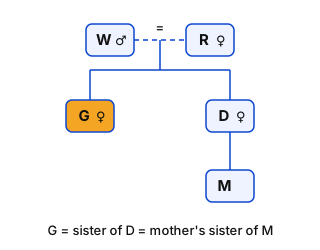
- G + R: G is the daughter of R. R × W: R is the wife of W → G is the daughter of W and R.
- W ÷ D: W is the father of D → D and G are sisters.
- D − M: D is the mother of M.
- So G is the sister of M's mother → mother's sister (maternal aunt).
Trick: Mark generations: G and D same level (siblings), M one level below → G = aunt.
Answer: (B) Mother's sister
अवधारणा: बाएँ से दाएँ कोड खोलकर वंश-वृक्ष बनाएँ।
- G + R: G, R की बेटी। R × W: R, W की पत्नी → G, W और R की बेटी।
- W ÷ D: W, D का पिता → D और G बहनें।
- D − M: D, M की माँ।
- अतः G, M की माँ की बहन → मौसी (mother's sister)।
ट्रिक: पीढ़ियाँ चिह्नित करें: G और D एक स्तर (बहनें), M एक स्तर नीचे → G = मौसी।
उत्तर: (B) Mother's sister
RRB NTPC Graduate CBT 1General Intelligence and ReasoningBlood Relations (Coded)RRB NTPC Graduate CBT 1 2025 · 16 Mar Shift 2
Q651.What should come in place of the question mark (?) in the given series?
20 22 25 30 37 ?
दी गई श्रेणी में प्रश्नचिह्न (?) के स्थान पर क्या आना चाहिए?
20 22 25 30 37 ?
- A49
- B55
- C48
- D51
Show answer
Concept: Check the differences between consecutive terms.
- – the differences are consecutive primes 2, 3, 5, 7.
- Next prime = 11 → .
Trick: Differences 2, 3, 5, 7, 11, 13 … = prime series; it appears very often in RRB papers.
Answer: (C) 48
अवधारणा: क्रमागत पदों के अंतर देखें।
- – अंतर क्रमागत अभाज्य संख्याएँ 2, 3, 5, 7।
- अगली अभाज्य = 11 → ।
ट्रिक: अंतर 2, 3, 5, 7, 11, 13 … = अभाज्य श्रृंखला; RRB में बहुत आम।
उत्तर: (C) 48
RRB NTPC Graduate CBT 1General Intelligence and ReasoningNumber SeriesRRB NTPC Graduate CBT 1 2025 · 16 Mar Shift 2
Q652.In a certain code language,
T + J means ‘ T is the father of J',
T - J means ‘ T is the daughter of J',
T X J means ‘ T is the mother of J', and
T # J means ‘ T is the husband of J ’.
Based on the above, how is G related to R if ' G # A - R + K'?
एक निश्चित कूट भाषा में,
T + J का अर्थ है 'T, J का पिता है',
T - J का अर्थ है 'T, J की पुत्री है',
T X J का अर्थ है 'T, J की माता है', और
T # J का अर्थ है 'T, J का पति है'।
उपर्युक्त के आधार पर, यदि 'G # A - R + K' है, तो G का R से क्या संबंध है?
- ADaughter's husbandपुत्री का पति
- BSister's husbandबहन का पति
- CHusband's brotherपति का भाई
- DHusbandपति
Show answer
Concept: Decode each symbol and build the tree from the person asked about.
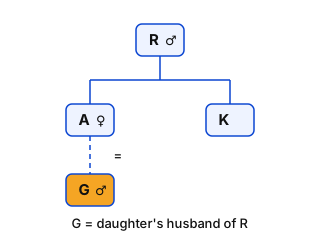
- G # A: G is the husband of A.
- A − R: A is the daughter of R.
- R + K: R is the father of K (K is just A's sibling).
- G is married to R's daughter → G is R's daughter's husband (son-in-law).
Trick: The last relation (R + K) is a distractor – the answer only needs G–A–R.
Answer: (A) Daughter's husband
अवधारणा: हर चिह्न खोलें और पूछे गए व्यक्ति से वंश-वृक्ष बनाएँ।
- G # A: G, A का पति।
- A − R: A, R की बेटी।
- R + K: R, K का पिता (K केवल A का भाई/बहन)।
- G का विवाह R की बेटी से → G, R का दामाद (daughter's husband)।
ट्रिक: अंतिम संबंध (R + K) भटकाने वाला है – उत्तर के लिए केवल G–A–R चाहिए।
उत्तर: (A) Daughter's husband
RRB NTPC Graduate CBT 1General Intelligence and ReasoningBlood Relations (Coded)RRB NTPC Graduate CBT 1 2025 · 16 Mar Shift 2
Q653.Refer to the following letter, symbol series and answer the question. Counting to be done from left to right only.
(Left) B * £ J E % $ * V € G * D H @ A £ O V $ T Y (Right)
How many such letters are there each of which is immediately preceded by a symbol and also immediately followed by a symbol?
निम्नलिखित अक्षर, प्रतीक श्रेणी को देखिए और प्रश्न का उत्तर दीजिए। गिनती केवल बाएँ से दाएँ की जानी है।
(बाएँ) B * £ J E % $ * V € G * D H @ A £ O V $ T Y (दाएँ)
ऐसे कितने अक्षर हैं जिनमें से प्रत्येक के ठीक पहले एक प्रतीक है और ठीक बाद भी एक प्रतीक है?
- A2
- B4
- C5
- D3
Show answer
Concept: Scan each letter and check both neighbours.
- Series: B * £ J E % $ * V € G * D H @ A £ O V $ T Y.
- Letters with a symbol on both sides: * V €, € G *, @ A £.
- J (£ J E), D (* D H), O (£ O V), T ($ T Y) have a letter on one side → not counted.
- Count = 3.
Trick: Look only at symbol pairs with exactly one character between them – a letter there is a hit.
Answer: (D) 3
अवधारणा: हर अक्षर के दोनों पड़ोसी जाँचें।
- श्रृंखला: B * £ J E % $ * V € G * D H @ A £ O V $ T Y।
- दोनों ओर प्रतीक वाले अक्षर: * V €, € G *, @ A £।
- J (£ J E), D (* D H), O (£ O V), T ($ T Y) के एक ओर अक्षर है → नहीं गिने जाएँगे।
- गिनती = 3।
ट्रिक: केवल उन प्रतीक-जोड़ों को देखें जिनके बीच ठीक एक अक्षर है।
उत्तर: (D) 3
RRB NTPC Graduate CBT 1General Intelligence and ReasoningLetter-Symbol SeriesRRB NTPC Graduate CBT 1 2025 · 16 Mar Shift 2
Q654.Which of the following letter-number clusters will replace the question mark “?” in the given series to make it logically complete?
QIL 14, UMP 18, YQT 22, CUX 26, ?
निम्नलिखित में से कौन-सा अक्षर-संख्या समूह दी गई श्रेणी में प्रश्नचिह्न "?" के स्थान पर आकर इसे तार्किक रूप से पूर्ण करेगा?
QIL 14, UMP 18, YQT 22, CUX 26, ?
- AHZC 29
- BGZD 30
- CGXZ 32
- DGYB 30
Show answer
Concept: Track each letter position and the number separately.
- Letters: Q(17)→U(21)→Y(25)→C(3)→G(7): each .
- I(9)→M(13)→Q(17)→U(21)→Y(25); L(12)→P(16)→T(20)→X(24)→B(28−26=2): each.
- Numbers: 14, 18, 22, 26 → 30.
- Next term = GYB 30.
Trick: All three letters jump – pattern = everywhere, so just add 4 (wrap after Z).
Answer: (D) GYB 30
अवधारणा: हर अक्षर की स्थिति और संख्या को अलग-अलग देखें।
- अक्षर: Q(17)→U(21)→Y(25)→C(3)→G(7): हर बार ।
- I→M→Q→U→Y; L→P→T→X→B (28−26=2): ।
- संख्याएँ: 14, 18, 22, 26 → 30।
- अगला पद = GYB 30।
ट्रिक: तीनों अक्षर कूदते हैं – हर जगह बस 4 जोड़ें (Z के बाद A से)।
उत्तर: (D) GYB 30
RRB NTPC Graduate CBT 1General Intelligence and ReasoningAlphanumeric SeriesRRB NTPC Graduate CBT 1 2025 · 16 Mar Shift 2
Q655.Seven people, K, L, M, N, P, Q and R, are sitting around a circular table facing the centre of the table but not necessarily in the same order. Only two people sit between N and Q when counted from the right of N. Only two people sit between Q and M. Only three people sit between N and P. L sits to the immediate left of R. Who sits third to the left of K?
सात व्यक्ति, K, L, M, N, P, Q और R, एक वृत्ताकार मेज़ के चारों ओर मेज़ के केंद्र की ओर मुख करके बैठे हैं, परंतु आवश्यक नहीं कि इसी क्रम में हों। N के दाईं ओर से गिनने पर N और Q के बीच केवल दो व्यक्ति बैठे हैं। Q और M के बीच केवल दो व्यक्ति बैठे हैं। N और P के बीच केवल तीन व्यक्ति बैठे हैं। L, R के ठीक बाएँ बैठा है। K के बाएँ तीसरे स्थान पर कौन बैठा है?
- AN
- BP
- CL
- DR
Show answer
Concept: Facing the centre, "right" is anticlockwise and "left" is clockwise.
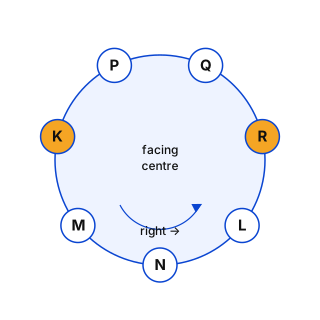
- Place N. Two people between N and Q from N's right → Q is 3rd to N's right.
- Two between Q and M, and three between N and P: M is 3rd to the left of N (the other spot is N itself), P is opposite-ish, 4th from N.
- Remaining three seats (1st, 2nd to N's right and 2nd to N's left) go to L, R, K with L immediately left of R → L 1st right of N, R 2nd right, K on the other side.
- Counting to the left of K: P, Q, R → R is third to the left of K.
Trick: Facing centre: right = anticlockwise. Fix one person and draw – never solve seating in the head.
Answer: (D) R
अवधारणा: केंद्र की ओर मुख होने पर "दायाँ" = वामावर्त (anticlockwise) और "बायाँ" = दक्षिणावर्त।
- N रखें। N के दाएँ से N और Q के बीच दो → Q, N के दाएँ तीसरा।
- Q और M के बीच दो, N और P के बीच तीन: M, N के बाएँ तीसरा; P, N से चौथा।
- बची तीन सीटें L, R, K को; L, R के ठीक बाएँ → L, N के ठीक दाएँ; R उसके बाद; K दूसरी ओर।
- K के बाएँ गिनें: P, Q, R → R, K के बाएँ तीसरा।
ट्रिक: केंद्र की ओर मुख: दायाँ = वामावर्त। एक व्यक्ति फिक्स कर चित्र बनाएँ – बैठक मन में कभी न सुलझाएँ।
उत्तर: (D) R
RRB NTPC Graduate CBT 1General Intelligence and ReasoningCircular SeatingRRB NTPC Graduate CBT 1 2025 · 16 Mar Shift 2
Q656.This question is based on the five, three-digit numbers given below.
(Left) 547 589 652 598 637 (Right)
(Example- 697 – First digit = 6, second digit = 9 and third digit = 7)
NOTE: All operations to be done from left to right.
What will be the resultant if the second digit of the highest number is added to the second digit of the lowest number?
यह प्रश्न नीचे दी गई पाँच तीन-अंकीय संख्याओं पर आधारित है।
(बाएँ) 547 589 652 598 637 (दाएँ)
(उदाहरण- 697 – पहला अंक = 6, दूसरा अंक = 9 और तीसरा अंक = 7)
नोट: सभी संक्रियाएँ बाएँ से दाएँ की जानी हैं।
यदि सबसे बड़ी संख्या के दूसरे अंक को सबसे छोटी संख्या के दूसरे अंक में जोड़ा जाए, तो परिणाम क्या होगा?
- A9
- B14
- C11
- D12
Show answer
Concept: Identify the required numbers, then pick the asked digit.
- Numbers: 547, 589, 652, 598, 637. Highest = 652, lowest = 547.
- Second digit of 652 = 5; second digit of 547 = 4.
- .
Trick: Compare hundreds digits first (6 > 5) to spot the highest/lowest instantly.
Answer: (A) 9
अवधारणा: पहले आवश्यक संख्याएँ पहचानें, फिर पूछा गया अंक लें।
- संख्याएँ: 547, 589, 652, 598, 637। सबसे बड़ी = 652, सबसे छोटी = 547।
- 652 का दूसरा अंक = 5; 547 का दूसरा अंक = 4।
- ।
ट्रिक: पहले सैकड़े का अंक देखें (6 > 5) – सबसे बड़ी/छोटी तुरंत मिल जाती है।
उत्तर: (A) 9
RRB NTPC Graduate CBT 1General Intelligence and ReasoningNumber ArrangementRRB NTPC Graduate CBT 1 2025 · 16 Mar Shift 2
Q657.Each of P, Q, R, S, T, U and V has an exam on a different day of a week starting from Monday and ending on Sunday of the same week.
Only four people have exams after V. Only four people have exams before S. P has the exam after R but before V. T has the exam on some day after Q but not on Sunday. How many people have exams between Q and U?
P, Q, R, S, T, U और V में से प्रत्येक की परीक्षा एक ही सप्ताह के सोमवार से शुरू होकर रविवार को समाप्त होने वाले सप्ताह के अलग-अलग दिन है।
V के बाद केवल चार व्यक्तियों की परीक्षा है। S से पहले केवल चार व्यक्तियों की परीक्षा है। P की परीक्षा R के बाद परंतु V से पहले है। T की परीक्षा Q के बाद किसी दिन है, परंतु रविवार को नहीं। Q और U के बीच कितने व्यक्तियों की परीक्षा है?
- AOneएक
- BFourचार
- CThreeतीन
- DTwoदो
Show answer
Concept: Count-based clues ("only four after/before") fix exact days; then place the rest.
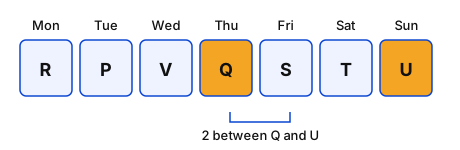
- Only four after V → V = Wednesday. Only four before S → S = Friday.
- R before P before V → R = Monday, P = Tuesday.
- Left: Thu, Sat, Sun for Q, T, U. T after Q and not Sunday → Q = Thursday, T = Saturday, U = Sunday.
- Between Q (Thu) and U (Sun): Fri, Sat → Two.
Trick: "Only four after X" in a 7-day week means X is on the 3rd day (Wednesday).
Answer: (D) Two
अवधारणा: गिनती वाले संकेत ("केवल चार बाद/पहले") सटीक दिन तय कर देते हैं; फिर बाकी रखें।
- V के बाद केवल चार → V = बुधवार। S से पहले केवल चार → S = शुक्रवार।
- R, फिर P, फिर V → R = सोमवार, P = मंगलवार।
- बचे गुरु, शनि, रवि – Q, T, U के लिए। T, Q के बाद और रविवार नहीं → Q = गुरुवार, T = शनिवार, U = रविवार।
- Q (गुरु) और U (रवि) के बीच: शुक्र, शनि → दो।
ट्रिक: 7 दिन के सप्ताह में "X के बाद केवल चार" = X तीसरे दिन (बुधवार)।
उत्तर: (D) Two
RRB NTPC Graduate CBT 1General Intelligence and ReasoningScheduling Puzzle (Days)RRB NTPC Graduate CBT 1 2025 · 16 Mar Shift 2
Q658.J, K, L, R, S and T live on six different floors of the same building. The lowermost floor in the building is numbered 1, the floor above it is numbered 2 and so on till the topmost floor is numbered 6. Only two people live between J and T. Only two people live between S and K. Only one person lives between L and K. L lives on floor number 1. J lives above K. How many people live between R and S?
J, K, L, R, S और T एक ही भवन की छह अलग-अलग मंज़िलों पर रहते हैं। भवन की सबसे निचली मंज़िल की संख्या 1 है, उसके ऊपर की मंज़िल की संख्या 2 है और इसी प्रकार सबसे ऊपरी मंज़िल की संख्या 6 है। J और T के बीच केवल दो व्यक्ति रहते हैं। S और K के बीच केवल दो व्यक्ति रहते हैं। L और K के बीच केवल एक व्यक्ति रहता है। L मंज़िल संख्या 1 पर रहता है। J, K से ऊपर रहता है। R और S के बीच कितने व्यक्ति रहते हैं?
- AThreeतीन
- BFourचार
- CTwoदो
- DOneएक
Show answer
Concept: Start from the fixed floor (L = 1) and chain the "between" clues.
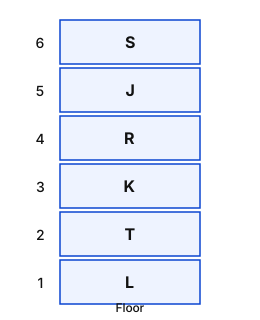
- L = 1; one person between L and K → K = 3.
- Two between S and K → S = 6 (floor 0 doesn't exist).
- Two between J and T with J above K: J = 5, T = 2 (J = 4 would need T = 1 or 7).
- R takes floor 4. Between R (4) and S (6): only J → One.
Trick: "Two people between A and B" = gap of 3 floors; with one end fixed, test both directions and discard the impossible one.
Answer: (D) One
अवधारणा: निश्चित मंज़िल (L = 1) से शुरू कर "बीच में" वाले संकेत जोड़ें।
- L = 1; L और K के बीच एक → K = 3।
- S और K के बीच दो → S = 6 (मंज़िल 0 नहीं है)।
- J और T के बीच दो, J, K से ऊपर: J = 5, T = 2 (J = 4 के लिए T = 1 या 7 चाहिए, असंभव)।
- R को मंज़िल 4। R (4) और S (6) के बीच केवल J → एक।
ट्रिक: "A और B के बीच दो लोग" = 3 मंज़िल का अंतर; एक सिरा तय हो तो दोनों दिशाएँ जाँचें, असंभव हटाएँ।
उत्तर: (D) One
RRB NTPC Graduate CBT 1General Intelligence and ReasoningFloor PuzzleRRB NTPC Graduate CBT 1 2025 · 16 Mar Shift 2
Q659.Below are given two sets of numbers. In each set of numbers, a certain mathematical operation on the first number results in the second number. Similarly, certain
mathematical operation on the second number results in the third number and so on. Which of the given options follows the same set of operations as in question? (NOTE – A two/three-digit number cannot be broken into individual digits for operations, e.g., if 37 is followed by 10, the operation cannot be 3+7 as a two-digit number cannot be broken into individual digits.)
6 - 11 - 22 - 32; 9 - 14 - 28 - 38
नीचे संख्याओं के दो समुच्चय दिए गए हैं। संख्याओं के प्रत्येक समुच्चय में, पहली संख्या पर एक निश्चित गणितीय संक्रिया करने से दूसरी संख्या प्राप्त होती है। इसी प्रकार, दूसरी संख्या पर एक निश्चित
गणितीय संक्रिया करने से तीसरी संख्या प्राप्त होती है, और इसी प्रकार आगे। दिए गए विकल्पों में से कौन-सा प्रश्न में दी गई संक्रियाओं के समान समुच्चय का अनुसरण करता है? (नोट – संक्रियाओं के लिए दो/तीन-अंकीय संख्या को अलग-अलग अंकों में नहीं तोड़ा जा सकता, उदाहरण के लिए, यदि 37 के बाद 10 है, तो संक्रिया 3+7 नहीं हो सकती क्योंकि दो-अंकीय संख्या को अलग-अलग अंकों में नहीं तोड़ा जा सकता।)
6 - 11 - 22 - 32; 9 - 14 - 28 - 38
- A7-12-24-14
- B14-19-38-58
- C13-18-36-46
- D12-17-34-54
Show answer
Concept: Find the chain of operations in the given sets and apply it to the options.
- ; .
- Option C: , , ✓.
- A ends in 14 (should be 34), B in 58 (should be 48), D in 54 (should be 44).
Trick: The first two steps match in all options – check only the last step ().
Answer: (C) 13-18-36-46
अवधारणा: दिए गए सेटों में संक्रियाओं की श्रृंखला खोजें और विकल्पों पर लगाएँ।
- ; ।
- विकल्प C: , , ✓।
- A का अंत 14 (34 होना चाहिए), B का 58 (48), D का 54 (44)।
ट्रिक: पहले दो चरण सभी विकल्पों में सही हैं – केवल अंतिम चरण () जाँचें।
उत्तर: (C) 13-18-36-46
RRB NTPC Graduate CBT 1General Intelligence and ReasoningNumber Operation SeriesRRB NTPC Graduate CBT 1 2025 · 16 Mar Shift 2
Q660.In a certain code language, 'VAJR' is coded as '102' and 'DOTG' is coded as '92'. What is the code for 'ZELW' in the given code language?
एक निश्चित कूट भाषा में, 'VAJR' को '102' के रूप में कूटबद्ध किया जाता है और 'DOTG' को '92' के रूप में कूटबद्ध किया जाता है। उसी कूट भाषा में 'ZELW' का कूट क्या है?
- A121
- B132
- C124
- D138
Show answer
Concept: Try the sum of alphabetical positions and look for a multiplier.
- VAJR: ; ✓.
- DOTG: ; ✓.
- ZELW: ; .
Trick: Even codes for 4-letter words → suspect (sum of positions) first.
Answer: (B) 132
अवधारणा: वर्णमाला स्थानों का योग लें और गुणक खोजें।
- VAJR: ; ✓।
- DOTG: ; ✓।
- ZELW: ; ।
ट्रिक: 4-अक्षर शब्दों के सम कोड → पहले (स्थानों का योग) जाँचें।
उत्तर: (B) 132
RRB NTPC Graduate CBT 1General Intelligence and ReasoningCoding-Decoding (Letter Values)RRB NTPC Graduate CBT 1 2025 · 16 Mar Shift 2

