Q661.If , then what is the value of ?
यदि , तो का मान क्या है?
- A724
- B709
- C776
- D770
Show answer
Concept: From build higher powers: , , and .
- .
- .
- .
Trick: Multiply the 2nd and 3rd power sums and subtract the 1st – works for any .
Answer: (A) 724
अवधारणा: से ऊँची घातें बनाएँ: , , और ।
- ।
- ।
- ।
ट्रिक: दूसरी और तीसरी घात के योग गुणा करें, पहली घटा दें – हर पर लागू।
उत्तर: (A) 724
RRB NTPC Graduate CBT 1MathematicsAlgebra – Power IdentitiesRRB NTPC Graduate CBT 1 2025 · 16 Mar Shift 3
Q662.If 4 : 28 :: 4.1 : x and 4 : 32 :: 3 : y, then what is the ratio of x to y?
यदि 4 : 28 :: 4.1 : x और 4 : 32 :: 3 : y, तो x और y का अनुपात क्या है?
- A287 : 240
- B285 : 241
- C288 : 238
- D291 : 250
Show answer
Concept: In , .
- .
- .
- .
Trick: means ×7 and means ×8 – just multiply and .
Answer: (A) 287 : 240
अवधारणा: में ।
- ।
- ।
- ।
ट्रिक: यानी ×7 और यानी ×8 – बस और करें।
उत्तर: (A) 287 : 240
RRB NTPC Graduate CBT 1MathematicsProportionRRB NTPC Graduate CBT 1 2025 · 16 Mar Shift 3
Q663.Madhu and Madhuri start a business by investing in the ratio 31 : 34. If total profit is ₹44,850, then what is the difference between the shares of profit (in ₹) of Madhu and Madhuri?
मधु और माधुरी 31 : 34 के अनुपात में निवेश करके एक व्यापार शुरू करते हैं। यदि कुल लाभ ₹44,850 है, तो मधु और माधुरी के लाभ के हिस्सों (₹ में) के बीच अंतर क्या है?
- A₹3,570
- B₹1,570
- C₹570
- D₹2,070
Show answer
Concept: With equal time, profit is shared in the ratio of investments.
- Ratio , total parts ; difference of parts .
- One part .
- Difference ₹.
Trick: Directly compute .
Answer: (D) ₹2,070
अवधारणा: समान समय पर लाभ निवेश के अनुपात में बँटता है।
- अनुपात , कुल भाग ; भागों का अंतर ।
- एक भाग ।
- अंतर ₹।
ट्रिक: सीधे निकालें।
उत्तर: (D) ₹2,070
RRB NTPC Graduate CBT 1MathematicsPartnershipRRB NTPC Graduate CBT 1 2025 · 16 Mar Shift 3
Q664.AB is the diameter of a circle with centre P. C and D are two points on the circle on either side of AB, such that and . What is the difference between the measures of and ?
AB, केंद्र P वाले एक वृत्त का व्यास है। C और D वृत्त पर AB के दोनों ओर स्थित दो बिंदु इस प्रकार हैं कि और । और के मापों के बीच अंतर क्या है?
- A
- B
- C
- D
Show answer
Concept: The angle in a semicircle is , and the angles of a triangle add to .
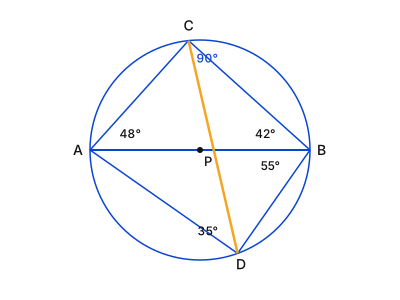
- In : , → .
- In : , → .
- C and D are on opposite sides of AB, so and .
- Difference .
Trick: (opposite angles of cyclic quadrilateral ACBD); difference .
Answer: (A)
अवधारणा: अर्धवृत्त का कोण होता है और त्रिभुज के कोणों का योग ।
- में: , → ।
- में: , → ।
- C और D, AB के विपरीत ओर हैं, अतः और ।
- अंतर ।
ट्रिक: (चक्रीय चतुर्भुज ACBD के सम्मुख कोण); अंतर ।
उत्तर: (A)
RRB NTPC Graduate CBT 1MathematicsCircle – Angle in a SemicircleRRB NTPC Graduate CBT 1 2025 · 16 Mar Shift 3
Q665.100 men have provisions for 27 days. If 55 men have left, for how many days the same provisions would last for the remaining men?
100 आदमियों के लिए 27 दिनों की खाद्य-सामग्री है। यदि 55 आदमी चले जाएँ, तो वही खाद्य-सामग्री शेष आदमियों के लिए कितने दिनों तक चलेगी?
- A60
- B64
- C62
- D58
Show answer
Concept: Provisions are fixed, so is constant.
- Remaining men .
- .
- days.
Trick: Fewer men → more days; , so .
Answer: (A) 60
अवधारणा: राशन निश्चित है, अतः स्थिर रहता है।
- बचे आदमी ।
- ।
- दिन।
ट्रिक: कम आदमी → ज़्यादा दिन; , अतः ।
उत्तर: (A) 60
RRB NTPC Graduate CBT 1MathematicsInverse Variation (Men & Provisions)RRB NTPC Graduate CBT 1 2025 · 16 Mar Shift 3
Q666.The price of each article of type P, Q, and R is ₹280, ₹180 and ₹115, respectively. Tejas buys articles of each type in the ratio 4 : 2 : 5 for ₹6,165. How many articles of type Q did he purchase?
P, Q और R प्रकार की प्रत्येक वस्तु का मूल्य क्रमशः ₹280, ₹180 और ₹115 है। तेजस ₹6,165 में प्रत्येक प्रकार की वस्तुएँ 4 : 2 : 5 के अनुपात में खरीदता है। उसने Q प्रकार की कितनी वस्तुएँ खरीदीं?
- A14
- B6
- C3
- D12
Show answer
Concept: Let the numbers bought be and equate total cost.
- Cost .
- .
- Articles of type Q .
Trick: Cost of one 'set' (4P+2Q+5R) ; sets.
Answer: (B) 6
अवधारणा: खरीदी संख्याएँ मानकर कुल लागत बराबर रखें।
- लागत ।
- ।
- Q प्रकार की वस्तुएँ ।
ट्रिक: एक 'सेट' (4P+2Q+5R) की लागत ; सेट।
उत्तर: (B) 6
RRB NTPC Graduate CBT 1MathematicsRatio – Cost of ArticlesRRB NTPC Graduate CBT 1 2025 · 16 Mar Shift 3
Q667.Find the mode of the following frequency distribution. (Round off the answer to two decimal places.)
| Class | 0-10 | 10-20 | 20-30 | 30-40 | 40-50 |
|---|
| Frequency | 5 | 8 | 12 | 20 | 10 |
|---|
निम्नलिखित बारंबारता बंटन का बहुलक (mode) ज्ञात कीजिए। (उत्तर को दो दशमलव स्थानों तक पूर्णांकित कीजिए।)
वर्ग: 0-10, 10-20, 20-30, 30-40, 40-50
बारंबारता: 5, 8, 12, 20, 10
- A32.25
- B31.51
- C33.35
- D34.44
Show answer
Concept: , where is the highest frequency.
- Modal class (), , , , .
- .
- .
Trick: Mode always lies inside the modal class (–) – only option D qualifies.
Answer: (D) 34.44
अवधारणा: , जहाँ सबसे अधिक बारंबारता है।
- बहुलक वर्ग (), , , , ।
- ।
- ।
ट्रिक: बहुलक हमेशा बहुलक वर्ग (–) के भीतर होता है – केवल विकल्प D इसमें है।
उत्तर: (D) 34.44
RRB NTPC Graduate CBT 1MathematicsStatistics – ModeRRB NTPC Graduate CBT 1 2025 · 16 Mar Shift 3
Q668.What should come in place of ‘?’ in the given series?
45 65 81 93 101 ?
दी गई श्रेणी में ‘?’ के स्थान पर क्या आना चाहिए?
45 65 81 93 101 ?
- A105
- B103
- C106
- D104
Show answer
Concept: Look at consecutive differences.
- , , , .
- Differences fall by 4 each time: → next .
- .
Trick: Decreasing differences in an arithmetic pattern – just continue the step.
Answer: (A) 105
अवधारणा: क्रमागत अंतर देखें।
- , , , ।
- अंतर हर बार 4 घटता है: → अगला ।
- ।
ट्रिक: समांतर रूप से घटते अंतर – बस अगला कदम बढ़ाएँ।
उत्तर: (A) 105
RRB NTPC Graduate CBT 1MathematicsNumber SeriesRRB NTPC Graduate CBT 1 2025 · 16 Mar Shift 3
Q669.A woman travelled at a speed of 20 m/min for 90 min, and at a speed of 55 m/min for 60 min. Her average speed (in m/min) for the entire journey is:
एक महिला 90 मिनट तक 20 m/min की चाल से और 60 मिनट तक 55 m/min की चाल से यात्रा करती है। संपूर्ण यात्रा के लिए उसकी औसत चाल (m/min में) है:
- A27
- B40
- C38
- D34
Show answer
Concept: .
- Distance 1 ; distance 2 .
- Total distance , total time min.
- Average .
Trick: Time-weighted mean: .
Answer: (D) 34
अवधारणा: ।
- दूरी 1 ; दूरी 2 ।
- कुल दूरी , कुल समय मिनट।
- औसत ।
ट्रिक: समय-भारित माध्य: ।
उत्तर: (D) 34
RRB NTPC Graduate CBT 1MathematicsAverage SpeedRRB NTPC Graduate CBT 1 2025 · 16 Mar Shift 3
Q670.Three friends travel along three consecutive segments: from P to Q, Q to R, and R to S. Their speeds on these segments are 48 km/h, 72 km/h, and 96 km/h, respectively. The distances of the three segments are in the ratio 2 : 3 : 1, and the total distance from P to S is 480 km. Calculate the average speed for the entire journey.
तीन मित्र तीन क्रमागत खंडों पर यात्रा करते हैं: P से Q, Q से R, और R से S। इन खंडों पर उनकी चाल क्रमशः 48 km/h, 72 km/h और 96 km/h है। तीन खंडों की दूरियाँ 2 : 3 : 1 के अनुपात में हैं, और P से S तक की कुल दूरी 480 km है। संपूर्ण यात्रा के लिए औसत चाल की गणना कीजिए।
- A58 km/h
- B64 km/h
- C65 km/h
- D68 km/h
Show answer
Concept: Average speed ; find each segment's time.
- Distances of → km.
- Times: h, h, h.
- Total time h.
- Average speed .
Trick: Work with 1 km units: h per 6 km → .
Answer: (B) 64 km/h
अवधारणा: औसत चाल ; हर खंड का समय निकालें।
- दूरियाँ का → km।
- समय: h, h, h।
- कुल समय h।
- औसत चाल ।
ट्रिक: इकाई दूरी से: h प्रति 6 km → ।
उत्तर: (B) 64 km/h
RRB NTPC Graduate CBT 1MathematicsAverage SpeedRRB NTPC Graduate CBT 1 2025 · 16 Mar Shift 3
Q671.The total surface area of a solid cube each side of which is 84 cm long is:
एक ठोस घन, जिसकी प्रत्येक भुजा 84 cm लंबी है, का कुल पृष्ठीय क्षेत्रफल है:
- A42365 cm2
- B42292 cm2
- C42359 cm2
- D42336 cm2
Show answer
Concept: Total surface area of a cube .
- cm → .
- .
Trick: ; unit digit → ends in 6, only option D.
Answer: (D)
अवधारणा: घन का कुल पृष्ठीय क्षेत्रफल ।
- cm → ।
- ।
ट्रिक: ; इकाई अंक → 6 पर समाप्त, केवल विकल्प D।
उत्तर: (D)
RRB NTPC Graduate CBT 1MathematicsMensuration – CubeRRB NTPC Graduate CBT 1 2025 · 16 Mar Shift 3
Q672.At what rate per annum will a sum of money become five times itself in 5 years under simple interest?
साधारण ब्याज पर कोई धनराशि 5 वर्षों में अपने से पाँच गुनी किस वार्षिक दर पर हो जाएगी?
- A82%
- B160%
- C80%
- D78%
Show answer
Concept: If a sum becomes times under SI, interest and .
- Five times → SI in 5 years.
- per annum.
Trick: → .
Answer: (C)
अवधारणा: साधारण ब्याज में राशि गुना हो तो ब्याज और ।
- पाँच गुना → SI , 5 वर्ष में।
- वार्षिक।
ट्रिक: → ।
उत्तर: (C)
RRB NTPC Graduate CBT 1MathematicsSimple InterestRRB NTPC Graduate CBT 1 2025 · 16 Mar Shift 3
Q673.Shan has ₹1407 with him. He divides this amount between his two sons, Piyush and Manoj, and asks them to invest their respective shares at a compound interest rate of 10% per annum, compounded annually. It is observed that Piyush’s investment amounts to the same value after 18 years as Manoj’s investment does after 19 years. How much (in ₹) did Shan give to Manoj?
शान के पास ₹1407 हैं। वह इस राशि को अपने दो पुत्रों, पीयूष और मनोज, के बीच बाँटता है और उन्हें अपने-अपने हिस्से को 10% वार्षिक चक्रवृद्धि ब्याज की दर पर, वार्षिक रूप से संयोजित, निवेश करने के लिए कहता है। यह देखा गया कि पीयूष का निवेश 18 वर्षों के बाद उसी मूल्य का हो जाता है जितना मनोज का निवेश 19 वर्षों के बाद होता है। शान ने मनोज को कितनी राशि (₹ में) दी?
- A670
- B837
- C737
- D520
Show answer
Concept: If amounts are equal after different periods, the shares are in the inverse ratio of growth factors.
- .
- Piyush : Manoj ; total parts → one part .
- Manoj ₹.
Trick: One extra year at → ratio ; the big '18 years / 19 years' is only to scare.
Answer: (A) 670
अवधारणा: अलग-अलग अवधि के बाद मिश्रधन बराबर हो तो हिस्से वृद्धि-गुणकों के व्युत्क्रम अनुपात में होते हैं।
- ।
- पीयूष : मनोज ; कुल भाग → एक भाग ।
- मनोज ₹।
ट्रिक: पर एक अतिरिक्त वर्ष → अनुपात ; '18 वर्ष / 19 वर्ष' केवल डराने के लिए है।
उत्तर: (A) 670
RRB NTPC Graduate CBT 1MathematicsCompound Interest – Equal AmountsRRB NTPC Graduate CBT 1 2025 · 16 Mar Shift 3
Q674.In an election between two candidates, 80% of the registered voters cast their vote and 10% of the votes polled were found invalid. Winning candidate got 89% of the valid votes and won the election by a margin of 351 votes. How many voters were registered?
दो उम्मीदवारों के बीच एक चुनाव में, पंजीकृत मतदाताओं के 80% ने मतदान किया और डाले गए मतों के 10% अवैध पाए गए। विजेता उम्मीदवार को वैध मतों के 89% मत मिले और वह 351 मतों के अंतर से चुनाव जीता। कितने मतदाता पंजीकृत थे?
- A625
- B650
- C600
- D675
Show answer
Concept: Margin = (winner % − loser %) of valid votes; chain the percentages back to registered voters.
- Let registered voters . Polled ; valid of that .
- Winner , loser → margin of .
- .
Trick: , and .
Answer: (A) 625
अवधारणा: अंतर = वैध मतों का (विजेता % − पराजित %); प्रतिशतों को पंजीकृत मतदाताओं तक पीछे जोड़ें।
- पंजीकृत मतदाता मानें। डाले गए ; वैध उसका ।
- विजेता , पराजित → अंतर का ।
- ।
ट्रिक: , और ।
उत्तर: (A) 625
RRB NTPC Graduate CBT 1MathematicsPercentage – ElectionsRRB NTPC Graduate CBT 1 2025 · 16 Mar Shift 3
Q675.A number when increased by 25% becomes equal to another number, which is 20% less than a third number. What is the ratio of the first number to the third number?
एक संख्या में 25% की वृद्धि करने पर वह एक दूसरी संख्या के बराबर हो जाती है, जो एक तीसरी संख्या से 20% कम है। पहली संख्या और तीसरी संख्या का अनुपात क्या है?
- A9:16
- B25:36
- C16:25
- D27:38
Show answer
Concept: Convert each percentage statement into a multiplier and link the numbers.
- Let the numbers be , , . and .
- So → .
- .
Trick: , ; equate → .
Answer: (C) 16:25
अवधारणा: हर प्रतिशत कथन को गुणक (multiplier) में बदलकर संख्याओं को जोड़ें।
- संख्याएँ , , लें। और ।
- अतः → ।
- ।
ट्रिक: , ; → ।
उत्तर: (C) 16:25
RRB NTPC Graduate CBT 1MathematicsPercentage – Ratio of NumbersRRB NTPC Graduate CBT 1 2025 · 16 Mar Shift 2
Q676.A triangle ABC with sides 3 cm, 4 cm and 5 cm is revolved about the side 3 cm. Find the volume of the solid so obtained. (Use )
3 cm, 4 cm और 5 cm भुजाओं वाले एक त्रिभुज ABC को 3 cm वाली भुजा के परितः घुमाया जाता है। इस प्रकार प्राप्त ठोस का आयतन ज्ञात कीजिए। ( का प्रयोग कीजिए)
- A55.61 cubic cm55.61 घन cm
- B40.55 cubic cm40.55 घन cm
- C42.62 cubic cm42.62 घन cm
- D50.24 cubic cm50.24 घन cm
Show answer
Concept: A right triangle revolved about one leg forms a cone: that leg is the height, the other leg is the radius, the hypotenuse is the slant height.
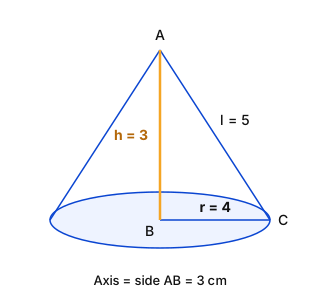
- Sides 3, 4, 5 form a right triangle (). Revolving about the side 3 cm: , , .
- .
Trick: The axis of rotation is the height; the other leg sweeps the circle (radius). Revolving about 4 cm would give instead.
Answer: (D) 50.24 cubic cm
अवधारणा: समकोण त्रिभुज को एक भुजा के परितः घुमाने पर शंकु बनता है: वह भुजा ऊँचाई, दूसरी भुजा त्रिज्या, कर्ण तिर्यक ऊँचाई।
- 3, 4, 5 समकोण त्रिभुज है ()। 3 cm भुजा के परितः घुमाने पर , , ।
- ।
ट्रिक: घूर्णन अक्ष = ऊँचाई; दूसरी भुजा वृत्त बनाती है (त्रिज्या)। 4 cm के परितः घुमाने पर आता।
उत्तर: (D) 50.24 cubic cm
RRB NTPC Graduate CBT 1MathematicsMensuration – Cone from Revolving TriangleRRB NTPC Graduate CBT 1 2025 · 16 Mar Shift 2
Q677.If the equations x2 – 3px + q = 0 and x2 – 2kx + t = 0 have one common root, and the first equation has equal roots, what is the value of (t + q)2?
यदि समीकरणों x2 – 3px + q = 0 और x2 – 2kx + t = 0 का एक मूल उभयनिष्ठ है, और पहले समीकरण के मूल समान हैं, तो (t + q)2 का मान क्या है?
- A0
- B
- C
- D
Show answer
Concept: Equal roots ⇒ discriminant zero and root ; the common root satisfies both equations.
- has equal roots: → , root .
- satisfies : → .
- → .
Trick: With equal roots, the common root is simply the repeated root – plug it straight in.
Answer: (C)
अवधारणा: समान मूल ⇒ विविक्तकर (discriminant) शून्य और मूल ; उभयनिष्ठ मूल दोनों समीकरणों को संतुष्ट करता है।
- के समान मूल: → , मूल ।
- को में रखें: → ।
- → ।
ट्रिक: समान मूल होने पर उभयनिष्ठ मूल वही दोहराया मूल है – सीधे रखें।
उत्तर: (C)
RRB NTPC Graduate CBT 1MathematicsQuadratic Equations – Common RootRRB NTPC Graduate CBT 1 2025 · 16 Mar Shift 2
Q678.A shopkeeper professes to sell his goods at a 60% loss but uses a false balance and gains 90%. The actual weight (rounded off to one decimal place) he uses for 1 kg is:
एक दुकानदार अपना सामान 60% हानि पर बेचने का दावा करता है, परंतु गलत तराजू का प्रयोग करके 90% लाभ कमाता है। 1 kg के लिए वह वास्तव में कितना भार (एक दशमलव स्थान तक पूर्णांकित) प्रयोग करता है?
- A210.5 gm
- B214.1 gm
- C209.5 gm
- D213.6 gm
Show answer
Concept: With a false weight, the shopkeeper charges for 1000 g but gives less; his real gain depends on the goods actually given.
- Let cost be ₹1 per gram. He "sells 1 kg" at a 60% loss, i.e. collects ₹.
- Real gain is 90%, so the cost of goods actually given → he gives about g.
- Check: cost ₹210.5, sold for ₹400 → gain ✓.
Trick: .
Answer: (A) 210.5 gm
अवधारणा: गलत बाट से दुकानदार 1000 g का दाम लेता है पर कम देता है; वास्तविक लाभ दिए गए माल पर निर्भर करता है।
- लागत ₹1 प्रति ग्राम लें। 60% हानि दिखाकर "1 kg" का ₹ लेता है।
- वास्तविक लाभ 90%, अतः दिए गए माल की लागत → लगभग g देता है।
- जाँच: लागत ₹210.5, बिक्री ₹400 → लाभ ✓।
ट्रिक: ।
उत्तर: (A) 210.5 gm
RRB NTPC Graduate CBT 1MathematicsProfit & Loss – False WeightRRB NTPC Graduate CBT 1 2025 · 16 Mar Shift 2
Q679.If , then the value of is
यदि है, तो का मान है
- A-6
- B-12
- C-3
- D-10
Show answer
Concept: Evaluate roots and "of" first, then multiplication, then subtraction.
- ; ; .
- .
- .
Trick: "of" means multiply and ranks with brackets – do it before the minus sign.
Answer: (A)
अवधारणा: पहले मूल और "of", फिर गुणा, फिर घटाव।
- का ; ; ।
- ।
- ।
ट्रिक: "of" का अर्थ गुणा है और यह कोष्ठक के स्तर का है – घटाव से पहले करें।
उत्तर: (A)
RRB NTPC Graduate CBT 1MathematicsSimplification – BODMASRRB NTPC Graduate CBT 1 2025 · 16 Mar Shift 2
Q680.Side PQ of a cyclic quadrilateral PQRS is produced to the point T. If , then the measure of is:
एक चक्रीय चतुर्भुज PQRS की भुजा PQ को बिंदु T तक बढ़ाया जाता है। यदि है, तो का माप है:
- A116°
- B122°
- C29°
- D58°
Show answer
Concept: In a cyclic quadrilateral the exterior angle at a vertex equals the interior opposite angle.
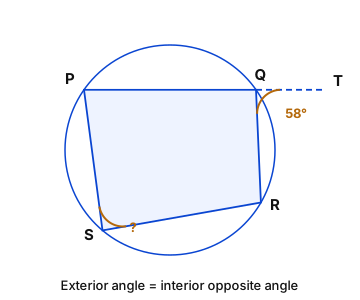
- PQ is produced to T, so is the exterior angle at Q.
- Interior opposite angle of Q is (at S).
- .
- Check: and ✓.
Trick: Exterior angle = opposite interior angle (because opposite angles sum to ). Option A () is the trap – that is .
Answer: (D)
अवधारणा: चक्रीय चतुर्भुज में किसी शीर्ष का बाह्य कोण उसके सम्मुख अंतःकोण के बराबर होता है।
- PQ को T तक बढ़ाया गया, अतः शीर्ष Q का बाह्य कोण है।
- Q का सम्मुख अंतःकोण (S पर) है।
- ।
- जाँच: और ✓।
ट्रिक: बाह्य कोण = सम्मुख अंतःकोण (क्योंकि सम्मुख कोणों का योग )। विकल्प A () जाल है – वह है।
उत्तर: (D)
RRB NTPC Graduate CBT 1MathematicsGeometry – Cyclic QuadrilateralRRB NTPC Graduate CBT 1 2025 · 16 Mar Shift 2

