RRB NTPC Graduate CBT 1 · 2,400 questions

RRB NTPC Graduate CBT 1 2025 PYQs

Real previous year questions, subject-wise. Try the question, then open the answer and the explanation in Hindi & English – free, no login.

Courses – airGurukul

705 questions in General Intelligence and Reasoning.

Q701.
Which of the following letter-clusters should replace # and % so that the pattern and relationship followed between the letter-cluster pair on the left side of :: is the same as that on the right side of :: ?
# : IGC :: TRN : %
निम्नलिखित में से कौन-से अक्षर-समूह # और % के स्थान पर आने चाहिए ताकि :: के बाईं ओर के अक्षर-समूह युग्म के बीच का पैटर्न और संबंध :: के दाईं ओर के युग्म के समान हो?
# : IGC :: TRN : %
  1. A# = LGY; % = QJH
  2. B# = LJF; % = QOK
  3. C# = LJK; % = QNJ
  4. D# = JKF; % = QJH
Show answer

Concept: Find the letter shift that turns # into IGC, and apply the same to TRN.

  1. Test option B: LJF → IGC: L(12)−3=I(9), J(10)−3=G(7), F(6)−3=C(3) ✓ — each letter moves 3 back.
  2. TRN: T(20)−3=Q(17), R(18)−3=O(15), N(14)−3=K(11) → QOK ✓
  3. Options A, C, D fail the uniform −3 pattern.

Trick: Options give # first — check which # maps to IGC by one uniform shift, then verify %.

Answer: (B) # = LJF; % = QOK

अवधारणा: # को IGC बनाने वाला अक्षर-परिवर्तन खोजें और वही TRN पर लगाएँ।

  1. विकल्प B जाँचें: LJF → IGC: L(12)−3=I(9), J(10)−3=G(7), F(6)−3=C(3) ✓ — हर अक्षर 3 पीछे।
  2. TRN: T(20)−3=Q(17), R(18)−3=O(15), N(14)−3=K(11) → QOK ✓
  3. विकल्प A, C, D में एकसमान −3 पैटर्न नहीं बनता।

ट्रिक: विकल्पों में # पहले दिया है — देखें कौन-सा # एकसमान शिफ्ट से IGC बनता है, फिर % जाँचें।

उत्तर: (B) # = LJF; % = QOK
RRB NTPC Graduate CBT 1General Intelligence and ReasoningLetter-cluster analogyRRB NTPC Graduate CBT 1 2025 · 16 Mar Shift 1
Q702.
Based on the alphabetical order, three of the following four are alike in a certain way and thus form a group. Which one does not belong to that group?
(Note: The odd one out is not based on the number of consonants or vowels or their position in the letter cluster)
वर्णमाला क्रम के आधार पर, निम्नलिखित चार में से तीन एक निश्चित प्रकार से समान हैं और इस प्रकार एक समूह बनाते हैं। कौन-सा उस समूह से संबंधित नहीं है?
(नोट: असंगत विकल्प व्यंजनों या स्वरों की संख्या या अक्षर-समूह में उनकी स्थिति पर आधारित नहीं है)
  1. AUWR
  2. BSUP
  3. CKMG
  4. DEGB
Show answer

Concept: Convert letters to positions and compare the gaps.

  1. UWR: 21, 23, 18 → +2,−5
  2. SUP: 19, 21, 16 → +2,−5; EGB: 5, 7, 2 → +2,−5
  3. KMG: 11, 13, 7 → +2,−6 — different pattern.

Trick: In a trio, check the gap between the 2nd and 3rd letter — the odd one usually breaks there.

Answer: (C) KMG

अवधारणा: अक्षरों को उनकी स्थिति में बदलकर अंतर की तुलना करें।

  1. UWR: 21, 23, 18 → +2,−5
  2. SUP: 19, 21, 16 → +2,−5; EGB: 5, 7, 2 → +2,−5
  3. KMG: 11, 13, 7 → +2,−6 — अलग पैटर्न।

ट्रिक: तीन अक्षरों में दूसरे और तीसरे का अंतर देखें — विषम प्रायः वहीं टूटता है।

उत्तर: (C) KMG

RRB NTPC Graduate CBT 1General Intelligence and ReasoningLetter cluster – odd one outRRB NTPC Graduate CBT 1 2025 · 16 Mar Shift 1
Q703.
Each of the digits in the number 15762349 is arranged in ascending order from left to right. The position of how many digits will remain unchanged as compared to that in the original number?
संख्या 15762349 के प्रत्येक अंक को बाएँ से दाएँ आरोही क्रम में व्यवस्थित किया जाता है। मूल संख्या की तुलना में कितने अंकों की स्थिति अपरिवर्तित रहेगी?
  1. ATwoदो
  2. BOneएक
  3. CNoneकोई नहीं
  4. DThreeतीन
Show answer

Concept: Write the ascending arrangement under the original and compare position by position.

  1. Original: 1 5 7 6 2 3 4 9
  2. Ascending: 1 2 3 4 5 6 7 9
  3. Unchanged: 1st (1) and 8th (9) → two digits.

Trick: The smallest and largest digits, if already at the ends, stay put — check them first.

Answer: (A) Two

अवधारणा: आरोही क्रम को मूल संख्या के नीचे लिखकर स्थान-दर-स्थान तुलना करें।

  1. मूल: 1 5 7 6 2 3 4 9
  2. आरोही: 1 2 3 4 5 6 7 9
  3. अपरिवर्तित: पहला (1) और आठवाँ (9) → दो अंक।

ट्रिक: सबसे छोटा और सबसे बड़ा अंक यदि पहले से सिरों पर हों तो वहीं रहते हैं — पहले उन्हें देखें।

उत्तर: (A) Two (दो)

RRB NTPC Graduate CBT 1General Intelligence and ReasoningDigit arrangementRRB NTPC Graduate CBT 1 2025 · 16 Mar Shift 1
Q704.
In this question, a question is followed by two statements numbered (I) and (II). You have to decide whether the data provided in the statements are sufficient to answer the question. Read both the statements and decide the appropriate answer.
Q. Five students – Isha, Kavita, Meenal, Nisha, and Priti – scored different marks. Who scored the second highest?
(I) Meenal scored more than Isha but less than Nisha.
(II) Priti scored more than Meenal but less than Nisha.
इस प्रश्न में, एक प्रश्न के बाद दो कथन (I) और (II) दिए गए हैं। आपको यह निर्णय करना है कि कथनों में दिए गए आँकड़े प्रश्न का उत्तर देने के लिए पर्याप्त हैं या नहीं। दोनों कथनों को पढ़िए और उचित उत्तर का चयन कीजिए।
प्रश्न. पाँच विद्यार्थियों – ईशा, कविता, मीनल, निशा और प्रीति – ने अलग-अलग अंक प्राप्त किए। दूसरे सबसे अधिक अंक किसने प्राप्त किए?
(I) मीनल ने ईशा से अधिक परंतु निशा से कम अंक प्राप्त किए।
(II) प्रीति ने मीनल से अधिक परंतु निशा से कम अंक प्राप्त किए।
  1. ABoth statements I and II together are NOT sufficient to answer the questionकथन I और II दोनों मिलकर भी प्रश्न का उत्तर देने के लिए पर्याप्त नहीं हैं
  2. BData in Statement II alone is sufficient to answer the question while data in Statement I is notकेवल कथन II के आँकड़े प्रश्न का उत्तर देने के लिए पर्याप्त हैं, जबकि कथन I के आँकड़े पर्याप्त नहीं हैं
  3. CData in Statement I alone is sufficient to answer the question while data in Statement II is notकेवल कथन I के आँकड़े प्रश्न का उत्तर देने के लिए पर्याप्त हैं, जबकि कथन II के आँकड़े पर्याप्त नहीं हैं
  4. DBoth statements I and II together (and not statement I alone or statement II alone) are sufficient to answer the questionकथन I और II दोनों मिलकर (और न केवल कथन I अकेले या कथन II अकेले) प्रश्न का उत्तर देने के लिए पर्याप्त हैं
Show answer

Concept: Combine the inequalities and see whether the second position is uniquely fixed.

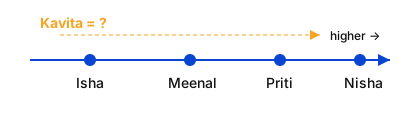
  1. (I): Nisha > Meenal > Isha. (II): Nisha > Priti > Meenal.
  2. Together: Nisha > Priti > Meenal > Isha — but Kavita's place is unknown; she could be above Nisha, between Nisha and Priti, or lower.
  3. Second highest may be Priti, Kavita or even Nisha → cannot be determined.

Trick: In ranking DS, a person who appears in no statement makes the answer "not sufficient" unless only the extremes are asked with full data.

Answer: (A) Both statements I and II together are NOT sufficient to answer the question

अवधारणा: असमानताओं को जोड़कर देखें कि दूसरा स्थान अद्वितीय रूप से तय होता है या नहीं।

  1. (I): निशा > मीनल > ईशा। (II): निशा > प्रीति > मीनल।
  2. दोनों मिलाकर: निशा > प्रीति > मीनल > ईशा — पर कविता का स्थान अज्ञात; वह निशा से ऊपर, निशा और प्रीति के बीच, या नीचे कहीं भी हो सकती है।
  3. दूसरा सर्वोच्च प्रीति, कविता या निशा भी हो सकता है → निर्धारित नहीं हो सकता।

ट्रिक: क्रम वाली DS में जो व्यक्ति किसी कथन में न हो, वह उत्तर "अपर्याप्त" बना देता है।

उत्तर: (A) Both statements I and II together are NOT sufficient (दोनों कथन मिलकर भी अपर्याप्त)

RRB NTPC Graduate CBT 1General Intelligence and ReasoningData sufficiency – rankingRRB NTPC Graduate CBT 1 2025 · 16 Mar Shift 1
Q705.
What should come in place of ‘?’ in the given series?
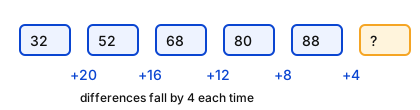
32 52 68 80 88 ?
दी गई श्रेणी में ‘?’ के स्थान पर क्या आना चाहिए?
32 52 68 80 88 ?
  1. A96
  2. B94
  3. C90
  4. D92
Show answer

Concept: Look at the differences between consecutive terms.

  1. 52−32=20, 68−52=16, 80−68=12, 88−80=8
  2. Differences fall by 4 each time → next difference =4
  3. 88+4=92

Trick: When terms grow slower and slower, the differences form a decreasing AP.

Answer: (D) 92

अवधारणा: क्रमागत पदों के अंतर देखें।

  1. 52−32=20, 68−52=16, 80−68=12, 88−80=8
  2. अंतर हर बार 4 घटता है → अगला अंतर =4
  3. 88+4=92

ट्रिक: जब पद धीरे-धीरे बढ़ें, तो अंतर एक घटती समांतर श्रेढ़ी बनाते हैं।

उत्तर: (D) 92

RRB NTPC Graduate CBT 1General Intelligence and ReasoningNumber seriesRRB NTPC Graduate CBT 1 2025 · 16 Mar Shift 1