RRB NTPC Graduate CBT 1 · 2,400 questions

RRB NTPC Graduate CBT 1 2025 PYQs

Real previous year questions, subject-wise. Try the question, then open the answer and the explanation in Hindi & English – free, no login.

Courses – airGurukul

735 questions in Mathematics.

Q721.
At present, Sharad is three times as old as his son, and his daughter is 3 years younger than the son. If the sum of the ages of these three people 3 years ago was 63 years, then Sharad's present age (in years) is:
वर्तमान में, शरद की आयु अपने पुत्र की आयु की तीन गुनी है, और उसकी पुत्री पुत्र से 3 वर्ष छोटी है। यदि 3 वर्ष पहले इन तीनों व्यक्तियों की आयु का योग 63 वर्ष था, तो शरद की वर्तमान आयु (वर्षों में) है:
  1. A50
  2. B55
  3. C45
  4. D35
Show answer

Concept: Express all present ages in one variable, then subtract 3 from each for "3 years ago".

  1. Son =s, Sharad =3s, daughter =s−3.
  2. 3 years ago: (3s−3)+(s−3)+(s−6)=63 ⇒ 5s−12=63 ⇒ s=15.
  3. Sharad =3×15=45 years.

Trick: Sum of present ages =63+3×3=72; 3s+s+(s−3)=72 ⇒ 5s=75 ⇒ s=15. Adding 3×(number of people) first is faster.

Answer: (C) 45

अवधारणा: सभी वर्तमान आयु एक चर में लिखिए, फिर "3 वर्ष पहले" के लिए हर एक में से 3 घटाइए।

  1. पुत्र =s, शरद =3s, पुत्री =s−3।
  2. 3 वर्ष पहले: (3s−3)+(s−3)+(s−6)=63 ⇒ 5s−12=63 ⇒ s=15।
  3. शरद =3×15=45 वर्ष।

ट्रिक: वर्तमान आयु का योग =63+3×3=72; 3s+s+(s−3)=72 ⇒ 5s=75 ⇒ s=15। पहले 3×(व्यक्तियों की संख्या) जोड़ना तेज़ है।

उत्तर: (C) 45
RRB NTPC Graduate CBT 1MathematicsAgesRRB NTPC Graduate CBT 1 2025 · 16 Mar Shift 1
Q722.
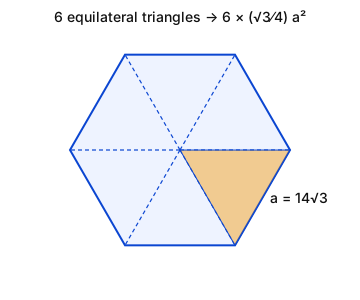
Find the area of a regular hexagon whose side measures 14√3 cm.
एक सम षट्भुज का क्षेत्रफल ज्ञात कीजिए जिसकी भुजा 14√3 cm है।
  1. A509√3 cm2
  2. B294√3 cm2
  3. C882√3 cm2
  4. D441√3 cm2
Show answer

Concept: A regular hexagon is six equilateral triangles: Area =6×34a2=332a2.

  1. a=143 ⇒ a2=196×3=588.
  2. Area =332×588=33×294=8823cm2.

Trick: With side k3, area =332×3k2=932k2; here k=14 ⇒ 9×19623=8823.

Answer: (C) 8823cm2

अवधारणा: सम षट्भुज छह समबाहु त्रिभुजों से बनता है: क्षेत्रफल =6×34a2=332a2।

  1. a=143 ⇒ a2=196×3=588।
  2. क्षेत्रफल =332×588=33×294=8823cm2।

ट्रिक: भुजा k3 हो तो क्षेत्रफल =332×3k2=932k2; यहाँ k=14 ⇒ 9×19623=8823।

उत्तर: (C) 8823cm2

RRB NTPC Graduate CBT 1MathematicsArea of a regular hexagonRRB NTPC Graduate CBT 1 2025 · 16 Mar Shift 1
Q723.
By selling an article at 615 of its actual selling price, Hitesh incurs a loss of 28%. If he sells it at 89% of its actual selling price, then the profit percentage is
किसी वस्तु को उसके वास्तविक विक्रय मूल्य के 615 पर बेचने से हितेश को 28% की हानि होती है। यदि वह उसे वास्तविक विक्रय मूल्य के 89% पर बेचता है, तो लाभ प्रतिशत है
  1. A59.2%
  2. B60.5%
  3. C60.2%
  4. D60.7%
Show answer

Concept: Express the actual selling price in terms of the cost price using the loss condition, then apply the new fraction.

  1. 615×SP=72% of CP ⇒ SP=0.72×156CP=1.8CP.
  2. New price =89% of SP=0.89×1.8CP=1.602CP.
  3. Profit =60.2%.

Trick: Take CP=100: 25SP=72 ⇒ SP=180; 89% of 180=160.2 ⇒ profit 60.2%.

Answer: (C) 60.2%

अवधारणा: हानि की शर्त से वास्तविक विक्रय मूल्य को क्रय मूल्य में व्यक्त कीजिए, फिर नया भिन्न लगाइए।

  1. 615×SP=CP का 72% ⇒ SP=0.72×156CP=1.8CP।
  2. नया मूल्य =SP का 89%=0.89×1.8CP=1.602CP।
  3. लाभ =60.2%।

ट्रिक: CP=100 लें: 25SP=72 ⇒ SP=180; 180 का 89%=160.2 ⇒ लाभ 60.2%।

उत्तर: (C) 60.2%

RRB NTPC Graduate CBT 1MathematicsProfit and lossRRB NTPC Graduate CBT 1 2025 · 16 Mar Shift 1
Q724.
If both the roots of the quadratic equation A(8x2 + 4) + Bx + 4x2 − 8 = 0 and 3A(2x2 + 1) + Kx + 3x2 − 6 = 0 are common, then what is the value of 9B2 − 16K2?
यदि द्विघात समीकरणों A(8x2 + 4) + Bx + 4x2 − 8 = 0 और 3A(2x2 + 1) + Kx + 3x2 − 6 = 0 के दोनों मूल उभयनिष्ठ हैं, तो 9B2 − 16K2 का मान क्या है?
  1. A−1
  2. B1
  3. C2
  4. D0
Show answer

Concept: If two quadratics have both roots common, their coefficients are proportional: a1a2=b1b2=c1c2.

  1. First: (8A+4)x2+Bx+(4A−8)=0. Second: (6A+3)x2+Kx+(3A−6)=0.
  2. 8A+46A+3=4(2A+1)3(2A+1)=43 and 4A−83A−6=43 ⇒ so BK=43 ⇒ 3B=4K.
  3. 9B2=16K2 ⇒ 9B2−16K2=0.

Trick: The second equation is just 34 of the first in x2 and constant terms – so K must be 34B; square both sides and the answer is 0.

Answer: (D) 0

अवधारणा: यदि दो द्विघात समीकरणों के दोनों मूल उभयनिष्ठ हों तो गुणांक समानुपाती होते हैं: a1a2=b1b2=c1c2।

  1. पहला: (8A+4)x2+Bx+(4A−8)=0। दूसरा: (6A+3)x2+Kx+(3A−6)=0।
  2. 8A+46A+3=4(2A+1)3(2A+1)=43 और 4A−83A−6=43 ⇒ अतः BK=43 ⇒ 3B=4K।
  3. 9B2=16K2 ⇒ 9B2−16K2=0।

ट्रिक: दूसरा समीकरण x2 और अचर पदों में पहले का ठीक 34 है – अतः K=34B होना चाहिए; दोनों पक्षों का वर्ग कीजिए, उत्तर 0।

उत्तर: (D) 0

RRB NTPC Graduate CBT 1MathematicsQuadratic equations – common rootsRRB NTPC Graduate CBT 1 2025 · 16 Mar Shift 1
Q725.
If a:b=2:3, then (7a3−2b3):(b3−a3)=
यदि a:b=2:3 है, तो (7a3−2b3):(b3−a3)=
  1. A2 : 19
  2. B3 : 11
  3. C13 : 6
  4. D3 : 14
Show answer

Concept: When only a ratio is given, put the simplest values (a=2, b=3) directly into the expression.

  1. 7a3−2b3=7×8−2×27=56−54=2
  2. b3−a3=27−8=19
  3. Required ratio =2:19

Trick: Ratio questions never need variables — plug the ratio numbers and compute.

Answer: (A) 2:19

अवधारणा: जब केवल अनुपात दिया हो, तो सीधे सरलतम मान (a=2, b=3) रखकर हल करें।

  1. 7a3−2b3=7×8−2×27=56−54=2
  2. b3−a3=27−8=19
  3. अभीष्ट अनुपात =2:19

ट्रिक: अनुपात वाले प्रश्नों में चर की ज़रूरत नहीं — अनुपात की संख्याएँ रखकर गणना करें।

उत्तर: (A) 2:19

RRB NTPC Graduate CBT 1MathematicsRatio – substitutionRRB NTPC Graduate CBT 1 2025 · 16 Mar Shift 1
Q726.
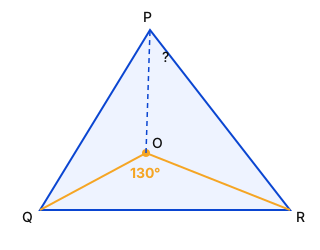
In a triangle PQR, ∠QOR = 130°, where O is the in-centre of triangle PQR. The measure of ∠QPR is:
एक त्रिभुज PQR में, ∠QOR = 130° है, जहाँ O त्रिभुज PQR का अंतःकेंद्र है। ∠QPR का माप है:
  1. A70°
  2. B80°
  3. C60°
  4. D50°
Show answer

Concept: For in-centre O of triangle PQR, ∠QOR=90∘+∠P2.

  1. 130∘=90∘+∠P2
  2. ∠P2=40∘⇒∠QPR=80∘

Yaad rakhein: In-centre: 90∘+A2; Circumcentre: 2A; Orthocentre: 180∘−A.

Answer: (B) 80∘

अवधारणा: त्रिभुज PQR के अंतःकेंद्र (in-centre) O के लिए ∠QOR=90∘+∠P2।

  1. 130∘=90∘+∠P2
  2. ∠P2=40∘⇒∠QPR=80∘

याद रखें: अंतःकेंद्र: 90∘+A2; परिकेंद्र: 2A; लंबकेंद्र: 180∘−A।

उत्तर: (B) 80∘

RRB NTPC Graduate CBT 1MathematicsGeometry – in-centre angleRRB NTPC Graduate CBT 1 2025 · 16 Mar Shift 1
Q727.
Three printing machines, P, Q and R, when each is working alone, can print one lakh books in, respectively, 8 hours, 16 hours and 24 hours. These machines print books in turns of one hour each, starting with P, followed by Q and then by R. However, after a total of 9 hours, P stops functioning, but Q and R continue working alternately for an hour each, with Q working during the 10th hour, till the printing of all the one lakh books is completed. In how many hours in all did machines Q and R complete printing the remaining books?
तीन प्रिंटिंग मशीनें P, Q और R, जब प्रत्येक अकेले काम करती है, एक लाख पुस्तकें क्रमशः 8 घंटे, 16 घंटे और 24 घंटे में छाप सकती हैं। ये मशीनें P से शुरू करके, उसके बाद Q और फिर R, एक-एक घंटे की बारी से पुस्तकें छापती हैं। किंतु, कुल 9 घंटे बाद P काम करना बंद कर देती है, परंतु Q और R एक-एक घंटे बारी-बारी से काम करती रहती हैं, जिसमें 10वें घंटे में Q काम करती है, जब तक कि सभी एक लाख पुस्तकों की छपाई पूरी नहीं हो जाती। मशीनों Q और R ने शेष पुस्तकों की छपाई कुल कितने घंटों में पूरी की?
  1. A9
  2. B6
  3. C12
  4. D15
Show answer

Concept: Take total work =LCM(8,16,24)=48 units; P, Q, R do 6,3,2 units/hour.

  1. One P-Q-R round (3 h) =6+3+2=11 units; 9 h = 3 rounds =33 units.
  2. Remaining =48−33=15 units.
  3. Now Q and R alternate: every 2 h they do 3+2=5 units ⇒15 units in 155×2=6 h (Q–R–Q–R–Q–R exactly).

Trick: In alternate-work problems, first find work per full cycle, then handle the leftover cycle by cycle.

Answer: (B) 6

अवधारणा: कुल कार्य =LCM(8,16,24)=48 इकाई; P, Q, R प्रति घंटे 6,3,2 इकाई करते हैं।

  1. एक P-Q-R चक्र (3 घंटे) =6+3+2=11 इकाई; 9 घंटे = 3 चक्र =33 इकाई।
  2. शेष =48−33=15 इकाई।
  3. अब Q और R बारी-बारी: हर 2 घंटे में 3+2=5 इकाई ⇒15 इकाई 155×2=6 घंटे में (Q–R–Q–R–Q–R ठीक पूरा)।

ट्रिक: बारी-बारी कार्य में पहले एक पूरे चक्र का कार्य निकालें, फिर बचा हुआ कार्य चक्र-दर-चक्र देखें।

उत्तर: (B) 6

RRB NTPC Graduate CBT 1MathematicsTime & Work – alternate workingRRB NTPC Graduate CBT 1 2025 · 16 Mar Shift 1
Q728.
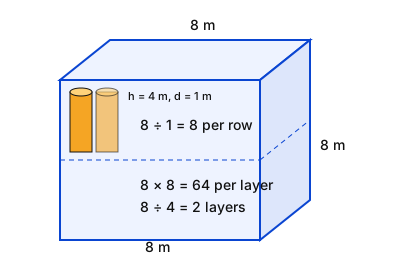
There is a wooden block in the form of a cube whose each side is 8 metres long. The maximum possible number of cylinders with a diameter of 1 metre and a height of 4 metres were cut from this block. The cylinders are to be painted at the rate of ₹14 per square metre.
What is the total amount (in ₹) needed to paint all the cylinders if we paint the entire surface of each cylinder? (Take π=227)
एक घन के आकार का लकड़ी का एक ब्लॉक है जिसकी प्रत्येक भुजा 8 मीटर लंबी है। इस ब्लॉक से 1 मीटर व्यास और 4 मीटर ऊँचाई वाले अधिकतम संभव संख्या में बेलन काटे गए। बेलनों को ₹14 प्रति वर्ग मीटर की दर से रंगा जाना है।
यदि हम प्रत्येक बेलन की संपूर्ण सतह को रंगते हैं, तो सभी बेलनों को रंगने के लिए आवश्यक कुल राशि (₹ में) क्या है? (π=227 लीजिए)
  1. A24,527
  2. B23,455
  3. C25,344
  4. D24,325
Show answer

Concept: Cylinders are cut whole, so count how many fit along each edge; then TSA of cylinder =2πr(r+h).

  1. Base 8×8 m, diameter 1 m ⇒8×8=64 cylinders per layer; height 8÷4=2 layers ⇒128 cylinders.
  2. TSA of one cylinder =2×227×12×(12+4)=227×92=997m2
  3. Total area =128×997; cost =128×997×14=128×198=25344

Trick: Keep 997 unsimplified — the rate ₹14 cancels the 7 neatly.

Answer: (C) ₹25,344

अवधारणा: बेलन पूरे-पूरे काटे जाते हैं, इसलिए हर किनारे पर कितने समाते हैं गिनें; फिर बेलन का कुल पृष्ठ =2πr(r+h)।

  1. आधार 8×8 m, व्यास 1 m ⇒8×8=64 बेलन प्रति परत; ऊँचाई 8÷4=2 परतें ⇒128 बेलन।
  2. एक बेलन का कुल पृष्ठ =2×227×12×(12+4)=227×92=997m2
  3. कुल क्षेत्रफल =128×997; लागत =128×997×14=128×198=25344

ट्रिक: 997 को सरल न करें — ₹14 की दर 7 को सीधे काट देती है।

उत्तर: (C) ₹25,344

RRB NTPC Graduate CBT 1MathematicsMensuration – cylinders from a cubeRRB NTPC Graduate CBT 1 2025 · 16 Mar Shift 1
Q729.
The sum of two numbers is 56. Their difference is 17 of their sum. Their LCM is:
दो संख्याओं का योग 56 है। उनका अंतर उनके योग का 17 है। उनका LCM है:
  1. A96
  2. B63
  3. C72
  4. D84
Show answer

Concept: Find the two numbers from sum and difference, then their LCM.

  1. Difference =17×56=8
  2. Numbers =56+82=32 and 56−82=24
  3. LCM(32,24)=96

Trick: Numbers =S+D2 and S−D2; LCM =32×24HCF 8=96.

Answer: (A) 96

अवधारणा: योग और अंतर से दोनों संख्याएँ निकालें, फिर उनका LCM।

  1. अंतर =17×56=8
  2. संख्याएँ =56+82=32 और 56−82=24
  3. LCM(32,24)=96

ट्रिक: संख्याएँ =S+D2 और S−D2; LCM =32×24HCF 8=96।

उत्तर: (A) 96

RRB NTPC Graduate CBT 1MathematicsLCM of two numbersRRB NTPC Graduate CBT 1 2025 · 16 Mar Shift 1
Q730.
685932564×257×168=?
  1. A28
  2. B37
  3. C30
  4. D38
Show answer

Concept: Evaluate the roots first: 193=6859 and 44=256.

  1. 68593=19,2564=4
  2. 194×257×168=19×2×1684×57
  3. 57=19×3, so =2×1684×3=33612=28

Trick: Cube ending in 9 → root ends in 9; 193=6859 is worth memorising.

Answer: (A) 28

अवधारणा: पहले मूल निकालें: 193=6859 और 44=256।

  1. 68593=19,2564=4
  2. 194×257×168=19×2×1684×57
  3. 57=19×3, अतः =2×1684×3=33612=28

ट्रिक: 9 पर समाप्त घन → मूल भी 9 पर समाप्त; 193=6859 याद रखें।

उत्तर: (A) 28

RRB NTPC Graduate CBT 1MathematicsSimplification – rootsRRB NTPC Graduate CBT 1 2025 · 16 Mar Shift 1
Q731.
At what rate (in percentage) per year will a sum of money double itself in 16 years on simple interest?
साधारण ब्याज पर कोई धनराशि 16 वर्षों में स्वयं की दोगुनी किस वार्षिक दर (प्रतिशत में) पर हो जाएगी?
  1. A4.25
  2. B12.5
  3. C8.25
  4. D6.25
Show answer

Concept: Money doubles on SI when interest = principal, i.e. R×T=100.

  1. R×16=100
  2. R=10016=6.25%

Trick: Double → RT=100; triple → RT=200; n times → RT=100(n−1).

Answer: (D) 6.25

अवधारणा: साधारण ब्याज पर धन तब दोगुना होता है जब ब्याज = मूलधन, अर्थात R×T=100।

  1. R×16=100
  2. R=10016=6.25%

ट्रिक: दोगुना → RT=100; तिगुना → RT=200; n गुना → RT=100(n−1)।

उत्तर: (D) 6.25

RRB NTPC Graduate CBT 1MathematicsSimple interest – doublingRRB NTPC Graduate CBT 1 2025 · 16 Mar Shift 1
Q732.
There are 78 members in group A, 22 members in group B and 34 members in group C. All the members of these groups went to a restaurant. The average amounts spent on each member of groups A, B and C are ₹136, ₹383 and ₹457, respectively. The overall average amount (in ₹) spent per member is:
समूह A में 78 सदस्य, समूह B में 22 सदस्य और समूह C में 34 सदस्य हैं। इन समूहों के सभी सदस्य एक रेस्तरां में गए। समूह A, B और C के प्रत्येक सदस्य पर खर्च की गई औसत राशि क्रमशः ₹136, ₹383 और ₹457 है। प्रति सदस्य खर्च की गई समग्र औसत राशि (₹ में) है:
  1. A256
  2. B261
  3. C258
  4. D255
Show answer

Concept: Overall average =total amounttotal members.

  1. Total =78×136+22×383+34×457=10608+8426+15538=34572
  2. Members =78+22+34=134
  3. Average =34572134=258

Trick: Check divisibility: 134×258=34572 exactly, confirming the option.

Answer: (C) 258

अवधारणा: कुल औसत =कुल राशिकुल सदस्य।

  1. कुल =78×136+22×383+34×457=10608+8426+15538=34572
  2. सदस्य =78+22+34=134
  3. औसत =34572134=258

ट्रिक: जाँच: 134×258=34572 ठीक आता है, विकल्प पुष्ट।

उत्तर: (C) 258

RRB NTPC Graduate CBT 1MathematicsWeighted averageRRB NTPC Graduate CBT 1 2025 · 16 Mar Shift 1
Q733.
P sells an item to Q at 50% profit. Q sells the same item to R at 60% loss. If R paid ₹ 3234 for the item, then at what price (in ₹) is the item purchased by P?
P एक वस्तु Q को 50% लाभ पर बेचता है। Q वही वस्तु R को 60% हानि पर बेचता है। यदि R ने वस्तु के लिए ₹ 3234 का भुगतान किया, तो P ने वह वस्तु किस मूल्य (₹ में) पर खरीदी?
  1. A5390
  2. B5387
  3. C5391
  4. D5393
Show answer

Concept: Work backwards from R's price: each step is a multiplier.

  1. Q's selling price (60% loss) =0.4× Q's cost =3234⇒ Q's cost =32340.4=8085
  2. P sold at 50% profit: 1.5× P's cost =8085⇒ P's cost =80851.5=5390

Trick: CPP=32341.5×0.4=32340.6=5390 in one step.

Answer: (A) ₹5390

अवधारणा: R के मूल्य से उल्टा चलें: हर चरण एक गुणक है।

  1. Q का विक्रय मूल्य (60% हानि) =0.4× Q का क्रय मूल्य =3234⇒ Q का क्रय मूल्य =32340.4=8085
  2. P ने 50% लाभ पर बेचा: 1.5× P का क्रय मूल्य =8085⇒ P का क्रय मूल्य =80851.5=5390

ट्रिक: एक ही चरण में CPP=32341.5×0.4=32340.6=5390।

उत्तर: (A) ₹5390

RRB NTPC Graduate CBT 1MathematicsSuccessive profit & lossRRB NTPC Graduate CBT 1 2025 · 16 Mar Shift 1
Q734.
A dealer buys two articles X and Y for ₹500 each. He marks each of them at the same price. He sells X by giving two successive discounts of 50% and 28% and still earns ₹958 as profit. If he sells Y at a single discount of 77%, then what is the profit
percentage on Y?
एक व्यापारी दो वस्तुएँ X और Y प्रत्येक ₹500 में खरीदता है। वह दोनों पर समान मूल्य अंकित करता है। वह X को 50% और 28% की दो क्रमागत छूट देकर बेचता है और फिर भी ₹958 का लाभ अर्जित करता है। यदि वह Y को 77% की एकल छूट पर बेचता है, तो Y पर लाभ
प्रतिशत क्या है?
  1. A86.3%
  2. B86%
  3. C85%
  4. D85.3%
Show answer

Concept: Find the common marked price from article X, then apply the 77% discount to Y.

  1. SP of X =M×0.5×0.72=0.36M; profit 958 ⇒0.36M=500+958=1458⇒M=4050
  2. SP of Y =4050×0.23=931.5
  3. Profit on Y =431.5; %=431.5500×100=86.3%

Trick: Successive discounts 50% and 28% ≡ single discount 64% (pay 36%).

Answer: (A) 86.3%

अवधारणा: वस्तु X से उभयनिष्ठ अंकित मूल्य निकालें, फिर Y पर 77% छूट लगाएँ।

  1. X का SP =M×0.5×0.72=0.36M; लाभ 958 ⇒0.36M=500+958=1458⇒M=4050
  2. Y का SP =4050×0.23=931.5
  3. Y पर लाभ =431.5; %=431.5500×100=86.3%

ट्रिक: 50% और 28% की क्रमिक छूट ≡ एकल छूट 64% (36% चुकाना)।

उत्तर: (A) 86.3%

RRB NTPC Graduate CBT 1MathematicsDiscount & profitRRB NTPC Graduate CBT 1 2025 · 16 Mar Shift 1
Q735.
Find the third proportional to the numbers 16 and 24.
संख्याओं 16 और 24 का तृतीयानुपाती ज्ञात कीजिए।
  1. A40
  2. B36
  3. C32
  4. D30
Show answer

Concept: Third proportional to a and b is c such that a:b=b:c⇒c=b2a.

  1. c=24216=57616=36

Yaad rakhein: Third proportional =b2a; mean proportional =ab; fourth proportional =bca.

Answer: (B) 36

अवधारणा: a और b का तृतीयानुपाती c है जहाँ a:b=b:c⇒c=b2a।

  1. c=24216=57616=36

याद रखें: तृतीयानुपाती =b2a; मध्यानुपाती =ab; चतुर्थानुपाती =bca।

उत्तर: (B) 36

RRB NTPC Graduate CBT 1MathematicsThird proportionalRRB NTPC Graduate CBT 1 2025 · 16 Mar Shift 1