Q81.C is the son of F. F is the sister of E. E is the son of G. G is the husband of H. How is C related to H?
C, F का पुत्र है। F, E की बहन है। E, G का पुत्र है। G, H का पति है। C, H से किस प्रकार संबंधित है?
- ASon's wife's brotherपुत्र की पत्नी का भाई
- BSon's sonपुत्र का पुत्र
- CDaughter's husbandपुत्री का पति
- DDaughter's sonपुत्री का पुत्र
Show answer
Concept: Build the family tree generation by generation, marking gender.
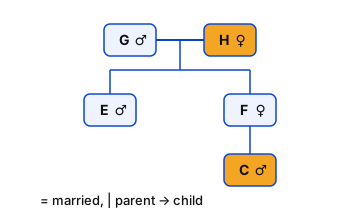
- G is husband of H → G, H are a couple. E is son of G → E is their son.
- F is sister of E → F is daughter of G and H.
- C is son of F → C is the son of H's daughter → daughter's son (grandson).
Trick: Start from the oldest couple and hang the others below – the relation of the lowest person to the top one reads straight off the tree.
Answer: (D) Daughter's son
अवधारणा: लिंग चिह्नित करते हुए पीढ़ी-दर-पीढ़ी वंश-वृक्ष बनाएँ।
- G, H का पति → G, H दंपति। E, G का पुत्र → E उनका बेटा।
- F, E की बहन → F, G और H की बेटी।
- C, F का पुत्र → C, H की बेटी का बेटा → daughter's son (नाती)।
ट्रिक: सबसे बड़े दंपति से शुरू करके बाकी को नीचे लटकाएँ – सबसे नीचे वाले का ऊपर वाले से संबंध सीधे पेड़ से पढ़ लें।
उत्तर: (D) Daughter's son
RRB NTPC Graduate CBT 1General Intelligence and ReasoningBlood RelationsRRB NTPC Graduate CBT 1 2025 · 27 Mar Shift 1
Q82.In a certain code language,
A + B means ‘A is the daughter of B’
A – B means ‘A is the brother of B’
A x B means ‘A is the wife of B’
A ÷ B means ‘A is the father of B’
Based on the above, how is D related to J if ‘D – F + G x H ÷ J’?
एक निश्चित कूट भाषा में,
A + B का अर्थ है ‘A, B की पुत्री है’
A – B का अर्थ है ‘A, B का भाई है’
A x B का अर्थ है ‘A, B की पत्नी है’
A ÷ B का अर्थ है ‘A, B का पिता है’
उपर्युक्त के आधार पर, यदि ‘D – F + G x H ÷ J’ है, तो D, J से किस प्रकार संबंधित है?
- AFatherपिता
- BSonपुत्र
- CHusbandपति
- DBrotherभाई
Show answer
Concept: Decode each symbol pair-wise from left to right and place everyone on a tree.
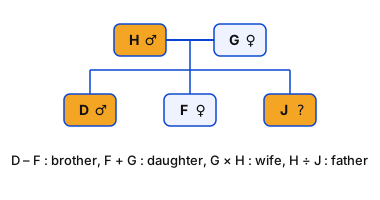
- D – F: D is brother of F (D male). F + G: F is daughter of G. G × H: G is wife of H → H is father of F.
- H ÷ J: H is father of J → J is a child of H and G, hence sibling of F and D.
- D (male) is a sibling of J → D is J's brother.
Trick: Decode from the end backwards (H ÷ J first) when the asked person is at the right – you reach the common parents fastest.
Answer: (D) Brother
अवधारणा: हर प्रतीक को बाएँ से दाएँ जोड़ी-वार डिकोड करें और सबको पेड़ पर रखें।
- D – F: D, F का भाई (D पुरुष)। F + G: F, G की बेटी। G × H: G, H की पत्नी → H, F का पिता।
- H ÷ J: H, J का पिता → J, H और G की संतान, अतः F और D का भाई/बहन।
- D (पुरुष), J का सहोदर → D, J का भाई।
ट्रिक: जब पूछा गया व्यक्ति दाईं ओर हो तो अंत से (H ÷ J पहले) डिकोड करें – साझा माता-पिता तक सबसे जल्दी पहुँचेंगे।
उत्तर: (D) Brother
RRB NTPC Graduate CBT 1General Intelligence and ReasoningCoded Blood RelationsRRB NTPC Graduate CBT 1 2025 · 27 Mar Shift 1
Q83.In the following number-pairs, the second number is obtained by applying certain mathematical operations to the first number. Select the set in which the numbers are related in the same way as are the numbers of the following sets.
(NOTE : Operations should be performed on the whole numbers, without breaking down the numbers into its constituent digits. E.g. 13 – Operations on 13 such as adding / subtracting /multiplying etc. to 13 can be performed. Breaking down 13 into 1 and 3 and then performing mathematical operations on 1 and 3 is not allowed)
19, 78
24, 98
निम्नलिखित संख्या-युग्मों में, पहली संख्या पर कुछ गणितीय संक्रियाएँ करके दूसरी संख्या प्राप्त की जाती है। उस समुच्चय का चयन कीजिए जिसमें संख्याएँ उसी प्रकार संबंधित हैं जिस प्रकार निम्नलिखित समुच्चयों की संख्याएँ संबंधित हैं।
(नोट : संक्रियाएँ पूर्ण संख्याओं पर की जानी चाहिए, संख्याओं को उनके घटक अंकों में तोड़े बिना। उदाहरण के लिए 13 – 13 पर संक्रियाएँ जैसे 13 में जोड़ना / घटाना / गुणा करना आदि की जा सकती हैं। 13 को 1 और 3 में तोड़कर फिर 1 और 3 पर गणितीय संक्रियाएँ करने की अनुमति नहीं है)
19, 78
24, 98
- A26, 112
- B26, 110
- C27, 112
- D27, 110
Show answer
Concept: Find one rule that fits both given pairs, then test the options.
- ✓, ✓ → rule: .
- (options A, B fail); ✓.
Trick: Multiplier ; then the constant is .
Answer: (D) 27, 110
अवधारणा: दोनों दिए जोड़ों पर फिट होने वाला एक नियम खोजें, फिर विकल्प जाँचें।
- ✓, ✓ → नियम: ।
- (विकल्प A, B गलत); ✓।
ट्रिक: गुणक ; फिर स्थिरांक ।
उत्तर: (D) 27, 110
RRB NTPC Graduate CBT 1General Intelligence and ReasoningNumber-Pair AnalogyRRB NTPC Graduate CBT 1 2025 · 27 Mar Shift 1
Q84.Seven people F, G, H, I, U, V, and W are sitting around a circular table facing the centre of the table. U sits second to the right of H. Only one person sits between U and W. Only one person sits between H and F. Only two people sit between V and W. Only one person sits between G and F. Who sits fourth to the right of I?
सात व्यक्ति F, G, H, I, U, V और W एक वृत्ताकार मेज़ के चारों ओर मेज़ के केंद्र की ओर मुख करके बैठे हैं। U, H के दाएँ दूसरे स्थान पर बैठा है। U और W के बीच केवल एक व्यक्ति बैठा है। H और F के बीच केवल एक व्यक्ति बैठा है। V और W के बीच केवल दो व्यक्ति बैठे हैं। G और F के बीच केवल एक व्यक्ति बैठा है। I के दाएँ चौथे स्थान पर कौन बैठा है?
- AV
- BW
- CG
- DU
Show answer
Concept: Facing the centre, a person's right is anticlockwise. Fix H and place the others clue by clue.
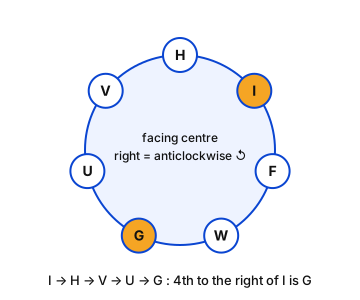
- U is 2nd to the right of H → U two seats anticlockwise from H. Only one between U and W (not H's side) → W is between F-side and U; only one between H and F → F is 2nd clockwise from H.
- Two between V and W → V sits immediately anticlockwise of H; one between G and F → G sits between W and U; I takes the last seat. Clockwise order: H, I, F, W, G, U, V.
- 4th to the right (anticlockwise) of I: H, V, U, G → G.
Trick: Draw 7 dots, mark H at the top, and count anticlockwise for "right" – never reverse the direction mid-puzzle.
Answer: (C) G
अवधारणा: केंद्र की ओर मुख होने पर दाईं ओर = वामावर्त (anticlockwise)। H को स्थिर रखकर बाकी को सूचना-दर-सूचना बैठाएँ।
- U, H के दाएँ दूसरा → H से दो सीट वामावर्त। U और W के बीच केवल एक (H की तरफ नहीं) → W, F की तरफ; H और F के बीच केवल एक → F, H से दो सीट दक्षिणावर्त।
- V और W के बीच दो → V, H के ठीक वामावर्त; अंतिम दक्षिणावर्त क्रम: H, I, F, W, G, U, V (G "G और F के बीच एक" से तय, I अंतिम सीट लेता है)।
- I के दाएँ (वामावर्त) चौथा: H, V, U, G → G।
ट्रिक: 7 बिंदु बनाएँ, H ऊपर रखें और "दाएँ" के लिए वामावर्त गिनें – बीच में दिशा कभी न बदलें।
उत्तर: (C) G
RRB NTPC Graduate CBT 1General Intelligence and ReasoningCircular Seating ArrangementRRB NTPC Graduate CBT 1 2025 · 27 Mar Shift 1
Q85.48 is related to 192 following a certain logic. Following the same logic, 52 is related to 208. To which of the following is 61 related, following the same logic?
(NOTE: Operations should be performed on the whole numbers, without breaking down the numbers into their constituent digits. E.g. 13 – Operations on 13 such as adding /subtracting /multiplying, etc. to 13 can be performed. Breaking down 13 into 1 and 3 and then performing mathematical operations on 1 and 3 is not allowed.)
48 किसी निश्चित तर्क के आधार पर 192 से संबंधित है। समान तर्क का अनुसरण करते हुए, 52, 208 से संबंधित है। समान तर्क का अनुसरण करते हुए 61 निम्नलिखित में से किससे संबंधित है?
(नोट: संक्रियाएँ पूर्ण संख्याओं पर की जानी चाहिए, संख्याओं को उनके घटक अंकों में तोड़े बिना। उदाहरण के लिए 13 – 13 पर संक्रियाएँ जैसे 13 में जोड़ना/घटाना/गुणा करना की जा सकती हैं। 13 को 1 और 3 में तोड़कर फिर 1 और 3 पर गणितीय संक्रियाएँ करने की अनुमति नहीं है।)
- A244
- B234
- C254
- D264
Show answer
Concept: Check the ratio of each pair; a constant ratio means the rule is multiplication.
- and → rule: second number first .
- .
Trick: Test first when both outputs are exact multiples of the inputs; it fits here, so no is needed.
Answer: (A) 244
अवधारणा: हर जोड़े का अनुपात देखें; स्थिर अनुपात का अर्थ नियम गुणा है।
- और → नियम: दूसरी संख्या पहली ।
- ।
ट्रिक: जब दोनों परिणाम इनपुट के पूर्ण गुणज हों तो पहले जाँचें; यहाँ फिट है, की ज़रूरत नहीं।
उत्तर: (A) 244
RRB NTPC Graduate CBT 1General Intelligence and ReasoningNumber AnalogyRRB NTPC Graduate CBT 1 2025 · 27 Mar Shift 1
Q86.Seven boxes P, Q, R, S, T, U and V are kept one over the other but not necessarily in the same order.
Q is kept immediately above P. S is kept immediately above V. Only R is kept above U. Only two boxes are kept above Q. S is not kept at third position from the bottom. How many boxes are kept between R and T?
सात बक्से P, Q, R, S, T, U और V एक के ऊपर एक रखे गए हैं, लेकिन आवश्यक नहीं कि इसी क्रम में हों।
Q, P के ठीक ऊपर रखा है। S, V के ठीक ऊपर रखा है। U के ऊपर केवल R रखा है। Q के ऊपर केवल दो बक्से रखे हैं। S नीचे से तीसरे स्थान पर नहीं रखा है। R और T के बीच कितने बक्से रखे हैं?
- A3
- B2
- C4
- D1
Show answer
Concept: Number positions 1 (top) to 7 (bottom) and fill the definite clues first.
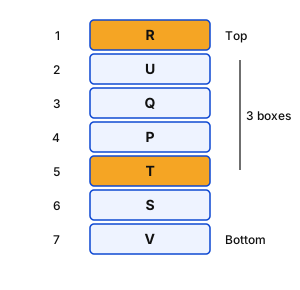
- Only R above U → R = 1, U = 2. Only two boxes above Q → Q = 3; Q immediately above P → P = 4.
- Positions 5, 6, 7 remain for S, V, T with S immediately above V. S cannot be at position 5 (3rd from bottom) → S = 6, V = 7, T = 5.
- Stack: R, U, Q, P, T, S, V. Between R (1) and T (5): U, Q, P = 3 boxes.
Trick: "Only X is above Y" fixes two positions at once – always start there.
Answer: (A) 3
अवधारणा: स्थान 1 (ऊपर) से 7 (नीचे) तक क्रमांकित करें और पहले निश्चित सूचनाएँ भरें।
- U के ऊपर केवल R → R = 1, U = 2। Q के ऊपर केवल दो बॉक्स → Q = 3; Q, P के ठीक ऊपर → P = 4।
- S, V, T के लिए स्थान 5, 6, 7 बचे, S, V के ठीक ऊपर। S स्थान 5 (नीचे से तीसरा) पर नहीं → S = 6, V = 7, T = 5।
- ढेर: R, U, Q, P, T, S, V। R (1) और T (5) के बीच: U, Q, P = 3 बॉक्स।
ट्रिक: "Y के ऊपर केवल X" से एक साथ दो स्थान तय हो जाते हैं – हमेशा वहीं से शुरू करें।
उत्तर: (A) 3
RRB NTPC Graduate CBT 1General Intelligence and ReasoningBox Arrangement (Stacking)RRB NTPC Graduate CBT 1 2025 · 27 Mar Shift 1
Q87.In a certain code language, ‘KITE’ is coded as ‘5871’ and ‘TIME’ is coded as ‘7853’. What is the code for ‘M’ in the given code language?
एक निश्चित कूट भाषा में, ‘KITE’ को ‘5871’ के रूप में और ‘TIME’ को ‘7853’ के रूप में कूटबद्ध किया जाता है। दी गई कूट भाषा में ‘M’ का कूट क्या है?
- A3
- B8
- C5
- D7
Show answer
Concept: Compare the two words – the common letters share the common digits; the leftover letter gets the leftover digit.
- KITE → 5871 and TIME → 7853 share T, I, E; the codes share 5, 7, 8.
- Letter not common in TIME is M; digit not common in 7853 is 3.
- So M = 3.
Trick: Elimination coding – cross out common letters and common digits; what remains pairs up.
Answer: (A) 3
अवधारणा: दोनों शब्दों की तुलना करें – समान अक्षरों के कोड समान अंक हैं; बचा अक्षर बचे अंक से जुड़ता है।
- KITE → 5871 और TIME → 7853 में T, I, E समान; कोड में 5, 7, 8 समान।
- TIME में असमान अक्षर M; 7853 में असमान अंक 3।
- अतः M = 3।
ट्रिक: विलोपन कोडिंग – समान अक्षर और समान अंक काट दें; जो बचे वे जोड़ी बनाते हैं।
उत्तर: (A) 3
RRB NTPC Graduate CBT 1General Intelligence and ReasoningCoding-DecodingRRB NTPC Graduate CBT 1 2025 · 27 Mar Shift 1
Q88.Which of the following letter-number clusters will replace the question mark (?) in the given series to make it logically complete?
AZA 27 XWX 36 UTU 45 RQR 54 ?
निम्नलिखित में से कौन-सा अक्षर-संख्या समूह दी गई श्रेणी में प्रश्नचिह्न (?) के स्थान पर आकर इसे तार्किक रूप से पूर्ण करेगा?
AZA 27 XWX 36 UTU 45 RQR 54 ?
- AOMN 62
- BONO 63
- COTZ 62
- DOON 63
Show answer
Concept: Treat the letter part and the number part as two separate series.
- Letters: AZA, XWX, UTU, RQR – first/third letter A→X→U→R ( each) → next O; middle letter Z→W→T→Q () → next N. So ONO.
- Numbers: 27, 36, 45, 54 () → 63.
- Term = ONO 63.
Trick: Each cluster is a palindrome with the middle letter one step behind the outer one (A–Z, X–W…) – O–N fits, so ONO.
Answer: (B) ONO 63
अवधारणा: अक्षर भाग और संख्या भाग को दो अलग श्रेणियाँ मानें।
- अक्षर: AZA, XWX, UTU, RQR – पहला/तीसरा अक्षर A→X→U→R (हर बार ) → अगला O; बीच का अक्षर Z→W→T→Q () → अगला N। अतः ONO।
- संख्याएँ: 27, 36, 45, 54 () → 63।
- पद = ONO 63।
ट्रिक: हर समूह पैलिंड्रोम है और बीच का अक्षर बाहरी से एक पीछे (A–Z, X–W…) – O–N फिट है, अतः ONO।
उत्तर: (B) ONO 63
RRB NTPC Graduate CBT 1General Intelligence and ReasoningLetter-Number SeriesRRB NTPC Graduate CBT 1 2025 · 27 Mar Shift 1
Q89.In a certain code language, ‘TIME’ is coded as ‘3519’ and ‘EARS’ is coded as ‘6894’. What is the code for ‘E’ in that language?
एक निश्चित कूट भाषा में, ‘TIME’ को ‘3519’ के रूप में और ‘EARS’ को ‘6894’ के रूप में कूटबद्ध किया जाता है। उस भाषा में ‘E’ का कूट क्या है?
- A4
- B6
- C8
- D9
Show answer
Concept: The only letter common to both words gets the only digit common to both codes.
- TIME → 3519 and EARS → 6894: common letter = E.
- Common digit in 3519 and 6894 = 9.
- So E = 9.
Trick: With one shared letter, just spot the one shared digit – no need to decode the rest.
Answer: (D) 9
अवधारणा: दोनों शब्दों में एकमात्र समान अक्षर को दोनों कोडों का एकमात्र समान अंक मिलता है।
- TIME → 3519 और EARS → 6894: समान अक्षर = E।
- 3519 और 6894 में समान अंक = 9।
- अतः E = 9।
ट्रिक: एक ही साझा अक्षर हो तो बस साझा अंक पहचानें – बाकी डिकोड करने की ज़रूरत नहीं।
उत्तर: (D) 9
RRB NTPC Graduate CBT 1General Intelligence and ReasoningCoding-DecodingRRB NTPC Graduate CBT 1 2025 · 27 Mar Shift 1
Q90.In a certain code language,
A + B means ‘A is the mother of B’
A – B means ‘A is the brother of B’
A x B means ‘A is the wife of B’
A % B means ‘A is the father of B’
A # B means ‘A is the daughter of B’
Based on the above, how is D related to E if ‘D x N % P + K # E’?
एक निश्चित कूट भाषा में,
A + B का अर्थ है ‘A, B की माता है’
A – B का अर्थ है ‘A, B का भाई है’
A x B का अर्थ है ‘A, B की पत्नी है’
A % B का अर्थ है ‘A, B का पिता है’
A # B का अर्थ है ‘A, B की पुत्री है’
उपर्युक्त के आधार पर, यदि ‘D x N % P + K # E’ है, तो D का E से क्या संबंध है?
- AWife’s fatherपत्नी का पिता
- BDaughter’s husbandपुत्री का पति
- CWife’s motherपत्नी की माता
- DDaughter’s daughterपुत्री की पुत्री
Show answer
Concept: Decode each symbol step by step and build the family tree, starting from the end (E) to reach D.
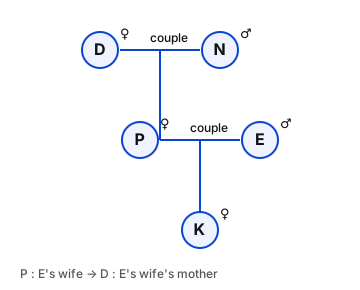
- D × N → D is the wife of N. N % P → N is the father of P, so D is P's mother.
- P + K → P is the mother of K. K # E → K is the daughter of E, so E is K's father and P's husband.
- D is the mother of P, and P is E's wife → D is E's wife's mother.
Trick: Whenever one person is "mother of X" and another is "father of X", they are husband and wife – that single link solves most coded-relation questions.
Answer: (C) Wife's mother
अवधारणा: प्रत्येक प्रतीक को एक-एक करके डिकोड कर वंश-वृक्ष बनाइए, अंत (E) से शुरू कर D तक पहुँचिए।
- D × N → D, N की पत्नी है। N % P → N, P का पिता है, अतः D, P की माँ है।
- P + K → P, K की माँ है। K # E → K, E की पुत्री है, अतः E, K का पिता और P का पति है।
- D, P की माँ है और P, E की पत्नी है → D, E की पत्नी की माँ (सास) है।
ट्रिक: जब एक व्यक्ति "X की माँ" और दूसरा "X का पिता" हो, तो वे पति-पत्नी हैं – यही एक कड़ी अधिकांश कोडित-संबंध प्रश्न हल कर देती है।
उत्तर: (C) पत्नी की माँ
RRB NTPC Graduate CBT 1General Intelligence and ReasoningBlood relations – codedRRB NTPC Graduate CBT 1 2025 · 25 Mar Shift 3
Q91.Based on the English alphabetical order, three of the following four are alike in a certain way and thus form a group. Which is the one that does not belong to that group? (Note: The odd one out is not based on the number of consonants/vowels or their position in the letter cluster.)
अंग्रेज़ी वर्णमाला क्रम के आधार पर, निम्नलिखित चार में से तीन एक निश्चित प्रकार से समान हैं और इस प्रकार एक समूह बनाते हैं। वह कौन-सा है जो उस समूह से संबंधित नहीं है? (नोट: विषम अक्षर-समूह व्यंजनों/स्वरों की संख्या या अक्षर-समूह में उनकी स्थिति पर आधारित नहीं है।)
- AJNT
- BLPU
- CWAF
- DDHM
Show answer
Concept: Write the place values (A=1 … Z=26) and compare the gaps between consecutive letters.
- LPU: 12, 16, 21 → +4, +5. WAF: 23, 1, 6 → +4 (W→A cyclic), +5. DHM: 4, 8, 13 → +4, +5.
- JNT: 10, 14, 20 → +4, +6 – the second gap breaks the pattern.
Trick: Check the first gap of all four; if all match, the odd one hides in the second gap. Remember that after Z the alphabet wraps to A.
Answer: (A) JNT
अवधारणा: अक्षरों के स्थानीय मान (A=1 … Z=26) लिखकर क्रमागत अक्षरों के अंतर की तुलना कीजिए।
- LPU: 12, 16, 21 → +4, +5। WAF: 23, 1, 6 → +4 (W→A चक्रीय), +5। DHM: 4, 8, 13 → +4, +5।
- JNT: 10, 14, 20 → +4, +6 – दूसरा अंतर पैटर्न तोड़ता है।
ट्रिक: चारों का पहला अंतर देखें; सब समान हों तो विषम दूसरे अंतर में छिपा है। Z के बाद वर्णमाला A से फिर शुरू होती है।
उत्तर: (A) JNT
RRB NTPC Graduate CBT 1General Intelligence and ReasoningOdd one out – letter clustersRRB NTPC Graduate CBT 1 2025 · 25 Mar Shift 3
Q92.Refer to the following letter, number, symbol series and answer the question. Counting to be done from left to right only. (All numbers are single digit numbers only)
(Left) G & R E 5 K % 7 @ 2 S & 6 C T # 3 4 Y * D (Right)
How many such symbols are there which are immediately preceded by a letter and also immediately followed by a number?
निम्नलिखित अक्षर, संख्या, प्रतीक श्रृंखला को देखिए और प्रश्न का उत्तर दीजिए। गिनती केवल बाएँ से दाएँ की जानी है। (सभी संख्याएँ केवल एक अंक की संख्याएँ हैं)
(बाएँ) G & R E 5 K % 7 @ 2 S & 6 C T # 3 4 Y * D (दाएँ)
ऐसे कितने प्रतीक हैं जिनके ठीक पहले एक अक्षर है और ठीक बाद एक संख्या है?
- ANoneकोई नहीं
- BTwoदो
- CThreeतीन
- DOneएक
Show answer
Concept: Scan each symbol and check the element just before it (must be a letter) and just after it (must be a number).
- Symbols in the series: & (G, R), % (K, 7), @ (7, 2), & (S, 6), # (T, 3), * (Y, D).
- Letter before and number after: K % 7, S & 6, T # 3 → three.
Trick: Underline only the symbols first (there are just six), then test neighbours – far faster than reading the whole series.
Answer: (C) Three
अवधारणा: प्रत्येक प्रतीक के ठीक पहले वाला तत्व (अक्षर होना चाहिए) और ठीक बाद वाला (संख्या होनी चाहिए) जाँचिए।
- श्रृंखला के प्रतीक: & (G, R), % (K, 7), @ (7, 2), & (S, 6), # (T, 3), * (Y, D)।
- पहले अक्षर और बाद में संख्या: K % 7, S & 6, T # 3 → तीन।
ट्रिक: पहले केवल प्रतीकों को रेखांकित करें (केवल छह हैं), फिर पड़ोसी जाँचें – पूरी श्रृंखला पढ़ने से कहीं तेज़।
उत्तर: (C) तीन
RRB NTPC Graduate CBT 1General Intelligence and ReasoningAlphanumeric seriesRRB NTPC Graduate CBT 1 2025 · 25 Mar Shift 3
Q93.Which of the following letter-number clusters will replace the question mark (?) in the given series to make it logically complete?
TWU 89 YBZ 81 DGE 73 ILJ 65 ?
दी गई श्रृंखला को तार्किक रूप से पूर्ण करने के लिए निम्नलिखित में से कौन-सा अक्षर-संख्या समूह प्रश्नचिह्न (?) के स्थान पर आएगा?
TWU 89 YBZ 81 DGE 73 ILJ 65 ?
- ANPN 56
- BNQU 56
- CNRN 57
- DNQO 57
Show answer
Concept: Treat the letters and the numbers as two separate series.
- Letters: each position moves +5. T→Y→D→I→N; W→B→G→L→Q; U→Z→E→J→O.
- Numbers: 89, 81, 73, 65 → each −8 → 57.
- Next term: NQO 57.
Trick: Decide the number first (57 → options C or D), then check just the first letter: I+5 = N in both, so check the second letter L+5 = Q → NQO.
Answer: (D) NQO 57
अवधारणा: अक्षरों और संख्याओं को दो अलग श्रृंखलाओं की तरह देखें।
- अक्षर: प्रत्येक स्थान +5 बढ़ता है। T→Y→D→I→N; W→B→G→L→Q; U→Z→E→J→O।
- संख्याएँ: 89, 81, 73, 65 → प्रत्येक −8 → 57।
- अगला पद: NQO 57।
ट्रिक: पहले संख्या तय करें (57 → विकल्प C या D), फिर दूसरा अक्षर जाँचें L+5 = Q → NQO।
उत्तर: (D) NQO 57
RRB NTPC Graduate CBT 1General Intelligence and ReasoningLetter-number seriesRRB NTPC Graduate CBT 1 2025 · 25 Mar Shift 3
Q94.In a certain code language, ‘SEMI’ is coded as ‘3615’ and ‘TIME’ is coded as ‘1523’. What is the code for ‘T’ in the given code language?
एक निश्चित कूट भाषा में, ‘SEMI’ को ‘3615’ के रूप में कूटबद्ध किया जाता है और ‘TIME’ को ‘1523’ के रूप में कूटबद्ध किया जाता है। दी गई कूट भाषा में ‘T’ का कूट क्या है?
- A3
- B1
- C5
- D2
Show answer
Concept: Compare the two words: letters common to both must share the common digits; the leftover letter gets the leftover digit.
- SEMI → 3615, TIME → 1523. Common letters: E, M, I. Common digits: 1, 5, 3.
- So in SEMI the uncommon letter S ↔ uncommon digit 6; in TIME the uncommon letter T ↔ uncommon digit 2.
Trick: In such questions the codes are jumbled – never match by position, always by "common vs uncommon" elimination.
Answer: (D) 2
अवधारणा: दोनों शब्दों की तुलना करें: दोनों में समान अक्षरों के कोड समान अंक होंगे; बचा हुआ अक्षर = बचा हुआ अंक।
- SEMI → 3615, TIME → 1523। समान अक्षर: E, M, I। समान अंक: 1, 5, 3।
- अतः SEMI में असमान अक्षर S ↔ असमान अंक 6; TIME में असमान अक्षर T ↔ असमान अंक 2।
ट्रिक: ऐसे प्रश्नों में कोड उलट-पुलट होते हैं – स्थान से नहीं, "समान बनाम असमान" विलोपन से मिलान करें।
उत्तर: (D) 2
RRB NTPC Graduate CBT 1General Intelligence and ReasoningCoding-decodingRRB NTPC Graduate CBT 1 2025 · 25 Mar Shift 3
Q95.Select the set in which the numbers are related in the same way as are the numbers of the following sets.
(NOTE: Operations should be performed on the whole numbers, without breaking down the numbers into its constituent digits. E.g. 13 – Operations on 13 such as adding / subtracting / multiplying etc. to 13 can be performed. Breaking down 13 into 1 and 3 and then performing mathematical operations on 1 and 3 is not allowed.)
(19, 24, 7)
(12, 14, 5)
उस समुच्चय का चयन कीजिए जिसमें संख्याएँ उसी प्रकार संबंधित हैं जिस प्रकार निम्नलिखित समुच्चयों की संख्याएँ संबंधित हैं।
(नोट: संक्रियाएँ पूर्ण संख्याओं पर की जानी चाहिए, संख्याओं को उनके घटक अंकों में तोड़े बिना। उदाहरण के लिए 13 – 13 पर संक्रियाएँ जैसे 13 में जोड़ना / घटाना / गुणा करना आदि की जा सकती हैं। 13 को 1 और 3 में तोड़कर फिर 1 और 3 पर गणितीय संक्रियाएँ करने की अनुमति नहीं है।)
(19, 24, 7)
(12, 14, 5)
- A(7, 5, 3)
- B(12, 5, 3)
- C(3, 4, 1)
- D(12, 5, 4)
Show answer
Concept: Find one rule connecting the three numbers of each given set, then test it on the options.
- (19, 24, 7): ✓. (12, 14, 5): ✓. Rule: second = 2 × (first − third).
- (3, 4, 1): ✓. Others fail: (7,5,3) → 8; (12,5,3) → 18; (12,5,4) → 16.
Trick: When the middle number is the largest, try "middle = (first ± third) × k" – here fits both sets at once.
Answer: (C) (3, 4, 1)
अवधारणा: दिए गए प्रत्येक समुच्चय की तीन संख्याओं को जोड़ने वाला एक नियम खोजें, फिर विकल्पों पर जाँचें।
- (19, 24, 7): ✓। (12, 14, 5): ✓। नियम: दूसरी = 2 × (पहली − तीसरी)।
- (3, 4, 1): ✓। बाकी असफल: (7,5,3) → 8; (12,5,3) → 18; (12,5,4) → 16।
ट्रिक: जब बीच की संख्या सबसे बड़ी हो, तो "बीच = (पहली ± तीसरी) × k" आज़माएँ – यहाँ दोनों समुच्चयों पर सही बैठता है।
उत्तर: (C) (3, 4, 1)
RRB NTPC Graduate CBT 1General Intelligence and ReasoningNumber analogy – setsRRB NTPC Graduate CBT 1 2025 · 25 Mar Shift 3
Q96.DMKZ is related to EKNV in a certain way based on the English alphabetical order. In the same way, LOJT is related to MMMP. To which of the following is SRLQ related, following the same logic?
अंग्रेज़ी वर्णमाला क्रम के आधार पर DMKZ, EKNV से एक निश्चित प्रकार से संबंधित है। उसी प्रकार, LOJT, MMMP से संबंधित है। उसी तर्क का अनुसरण करते हुए, SRLQ निम्नलिखित में से किससे संबंधित है?
- ATPIU
- BTONL
- CTPOM
- DTTNP
Show answer
Concept: Find the position-wise shift from the first word to the second and apply the same shift.
- DMKZ → EKNV: D+1=E, M−2=K, K+3=N, Z−4=V. Pattern: +1, −2, +3, −4.
- Check LOJT → MMMP: L+1=M, O−2=M, J+3=M, T−4=P ✓.
- SRLQ: S+1=T, R−2=P, L+3=O, Q−4=M → TPOM.
Trick: Alternating signs with increasing magnitude (+1, −2, +3, −4) is a very common RRB pattern – verify with the second pair, then apply.
Answer: (C) TPOM
अवधारणा: पहले शब्द से दूसरे शब्द तक प्रत्येक स्थान का बदलाव निकालें और वही लागू करें।
- DMKZ → EKNV: D+1=E, M−2=K, K+3=N, Z−4=V। पैटर्न: +1, −2, +3, −4।
- जाँच LOJT → MMMP: L+1=M, O−2=M, J+3=M, T−4=P ✓।
- SRLQ: S+1=T, R−2=P, L+3=O, Q−4=M → TPOM।
ट्रिक: बढ़ते परिमाण के साथ बदलते चिह्न (+1, −2, +3, −4) RRB का बहुत सामान्य पैटर्न है – दूसरे युग्म से पुष्टि करें, फिर लागू करें।
उत्तर: (C) TPOM
RRB NTPC Graduate CBT 1General Intelligence and ReasoningLetter analogyRRB NTPC Graduate CBT 1 2025 · 25 Mar Shift 3
Q97.If 1 is added to each odd digit and 1 is subtracted from each even digit in the number 48572613, what will be the product of the greatest and smallest digit in the new number thus formed?
यदि संख्या 48572613 के प्रत्येक विषम अंक में 1 जोड़ा जाए और प्रत्येक सम अंक से 1 घटाया जाए, तो इस प्रकार बनी नई संख्या के सबसे बड़े और सबसे छोटे अंक का गुणनफल क्या होगा?
- A8
- B9
- C18
- D0
Show answer
Concept: Change each digit as instructed, then pick the greatest and smallest digits of the new number.
- 48572613 → 4−1=3, 8−1=7, 5+1=6, 7+1=8, 2−1=1, 6−1=5, 1+1=2, 3+1=4 → new number 37681524.
- Greatest digit 8, smallest digit 1 → product .
Trick: Odd +1 and even −1 just swaps each digit with its neighbour pair (1↔2, 3↔4, 5↔6, 7↔8); only 9 would become 10 and 0 would become −1 – neither occurs here.
Answer: (A) 8
अवधारणा: निर्देशानुसार प्रत्येक अंक बदलें, फिर नई संख्या के सबसे बड़े व सबसे छोटे अंक चुनें।
- 48572613 → 4−1=3, 8−1=7, 5+1=6, 7+1=8, 2−1=1, 6−1=5, 1+1=2, 3+1=4 → नई संख्या 37681524।
- सबसे बड़ा अंक 8, सबसे छोटा 1 → गुणनफल ।
ट्रिक: विषम +1 और सम −1 हर अंक को उसके जोड़ीदार से बदल देता है (1↔2, 3↔4, 5↔6, 7↔8); केवल 9 → 10 और 0 → −1 की समस्या होती, जो यहाँ नहीं हैं।
उत्तर: (A) 8
RRB NTPC Graduate CBT 1General Intelligence and ReasoningNumber operations – digitsRRB NTPC Graduate CBT 1 2025 · 25 Mar Shift 3
Q98.C, D, N, O, P and Q live on six different floors of the same building. The lowermost floor in the building is numbered 1, the floor above it is numbered 2 and so on, till the topmost floor, which is numbered 6. No one lives above D. Only two people live between D and C. Only two people live between O and Q. Q lives below C but above N. How many people live between P and N?
C, D, N, O, P और Q एक ही भवन की छह अलग-अलग मंज़िलों पर रहते हैं। भवन की सबसे निचली मंज़िल की संख्या 1 है, उसके ऊपर की मंज़िल की संख्या 2 है और इसी प्रकार सबसे ऊपरी मंज़िल तक, जिसकी संख्या 6 है। D के ऊपर कोई नहीं रहता है। D और C के बीच केवल दो व्यक्ति रहते हैं। O और Q के बीच केवल दो व्यक्ति रहते हैं। Q, C के नीचे परंतु N के ऊपर रहता है। P और N के बीच कितने व्यक्ति रहते हैं?
- AOneएक
- BThreeतीन
- CZeroशून्य
- DTwoदो
Show answer
Concept: Start with the definite clue (top floor), then fix the rest using "only two between" constraints.
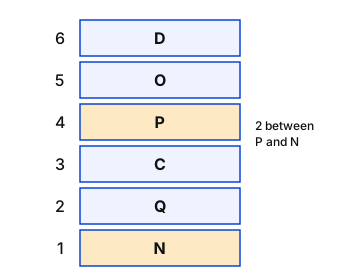
- No one above D → D on floor 6. Only two between D and C → C on floor 3.
- Q below C but above N → Q = 2, N = 1. Only two between O and Q → O = 5. Remaining P = 4.
- Between P (4) and N (1) are floors 3 and 2 → two people (C and Q).
Trick: Draw the 6 boxes first; "only two between X and Y" means X and Y are exactly 3 floors apart.
Answer: (D) Two
अवधारणा: निश्चित सुराग (सबसे ऊपरी मंज़िल) से शुरू करें, फिर "केवल दो के बीच" शर्तों से बाकी तय करें।
- D के ऊपर कोई नहीं → D मंज़िल 6 पर। D और C के बीच केवल दो → C मंज़िल 3 पर।
- Q, C से नीचे पर N से ऊपर → Q = 2, N = 1। O और Q के बीच केवल दो → O = 5। शेष P = 4।
- P (4) और N (1) के बीच मंज़िल 3 और 2 → दो लोग (C और Q)।
ट्रिक: पहले 6 बॉक्स बनाएँ; "X और Y के बीच केवल दो" का अर्थ है X और Y ठीक 3 मंज़िल दूर।
उत्तर: (D) दो
RRB NTPC Graduate CBT 1General Intelligence and ReasoningFloor puzzleRRB NTPC Graduate CBT 1 2025 · 25 Mar Shift 3
Q99.In a certain code language,
A + B means ‘A is the daughter of B’
A – B means ‘A is the brother of B’
A x B means ‘A is the wife of B’
A ÷ B means ‘A is the father of B’
Based on the above, how is D related to J if ‘D – F + G ÷ H x J’?
एक निश्चित कूट भाषा में,
A + B का अर्थ है ‘A, B की पुत्री है’
A – B का अर्थ है ‘A, B का भाई है’
A x B का अर्थ है ‘A, B की पत्नी है’
A ÷ B का अर्थ है ‘A, B का पिता है’
उपर्युक्त के आधार पर, यदि ‘D – F + G ÷ H x J’ है, तो D का J से क्या संबंध है?
- AWife's brotherपत्नी का भाई
- BWife's fatherपत्नी का पिता
- CFatherपिता
- DBrotherभाई
Show answer
Concept: Decode each symbol and draw the family tree; the gender of D is given by "brother".
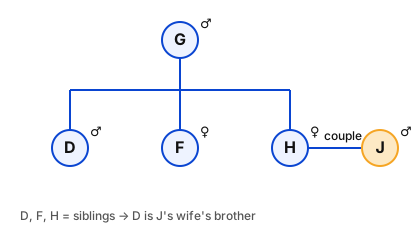
- D − F → D is the brother of F. F + G → F is the daughter of G, so D is also G's son.
- G ÷ H → G is the father of H, so D, F and H are siblings. H × J → H is the wife of J.
- D is the brother of J's wife → wife's brother.
Trick: Siblings of a parent's other children are your own siblings – once D and H share father G, D is H's brother, hence J's brother-in-law.
Answer: (A) Wife's brother
अवधारणा: प्रत्येक प्रतीक को डिकोड कर वंश-वृक्ष बनाएँ; "भाई" से D का लिंग पता चलता है।
- D − F → D, F का भाई है। F + G → F, G की पुत्री है, अतः D भी G का पुत्र है।
- G ÷ H → G, H का पिता है, अतः D, F और H भाई-बहन हैं। H × J → H, J की पत्नी है।
- D, J की पत्नी का भाई है → पत्नी का भाई (साला)।
ट्रिक: एक ही पिता की संतानें आपस में भाई-बहन हैं – D और H का पिता G है, अतः D, H का भाई और J का साला।
उत्तर: (A) पत्नी का भाई
RRB NTPC Graduate CBT 1General Intelligence and ReasoningBlood relations – codedRRB NTPC Graduate CBT 1 2025 · 25 Mar Shift 3
Q100.A, B, C, D, E, F and G sit around a circular table, facing the centre.
Only two people sit between F and B when counted from the left of B. G sits third to the left of E. A sits to the immediate right of E. A sits second to the left of F. D is an immediate neighbour of G.
How many people sit between A and G when counted from the right of G?
A, B, C, D, E, F और G एक वृत्ताकार मेज़ के चारों ओर केंद्र की ओर मुख करके बैठे हैं।
B के बाएँ से गिनने पर F और B के बीच केवल दो व्यक्ति बैठे हैं। G, E के बाएँ तीसरे स्थान पर बैठा है। A, E के ठीक दाएँ बैठा है। A, F के बाएँ दूसरे स्थान पर बैठा है। D, G का निकटतम पड़ोसी है।
G के दाएँ से गिनने पर A और G के बीच कितने व्यक्ति बैठे हैं?
- A2
- B1
- C3
- D4
Show answer
Concept: For people facing the centre, "left" is clockwise and "right" is anticlockwise. Fix E first and place the others.
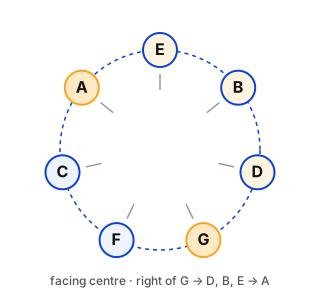
- A is immediately right of E. G is third to the left of E. A is second to the left of F → F is second to the right of A.
- Two people between F and B counted from B's left → B is third to the right of F. D is the neighbour of G, and the remaining seat goes to C.
- Order (clockwise): E, B, D, G, F, C, A. From G's right: D, B, E, then A → 3 people between.
Trick: Use the clue with two fixed names (E and A) first, then clues connecting a placed person to a new one; D's "neighbour of G" is decided last by elimination.
Answer: (C) 3
अवधारणा: केंद्र की ओर मुख वाले लोगों के लिए "बायाँ" दक्षिणावर्त (clockwise) और "दायाँ" वामावर्त है। पहले E को रखें, फिर बाकी।
- A, E के तुरंत दाएँ। G, E के बाएँ तीसरा। A, F के बाएँ दूसरा → F, A के दाएँ दूसरा।
- B के बाएँ से गिनने पर F और B के बीच दो → B, F के दाएँ तीसरा। D, G का पड़ोसी, शेष सीट C की।
- क्रम (दक्षिणावर्त): E, B, D, G, F, C, A। G के दाएँ से: D, B, E, फिर A → बीच में 3 लोग।
ट्रिक: पहले वह सुराग लें जिसमें दो निश्चित नाम हों (E और A), फिर रखे गए व्यक्ति को नए से जोड़ने वाले सुराग; D का "G का पड़ोसी" अंत में विलोपन से तय होता है।
उत्तर: (C) 3
RRB NTPC Graduate CBT 1General Intelligence and ReasoningCircular seatingRRB NTPC Graduate CBT 1 2025 · 25 Mar Shift 3

