RRB NTPC Graduate CBT 1 · 2,400 questions

RRB NTPC Graduate CBT 1 2025 PYQs

Real previous year questions, subject-wise. Try the question, then open the answer and the explanation in Hindi & English – free, no login.

Courses – airGurukul

735 questions in Mathematics.

Q81.
At what rate per annum will a sum of money become five times itself in 6 years under simple interest?
साधारण ब्याज पर कोई धनराशि 6 वर्षों में अपने से पाँच गुनी किस वार्षिक दर पर हो जाएगी?
  1. A6423%
  2. B6623%
  3. C13313%
  4. D6813%
Show answer

Concept: If a sum becomes n times in T years at simple interest, R=(n−1)×100T%.

  1. Amount =5P → SI =4P.
  2. R=4P×100P×6=4006=6623%.

Trick: "n times" means interest is (n−1) times the principal – never use n directly.

Answer: (B) 6623%

अवधारणा: साधारण ब्याज पर राशि T वर्षों में n गुना हो तो R=(n−1)×100T%।

  1. मिश्रधन =5P → ब्याज =4P।
  2. R=4P×100P×6=4006=6623%।

ट्रिक: "n गुना" का मतलब ब्याज मूलधन का (n−1) गुना है – सीधे n कभी न लें।

उत्तर: (B) 6623%

RRB NTPC Graduate CBT 1MathematicsSimple InterestRRB NTPC Graduate CBT 1 2025 · 27 Mar Shift 1
Q82.
What should come in place of ‘?’ in the given series?
44 50 62 80 104 ?
दी गई श्रेणी में ‘?’ के स्थान पर क्या आना चाहिए?
44 50 62 80 104 ?
  1. A132
  2. B136
  3. C138
  4. D134
Show answer

Concept: Check the differences; if they form a simple pattern (multiples of 6 here), extend it.

  1. 50−44=6, 62−50=12, 80−62=18, 104−80=24.
  2. Differences 6,12,18,24 → next difference 30.
  3. ?=104+30=134.

Trick: Differences increasing by a constant = second-level AP; just add the next multiple.

Answer: (D) 134

अवधारणा: अंतर देखें; यदि वे सरल पैटर्न (यहाँ 6 के गुणज) बनाते हैं तो उसे आगे बढ़ाएँ।

  1. 50−44=6, 62−50=12, 80−62=18, 104−80=24।
  2. अंतर 6,12,18,24 → अगला अंतर 30।
  3. ?=104+30=134।

ट्रिक: समान वृद्धि वाले अंतर = द्वितीय-स्तर समांतर श्रेणी; बस अगला गुणज जोड़ें।

उत्तर: (D) 134

RRB NTPC Graduate CBT 1MathematicsNumber SeriesRRB NTPC Graduate CBT 1 2025 · 27 Mar Shift 1
Q83.
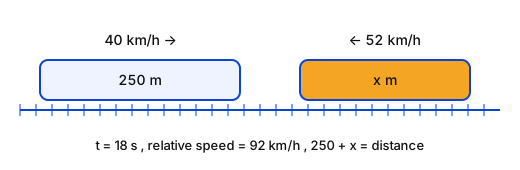
Two trains running in opposite directions at 40 km/hr and 52 km/hr cross each other in 18 seconds . If one train is 250 m long, then find the length of the other train.
विपरीत दिशाओं में 40 km/hr और 52 km/hr की चाल से चल रही दो रेलगाड़ियाँ एक-दूसरे को 18 सेकंड में पार करती हैं। यदि एक रेलगाड़ी 250 m लंबी है, तो दूसरी रेलगाड़ी की लंबाई ज्ञात कीजिए।
  1. A190 m
  2. B220 m
  3. C200 m
  4. D210 m
Show answer

Concept: Opposite directions → relative speed = sum of speeds; distance covered while crossing = sum of lengths.

  1. Relative speed =40+52=92km/h=92×518=2309m/s.
  2. Distance in 18 s =2309×18=460m.
  3. Other train =460−250=210m.

Trick: 92×18×518=92×5=460 – the 18 cancels, so no fraction work needed.

Answer: (D) 210 m

अवधारणा: विपरीत दिशा → सापेक्ष चाल = चालों का योग; पार करते समय तय दूरी = लंबाइयों का योग।

  1. सापेक्ष चाल =40+52=92km/h=92×518=2309m/s।
  2. 18 s में दूरी =2309×18=460m।
  3. दूसरी रेलगाड़ी =460−250=210m।

ट्रिक: 92×18×518=92×5=460 – 18 कट जाता है, भिन्न का काम ही नहीं।

उत्तर: (D) 210 m

RRB NTPC Graduate CBT 1MathematicsTrains – Relative SpeedRRB NTPC Graduate CBT 1 2025 · 27 Mar Shift 1
Q84.
Find the value of y, satisfying 26×5×715÷3025=y+913
y का वह मान ज्ञात कीजिए, जो 26×5×715÷3025=y+913 को संतुष्ट करता है
  1. A777
  2. B772
  3. C771
  4. D780
Show answer

Concept: Evaluate the root, then do × and ÷ from left to right, then solve for y.

  1. 3025=55.
  2. 26×5×715÷55=130×13=1690 (since 715÷55=13).
  3. y=1690−913=777.

Trick: Divide first where it cancels cleanly: 715=55×13 saves a big multiplication.

Answer: (A) 777

अवधारणा: पहले मूल निकालें, फिर बाएँ से दाएँ × और ÷ करें, फिर y निकालें।

  1. 3025=55।
  2. 26×5×715÷55=130×13=1690 (क्योंकि 715÷55=13)।
  3. y=1690−913=777।

ट्रिक: जहाँ साफ कटे वहाँ पहले भाग करें: 715=55×13 से बड़ा गुणा बच जाता है।

उत्तर: (A) 777

RRB NTPC Graduate CBT 1MathematicsSimplification (BODMAS)RRB NTPC Graduate CBT 1 2025 · 27 Mar Shift 1
Q85.
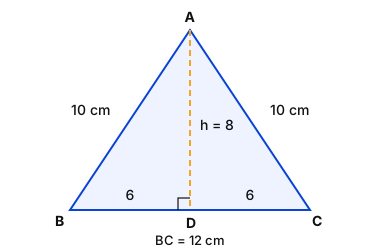
In an isosceles triangle ABC, the equal sides AB and AC are each 10 cm, and the base BC is 12 cm. Find the area of the triangle.
एक समद्विबाहु त्रिभुज ABC में, समान भुजाएँ AB और AC प्रत्येक 10 cm हैं, और आधार BC 12 cm है। त्रिभुज का क्षेत्रफल ज्ञात कीजिए।
  1. A40 cm2
  2. B45 cm2
  3. C48 cm2
  4. D36 cm2
Show answer

Concept: In an isosceles triangle the altitude from the apex bisects the base; use Pythagoras to get the height.

  1. BD=DC=122=6 cm.
  2. AD=102−62=64=8 cm.
  3. Area =12×12×8=48cm2.

Trick: 6-8-10 is a 3-4-5 triple – spot it and skip the square root.

Answer: (C) 48 cm2

अवधारणा: समद्विबाहु त्रिभुज में शीर्ष से डाला गया लंब आधार को समद्विभाजित करता है; पाइथागोरस से ऊँचाई निकालें।

  1. BD=DC=122=6 cm।
  2. AD=102−62=64=8 cm।
  3. क्षेत्रफल =12×12×8=48cm2।

ट्रिक: 6-8-10, 3-4-5 का त्रिक है – पहचानें और वर्गमूल छोड़ दें।

उत्तर: (C) 48 cm2

RRB NTPC Graduate CBT 1MathematicsArea of Isosceles TriangleRRB NTPC Graduate CBT 1 2025 · 27 Mar Shift 1
Q86.
There are 85 members in group A, 23 members in group B and 42 members in group C. All the members of these groups went to a restaurant. The average amounts spent on each member of groups A, B and C are ₹407, ₹365 and ₹280, respectively. The overall average amount (in ₹) spent per member is:
समूह A में 85 सदस्य, समूह B में 23 सदस्य और समूह C में 42 सदस्य हैं। इन समूहों के सभी सदस्य एक रेस्तरां में गए। समूह A, B और C के प्रत्येक सदस्य पर खर्च की गई औसत राशि क्रमशः ₹407, ₹365 और ₹280 है। प्रति सदस्य खर्च की गई समग्र औसत राशि (₹ में) है:
  1. A362
  2. B363
  3. C368
  4. D365
Show answer

Concept: Overall average =total amounttotal members (weighted mean).

  1. Total =85×407+23×365+42×280=34595+8395+11760=54750.
  2. Members =85+23+42=150.
  3. Average =54750150=365.

Trick: Take 365 as base: deviations 85×42=3570 and 42×(−85)=−3570 cancel exactly, B is at the base → answer 365 without division.

Answer: (D) 365

अवधारणा: कुल औसत =कुल राशिकुल सदस्य (भारित माध्य)।

  1. कुल =85×407+23×365+42×280=34595+8395+11760=54750।
  2. सदस्य =85+23+42=150।
  3. औसत =54750150=365।

ट्रिक: 365 को आधार लें: विचलन 85×42=3570 और 42×(−85)=−3570 पूरी तरह कट जाते हैं, B आधार पर ही है → बिना भाग किए उत्तर 365।

उत्तर: (D) 365

RRB NTPC Graduate CBT 1MathematicsWeighted AverageRRB NTPC Graduate CBT 1 2025 · 27 Mar Shift 1
Q87.
The ages (in years) of patients in a clinic are recorded as follows: 15 , 18 , 21 , 21 , 23 , 25 , 28 , 30 , 35 , 40 , 45 , 50 , 55. Calculate the difference between the median age now and after removing the oldest patient (55 years) from the data set.
एक क्लिनिक में रोगियों की आयु (वर्षों में) निम्न प्रकार दर्ज की गई है: 15 , 18 , 21 , 21 , 23 , 25 , 28 , 30 , 35 , 40 , 45 , 50 , 55। वर्तमान माध्यिका आयु और आँकड़ों से सबसे वृद्ध रोगी (55 वर्ष) को हटाने के बाद की माध्यिका आयु के बीच का अंतर परिकलित कीजिए।
  1. A1.75 years1.75 वर्ष
  2. B1.5 years1.5 वर्ष
  3. C2.5 years2.5 वर्ष
  4. D1.25 years1.25 वर्ष
Show answer

Concept: For n sorted values the median is the n+12-th value (odd n) or the mean of the two middle values (even n).

  1. 13 values (already sorted): median = 7th value = 28.
  2. Remove 55 → 12 values: median =6th+7th2=25+282=26.5.
  3. Difference =28−26.5=1.5 years.

Trick: Removing the largest value shifts the median down by half the gap between the two middle values – here 28−252=1.5.

Answer: (B) 1.5 years

अवधारणा: n क्रमबद्ध मानों की माध्यिका n+12-वाँ मान (विषम n) या बीच के दो मानों का औसत (सम n) होती है।

  1. 13 मान (पहले से क्रम में): माध्यिका = 7वाँ मान = 28।
  2. 55 हटाने पर 12 मान: माध्यिका =6वाँ+7वाँ2=25+282=26.5।
  3. अंतर =28−26.5=1.5 वर्ष।

ट्रिक: सबसे बड़ा मान हटाने पर माध्यिका बीच के दो मानों के अंतर के आधे से नीचे खिसकती है – यहाँ 28−252=1.5।

उत्तर: (B) 1.5 years

RRB NTPC Graduate CBT 1MathematicsMedianRRB NTPC Graduate CBT 1 2025 · 27 Mar Shift 1
Q88.
If x4=322−1x4 and x≥1, then the value of x3−1x3 is:
यदि x4=322−1x4 और x≥1 है, तो x3−1x3 का मान है:
  1. A76
  2. B72
  3. C64
  4. D62
Show answer

Concept: Step down from x4+1x4 to x−1x using (x2+1x2)2=x4+1x4+2 and (x−1x)2=x2+1x2−2.

  1. x4+1x4=322 → x2+1x2=324=18.
  2. (x−1x)2=18−2=16 → x−1x=4 (positive as x≥1).
  3. x3−1x3=(x−1x)3+3(x−1x)=64+12=76.

Trick: Remember the chain 322→18→4: each step is "add or subtract 2, then square-root".

Answer: (A) 76

अवधारणा: (x2+1x2)2=x4+1x4+2 और (x−1x)2=x2+1x2−2 से x4+1x4 से x−1x तक उतरें।

  1. x4+1x4=322 → x2+1x2=324=18।
  2. (x−1x)2=18−2=16 → x−1x=4 (x≥1 से धनात्मक)।
  3. x3−1x3=(x−1x)3+3(x−1x)=64+12=76।

ट्रिक: शृंखला 322→18→4 याद रखें: हर कदम "2 जोड़ें/घटाएँ, फिर वर्गमूल"।

उत्तर: (A) 76

RRB NTPC Graduate CBT 1MathematicsAlgebraic IdentitiesRRB NTPC Graduate CBT 1 2025 · 27 Mar Shift 1
Q89.
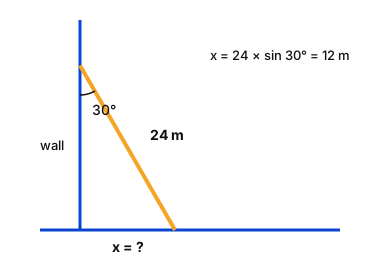
A 24 m long ladder is leaning against a wall. If the ladder makes an angle of 30o with the wall, what is the distance (in m) of the foot of the ladder from the wall?
24 m लंबी एक सीढ़ी एक दीवार के सहारे झुकी हुई है। यदि सीढ़ी दीवार के साथ 30o का कोण बनाती है, तो सीढ़ी के पाद की दीवार से दूरी (m में) क्या है?
  1. A12
  2. B122
  3. C123
  4. D123
Show answer

Concept: The ladder, wall and ground form a right triangle; the side opposite the angle at the top (between ladder and wall) is the foot-to-wall distance, so use sin.

  1. Angle with the wall =30∘, hypotenuse (ladder) =24 m.
  2. Distance from wall =24sin30∘=24×12=12 m.

Trick: Angle with the wall → sin gives the ground distance; angle with the ground → cos gives it. Here it is simply half the ladder.

Answer: (A) 12

अवधारणा: सीढ़ी, दीवार और ज़मीन समकोण त्रिभुज बनाते हैं; ऊपर के कोण (सीढ़ी और दीवार के बीच) की सम्मुख भुजा ही पाद-से-दीवार दूरी है, अतः sin लगाएँ।

  1. दीवार से कोण =30∘, कर्ण (सीढ़ी) =24 m।
  2. दीवार से दूरी =24sin30∘=24×12=12 m।

ट्रिक: दीवार से कोण → sin से ज़मीनी दूरी; ज़मीन से कोण → cos से। यहाँ यह सीढ़ी की आधी है।

उत्तर: (A) 12

RRB NTPC Graduate CBT 1MathematicsHeights and DistancesRRB NTPC Graduate CBT 1 2025 · 27 Mar Shift 1
Q90.
The radius of a right circular cone is increased by 8% and slant height is decreased by 15%. Find the percentage change in curved surface area of the cone.
एक लंब वृत्तीय शंकु की त्रिज्या में 8% की वृद्धि की जाती है और तिर्यक ऊँचाई में 15% की कमी की जाती है। शंकु के वक्र पृष्ठीय क्षेत्रफल में प्रतिशत परिवर्तन ज्ञात कीजिए।
  1. Adecreases by 8.2%8.2% की कमी
  2. Bincreases by 7%7% की वृद्धि
  3. Cdecreases by 11.5%11.5% की कमी
  4. Ddecreases by 7%7% की कमी
Show answer

Concept: CSA of a cone =πrl; when r and l change by a% and b%, net change =a+b+ab100%.

  1. a=+8, b=−15: net =8−15+8×(−15)100=−7−1.2=−8.2%.
  2. Check: 1.08×0.85=0.918 → a 8.2% decrease.

Trick: For a product of two quantities, use the successive-percentage formula; the sign of ab100 is negative when one rises and the other falls.

Answer: (A) decreases by 8.2%

अवधारणा: शंकु का वक्र पृष्ठ =πrl; r और l में a% और b% परिवर्तन पर शुद्ध परिवर्तन =a+b+ab100%।

  1. a=+8, b=−15: शुद्ध =8−15+8×(−15)100=−7−1.2=−8.2%।
  2. जाँच: 1.08×0.85=0.918 → 8.2% की कमी।

ट्रिक: दो राशियों के गुणनफल के लिए क्रमिक-प्रतिशत सूत्र लगाएँ; एक बढ़े और दूसरी घटे तो ab100 ऋणात्मक होता है।

उत्तर: (A) decreases by 8.2%

RRB NTPC Graduate CBT 1MathematicsPercentage Change – CSA of ConeRRB NTPC Graduate CBT 1 2025 · 27 Mar Shift 1
Q91.
A trader marks an article at a certain price and offers a 20% discount on it. Additionally, for every 120 articles purchased, he gives 3 more articles free of cost. If his overall profit on the transaction is 28%, find the percentage by which the marked price of an article exceeds its cost price. Assume the customer pays for only 120 articles.
एक व्यापारी किसी वस्तु पर एक निश्चित मूल्य अंकित करता है और उस पर 20% की छूट देता है। इसके अतिरिक्त, खरीदी गई प्रत्येक 120 वस्तुओं पर वह 3 और वस्तुएँ निःशुल्क देता है। यदि इस लेन-देन पर उसका कुल लाभ 28% है, तो ज्ञात कीजिए कि वस्तु का अंकित मूल्य उसके क्रय मूल्य से कितने प्रतिशत अधिक है। मान लीजिए कि ग्राहक केवल 120 वस्तुओं का भुगतान करता है।
  1. A64%
  2. B68%
  3. C72%
  4. D60%
Show answer

Concept: Let CP of each article be ₹1 and MP be ₹m. The customer pays for 120 articles at the discounted price but receives 123.

  1. Cost to trader =123×1=123; revenue =120×0.8m=96m.
  2. Profit 28% → 96m=1.28×123=157.44 → m=1.64.
  3. MP exceeds CP by 64%.

Trick: MPCP=(1+profit)(1−discount)×articles givenarticles paid=1.280.8×123120=1.6×1.025=1.64.

Answer: (A) 64%

अवधारणा: हर वस्तु का क्रय मूल्य ₹1 और अंकित मूल्य ₹m मानें। ग्राहक 120 वस्तुओं का छूट वाला दाम देता है पर 123 वस्तुएँ पाता है।

  1. व्यापारी की लागत =123×1=123; प्राप्ति =120×0.8m=96m।
  2. लाभ 28% → 96m=1.28×123=157.44 → m=1.64।
  3. अंकित मूल्य, क्रय मूल्य से 64% अधिक।

ट्रिक: MPCP=(1+लाभ)(1−छूट)×दी गई वस्तुएँभुगतान वाली वस्तुएँ=1.280.8×123120=1.6×1.025=1.64।

उत्तर: (A) 64%

RRB NTPC Graduate CBT 1MathematicsProfit, Discount and Free ArticlesRRB NTPC Graduate CBT 1 2025 · 27 Mar Shift 1
Q92.
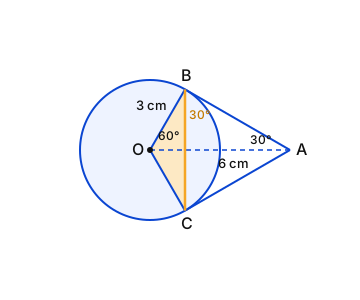
Two tangents, AB and AC, are drawn on a circle from an external point A, which is 6 cm away from its centre O. If the radius of the circle is 3 cm, then what is the measure of angle OBC?
एक वृत्त पर उसके केंद्र O से 6 cm दूर स्थित एक बाह्य बिंदु A से दो स्पर्श रेखाएँ AB और AC खींची गई हैं। यदि वृत्त की त्रिज्या 3 cm है, तो कोण OBC का माप क्या है?
  1. A30∘
  2. B100∘
  3. C60∘
  4. D120∘
Show answer

Concept: A tangent is perpendicular to the radius at the point of contact, so △OBA is right-angled at B. Also OB=OC, so △OBC is isosceles.

  1. In △OBA: sin∠OAB=OBOA=36=12⇒∠OAB=30∘, so ∠AOB=60∘.
  2. By symmetry ∠AOC=60∘, hence ∠BOC=120∘.
  3. In isosceles △OBC: ∠OBC=∠OCB=180∘−120∘2=30∘.

Trick: When the external point is at distance 2r from the centre, the two tangents make 60∘ with each other, the central angle is 120∘ and each base angle of △OBC is 30∘.

Answer: (A) 30∘

अवधारणा: स्पर्श रेखा, स्पर्श बिंदु पर त्रिज्या के लंबवत होती है, अतः △OBA में B पर समकोण है। साथ ही OB=OC, इसलिए △OBC समद्विबाहु है।

  1. △OBA में: sin∠OAB=OBOA=36=12⇒∠OAB=30∘, अतः ∠AOB=60∘।
  2. सममिति से ∠AOC=60∘, इसलिए ∠BOC=120∘।
  3. समद्विबाहु △OBC में: ∠OBC=∠OCB=180∘−120∘2=30∘।

ट्रिक: जब बाहरी बिंदु केंद्र से 2r दूरी पर हो, तो दोनों स्पर्श रेखाओं के बीच 60∘, केंद्रीय कोण 120∘ और △OBC का प्रत्येक आधार कोण 30∘ होता है।

उत्तर: (A) 30∘

RRB NTPC Graduate CBT 1MathematicsCircle – TangentsRRB NTPC Graduate CBT 1 2025 · 25 Mar Shift 3
Q93.
If 9 students can prepare 117 charts in 3 hours, how many students are needed to prepare 208 charts in 1 hour?
यदि 9 विद्यार्थी 3 घंटे में 117 चार्ट तैयार कर सकते हैं, तो 1 घंटे में 208 चार्ट तैयार करने के लिए कितने विद्यार्थियों की आवश्यकता होगी?
  1. A42 students42 विद्यार्थी
  2. B48 students48 विद्यार्थी
  3. C46 students46 विद्यार्थी
  4. D45 students45 विद्यार्थी
Show answer

Concept: M1T1W1=M2T2W2 (men × time ∝ work).

  1. 9×3117=M2×1208
  2. M2=27×208117=27×208117; since 117=9×13 and 208=16×13: M2=27×169=48.

Trick: One student makes 11727=133 charts per hour, so 208÷133=16×3=48 students.

Answer: (B) 48 students

अवधारणा: M1T1W1=M2T2W2 (व्यक्ति × समय ∝ कार्य)।

  1. 9×3117=M2×1208
  2. M2=27×208117; चूँकि 117=9×13 और 208=16×13: M2=27×169=48।

ट्रिक: एक छात्र प्रति घंटे 11727=133 चार्ट बनाता है, अतः 208÷133=16×3=48 छात्र।

उत्तर: (B) 48 छात्र

RRB NTPC Graduate CBT 1MathematicsWork and time – chain ruleRRB NTPC Graduate CBT 1 2025 · 25 Mar Shift 3
Q94.
If the mean proportional between x and 36 is 18, what is the value of x?
यदि x और 36 के बीच मध्यानुपाती 18 है, तो x का मान क्या है?
  1. A12
  2. B18
  3. C9
  4. D6
Show answer

Concept: The mean proportional between a and b is ab, i.e. m2=ab.

  1. 182=x×36
  2. x=32436=9

Trick: x:18=18:36; the right ratio is 1:2, so x=182=9.

Answer: (C) 9

अवधारणा: a और b के बीच मध्यानुपाती (mean proportional) =ab, अर्थात् m2=ab।

  1. 182=x×36
  2. x=32436=9

ट्रिक: x:18=18:36; दाहिना अनुपात 1:2 है, अतः x=182=9।

उत्तर: (C) 9

RRB NTPC Graduate CBT 1MathematicsRatio – mean proportionalRRB NTPC Graduate CBT 1 2025 · 25 Mar Shift 3
Q95.
Sharad is two times as old as his younger brother, and his other brother is 3 years younger than the younger brother. If the sum of the ages of these three brothers 3 years ago was 28 years, find Sharad’s present age, in years.
शरद की आयु अपने छोटे भाई की आयु की दो गुनी है, और उसका दूसरा भाई छोटे भाई से 3 वर्ष छोटा है। यदि 3 वर्ष पहले इन तीनों भाइयों की आयु का योग 28 वर्ष था, तो शरद की वर्तमान आयु (वर्षों में) ज्ञात कीजिए।
  1. A26
  2. B20
  3. C22
  4. D18
Show answer

Concept: Take the younger brother's present age as x and express the others in terms of x; "3 years ago" reduces each age by 3.

  1. Younger brother =x, Sharad =2x, other brother =x−3. Present sum =4x−3.
  2. Three years ago: (4x−3)−9=28⇒4x=40⇒x=10.
  3. Sharad's age =2x=20 years.

Trick: Sum of ages 3 years ago =28 → present sum =28+3×3=37. Then 4x−3=37⇒x=10.

Answer: (B) 20

अवधारणा: छोटे भाई की वर्तमान आयु x मानकर बाकी को x में लिखिए; "3 वर्ष पहले" में प्रत्येक आयु 3 कम हो जाती है।

  1. छोटा भाई =x, शरद =2x, दूसरा भाई =x−3। वर्तमान योग =4x−3।
  2. तीन वर्ष पहले: (4x−3)−9=28⇒4x=40⇒x=10।
  3. शरद की आयु =2x=20 वर्ष।

ट्रिक: 3 वर्ष पहले योग =28 → वर्तमान योग =28+3×3=37। फिर 4x−3=37⇒x=10।

उत्तर: (B) 20

RRB NTPC Graduate CBT 1MathematicsAgesRRB NTPC Graduate CBT 1 2025 · 25 Mar Shift 3
Q96.
Find the value of y, satisfying 22×3×816÷2601=y+794.
y का वह मान ज्ञात कीजिए, जो 22×3×816÷2601=y+794 को संतुष्ट करता है।
  1. A258
  2. B262
  3. C270
  4. D256
Show answer

Concept: Apply BODMAS: evaluate the square root first, then multiplication/division from left to right.

  1. 2601=51 (since 512=2601).
  2. 22×3×816÷51=66×81651=66×16=1056.
  3. y=1056−794=262.

Trick: 816=51×16 – spot such factors before multiplying, it keeps numbers small.

Answer: (B) 262

अवधारणा: BODMAS लागू करें: पहले वर्गमूल, फिर गुणा/भाग बाएँ से दाएँ।

  1. 2601=51 (क्योंकि 512=2601)।
  2. 22×3×816÷51=66×81651=66×16=1056।
  3. y=1056−794=262।

ट्रिक: 816=51×16 – गुणा करने से पहले ऐसे गुणनखंड पहचानें, संख्याएँ छोटी रहती हैं।

उत्तर: (B) 262

RRB NTPC Graduate CBT 1MathematicsSimplification – BODMASRRB NTPC Graduate CBT 1 2025 · 25 Mar Shift 3
Q97.
Trisha and Riya started a partnership business, investing some amount in the ratio of 8 : 5. Poorva joined then after six months with an amount equal to that of Riya. In what ratio should the profit at the end of one year be distributed among Trisha, Riya and Poorva?
तृषा और रिया ने 8 : 5 के अनुपात में कुछ राशि निवेश करके एक साझेदारी व्यवसाय शुरू किया। छह महीने बाद पूर्वा रिया के बराबर राशि के साथ उनके साथ जुड़ गई। एक वर्ष के अंत में लाभ को तृषा, रिया और पूर्वा के बीच किस अनुपात में वितरित किया जाना चाहिए?
  1. A19 : 15 : 8
  2. B15 : 5 : 2
  3. C16 : 10 : 5
  4. D17 : 7 : 3
Show answer

Concept: Profit is shared in the ratio of (capital × time).

  1. Trisha: 8×12=96; Riya: 5×12=60; Poorva (equal to Riya, for 6 months): 5×6=30.
  2. Ratio =96:60:30=16:10:5.

Trick: Poorva's capital equals Riya's but for half the time, so her share is half of Riya's: 8:5:2.5=16:10:5.

Answer: (C) 16 : 10 : 5

अवधारणा: लाभ (पूँजी × समय) के अनुपात में बँटता है।

  1. तृषा: 8×12=96; रिया: 5×12=60; पूर्वा (रिया के बराबर, 6 माह): 5×6=30।
  2. अनुपात =96:60:30=16:10:5।

ट्रिक: पूर्वा की पूँजी रिया के बराबर पर आधे समय के लिए है, अतः उसका हिस्सा रिया का आधा: 8:5:2.5=16:10:5।

उत्तर: (C) 16 : 10 : 5

RRB NTPC Graduate CBT 1MathematicsPartnershipRRB NTPC Graduate CBT 1 2025 · 25 Mar Shift 3
Q98.
A shopkeeper professes to sell his goods at a 45% loss but uses a false balance and gains 50%. The actual weight (rounded off to one decimal place) that he uses instead of 1 kg is:
एक दुकानदार अपना सामान 45% हानि पर बेचने का दावा करता है, परंतु गलत तराज़ू का उपयोग करके 50% लाभ प्राप्त करता है। 1 kg के स्थान पर वह जो वास्तविक भार (एक दशमलव स्थान तक पूर्णांकित) उपयोग करता है, वह है:
  1. A369.3 gm
  2. B368.6 gm
  3. C366.7 gm
  4. D365.2 gm
Show answer

Concept: If the shopkeeper claims a loss of 45%, he charges only 55% of the cost of 1 kg. To still gain 50%, the goods he actually gives must cost 55150 of 1 kg.

  1. Amount charged =0.55×(CP of 1 kg).
  2. Gain 50% ⇒ actual CP of goods given =0.551.5 kg =55150=1130 kg.
  3. 1130×1000=366.67≈366.7 g.

Trick: True weight=100−claimed loss%100+actual gain%×1000=55150×1000=366.7 g.

Answer: (C) 366.7 gm

अवधारणा: दुकानदार 45% हानि का दावा करता है, अर्थात् वह 1 kg की लागत का केवल 55% लेता है। फिर भी 50% लाभ पाने के लिए दिए गए माल की लागत 1 kg की 55150 होनी चाहिए।

  1. वसूली गई राशि =0.55×(1 kg का CP)।
  2. 50% लाभ ⇒ दिए गए माल का वास्तविक CP =0.551.5 kg =55150=1130 kg।
  3. 1130×1000=366.67≈366.7 g।

ट्रिक: वास्तविक भार=100−कथित हानि%100+वास्तविक लाभ%×1000=55150×1000=366.7 g।

उत्तर: (C) 366.7 gm

RRB NTPC Graduate CBT 1MathematicsProfit & loss – false weightRRB NTPC Graduate CBT 1 2025 · 25 Mar Shift 3
Q99.
If 3A = 4B = 8C, what is A : B : C?
यदि 3A = 4B = 8C है, तो A : B : C क्या है?
  1. A6 : 3 : 8
  2. B8 : 6 : 3
  3. C8 : 4 : 3
  4. D6 : 8 : 3
Show answer

Concept: If 3A=4B=8C=k, then A=k3, B=k4, C=k8.

  1. Take k=LCM(3,4,8)=24.
  2. A=8, B=6, C=3 → A:B:C=8:6:3.

Trick: A:B:C=13:14:18; multiply by 24 → 8:6:3. The biggest coefficient gives the smallest share.

Answer: (B) 8 : 6 : 3

अवधारणा: यदि 3A=4B=8C=k, तो A=k3, B=k4, C=k8।

  1. k=LCM(3,4,8)=24 लें।
  2. A=8, B=6, C=3 → A:B:C=8:6:3।

ट्रिक: A:B:C=13:14:18; 24 से गुणा → 8:6:3। सबसे बड़ा गुणांक सबसे छोटा हिस्सा देता है।

उत्तर: (B) 8 : 6 : 3

RRB NTPC Graduate CBT 1MathematicsRatio – equal productsRRB NTPC Graduate CBT 1 2025 · 25 Mar Shift 3
Q100.
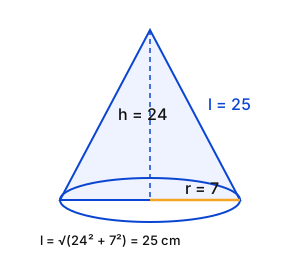
A manufacturer is making conical paper cups of height 24 cm and radius 7 cm. How much paper (in m2 correct up to 2 decimal places) is needed to make 1000 such cups? (Take π=3.14)
एक निर्माता 24 cm ऊँचाई और 7 cm त्रिज्या वाले शंक्वाकार कागज़ के कप बना रहा है। ऐसे 1000 कप बनाने के लिए कितना कागज़ (m2 में, 2 दशमलव स्थानों तक सही) चाहिए? (π=3.14 लीजिए)
  1. A71.34 m2
  2. B70.34 m2
  3. C80.34 m2
  4. D54.95 m2
Show answer

Concept: A paper cup is an open cone, so paper needed = curved surface area =πrl, where slant height l=h2+r2.

  1. l=242+72=576+49=625=25 cm.
  2. CSA of one cup =3.14×7×25=549.5 cm2.
  3. 1000 cups: 549500 cm2=54950010000=54.95 m2.

Trick: 7-24-25 is a Pythagorean triplet – no calculation needed for l. And 1 m2=104 cm2.

Answer: (D) 54.95 m2

अवधारणा: कागज़ का कप खुला शंकु है, अतः आवश्यक कागज़ = वक्र पृष्ठीय क्षेत्रफल =πrl, जहाँ तिर्यक ऊँचाई l=h2+r2।

  1. l=242+72=576+49=625=25 cm।
  2. एक कप का CSA =3.14×7×25=549.5 cm2।
  3. 1000 कप: 549500 cm2=54950010000=54.95 m2।

ट्रिक: 7-24-25 पाइथागोरस त्रिक है – l के लिए गणना नहीं चाहिए। और 1 m2=104 cm2।

उत्तर: (D) 54.95 m2

RRB NTPC Graduate CBT 1MathematicsMensuration – coneRRB NTPC Graduate CBT 1 2025 · 25 Mar Shift 3