Q121.In a certain code language,
A + B means ‘A is the husband of B’
A - B means ‘A is the daughter of B’
A × B means ‘A is the brother of B’
A ÷ B means ‘A is the sister of B’
Based on the above, how is S related to M if ‘S × R - U + N ÷ M’?
एक निश्चित कूट भाषा में,
A + B का अर्थ है ‘A, B का पति है’
A - B का अर्थ है ‘A, B की पुत्री है’
A × B का अर्थ है ‘A, B का भाई है’
A ÷ B का अर्थ है ‘A, B की बहन है’
उपर्युक्त के आधार पर, यदि ‘S × R - U + N ÷ M’ है, तो S का M से क्या संबंध है?
- ADaughter’s sonपुत्री का पुत्र
- BBrother’s sonभाई का पुत्र
- CSister's sonबहन का पुत्र
- DSon’s sonपुत्र का पुत्र
Show answer
Concept: Decode each symbol pair-wise and build the family tree, fixing gender from the words brother/sister/daughter/husband.
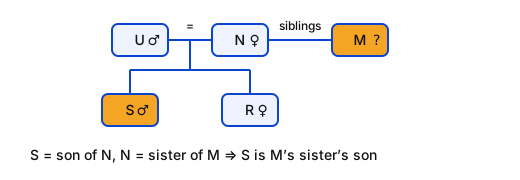
- S × R: S is brother of R; R − U: R is daughter of U ⇒ S is son of U.
- U + N: U is husband of N ⇒ N is mother of S.
- N ÷ M: N is sister of M ⇒ S is the son of M's sister.
Trick: Reach the person asked about (M) through the chain, then read back: M → sister (N) → son (S).
Answer: (C) Sister's son
अवधारणा: हर संकेत को जोड़ी में पढ़ें और वंश-वृक्ष बनाएँ; brother/sister/daughter/husband से लिंग तय करें।
- S × R: S, R का भाई; R − U: R, U की बेटी ⇒ S, U का बेटा।
- U + N: U, N का पति ⇒ N, S की माँ।
- N ÷ M: N, M की बहन ⇒ S, M की बहन का बेटा।
ट्रिक: पूछे गए व्यक्ति (M) तक पहुँचें, फिर उल्टा पढ़ें: M → बहन (N) → बेटा (S)।
उत्तर: (C) बहन का बेटा (Sister's son)
RRB NTPC Graduate CBT 1General Intelligence and ReasoningBlood RelationsRRB NTPC Graduate CBT 1 2025 · 25 Mar Shift 2
Q122.A, B, C, D, E and F live on six different floors of the same building. The lowermost floor in the building is numbered 1, the floor above it is numbered 2, and so on till the topmost floor is numbered 6. B lives on the topmost floor. Only three people live between B and D. F lives immediately above A, but immediately below E. How many people live between F and C?
A, B, C, D, E और F एक ही भवन की छह अलग-अलग मंज़िलों पर रहते हैं। भवन की सबसे निचली मंज़िल की संख्या 1 है, उसके ऊपर की मंज़िल की संख्या 2 है, और इसी प्रकार सबसे ऊपरी मंज़िल तक, जिसकी संख्या 6 है। B सबसे ऊपरी मंज़िल पर रहता है। B और D के बीच केवल तीन व्यक्ति रहते हैं। F, A के ठीक ऊपर, लेकिन E के ठीक नीचे रहता है। F और C के बीच कितने व्यक्ति रहते हैं?
- ANoneकोई नहीं
- BOneएक
- CTwoदो
- DThreeतीन
Show answer
Concept: Fix the definite clues first (top floor, counted gaps), then place the consecutive block.
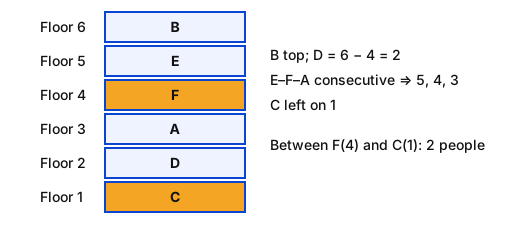
- B = 6; three people between B and D ⇒ D = 2.
- E, F, A are consecutive (E above F above A); free floors 1, 3, 4, 5 ⇒ E = 5, F = 4, A = 3.
- C takes floor 1. Between F (4) and C (1): floors 3 and 2 ⇒ two people.
Trick: "Immediately above/below" clues form a rigid block – slide it into the only gap that fits.
Answer: (C) Two
अवधारणा: पहले निश्चित संकेत (सबसे ऊपरी मंज़िल, बीच की गिनती) लगाएँ, फिर लगातार वाले समूह को रखें।
- B = 6; B और D के बीच तीन ⇒ D = 2।
- E, F, A लगातार हैं (E ऊपर, फिर F, फिर A); खाली मंज़िलें 1, 3, 4, 5 ⇒ E = 5, F = 4, A = 3।
- C मंज़िल 1 पर। F (4) और C (1) के बीच मंज़िल 3, 2 ⇒ दो लोग।
ट्रिक: "ठीक ऊपर/नीचे" वाले संकेत एक कठोर ब्लॉक बनाते हैं – उसे उसी खाली जगह में खिसकाएँ जहाँ वह फिट हो।
उत्तर: (C) दो
RRB NTPC Graduate CBT 1General Intelligence and ReasoningFloor PuzzleRRB NTPC Graduate CBT 1 2025 · 25 Mar Shift 2
Q123.In this question, a question is followed by two statements numbered (I) and (II). You have to decide whether the data provided in the statements are sufficient to answer the question. Read both the statements and decide the appropriate answer.
Q. Five cousins – Kriti, Leena, Mona, Pooja, and Reema – are of different ages. Who is the youngest?
(I) Leena is older than Kriti but younger than Mona.
(II) Pooja is older than Kriti but younger than Leena.
इस प्रश्न में, एक प्रश्न के बाद (I) और (II) क्रमांकित दो कथन दिए गए हैं। आपको यह निर्णय करना है कि कथनों में दिए गए आँकड़े प्रश्न का उत्तर देने के लिए पर्याप्त हैं या नहीं। दोनों कथनों को पढ़िए और उचित उत्तर का चयन कीजिए।
प्रश्न. पाँच चचेरी बहनें – कृति, लीना, मोना, पूजा और रीमा – अलग-अलग आयु की हैं। सबसे छोटी कौन है?
(I) लीना, कृति से बड़ी है लेकिन मोना से छोटी है।
(II) पूजा, कृति से बड़ी है लेकिन लीना से छोटी है।
- AData in Statement II alone is sufficient to answer the question while data in Statement I is notकेवल कथन II के आँकड़े प्रश्न का उत्तर देने के लिए पर्याप्त हैं, जबकि कथन I के आँकड़े पर्याप्त नहीं हैं
- BBoth statements I and II together are NOT sufficient to answer the questionकथन I और II दोनों मिलकर भी प्रश्न का उत्तर देने के लिए पर्याप्त नहीं हैं
- CBoth statements I and II together (and not statement I alone or statement II alone) are sufficient to answer the questionकथन I और II दोनों मिलकर (और न केवल कथन I अकेले या कथन II अकेले) प्रश्न का उत्तर देने के लिए पर्याप्त हैं
- DData in Statement I alone is sufficient to answer the question while data in Statement II is notकेवल कथन I के आँकड़े प्रश्न का उत्तर देने के लिए पर्याप्त हैं, जबकि कथन II के आँकड़े पर्याप्त नहीं हैं
Show answer
Concept: To name the youngest of five, every person must be placed below the others – an unmentioned person leaves the answer open.
- (I): Mona > Leena > Kriti. Pooja and Reema unknown.
- (II): Leena > Pooja > Kriti. Mona and Reema unknown.
- Together: Mona > Leena > Pooja > Kriti, but Reema is not mentioned anywhere – she could be the youngest. Not sufficient.
Trick: First check whether all names appear in the statements; a missing name usually means "not sufficient".
Answer: (B) Both statements together are NOT sufficient
अवधारणा: पाँच में सबसे छोटा बताने के लिए हर व्यक्ति की स्थिति तय होनी चाहिए – जिसका ज़िक्र ही नहीं, वह उत्तर अधूरा छोड़ देता है।
- (I): मोना > लीना > कृति; पूजा और रीमा अज्ञात।
- (II): लीना > पूजा > कृति; मोना और रीमा अज्ञात।
- दोनों मिलाकर: मोना > लीना > पूजा > कृति, पर रीमा का कहीं उल्लेख नहीं – वह सबसे छोटी हो सकती है। अपर्याप्त।
ट्रिक: पहले देखें कि सभी नाम कथनों में आए हैं या नहीं; छूटा हुआ नाम प्रायः "अपर्याप्त" का संकेत है।
उत्तर: (B) दोनों कथन मिलकर भी पर्याप्त नहीं
RRB NTPC Graduate CBT 1General Intelligence and ReasoningData SufficiencyRRB NTPC Graduate CBT 1 2025 · 25 Mar Shift 2
Q124.What should come in place of ‘?’ in the given series?
99 124 140 149 153 ?
दी गई शृंखला में ‘?’ के स्थान पर क्या आना चाहिए?
99 124 140 149 153 ?
- A166
- B154
- C152
- D164
Show answer
Concept: Check the differences between consecutive terms – here they are perfect squares in decreasing order.
- , , , .
- Pattern ⇒ next difference .
- .
Trick: Shrinking differences 25, 16, 9, 4 → squares; next is 1.
Answer: (B) 154
अवधारणा: लगातार पदों के अंतर देखें – यहाँ वे घटते क्रम में पूर्ण वर्ग हैं।
- , , , ।
- पैटर्न ⇒ अगला अंतर ।
- ।
ट्रिक: घटते अंतर 25, 16, 9, 4 → वर्ग संख्याएँ; अगला 1।
उत्तर: (B) 154
RRB NTPC Graduate CBT 1General Intelligence and ReasoningNumber SeriesRRB NTPC Graduate CBT 1 2025 · 25 Mar Shift 2
Q125.Read the given statements and conclusions carefully. You have to take the given statements to be true even if they seem to be at variance from commonly known facts. You have to decide which conclusion/s logically follow/s from the given statements. Statements:
All papers are books. All books are erasers. Some erasers are crayons.
Conclusions:
(I) Some papers are crayons.
(II) Some books are crayons.
दिए गए कथनों और निष्कर्षों को ध्यानपूर्वक पढ़िए। आपको दिए गए कथनों को सत्य मानना है, भले ही वे सामान्यतः ज्ञात तथ्यों से भिन्न प्रतीत होते हों। आपको यह निर्णय करना है कि दिए गए कथनों से कौन-सा/से निष्कर्ष तार्किक रूप से अनुसरण करता/करते है/हैं। कथन:
सभी कागज़, पुस्तकें हैं। सभी पुस्तकें, रबड़ हैं। कुछ रबड़, क्रेयॉन हैं।
निष्कर्ष:
(I) कुछ कागज़, क्रेयॉन हैं।
(II) कुछ पुस्तकें, क्रेयॉन हैं।
- ABoth conclusions I and II follow.निष्कर्ष I और II दोनों अनुसरण करते हैं।
- BOnly conclusion I follows.केवल निष्कर्ष I अनुसरण करता है।
- CNeither conclusion I nor II follows.न तो निष्कर्ष I और न ही II अनुसरण करता है।
- DOnly conclusion II follows.केवल निष्कर्ष II अनुसरण करता है।
Show answer
Concept: Draw the Venn diagram: papers ⊂ books ⊂ erasers; "some erasers are crayons" only guarantees an overlap with the eraser set.
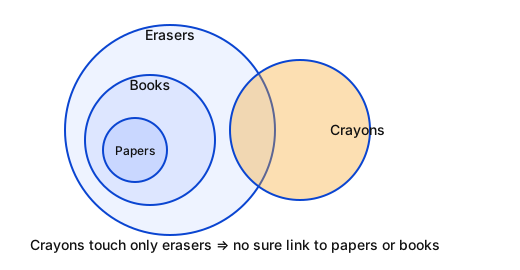
- The crayon circle can intersect erasers outside the book region, so "some books are crayons" is not definite.
- Likewise "some papers are crayons" is not definite.
- Neither conclusion follows.
Trick: All + All + Some (at the far end) → the "some" never travels back to the first terms.
Answer: (C) Neither conclusion I nor II follows
अवधारणा: वेन आरेख बनाएँ: papers ⊂ books ⊂ erasers; "कुछ erasers crayons हैं" केवल eraser समूह से ओवरलैप पक्का करता है।
- crayon वृत्त erasers के उस भाग को छू सकता है जो books से बाहर है, अतः "कुछ books crayons हैं" निश्चित नहीं।
- इसी तरह "कुछ papers crayons हैं" भी निश्चित नहीं।
- कोई निष्कर्ष नहीं निकलता।
ट्रिक: All + All + Some (अंत में) → "some" पीछे के पदों तक कभी नहीं लौटता।
उत्तर: (C) न I न II
RRB NTPC Graduate CBT 1General Intelligence and ReasoningSyllogismRRB NTPC Graduate CBT 1 2025 · 25 Mar Shift 2
Q126.Refer to the following letter, number and symbol series and answer the question that follows. Counting to be done from left to right only.
(Left) D 8 € K K 6 * @ F Y 9 5 L 8 € 7 2 X Y € O & (Right)
If all the letters are dropped from the series, which of the following will be fifth from the left?
निम्नलिखित अक्षर, संख्या और प्रतीक शृंखला को देखिए और उसके बाद दिए गए प्रश्न का उत्तर दीजिए। गिनती केवल बाएँ से दाएँ की जानी है।
(बाएँ) D 8 € K K 6 * @ F Y 9 5 L 8 € 7 2 X Y € O & (दाएँ)
यदि शृंखला से सभी अक्षर हटा दिए जाएँ, तो निम्नलिखित में से कौन-सा बाएँ से पाँचवाँ होगा?
- A5
- B@
- C9
- D€
Show answer
Concept: Remove the letters and count the remaining items from the left.
- Series without letters: 8 € 6 * @ 9 5 8 € 7 2 € &
- Positions: 1st 8, 2nd €, 3rd 6, 4th *, 5th @.
Trick: Strike letters directly in the row and count with a finger – no need to rewrite the whole series.
Answer: (B) @
अवधारणा: अक्षर हटाकर बचे हुए पदों को बाएँ से गिनें।
- अक्षर हटाने पर: 8 € 6 * @ 9 5 8 € 7 2 € &
- क्रम: पहला 8, दूसरा €, तीसरा 6, चौथा *, पाँचवाँ @।
ट्रिक: पंक्ति में ही अक्षर काटें और उँगली से गिनें – पूरी श्रृंखला दोबारा लिखने की ज़रूरत नहीं।
उत्तर: (B) @
RRB NTPC Graduate CBT 1General Intelligence and ReasoningLetter-Number-Symbol SeriesRRB NTPC Graduate CBT 1 2025 · 25 Mar Shift 2
Q127.Seven boxes, A, B, C, D, E, F and G, are kept one over the other but not necessarily in the same order. Only G is kept above C. Only E is kept between C and F. Only D is kept below B.
How many boxes are kept below F?
सात बक्से, A, B, C, D, E, F और G, एक के ऊपर एक रखे गए हैं, लेकिन आवश्यक नहीं कि इसी क्रम में हों। C के ऊपर केवल G रखा है। C और F के बीच केवल E रखा है। B के नीचे केवल D रखा है।
F के नीचे कितने बक्से रखे हैं?
- A3
- B1
- C2
- D4
Show answer
Concept: "Only X is above/below Y" pins positions at the ends of the stack; fill the middle with the remaining clue.
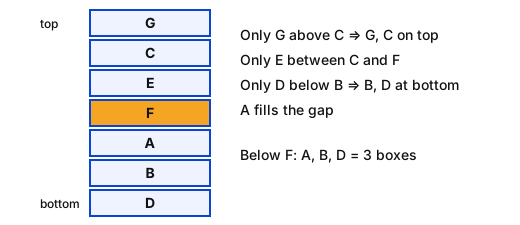
- Only G above C ⇒ G is 1st (top), C is 2nd.
- Only E between C and F ⇒ E 3rd, F 4th.
- Only D below B ⇒ B 6th, D 7th (bottom); A takes the 5th place.
- Below F: A, B, D ⇒ 3 boxes.
Trick: Write the stack top-to-bottom as a column; "only" clues give exact positions without cases.
Answer: (A) 3
अवधारणा: "केवल X, Y के ऊपर/नीचे" जैसे संकेत ढेर के सिरों पर स्थिति तय कर देते हैं; बीच को बचे संकेत से भरें।
- केवल G, C के ऊपर ⇒ G पहला (सबसे ऊपर), C दूसरा।
- C और F के बीच केवल E ⇒ E तीसरा, F चौथा।
- केवल D, B के नीचे ⇒ B छठा, D सातवाँ (सबसे नीचे); A पाँचवें स्थान पर।
- F के नीचे: A, B, D ⇒ 3 बॉक्स।
ट्रिक: ढेर को ऊपर से नीचे स्तंभ में लिखें; "केवल" वाले संकेत बिना केस बनाए सटीक स्थान देते हैं।
उत्तर: (A) 3
RRB NTPC Graduate CBT 1General Intelligence and ReasoningBox ArrangementRRB NTPC Graduate CBT 1 2025 · 25 Mar Shift 2
Q128.Based on the English alphabetical order, three of the following four letter cluster pairs are alike in a certain way and thus form a group. Which is the one that does not belong to that group?
(Note: The odd man out is not based on the number of consonants/vowels or their position in the letter cluster)
अंग्रेज़ी वर्णमाला क्रम के आधार पर, निम्नलिखित चार अक्षर-समूह युग्मों में से तीन एक निश्चित प्रकार से समान हैं और इस प्रकार एक समूह बनाते हैं। वह कौन-सा है जो उस समूह से संबंधित नहीं है?
(नोट: असंगत युग्म का चयन व्यंजनों/स्वरों की संख्या या अक्षर-समूह में उनकी स्थिति पर आधारित नहीं है)
- AUW-XZ
- BGI-JL
- CRT-VX
- DAC-DF
Show answer
Concept: Compare the gap inside each pair and the gap between the two clusters.
- UW-XZ: U→W (+2), W→X (+1), X→Z (+2).
- GI-JL: +2, I→J (+1), +2. AC-DF: +2, C→D (+1), +2.
- RT-VX: +2, but T→V is +2, not +1 – different.
Trick: Three options skip exactly one letter between the clusters (W-X, I-J, C-D are neighbours); RT-VX skips U.
Answer: (C) RT-VX
अवधारणा: हर जोड़ी के भीतर का अंतर और दोनों समूहों के बीच का अंतर तुलना करें।
- UW-XZ: U→W (+2), W→X (+1), X→Z (+2)।
- GI-JL: +2, I→J (+1), +2। AC-DF: +2, C→D (+1), +2।
- RT-VX: +2, पर T→V +2 है, +1 नहीं – अलग।
ट्रिक: तीन विकल्पों में दोनों समूह सटे अक्षर हैं (W-X, I-J, C-D); RT-VX में बीच में U छूटता है।
उत्तर: (C) RT-VX
RRB NTPC Graduate CBT 1General Intelligence and ReasoningLetter Cluster ClassificationRRB NTPC Graduate CBT 1 2025 · 25 Mar Shift 2
Q129.In a certain code language,
A + B means ‘A is the mother of B’
A – B means ‘A is the brother of B’
A x B means ‘A is the sister of B’
A ÷ B means ‘A is the father of B’
A % B means ‘A is the husband of B’
A # B means ‘A is the wife of B’
Based on the above, how is R related to W if ‘W # A ÷ M – P + I x R ÷ E’?
एक निश्चित कूट भाषा में,
A + B का अर्थ है ‘A, B की माता है’
A – B का अर्थ है ‘A, B का भाई है’
A x B का अर्थ है ‘A, B की बहन है’
A ÷ B का अर्थ है ‘A, B का पिता है’
A % B का अर्थ है ‘A, B का पति है’
A # B का अर्थ है ‘A, B की पत्नी है’
उपर्युक्त के आधार पर, यदि ‘W # A ÷ M – P + I x R ÷ E’ है, तो R का W से क्या संबंध है?
- ABrother's Sonभाई का पुत्र
- BSister's Sonबहन का पुत्र
- CDaughter's Sonपुत्री का पुत्र
- DSon's Sonपुत्र का पुत्र
Show answer
Concept: Decode the chain step by step and build a family tree with genders.
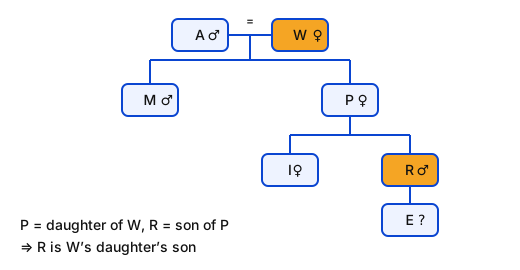
- W # A: W is wife of A. A ÷ M: A is father of M. M − P: M is brother of P ⇒ P is also a child of A and W.
- P + I: P is mother of I ⇒ P is a daughter of W.
- I × R: I is sister of R; R ÷ E: R is father of E ⇒ R is male, a son of P.
- So R is the son of W's daughter.
Trick: A person who is a "father/mother" in a later step reveals gender – use it to decide son vs daughter.
Answer: (C) Daughter's Son
अवधारणा: श्रृंखला को चरणबद्ध पढ़ें और लिंग सहित वंश-वृक्ष बनाएँ।
- W # A: W, A की पत्नी। A ÷ M: A, M का पिता। M − P: M, P का भाई ⇒ P भी A और W की संतान।
- P + I: P, I की माँ ⇒ P, W की बेटी।
- I × R: I, R की बहन; R ÷ E: R, E का पिता ⇒ R पुरुष, P का बेटा।
- अतः R, W की बेटी का बेटा।
ट्रिक: जो आगे चलकर "पिता/माता" बनता है उससे लिंग पता चलता है – इसी से बेटा/बेटी तय करें।
उत्तर: (C) बेटी का बेटा (Daughter's Son)
RRB NTPC Graduate CBT 1General Intelligence and ReasoningBlood RelationsRRB NTPC Graduate CBT 1 2025 · 25 Mar Shift 2
Q130.Refer to the following number and symbol series and answer the question. Counting to be done from left to right only. (All numbers are single-digit numbers only.)
(Left) 6 2 @ # & * % ~ 7 = Ω 1 8 ? £ $ 4 3 5 + 9 (Right)
How many such symbols are there, each of which is immediately preceded by a number and also immediately followed by another number?
निम्नलिखित संख्या और प्रतीक शृंखला को देखिए और प्रश्न का उत्तर दीजिए। गिनती केवल बाएँ से दाएँ की जानी है। (सभी संख्याएँ केवल एक-अंकीय संख्याएँ हैं।)
(बाएँ) 6 2 @ # & * % ~ 7 = Ω 1 8 ? £ $ 4 3 5 + 9 (दाएँ)
ऐसे कितने प्रतीक हैं, जिनमें से प्रत्येक के ठीक पहले एक संख्या है और ठीक बाद भी एक अन्य संख्या है?
- AOneएक
- BThreeतीन
- CNoneकोई नहीं
- DTwoदो
Show answer
Concept: We need the pattern number – symbol – number. Check each symbol's left and right neighbours.
- Symbols and neighbours: @ (2, #), = (7, Ω), Ω (=, 1), ? (8, £), $ (£, 4), + (5, 9).
- Only "+" has numbers on both sides (5 + 9).
Trick: Scan only the symbols that sit between two digits – most are flanked by other symbols and can be skipped.
Answer: (A) One
अवधारणा: पैटर्न चाहिए: अंक – प्रतीक – अंक। हर प्रतीक के बाएँ-दाएँ पड़ोसी देखें।
- प्रतीक और पड़ोसी: @ (2, #), = (7, Ω), Ω (=, 1), ? (8, £), $ (£, 4), + (5, 9)।
- केवल "+" के दोनों ओर अंक हैं (5 + 9)।
ट्रिक: केवल उन्हीं प्रतीकों को देखें जो दो अंकों के बीच हैं – बाकी प्रतीकों के पास प्रतीक ही हैं, छोड़ दें।
उत्तर: (A) एक
RRB NTPC Graduate CBT 1General Intelligence and ReasoningNumber-Symbol SeriesRRB NTPC Graduate CBT 1 2025 · 25 Mar Shift 2
Q131.Each of F, G, H, I, M, N and O has an exam on a different day of a week starting from Monday and ending on Sunday of the same week. Only three people have exams between I and O. O has exam on the last day of the week. Only one person has exam between F and H. N has exam immediately the day before M. G doesn't have exam on Friday. How many people have exam(s) between G and N?
F, G, H, I, M, N और O में से प्रत्येक की परीक्षा एक ही सप्ताह के सोमवार से शुरू होकर रविवार को समाप्त होने वाले अलग-अलग दिन है। I और O के बीच केवल तीन व्यक्तियों की परीक्षा है। O की परीक्षा सप्ताह के अंतिम दिन है। F और H के बीच केवल एक व्यक्ति की परीक्षा है। N की परीक्षा M से ठीक एक दिन पहले है। G की परीक्षा शुक्रवार को नहीं है। G और N के बीच कितने व्यक्तियों की परीक्षा है?
- AFourचार
- BThreeतीन
- CTwoदो
- DOneएक
Show answer
Concept: Place the fixed person first, then test the rigid pairs (N just before M; one person between F and H) against the remaining days.
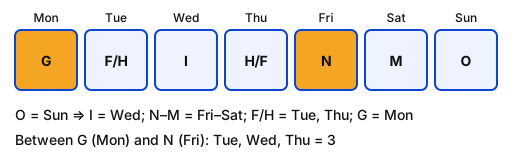
- O = Sunday; three between I and O ⇒ I = Wednesday.
- Free days: Mon, Tue, Thu, Fri, Sat. N–M consecutive: Mon–Tue, Thu–Fri or Fri–Sat.
- Only Fri–Sat works, leaving Tue/Thu for F and H (one gap) and Mon for G (G is not on Friday).
- Between G (Mon) and N (Fri): Tue, Wed, Thu ⇒ three.
Trick: Eliminate cases quickly: Mon–Tue for N–M forces G on Friday (not allowed); Thu–Fri leaves no slot with one gap for F–H.
Answer: (B) Three
अवधारणा: पहले निश्चित व्यक्ति रखें, फिर कठोर जोड़ियों (N ठीक M से पहले; F–H के बीच एक व्यक्ति) को बचे दिनों में जाँचें।
- O = रविवार; I और O के बीच तीन ⇒ I = बुधवार।
- खाली दिन: सोम, मंगल, गुरु, शुक्र, शनि। N–M लगातार: सोम–मंगल, गुरु–शुक्र या शुक्र–शनि।
- केवल शुक्र–शनि संभव; F, H मंगल/गुरु (बीच में एक) और G सोमवार (G शुक्रवार को नहीं)।
- G (सोम) और N (शुक्र) के बीच: मंगल, बुध, गुरु ⇒ तीन।
ट्रिक: केस जल्दी काटें: N–M सोम–मंगल से G शुक्रवार पर आता है (मना है); गुरु–शुक्र में F–H के लिए एक-अंतर वाली जगह नहीं बचती।
उत्तर: (B) तीन
RRB NTPC Graduate CBT 1General Intelligence and ReasoningDay Scheduling PuzzleRRB NTPC Graduate CBT 1 2025 · 25 Mar Shift 2
Q132.Seven people, C, D, E, N, O, P and Q, are sitting in a straight line, facing north. E sits second to the right of N. Only two people sit between E and P. Only two people sit to the left of N. Only three people sit between N and C. O sits at some place to the right of Q but at some place to the left of D. How many people sit to the right of O?
सात व्यक्ति, C, D, E, N, O, P और Q, एक सीधी पंक्ति में उत्तर की ओर मुख करके बैठे हैं। E, N के दाएँ दूसरे स्थान पर बैठा है। E और P के बीच केवल दो व्यक्ति बैठे हैं। N के बाएँ केवल दो व्यक्ति बैठे हैं। N और C के बीच केवल तीन व्यक्ति बैठे हैं। O, Q के दाएँ किसी स्थान पर, लेकिन D के बाएँ किसी स्थान पर बैठा है। O के दाएँ कितने व्यक्ति बैठे हैं?
- ATwoदो
- BThreeतीन
- COneएक
- DFourचार
Show answer
Concept: Number the seats 1–7 from left to right; for people facing north, "right" means a higher number.
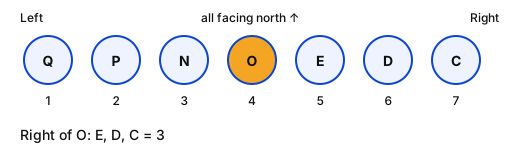
- Two people left of N ⇒ N = 3; E second to the right ⇒ E = 5.
- Two between E and P ⇒ P = 2; three between N and C ⇒ C = 7.
- Remaining seats 1, 4, 6 for Q, O, D with Q left of O left of D ⇒ Q = 1, O = 4, D = 6.
- To the right of O: E, D, C ⇒ three.
Trick: Start with the clue that fixes an absolute position ("only two sit to the left of N") – it anchors everything.
Answer: (B) Three
अवधारणा: बाएँ से दाएँ सीटें 1–7 मानें; उत्तर की ओर मुख होने पर "दाएँ" का अर्थ बड़ी संख्या।
- N के बाएँ दो ⇒ N = 3; E, N के दाएँ दूसरा ⇒ E = 5।
- E और P के बीच दो ⇒ P = 2; N और C के बीच तीन ⇒ C = 7।
- बची सीटें 1, 4, 6 पर Q, O, D (Q बाएँ, फिर O, फिर D) ⇒ Q = 1, O = 4, D = 6।
- O के दाएँ: E, D, C ⇒ तीन।
ट्रिक: उस संकेत से शुरू करें जो निश्चित स्थान देता है ("N के बाएँ केवल दो") – वही पूरी व्यवस्था का आधार बनता है।
उत्तर: (B) तीन
RRB NTPC Graduate CBT 1General Intelligence and ReasoningLinear Seating ArrangementRRB NTPC Graduate CBT 1 2025 · 25 Mar Shift 2
Q133.WELD is related to YHPI in a certain way based on the English alphabetical order. In the same way, AKTN is related to CNXS. To which of the following is EQBX related, following the same logic?
अंग्रेज़ी वर्णमाला क्रम के आधार पर WELD एक निश्चित प्रकार से YHPI से संबंधित है। उसी प्रकार, AKTN, CNXS से संबंधित है। उसी तर्क का अनुसरण करते हुए, EQBX निम्नलिखित में से किससे संबंधित है?
- AFUDB
- BHSED
- CGUED
- DGTFC
Show answer
Concept: Find the shift applied to each letter position in the given pairs.
- WELD → YHPI: W+2=Y, E+3=H, L+4=P, D+5=I. AKTN → CNXS: +2, +3, +4, +5 as well.
- EQBX: E+2=G, Q+3=T, B+4=F, X+5=C (X→Y→Z→A→B→C).
- Result: GTFC.
Trick: Pattern +2, +3, +4, +5; remember the wrap-around after Z.
Answer: (D) GTFC
अवधारणा: दी गई जोड़ियों में हर अक्षर-स्थान पर लगा शिफ्ट पहचानें।
- WELD → YHPI: W+2=Y, E+3=H, L+4=P, D+5=I। AKTN → CNXS में भी +2, +3, +4, +5।
- EQBX: E+2=G, Q+3=T, B+4=F, X+5=C (X→Y→Z→A→B→C)।
- परिणाम: GTFC।
ट्रिक: पैटर्न +2, +3, +4, +5; Z के बाद A से फिर गिनना याद रखें।
उत्तर: (D) GTFC
RRB NTPC Graduate CBT 1General Intelligence and ReasoningLetter AnalogyRRB NTPC Graduate CBT 1 2025 · 25 Mar Shift 2
Q134.Which of the following letter-clusters should replace # and % so that the pattern and relationship followed between the letter-cluster pair on the left side of :: is the same as that on the right side of :: ?
# : NXF :: JTB : %
निम्नलिखित में से किन अक्षर-समूहों को # और % के स्थान पर रखा जाना चाहिए ताकि :: के बाईं ओर के अक्षर-समूह युग्म के बीच का पैटर्न और संबंध :: के दाईं ओर के युग्म के समान हो?
# : NXF :: JTB : %
- A# = CMU % = UEN
- B# = CNU % = UEM
- C# = DMU % = UEM
- D# = CMU % = UEM
Show answer
Concept: The same rule must turn # into NXF and JTB into %. Test the options for a uniform letter shift.
- Option D: CMU → NXF: C+11=N, M+11=X, U+11=F (U→F wraps past Z). ✓
- Apply +11 to JTB: J+11=U, T+11=E, B+11=M ⇒ UEM. ✓
- Other options break the uniform +11 (e.g. CNU gives NYF; UEN needs B+12).
Trick: Check the known half (JTB → UEM or UEN) first; +11 on B gives M, which eliminates options A and C instantly.
Answer: (D) # = CMU, % = UEM
अवधारणा: एक ही नियम से # → NXF और JTB → % बनना चाहिए। विकल्पों में समान अक्षर-शिफ्ट जाँचें।
- विकल्प D: CMU → NXF: C+11=N, M+11=X, U+11=F (U→F में Z के बाद A से)। ✓
- JTB पर +11: J+11=U, T+11=E, B+11=M ⇒ UEM। ✓
- अन्य विकल्पों में +11 टूटता है (जैसे CNU से NYF बनता; UEN के लिए B+12 चाहिए)।
ट्रिक: पहले ज्ञात आधा (JTB → UEM या UEN) जाँचें; B+11=M से विकल्प A और C तुरंत कट जाते हैं।
उत्तर: (D) # = CMU, % = UEM
RRB NTPC Graduate CBT 1General Intelligence and ReasoningLetter Cluster AnalogyRRB NTPC Graduate CBT 1 2025 · 25 Mar Shift 2
Q135.Refer to the following letter and symbol series and answer the question that follows. Counting to be done from left to right only.
(Left) S * & € L £ O & £ £ S # T * © M @ Y T $ L £ (Right)
How many such letters are there each of which is immediately preceded by a symbol and also immediately followed by a symbol?
निम्नलिखित अक्षर और प्रतीक शृंखला को देखिए और उसके बाद दिए गए प्रश्न का उत्तर दीजिए। गिनती केवल बाएँ से दाएँ की जानी है।
(बाएँ) S * & € L £ O & £ £ S # T * © M @ Y T $ L £ (दाएँ)
ऐसे कितने अक्षर हैं, जिनमें से प्रत्येक के ठीक पहले एक प्रतीक है और ठीक बाद भी एक प्रतीक है?
- A6
- B7
- C5
- D8
Show answer
Concept: We need letters with a symbol immediately before and after them.
- Letters and neighbours: S(start) ✗, L (€, £) ✓, O (£, &) ✓, S (£, #) ✓, T (#, *) ✓, M (©, @) ✓, Y (@, T) ✗, T (Y, $) ✗, L ($, £) ✓.
- Count .
Trick: Letters standing next to another letter (Y T) or at the ends are rejected at once – check only isolated letters.
Answer: (A) 6
अवधारणा: ऐसे अक्षर चाहिए जिनके ठीक पहले और ठीक बाद प्रतीक हो।
- अक्षर और पड़ोसी: S(शुरू) ✗, L (€, £) ✓, O (£, &) ✓, S (£, #) ✓, T (#, *) ✓, M (©, @) ✓, Y (@, T) ✗, T (Y, $) ✗, L ($, £) ✓।
- गिनती ।
ट्रिक: जो अक्षर किसी दूसरे अक्षर से सटे हैं (Y T) या सिरों पर हैं, वे तुरंत कट जाते हैं – केवल अकेले अक्षर जाँचें।
उत्तर: (A) 6
RRB NTPC Graduate CBT 1General Intelligence and ReasoningLetter-Symbol SeriesRRB NTPC Graduate CBT 1 2025 · 25 Mar Shift 2
Q136.Each of the digits in the number 7834126 is arranged in ascending order from left to right. The position of how many digits will remain unchanged as compared to that in the original number?
संख्या 7834126 के प्रत्येक अंक को बाएँ से दाएँ आरोही क्रम में व्यवस्थित किया जाता है। मूल संख्या की तुलना में कितने अंकों की स्थिति अपरिवर्तित रहेगी?
- AOneएक
- BTwoदो
- CNoneकोई नहीं
- DThreeतीन
Show answer
Concept: Write the ascending order below the original and compare position by position.
- Original: 7 8 3 4 1 2 6; ascending: 1 2 3 4 6 7 8.
- Matches: 3rd place (3 = 3) and 4th place (4 = 4).
- Two digits keep their positions.
Trick: Align the two rows and tick identical columns – do not count by memory.
Answer: (B) Two
अवधारणा: आरोही क्रम को मूल संख्या के नीचे लिखकर स्थान-दर-स्थान तुलना करें।
- मूल: 7 8 3 4 1 2 6; आरोही: 1 2 3 4 6 7 8।
- समान: तीसरा स्थान (3 = 3) और चौथा स्थान (4 = 4)।
- दो अंकों की स्थिति अपरिवर्तित।
ट्रिक: दोनों पंक्तियाँ सीध में लिखें और समान स्तंभों पर टिक लगाएँ – याददाश्त से न गिनें।
उत्तर: (B) दो
RRB NTPC Graduate CBT 1General Intelligence and ReasoningDigit ArrangementRRB NTPC Graduate CBT 1 2025 · 25 Mar Shift 2
Q137.Read the given statements and conclusions carefully. Assuming that the information given in the statements is true, even if it appears to be at variance with commonly known facts, decide which of the given conclusions logically follow(s) from the statements.
Statements:
Some cows are goats.
Some goats are dogs.
All dogs are tigers.
Conclusions:
(I) All dogs are cows.
(II) Some tigers are goats.
दिए गए कथनों और निष्कर्षों को ध्यानपूर्वक पढ़िए। यह मानते हुए कि कथनों में दी गई जानकारी सत्य है, भले ही वह सामान्यतः ज्ञात तथ्यों से भिन्न प्रतीत होती हो, निर्णय कीजिए कि दिए गए निष्कर्षों में से कौन-सा/से कथनों से तार्किक रूप से अनुसरण करता/करते है/हैं।
कथन:
कुछ गायें, बकरियाँ हैं।
कुछ बकरियाँ, कुत्ते हैं।
सभी कुत्ते, बाघ हैं।
निष्कर्ष:
(I) सभी कुत्ते, गायें हैं।
(II) कुछ बाघ, बकरियाँ हैं।
- AOnly conclusion (I) followsकेवल निष्कर्ष (I) अनुसरण करता है
- BNeither conclusion (I) nor (II) followsन तो निष्कर्ष (I) और न ही (II) अनुसरण करता है
- COnly conclusion (II) followsकेवल निष्कर्ष (II) अनुसरण करता है
- DBoth conclusions (I) and (II) followनिष्कर्ष (I) और (II) दोनों अनुसरण करते हैं
Show answer
Concept: Draw the Venn diagram; "some" statements give only overlaps, "all" puts one set inside another.
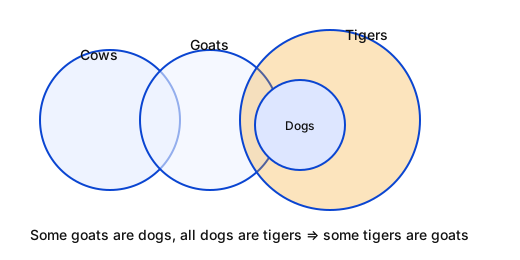
- Goats overlap dogs, and every dog is a tiger ⇒ the goat-dog part lies inside tigers ⇒ some tigers are goats. Conclusion II follows.
- "All dogs are cows" is not forced – dogs need not touch cows at all. Conclusion I does not follow.
Trick: Some A are B + All B are C ⇒ Some A are C (and its converse Some C are A) always holds.
Answer: (C) Only conclusion (II) follows
अवधारणा: वेन आरेख बनाएँ; "कुछ" कथन केवल ओवरलैप देते हैं, "सभी" एक समूह को दूसरे के अंदर रखता है।
- Goats और dogs में ओवरलैप है, और हर dog tiger है ⇒ goat-dog वाला भाग tigers के अंदर ⇒ कुछ tigers goats हैं। निष्कर्ष II सही।
- "सभी dogs cows हैं" ज़रूरी नहीं – dogs का cows से कोई संबंध न भी हो। निष्कर्ष I नहीं निकलता।
ट्रिक: Some A are B + All B are C ⇒ Some A are C (और इसका विलोम Some C are A) सदैव सत्य।
उत्तर: (C) केवल निष्कर्ष (II)
RRB NTPC Graduate CBT 1General Intelligence and ReasoningSyllogismRRB NTPC Graduate CBT 1 2025 · 25 Mar Shift 2
Q138.Below are given two sets of numbers. In each set of numbers, a certain mathematical operation on the first number results in the second number. Similarly, certain
mathematical operations on the second number results in the third number and so on. Which of the given options follows the same set of operations as in question? (NOTE – A two/three-digit number cannot be broken into individual digits for operations, e.g., if 37 is followed by 10, the operation cannot be 3+7 as a two-digit number cannot be broken into individual digits.)
12 – 24 – 44 – 74; 18 – 36 – 56 – 86
नीचे संख्याओं के दो समुच्चय दिए गए हैं। संख्याओं के प्रत्येक समुच्चय में, पहली संख्या पर एक निश्चित गणितीय संक्रिया करने से दूसरी संख्या प्राप्त होती है। इसी प्रकार, दूसरी संख्या पर निश्चित
गणितीय संक्रियाएँ करने से तीसरी संख्या प्राप्त होती है, और इसी प्रकार आगे। दिए गए विकल्पों में से कौन-सा प्रश्न के समान संक्रियाओं के समुच्चय का अनुसरण करता है? (नोट – संक्रियाओं के लिए दो/तीन-अंकीय संख्या को उसके अलग-अलग अंकों में विभाजित नहीं किया जा सकता, उदाहरण के लिए, यदि 37 के बाद 10 आता है, तो संक्रिया 3+7 नहीं हो सकती, क्योंकि दो-अंकीय संख्या को अलग-अलग अंकों में विभाजित नहीं किया जा सकता।)
12 – 24 – 44 – 74; 18 – 36 – 56 – 86
- A17 – 34 – 44 – 74
- B10 – 20 – 40 – 80
- C8 – 24 – 44 – 74
- D15 – 30 – 50 – 80
Show answer
Concept: Find the chain of operations in the given sets and apply the same chain to each option.
- and .
- Rule: .
- Option (D): ✓. (A) but ; (B) but ; (C) .
Trick: Check the first step () – it alone eliminates (C); then check the last step.
Answer: (D) 15 – 30 – 50 – 80
अवधारणा: दिए गए समूहों में संक्रियाओं की शृंखला पहचानें और हर विकल्प पर वही लागू करें।
- तथा ।
- नियम: ।
- विकल्प (D): ✓। (A) में ; (B) में ; (C) में ।
ट्रिक: पहला चरण () जाँचते ही (C) कट जाता है; फिर अंतिम चरण देखें।
उत्तर: (D) 15 – 30 – 50 – 80
RRB NTPC Graduate CBT 1General Intelligence and ReasoningNumber series (operations)RRB NTPC Graduate CBT 1 2025 · 25 Mar Shift 2
Q139.Which of the following letter-number clusters will replace the question mark (?) in the given series to make it logically complete?
LJL 62 IGI 54 FDF 46 CAC 38 ?
निम्नलिखित में से कौन-सा अक्षर-संख्या समूह दी गई शृंखला में प्रश्नचिह्न (?) के स्थान पर आकर उसे तार्किक रूप से पूर्ण करेगा?
LJL 62 IGI 54 FDF 46 CAC 38 ?
- AZXZ 30
- BZYY 30
- CZWY 29
- DZHQ 29
Show answer
Concept: Treat the letters and the number as two separate series.
- Letters: L(12) J(10) L(12) → I(9) G(7) I(9) → F(6) D(4) F(6) → C(3) A(1) C(3): every letter moves back by 3.
- Next: C − 3 = Z(26), A − 3 = X(24), C − 3 = Z → ZXZ.
- Numbers: 62, 54, 46, 38 decrease by 8 → 38 − 8 = 30.
Trick: Going below A wraps around: A−1 = Z, A−2 = Y, A−3 = X.
Answer: (A) ZXZ 30
अवधारणा: अक्षरों और संख्या को दो अलग श्रृंखलाओं की तरह देखें।
- अक्षर: L(12) J(10) L(12) → I(9) G(7) I(9) → F(6) D(4) F(6) → C(3) A(1) C(3): हर अक्षर 3 पीछे जाता है।
- अगला: C − 3 = Z(26), A − 3 = X(24), C − 3 = Z → ZXZ।
- संख्याएँ: 62, 54, 46, 38 में हर बार 8 घटता है → 38 − 8 = 30।
ट्रिक: A से पीछे जाने पर घूमकर Z पर आते हैं: A−1 = Z, A−2 = Y, A−3 = X।
उत्तर: (A) ZXZ 30
RRB NTPC Graduate CBT 1General Intelligence and ReasoningLetter-number seriesRRB NTPC Graduate CBT 1 2025 · 25 Mar Shift 2
Q140.In a certain code language, ' OENI' is coded as '79' and 'WASR' is coded as '61' . What is the code for 'QJTD' in the given code language?
एक निश्चित कूट भाषा में, 'OENI' को '79' के रूप में और 'WASR' को '61' के रूप में कूटबद्ध किया जाता है। उसी कूट भाषा में 'QJTD' का कूट क्या है?
- A78
- B62
- C66
- D71
Show answer
Concept: Use the opposite-letter (reverse) values: A = 26, B = 25, …, Z = 1. Code = sum of reverse values + 14.
- OENI: O = 12, E = 22, N = 13, I = 18 → sum 65; ✓.
- WASR: W = 4, A = 26, S = 8, R = 9 → sum 47; ✓.
- QJTD: Q = 10, J = 17, T = 7, D = 23 → sum 57; .
Trick: Reverse value = 27 − forward value. Equivalently, code = 122 − (sum of forward values): .
Answer: (D) 71
अवधारणा: विपरीत (reverse) अक्षर मान लें: A = 26, B = 25, …, Z = 1। कोड = विपरीत मानों का योग + 14।
- OENI: O = 12, E = 22, N = 13, I = 18 → योग 65; ✓।
- WASR: W = 4, A = 26, S = 8, R = 9 → योग 47; ✓।
- QJTD: Q = 10, J = 17, T = 7, D = 23 → योग 57; ।
ट्रिक: विपरीत मान = 27 − सीधा मान। यानी कोड = 122 − (सीधे मानों का योग): ।
उत्तर: (D) 71
RRB NTPC Graduate CBT 1General Intelligence and ReasoningCoding–decoding (letter values)RRB NTPC Graduate CBT 1 2025 · 25 Mar Shift 2

