Q141.Mansi and Neha started a partnership business, investing some amount in the ratio of 7 : 9. Utsavi joined then after six months with an amount equal to that of Neha. In what ratio should the profit at the end of one year be distributed among Mansi, Neha and Utsavi?
मानसी और नेहा ने 7 : 9 के अनुपात में कुछ राशि निवेश करके एक साझेदारी व्यापार शुरू किया। उत्सवी छह महीने बाद नेहा के बराबर राशि के साथ उनके साथ शामिल हुई। एक वर्ष के अंत में लाभ को मानसी, नेहा और उत्सवी के बीच किस अनुपात में वितरित किया जाना चाहिए?
- A18 : 19 : 10
- B13 : 14 : 8
- C14 : 18 : 9
- D12 : 17 : 8
Show answer
Concept: Profit ratio = (investment × months) for each partner.
- Mansi: ; Neha: .
- Utsavi joins after 6 months with : .
- Ratio (dividing by 6).
Trick: Half the time with the same amount as Neha → Utsavi gets exactly half of Neha's share ().
Answer: (C)
अवधारणा: लाभ का अनुपात = प्रत्येक साझेदार का (निवेश × महीने)।
- मानसी: ; नेहा: ।
- उत्सवी 6 महीने बाद के साथ जुड़ी: ।
- अनुपात ।
ट्रिक: नेहा जितनी राशि आधे समय के लिए → उत्सवी का हिस्सा नेहा का ठीक आधा ()।
उत्तर: (C)
RRB NTPC Graduate CBT 1MathematicsPartnership – time-weighted ratioRRB NTPC Graduate CBT 1 2025 · 25 Mar Shift 2
Q142.The price of fuel decreases by 30%, 20% and 50% in three successive months, but increases by 40% in the fourth month. What is the percentage increase or decrease in the price of fuel in the fourth month as compared to its original price?
ईंधन की कीमत तीन क्रमागत महीनों में 30%, 20% और 50% घटती है, लेकिन चौथे महीने में 40% बढ़ जाती है। चौथे महीने में ईंधन की कीमत में उसकी मूल कीमत की तुलना में प्रतिशत वृद्धि या कमी क्या है?
- ADecrease by 57.2%57.2% की कमी
- BDecrease by 60.8%60.8% की कमी
- CIncrease by 55.4%55.4% की वृद्धि
- DIncrease by 63.2%63.2% की वृद्धि
Show answer
Concept: Successive changes multiply: final .
- Let original price .
- After : .
- ; ; → price .
- Change decrease.
Trick: Work with 100 and multiply decimals; a final value below 100 means a decrease.
Answer: (B) Decrease by
अवधारणा: क्रमिक परिवर्तन गुणा होते हैं: अंतिम ।
- मूल कीमत मानें।
- के बाद: ।
- ; ; → कीमत ।
- परिवर्तन कमी।
ट्रिक: 100 मानकर दशमलव गुणा करें; 100 से कम अंतिम मान = कमी।
उत्तर: (B) की कमी
RRB NTPC Graduate CBT 1MathematicsSuccessive percentage changeRRB NTPC Graduate CBT 1 2025 · 25 Mar Shift 2
Q143.For what values of ‘k’ will the value of (12x2 – kx + 27) be always positive?
‘k’ के किन मानों के लिए (12x2 – kx + 27) का मान सदैव धनात्मक होगा?
- A–36 < k < 36
- Bk < –36
- C–36 ≤ k ≤ 36
- Dk > 36
Show answer
Concept: for all when and discriminant .
- Here , , .
- .
- (strict, since would allow the value 0, which is not positive).
Trick: – recognise the perfect square.
Answer: (A)
अवधारणा: सभी के लिए तब, जब और विविक्तकर (discriminant) ।
- यहाँ , , ।
- ।
- (बराबर नहीं, क्योंकि पर मान 0 हो सकता है जो धनात्मक नहीं)।
ट्रिक: – पूर्ण वर्ग पहचानें।
उत्तर: (A)
RRB NTPC Graduate CBT 1MathematicsQuadratic – always positiveRRB NTPC Graduate CBT 1 2025 · 25 Mar Shift 2
Q144.What is the value of
, if the mean of the following distribution is 50?
| Class | 0–20 | 20–40 | 40–60 | 60–80 | 80–100 | Total |
|---|
| Frequency | 8 | 18 | x | 2 | y | 52 |
|---|
यदि निम्नलिखित बंटन का माध्य 50 है, तो
का मान क्या है?
| वर्ग | 0–20 | 20–40 | 40–60 | 60–80 | 80–100 | कुल |
|---|
| बारंबारता | 8 | 18 | x | 2 | y | 52 |
|---|
- A184
- B193
- C166
- D191
Show answer
Concept: Mean with = class mid-points (10, 30, 50, 70, 90).
- Frequencies: .
- .
- Put : .
- .
Trick: Using assumed mean 50, deviations : directly.
Answer: (A) 184
अवधारणा: माध्य , जहाँ = वर्ग मध्य-बिंदु (10, 30, 50, 70, 90)।
- बारंबारताएँ: ।
- ।
- रखें: ।
- ।
ट्रिक: कल्पित माध्य 50 लेकर विचलन : सीधे।
उत्तर: (A) 184
RRB NTPC Graduate CBT 1MathematicsStatistics – mean of grouped dataRRB NTPC Graduate CBT 1 2025 · 25 Mar Shift 2
Q145.Veer has ₹1404 with him. He divides this amount between his two sons, Nitin and Pravin, and asks them to invest their respective shares at a compound interest rate of 8% per annum, compounded annually. It is observed that Nitin’s investment amounts to the same value after 19 years as Pravin’s investment does after 20 years. How much (in ₹) did Veer give to Pravin?
वीर के पास ₹1404 हैं। वह इस राशि को अपने दो पुत्रों, नितिन और प्रवीण, के बीच बाँटता है और उन्हें अपने-अपने हिस्से को 8% वार्षिक चक्रवृद्धि ब्याज की दर पर, वार्षिक रूप से संयोजित, निवेश करने के लिए कहता है। यह देखा गया कि नितिन का निवेश 19 वर्षों के बाद उतनी ही राशि हो जाता है, जितनी प्रवीण का निवेश 20 वर्षों के बाद होता है। वीर ने प्रवीण को कितनी राशि (₹ में) दी?
- A675
- B525
- C829
- D729
Show answer
Concept: If for years and for years give equal amounts at rate , then .
- .
- Total parts 1 part .
- Pravin's share (Nitin gets ).
Trick: One extra year at 8% → ratio ; the one invested longer gets the smaller share.
Answer: (A) 675
अवधारणा: यदि को वर्ष और को वर्ष में दर पर समान मिश्रधन मिले, तो ।
- ।
- कुल भाग 1 भाग ।
- प्रवीण का हिस्सा (नितिन को )।
ट्रिक: 8% पर एक वर्ष अधिक → अनुपात ; जो अधिक समय निवेश करता है उसे छोटा हिस्सा।
उत्तर: (A) 675
RRB NTPC Graduate CBT 1MathematicsCompound interest – equal amountsRRB NTPC Graduate CBT 1 2025 · 25 Mar Shift 2
Q146.Evaluate: 16 + 20 ÷ 5 - 2 × 4
मान ज्ञात कीजिए: 16 + 20 ÷ 5 - 2 × 4
- A11
- B15
- C12
- D14
Show answer
Concept: Division and multiplication before addition and subtraction (BODMAS).
- and .
- .
Trick: Never work left to right blindly – first would be wrong.
Answer: (C) 12
अवधारणा: जोड़-घटाव से पहले भाग और गुणा (BODMAS)।
- और ।
- ।
ट्रिक: बाएँ से दाएँ अंधाधुंध न करें – पहले करना ग़लत होगा।
उत्तर: (C) 12
RRB NTPC Graduate CBT 1MathematicsBODMASRRB NTPC Graduate CBT 1 2025 · 25 Mar Shift 2
Q147.What is the fraction equal to in simplest form?
सरलतम रूप में के बराबर भिन्न क्या है?
- A
- B
- C
- D
Show answer
Concept: ; a terminating decimal is written over a power of 10.
- and .
- .
- 59 is prime, so the fraction is already in simplest form.
Trick: Pure recurring → denominator 9s; mixed/terminating → 10s. LCM of 9 and 10 is 90.
Answer: (D)
अवधारणा: ; सांत दशमलव को 10 की घात पर लिखें।
- और ।
- ।
- 59 अभाज्य है, अतः भिन्न पहले से सरलतम रूप में है।
ट्रिक: शुद्ध आवर्ती → हर में 9; सांत → हर में 10। 9 और 10 का LCM 90।
उत्तर: (D)
RRB NTPC Graduate CBT 1MathematicsRecurring decimals to fractionsRRB NTPC Graduate CBT 1 2025 · 25 Mar Shift 2
Q148.In a right-angled triangle, if the lengths of the opposite side and the adjacent side to angle θ are 7 cm and 21 cm, respectively, then what is the value of tanθ?
एक समकोण त्रिभुज में, यदि कोण θ की सम्मुख भुजा और आसन्न भुजा की लंबाइयाँ क्रमशः 7 cm और 21 cm हैं, तो tanθ का मान क्या है?
- A
- B
- C
- D
Show answer
Concept: .
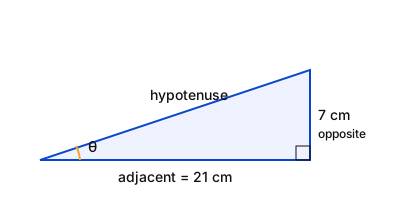
- Opposite side , adjacent side .
- .
Trick: Remember SOH-CAH-TOA: Tan = Opposite over Adjacent – the hypotenuse is not needed.
Answer: (A)
अवधारणा: ।
- लंब (opposite) , आधार (adjacent) ।
- ।
ट्रिक: SOH-CAH-TOA याद रखें: Tan = लंब/आधार – कर्ण की ज़रूरत नहीं।
उत्तर: (A)
RRB NTPC Graduate CBT 1MathematicsTrigonometric ratiosRRB NTPC Graduate CBT 1 2025 · 25 Mar Shift 2
Q149.Simplify:
सरल कीजिए:
- A5.2
- B5.1
- C5.3
- D5
Show answer
Concept: .
- Take . Then – exactly the numbers subtracted in the denominator.
- So the expression .
- .
Trick: Whenever you see cubes with on top and squares with products below, the answer is just .
Answer: (B)
अवधारणा: ।
- लें। तब – हर में घटाई गई संख्याएँ यही हैं।
- अतः व्यंजक ।
- ।
ट्रिक: ऊपर घन और , नीचे वर्ग और गुणनफल दिखें तो उत्तर सीधे ।
उत्तर: (B)
RRB NTPC Graduate CBT 1MathematicsAlgebraic identity a³+b³+c³−3abcRRB NTPC Graduate CBT 1 2025 · 25 Mar Shift 2
Q150.A shopkeeper professes to sell his goods at a 35% loss but uses a false balance and gains 55%. The actual weight (rounded off to one decimal place) he uses instead of 1 kg is:
एक दुकानदार अपना सामान 35% हानि पर बेचने का दावा करता है, लेकिन गलत तराजू का उपयोग करता है और 55% लाभ कमाता है। 1 kg के स्थान पर वह वास्तव में जो भार (एक दशमलव स्थान तक पूर्णांकित) उपयोग करता है, वह है:
- A419.4 gm
- B420.8 gm
- C417.6 gm
- D417.9 gm
Show answer
Concept: With a false weight g used for 1000 g, true cost CP, while the customer pays the professed price.
- Let CP of 1 kg = ₹100. Professing 35% loss, he sells "1 kg" for ₹65.
- He actually gains 55%, so his real cost .
- Cost ₹41.935 corresponds to .
Trick: .
Answer: (A)
अवधारणा: 1000 g की जगह g का बाट प्रयोग करने पर वास्तविक लागत CP, जबकि ग्राहक घोषित मूल्य देता है।
- 1 kg का CP = ₹100 मानें। 35% हानि का दावा → "1 kg" ₹65 में बेचता है।
- वास्तव में 55% लाभ, अतः असली लागत ।
- ₹41.935 लागत के बराबर।
ट्रिक: ।
उत्तर: (A)
RRB NTPC Graduate CBT 1MathematicsDishonest dealer – false weightRRB NTPC Graduate CBT 1 2025 · 25 Mar Shift 2
Q151.The monthly incomes of two friends Tushar and Salil, are in the ratio 6 : 7 respectively and each of them saves ₹66,000 every month. If the ratio of their monthly expenditure is 2 : 4, find the monthly income of Tushar (in ₹).
दो मित्रों तुषार और सलिल की मासिक आय क्रमशः 6 : 7 के अनुपात में है और उनमें से प्रत्येक हर महीने ₹66,000 की बचत करता है। यदि उनके मासिक व्यय का अनुपात 2 : 4 है, तो तुषार की मासिक आय (₹ में) ज्ञात कीजिए।
- A1,10,880
- B79,200
- C78,200
- D80,200
Show answer
Concept: Expenditure = Income − Savings; set up the ratio of expenditures.
- Incomes and ; savings ₹66,000 each.
- .
- .
- Tushar's income .
Trick: Simplify to first; the cross-multiplication then stays small.
Answer: (B) 79,200
अवधारणा: व्यय = आय − बचत; व्ययों का अनुपात बनाएँ।
- आय और ; बचत प्रत्येक ₹66,000।
- ।
- ।
- तुषार की आय ।
ट्रिक: पहले को करें; फिर वज्र-गुणन छोटा रहता है।
उत्तर: (B) 79,200
RRB NTPC Graduate CBT 1MathematicsRatio – income, expenditure, savingsRRB NTPC Graduate CBT 1 2025 · 25 Mar Shift 2
Q152.What is the mean of the following distribution?
| Marks | 11 | 34 | 51 | 62 | 98 |
|---|
| No. of Students | 57 | 23 | 95 | 14 | 96 |
|---|
निम्नलिखित बंटन (distribution) का माध्य क्या है?
| अंक | 11 | 34 | 51 | 62 | 98 |
|---|
| विद्यार्थियों की संख्या | 57 | 23 | 95 | 14 | 96 |
|---|
- A64
- B79
- C58
- D44
Show answer
Concept: .
- .
- .
- Mean .
Trick: – check the division by multiplying back.
Answer: (C) 58
अवधारणा: ।
- ।
- ।
- माध्य ।
ट्रिक: – भाग की जाँच गुणा करके करें।
उत्तर: (C) 58
RRB NTPC Graduate CBT 1MathematicsMean of a frequency distributionRRB NTPC Graduate CBT 1 2025 · 25 Mar Shift 1
Q153.If the standard deviation of 11, 13, 15, 17,...., 71 is m, then find the integral part of m.
यदि 11, 13, 15, 17,...., 71 का मानक विचलन (standard deviation) m है, तो m का पूर्णांक भाग ज्ञात कीजिए।
- A16
- B13
- C17
- D18
Show answer
Concept: For an AP of terms with common difference , variance .
- : , .
- Variance .
- (since ). Integral part .
Trick: SD of the first natural numbers is ; multiply by for any AP – shifting the terms does not change SD.
Answer: (C) 17
अवधारणा: पदों और सार्व अंतर वाली समांतर श्रेणी (AP) का प्रसरण ।
- : , ।
- प्रसरण ।
- (क्योंकि )। पूर्णांक भाग ।
ट्रिक: पहली प्राकृत संख्याओं का SD है; किसी भी AP के लिए इसे से गुणा करें – पदों को खिसकाने से SD नहीं बदलता।
उत्तर: (C) 17
RRB NTPC Graduate CBT 1MathematicsStandard deviation of an APRRB NTPC Graduate CBT 1 2025 · 25 Mar Shift 1
Q154.A train of length 120 m travelling at 60 km/hr crosses another train travelling in the same direction at 24 km/hr in 30 seconds. What is the length (in m) of another train?
60 km/hr की चाल से चल रही 120 m लंबी एक ट्रेन, उसी दिशा में 24 km/hr की चाल से चल रही दूसरी ट्रेन को 30 सेकंड में पार करती है। दूसरी ट्रेन की लंबाई (m में) क्या है?
- A250
- B200
- C225
- D180
Show answer
Concept: Same direction → relative speed = difference of speeds; distance covered = sum of lengths.
- Relative speed .
- Distance in 30 s .
- Other train .
Trick: km/h → m/s: multiply by ; 36 km/h is exactly 10 m/s.
Answer: (D) 180
अवधारणा: समान दिशा → सापेक्ष चाल = चालों का अंतर; तय दूरी = लंबाइयों का योग।
- सापेक्ष चाल ।
- 30 s में दूरी ।
- दूसरी रेलगाड़ी ।
ट्रिक: km/h → m/s: से गुणा करें; 36 km/h ठीक 10 m/s है।
उत्तर: (D) 180
RRB NTPC Graduate CBT 1MathematicsTrains – same directionRRB NTPC Graduate CBT 1 2025 · 25 Mar Shift 1
Q155.Harishika bought an article for ₹200 and sold it to Ritu at a loss of 30%. With this amount, Harishika bought another article and sold it at a gain of 75%. What is Harishika's overall gain percentage?
हरिशिका ने एक वस्तु ₹200 में खरीदी और उसे 30% की हानि पर रितु को बेच दिया। इस राशि से हरिशिका ने एक अन्य वस्तु खरीदी और उसे 75% के लाभ पर बेच दिया। हरिशिका का कुल लाभ प्रतिशत क्या है?
- A17.5%
- B19.4%
- C22.5%
- D24.5%
Show answer
Concept: Track the actual money: total investment is ₹200 (the second purchase is made from the first sale's money).
- Sale 1: (loss 30%).
- Second article bought for ₹140, sold at 75% gain: .
- Overall gain on ₹200 .
Trick: Successive % formula: .
Answer: (C) 22.5%
अवधारणा: वास्तविक धन पर नज़र रखें: कुल निवेश ₹200 है (दूसरी खरीद पहली बिक्री के पैसे से होती है)।
- बिक्री 1: (30% हानि)।
- दूसरी वस्तु ₹140 में खरीदी, 75% लाभ पर बेची: ।
- कुल लाभ , ₹200 पर ।
ट्रिक: क्रमिक % सूत्र: ।
उत्तर: (C) 22.5%
RRB NTPC Graduate CBT 1MathematicsSuccessive profit and lossRRB NTPC Graduate CBT 1 2025 · 25 Mar Shift 1
Q156.The population of a village was 2,90,000. It increased by 10% in the first year and increased by 30% in the second year. Its population after two years is _______.
एक गाँव की जनसंख्या 2,90,000 थी। पहले वर्ष में इसमें 10% की वृद्धि हुई और दूसरे वर्ष में 30% की वृद्धि हुई। दो वर्षों के बाद इसकी जनसंख्या _______ है।
- A3,19,000
- B3,77,000
- C4,14,700
- D4,06,000
Show answer
Concept: Successive increases multiply: .
- After year 1: .
- After year 2: .
Trick: Net % ; .
Answer: (C) 4,14,700
अवधारणा: क्रमिक वृद्धियाँ गुणा होती हैं: ।
- पहले वर्ष बाद: ।
- दूसरे वर्ष बाद: ।
ट्रिक: शुद्ध % ; ।
उत्तर: (C) 4,14,700
RRB NTPC Graduate CBT 1MathematicsSuccessive percentage increaseRRB NTPC Graduate CBT 1 2025 · 25 Mar Shift 1
Q157.The average of 7 numbers is 47. If each number is decreased by 7, what will the new average be?
7 संख्याओं का औसत 47 है। यदि प्रत्येक संख्या में 7 की कमी कर दी जाए, तो नया औसत क्या होगा?
- A33
- B40
- C7
- D47
Show answer
Concept: If every observation changes by the same amount , the average changes by exactly .
- Each of the 7 numbers decreases by 7, so the total decreases by .
- New average .
Trick: Add/subtract to all → average shifts by the same; multiply all → average multiplies by the same.
Answer: (B) 40
अवधारणा: यदि हर प्रेक्षण में समान राशि का परिवर्तन हो, तो औसत में ठीक का परिवर्तन होता है।
- 7 संख्याओं में प्रत्येक 7 घटती है, अतः योग घटता है।
- नया औसत ।
ट्रिक: सबमें जोड़ें/घटाएँ → औसत उतना ही खिसकता है; सबको गुणा करें → औसत उतने ही गुना।
उत्तर: (B) 40
RRB NTPC Graduate CBT 1MathematicsAverage – shifting all valuesRRB NTPC Graduate CBT 1 2025 · 25 Mar Shift 1
Q158.Evaluate: 16 + 18 ÷ 6 - 3 × 4
मान ज्ञात कीजिए: 16 + 18 ÷ 6 - 3 × 4
- A6
- B9
- C10
- D7
Show answer
Concept: Order of operations: Division and Multiplication first (left to right), then Addition and Subtraction.
- and .
- .
Trick: Never add first – that is the common trap.
Answer: (D) 7
अवधारणा: संक्रियाओं का क्रम: पहले भाग और गुणा (बाएँ से दाएँ), फिर जोड़ और घटाव।
- और ।
- ।
ट्रिक: कभी पहले न जोड़ें – यही आम जाल है।
उत्तर: (D) 7
RRB NTPC Graduate CBT 1MathematicsBODMASRRB NTPC Graduate CBT 1 2025 · 25 Mar Shift 1
Q159.Find the value of .
का मान ज्ञात कीजिए।
- Acos 45°
- Bcos 30°
- Ccos 60°
- Dcos 90°
Show answer
Concept: .
- With : value .
- Direct check: , so .
- .
Trick: (complementary angles) – the options are in cos, so convert.
Answer: (B)
अवधारणा: ।
- पर: मान ।
- सीधी जाँच: , अतः ।
- ।
ट्रिक: (पूरक कोण) – विकल्प cos में हैं, इसलिए बदलें।
उत्तर: (B)
RRB NTPC Graduate CBT 1MathematicsTrigonometric identitiesRRB NTPC Graduate CBT 1 2025 · 25 Mar Shift 1
Q160.Find the value of m, satisfying equation:
समीकरण को संतुष्ट करने वाले m का मान ज्ञात कीजिए:
- A
- B
- C
- D
Show answer
Concept: ; make all bases equal, then equate powers.
- LHS .
- RHS .
- .
Trick: Flipping a fraction flips the sign of its exponent – convert everything to one base before adding powers.
Answer: (B)
अवधारणा: ; सभी आधार समान करें, फिर घातों की तुलना करें।
- LHS ।
- RHS ।
- ।
ट्रिक: भिन्न को उलटने से घात का चिह्न उलट जाता है – घात जोड़ने से पहले सबको एक आधार में लाएँ।
उत्तर: (B)
RRB NTPC Graduate CBT 1MathematicsLaws of indicesRRB NTPC Graduate CBT 1 2025 · 25 Mar Shift 1

