Q1.Based on the English alphabetical order, three of the following four letter cluster pairs are alike in a certain way and thus form a group. Which is the one that does not belong to that group? (Note: The odd man out is not based on the number of
consonants/vowels or their position in the letter cluster)
अंग्रेज़ी वर्णमाला क्रम के आधार पर, निम्नलिखित चार अक्षर-समूह युग्मों में से तीन किसी निश्चित प्रकार से एक समान हैं और इस प्रकार एक समूह बनाते हैं। वह कौन-सा है जो उस समूह से संबंधित नहीं है? (नोट: असंगत युग्म व्यंजनों/स्वरों की संख्या या अक्षर-समूह में उनकी स्थिति पर
आधारित नहीं है)
- ANP-RT
- BKM-OQ
- CIK-MO
- DCE-HJ
Show answer
Concept: Check the gap between corresponding letters of the two clusters.
- NP–RT: N=R, P=T.
- KM–OQ: K=O, M=Q; IK–MO: I=M, K=O.
- CE–HJ: C=H, E=J → different pattern.
Trick: Write positions (N14 P16 → R18 T20) and compare differences quickly.
Answer: (D) CE-HJ
अवधारणा: दोनों समूहों के संगत अक्षरों का अंतर देखें।
- NP–RT: N=R, P=T।
- KM–OQ: K=O, M=Q; IK–MO: I=M, K=O।
- CE–HJ: C=H, E=J → अलग पैटर्न।
ट्रिक: अक्षरों की स्थिति लिखें (N14 P16 → R18 T20) और अंतर तुरंत तुलना करें।
उत्तर: (D) CE-HJ
RRB NTPC Graduate CBT 1General Intelligence and ReasoningLetter Cluster AnalogyRRB NTPC Graduate CBT 1 2025 · 27 Mar Shift 3
Q2.Below are given two sets of numbers. In each set of numbers, a certain mathematical operation on the first number results in the second number. Similarly, a certain mathematical operation on the second number results in the third number, and so on. Which of the given options follows the same set of operations as in the question? (NOTE: A two-/three-digit number cannot be broken into individual digits for operations, e.g. if 37 is followed by 10, the operation cannot be 3 + 7, as a two-digit number cannot be broken into individual digits.)
14 – 196 – 186 – 166 ; 18 – 324 – 314 – 294
नीचे संख्याओं के दो समुच्चय दिए गए हैं। संख्याओं के प्रत्येक समुच्चय में, पहली संख्या पर कोई निश्चित गणितीय संक्रिया करने पर दूसरी संख्या प्राप्त होती है। इसी प्रकार, दूसरी संख्या पर कोई निश्चित गणितीय संक्रिया करने पर तीसरी संख्या प्राप्त होती है, और इसी प्रकार आगे भी। दिए गए विकल्पों में से कौन-सा विकल्प प्रश्न में दी गई संक्रियाओं के समान समुच्चय का अनुसरण करता है? (नोट: संक्रियाओं के लिए दो/तीन अंकों की संख्या को उसके अलग-अलग अंकों में विभाजित नहीं किया जा सकता, उदाहरण के लिए यदि 37 के बाद 10 आता है, तो संक्रिया 3 + 7 नहीं हो सकती, क्योंकि दो अंकों की संख्या को अलग-अलग अंकों में विभाजित नहीं किया जा सकता।)
14 – 196 – 186 – 166 ; 18 – 324 – 314 – 294
- A21 – 441 – 431 – 451
- B16 – 256 – 266 – 246
- C18 – 320 – 330 – 350
- D11 – 121 – 111 – 91
Show answer
Concept: Find the chain of operations in the given sets and test each option.
- ; — same: square, , .
- Option D: , , ✓.
- A: ; B: ; C: — all fail.
Trick: Second number is a perfect square of the first → check squares first.
Answer: (D) 11 – 121 – 111 – 91
अवधारणा: दिए गए सेटों में संक्रियाओं की श्रृंखला पहचानें और हर विकल्प जाँचें।
- ; — वही: वर्ग, , ।
- विकल्प D: , , ✓।
- A: ; B: ; C: — सब गलत।
ट्रिक: दूसरी संख्या पहली का पूर्ण वर्ग है → पहले वर्ग जाँचें।
उत्तर: (D) 11 – 121 – 111 – 91
RRB NTPC Graduate CBT 1General Intelligence and ReasoningNumber Operations SeriesRRB NTPC Graduate CBT 1 2025 · 27 Mar Shift 3
Q3.Seven boxes, A, B, C, D, E, F and G, are kept one over the other but not necessarily in the same order. Only B is kept above C. Only E is kept between C and F. Only A is kept below G. How many boxes are kept between C and G?
सात बक्से A, B, C, D, E, F और G एक के ऊपर एक रखे गए हैं, लेकिन आवश्यक नहीं कि इसी क्रम में हों। केवल B को C के ऊपर रखा गया है। C और F के बीच केवल E रखा गया है। केवल A को G के नीचे रखा गया है। C और G के बीच कितने बक्से रखे गए हैं?
- A4
- B3
- C2
- D1
Show answer
Concept: Fix the extremes first, then fill the middle.
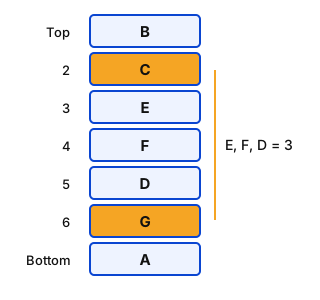
- Only B above C → B is top, C is 2nd. Only A below G → G is 6th, A is bottom.
- Only E between C and F → E 3rd, F 4th; remaining D is 5th.
- Order (top→bottom): B, C, E, F, D, G, A. Between C and G: E, F, D = 3 boxes.
Trick: "Only X is above/below Y" pins both boxes at an end instantly.
Answer: (B) 3
अवधारणा: पहले सिरे तय करें, फिर बीच के स्थान भरें।
- केवल B, C के ऊपर → B सबसे ऊपर, C दूसरा। केवल A, G के नीचे → G छठा, A सबसे नीचे।
- C और F के बीच केवल E → E तीसरा, F चौथा; बचा D पाँचवाँ।
- क्रम (ऊपर→नीचे): B, C, E, F, D, G, A। C और G के बीच: E, F, D = 3 बॉक्स।
ट्रिक: "केवल X, Y के ऊपर/नीचे" दोनों बॉक्स तुरंत सिरे पर फिक्स कर देता है।
उत्तर: (B) 3
RRB NTPC Graduate CBT 1General Intelligence and ReasoningBox ArrangementRRB NTPC Graduate CBT 1 2025 · 27 Mar Shift 3
Q4.Below are given two sets of numbers. In each set of numbers, a certain mathematical operation on the first number results in the second number. Similarly, a certain mathematical operation on the second number results in the third number and so on. Which of the given options follows the same set of operations as in the question? (NOTE – A two/three-digit number cannot be broken into individual digits for
operations. E.g. if 37 is followed by 10, the operation cannot be 3+7 as a two-digit number cannot be broken into individual digits.)
3 – 30 – 150 – 151
9 – 90 – 450 – 451
नीचे संख्याओं के दो समुच्चय दिए गए हैं। संख्याओं के प्रत्येक समुच्चय में, पहली संख्या पर कोई निश्चित गणितीय संक्रिया करने पर दूसरी संख्या प्राप्त होती है। इसी प्रकार, दूसरी संख्या पर कोई निश्चित गणितीय संक्रिया करने पर तीसरी संख्या प्राप्त होती है और इसी प्रकार आगे भी। दिए गए विकल्पों में से कौन-सा विकल्प प्रश्न में दी गई संक्रियाओं के समान समुच्चय का अनुसरण करता है? (नोट – संक्रियाओं के लिए दो/तीन अंकों की संख्या को उसके अलग-अलग अंकों में विभाजित नहीं किया जा
सकता। उदाहरण के लिए, यदि 37 के बाद 10 आता है, तो संक्रिया 3+7 नहीं हो सकती, क्योंकि दो अंकों की संख्या को अलग-अलग अंकों में विभाजित नहीं किया जा सकता।)
3 – 30 – 150 – 151
9 – 90 – 450 – 451
- A6 – 60 – 30 – 150
- B12 – 120 – 600 – 601
- C15 – 150 – 750 – 749
- D8 – 80 – 400 – 40
Show answer
Concept: Identify the operation chain and apply it to each option.
- ; ✓ (×10, ×5, +1).
- Option B: , , ✓.
- A: (÷2); C: (); D: — fail.
Trick: Check the last step (+1) first – only B ends with +1.
Answer: (B) 12 – 120 – 600 – 601
अवधारणा: संक्रिया श्रृंखला पहचानें और हर विकल्प पर लागू करें।
- ; ✓ (×10, ×5, +1)।
- विकल्प B: , , ✓।
- A: (÷2); C: (); D: — गलत।
ट्रिक: अंतिम चरण (+1) पहले जाँचें – केवल B में +1 है।
उत्तर: (B) 12 – 120 – 600 – 601
RRB NTPC Graduate CBT 1General Intelligence and ReasoningNumber Operations SeriesRRB NTPC Graduate CBT 1 2025 · 27 Mar Shift 3
Q5.Read the given statements and conclusions carefully. Assuming that the information given in the statements is true, even if it appears to be at variance with commonly known facts, decide which of the given conclusion(s) logically follow(s) from the statements.
Statements:
All streams are canals. Some canals are rivers. Some rivers are seas.
Conclusions:
(I) Some seas are streams.
(II) Some rivers are streams.
दिए गए कथनों और निष्कर्षों को ध्यानपूर्वक पढ़िए। यह मानते हुए कि कथनों में दी गई जानकारी सत्य है, भले ही वह सामान्यतः ज्ञात तथ्यों से भिन्न प्रतीत होती हो, निर्णय लीजिए कि दिए गए निष्कर्षों में से कौन-सा/से निष्कर्ष कथनों का तार्किक रूप से अनुसरण करता/करते है/हैं।
कथन:
सभी धाराएँ नहरें हैं। कुछ नहरें नदियाँ हैं। कुछ नदियाँ समुद्र हैं।
निष्कर्ष:
(I) कुछ समुद्र धाराएँ हैं।
(II) कुछ नदियाँ धाराएँ हैं।
- AOnly conclusion (I) follows.केवल निष्कर्ष (I) अनुसरण करता है।
- BOnly conclusion (II) follows.केवल निष्कर्ष (II) अनुसरण करता है।
- CNeither conclusion (I) nor (II) follows.न तो निष्कर्ष (I) और न ही (II) अनुसरण करता है।
- DBoth conclusions (I) and (II) follow.निष्कर्ष (I) और (II) दोनों अनुसरण करते हैं।
Show answer
Concept: Draw a Venn diagram; a conclusion follows only if it is true in every possible diagram.
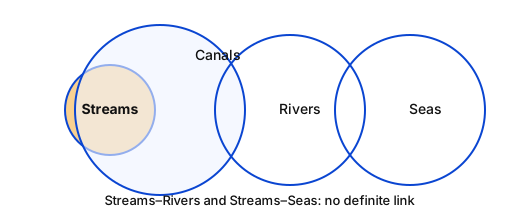
- All streams ⊂ canals; only some canals are rivers – streams may lie entirely in the non-river part of canals.
- So "some rivers are streams" (II) is not definite; seas are linked only through rivers, so "some seas are streams" (I) is not definite either.
Trick: Two "some" statements in a chain never give a definite "some" conclusion across them.
Answer: (C) Neither conclusion (I) nor (II) follows.
अवधारणा: वेन आरेख बनाएँ; निष्कर्ष तभी मान्य है जब वह हर संभव आरेख में सत्य हो।
- सभी streams ⊂ canals; केवल कुछ canals rivers हैं – streams पूरी तरह canals के गैर-river भाग में हो सकते हैं।
- अतः "कुछ rivers, streams हैं" (II) निश्चित नहीं; seas केवल rivers से जुड़े हैं, इसलिए "कुछ seas, streams हैं" (I) भी निश्चित नहीं।
ट्रिक: श्रृंखला में दो "कुछ" कथन कभी पार करके निश्चित "कुछ" निष्कर्ष नहीं देते।
उत्तर: (C) Neither conclusion (I) nor (II) follows.
RRB NTPC Graduate CBT 1General Intelligence and ReasoningSyllogismRRB NTPC Graduate CBT 1 2025 · 27 Mar Shift 3
Q6.SP 12 is related to WT 16 in a certain way. In the same way, MJ 15 is related to QN 19. To which of the following is EB 24 related, following the same logic?
SP 12, WT 16 से एक निश्चित प्रकार से संबंधित है। उसी प्रकार, MJ 15, QN 19 से संबंधित है। समान तर्क का अनुसरण करते हुए, EB 24 निम्नलिखित में से किससे संबंधित है?
- AJF 28
- BJG 29
- CIG 29
- DIF 28
Show answer
Concept: Find how each letter and the number change from the first term to the second.
- SP 12 → WT 16: S=W, P=T, .
- MJ 15 → QN 19: M=Q, J=N, ✓ same rule.
- EB 24 → E=I, B=F, → IF 28.
Trick: Everything shifts by +4 – letters and number alike.
Answer: (D) IF 28
अवधारणा: पहले पद से दूसरे पद तक हर अक्षर और संख्या का परिवर्तन देखें।
- SP 12 → WT 16: S=W, P=T, ।
- MJ 15 → QN 19: M=Q, J=N, ✓ वही नियम।
- EB 24 → E=I, B=F, → IF 28।
ट्रिक: सब कुछ +4 से बढ़ता है – अक्षर भी, संख्या भी।
उत्तर: (D) IF 28
RRB NTPC Graduate CBT 1General Intelligence and ReasoningLetter-Number AnalogyRRB NTPC Graduate CBT 1 2025 · 27 Mar Shift 3
Q7.Refer to the following letter and symbol series and answer the question that follows. Counting to be done from left to right only.
(Left) ? A ? M V R ? F @ D E Q * ? R V M / % * M (Right)
How many such letters are there each of which is immediately preceded by a letter and also immediately followed by a symbol?
निम्नलिखित अक्षर और प्रतीक शृंखला को देखिए और उसके बाद दिए गए प्रश्न का उत्तर दीजिए। गिनती केवल बाएँ से दाएँ की ओर की जानी है।
(बाएँ) ? A ? M V R ? F @ D E Q * ? R V M / % * M (दाएँ)
ऐसे कितने अक्षर हैं, जिनमें से प्रत्येक के ठीक पहले एक अक्षर है और ठीक बाद एक प्रतीक है?
- AOneएक
- BThreeतीन
- CNoneकोई नहीं
- DTwoदो
Show answer
Concept: Look for the pattern letter – LETTER – symbol moving left to right.
- Series: ? A ? M V R ? F @ D E Q * ? R V M / % * M.
- V R ? ✓ ; E Q * ✓ ; V M / ✓.
- F is preceded by a symbol (?), so it does not count. Total = 3.
Trick: First mark every symbol, then check only the letter just before each symbol.
Answer: (B) Three
अवधारणा: बाएँ से दाएँ अक्षर – अक्षर – प्रतीक पैटर्न खोजें।
- श्रृंखला: ? A ? M V R ? F @ D E Q * ? R V M / % * M।
- V R ? ✓ ; E Q * ✓ ; V M / ✓।
- F से पहले प्रतीक (?) है, इसलिए वह नहीं गिना जाएगा। कुल = 3।
ट्रिक: पहले हर प्रतीक चिह्नित करें, फिर केवल उससे ठीक पहले वाला अक्षर जाँचें।
उत्तर: (B) Three
RRB NTPC Graduate CBT 1General Intelligence and ReasoningLetter-Symbol SeriesRRB NTPC Graduate CBT 1 2025 · 27 Mar Shift 3
Q8.In a certain code language,
Q + W means ‘Q is the father of W',
Q @ W means ‘Q is the brother of W',
Q $ W means ‘Q is the mother of W', and
Q # W means ‘Q is the sister of W'.
Based on the above, how is N related to S if ' N @ R + K @ S ’?
एक निश्चित कूट भाषा में,
Q + W का अर्थ है ‘Q, W का पिता है',
Q @ W का अर्थ है ‘Q, W का भाई है',
Q $ W का अर्थ है ‘Q, W की माता है', और
Q # W का अर्थ है ‘Q, W की बहन है'।
उपर्युक्त के आधार पर, यदि ' N @ R + K @ S ’ है, तो N, S से किस प्रकार संबंधित है?
- ASonपुत्र
- BBrother's sonभाई का पुत्र
- CFather's brotherपिता का भाई
- DBrotherभाई
Show answer
Concept: Decode each symbol and build the family tree.
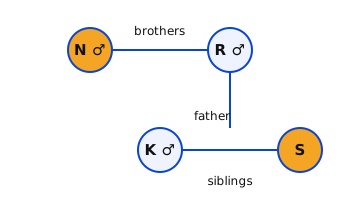
- N @ R → N is brother of R; R + K → R is father of K; K @ S → K is brother of S.
- So R is the father of K and S; N is R's brother.
- N is the father's brother (uncle) of S.
Trick: Brother of the father = "Father's brother" (chacha/tau).
Answer: (C) Father's brother
अवधारणा: हर प्रतीक को डिकोड करके वंश-वृक्ष बनाएँ।
- N @ R → N, R का भाई; R + K → R, K का पिता; K @ S → K, S का भाई।
- अतः R, K और S का पिता है; N, R का भाई है।
- N, S के पिता का भाई (चाचा/ताऊ) है।
ट्रिक: पिता का भाई = "Father's brother" (चाचा/ताऊ)।
उत्तर: (C) Father's brother
RRB NTPC Graduate CBT 1General Intelligence and ReasoningBlood Relations (Coded)RRB NTPC Graduate CBT 1 2025 · 27 Mar Shift 3
Q9.L, M, N, D, E and F live on six different floors of the same building. The lowermost floor in the building is numbered 1, the floor above it is numbered 2 and so on till the topmost floor is numbered 6. M lives on the topmost floor. Only three people live between M and D. N lives on a floor below D. E lives on an even numbered floor. L lives on an odd numbered floor, but not on floor number 5. How many people live between F and D?
L, M, N, D, E और F एक ही इमारत की छह अलग-अलग मंजिलों पर रहते हैं। इमारत की सबसे निचली मंजिल की संख्या 1 है, उसके ऊपर की मंजिल की संख्या 2 है और इसी प्रकार सबसे ऊपरी मंजिल की संख्या 6 है। M सबसे ऊपरी मंजिल पर रहता है। M और D के बीच केवल तीन व्यक्ति रहते हैं। N, D से नीचे की किसी मंजिल पर रहता है। E सम संख्या वाली मंजिल पर रहता है। L विषम संख्या वाली मंजिल पर रहता है, लेकिन मंजिल संख्या 5 पर नहीं। F और D के बीच कितने व्यक्ति रहते हैं?
- AThreeतीन
- BFourचार
- COneएक
- DTwoदो
Show answer
Concept: Place the definite clues first, then use parity (odd/even) clues.
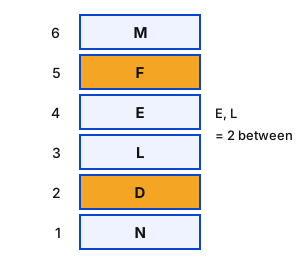
- M on 6; three people between M and D → D on 2; N below D → N on 1.
- E on an even floor → 4 (2 and 6 taken). L odd but not 5 → 3. F gets 5.
- Between F (5) and D (2): floors 3 and 4 → E and L = two people.
Trick: Draw six boxes and strike floors as you fill them.
Answer: (D) Two
अवधारणा: पहले निश्चित सुराग रखें, फिर सम/विषम वाले सुराग प्रयोग करें।
- M छठी मंज़िल पर; M और D के बीच तीन लोग → D दूसरी पर; N, D से नीचे → N पहली पर।
- E सम मंज़िल पर → 4 (2 और 6 भर चुके)। L विषम पर पर 5 नहीं → 3। F को 5 मिली।
- F (5) और D (2) के बीच: मंज़िल 3 और 4 → E और L = दो लोग।
ट्रिक: छह डिब्बे बनाएँ और भरते जाएँ।
उत्तर: (D) Two
RRB NTPC Graduate CBT 1General Intelligence and ReasoningFloor PuzzleRRB NTPC Graduate CBT 1 2025 · 27 Mar Shift 3
Q10.In a certain code language, ‘MODE’ is coded as ‘3519’ and ‘DIGS’ is coded as ‘6894’. What is the code for ‘D’ in that language?
एक निश्चित कूट भाषा में, ‘MODE’ को ‘3519’ के रूप में कूटबद्ध किया जाता है और ‘DIGS’ को ‘6894’ के रूप में कूटबद्ध किया जाता है। उस भाषा में ‘D’ का कूट क्या है?
- A9
- B1
- C4
- D6
Show answer
Concept: Common letters in two coded words share the common digit.
- MODE → 3519 and DIGS → 6894.
- Only common letter: D; only common digit: 9.
- Hence D = 9.
Trick: Intersect the letters and intersect the digits – the match is the code.
Answer: (A) 9
अवधारणा: दो कोडित शब्दों के साझा अक्षर का कोड साझा अंक होता है।
- MODE → 3519 और DIGS → 6894।
- एकमात्र साझा अक्षर: D; एकमात्र साझा अंक: 9।
- अतः D = 9।
ट्रिक: अक्षरों का उभयनिष्ठ और अंकों का उभयनिष्ठ निकालें – वही कोड है।
उत्तर: (A) 9
RRB NTPC Graduate CBT 1General Intelligence and ReasoningCoding-DecodingRRB NTPC Graduate CBT 1 2025 · 27 Mar Shift 3
Q11.This question is based on the five, three-digit numbers given below.
(Left) 917 946 857 971 587 (Right)
(Example: 697 – First digit = 6, second digit = 9 and third digit = 7)
NOTE: All operations to be done from left to right.
What will be the resultant if the second digit of the highest number is added to the third digit of the lowest number?
यह प्रश्न नीचे दी गई पाँच, तीन-अंकीय संख्याओं पर आधारित है।
(बाएँ) 917 946 857 971 587 (दाएँ)
(उदाहरण: 697 – पहला अंक = 6, दूसरा अंक = 9 और तीसरा अंक = 7)
नोट: सभी संक्रियाएँ बाएँ से दाएँ की ओर की जानी हैं।
यदि सबसे बड़ी संख्या के दूसरे अंक को सबसे छोटी संख्या के तीसरे अंक में जोड़ा जाए, तो परिणाम क्या होगा?
- A14
- B18
- C19
- D17
Show answer
Concept: Identify the required numbers, then pick the asked digits.
- Numbers: 917, 946, 857, 971, 587. Highest = 971, lowest = 587.
- Second digit of 971 = 7; third digit of 587 = 7.
- .
Trick: Compare hundreds digits first (9,9,8,9,5) to spot highest/lowest quickly.
Answer: (A) 14
अवधारणा: पहले अभीष्ट संख्याएँ पहचानें, फिर पूछे गए अंक चुनें।
- संख्याएँ: 917, 946, 857, 971, 587। सबसे बड़ी = 971, सबसे छोटी = 587।
- 971 का दूसरा अंक = 7; 587 का तीसरा अंक = 7।
- ।
ट्रिक: पहले सैकड़े का अंक (9,9,8,9,5) देखकर बड़ी/छोटी संख्या तुरंत पहचानें।
उत्तर: (A) 14
RRB NTPC Graduate CBT 1General Intelligence and ReasoningNumber ArrangementRRB NTPC Graduate CBT 1 2025 · 27 Mar Shift 3
Q12.Based on the alphabetical order, three of the following four are alike in a certain way and thus form a group. Which is the one that does not belong to that group?
(Note: The odd one out is not based on the number of consonants/vowels or their position in the letter cluster)
वर्णमाला क्रम के आधार पर, निम्नलिखित चार में से तीन किसी निश्चित प्रकार से एक समान हैं और इस प्रकार एक समूह बनाते हैं। वह कौन-सा है जो उस समूह से संबंधित नहीं है?
(नोट: असंगत विकल्प व्यंजनों/स्वरों की संख्या या अक्षर-समूह में उनकी स्थिति पर आधारित नहीं है)
- AFHJ
- BHJL
- CBDF
- DTVY
Show answer
Concept: Check the gap between consecutive letters inside each cluster.
- FHJ: ; HJL: ; BDF: .
- TVY: T=V, V=Y → breaks the pattern.
Trick: Alternate letters (skip one) – T, V, X would fit; Y does not.
Answer: (D) TVY
अवधारणा: हर समूह के क्रमागत अक्षरों का अंतर देखें।
- FHJ: ; HJL: ; BDF: ।
- TVY: T=V, V=Y → पैटर्न टूटता है।
ट्रिक: एक अक्षर छोड़कर – T, V, X होना चाहिए था; Y नहीं।
उत्तर: (D) TVY
RRB NTPC Graduate CBT 1General Intelligence and ReasoningLetter Cluster ClassificationRRB NTPC Graduate CBT 1 2025 · 27 Mar Shift 3
Q13.Read the given statements and conclusions carefully. Assuming that the information given in the statements is true, even if it appears to be at variance with commonly known facts, decide which of the given conclusions logically follow(s) from the statements.
Statements:
All cars are planes. Some planes are trains. Some trains are ships.
Conclusions:
(I) Some cars are trains.
(II) Some planes are ships.
दिए गए कथनों और निष्कर्षों को ध्यानपूर्वक पढ़िए। यह मानते हुए कि कथनों में दी गई जानकारी सत्य है, भले ही वह सामान्यतः ज्ञात तथ्यों से भिन्न प्रतीत होती हो, निर्णय लीजिए कि दिए गए निष्कर्षों में से कौन-सा/से निष्कर्ष कथनों का तार्किक रूप से अनुसरण करता/करते है/हैं।
कथन:
सभी कारें विमान हैं। कुछ विमान रेलगाड़ियाँ हैं। कुछ रेलगाड़ियाँ जहाज़ हैं।
निष्कर्ष:
(I) कुछ कारें रेलगाड़ियाँ हैं।
(II) कुछ विमान जहाज़ हैं।
- AOnly conclusion (I) followsकेवल निष्कर्ष (I) अनुसरण करता है
- BBoth conclusions (I) and (II) followनिष्कर्ष (I) और (II) दोनों अनुसरण करते हैं
- CNeither conclusion (I) nor (II) followsन तो निष्कर्ष (I) और न ही (II) अनुसरण करता है
- DOnly conclusion (II) followsकेवल निष्कर्ष (II) अनुसरण करता है
Show answer
Concept: A conclusion is valid only if it holds in every possible Venn diagram.
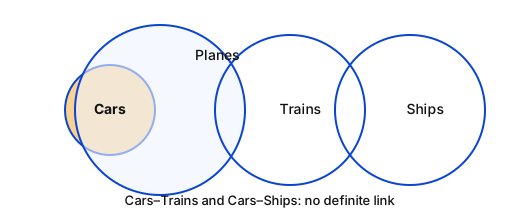
- All cars ⊂ planes, but only some planes are trains – cars may be entirely outside trains → (I) not definite.
- Planes and ships are connected only through "some trains" – no definite overlap → (II) not definite.
Trick: "Some A are B, some B are C" never yields a definite conclusion about A and C.
Answer: (C) Neither conclusion (I) nor (II) follows
अवधारणा: निष्कर्ष तभी मान्य है जब वह हर संभव वेन आरेख में सत्य हो।
- सभी cars ⊂ planes, पर केवल कुछ planes trains हैं – cars पूरी तरह trains से बाहर हो सकती हैं → (I) निश्चित नहीं।
- planes और ships केवल "कुछ trains" से जुड़े हैं – कोई निश्चित उभयनिष्ठ भाग नहीं → (II) निश्चित नहीं।
ट्रिक: "कुछ A, B हैं; कुछ B, C हैं" से A और C के बारे में कभी निश्चित निष्कर्ष नहीं निकलता।
उत्तर: (C) Neither conclusion (I) nor (II) follows
RRB NTPC Graduate CBT 1General Intelligence and ReasoningSyllogismRRB NTPC Graduate CBT 1 2025 · 27 Mar Shift 3
Q14.In the following triads, each group of letters is related to the subsequent one following a certain logic. Select from the given options, the one which follows the same logic. HUGE - UEGH - EGUH
LIST - ITSL - TSIL
निम्नलिखित त्रिकों में, अक्षरों का प्रत्येक समूह एक निश्चित तर्क के अनुसार अपने बाद वाले समूह से संबंधित है। दिए गए विकल्पों में से वह चुनिए जो समान तर्क का अनुसरण करता है। HUGE - UEGH - EGUH
LIST - ITSL - TSIL
- AEAST - AEST - TASE
- BHEAR - ERAH - RAEH
- CVIBE - IVBE - EIBV
- DBANK - BNAK - KNAB
Show answer
Concept: Track positions (1 2 3 4) of the letters through each step.
- HUGE → UEGH: positions 2, 4, 3, 1. LIST → ITSL: 2, 4, 3, 1 ✓.
- UEGH → EGUH: positions 2, 3, 1, 4. ITSL → TSIL: 2, 3, 1, 4 ✓.
- HEAR → (2,4,3,1) E R A H → (2,3,1,4) R A E H ✓ option B.
Trick: Write the position codes 2431 then 2314 and apply to each option.
Answer: (B) HEAR - ERAH - RAEH
अवधारणा: हर चरण में अक्षरों की स्थिति (1 2 3 4) ट्रैक करें।
- HUGE → UEGH: स्थिति 2, 4, 3, 1। LIST → ITSL: 2, 4, 3, 1 ✓।
- UEGH → EGUH: स्थिति 2, 3, 1, 4। ITSL → TSIL: 2, 3, 1, 4 ✓।
- HEAR → (2,4,3,1) E R A H → (2,3,1,4) R A E H ✓ विकल्प B।
ट्रिक: स्थिति कोड 2431 फिर 2314 लिखें और हर विकल्प पर लागू करें।
उत्तर: (B) HEAR - ERAH - RAEH
RRB NTPC Graduate CBT 1General Intelligence and ReasoningLetter RearrangementRRB NTPC Graduate CBT 1 2025 · 27 Mar Shift 3
Q15.What should come in place of ‘?’ in the given series?
56 55 51 42 26 ?
दी गई शृंखला में ‘?’ के स्थान पर क्या आना चाहिए?
56 55 51 42 26 ?
- A2
- B3
- C1
- D4
Show answer
Concept: Look at the differences between consecutive terms.
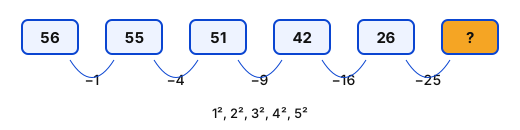
- , , , → differences are .
- Next difference → .
Trick: Differences 1, 4, 9, 16 are perfect squares – next is 25.
Answer: (C) 1
अवधारणा: क्रमागत पदों के अंतर देखें।
- , , , → अंतर ।
- अगला अंतर → ।
ट्रिक: अंतर 1, 4, 9, 16 पूर्ण वर्ग हैं – अगला 25।
उत्तर: (C) 1
RRB NTPC Graduate CBT 1General Intelligence and ReasoningNumber SeriesRRB NTPC Graduate CBT 1 2025 · 27 Mar Shift 3
Q16.Each of the digits in the number 386152479 is arranged in ascending order from left to right. The position of how many digits will remain unchanged as compared to that in the original number?
संख्या 386152479 के प्रत्येक अंक को बाएँ से दाएँ आरोही क्रम में व्यवस्थित किया जाता है। मूल संख्या की तुलना में कितने अंकों की स्थिति अपरिवर्तित रहेगी?
- ANoneकोई नहीं
- BThreeतीन
- COneएक
- DTwoदो
Show answer
Concept: Write the original and the sorted number one below the other and compare position by position.
- Original: 3 8 6 1 5 2 4 7 9; Ascending: 1 2 3 4 5 6 7 8 9.
- Match at position 5 (5 = 5) and position 9 (9 = 9) only.
- So two digits keep their place.
Trick: In a 1–9 arrangement, digit stays only if it was already at the th place.
Answer: (D) Two
अवधारणा: मूल और क्रमबद्ध संख्या को एक के नीचे एक लिखकर स्थान-दर-स्थान तुलना करें।
- मूल: 3 8 6 1 5 2 4 7 9; आरोही: 1 2 3 4 5 6 7 8 9।
- केवल स्थान 5 (5 = 5) और स्थान 9 (9 = 9) पर मेल।
- अतः दो अंक अपनी जगह पर रहते हैं।
ट्रिक: 1–9 की व्यवस्था में अंक तभी स्थिर रहता है जब वह पहले से वें स्थान पर हो।
उत्तर: (D) Two
RRB NTPC Graduate CBT 1General Intelligence and ReasoningDigit ArrangementRRB NTPC Graduate CBT 1 2025 · 27 Mar Shift 3
Q17.In a certain code language, ‘MATE’ is coded as ‘9827’ and ‘TIME’ is coded as ‘9218’. What is the code for ‘I’ in the given code language?
एक निश्चित कूट भाषा में, ‘MATE’ को ‘9827’ के रूप में कूटबद्ध किया जाता है और ‘TIME’ को ‘9218’ के रूप में कूटबद्ध किया जाता है। दी गई कूट भाषा में ‘I’ का कूट क्या है?
- A9
- B8
- C2
- D1
Show answer
Concept: Compare the two words – common letters get common digits; the leftover letter gets the leftover digit.
- MATE 9827, TIME 9218.
- Common letters M, T, E common digits 9, 2, 8.
- Leftover: A 7 (from MATE) and I 1 (from TIME).
Trick: You never need the full mapping – only match the odd-one-out letter with the odd-one-out digit.
Answer: (D) 1
अवधारणा: दोनों शब्दों की तुलना करें – समान अक्षरों को समान अंक मिलते हैं; बचा अक्षर = बचा अंक।
- MATE 9827, TIME 9218।
- समान अक्षर M, T, E समान अंक 9, 2, 8।
- बचे हुए: A 7 (MATE से) और I 1 (TIME से)।
ट्रिक: पूरी मैपिंग की ज़रूरत नहीं – बस अलग बचे अक्षर को अलग बचे अंक से मिलाएँ।
उत्तर: (D) 1
RRB NTPC Graduate CBT 1General Intelligence and ReasoningCoding–DecodingRRB NTPC Graduate CBT 1 2025 · 27 Mar Shift 3
Q18.What should come in place of the question mark (?) in the given series?
89 87 84 79 72 ?
दी गई शृंखला में प्रश्नवाचक चिह्न (?) के स्थान पर क्या आना चाहिए?
89 87 84 79 72 ?
- A61
- B59
- C62
- D63
Show answer
Concept: Find the differences between consecutive terms and look for a known pattern.
- : differences .
- These are consecutive prime numbers; next prime .
- .
Trick: Differences (primes) is a favourite RRB pattern – check it whenever gaps grow irregularly.
Answer: (A) 61
अवधारणा: लगातार पदों का अंतर निकालें और परिचित पैटर्न खोजें।
- : अंतर ।
- ये क्रमागत अभाज्य (prime) संख्याएँ हैं; अगली अभाज्य ।
- ।
ट्रिक: अंतर (अभाज्य) RRB का पसंदीदा पैटर्न है – जब अंतर अनियमित बढ़ें तो इसे ज़रूर जाँचें।
उत्तर: (A) 61
RRB NTPC Graduate CBT 1General Intelligence and ReasoningNumber SeriesRRB NTPC Graduate CBT 1 2025 · 27 Mar Shift 3
Q19.Seven boxes, C, F, J, N, Q, S and V are kept one over the other but not necessarily in the same order. Only Q is kept above F. Only V is kept between J and S. Only N is kept below J. How many boxes are kept between C and N?
सात बक्से C, F, J, N, Q, S और V एक के ऊपर एक रखे गए हैं, लेकिन आवश्यक नहीं कि इसी क्रम में हों। केवल Q को F के ऊपर रखा गया है। J और S के बीच केवल V रखा गया है। केवल N को J के नीचे रखा गया है। C और N के बीच कितने बक्से रखे गए हैं?
- ATwoदो
- BThreeतीन
- COneएक
- DFourचार
Show answer
Concept: Fix the certain positions first ("only X above/below Y"), then fill the rest.
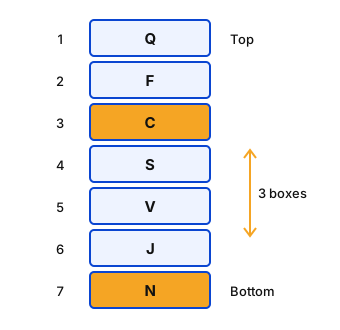
- Only Q above F Q = 1st (top), F = 2nd.
- Only N below J J = 6th, N = 7th (bottom).
- Only V between J and S S = 4th, V = 5th; the remaining C = 3rd.
- Between C (3rd) and N (7th): S, V, J = three boxes.
Trick: "Only one box above X" pins X at position 2 instantly – start with such clues.
Answer: (B) Three
अवधारणा: पहले निश्चित स्थान तय करें ("केवल X, Y के ऊपर/नीचे"), फिर बाकी भरें।
- केवल Q, F के ऊपर Q = पहला (सबसे ऊपर), F = दूसरा।
- केवल N, J के नीचे J = छठा, N = सातवाँ (सबसे नीचे)।
- J और S के बीच केवल V S = चौथा, V = पाँचवाँ; बचा C = तीसरा।
- C (तीसरा) और N (सातवाँ) के बीच: S, V, J = तीन बॉक्स।
ट्रिक: "X के ऊपर केवल एक बॉक्स" X को तुरंत स्थान 2 पर जमा देता है – ऐसे सूत्रों से शुरुआत करें।
उत्तर: (B) Three
RRB NTPC Graduate CBT 1General Intelligence and ReasoningBox ArrangementRRB NTPC Graduate CBT 1 2025 · 27 Mar Shift 3
Q20.Which of the following letter-number clusters will replace the question mark (?) in the given series to make it logically complete?
NON 40 LML 30 JKJ 20 HIH 10 ?
निम्नलिखित में से कौन-सा अक्षर-संख्या समूह दी गई शृंखला में प्रश्नवाचक चिह्न (?) के स्थान पर आकर उसे तार्किक रूप से पूर्ण करेगा?
NON 40 LML 30 JKJ 20 HIH 10 ?
- AFNW 7
- BFHE 0
- CFFE 5
- DFGF 0
Show answer
Concept: Treat each letter position and the number as separate series.
- 1st/3rd letters: N, L, J, H – each next F.
- Middle letter: O, M, K, I – each next G.
- Numbers: – each .
- Cluster FGF 0.
Trick: The middle letter is always one ahead of the outer letters (N–O, L–M, …) so F pairs with G.
Answer: (D) FGF 0
अवधारणा: हर अक्षर-स्थान और संख्या को अलग-अलग श्रृंखला मानें।
- पहला/तीसरा अक्षर: N, L, J, H – हर बार अगला F।
- बीच का अक्षर: O, M, K, I – हर बार अगला G।
- संख्याएँ: – हर बार ।
- समूह FGF 0।
ट्रिक: बीच का अक्षर हमेशा बाहरी अक्षरों से एक आगे है (N–O, L–M, …), इसलिए F के साथ G आएगा।
उत्तर: (D) FGF 0
RRB NTPC Graduate CBT 1General Intelligence and ReasoningLetter–Number SeriesRRB NTPC Graduate CBT 1 2025 · 27 Mar Shift 3

