Q1.Based on the English alphabetical order, three of the following four letter-cluster pairs are alike in a certain way and thus form a group. Which is the letter-cluster pair that DOES NOT belong to that group?
(Note: The odd one out is not based on the number of consonants/vowels or their position in the letter-cluster.)
अंग्रेज़ी वर्णमाला क्रम के आधार पर, निम्नलिखित चार अक्षर-समूह युग्मों में से तीन किसी निश्चित प्रकार से एकसमान हैं और इस प्रकार एक समूह बनाते हैं। वह अक्षर-समूह युग्म कौन-सा है जो उस समूह से संबंधित नहीं है?
(ध्यान दें: असंगत अक्षर-समूह, उस अक्षर-समूह में व्यंजनों/स्वरों की संख्या या उनकी स्थिति पर आधारित नहीं है।)
- ANQ−NT
- BLO−MP
- CIL−JM
- DJM−KN
Show answer
Concept: Compare each letter of the first cluster with the corresponding letter of the second.
- LO−MP: L→M , O→P .
- IL−JM: ; JM−KN: .
- NQ−NT: N→N , Q→T – different.
Trick: In such pairs write the jump under each letter; the pair with a different jump is the answer.
Answer: (A) NQ−NT
अवधारणा: पहले समूह के हर अक्षर की तुलना दूसरे समूह के संगत अक्षर से करें।
- LO−MP: L→M , O→P ।
- IL−JM और JM−KN: ।
- NQ−NT: N→N , Q→T – अलग।
ट्रिक: हर अक्षर के नीचे अंतर लिखें; जिसका अंतर अलग हो वही उत्तर।
उत्तर: (A) NQ−NT
RRB NTPC Graduate CBT 2General Intelligence and ReasoningOdd One Out (Letter Pairs)RRB NTPC Graduate CBT 2 2024 · 13 Oct Shift 2
Q2.Based on the English alphabetical order, three of the following four letter-cluster pairs are alike in a certain way and thus form a group. Which is the letter-cluster pair that DOES NOT belong to that group?
(Note: The odd one out is not based on the number of consonants/vowels or their position in the letter-cluster.)
अंग्रेज़ी वर्णमाला क्रम के आधार पर, निम्नलिखित चार अक्षर-समूह युग्मों में से तीन किसी निश्चित प्रकार से एकसमान हैं और इस प्रकार एक समूह बनाते हैं। वह अक्षर-समूह युग्म कौन-सा है जो उस समूह से संबंधित नहीं है?
(ध्यान दें: असंगत अक्षर-समूह, उस अक्षर-समूह में व्यंजनों/स्वरों की संख्या या उनकी स्थिति पर आधारित नहीं है।)
- ADH−DK
- BNR−OS
- CQU−RV
- DVZ−WA
Show answer
Concept: Compare corresponding letters of the two clusters in each pair.
- NR−OS: ; QU−RV: .
- VZ−WA: V→W , Z→A , wrapping.
- DH−DK: D→D , H→K – odd.
Trick: After Z comes A again – treat the alphabet as a circle.
Answer: (A) DH−DK
अवधारणा: हर युग्म में दोनों समूहों के संगत अक्षरों की तुलना करें।
- NR−OS और QU−RV: ।
- VZ−WA: V→W , Z→A (चक्रीय)।
- DH−DK: – विषम।
ट्रिक: Z के बाद फिर A आता है – वर्णमाला को चक्र मानें।
उत्तर: (A) DH−DK
RRB NTPC Graduate CBT 2General Intelligence and ReasoningOdd One Out (Letter Pairs)RRB NTPC Graduate CBT 2 2024 · 13 Oct Shift 2
Q3.J, K, L, M, P and Q each scored different marks. Only two people have scored between P and K. Only one person has scored more than M. Only three people have scored between M and P. Q has scored more than L but less than J. How many people have scored less than L?
J, K, L, M, P और Q में से प्रत्येक ने अलग-अलग अंक प्राप्त किए। केवल दो व्यक्तियों ने P और K के बीच अंक प्राप्त किए हैं। केवल एक व्यक्ति ने M से अधिक अंक प्राप्त किए हैं। केवल तीन व्यक्तियों ने M और P के बीच अंक प्राप्त किए हैं। Q ने L से अधिक लेकिन J से कम अंक प्राप्त किए हैं। कितने व्यक्तियों ने L से कम अंक प्राप्त किए हैं?
- AFourचार
- BOneएक
- CTwoदो
- DThree
तीन
Show answer
Concept: Place people on ranks 1 (highest) to 6 using fixed clues first.
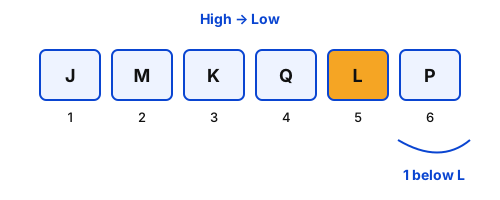
- Only one above M → M is 2nd.
- Three between M and P → P is 6th.
- Two between P and K → K is 3rd.
- J, Q, L fill 1, 4, 5 with L < Q < J → J 1st, Q 4th, L 5th.
- Below L: only P → one person.
Trick: Start with 'only one more than' type clues – they fix a rank immediately.
Answer: (B) One
अवधारणा: निश्चित संकेतों से रैंक 1 (सबसे अधिक) से 6 तक व्यवस्था बनाएँ।
- M से अधिक केवल एक → M दूसरा।
- M और P के बीच तीन → P छठा।
- P और K के बीच दो → K तीसरा।
- J, Q, L स्थान 1, 4, 5 पर; L < Q < J → J 1, Q 4, L 5।
- L से कम: केवल P → एक।
ट्रिक: 'केवल एक से अधिक' जैसे संकेत तुरंत रैंक तय करते हैं।
उत्तर: (B) एक
RRB NTPC Graduate CBT 2General Intelligence and ReasoningRanking / OrderRRB NTPC Graduate CBT 2 2024 · 13 Oct Shift 2
Q4.Ajit starts from point A and drives 8 km towards east. He then takes a right turn and drives 17 km. He takes a final left turn and drives 10 km and stops at point B. Vishal starts from point P, which is 13 km east of point A, and drives 6 km towards east. He then takes a right turn and drives 17 km. He takes a final left turn and drives 1 km and stops at point Q. What is the shortest distance between point Q and point B? (All turns are 90-degree turns only.)
अजीत बिंदु A से चलना शुरू करता है और पूर्व की ओर 8 km गाड़ी चलाता है। फिर वह दाएँ मुड़ता है और 17 km गाड़ी चलाता है। वह अंतिम बार बाएँ मुड़ता है और 10 km गाड़ी चलाकर बिंदु B पर रुक जाता है। विशाल बिंदु P से चलना शुरू करता है, जो बिंदु A से 13 km पूर्व में है, और पूर्व की ओर 6 km गाड़ी चलाता है। फिर वह दाएँ मुड़ता है और 17 km गाड़ी चलाता है। वह अंतिम बार बाएँ मुड़ता है और 1 km गाड़ी चलाकर बिंदु Q पर रुक जाता है। बिंदु Q और बिंदु B के बीच की न्यूनतम दूरी कितनी है? (सभी मोड़ केवल 90 डिग्री के मोड़ हैं।)
- A3 km
- B1 km
- C4 km
- D2 km
Show answer
Concept: Use coordinates with A at origin, east = +x, south = −y.
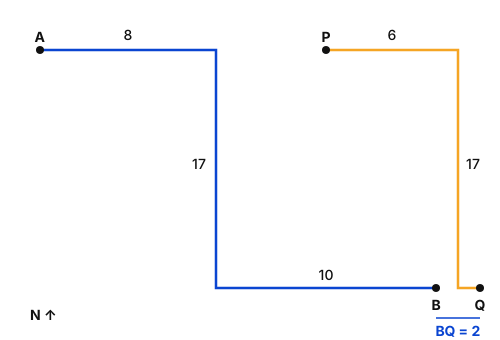
- Ajit: east 8 → (8, 0); right turn (south) 17 → (8, −17); left turn (east) 10 → B (18, −17).
- Vishal: P (13, 0); east 6 → (19, 0); south 17 → (19, −17); east 1 → Q (20, −17).
- B and Q lie on the same line: .
Trick: Both went 17 km south, so only eastward totals matter: vs .
Answer: (D) 2 km
अवधारणा: A को मूल बिंदु लें, पूर्व = +x, दक्षिण = −y।
- अजीत: पूर्व 8 → (8, 0); दाएँ (दक्षिण) 17 → (8, −17); बाएँ (पूर्व) 10 → B (18, −17)।
- विशाल: P (13, 0); पूर्व 6 → (19, 0); दक्षिण 17; पूर्व 1 → Q (20, −17)।
- ।
ट्रिक: दोनों 17 km दक्षिण गए, इसलिए केवल पूर्व की कुल दूरी देखें: 18 बनाम 20।
उत्तर: (D) 2 km
RRB NTPC Graduate CBT 2General Intelligence and ReasoningDirection & DistanceRRB NTPC Graduate CBT 2 2024 · 13 Oct Shift 2
Q5.A, B, C, D, E, F, G and H are sitting around a square table facing the centre of the table. Some of them are sitting at the corners while some are sitting at the exact centre of the sides. E sits third to the left of B. E does not sit at the centre of any side. F sits second to the right of B. G is the immediate neighbour of D and B. H sits to the immediate left of F. C does not sit in a corner. How many people sit between D and A when counted from the left of D?
A, B, C, D, E, F, G और H एक वर्गाकार मेज़ के चारों ओर मेज़ के केंद्र की ओर मुख करके बैठे हैं। उनमें से कुछ कोनों पर बैठे हैं जबकि कुछ भुजाओं के ठीक मध्य में बैठे हैं। E, B के बाएँ से तीसरे स्थान पर बैठा है। E किसी भी भुजा के मध्य में नहीं बैठा है। F, B के दाएँ से दूसरे स्थान पर बैठा है। G, D और B दोनों का निकटतम पड़ोसी है। H, F के ठीक बाएँ बैठा है। C किसी कोने पर नहीं बैठा है। D के बाएँ से गिनने पर D और A के बीच कितने व्यक्ति बैठे हैं?
- AFourचार
- BOneएक
- CTwoदो
- DFiveपाँच
Show answer
Concept: Facing the centre, 'left' means clockwise. Corners and side-centres alternate.
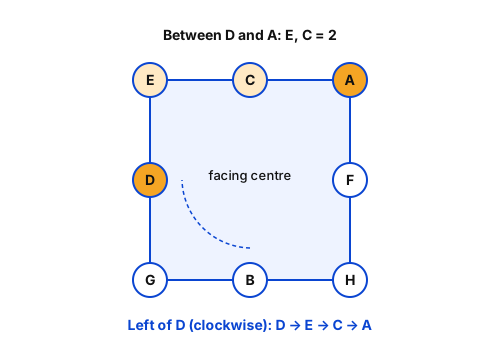
- Fix B at a side-centre. E third to left of B (a corner ✓); F second to right of B; H immediately left of F, i.e. right neighbour of B.
- G is between D and B → G left of B, D next.
- Remaining two seats (between E and F): side-centre and corner. C is not at a corner → C beside E, A at the corner.
- From D going left: E, C, then A → two people between.
Trick: Draw 8 seats first and mark corners; place B, then fill using 'left = clockwise'.
Answer: (C) Two
अवधारणा: केंद्र की ओर मुख होने पर 'बाएँ' = दक्षिणावर्त (clockwise)। कोने और भुजा-मध्य बारी-बारी से।
- B को भुजा के मध्य रखें। E, B के बाएँ तीसरा (कोना ✓); F, B के दाएँ दूसरा; H, F के तुरंत बाएँ यानी B के दाएँ।
- G, D और B के बीच → G, B के बाएँ, फिर D।
- शेष दो सीटें (E और F के बीच): C कोने पर नहीं → C, E के बगल, A कोने पर।
- D के बाएँ से: E, C, फिर A → बीच में दो।
ट्रिक: पहले 8 सीटें और कोने बनाएँ; B रखें, फिर 'बाएँ = clockwise' से भरें।
उत्तर: (C) दो
RRB NTPC Graduate CBT 2General Intelligence and ReasoningSeating – Square TableRRB NTPC Graduate CBT 2 2024 · 13 Oct Shift 2
Q6.Select the triad that follows the same pattern as the one followed by the two triads given below. Both triads follow the same pattern.
KH-MI-NP
MJ-OK-PR
उस त्रिक का चयन कीजिए जो उसी पैटर्न का अनुसरण करता है जिसका अनुसरण नीचे दिए गए दो त्रिक करते हैं। दोनों त्रिक एक ही पैटर्न का अनुसरण करते हैं।
KH-MI-NP
MJ-OK-PR
- APL-QN-RV
- BOL-QM-RV
- COL-QM-RT
- DPL-QM-RV
Show answer
Concept: Track first letters and second letters across the three clusters separately.
- KH-MI-NP: first letters K→M→N ; second letters H→I→P .
- MJ-OK-PR: M→O→P ; J→K→R ✓.
- OL-QM-RT: O→Q→R ; L→M→T ✓. (OL-QM-RV has M→V .)
Trick: Two similar options differ only in the last letter – check just that jump.
Answer: (C) OL-QM-RT
अवधारणा: तीनों समूहों में पहले अक्षर और दूसरे अक्षर अलग-अलग देखें।
- KH-MI-NP: पहले अक्षर ; दूसरे अक्षर ।
- MJ-OK-PR: और ✓।
- OL-QM-RT: O→Q→R ; L→M→T ✓।
ट्रिक: मिलते-जुलते विकल्प केवल अंतिम अक्षर में अलग हैं – वही जाँचें।
उत्तर: (C) OL-QM-RT
RRB NTPC Graduate CBT 2General Intelligence and ReasoningLetter Analogy (Triads)RRB NTPC Graduate CBT 2 2024 · 13 Oct Shift 2
Q7.In the following triads, each group of letters is related to the subsequent one following a certain logic. Select from the given options, the one which follows the same logic. CLAY - YLCA - LACY
BOWS - SOBW - OWBS
निम्नलिखित त्रिकों में, अक्षरों का प्रत्येक समूह एक निश्चित तर्क का अनुसरण करते हुए अगले समूह से संबंधित है। दिए गए विकल्पों में से उस विकल्प का चयन कीजिए जो उसी तर्क का अनुसरण करता है। CLAY - YLCA - LACY
BOWS - SOBW - OWBS
- ADENT - EDNT - TEND
- BFROM - MRFO - ROFM
- CFILE - EIFL - LIFE
- DGEAR - GAER - RAEG
Show answer
Concept: Number the letters 1-2-3-4 and track their positions.
- CLAY (1234) → YLCA = 4-2-1-3; YLCA → LACY = 2-4-3-1 of the second word.
- BOWS → SOBW (4-2-1-3) → OWBS (2-4-3-1) ✓.
- FROM → MRFO (4-2-1-3) → ROFM (2-4-3-1) ✓.
Trick: Check only the first step (4-2-1-3) on all options; usually only one survives.
Answer: (B) FROM - MRFO - ROFM
अवधारणा: अक्षरों को 1-2-3-4 क्रमांक देकर स्थान देखें।
- CLAY → YLCA = 4-2-1-3; YLCA → LACY = दूसरे शब्द का 2-4-3-1।
- BOWS → SOBW → OWBS ✓।
- FROM → MRFO (4-2-1-3) → ROFM (2-4-3-1) ✓।
ट्रिक: पहले चरण (4-2-1-3) से ही विकल्प जाँचें; प्रायः एक ही बचता है।
उत्तर: (B) FROM - MRFO - ROFM
RRB NTPC Graduate CBT 2General Intelligence and ReasoningLetter RearrangementRRB NTPC Graduate CBT 2 2024 · 13 Oct Shift 2
Q8.If ‘A’ stands for ‘+’, ‘B’ stands for ‘−’, ‘C’ stands for ‘×’ and ‘D’ stands for ‘÷‘, what will come in place of the question mark (?) in the following equation?
8 C 7 B 24 D 8 A 5 = ?
यदि 'A' का अर्थ '+', 'B' का अर्थ '−', 'C' का अर्थ '×' और 'D' का अर्थ '÷' है, तो निम्नलिखित समीकरण में प्रश्न चिह्न (?) के स्थान पर क्या आएगा?
8 C 7 B 24 D 8 A 5 = ?
- A56
- B57
- C59
- D58
Show answer
Concept: Replace letters by signs and apply BODMAS.
- .
- .
- .
Trick: Do and first, then and left to right.
Answer: (D) 58
अवधारणा: अक्षरों के स्थान पर चिह्न रखें और BODMAS लगाएँ।
- ।
- ।
- ।
ट्रिक: पहले , , फिर , ।
उत्तर: (D) 58
RRB NTPC Graduate CBT 2General Intelligence and ReasoningMathematical OperationsRRB NTPC Graduate CBT 2 2024 · 13 Oct Shift 2
Q9.Based on the English alphabetical order, three of the following four letter-clusters are alike in a certain way and thus form a group. Which letter-cluster DOES NOT belong to that group?
(Note: The odd one out is not based on the number of consonants/vowels or their position in the letter-cluster.)
अंग्रेज़ी वर्णमाला क्रम के आधार पर, निम्नलिखित चार अक्षर-समूहों में से तीन किसी निश्चित प्रकार से एकसमान हैं और इस प्रकार एक समूह बनाते हैं। कौन-सा अक्षर-समूह उस समूह से संबंधित नहीं है?
(ध्यान दें: असंगत अक्षर-समूह, उस अक्षर-समूह में व्यंजनों/स्वरों की संख्या या उनकी स्थिति पर आधारित नहीं है।)
- ALCT
- BIZQ
- CSAI
- DOFW
Show answer
Concept: Find the gap between consecutive letters (wrapping after Z).
- LCT: L→C (12→29→3), C→T .
- IZQ: ; OFW: O→F , F→W .
- SAI: S→A , A→I – different.
Trick: forward is the same as backward (L→C is 9 steps back).
Answer: (C) SAI
अवधारणा: क्रमागत अक्षरों का अंतर निकालें (Z के बाद A)।
- LCT: L→C , C→T ।
- IZQ और OFW: ।
- SAI: – अलग।
ट्रिक: आगे = पीछे (L से C, 9 कदम पीछे)।
उत्तर: (C) SAI
RRB NTPC Graduate CBT 2General Intelligence and ReasoningOdd One Out (Letter Clusters)RRB NTPC Graduate CBT 2 2024 · 13 Oct Shift 2
Q10.Each of P, Q, R, S, T, U and V has an exam on a different day of a week starting from Monday and ending on Sunday of the same week. U has an exam on Saturday. Only four people have an exam between T and S, neither of whom has an exam on Monday. V has an exam immediately after P and Q has an exam immediately before P. S has an exam after V. How many people have exams after T?
P, Q, R, S, T, U और V में से प्रत्येक की परीक्षा एक ही सप्ताह के सोमवार से शुरू होकर रविवार को समाप्त होने वाले सप्ताह के एक अलग दिन है। U की परीक्षा शनिवार को है। T और S के बीच केवल चार व्यक्तियों की परीक्षा है, जिनमें से किसी की भी परीक्षा सोमवार को नहीं है। V की परीक्षा P के ठीक बाद है और Q की परीक्षा P के ठीक पहले है। S की परीक्षा V के बाद है। T के बाद कितने व्यक्तियों की परीक्षाएँ हैं?
- A5
- B2
- C3
- D4
Show answer
Concept: Fix U, then try the possible places of T and S.
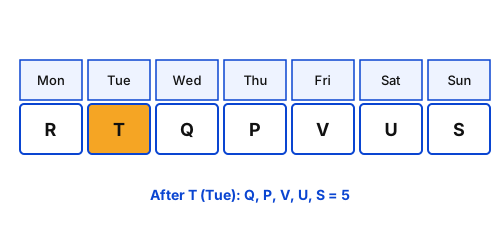
- U = Saturday. Four between T and S → (Mon, Sat) or (Tue, Sun); Sat is U, so T/S are Tue and Sun.
- Q, P, V are consecutive and S is after V → S cannot be Tue, so T = Tue, S = Sun.
- Q-P-V fit only on Wed-Thu-Fri; R = Mon.
- After T (Tue): Q, P, V, U, S = 5.
Trick: Check the case-breaking clue ('S after V') immediately after placing a pair.
Answer: (A) 5
अवधारणा: पहले U तय करें, फिर T और S के संभव स्थान देखें।
- U = शनिवार। T और S के बीच चार → (सोम, शनि) या (मंगल, रवि); शनि U का है, अतः मंगल और रवि।
- Q, P, V लगातार हैं और S, V के बाद → S मंगल नहीं, अतः T = मंगल, S = रवि।
- Q-P-V = बुध-गुरु-शुक्र; R = सोम।
- T के बाद: Q, P, V, U, S = 5।
ट्रिक: जोड़ी रखते ही निर्णायक संकेत ('S, V के बाद') जाँचें।
उत्तर: (A) 5
RRB NTPC Graduate CBT 2General Intelligence and ReasoningScheduling – DaysRRB NTPC Graduate CBT 2 2024 · 13 Oct Shift 2
Q11.In the following series, only one letter-cluster is incorrect. Select the INCORRECT letter- cluster.
DVN ASP XPH UME RJB OGY
निम्नलिखित श्रृंखला में, केवल एक अक्षर-समूह गलत है। गलत अक्षर-समूह का चयन कीजिए।
DVN ASP XPH UME RJB OGY
- ARJB
- BUME
- CXPH
- DASP
Show answer
Concept: Each position of the cluster follows its own pattern.
- First letters: D, A, X, U, R, O .
- Second letters: V, S, P, M, J, G .
- Third letters should be N, K, H, E, B, Y ; the 2nd cluster has P instead of K.
- Correct term would be ASK, so ASP is wrong.
Trick: Write three separate mini-series – the break shows up at once.
Answer: (D) ASP
अवधारणा: समूह के हर स्थान की अपनी श्रृंखला है।
- पहले अक्षर: D, A, X, U, R, O ।
- दूसरे अक्षर: V, S, P, M, J, G ।
- तीसरे अक्षर N, K, H, E, B, Y होने चाहिए; दूसरे पद में K की जगह P है।
- सही पद ASK, अतः ASP गलत।
ट्रिक: तीन अलग छोटी श्रृंखलाएँ लिखें – गलती तुरंत दिखेगी।
उत्तर: (D) ASP
RRB NTPC Graduate CBT 2General Intelligence and ReasoningLetter Series – Wrong TermRRB NTPC Graduate CBT 2 2024 · 13 Oct Shift 2
Q12.In the following number-pairs, the second number is obtained by applying certain mathematical operation(s) to the first number. Select the number-pair in which the numbers are related in the same way as are the numbers of the following pairs. (NOTE: Operations should be performed on the whole numbers, without breaking down the numbers into their constituent digits. E.g. 13 – Operations on 13 such as adding to/subtracting from/multiplying with 13 can be performed. Breaking down 13 into 1 and 3 and then performing mathematical operations on 1 and 3 is not allowed.)
8, 38
11, 53
निम्नलिखित संख्या-युग्मों में, पहली संख्या पर कुछ गणितीय संक्रिया/संक्रियाएँ करके दूसरी संख्या प्राप्त की जाती है। उस संख्या-युग्म का चयन कीजिए जिसमें संख्याएँ उसी प्रकार संबंधित हैं जिस प्रकार निम्नलिखित युग्मों की संख्याएँ संबंधित हैं। (ध्यान दें: संख्याओं को उनके घटक अंकों में विभक्त किए बिना, पूर्ण संख्याओं पर संक्रियाएँ की जानी चाहिए। उदाहरण के लिए, 13 – 13 पर संक्रियाएँ जैसे 13 में जोड़ना/13 में से घटाना/13 से गुणा करना आदि की जा सकती हैं। 13 को 1 और 3 में विभक्त करना और फिर 1 और 3 पर गणितीय संक्रियाएँ करना वर्जित है।)
8, 38
11, 53
- A14, 67
- B14, 68
- C15, 68
- D15, 67
Show answer
Concept: Find one operation that works for both given pairs.
- ; ✓.
- → (14, 68) ✓.
- , so (15, 67) and (15, 68) fail; (14, 67) fails.
Trick: Second number ends in 8 or 3 → think '×5 − 2'.
Answer: (B) 14, 68
अवधारणा: ऐसी संक्रिया खोजें जो दोनों युग्मों पर लागू हो।
- ; ✓।
- → (14, 68) ✓।
- , अतः 15 वाले विकल्प गलत; (14, 67) भी गलत।
ट्रिक: दूसरी संख्या 8 या 3 पर समाप्त → '×5 − 2' सोचें।
उत्तर: (B) 14, 68
RRB NTPC Graduate CBT 2General Intelligence and ReasoningNumber Pair AnalogyRRB NTPC Graduate CBT 2 2024 · 13 Oct Shift 2
Q13.In a certain code, ‘lion tiger cat’ is coded as ‘dz ph st’, ‘cat dog horse’ is coded as ‘lp jk st’, and ‘dog lion rat’ is coded as ‘ug ph jk’. What is the word 'tiger' coded as in that code? (All the codes are two letter coded only.)
एक निश्चित कूट भाषा में, 'lion tiger cat' को 'dz ph st' लिखा जाता है, 'cat dog horse' को 'lp jk st' लिखा जाता है, और 'dog lion rat' को 'ug ph jk' लिखा जाता है। उस कूट भाषा में शब्द 'tiger' को किस प्रकार लिखा जाएगा? (सभी कूट केवल दो अक्षर वाले कूट हैं।)
- Ast
- Bdz
- Cph
- Djk
Show answer
Concept: A word common to two sentences takes the code common to both.
- Sentences 1 and 2 share 'cat' and code 'st' → cat = st.
- Sentences 1 and 3 share 'lion' and code 'ph' → lion = ph.
- Sentence 1: lion tiger cat = dz ph st → tiger = dz.
Trick: Remove known codes from a sentence; what is left is the answer.
Answer: (B) dz
अवधारणा: दो वाक्यों में समान शब्द का कोड भी दोनों में समान होता है।
- वाक्य 1 और 2: 'cat' = 'st'।
- वाक्य 1 और 3: 'lion' = 'ph'।
- वाक्य 1: lion tiger cat = dz ph st → tiger = dz।
ट्रिक: ज्ञात कोड हटाएँ; जो बचे वही उत्तर।
उत्तर: (B) dz
RRB NTPC Graduate CBT 2General Intelligence and ReasoningCoding – Word CodesRRB NTPC Graduate CBT 2 2024 · 13 Oct Shift 2
Q14.Each of A, B, C, D, E, F, and G has an exam on a different day of a week starting from Monday and ending on Sunday of the same week. A has an exam on Tuesday. Exactly three people have exams between A and D. F’s exam is immediately after G’s exam. Only one person has an exam between B and F. C has an exam before both B and E. E does not have an exam on Saturday or Sunday. How many people have exams after C?
A, B, C, D, E, F और G में से प्रत्येक की परीक्षा एक ही सप्ताह के सोमवार से शुरू होकर रविवार को समाप्त होने वाले सप्ताह के एक अलग दिन है। A की परीक्षा मंगलवार को है। A और D के बीच ठीक तीन व्यक्तियों की परीक्षाएँ हैं। F की परीक्षा G की परीक्षा के ठीक बाद है। B और F के बीच केवल एक व्यक्ति की परीक्षा है। C की परीक्षा B और E दोनों से पहले है। E की परीक्षा शनिवार या रविवार को नहीं है। C के बाद कितने व्यक्तियों की परीक्षाएँ हैं?
- A3
- B6
- C5
- D4
Show answer
Concept: Fix A, then D, then test the G–F block.
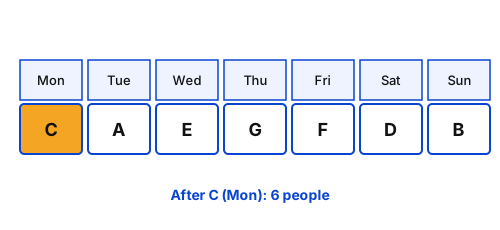
- A = Tue. Three between A and D → D = Sat.
- G–F consecutive in free days (Mon, Wed, Thu, Fri, Sun): G–F = Wed–Thu or Thu–Fri.
- Wed–Thu: B must be Tue or Sat – both taken ✗. So G = Thu, F = Fri; B = Wed or Sun.
- If B = Wed, C and E get Mon/Sun and E ≠ Sun → C = Sun, but C must be before E ✗. So B = Sun, C = Mon, E = Wed.
- C is on Monday → 6 people after C.
Trick: C before both B and E pushes C to the earliest free day.
Answer: (B) 6
अवधारणा: A तय करें, फिर D, फिर G–F जोड़ी जाँचें।
- A = मंगल। A और D के बीच तीन → D = शनि।
- खाली दिन (सोम, बुध, गुरु, शुक्र, रवि) में G–F = बुध–गुरु या गुरु–शुक्र।
- बुध–गुरु पर B मंगल या शनि – दोनों भरे ✗। अतः G = गुरु, F = शुक्र; B = बुध या रवि।
- B = बुध हो तो E ≠ रवि → C = रवि, पर C, E से पहले चाहिए ✗। अतः B = रवि, C = सोम, E = बुध।
- C सोमवार → उसके बाद 6 लोग।
ट्रिक: C, B और E दोनों से पहले → C सबसे पहले खाली दिन पर।
उत्तर: (B) 6
RRB NTPC Graduate CBT 2General Intelligence and ReasoningScheduling – DaysRRB NTPC Graduate CBT 2 2024 · 13 Oct Shift 2
Q15.This question is based on the following words.
GOT HER WAR FIT
In each of the words, each vowel is changed to the letter immediately following it in the English alphabetical order and each consonant is changed to the letter immediately preceding it in the English alphabetical order. In how many letter-clusters thus formed, will no vowel appear?
यह प्रश्न निम्नलिखित शब्दों पर आधारित है।
GOT HER WAR FIT
प्रत्येक शब्द में, प्रत्येक स्वर को अंग्रेज़ी वर्णमाला क्रम में उसके ठीक बाद वाले अक्षर से बदल दिया जाता है और प्रत्येक व्यंजन को अंग्रेज़ी वर्णमाला क्रम में उसके ठीक पहले वाले अक्षर से बदल दिया जाता है। इस प्रकार बने कितने अक्षर-समूहों में कोई भी स्वर नहीं आएगा?
- AFourचार
- BTwoदो
- CThreeतीन
- DOneएक
Show answer
Concept: Vowel → next letter; consonant → previous letter. A consonant can become a vowel (e.g. F → E).
- GOT → F P S = FPS (no vowel).
- HER → G F Q = GFQ (no vowel).
- WAR → V B Q = VBQ (no vowel).
- FIT → E J S = EJS (has E). So three clusters without a vowel.
Trick: Watch consonants just after a vowel: B, F, J, P, V become A, E, I, O, U.
Answer: (C) Three
अवधारणा: स्वर → अगला अक्षर; व्यंजन → पिछला अक्षर। व्यंजन स्वर बन सकता है (जैसे F → E)।
- GOT → FPS (स्वर नहीं)।
- HER → GFQ (स्वर नहीं)।
- WAR → VBQ (स्वर नहीं)।
- FIT → EJS (E स्वर है)। अतः तीन समूहों में स्वर नहीं।
ट्रिक: स्वर के ठीक बाद वाले व्यंजन B, F, J, P, V पीछे जाकर A, E, I, O, U बनते हैं।
उत्तर: (C) तीन
RRB NTPC Graduate CBT 2General Intelligence and ReasoningLetter Coding – VowelsRRB NTPC Graduate CBT 2 2024 · 13 Oct Shift 2
Q16.In the following series, only one letter-cluster is incorrect. Select the INCORRECT letter- cluster.
SAI XFN CUM HPX MUC RZH
निम्नलिखित श्रृंखला में, केवल एक अक्षर-समूह गलत है। गलत अक्षर-समूह का चयन कीजिए।
SAI XFN CUM HPX MUC RZH
- ACUM
- BRZH
- CMUC
- DHPQ
Show answer
Concept: Each position of the cluster increases by a fixed step.
- First letters: S, X, C, H, M, R .
- Second letters should be A, F, K, P, U, Z ; third letters I, N, S, X, C, H .
- The third cluster should be CKS but is CUM – wrong.
Trick: Write the three positions as three separate series; the term breaking two of them is the culprit.
Answer: (A) CUM
अवधारणा: समूह का हर स्थान एक निश्चित अंतर से बढ़ता है।
- पहले अक्षर: S, X, C, H, M, R ।
- दूसरे अक्षर A, F, K, P, U, Z और तीसरे I, N, S, X, C, H होने चाहिए ।
- तीसरा पद CKS होना चाहिए, पर CUM है – गलत।
ट्रिक: तीनों स्थानों को अलग श्रृंखला लिखें; जो पद दो श्रृंखलाएँ तोड़े वही गलत।
उत्तर: (A) CUM
RRB NTPC Graduate CBT 2General Intelligence and ReasoningLetter Series – Wrong TermRRB NTPC Graduate CBT 2 2024 · 13 Oct Shift 2
Q17.A question is followed by two statements numbered I and II. You have to decide whether the data provided in the statements are sufficient to answer the question. Read both the statements and select the most appropriate answer.
Question:
Six friends, B, C, D, E, F and G, are sitting in a straight line, facing north. Who among them is sitting at the extreme right end?
Statements:
(I) There are exactly four people sitting between B and E. G sits to the immediate right of E.
(II) F is an immediate neighbour of C. Exactly two people sit between B and C.
एक प्रश्न के बाद दो कथन I और II दिए गए हैं। आपको यह तय करना है कि कथनों में दिए गए आँकड़े प्रश्न का उत्तर देने के लिए पर्याप्त हैं या नहीं। दोनों कथनों को पढ़िए और सबसे उपयुक्त उत्तर का चयन कीजिए।
प्रश्न:
छह मित्र, B, C, D, E, F और G, उत्तर की ओर मुख करके एक सीधी पंक्ति में बैठे हैं। उनमें से कौन सबसे दाएँ छोर पर बैठा है?
कथन:
(I) B और E के बीच ठीक चार व्यक्ति बैठे हैं। G, E के ठीक दाएँ बैठा है।
(II) F, C का निकटतम पड़ोसी है। B और C के बीच ठीक दो व्यक्ति बैठे हैं।
- AData in statements I and II together are sufficient to answer the question.कथन I और II के आँकड़े एक साथ प्रश्न का उत्तर देने के लिए पर्याप्त हैं।
- BData in statement I alone is sufficient to answer the question, while data in statement II is not.केवल कथन I के आँकड़े प्रश्न का उत्तर देने के लिए पर्याप्त हैं, जबकि कथन II के आँकड़े पर्याप्त नहीं हैं।
- CData in statements I and II together are not sufficient to answer the question.कथन I और II के आँकड़े एक साथ भी प्रश्न का उत्तर देने के लिए पर्याप्त नहीं हैं।
- DData in statement II alone is sufficient to answer the question, while data in statement I is not.केवल कथन II के आँकड़े प्रश्न का उत्तर देने के लिए पर्याप्त हैं, जबकि कथन I के आँकड़े पर्याप्त नहीं हैं।
Show answer
Concept: 6 seats in a line; check each statement separately.
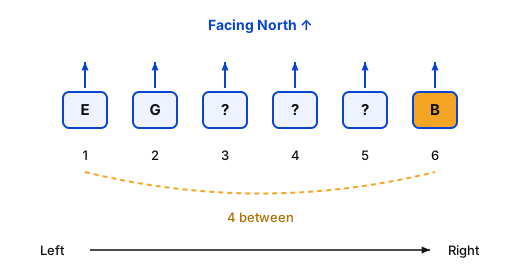
- Statement I: 4 people between B and E means they occupy the two ends (seats 1 and 6).
- G is immediately right of E, so E cannot be at seat 6 → E at 1, G at 2, B at 6. Extreme right = B. I alone is sufficient.
- Statement II gives only relative pairs (F–C, B–C) with no end fixed → not sufficient.
Trick: "4 between" in a row of 6 = both persons at the two ends.
Answer: (B) Data in statement I alone is sufficient, while II is not.
अवधारणा: एक पंक्ति में 6 सीटें; हर कथन अलग-अलग जाँचें।
- कथन I: B और E के बीच 4 लोग, अर्थात दोनों सिरों पर (सीट 1 और 6)।
- G, E के ठीक दाएँ है, अतः E सीट 6 पर नहीं हो सकता → E = 1, G = 2, B = 6। दाएँ छोर पर B। I अकेला पर्याप्त।
- कथन II में कोई छोर तय नहीं → अपर्याप्त।
ट्रिक: 6 की पंक्ति में "बीच में 4" = दोनों व्यक्ति दोनों सिरों पर।
उत्तर: (B) केवल कथन I पर्याप्त है, II नहीं।
RRB NTPC Graduate CBT 2General Intelligence and ReasoningData Sufficiency – SeatingRRB NTPC Graduate CBT 2 2024 · 13 Oct Shift 2
Q18.What should come in place of the question mark (?) in the given series?
14, 25, 47, 80, 124 , ?
दी गई श्रृंखला में प्रश्न चिह्न (?) के स्थान पर क्या आना चाहिए?
14, 25, 47, 80, 124 , ?
- A177
- B179
- C178
- D180
Show answer
Concept: Look at successive differences.
- Differences: , , , .
- They are multiples of 11: next difference .
- .
Trick: Differences – table of 11.
Answer: (B) 179
अवधारणा: क्रमागत अंतर देखें।
- अंतर: , , , ।
- ये 11 के गुणज हैं, अगला अंतर ।
- ।
ट्रिक: अंतर – 11 का पहाड़ा।
उत्तर: (B) 179
RRB NTPC Graduate CBT 2General Intelligence and ReasoningNumber SeriesRRB NTPC Graduate CBT 2 2024 · 13 Oct Shift 2
Q19.A question is followed by two statements numbered (I) and (II). You have to decide whether the data provided in the statements are sufficient to answer the question. Read both the statements and decide the appropriate answer.
Five people P, Q, R, S and T are sitting in a row, all facing north. Who is sitting second from the left end?
Statements:
I. P is sitting to the immediate right of T. P is sitting to the immediate left of S.
II. Only T is sitting between P and Q.
एक प्रश्न के बाद दो कथन (I) और (II) दिए गए हैं। आपको यह तय करना है कि कथनों में दिए गए आँकड़े प्रश्न का उत्तर देने के लिए पर्याप्त हैं या नहीं। दोनों कथनों को पढ़िए और उपयुक्त उत्तर तय कीजिए।
पाँच व्यक्ति P, Q, R, S और T एक पंक्ति में उत्तर की ओर मुख करके बैठे हैं। बाएँ छोर से दूसरे स्थान पर कौन बैठा है?
कथन:
I. P, T के ठीक दाएँ बैठा है। P, S के ठीक बाएँ बैठा है।
II. P और Q के बीच केवल T बैठा है।
- AData in statement I alone is sufficient to answer the question while data in statement II is notकेवल कथन I के आँकड़े प्रश्न का उत्तर देने के लिए पर्याप्त हैं, जबकि कथन II के आँकड़े पर्याप्त नहीं हैं
- BBoth statements I and II together are NOT sufficient to answer the questionकथन I और II दोनों एक साथ भी प्रश्न का उत्तर देने के लिए पर्याप्त नहीं हैं
- CBoth statements I and II together (and not statement I alone or statement II alone) are sufficient to answer the questionकथन I और II दोनों एक साथ (न कि केवल कथन I या केवल कथन II) प्रश्न का उत्तर देने के लिए पर्याप्त हैं
- DData in statement II alone is sufficient to answer the question while data in statement I is notकेवल कथन II के आँकड़े प्रश्न का उत्तर देने के लिए पर्याप्त हैं, जबकि कथन I के आँकड़े पर्याप्त नहीं हैं
Show answer
Concept: 5 people in a row facing north; combine I and II and see if one answer is fixed.
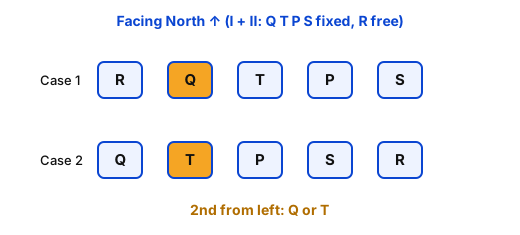
- I: T P S sit together in that order. Alone, many positions possible.
- II: only T between P and Q → with I, the block becomes Q T P S.
- R can be at either end: R Q T P S or Q T P S R → 2nd from left is Q or T.
- Even together the answer is not unique.
Trick: If even after combining one person (R) can float, data is insufficient.
Answer: (B) Both statements I and II together are NOT sufficient.
अवधारणा: 5 लोग उत्तर की ओर मुख किए पंक्ति में; I और II मिलाकर देखें।
- I: T P S इसी क्रम में साथ बैठे हैं। अकेले अनेक स्थितियाँ संभव।
- II: P और Q के बीच केवल T → I के साथ खंड Q T P S बनता है।
- R किसी भी सिरे पर हो सकता है: R Q T P S या Q T P S R → बाएँ से दूसरा Q या T।
- दोनों मिलाकर भी उत्तर निश्चित नहीं।
ट्रिक: मिलाने पर भी कोई व्यक्ति (R) घूम सकता हो तो डेटा अपर्याप्त है।
उत्तर: (B) कथन I और II मिलकर भी पर्याप्त नहीं हैं।
RRB NTPC Graduate CBT 2General Intelligence and ReasoningData Sufficiency – SeatingRRB NTPC Graduate CBT 2 2024 · 13 Oct Shift 2
Q20.A, B, C, D, E and F have different heights. E is taller than exactly 4 people and F is shorter than exactly 4 people. D is shorter than A but taller than C. C is not the shortest. How many people are shorter than C?
A, B, C, D, E और F की ऊँचाइयाँ अलग-अलग हैं। E ठीक 4 व्यक्तियों से लंबा है और F ठीक 4 व्यक्तियों से छोटा है। D, A से छोटा है लेकिन C से लंबा है। C सबसे छोटा नहीं है। कितने व्यक्ति C से छोटे हैं?
- A2
- B4
- C3
- D1
Show answer
Concept: Rank the six from tallest (1) to shortest (6).
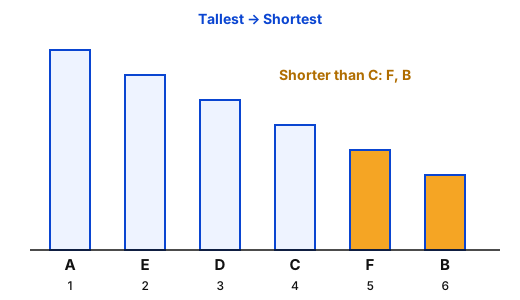
- E taller than exactly 4 → 2nd. F shorter than exactly 4 → 5th.
- A > D > C, and C is not the shortest; left places are 1, 3, 4, 6.
- So A = 1, D = 3, C = 4, B = 6.
- Shorter than C: F and B → 2.
Trick: "Taller than exactly " in people → rank from top.
Answer: (A) 2
अवधारणा: छहों को सबसे लंबे (1) से सबसे छोटे (6) तक क्रम दें।
- E ठीक 4 से लंबा → दूसरा। F ठीक 4 से छोटा → पाँचवाँ।
- A > D > C, और C सबसे छोटा नहीं; बचे स्थान 1, 3, 4, 6।
- अतः A = 1, D = 3, C = 4, B = 6।
- C से छोटे: F और B → 2।
ट्रिक: में "ठीक से लंबा" → ऊपर से स्थान ।
उत्तर: (A) 2
RRB NTPC Graduate CBT 2General Intelligence and ReasoningRanking – HeightRRB NTPC Graduate CBT 2 2024 · 13 Oct Shift 2

