Q41.What will come in the place of the question mark (?) in the following equation, if ‘+’ and ‘−’ are interchanged and ‘×’ and ‘÷’ are interchanged?
26 + 8 × 4 − 10 ÷ 5 = ?
यदि ‘+’ और ‘−’ को आपस में बदल दिया जाए तथा ‘×’ और ‘÷’ को आपस में बदल दिया जाए, तो निम्नलिखित समीकरण में प्रश्न चिह्न (?) के स्थान पर क्या आएगा?
26 + 8 × 4 − 10 ÷ 5 = ?
- A75
- B73
- C77
- D74
Show answer
Concept: Swap the signs first, then solve using BODMAS.
- After swapping:
- ,
Trick: Rewrite the whole expression with new signs before any calculation – avoids half-swapped errors.
Answer: (D) 74
अवधारणा: पहले चिह्न बदलें, फिर BODMAS से हल करें।
- बदलने के बाद:
- ,
ट्रिक: गणना से पहले पूरा व्यंजक नए चिह्नों के साथ दोबारा लिखें।
उत्तर: (D) 74
RRB NTPC Graduate CBT 2General Intelligence and ReasoningMathematical operations – interchangeRRB NTPC Graduate CBT 2 2024 · 13 Oct Shift 1
Q42.A, B, C, D, E, F, G and H are sitting around a square table facing the centre of the table. Some of them are sitting at the corners while some are sitting at the exact centre of the sides. F sits second to the right of G. F sits at one of the corners. Only three people sit between G and E when counted from the left of G. H sits third to the left of E. Only three people sit between H and B when counted from the left of H. C sits second to the right of B. D is not an immediate neighbour of E. How many people sit between E and D, when counted from the left of D?
A, B, C, D, E, F, G और H एक वर्गाकार मेज़ के चारों ओर मेज़ के केंद्र की ओर मुख करके बैठे हैं। उनमें से कुछ कोनों पर बैठे हैं, जबकि कुछ भुजाओं के ठीक मध्य में बैठे हैं। F, G के दाईं ओर दूसरे स्थान पर बैठा है। F एक कोने पर बैठा है। G के बाईं ओर से गिनने पर G और E के बीच केवल तीन व्यक्ति बैठे हैं। H, E के बाईं ओर तीसरे स्थान पर बैठा है। H के बाईं ओर से गिनने पर H और B के बीच केवल तीन व्यक्ति बैठे हैं। C, B के दाईं ओर दूसरे स्थान पर बैठा है। D, E का निकटतम पड़ोसी नहीं है। D के बाईं ओर से गिनने पर E और D के बीच कितने व्यक्ति बैठे हैं?
- ANoneकोई नहीं
- BOneएक
- CTwoदो
- DMore than twoदो से अधिक
Show answer
Concept: All face the centre, so 'left' means clockwise and 'right' means anticlockwise (seen from above).
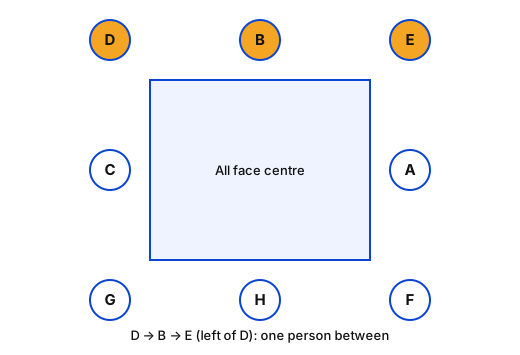
- Place G at a corner (F, second to G's right, must be a corner); F is two seats anticlockwise.
- E is 4th to G's left (three between); H is third to the left of E, i.e. just right of G.
- B is 4th to H's left; C is second to B's right; remaining seats go to D and A – D not next to E, so D sits between C and B.
- Going left (clockwise) from D: D → B → E, so one person (B) sits between.
Trick: In a facing-centre circle/square, left = clockwise; count seats, not people.
Answer: (B) One
अवधारणा: सभी केंद्र की ओर देख रहे हैं, अतः ऊपर से देखने पर 'बाएँ' = दक्षिणावर्त, 'दाएँ' = वामावर्त।
- G को कोने पर रखें (G के दूसरे दाएँ F कोने पर है); F, G से दो स्थान वामावर्त।
- E, G के बाएँ चौथे स्थान पर (बीच में तीन); H, E के तीसरे बाएँ, अर्थात G के ठीक दाएँ।
- B, H के बाएँ चौथे स्थान पर; C, B के दूसरे दाएँ; शेष स्थान D और A – D, E का पड़ोसी नहीं, अतः D, C और B के बीच।
- D से बाएँ (दक्षिणावर्त) गिनें: D → B → E, बीच में एक व्यक्ति (B)।
ट्रिक: केंद्र की ओर मुख हो तो बायाँ = दक्षिणावर्त; स्थान गिनें, सावधानी से।
उत्तर: (B) एक
RRB NTPC Graduate CBT 2General Intelligence and ReasoningSeating arrangement – square tableRRB NTPC Graduate CBT 2 2024 · 13 Oct Shift 1
Q43.In the following series, only one letter-cluster is incorrect. Select the INCORRECT letter- cluster.
HQK KNN NKQ QHS TEW WBZ
निम्नलिखित शृंखला में केवल एक अक्षर-समूह गलत है। गलत अक्षर-समूह का चयन कीजिए।
HQK KNN NKQ QHS TEW WBZ
- ANKQ
- BTEW
- CQHS
- DWBZ
Show answer
Concept: Track each letter position of the clusters separately.
- 1st letters: H, K, N, Q, T, W → each.
- 2nd letters: Q, N, K, H, E, B → each.
- 3rd letters: K, N, Q, T, W, Z → each; so 4th term should be QHT, not QHS.
Trick: Write position numbers under the third letters: 11, 14, 17, 19, 23, 26 – the break is obvious.
Answer: (C) QHS
अवधारणा: प्रत्येक स्थान के अक्षरों को अलग-अलग देखें।
- पहले अक्षर: H, K, N, Q, T, W → ।
- दूसरे अक्षर: Q, N, K, H, E, B → ।
- तीसरे अक्षर: K, N, Q, T, W, Z → ; अतः चौथा पद QHT होना चाहिए, QHS नहीं।
ट्रिक: तीसरे अक्षरों के क्रमांक: 11, 14, 17, 19, 23, 26 – गड़बड़ी तुरंत दिखती है।
उत्तर: (C) QHS
RRB NTPC Graduate CBT 2General Intelligence and ReasoningLetter series – wrong termRRB NTPC Graduate CBT 2 2024 · 13 Oct Shift 1
Q44.What should come in place of the question mark (?) in the given series?
7, 25, 61, 115, 187 , ?
दी गई शृंखला में प्रश्न चिह्न (?) के स्थान पर क्या आना चाहिए?
7, 25, 61, 115, 187 , ?
- A278
- B277
- C276
- D275
Show answer
Concept: Find the differences between consecutive terms.
- Differences: → multiples of 18.
- Next difference
Trick: Differences → arithmetic progression of second order.
Answer: (B) 277
अवधारणा: क्रमागत पदों के अंतर निकालें।
- अंतर: → 18 के गुणज।
- अगला अंतर
ट्रिक: अंतर → द्वितीय कोटि की समांतर श्रेणी।
उत्तर: (B) 277
RRB NTPC Graduate CBT 2General Intelligence and ReasoningNumber seriesRRB NTPC Graduate CBT 2 2024 · 13 Oct Shift 1
Q45.MOST is related to EFKK in a certain way based on the English alphabetical order. In the same way, GEMJ is related to YVEA. To which of the given options is IDOI related, following the same logic?
अंग्रेज़ी वर्णमाला क्रम के आधार पर MOST एक निश्चित प्रकार से EFKK से संबंधित है। उसी प्रकार, GEMJ, YVEA से संबंधित है। समान तर्क का अनुसरण करते हुए, IDOI दिए गए विकल्पों में से किससे संबंधित है?
- AAUZG
- BAGUZ
- CAUGZ
- DAGZU
Show answer
Concept: Find the shift for each letter position (cyclic A–Z).
- MOST → EFKK: , , ,
- Check GEMJ → YVEA: ✓
- IDOI: , , , → AUGZ
Trick: Alternate ; going below A wraps to Z (e.g. ).
Answer: (C) AUGZ
अवधारणा: प्रत्येक स्थान का विस्थापन ज्ञात करें (A–Z चक्रीय)।
- MOST → EFKK: , , ,
- जाँच GEMJ → YVEA: ✓
- IDOI: , , , → AUGZ
ट्रिक: बारी-बारी ; A से नीचे जाने पर Z पर लौटें ()।
उत्तर: (C) AUGZ
RRB NTPC Graduate CBT 2General Intelligence and ReasoningAnalogy – letter shiftsRRB NTPC Graduate CBT 2 2024 · 13 Oct Shift 1
Q46.What should come in place of the question mark (?) in the given series?
2 12 60 240 ? 1440
दी गई शृंखला में प्रश्न चिह्न (?) के स्थान पर क्या आना चाहिए?
2 12 60 240 ? 1440
- A760
- B720
- C660
- D780
Show answer
Concept: Check the ratio of consecutive terms.
- , ,
- Next:
- Check: ✓
Trick: Multipliers fall by 1: .
Answer: (B) 720
अवधारणा: क्रमागत पदों का अनुपात देखें।
- , ,
- अगला:
- जाँच: ✓
ट्रिक: गुणक 1-1 घटते हैं: ।
उत्तर: (B) 720
RRB NTPC Graduate CBT 2General Intelligence and ReasoningNumber seriesRRB NTPC Graduate CBT 2 2024 · 13 Oct Shift 1
Q47.Samar starts from point A and drives 7 km towards east. He then takes a right turn and drives 9 km. He takes a final right turn and drives 13 km and stops at point B. Wahid starts from point P, which is 14 km east of Point A, and drives 3 km towards west. He then takes a left turn and drives 9 km. He takes a final right turn and drives 8 km and stops at Point Q. What is the shortest distance between Point Q and Point B? (All turns are 90 degree turns only.)
समर बिंदु A से चलना शुरू करता है और पूर्व की ओर 7 km गाड़ी चलाता है। फिर वह दाएँ मुड़ता है और 9 km गाड़ी चलाता है। वह अंतिम बार दाएँ मुड़ता है और 13 km गाड़ी चलाकर बिंदु B पर रुक जाता है। वाहिद बिंदु P से, जो बिंदु A से 14 km पूर्व में है, चलना शुरू करता है और पश्चिम की ओर 3 km गाड़ी चलाता है। फिर वह बाएँ मुड़ता है और 9 km गाड़ी चलाता है। वह अंतिम बार दाएँ मुड़ता है और 8 km गाड़ी चलाकर बिंदु Q पर रुक जाता है। बिंदु Q और बिंदु B के बीच की न्यूनतम दूरी क्या है? (सभी मोड़ केवल 90 डिग्री के मोड़ हैं।)
- A11 km
- B10 km
- C9 km
- D8 km
Show answer
Concept: Take A as origin (East = +x, North = +y) and track coordinates after every turn.
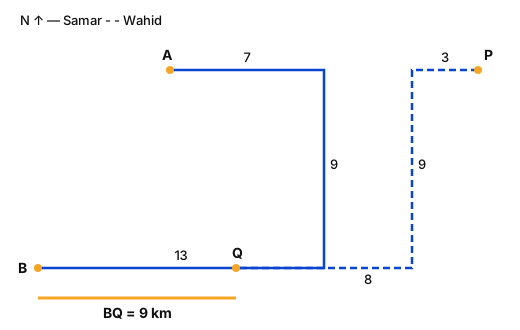
- Samar: east 7 → ; right (south) 9 → ; right (west) 13 → B .
- Wahid: P ; west 3 → ; left (south) 9 → ; right (west) 8 → Q .
- B and Q are on the same horizontal line: km.
Trick: Same y-coordinate → distance is just the difference of x-coordinates.
Answer: (C) 9 km
अवधारणा: A को मूल बिंदु लें (पूर्व = +x, उत्तर = +y) और हर मोड़ के बाद निर्देशांक लिखें।
- समर: पूर्व 7 → ; दाएँ (दक्षिण) 9 → ; दाएँ (पश्चिम) 13 → B ।
- वाहिद: P ; पश्चिम 3 → ; बाएँ (दक्षिण) 9 → ; दाएँ (पश्चिम) 8 → Q ।
- B और Q एक ही क्षैतिज रेखा पर: km।
ट्रिक: y-निर्देशांक समान → दूरी = x-निर्देशांकों का अंतर।
उत्तर: (C) 9 km
RRB NTPC Graduate CBT 2General Intelligence and ReasoningDirection and distanceRRB NTPC Graduate CBT 2 2024 · 13 Oct Shift 1
Q48.If ‘A’ stands for ‘+’, ‘B’ stands for ‘−’, ‘C’ stands for ‘×’ and ‘D’ stands for ‘÷‘, what will come in place of the question mark (?) in the following equation?
25 C 3 B 12 D 4 A 10 = ?
यदि ‘A’ का अर्थ ‘+’, ‘B’ का अर्थ ‘−’, ‘C’ का अर्थ ‘×’ और ‘D’ का अर्थ ‘÷‘ है, तो निम्नलिखित समीकरण में प्रश्न चिह्न (?) के स्थान पर क्या आएगा?
25 C 3 B 12 D 4 A 10 = ?
- A83
- B81
- C82
- D80
Show answer
Concept: Replace letters by operators, then apply BODMAS.
- ,
Trick: Decode the whole line first: C = ×, B = −, D = ÷, A = +.
Answer: (C) 82
अवधारणा: अक्षरों को चिह्नों से बदलें, फिर BODMAS लगाएँ।
- ,
ट्रिक: पहले पूरी पंक्ति डिकोड करें: C = ×, B = −, D = ÷, A = +।
उत्तर: (C) 82
RRB NTPC Graduate CBT 2General Intelligence and ReasoningMathematical operations – letter codingRRB NTPC Graduate CBT 2 2024 · 13 Oct Shift 1
Q49.In the following series, only one letter-cluster is incorrect. Select the INCORRECT letter- cluster.
FHK IKN LNQ OQT RSW
निम्नलिखित शृंखला में केवल एक अक्षर-समूह गलत है। गलत अक्षर-समूह का चयन कीजिए।
FHK IKN LNQ OQT RSW
- AOQT
- BFHK
- CLNQ
- DRSW
Show answer
Concept: Check each letter position separately.
- 1st letters: F, I, L, O, R →
- 2nd letters: H, K, N, Q, should be T →
- 3rd letters: K, N, Q, T, W → ; so last term should be RTW, not RSW.
Trick: Each cluster is 'x, x+2, x+5' – RSW breaks the gap of 2 between first and second letters.
Answer: (D) RSW
अवधारणा: प्रत्येक स्थान के अक्षर अलग से देखें।
- पहले अक्षर: F, I, L, O, R →
- दूसरे अक्षर: H, K, N, Q, अगला T होना चाहिए →
- तीसरे अक्षर: K, N, Q, T, W → ; अतः अंतिम पद RTW होना चाहिए, RSW नहीं।
ट्रिक: प्रत्येक समूह 'x, x+2, x+5' है – RSW में पहले-दूसरे अक्षर का अंतर 2 नहीं।
उत्तर: (D) RSW
RRB NTPC Graduate CBT 2General Intelligence and ReasoningLetter series – wrong termRRB NTPC Graduate CBT 2 2024 · 13 Oct Shift 1
Q50.What will come in the place of the question mark (?) in the following equation, if ‘+’ and ‘−’ are interchanged and ‘×’ and ‘÷’ are interchanged?
32 − 15 ÷ 5 + 10 × 2 = ?
यदि ‘+’ और ‘−’ को आपस में बदल दिया जाए तथा ‘×’ और ‘÷’ को आपस में बदल दिया जाए, तो निम्नलिखित समीकरण में प्रश्न चिह्न (?) के स्थान पर क्या आएगा?
32 − 15 ÷ 5 + 10 × 2 = ?
- A101
- B100
- C103
- D102
Show answer
Concept: Interchange the signs first, then apply BODMAS.
- After swapping:
- ,
Trick: Rewrite the full expression with new signs before solving.
Answer: (D) 102
अवधारणा: पहले चिह्न बदलें, फिर BODMAS लगाएँ।
- बदलने के बाद:
- ,
ट्रिक: हल करने से पहले पूरा व्यंजक नए चिह्नों से लिखें।
उत्तर: (D) 102
RRB NTPC Graduate CBT 2General Intelligence and ReasoningMathematical operations – interchangeRRB NTPC Graduate CBT 2 2024 · 13 Oct Shift 1
Q51.Refer to the following letter, number, symbol series and answer the question
(Left) $ T 1 & 9 Z 7 * A M S 1 * D % 7 * (Right)
If all the symbols are dropped from the series, which of the following will be seventh from the right?
निम्नलिखित अक्षर, संख्या, प्रतीक शृंखला को देखिए और प्रश्न का उत्तर दीजिए
(बाएँ) $ T 1 & 9 Z 7 * A M S 1 * D % 7 * (दाएँ)
यदि शृंखला से सभी प्रतीक हटा दिए जाएँ, तो निम्नलिखित में से कौन दाएँ से सातवाँ होगा?
- AT
- B7
- C9
- D1
Show answer
Concept: Remove all symbols ($, &, *, %) and then count positions.
- Remaining: T 1 9 Z 7 A M S 1 D 7 → 11 elements.
- 7th from right = th from left.
- 5th from left = 7
Trick: th from right th from left.
Answer: (B) 7
अवधारणा: सभी चिह्न ($, &, *, %) हटाएँ, फिर स्थान गिनें।
- शेष: T 1 9 Z 7 A M S 1 D 7 → 11 पद।
- दाएँ से 7वाँ वाँ बाएँ से।
- बाएँ से 5वाँ = 7
ट्रिक: दाएँ से वाँ वाँ बाएँ से।
उत्तर: (B) 7
RRB NTPC Graduate CBT 2General Intelligence and ReasoningAlphanumeric seriesRRB NTPC Graduate CBT 2 2024 · 13 Oct Shift 1
Q52.A, B, C, D, X and Y each scored different marks. Only two people have scored more than A. Only B has scored less than D. X has scored more than Y but less than C. How many people have scored more than X?
A, B, C, D, X और Y में से प्रत्येक ने अलग-अलग अंक प्राप्त किए। केवल दो व्यक्तियों ने A से अधिक अंक प्राप्त किए हैं। केवल B ने D से कम अंक प्राप्त किए हैं। X ने Y से अधिक लेकिन C से कम अंक प्राप्त किए हैं। कितने व्यक्तियों ने X से अधिक अंक प्राप्त किए हैं?
- AFourचार
- BOneएक
- CTwoदो
- DThreeतीन
Show answer
Concept: Fix the definite positions first, then fill the rest with the remaining conditions.
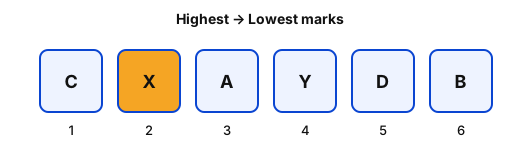
- Only two scored more than A → A is 3rd.
- Only B scored less than D → B is 6th, D is 5th.
- Left positions 1, 2, 4 for C, X, Y with C > X > Y → C 1st, X 2nd, Y 4th.
- Only C scored more than X → one person.
Trick: Place the 'only' clues first – they fix exact ranks.
Answer: (B) One
अवधारणा: पहले निश्चित स्थान तय करें, फिर बाकी शर्तों से भरें।
- केवल दो ने A से अधिक अंक पाए → A तीसरे स्थान पर।
- केवल B ने D से कम पाए → B छठे, D पाँचवें।
- शेष स्थान 1, 2, 4 पर C, X, Y; C > X > Y → C पहले, X दूसरे, Y चौथे।
- X से अधिक केवल C → एक व्यक्ति।
ट्रिक: 'केवल' वाले संकेत पहले लगाएँ – वे सटीक स्थान देते हैं।
उत्तर: (B) एक
RRB NTPC Graduate CBT 2General Intelligence and ReasoningRanking – comparisonRRB NTPC Graduate CBT 2 2024 · 13 Oct Shift 1
Q53.MPQO is related to UXYW in a certain way based on the English alphabetical order. In the same way, DGHF is related to LOPN. To which of the given options is KNOM related, following the same logic?
अंग्रेज़ी वर्णमाला क्रम के आधार पर MPQO एक निश्चित प्रकार से UXYW से संबंधित है। उसी प्रकार, DGHF, LOPN से संबंधित है। समान तर्क का अनुसरण करते हुए, KNOM दिए गए विकल्पों में से किससे संबंधित है?
- ASWUV
- BSVWU
- CSUWV
- DSWVU
Show answer
Concept: Each letter of the first cluster is shifted forward by the same number of places.
- M→U, P→X, Q→Y, O→W: each letter .
- D→L, G→O, H→P, F→N: again each .
- K+8 = S, N+8 = V, O+8 = W, M+8 = U → SVWU.
Trick: Check only the first letter of each option: all start with S, so test the second letter N+8 = V.
Answer: (B) SVWU
अवधारणा: पहले समूह के हर अक्षर को समान स्थान आगे बढ़ाया गया है।
- M→U, P→X, Q→Y, O→W: हर अक्षर ।
- D→L, G→O, H→P, F→N: फिर से हर अक्षर ।
- K+8 = S, N+8 = V, O+8 = W, M+8 = U → SVWU।
ट्रिक: सभी विकल्प S से शुरू हैं, तो दूसरा अक्षर जाँचें: N+8 = V, केवल (B) में।
उत्तर: (B) SVWU
RRB NTPC Graduate CBT 2General Intelligence and ReasoningLetter AnalogyRRB NTPC Graduate CBT 2 2024 · 13 Oct Shift 1
Q54.Each of P, Q, R, S, T, U and V has an exam on a different day of a week starting from Monday and ending on Sunday of the same week. Q has an exam on Thursday. Exactly four people have their exam between U and P, neither of whom has an exam on Sunday. R has an exam immediately before S. V does not have an exam on Friday. U does not have an exam after S. How many people have exams after P?
P, Q, R, S, T, U और V में से प्रत्येक की परीक्षा एक ही सप्ताह के सोमवार से शुरू होकर रविवार को समाप्त होने वाले सप्ताह के अलग-अलग दिन है। Q की परीक्षा गुरुवार को है। U और P के बीच ठीक चार व्यक्तियों की परीक्षा है, और इन दोनों (U और P) में से किसी की भी परीक्षा रविवार को नहीं है। R की परीक्षा S से ठीक पहले है। V की परीक्षा शुक्रवार को नहीं है। U की परीक्षा S के बाद नहीं है। P के बाद कितने व्यक्तियों की परीक्षा है?
- A4
- B3
- C1
- D2
Show answer
Concept: Use the fixed day (Q on Thursday) and the gap condition between U and P first.
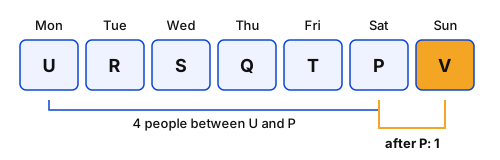
- Four people between U and P → they are on (Mon, Sat) or (Tue, Sun); Sunday is not allowed → U, P on Mon and Sat.
- If U were Saturday, S would have to be Sunday and R Saturday – clash. So U = Mon, P = Sat.
- R, S consecutive in the free days → R = Tue, S = Wed.
- T and V take Fri, Sun; V not Friday → T = Fri, V = Sun. After P (Sat) only V → 1.
Trick: With 7 days, "4 between" leaves only two pairs: (1, 6) or (2, 7).
Answer: (C) 1
अवधारणा: पहले निश्चित दिन (Q – गुरुवार) और U, P के बीच के अंतर वाली शर्त लगाएँ।
- U और P के बीच 4 लोग → (सोम, शनि) या (मंगल, रवि); रविवार नहीं हो सकता → U, P सोम और शनि पर।
- यदि U शनिवार हो तो S रविवार और R शनिवार होगा – टकराव। अतः U = सोम, P = शनि।
- R, S लगातार → R = मंगल, S = बुध।
- T, V के लिए शुक्र, रवि; V शुक्रवार नहीं → T = शुक्र, V = रवि। P (शनि) के बाद केवल V → 1।
ट्रिक: 7 दिनों में "बीच में 4" के केवल दो जोड़े: (1, 6) या (2, 7)।
उत्तर: (C) 1
RRB NTPC Graduate CBT 2General Intelligence and ReasoningScheduling PuzzleRRB NTPC Graduate CBT 2 2024 · 13 Oct Shift 1
Q55.Study the given Venn diagram carefully and answer the question that follows. The numbers in different sections indicate the number of persons.
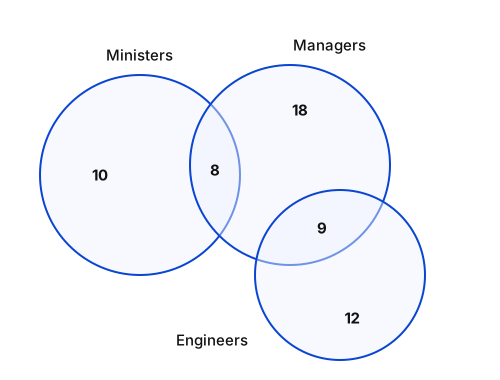
How many Ministers are there who are Managers but NOT Engineers?
दिए गए वेन आरेख का ध्यानपूर्वक अध्ययन कीजिए और उसके बाद दिए गए प्रश्न का उत्तर दीजिए। विभिन्न भागों में दी गई संख्याएँ व्यक्तियों की संख्या दर्शाती हैं।
ऐसे कितने मंत्री (Ministers) हैं जो प्रबंधक (Managers) हैं लेकिन इंजीनियर (Engineers) नहीं हैं?
- A10
- B8
- C9
- D18
Show answer
Concept: Ministers who are Managers but not Engineers = region common to Ministers and Managers only, outside the Engineers circle.
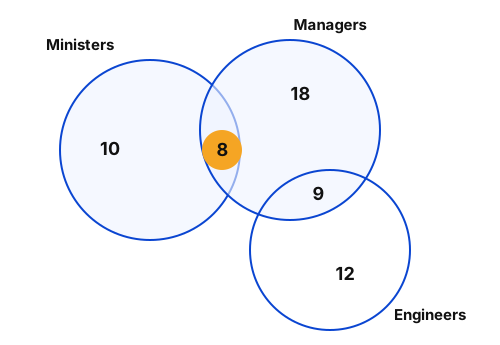
- Region only in Ministers = 10 (not Managers).
- Region in Managers and Engineers = 9 (not Ministers).
- Region common to Ministers and Managers only = 8.
Trick: Read the question as "inside A and B, outside C" and shade just that region.
Answer: (B) 8
अवधारणा: जो मंत्री (Ministers) प्रबंधक (Managers) हैं पर इंजीनियर नहीं = केवल Ministers और Managers का साझा भाग, Engineers वृत्त के बाहर।
- केवल Ministers वाला भाग = 10 (Managers नहीं)।
- Managers और Engineers का भाग = 9 (Ministers नहीं)।
- केवल Ministers और Managers का साझा भाग = 8।
ट्रिक: प्रश्न को "A और B के अंदर, C के बाहर" पढ़ें और केवल वही भाग छायांकित करें।
उत्तर: (B) 8
RRB NTPC Graduate CBT 2General Intelligence and ReasoningVenn DiagramRRB NTPC Graduate CBT 2 2024 · 13 Oct Shift 1
Q56.What should come in place of the question mark (?) in the given series?
12, 25, 51, 90, 142 , ?
दी गई शृंखला में प्रश्न चिह्न (?) के स्थान पर क्या आना चाहिए?
12, 25, 51, 90, 142 , ?
- A207
- B206
- C208
- D209
Show answer
Concept: Look at the differences between consecutive terms.
- Differences: , , , .
- They are multiples of 13: .
- Next difference → .
Trick: Differences in a table of a number (13, 26, 39…) → just add the next multiple.
Answer: (A) 207
अवधारणा: क्रमागत पदों के अंतर देखें।
- अंतर: , , , ।
- ये 13 के गुणज हैं: ।
- अगला अंतर → ।
ट्रिक: अंतर किसी संख्या का पहाड़ा (13, 26, 39…) हों तो अगला गुणज जोड़ दें।
उत्तर: (A) 207
RRB NTPC Graduate CBT 2General Intelligence and ReasoningNumber SeriesRRB NTPC Graduate CBT 2 2024 · 13 Oct Shift 1
Q57.In a certain code language,
A + B means ‘A is the mother of B’,
A – B means ‘A is the brother of B’,
A x B means ‘A is the wife of B’,
and A ÷ B means ‘A is the father of B’.
Which of the following means that R is the mother's brother of T ?
एक निश्चित कूट भाषा में,
A + B का अर्थ है ‘A, B की माता है’,
A – B का अर्थ है ‘A, B का भाई है’,
A x B का अर्थ है ‘A, B की पत्नी है’,
और A ÷ B का अर्थ है ‘A, B का पिता है’।
निम्नलिखित में से किसका अर्थ है कि R, T का मामा (माता का भाई) है?
- AP x Q ÷ R – S x T
- BP ÷ Q x R ÷ S + T
- CP ÷ Q x R – S + T
- DP ÷ Q – R x S – T
Show answer
Concept: Decode each option; R must be the brother of a woman who is T's mother.
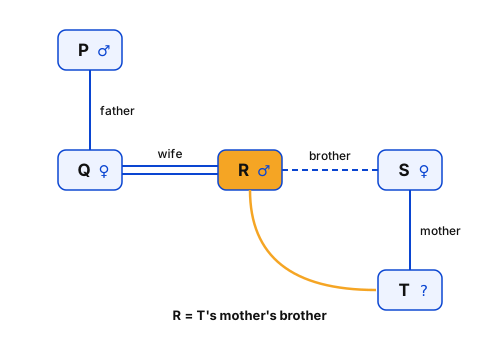
- Option (C): P ÷ Q → P is father of Q; Q × R → Q is wife of R.
- R – S → R is brother of S; S + T → S is mother of T.
- So S is T's mother and R is her brother → R is T's mother's brother (maternal uncle).
- In (B), R ÷ S makes R a father, and in (D), R × S makes R a wife – both wrong.
Trick: Look for the pattern "R – S + T" (R brother of S, S mother of T) in the options.
Answer: (C) P ÷ Q x R – S + T
अवधारणा: हर विकल्प को डिकोड करें; R उस महिला का भाई होना चाहिए जो T की माँ है।
- विकल्प (C): P ÷ Q → P, Q का पिता; Q × R → Q, R की पत्नी।
- R – S → R, S का भाई; S + T → S, T की माँ।
- अतः S, T की माँ है और R उसका भाई → R, T का मामा (mother's brother) है।
- (B) में R ÷ S से R पिता बनता है, (D) में R × S से R पत्नी – दोनों गलत।
ट्रिक: विकल्पों में "R – S + T" (R, S का भाई; S, T की माँ) ढूँढें।
उत्तर: (C) P ÷ Q x R – S + T
RRB NTPC Graduate CBT 2General Intelligence and ReasoningCoded Blood RelationsRRB NTPC Graduate CBT 2 2024 · 13 Oct Shift 1
Q58.In the following series, only one letter-cluster is incorrect. Select the INCORRECT letter- cluster.
JFB RNJ ZVR HDZ PLK XTP
निम्नलिखित शृंखला में केवल एक अक्षर-समूह गलत है। गलत अक्षर-समूह का चयन कीजिए।
JFB RNJ ZVR HDZ PLK XTP
- AHDZ
- BZVR
- CPLK
- DRNJ
Show answer
Concept: Each position of the clusters moves forward by the same step.
- First letters: J, R, Z, H, P, X – each (with wrap-around).
- Second letters: F, N, V, D, L, T – each .
- Third letters: B, J, R, Z, ?, P → after Z comes Z+8 = H, so the fifth cluster should be PLH.
- Given PLK breaks the pattern.
Trick: Check one position at a time; the odd letter shows the wrong cluster at once.
Answer: (C) PLK
अवधारणा: हर समूह का हर स्थान समान कदम से आगे बढ़ता है।
- पहले अक्षर: J, R, Z, H, P, X – हर बार (Z के बाद फिर A से)।
- दूसरे अक्षर: F, N, V, D, L, T – हर बार ।
- तीसरे अक्षर: B, J, R, Z, ?, P → Z+8 = H, अतः पाँचवाँ समूह PLH होना चाहिए।
- दिया गया PLK पैटर्न तोड़ता है।
ट्रिक: एक-एक स्थान अलग जाँचें; गलत अक्षर तुरंत गलत समूह दिखा देता है।
उत्तर: (C) PLK
RRB NTPC Graduate CBT 2General Intelligence and ReasoningLetter Cluster SeriesRRB NTPC Graduate CBT 2 2024 · 13 Oct Shift 1
Q59.Based on the English alphabetical order, three of the following four letter-cluster pairs are alike in a certain way and thus form a group. Which is the letter-cluster pair that DOES NOT belong to that group?
(Note: The odd one out is not based on the number of consonants/vowels or their position in the letter-cluster.)
अंग्रेज़ी वर्णमाला क्रम के आधार पर, निम्नलिखित चार अक्षर-समूह युग्मों में से तीन किसी निश्चित प्रकार से एक समान हैं और इस प्रकार एक समूह बनाते हैं। वह कौन-सा अक्षर-समूह युग्म है जो उस समूह से संबंधित नहीं है?
(नोट: असंगत को व्यंजनों/स्वरों की संख्या या अक्षर-समूह में उनके स्थान के आधार पर नहीं चुना गया है।)
- AKO−NR
- BMQ−PT
- CAE−DH
- DGK−IP
Show answer
Concept: Find the letter-gaps inside each pair: first cluster XY, second cluster PQ.
- KO−NR: K+4 = O, K+3 = N, N+4 = R.
- MQ−PT: M+4 = Q, M+3 = P, P+4 = T. AE−DH: A+4 = E, A+3 = D, D+4 = H.
- GK−IP: G+4 = K but G+2 = I and I+7 = P – pattern broken.
Trick: Pattern is (+4) in each cluster and (+3) between clusters; GK−IP fails at once.
Answer: (D) GK−IP
अवधारणा: हर युग्म के अंदर अक्षरों का अंतर देखें।
- KO−NR: K+4 = O, K+3 = N, N+4 = R।
- MQ−PT: M+4 = Q, M+3 = P, P+4 = T। AE−DH: A+4 = E, A+3 = D, D+4 = H।
- GK−IP: G+4 = K पर G+2 = I और I+7 = P – पैटर्न टूटा।
ट्रिक: हर समूह में (+4) और दोनों समूहों के बीच (+3); GK−IP तुरंत अलग।
उत्तर: (D) GK−IP
RRB NTPC Graduate CBT 2General Intelligence and ReasoningOdd One Out (Letter Pairs)RRB NTPC Graduate CBT 2 2024 · 13 Oct Shift 1
Q60.In the following triads, each group of letters is related to the subsequent one following a certain logic. Select from the given options, the one which follows the same logic. WASH - HSWA - WSAH
NEST - TSNE - NSET
निम्नलिखित त्रयी (triads) में, अक्षरों का प्रत्येक समूह एक निश्चित तर्क का अनुसरण करते हुए अगले समूह से संबंधित है। दिए गए विकल्पों में से उसका चयन कीजिए जो समान तर्क का अनुसरण करता है। WASH - HSWA - WSAH
NEST - TSNE - NSET
- AFOGS - SGFO - OGFS
- BPACE - PCAE - ECAP
- CTRAY - RATY - RAYT
- DOILS - SLOI - OLIS
Show answer
Concept: Number the letters 1 2 3 4 and find how positions move.
- WASH → HSWA: order 4 3 1 2. NEST → TSNE: same 4 3 1 2.
- HSWA → WSAH: order 3 2 4 1 of the second word (NSET from TSNE too).
- OILS → 4 3 1 2 = SLOI; SLOI → 3 2 4 1 = OLIS. Matches (D).
- FOGS → 4 3 1 2 would be SGFO ✓, but SGFO → 3 2 4 1 = FGOS, not OGFS.
Trick: Fix the rule on one triad, verify on the second, then test options only.
Answer: (D) OILS - SLOI - OLIS
अवधारणा: अक्षरों को 1 2 3 4 क्रमांक दें और स्थान परिवर्तन देखें।
- WASH → HSWA: क्रम 4 3 1 2। NEST → TSNE: वही 4 3 1 2।
- HSWA → WSAH: दूसरे शब्द का क्रम 3 2 4 1 (TSNE → NSET भी)।
- OILS → 4 3 1 2 = SLOI; SLOI → 3 2 4 1 = OLIS। (D) मेल खाता है।
- FOGS → SGFO ✓, पर SGFO → 3 2 4 1 = FGOS, OGFS नहीं।
ट्रिक: एक त्रिक से नियम निकालें, दूसरे पर जाँचें, फिर विकल्प परखें।
उत्तर: (D) OILS - SLOI - OLIS
RRB NTPC Graduate CBT 2General Intelligence and ReasoningLetter Triads (Position Rearrangement)RRB NTPC Graduate CBT 2 2024 · 13 Oct Shift 1

