RRB NTPC Graduate CBT 2 · 120 questions

RRB NTPC Graduate CBT 2 2025 PYQs

Real previous year questions, subject-wise. Try the question, then open the answer and the explanation in Hindi & English – free, no login.

Courses – airGurukul

35 questions in Mathematics.

Q21.
A person travels from place P to place Q to buy an article that costs 15% less at Q than at P. He spends ₹150 on travel and still saves ₹150 compared to buying the article at P. What is his percentage saving with respect to the price at P?
एक व्यक्ति एक वस्तु खरीदने के लिए स्थान P से स्थान Q जाता है, जिसकी कीमत Q पर P की तुलना में 15% कम है। वह यात्रा पर ₹150 खर्च करता है और फिर भी P पर वस्तु खरीदने की तुलना में ₹150 बचाता है। P पर कीमत के सापेक्ष उसकी प्रतिशत बचत कितनी है?
  1. A7.5%
  2. B3.5%
  3. C9%
  4. D4.5%
Show answer

Concept: Net saving = (price at P) − (price at Q + travel cost). Form an equation in the price at P.

  1. Let price at P =x; at Q it is 0.85x.
  2. x−(0.85x+150)=150⇒0.15x=300⇒x=2000.
  3. Saving % w.r.t. P =1502000×100=7.5%.

Trick: 15% of the price = travel + saving = ₹300, so price = ₹2000; ₹150 of ₹2000 = 7.5%.

Answer: (A) 7.5%

अवधारणा: शुद्ध बचत = (P पर मूल्य) − (Q पर मूल्य + यात्रा खर्च)। P के मूल्य में समीकरण बनाएँ।

  1. P पर मूल्य =x; Q पर 0.85x।
  2. x−(0.85x+150)=150⇒0.15x=300⇒x=2000।
  3. P के सापेक्ष बचत % =1502000×100=7.5%।

ट्रिक: मूल्य का 15% = यात्रा + बचत = ₹300, अतः मूल्य = ₹2000; ₹2000 में ₹150 = 7.5%।

उत्तर: (A) 7.5%
RRB NTPC Graduate CBT 2MathematicsPercentageRRB NTPC Graduate CBT 2 2025 · 10 Jul Shift 1
Q22.
A sum of ₹3059 is divided into three parts such that half of the first part, one-fourth of the second part, and one-eighth of the third part are equal. Find the value (in ₹) of the third part.
₹3059 की एक राशि को तीन भागों में इस प्रकार विभाजित किया जाता है कि पहले भाग का आधा, दूसरे भाग का एक-चौथाई और तीसरे भाग का एक-आठवाँ बराबर हों। तीसरे भाग का मान (₹ में) ज्ञात कीजिए।
  1. A1848
  2. B1748
  3. C1548
  4. D1948
Show answer

Concept: If a2=b4=c8=k, then a:b:c=2:4:8=1:2:4.

  1. Total ratio units =1+2+4=7.
  2. Third part =47×3059=4×437=1748.

Trick: Fractions 12,14,18 equal ⇒ parts are in ratio of the denominators 2 : 4 : 8.

Answer: (B) 1748

अवधारणा: यदि a2=b4=c8=k, तो a:b:c=2:4:8=1:2:4।

  1. कुल अनुपात इकाइयाँ =1+2+4=7।
  2. तीसरा भाग =47×3059=4×437=1748।

ट्रिक: 12,14,18 बराबर ⇒ भाग हरों के अनुपात 2 : 4 : 8 में होंगे।

उत्तर: (B) 1748

RRB NTPC Graduate CBT 2MathematicsRatio – Division of a SumRRB NTPC Graduate CBT 2 2025 · 10 Jul Shift 1
Q23.
A can complete a work in 9 days and B can complete the same work in 22 days. If they work together for 2 days, what fraction of the work remains unfinished?
A एक कार्य को 9 दिनों में और B उसी कार्य को 22 दिनों में पूरा कर सकता है। यदि वे 2 दिनों तक एक साथ कार्य करते हैं, तो कार्य का कितना भाग अपूर्ण रह जाता है?
  1. A7699
  2. B6899
  3. C7199
  4. D7399
Show answer

Concept: One-day work of A and B together =1a+1b; remaining work =1− work done.

  1. Together in 1 day: 19+122=22+9198=31198.
  2. In 2 days: 62198=3199.
  3. Remaining =1−3199=6899.

Trick: Take total work = LCM(9, 22) = 198 units; A = 22/day, B = 9/day; 2 days = 62 units; left =136198=6899.

Answer: (B) 6899

अवधारणा: A और B का एक दिन का कार्य =1a+1b; शेष कार्य =1− किया गया कार्य।

  1. एक दिन में साथ: 19+122=22+9198=31198।
  2. 2 दिन में: 62198=3199।
  3. शेष =1−3199=6899।

ट्रिक: कुल कार्य = LCM(9, 22) = 198 इकाई; A = 22/दिन, B = 9/दिन; 2 दिन = 62 इकाई; शेष =136198=6899।

उत्तर: (B) 6899

RRB NTPC Graduate CBT 2MathematicsTime and WorkRRB NTPC Graduate CBT 2 2025 · 10 Jul Shift 1
Q24.
A shopkeeper buys a laptop for ₹40,000. He first sells it at a 20% profit. Later, the buyer sells it to another person at a 10% loss. What is the final selling price of the laptop?
एक दुकानदार ₹40,000 में एक लैपटॉप खरीदता है। वह पहले इसे 20% लाभ पर बेचता है। बाद में, खरीदार इसे किसी अन्य व्यक्ति को 10% हानि पर बेच देता है। लैपटॉप का अंतिम विक्रय मूल्य क्या है?
  1. A₹43,200
  2. B₹42,000
  3. C₹50,000
  4. D₹48,000
Show answer

Concept: Apply each percentage change on the latest price: SP =CP×100±r100.

  1. First sale at 20% profit: 40000×1.2= ₹48,000.
  2. Second sale at 10% loss: 48000×0.9= ₹43,200.

Trick: Net multiplier =1.2×0.9=1.08, i.e. 40000×1.08=43200.

Answer: (A) ₹43,200

अवधारणा: हर प्रतिशत परिवर्तन नवीनतम मूल्य पर लगाएँ: SP =CP×100±r100।

  1. पहली बिक्री 20% लाभ पर: 40000×1.2= ₹48,000।
  2. दूसरी बिक्री 10% हानि पर: 48000×0.9= ₹43,200।

ट्रिक: शुद्ध गुणक =1.2×0.9=1.08, अर्थात 40000×1.08=43200।

उत्तर: (A) ₹43,200

RRB NTPC Graduate CBT 2MathematicsProfit and Loss – Successive TransactionsRRB NTPC Graduate CBT 2 2025 · 10 Jul Shift 1
Q25.
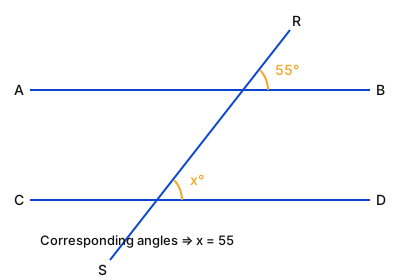
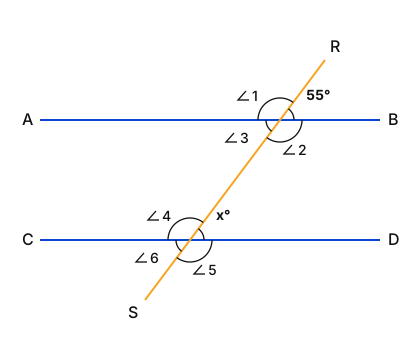
In the given figure, AB is parallel to CD and RS is a transversal. Find the value of X.
दी गई आकृति में, AB, CD के समांतर है और RS एक तिर्यक रेखा है। X का मान ज्ञात कीजिए।
  1. A55
  2. B45
  3. C35
  4. D65
Show answer

Concept: When a transversal cuts two parallel lines, corresponding angles are equal.

  1. The 55∘ angle is at the upper-right of the intersection with AB; x∘ is at the upper-right of the intersection with CD.
  2. These are corresponding angles (same position at each intersection), so x=55.

Trick: Parallel lines + transversal: “same corner” angles (F-shape) are equal; the acute angles all equal 55∘ and the obtuse ones 125∘.

Answer: (A) 55

अवधारणा: दो समांतर रेखाओं को काटने वाली तिर्यक रेखा से बने संगत कोण (corresponding angles) बराबर होते हैं।

  1. 55∘ का कोण AB के प्रतिच्छेद बिंदु के ऊपर-दाईं ओर है; x∘ CD के प्रतिच्छेद बिंदु के ऊपर-दाईं ओर।
  2. ये संगत कोण हैं (दोनों प्रतिच्छेदों पर एक ही स्थिति), अतः x=55।

ट्रिक: समांतर रेखाएँ + तिर्यक रेखा: “एक ही कोने” वाले कोण (F-आकार) बराबर; सभी न्यून कोण 55∘ और सभी अधिक कोण 125∘।

उत्तर: (A) 55

RRB NTPC Graduate CBT 2MathematicsLines and Angles – Parallel LinesRRB NTPC Graduate CBT 2 2025 · 10 Jul Shift 1
Q26.
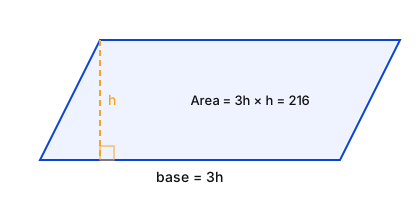
The base of a parallelogram is thrice its height. If the area of the parallelogram is 216 cm2, then find its height.
एक समांतर चतुर्भुज का आधार उसकी ऊँचाई का तीन गुना है। यदि समांतर चतुर्भुज का क्षेत्रफल 216 cm2 है, तो उसकी ऊँचाई ज्ञात कीजिए।
  1. A52 cm
  2. B72 cm
  3. C82 cm
  4. D62 cm
Show answer

Concept: Area of a parallelogram =base×height.

  1. Let height =h, base =3h.
  2. 3h×h=216⇒h2=72.
  3. h=72=36×2=62 cm.

Trick: 72=36×2 – pull out the perfect square to simplify the root quickly.

Answer: (D) 62 cm

अवधारणा: समांतर चतुर्भुज का क्षेत्रफल =आधार×ऊँचाई।

  1. ऊँचाई =h, आधार =3h।
  2. 3h×h=216⇒h2=72।
  3. h=72=36×2=62 cm।

ट्रिक: 72=36×2 – पूर्ण वर्ग बाहर निकालकर मूल जल्दी सरल करें।

उत्तर: (D) 62 cm

RRB NTPC Graduate CBT 2MathematicsMensuration – ParallelogramRRB NTPC Graduate CBT 2 2025 · 10 Jul Shift 1
Q27.
Find the vertex C (x, y) of a ∆ABC whose other vertices are A(1, 5) and B(4, 7), and the centroid is D(4, 5).
एक ∆ABC का शीर्ष C (x, y) ज्ञात कीजिए, जिसके अन्य शीर्ष A(1, 5) और B(4, 7) हैं और केंद्रक D(4, 5) है।
  1. AC (7, 4)
  2. BC (3, 6)
  3. CC (6, 3)
  4. DC (7, 3)
Show answer

Concept: Centroid =(x1+x2+x33,y1+y2+y33).

  1. 1+4+x3=4⇒x=12−5=7.
  2. 5+7+y3=5⇒y=15−12=3.
  3. C =(7,3).

Trick: Third vertex =3×centroid−(A+B)=(12−5,15−12).

Answer: (D) C (7, 3)

अवधारणा: केन्द्रक =(x1+x2+x33,y1+y2+y33)।

  1. 1+4+x3=4⇒x=12−5=7।
  2. 5+7+y3=5⇒y=15−12=3।
  3. C =(7,3)।

ट्रिक: तीसरा शीर्ष =3×केन्द्रक−(A+B)=(12−5,15−12)।

उत्तर: (D) C (7, 3)

RRB NTPC Graduate CBT 2MathematicsCoordinate Geometry – CentroidRRB NTPC Graduate CBT 2 2025 · 10 Jul Shift 1
Q28.
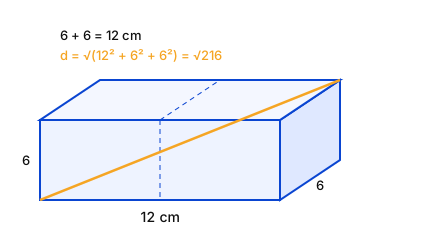
Two cubes, each of volume 216 cm3, are joined end to end. Find the length of the diagonal of the resulting cuboid.
216 cm3 आयतन वाले दो घनों को सिरे से सिरा मिलाकर जोड़ा जाता है। इस प्रकार बने घनाभ के विकर्ण की लंबाई ज्ञात कीजिए।
  1. A52 cm
  2. B87 cm
  3. C73 cm
  4. D66 cm
Show answer

Concept: Diagonal of a cuboid =l2+b2+h2.

  1. Cube side =2163=6 cm.
  2. Joined end to end: cuboid 12×6×6 cm.
  3. Diagonal =144+36+36=216=66 cm.

Trick: For a cuboid 2a×a×a, diagonal =a6; here a=6.

Answer: (D) 66 cm

अवधारणा: घनाभ का विकर्ण =l2+b2+h2।

  1. घन की भुजा =2163=6 cm।
  2. सिरे से सिरा जोड़ने पर घनाभ 12×6×6 cm।
  3. विकर्ण =144+36+36=216=66 cm।

ट्रिक: 2a×a×a घनाभ का विकर्ण =a6; यहाँ a=6।

उत्तर: (D) 66 cm

RRB NTPC Graduate CBT 2MathematicsMensuration – Cuboid DiagonalRRB NTPC Graduate CBT 2 2025 · 10 Jul Shift 1
Q29.
Choose the correct statements about quadrilaterals from the ones given below. A. In an isosceles trapezium, the parallel sides are equal.
B. Kite is a type of parallelogram.
C. All squares are rhombus.
D. The quadrilateral formed by joining the mid-points of the sides of any quadrilateral is a trapezium.
नीचे दिए गए कथनों में से चतुर्भुजों के बारे में सही कथनों का चयन कीजिए। A. एक समद्विबाहु समलंब में, समांतर भुजाएँ बराबर होती हैं।
B. पतंग (kite) एक प्रकार का समांतर चतुर्भुज है।
C. सभी वर्ग समचतुर्भुज होते हैं।
D. किसी भी चतुर्भुज की भुजाओं के मध्य-बिंदुओं को मिलाने से बना चतुर्भुज एक समलंब होता है।
  1. AA, B, D
  2. BOnly Cकेवल C
  3. CA, D
  4. DB, C
Show answer

Concept: Check each statement against the definitions.

  1. A – false: in an isosceles trapezium the non-parallel legs are equal, not the parallel sides.
  2. B – false: a kite has two pairs of equal adjacent sides and is not a parallelogram (only a rhombus-kite is).
  3. C – true: every square has four equal sides, so it is a rhombus. D – false: the mid-point quadrilateral is always a parallelogram (mid-point theorem).

Yaad rakhein: Square ⊂ Rhombus ⊂ Parallelogram; mid-points of any quadrilateral → parallelogram (Varignon).

Answer: (B) Only C

अवधारणा: हर कथन को परिभाषाओं से जाँचें।

  1. A – गलत: समद्विबाहु समलंब में असमांतर भुजाएँ बराबर होती हैं, समांतर नहीं।
  2. B – गलत: पतंग (kite) में दो जोड़ी आसन्न भुजाएँ बराबर होती हैं, यह समांतर चतुर्भुज नहीं है।
  3. C – सही: हर वर्ग की चारों भुजाएँ बराबर हैं, अतः वह समचतुर्भुज है। D – गलत: मध्य-बिंदुओं से बना चतुर्भुज सदैव समांतर चतुर्भुज होता है (मध्य-बिंदु प्रमेय)।

याद रखें: वर्ग ⊂ समचतुर्भुज ⊂ समांतर चतुर्भुज; किसी भी चतुर्भुज के मध्य-बिंदु → समांतर चतुर्भुज (Varignon)।

उत्तर: (B) Only C

RRB NTPC Graduate CBT 2MathematicsQuadrilaterals – PropertiesRRB NTPC Graduate CBT 2 2025 · 10 Jul Shift 1
Q30.
Five interior angles of a 10-sided figure are each 185 degrees. If the remaining five interior angles are equal, then each of the five angles (in degrees) is equal to:
एक 10-भुजा वाली आकृति के पाँच अंतः कोण प्रत्येक 185 डिग्री के हैं। यदि शेष पाँच अंतः कोण बराबर हैं, तो उन पाँच कोणों में से प्रत्येक (डिग्री में) बराबर है:
  1. A101
  2. B107
  3. C105
  4. D103
Show answer

Concept: Sum of interior angles of an n-gon =(n−2)×180∘.

  1. For 10 sides: 8×180∘=1440∘.
  2. Five angles of 185∘ total 925∘ (a concave decagon).
  3. Remaining 1440−925=515∘, so each =5155=103∘.

Trick: Average angle of a decagon is 144∘; five are 41∘ above average, so the other five are 41∘ below: 144−41=103.

Answer: (D) 103

अवधारणा: n भुजाओं वाले बहुभुज के अंतःकोणों का योग =(n−2)×180∘।

  1. 10 भुजाओं के लिए: 8×180∘=1440∘।
  2. 185∘ के पाँच कोणों का योग 925∘ (अवतल दशभुज)।
  3. शेष 1440−925=515∘, अतः प्रत्येक =5155=103∘।

ट्रिक: दशभुज का औसत कोण 144∘; पाँच कोण औसत से 41∘ ऊपर, तो बाकी पाँच 41∘ नीचे: 144−41=103।

उत्तर: (D) 103

RRB NTPC Graduate CBT 2MathematicsPolygon – Interior AnglesRRB NTPC Graduate CBT 2 2025 · 10 Jul Shift 1
Q31.
Sushant and Varun are running on a circular track of 400 metres. Sushant completes one round in 100 seconds, and Varun completes one round in 80 seconds. They start simultaneously from the same point and run in opposite directions. How many times do they meet before they both return together to the starting point again?
सुशांत और वरुण 400 मीटर के एक वृत्ताकार ट्रैक पर दौड़ रहे हैं। सुशांत एक चक्कर 100 सेकंड में और वरुण एक चक्कर 80 सेकंड में पूरा करता है। वे एक ही बिंदु से एक साथ दौड़ना शुरू करते हैं और विपरीत दिशाओं में दौड़ते हैं। दोनों के एक साथ पुनः प्रारंभिक बिंदु पर लौटने से पहले वे कितनी बार मिलते हैं?
  1. A9
  2. B8
  3. C12
  4. D10
Show answer

Concept: Opposite directions: first meeting time =Lv1+v2; both at the start together after LCM of their lap times.

  1. Speeds: 400100=4 m/s and 40080=5 m/s; relative speed =9 m/s.
  2. They meet every 4009 s; both return to the start at LCM(100, 80) =400 s.
  3. Meetings in 400 s =400400/9=9, but the 9th meeting is at the starting point itself, so 8 meetings occur before it.

Trick: Opposite directions, lap ratio 4:5 ⇒ meetings per cycle =4+5=9; subtract 1 for the meeting at the start.

Answer: (B) 8

अवधारणा: विपरीत दिशा: पहली मुलाकात =Lv1+v2; दोनों प्रारंभ बिंदु पर साथ LCM(चक्कर समय) के बाद।

  1. चाल: 400100=4 m/s और 40080=5 m/s; सापेक्ष चाल =9 m/s।
  2. हर 4009 s पर मिलते हैं; दोनों प्रारंभ बिंदु पर LCM(100, 80) =400 s पर।
  3. 400 s में मुलाकातें =400400/9=9, पर 9वीं मुलाकात प्रारंभ बिंदु पर ही है, अतः उससे पहले 8 मुलाकातें।

ट्रिक: विपरीत दिशा, चक्कर अनुपात 4:5 ⇒ प्रति चक्र मुलाकातें =4+5=9; प्रारंभ बिंदु वाली 1 घटाएँ।

उत्तर: (B) 8

RRB NTPC Graduate CBT 2MathematicsCircular Motion – MeetingsRRB NTPC Graduate CBT 2 2025 · 10 Jul Shift 1
Q32.
In a linear race of 750 meters, X can beat Y by 10 meters. In a race of 444 meters, Y can beat Z by 6 meters. In a race of 150 meters, X will beat Z by how many meters?
750 मीटर की एक सीधी दौड़ में, X, Y को 10 मीटर से हरा सकता है। 444 मीटर की दौड़ में, Y, Z को 6 मीटर से हरा सकता है। 150 मीटर की दौड़ में X, Z को कितने मीटर से हराएगा?
  1. A3
  2. B4
  3. C2
  4. D6
Show answer

Concept: “X beats Y by d m in an L m race” ⇒ when X runs L, Y runs L−d; speed ratio =L:(L−d).

  1. X : Y =750:740=75:74.
  2. Y : Z =444:438=74:73.
  3. X : Z =75:73. When X runs 150 m, Z runs 150×7375=146 m ⇒ X beats Z by 4 m.

Trick: The ratios chain neatly through 74, giving X : Z =75:73 – a 2 m gap per 75 m, so 4 m per 150 m.

Answer: (B) 4

अवधारणा: “L m की दौड़ में X, Y को d m से हराता है” ⇒ X के L चलने पर Y, L−d चलता है; चाल अनुपात =L:(L−d)।

  1. X : Y =750:740=75:74।
  2. Y : Z =444:438=74:73।
  3. X : Z =75:73। X के 150 m चलने पर Z =150×7375=146 m ⇒ X, Z को 4 m से हराता है।

ट्रिक: अनुपात 74 से सीधे जुड़ जाते हैं, X : Z =75:73 – हर 75 m पर 2 m का अंतर, अतः 150 m पर 4 m।

उत्तर: (B) 4

RRB NTPC Graduate CBT 2MathematicsRacesRRB NTPC Graduate CBT 2 2025 · 10 Jul Shift 1
Q33.
A and B complete a work in 35 days. If A alone can do it in 60 days, then B alone can do one-third of the same work in ______________days.
A और B एक कार्य को 35 दिनों में पूरा करते हैं। यदि A अकेला इसे 60 दिनों में कर सकता है, तो B अकेला उसी कार्य का एक-तिहाई भाग ______________ दिनों में करेगा।
  1. A28
  2. B84
  3. C36
  4. D42
Show answer

Concept: B's one-day work =1together−1A.

  1. 135−160=12−7420=5420=184 ⇒ B alone takes 84 days.
  2. One-third of the work: 843=28 days.

Trick: B alone =35×6060−35=210025=84; then divide by 3.

Answer: (A) 28

अवधारणा: B का एक दिन का कार्य =1साथ−1A।

  1. 135−160=12−7420=5420=184 ⇒ B अकेले 84 दिन।
  2. एक-तिहाई कार्य: 843=28 दिन।

ट्रिक: B अकेले =35×6060−35=210025=84; फिर 3 से भाग दें।

उत्तर: (A) 28

RRB NTPC Graduate CBT 2MathematicsTime and WorkRRB NTPC Graduate CBT 2 2025 · 10 Jul Shift 1
Q34.
The ratio of Rahul’s age to his son’s age is 7 : 2. If Rahul is 49 years old, what is his son’s age?
राहुल की आयु और उसके पुत्र की आयु का अनुपात 7 : 2 है। यदि राहुल 49 वर्ष का है, तो उसके पुत्र की आयु कितनी है?
  1. A14 years14 वर्ष
  2. B12 years12 वर्ष
  3. C15 years15 वर्ष
  4. D13 years13 वर्ष
Show answer

Concept: If the ratio is 7:2, the ages are 7k and 2k.

  1. 7k=49⇒k=7.
  2. Son's age =2k=14 years.

Trick: 49÷7=7 per ratio unit; son =2×7=14.

Answer: (A) 14 years

अवधारणा: अनुपात 7:2 हो तो आयु 7k और 2k।

  1. 7k=49⇒k=7।
  2. पुत्र की आयु =2k=14 वर्ष।

ट्रिक: 49÷7=7 प्रति इकाई; पुत्र =2×7=14।

उत्तर: (A) 14 years

RRB NTPC Graduate CBT 2MathematicsRatio – AgesRRB NTPC Graduate CBT 2 2025 · 10 Jul Shift 1
Q35.
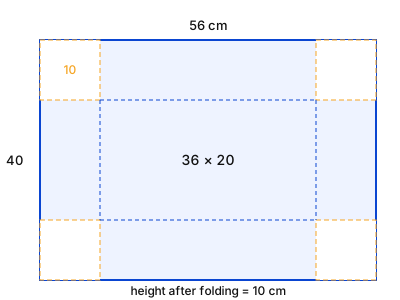
A metallic sheet is of the rectangular shape with length 56 cm and width 40 cm. From each corner, a square of 10 cm is cut-off. A closed box is made of the remaining sheet. How many match boxes of length 4.0 cm breadth 2.0 cm and height 1.5 cm it can accommodate?
एक धातु की चादर आयताकार आकार की है, जिसकी लंबाई 56 cm और चौड़ाई 40 cm है। प्रत्येक कोने से 10 cm का एक वर्ग काट दिया जाता है। शेष चादर से एक बंद बक्सा बनाया जाता है। इसमें 4.0 cm लंबाई, 2.0 cm चौड़ाई और 1.5 cm ऊँचाई वाली कितनी माचिस की डिब्बियाँ समा सकती हैं?
  1. A620 boxes620 डिब्बियाँ
  2. B600 boxes600 डिब्बियाँ
  3. C610 boxes610 डिब्बियाँ
  4. D550 boxes550 डिब्बियाँ
Show answer

Concept: Cutting squares of side a from the corners and folding gives a box of (l−2a)×(b−2a)×a; number of small boxes =volume of big boxvolume of one small box.

  1. Box dimensions: (56−20)×(40−20)×10=36×20×10 ⇒ volume =7200 cm³.
  2. Match box volume =4×2×1.5=12 cm³.
  3. Number =720012=600.

Trick: Subtract twice the cut side from both length and breadth; the cut side becomes the height.

Answer: (B) 600 boxes

अवधारणा: कोनों से a भुजा के वर्ग काटकर मोड़ने पर बॉक्स (l−2a)×(b−2a)×a बनता है; छोटे बॉक्सों की संख्या =बड़े बॉक्स का आयतनएक छोटे बॉक्स का आयतन।

  1. बॉक्स की विमाएँ: (56−20)×(40−20)×10=36×20×10 ⇒ आयतन =7200 cm³।
  2. माचिस की डिब्बी का आयतन =4×2×1.5=12 cm³।
  3. संख्या =720012=600।

ट्रिक: लंबाई और चौड़ाई दोनों से कटी भुजा का दोगुना घटाएँ; कटी भुजा ही ऊँचाई बन जाती है।

उत्तर: (B) 600 boxes

RRB NTPC Graduate CBT 2MathematicsMensuration – Open Box from SheetRRB NTPC Graduate CBT 2 2025 · 10 Jul Shift 1