Q181.Sophie starts from Point A and drives 8 km towards south. She then takes a right turn, drives 6 km, turns left and drives 5 km. She then takes a left turn and drives 6 km. She takes a final right turn, drives 9 km and stops at Point P. How far (shortest distance) and towards which direction should she drive in order to reach Point A again? (All turns are 90° turns only unless specified.)
सोफी बिंदु A से आरंभ करती है और दक्षिण की ओर 8 km गाड़ी चलाती है। फिर वह दाएँ मुड़ती है, 6 km गाड़ी चलाती है, बाएँ मुड़ती है और 5 km गाड़ी चलाती है। फिर वह बाएँ मुड़ती है और 6 km गाड़ी चलाती है। वह अंतिम बार दाएँ मुड़ती है, 9 km गाड़ी चलाती है और बिंदु P पर रुक जाती है। पुनः बिंदु A पर पहुँचने के लिए उसे कितनी दूर (न्यूनतम दूरी) और किस दिशा में गाड़ी चलानी चाहिए? (जब तक निर्दिष्ट न हो, सभी मोड़ केवल 90° के मोड़ हैं।)
- A18 km towards southदक्षिण की ओर 18 km
- B22 km towards southदक्षिण की ओर 22 km
- C18 km towards eastपूर्व की ओर 18 km
- D22 km towards northउत्तर की ओर 22 km
Show answer
Concept: Draw the path step by step; a right turn while facing south means heading west.
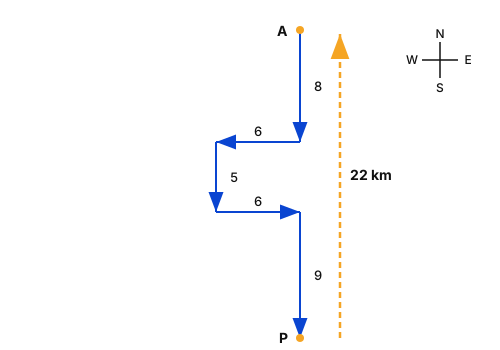
- 8 km south, right → west 6 km, left → south 5 km.
- Left → east 6 km (back in line with A), right → south 9 km to P.
- East–west moves cancel (); south total km.
- So P is 22 km south of A → drive 22 km north.
Trick: Net displacement = (sum of east − west, sum of north − south).
Answer: (D) 22 km towards north
अवधारणा: रास्ता क्रम से बनाएँ; दक्षिण की ओर मुँह करके दाएँ मुड़ने पर दिशा पश्चिम होती है।
- 8 km दक्षिण, दाएँ → पश्चिम 6 km, बाएँ → दक्षिण 5 km।
- बाएँ → पूर्व 6 km, दाएँ → दक्षिण 9 km तक P।
- पूर्व–पश्चिम कट जाते हैं (); कुल दक्षिण km।
- P, A से 22 km दक्षिण में → 22 km उत्तर जाना होगा।
ट्रिक: शुद्ध विस्थापन = (पूर्व − पश्चिम, उत्तर − दक्षिण)।
उत्तर: (D) 22 km उत्तर की ओर
RRB NTPC Undergraduate CBT 1General Intelligence and ReasoningDirection and DistanceRRB NTPC Undergraduate CBT 1 2024 · 4 Sep Shift 3
Q182.Based on the English alphabetical order, three of the following four letter-cluster pairs are alike in a certain way and thus form a group. Which letter-cluster pair DOES NOT belong to that group?
(Note: The odd one out is not based on the number of consonants/vowels or their position in the letter-cluster pair.)
अंग्रेज़ी वर्णमाला क्रम के आधार पर, निम्नलिखित चार अक्षर-समूह युग्मों में से तीन किसी निश्चित प्रकार से एक समान हैं और इस प्रकार एक समूह बनाते हैं। कौन-सा अक्षर-समूह युग्म उस समूह से संबंधित नहीं है?
(नोट: असंगत युग्म, अक्षर-समूह युग्म में व्यंजनों/स्वरों की संख्या या उनके स्थान पर आधारित नहीं है।)
- ASV-YD
- BBE-HM
- CDG-JO
- DFI-LO
Show answer
Concept: Use letter positions (A = 1 … Z = 26) and find the gaps.
- SV-YD: S→V , S→Y , V→D (22 + 8 = 30 − 26 = 4).
- BE-HM: , , ; DG-JO: , , .
- FI-LO: F→I , F→L , but I→O (not ).
Trick: Write gaps as a triple (+3, +6, +8) for each pair; the one with a different triple is odd.
Answer: (D) FI-LO
अवधारणा: अक्षरों की स्थिति (A = 1 … Z = 26) से अंतर देखें।
- SV-YD: S→V , S→Y , V→D (22 + 8 = 30 − 26 = 4)।
- BE-HM: , , ; DG-JO: , , ।
- FI-LO: , , पर I→O ( नहीं)।
ट्रिक: हर जोड़ी के अंतर (+3, +6, +8) लिखें; अलग वाला विषम है।
उत्तर: (D) FI-LO
RRB NTPC Undergraduate CBT 1General Intelligence and ReasoningLetter Analogy / Odd One OutRRB NTPC Undergraduate CBT 1 2024 · 4 Sep Shift 3
Q183.In the following number-pairs, the second number is obtained by applying certain mathematical operations to the first number. Select the pair in which the numbers are related in the same way as are the numbers of the following pairs.
(Note: Operations should be performed on the whole numbers, without breaking down the numbers into its constituent digits. E.g., 13 – Operations on 13 such as
adding/subtracting/multiplying etc. to 13 can be performed. Breaking down 13 into 1 and 3 and then performing mathematical operations on 1 and 3 is not allowed.) 96, 12
184, 23
निम्नलिखित संख्या-युग्मों में, पहली संख्या पर कुछ गणितीय संक्रियाएँ करके दूसरी संख्या प्राप्त की जाती है। उस युग्म का चयन कीजिए जिसमें संख्याएँ उसी प्रकार संबंधित हैं जिस प्रकार निम्नलिखित युग्मों की संख्याएँ संबंधित हैं।
(नोट: संख्याओं को उनके घटक अंकों में विभाजित किए बिना, पूर्ण संख्याओं पर संक्रियाएँ की जानी चाहिए। उदाहरण के लिए, 13 – 13 पर संक्रियाएँ जैसे
13 में जोड़ना/घटाना/गुणा करना आदि किया जा सकता है। 13 को 1 और 3 में विभाजित करना और फिर 1 और 3 पर गणितीय संक्रियाएँ करना वर्जित है।) 96, 12
184, 23
- A164, 20
- B144, 18
- C172, 21
- D130, 16
Show answer
Concept: Find the single operation linking the two numbers.
- , .
- ✓; , , .
Trick: Second number = first ÷ 8, i.e. first second.
Answer: (B) 144, 18
अवधारणा: दोनों संख्याओं को जोड़ने वाली क्रिया खोजें।
- , ।
- ✓; , , ।
ट्रिक: दूसरी संख्या = पहली ÷ 8।
उत्तर: (B) 144, 18
RRB NTPC Undergraduate CBT 1General Intelligence and ReasoningNumber Pair AnalogyRRB NTPC Undergraduate CBT 1 2024 · 4 Sep Shift 3
Q184.Seven people A, B, C, D, E, F and G are sitting in a row, facing the north. Only five people sit to the left of B. Only five people sit to the right of A. C sits to the immediate left of F but right of D. E does not sit to the right of D. How many people sit to the right of G?
सात व्यक्ति A, B, C, D, E, F और G एक पंक्ति में उत्तर की ओर मुख करके बैठे हैं। B के बाईं ओर केवल पाँच व्यक्ति बैठे हैं। A के दाईं ओर केवल पाँच व्यक्ति बैठे हैं। C, F के ठीक बाईं ओर लेकिन D के दाईं ओर बैठा है। E, D के दाईं ओर नहीं बैठा है। G के दाईं ओर कितने व्यक्ति बैठे हैं?
- AFiveपाँच
- BZeroशून्य
- CThreeतीन
- DFourचार
Show answer
Concept: Fix the definite positions first (counted from the left for north-facing people).
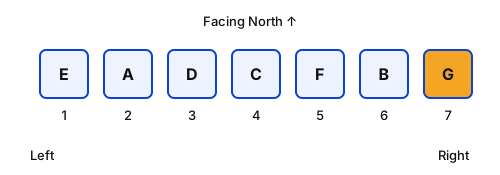
- 5 people left of B → B is 6th; 5 people right of A → A is 2nd.
- E is left of D, D left of C, and C is immediately left of F.
- C–F at 3–4 leaves no room for both E and D before C; so E = 1, D = 3, C = 4, F = 5, G = 7.
- Order: E A D C F B G → nobody is right of G.
Trick: Place the people with exact positions first; the chain E < D < C-F then fits only one way.
Answer: (B) Zero
अवधारणा: पहले निश्चित स्थान तय करें (उत्तर की ओर मुख वालों के लिए बाएँ से गिनती)।
- B के बाएँ 5 → B छठा; A के दाएँ 5 → A दूसरा।
- E, D के बाएँ; D, C के बाएँ; C, F के ठीक बाएँ।
- अतः E = 1, D = 3, C = 4, F = 5, G = 7।
- क्रम: E A D C F B G → G के दाएँ कोई नहीं।
ट्रिक: पहले निश्चित स्थान भरें; फिर श्रृंखला E < D < C-F केवल एक तरह बैठती है।
उत्तर: (B) शून्य (Zero)
RRB NTPC Undergraduate CBT 1General Intelligence and ReasoningLinear Seating ArrangementRRB NTPC Undergraduate CBT 1 2024 · 4 Sep Shift 3
Q185.If 1 is added for each even digit and 1 is subtracted from each odd digit of the number 56218643, how many digits are repeated more than once in the new number thus formed?
यदि संख्या 56218643 के प्रत्येक सम अंक में 1 जोड़ा जाए और प्रत्येक विषम अंक में से 1 घटाया जाए, तो इस प्रकार बनी नई संख्या में कितने अंक एक से अधिक बार आएँगे?
- ATwoदो
- BNoneकोई नहीं
- CThreeतीन
- DOneएक
Show answer
Concept: Apply the rule digit by digit: even → +1, odd → −1.
- 5 6 2 1 8 6 4 3 → 4 7 3 0 9 7 5 2.
- Count each digit in 47309752: only 7 appears twice; the rest once.
- So one digit is repeated.
Trick: Equal original digits give equal new digits — the two 6's become two 7's; check others don't collide (5→4 and 4→5 swap, 3→2 and 2→3 swap).
Answer: (D) One
अवधारणा: हर अंक पर नियम लगाएँ: सम → +1, विषम → −1।
- 5 6 2 1 8 6 4 3 → 4 7 3 0 9 7 5 2।
- 47309752 में केवल 7 दो बार आया; बाकी एक-एक बार।
- अतः एक अंक दोहराया गया।
ट्रिक: मूल संख्या के समान अंक नई संख्या में भी समान होंगे — दोनों 6 बने दो 7; बाकी (5↔4, 3↔2) आपस में अदला-बदली करते हैं।
उत्तर: (D) एक (One)
RRB NTPC Undergraduate CBT 1General Intelligence and ReasoningDigit OperationsRRB NTPC Undergraduate CBT 1 2024 · 4 Sep Shift 3
Q186.Read the given statements and conclusions carefully. Assuming that the information given in the statements is true, even if it appears to be at variance with commonly known facts, decide which of the given conclusions logically follow(s) from the statements.
Statements:
All fans are lights.
No fan is a bulb.
Conclusions:
(I) No light is an bulb.
(II) No bulb is a fan.
दिए गए कथनों और निष्कर्षों को ध्यानपूर्वक पढ़िए। यह मानते हुए कि कथनों में दी गई जानकारी सत्य है, भले ही वह सामान्यतः ज्ञात तथ्यों से भिन्न प्रतीत होती हो, निर्णय कीजिए कि दिए गए निष्कर्षों में से कौन-सा/कौन-से निष्कर्ष कथनों का तार्किक रूप से अनुसरण करता है/करते हैं।
कथन:
सभी पंखे, लाइटें हैं।
कोई पंखा, बल्ब नहीं है।
निष्कर्ष:
(I) कोई लाइट, बल्ब नहीं है।
(II) कोई बल्ब, पंखा नहीं है।
- AOnly conclusion II follows.केवल निष्कर्ष II अनुसरण करता है।
- BNeither conclusion I nor II follows.न तो निष्कर्ष I और न ही II अनुसरण करता है।
- COnly conclusion I follows.केवल निष्कर्ष I अनुसरण करता है।
- DBoth conclusions I and II follow.निष्कर्ष I और II दोनों अनुसरण करते हैं।
Show answer
Concept: Draw the least-overlap Venn diagram and test each conclusion.
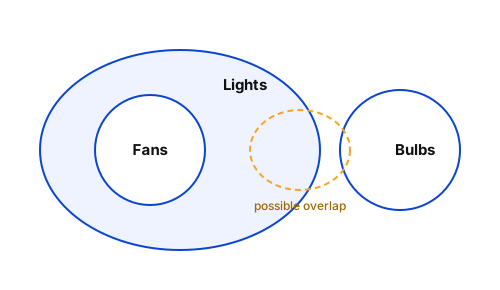
- Fans lie inside Lights; Bulbs are kept away from Fans.
- Lights and Bulbs may or may not overlap (outside the Fans part) → I (No light is a bulb) is not certain.
- 'No fan is a bulb' converts to 'No bulb is a fan' → II follows.
Yaad rakhein: An E-type statement (No A is B) always converts to No B is A.
Answer: (A) Only conclusion II follows.
अवधारणा: न्यूनतम ओवरलैप वाला वेन आरेख बनाकर हर निष्कर्ष जाँचें।
- Fans, Lights के अंदर; Bulbs, Fans से अलग।
- Lights और Bulbs का मिलना संभव है (Fans वाले भाग के बाहर) → I निश्चित नहीं।
- 'कोई fan bulb नहीं' का विलोम 'कोई bulb fan नहीं' → II सही।
याद रखें: E-प्रकार का कथन (कोई A, B नहीं) हमेशा 'कोई B, A नहीं' में बदलता है।
उत्तर: (A) केवल निष्कर्ष II अनुसरण करता है।
RRB NTPC Undergraduate CBT 1General Intelligence and ReasoningSyllogismRRB NTPC Undergraduate CBT 1 2024 · 4 Sep Shift 3
Q187.Which of the following letter-number clusters will replace the question mark (?) in the given series to make it logically complete?
PHZ 3, SKC 7, VNF 15, YQI 31, BTL 63, ?
निम्नलिखित में से कौन-सा अक्षर-संख्या समूह दी गई शृंखला को तार्किक रूप से पूर्ण करने के लिए प्रश्न चिह्न (?) का स्थान लेगा?
PHZ 3, SKC 7, VNF 15, YQI 31, BTL 63, ?
- AEWO 127
- BFWO 127
- CEHO 127
- DEWO 128
Show answer
Concept: Track each letter position and the number separately.
- 1st letters: P, S, V, Y, B, E (+3 each, Y→B wraps).
- 2nd letters: H, K, N, Q, T, W (+3).
- 3rd letters: Z, C, F, I, L, O (+3).
- Numbers: : .
Trick: Numbers 3, 7, 15, 31, 63 are → next .
Answer: (A) EWO 127
अवधारणा: हर अक्षर स्थान और संख्या को अलग-अलग देखें।
- पहले अक्षर: P, S, V, Y, B, E (+3)।
- दूसरे अक्षर: H, K, N, Q, T, W (+3)।
- तीसरे अक्षर: Z, C, F, I, L, O (+3)।
- संख्याएँ: : ।
ट्रिक: 3, 7, 15, 31, 63 = → अगली ।
उत्तर: (A) EWO 127
RRB NTPC Undergraduate CBT 1General Intelligence and ReasoningLetter-Number SeriesRRB NTPC Undergraduate CBT 1 2024 · 4 Sep Shift 3
Q188.In the following triads, each group of letters is related to the subsequent one following a certain logic. Select from the given options, the one which follows the same logic. HARD - AHRD - DRAH
ITEM - TIEM - METI
निम्नलिखित त्रिकों में, अक्षरों का प्रत्येक समूह एक निश्चित तर्क का अनुसरण करते हुए अगले समूह से संबंधित है। दिए गए विकल्पों में से उस विकल्प का चयन कीजिए जो समान तर्क का अनुसरण करता है। HARD - AHRD - DRAH
ITEM - TIEM - METI
- AWENT - EWNT - TENW
- BDUSK - UDSK - KSUD
- CBITE - BTIE - ETIB
- DLONG - OLNG - ONGL
Show answer
Concept: Find the rule from HARD - AHRD - DRAH.
- Step 1: swap the first two letters (HARD → AHRD).
- Step 2: third term = original word reversed (HARD → DRAH); same for ITEM → METI.
- DUSK → UDSK (swap) and DUSK reversed = KSUD ✓.
Trick: Check the reverse quickly: WENT reversed is TNEW (not TENW), so A fails.
Answer: (B) DUSK - UDSK - KSUD
अवधारणा: HARD - AHRD - DRAH से नियम निकालें।
- चरण 1: पहले दो अक्षर बदलें (HARD → AHRD)।
- चरण 2: तीसरा पद = मूल शब्द उल्टा (HARD → DRAH); ITEM → METI भी ऐसे ही।
- DUSK → UDSK और DUSK उल्टा = KSUD ✓।
ट्रिक: उल्टा जाँचें: WENT का उल्टा TNEW होगा (TENW नहीं), अतः A गलत।
उत्तर: (B) DUSK - UDSK - KSUD
RRB NTPC Undergraduate CBT 1General Intelligence and ReasoningLetter TriadsRRB NTPC Undergraduate CBT 1 2024 · 4 Sep Shift 3
Q189.Read the given statements and conclusions carefully. Assuming that the information given in the statements is true, even if it appears to be at variance with commonly known facts, decide which of the given conclusion(s) logically follow(s) from the statements.
Statements:
All pins are bricks.
All pins are rulers.
Conclusions:
(I) Some bricks are rulers.
(II) All rulers are pins.
दिए गए कथनों और निष्कर्षों को ध्यानपूर्वक पढ़िए। यह मानते हुए कि कथनों में दी गई जानकारी सत्य है, भले ही वह सामान्यतः ज्ञात तथ्यों से भिन्न प्रतीत होती हो, निर्णय कीजिए कि दिए गए निष्कर्षों में से कौन-सा/कौन-से निष्कर्ष कथनों का तार्किक रूप से अनुसरण करता है/करते हैं।
कथन:
सभी पिन, ईंटें हैं।
सभी पिन, रूलर हैं।
निष्कर्ष:
(I) कुछ ईंटें, रूलर हैं।
(II) सभी रूलर, पिन हैं।
- AOnly conclusion (I) follows.केवल निष्कर्ष (I) अनुसरण करता है।
- BNeither conclusion (I) nor (II) follows.न तो निष्कर्ष (I) और न ही (II) अनुसरण करता है।
- COnly conclusion (II) follows.केवल निष्कर्ष (II) अनुसरण करता है।
- DBoth conclusions (I) and (II) follow.निष्कर्ष (I) और (II) दोनों अनुसरण करते हैं।
Show answer
Concept: Draw a Venn diagram with Pins common to Bricks and Rulers.
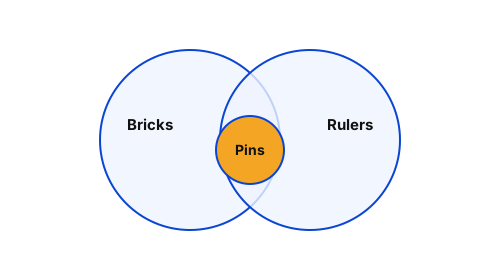
- Pins lie inside both Bricks and Rulers, so Bricks and Rulers must share the Pins region → 'Some bricks are rulers' follows.
- Rulers may extend beyond Pins → 'All rulers are pins' does not follow.
Yaad rakhein: Two 'All' statements with the same subject always give 'Some' between their predicates.
Answer: (A) Only conclusion (I) follows.
अवधारणा: वेन आरेख बनाएँ जिसमें Pins, Bricks और Rulers दोनों के अंदर हों।
- Pins दोनों के अंदर हैं, अतः Bricks और Rulers का कुछ भाग साझा → 'कुछ bricks, rulers हैं' सही।
- Rulers, Pins से बाहर भी हो सकते हैं → 'सभी rulers, pins हैं' गलत।
याद रखें: एक ही विषय वाले दो 'सभी' कथन, उनके विधेयों में 'कुछ' संबंध देते हैं।
उत्तर: (A) केवल निष्कर्ष (I) अनुसरण करता है।
RRB NTPC Undergraduate CBT 1General Intelligence and ReasoningSyllogismRRB NTPC Undergraduate CBT 1 2024 · 4 Sep Shift 3
Q190.Yusif starts from Point A and drives 9 km towards North. He then takes a left turn, drives 4 km, turns left and drives 11 km. He then takes a left turn and drives 5 km. He takes a final left turn, drives 2 km and stops at Point P. How far (shortest distance) and towards which direction should he drive in order to reach Point A again? (All turns are 90° turns only unless specified.)
यूसिफ़ बिंदु A से आरंभ करता है और उत्तर की ओर 9 km गाड़ी चलाता है। फिर वह बाएँ मुड़ता है, 4 km गाड़ी चलाता है, बाएँ मुड़ता है और 11 km गाड़ी चलाता है। फिर वह बाएँ मुड़ता है और 5 km गाड़ी चलाता है। वह अंतिम बार बाएँ मुड़ता है, 2 km गाड़ी चलाता है और बिंदु P पर रुक जाता है। पुनः बिंदु A पर पहुँचने के लिए उसे कितनी दूर (न्यूनतम दूरी) और किस दिशा में गाड़ी चलानी चाहिए? (जब तक निर्दिष्ट न हो, सभी मोड़ केवल 90° के मोड़ हैं।)
- A1 km to the Westपश्चिम की ओर 1 km
- B1 km to the Eastपूर्व की ओर 1 km
- C2 km to the Northउत्तर की ओर 2 km
- D2 km to the Southदक्षिण की ओर 2 km
Show answer
Concept: Facing north, a left turn means west; trace each turn on a sketch.
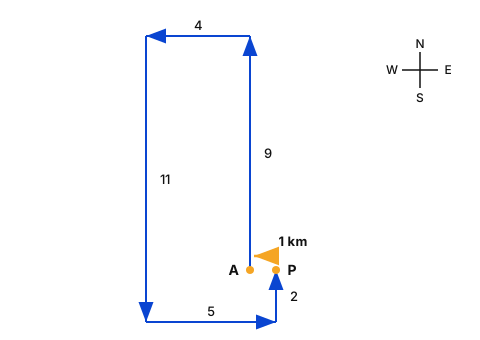
- 9 km north, left → west 4 km, left → south 11 km (now 2 km south of A's level).
- Left → east 5 km (1 km east of A's line), left → north 2 km → P.
- P is on A's level, 1 km east of A.
- To reach A: 1 km to the west.
Trick: Net: north ; east → P is 1 km east, so go west.
Answer: (A) 1 km to the West
अवधारणा: उत्तर की ओर मुँह करके बाएँ मुड़ने पर पश्चिम; हर मोड़ स्केच पर बनाएँ।
- 9 km उत्तर, बाएँ → पश्चिम 4 km, बाएँ → दक्षिण 11 km।
- बाएँ → पूर्व 5 km, बाएँ → उत्तर 2 km → P।
- P, A के स्तर पर, A से 1 km पूर्व।
- A तक: 1 km पश्चिम।
ट्रिक: शुद्ध: उत्तर ; पूर्व → P, 1 km पूर्व में, अतः पश्चिम जाएँ।
उत्तर: (A) 1 km पश्चिम की ओर
RRB NTPC Undergraduate CBT 1General Intelligence and ReasoningDirection and DistanceRRB NTPC Undergraduate CBT 1 2024 · 4 Sep Shift 3
Q191.Refer to the following number, symbol series and answer the question. Counting to be done from left to right only.
(Left) 2 / \ < > 2 5 $ % + 6 3 / 6 5 6 9 3 @ < & (Right)
How many such numbers are there each of which is immediately preceded by another number and also immediately followed by a symbol?
निम्नलिखित संख्या, प्रतीक शृंखला का संदर्भ लेकर प्रश्न का उत्तर दीजिए। गिनती केवल बाएँ से दाएँ की जानी है।
(बाएँ) 2 / \ < > 2 5 $ % + 6 3 / 6 5 6 9 3 @ < & (दाएँ)
ऐसी कितनी संख्याएँ हैं जिनमें से प्रत्येक के ठीक पहले एक अन्य संख्या है और ठीक बाद एक प्रतीक भी है?
- ATwoदो
- BFourचार
- COneएक
- DThreeतीन
Show answer
Concept: Look for the pattern Number – Number – Symbol.
- 2 5 $ → 5 qualifies.
- 6 3 / → 3 qualifies.
- 9 3 @ → 3 qualifies.
- Others fail (e.g. 6 after +, 5 6 6, 9 3 followed by numbers).
Trick: Scan only the numbers that are followed by a symbol, then check the previous element.
Answer: (D) Three
अवधारणा: पैटर्न खोजें: संख्या – संख्या – प्रतीक।
- 2 5 $ → 5 मान्य।
- 6 3 / → 3 मान्य।
- 9 3 @ → 3 मान्य।
- बाकी नहीं (जैसे + के बाद 6, या आगे संख्या वाली)।
ट्रिक: केवल उन संख्याओं को देखें जिनके बाद प्रतीक है, फिर उनसे पहले वाला तत्व जाँचें।
उत्तर: (D) तीन (Three)
RRB NTPC Undergraduate CBT 1General Intelligence and ReasoningNumber-Symbol SeriesRRB NTPC Undergraduate CBT 1 2024 · 4 Sep Shift 3
Q192.Which of the following letter-number clusters will replace the question mark (?) in the given series to make it logically complete?
GNU 11, DKR 21, AHO 41, XEL 81, UBI 161, ?
निम्नलिखित में से कौन-सा अक्षर-संख्या समूह दी गई शृंखला को तार्किक रूप से पूर्ण करने के लिए प्रश्न चिह्न (?) का स्थान लेगा?
GNU 11, DKR 21, AHO 41, XEL 81, UBI 161, ?
- ARYF 320
- BROF 321
- CYYF 321
- DRYF 321
Show answer
Concept: Each letter moves −3; numbers follow .
- G, D, A, X, U, R; N, K, H, E, B, Y; U, R, O, L, I, F.
- .
Trick: Wrap-around: A − 3 = X, B − 3 = Y.
Answer: (D) RYF 321
अवधारणा: हर अक्षर −3; संख्याएँ ।
- G, D, A, X, U, R; N, K, H, E, B, Y; U, R, O, L, I, F।
- ।
ट्रिक: घुमाव: A − 3 = X, B − 3 = Y।
उत्तर: (D) RYF 321
RRB NTPC Undergraduate CBT 1General Intelligence and ReasoningLetter-Number SeriesRRB NTPC Undergraduate CBT 1 2024 · 4 Sep Shift 3
Q193.In a row of 172 students facing north, Mr. Maxi is 21st from the right end. If Mr. Han is 61st to the left of Mr. Maxi, what is Mr. Han's position from the left end of the line?
उत्तर की ओर मुख करके खड़े 172 विद्यार्थियों की एक पंक्ति में, श्री मैक्सी दाएँ छोर से 21वें स्थान पर हैं। यदि श्री हान, श्री मैक्सी के बाईं ओर 61वें स्थान पर हैं, तो पंक्ति के बाएँ छोर से श्री हान का स्थान क्या है?
- A91st91वाँ
- B92nd92वाँ
- C90th90वाँ
- D93rd93वाँ
Show answer
Concept: Position from left .
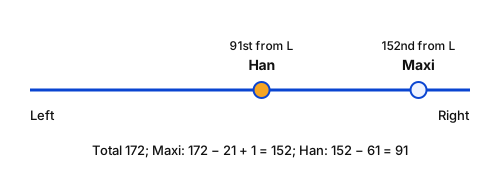
- Maxi from left .
- Han is 61 places to the left → .
Trick: Convert everything to one end first, then move left (subtract) or right (add).
Answer: (A) 91st
अवधारणा: बाएँ से स्थान ।
- Maxi बाएँ से ।
- Han, 61 स्थान बाएँ → ।
ट्रिक: पहले सब कुछ एक सिरे से बदलें, फिर बाएँ (घटाएँ) या दाएँ (जोड़ें)।
उत्तर: (A) 91st
RRB NTPC Undergraduate CBT 1General Intelligence and ReasoningRankingRRB NTPC Undergraduate CBT 1 2024 · 4 Sep Shift 3
Q194.What should come in place of the question mark (?) in the given series?
48 69 94 123 156 ?
दी गई शृंखला में प्रश्न चिह्न (?) के स्थान पर क्या आना चाहिए?
48 69 94 123 156 ?
- A223
- B213
- C193
- D203
Show answer
Concept: Check differences of consecutive terms.
- Differences: 21, 25, 29, 33 (increase by 4).
- Next difference → .
Trick: Second differences constant (4) → add the next difference.
Answer: (C) 193
अवधारणा: क्रमागत पदों का अंतर देखें।
- अंतर: 21, 25, 29, 33 (हर बार 4 बढ़ता)।
- अगला अंतर → ।
ट्रिक: दूसरा अंतर स्थिर (4) → अगला अंतर जोड़ें।
उत्तर: (C) 193
RRB NTPC Undergraduate CBT 1General Intelligence and ReasoningNumber SeriesRRB NTPC Undergraduate CBT 1 2024 · 4 Sep Shift 3
Q195.Seven people D, E, F, G, H, I and O are sitting around a circular table, facing the centre of the table. Only one person sits between H and O when counted from the left of O. I sits third to the right of D. F sits third to the left of E. I sits to the immediate right of F. G is not an immediate neighbour of F. How many people sit between G and O when counted from the right of G?
सात व्यक्ति D, E, F, G, H, I और O एक वृत्ताकार मेज़ के चारों ओर मेज़ के केंद्र की ओर मुख करके बैठे हैं। O के बाईं ओर से गिनने पर H और O के बीच केवल एक व्यक्ति बैठा है। I, D के दाईं ओर तीसरे स्थान पर बैठा है। F, E के बाईं ओर तीसरे स्थान पर बैठा है। I, F के ठीक दाईं ओर बैठा है। G, F का निकटतम पड़ोसी नहीं है। G के दाईं ओर से गिनने पर G और O के बीच कितने व्यक्ति बैठे हैं?
- AOneएक
- BThreeतीन
- CTwoदो
- DFourचार
Show answer
Concept: Facing the centre: a person's right is anticlockwise, left is clockwise.
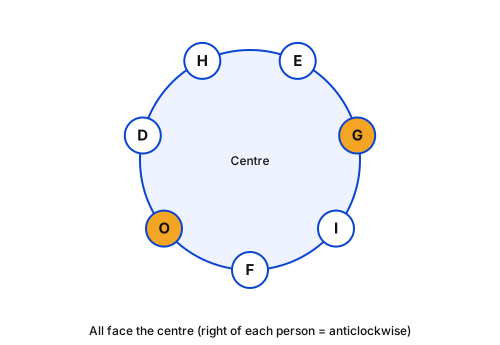
- Fix F; I is immediately right of F; E is 3rd to the right of F (F 3rd to left of E).
- I is 3rd to the right of D → D is 3rd to the left of I.
- G is not next to F → G sits right of I; then H and O fill the rest with one person between them from O's left: O next to F, H between E and D.
- From the right of G: E, H, D, then O → 3 persons between.
Trick: Start with the person mentioned most (F/I), then place others by counting.
Answer: (B) Three
अवधारणा: केंद्र की ओर मुख: व्यक्ति का दायाँ = वामावर्त (anticlockwise), बायाँ = दक्षिणावर्त।
- F तय करें; I, F के ठीक दाएँ; E, F से तीसरा दाएँ।
- I, D से तीसरा दाएँ → D, I से तीसरा बाएँ।
- G, F का पड़ोसी नहीं → G, I के दाएँ; O, F के पास और H, E और D के बीच।
- G के दाएँ से: E, H, D, फिर O → बीच में 3 व्यक्ति।
ट्रिक: सबसे ज़्यादा उल्लेखित व्यक्ति (F/I) से शुरू करें, फिर गिनकर बाकी बिठाएँ।
उत्तर: (B) तीन (Three)
RRB NTPC Undergraduate CBT 1General Intelligence and ReasoningCircular Seating ArrangementRRB NTPC Undergraduate CBT 1 2024 · 4 Sep Shift 3
Q196.If 1 is added to each even digit and 1 is subtracted from each odd digit of the number 56218643, how many digits are repeated more than once in the new number formed?
यदि संख्या 56218643 के प्रत्येक सम अंक में 1 जोड़ा जाए और प्रत्येक विषम अंक में से 1 घटाया जाए, तो बनी नई संख्या में कितने अंक एक से अधिक बार आएँगे?
- ATwoदो
- BOneएक
- CThreeतीन
- DNoneकोई नहीं
Show answer
Concept: Apply the rule digit by digit: even → +1, odd → −1.
- 5 6 2 1 8 6 4 3 → 4 7 3 0 9 7 5 2.
- Count each digit in 47309752: only 7 appears twice; the rest once.
- So one digit is repeated.
Trick: Equal original digits give equal new digits — the two 6's become two 7's; check others don't collide (5→4 and 4→5 swap, 3→2 and 2→3 swap).
Answer: (B) One
अवधारणा: हर अंक पर नियम लगाएँ: सम → +1, विषम → −1।
- 5 6 2 1 8 6 4 3 → 4 7 3 0 9 7 5 2।
- 47309752 में केवल 7 दो बार आया; बाकी एक-एक बार।
- अतः एक अंक दोहराया गया।
ट्रिक: मूल संख्या के समान अंक नई संख्या में भी समान होंगे — दोनों 6 बने दो 7; बाकी (5↔4, 3↔2) आपस में अदला-बदली करते हैं।
उत्तर: (B) एक (One)
RRB NTPC Undergraduate CBT 1General Intelligence and ReasoningDigit OperationsRRB NTPC Undergraduate CBT 1 2024 · 4 Sep Shift 3
Q197.Based on the English alphabetical order, three of the following four letter-cluster pairs are alike in a certain way and thus form a group. Which letter-cluster pair DOES NOT belong to that group?
(Note: The odd one out is not based on the number of consonants/vowels or their position in the letter-cluster.)
अंग्रेज़ी वर्णमाला क्रम के आधार पर, निम्नलिखित चार अक्षर-समूह युग्मों में से तीन किसी निश्चित प्रकार से एक समान हैं और इस प्रकार एक समूह बनाते हैं। कौन-सा अक्षर-समूह युग्म उस समूह से संबंधित नहीं है?
(नोट: असंगत युग्म, अक्षर-समूह में व्यंजनों/स्वरों की संख्या या उनके स्थान पर आधारित नहीं है।)
- AQU-YE
- BMI-QW
- CGK-OU
- DVZ-DJ
Show answer
Concept: Compare letter-position gaps in each pair.
- QU-YE: Q→U , Q→Y , U→E (21 + 10 = 31 − 26 = 5).
- GK-OU: , , ; VZ-DJ: , , .
- MI-QW: M→I is and I→W is — different.
Trick: Write the three gaps for each pair; the odd triple is the answer.
Answer: (B) MI-QW
अवधारणा: हर जोड़ी में अक्षर स्थानों के अंतर देखें।
- QU-YE: , , U→E (21 + 10 = 31 − 26 = 5)।
- GK-OU: , , ; VZ-DJ: , , ।
- MI-QW: M→I और I→W — अलग।
ट्रिक: हर जोड़ी के तीन अंतर लिखें; अलग वाला उत्तर है।
उत्तर: (B) MI-QW
RRB NTPC Undergraduate CBT 1General Intelligence and ReasoningLetter Analogy / Odd One OutRRB NTPC Undergraduate CBT 1 2024 · 4 Sep Shift 3
Q198.Select the pair which follows the same pattern as that followed by the two pairs given below. Both pairs follow the same pattern.
FCV : KZQ
ZQB : ENW
उस युग्म का चयन कीजिए जो उसी पैटर्न का अनुसरण करता है जिसका अनुसरण नीचे दिए गए दो युग्म करते हैं। दोनों युग्म समान पैटर्न का अनुसरण करते हैं।
FCV : KZQ
ZQB : ENW
- AMUV : QPZ
- BPWL : UTG
- CYNQ : BIT
- DFLH : KHM
Show answer
Concept: Find the shift for each letter position.
- FCV → KZQ: , , ; ZQB → ENW: , , .
- PWL → UTG: P→U , W→T , L→G ✓.
- Others fail, e.g. MUV → QPZ: M→Q is .
Trick: Check the first letter (+5) of each option first — it removes A and C straight away.
Answer: (B) PWL : UTG
अवधारणा: हर अक्षर स्थान का खिसकाव निकालें।
- FCV → KZQ: , , ; ZQB → ENW: , , ।
- PWL → UTG: , , ✓।
- अन्य गलत, जैसे MUV → QPZ: M→Q ।
ट्रिक: पहले हर विकल्प का पहला अक्षर (+5) जाँचें — A और C तुरंत हट जाते हैं।
उत्तर: (B) PWL : UTG
RRB NTPC Undergraduate CBT 1General Intelligence and ReasoningLetter AnalogyRRB NTPC Undergraduate CBT 1 2024 · 4 Sep Shift 3
Q199.In a certain code language,
'A = B' means ‘A is the brother of B’,
'A ¥ B' means ‘A is the father of B’,
'A # B' means ‘A is the wife of B’ and
'A % B' means ‘A is the sister of B’.
How is B related to S if 'B ¥ O % A = T # S'?
एक निश्चित कूट भाषा में,
'A = B' का अर्थ है 'A, B का भाई है',
'A ¥ B' का अर्थ है 'A, B का पिता है',
'A # B' का अर्थ है 'A, B की पत्नी है' और
'A % B' का अर्थ है 'A, B की बहन है'।
यदि 'B ¥ O % A = T # S' है, तो B का S से क्या संबंध है?
- AWife's motherपत्नी की माता
- BWife's fatherपत्नी के पिता
- CWife's brotherपत्नी का भाई
- DWife's sisterपत्नी की बहन
Show answer
Concept: Decode symbol by symbol and build the family tree.
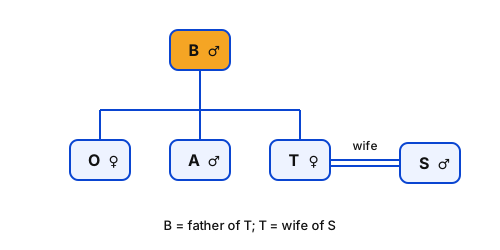
- B ¥ O: B is father of O. O % A: O is sister of A.
- A = T: A is brother of T, so T is also B's child.
- T # S: T is wife of S.
- B is father of S's wife → wife's father.
Trick: Since A is a brother of T, T shares parents with O and A — B is T's father.
Answer: (B) Wife's father
अवधारणा: हर चिह्न को क्रम से खोलें और वंश-वृक्ष बनाएँ।
- B ¥ O: B, O का पिता। O % A: O, A की बहन।
- A = T: A, T का भाई → T भी B की संतान।
- T # S: T, S की पत्नी।
- B, S की पत्नी का पिता है → ससुर (wife's father)।
ट्रिक: A, T का भाई है, अतः T, O और A के ही माता-पिता की संतान — B, T का पिता।
उत्तर: (B) पत्नी के पिता (Wife's father)
RRB NTPC Undergraduate CBT 1General Intelligence and ReasoningCoded Blood RelationsRRB NTPC Undergraduate CBT 1 2024 · 4 Sep Shift 3
Q200.Seven boxes I, J, K, L, M, N and P are kept one over the other but not necessarily in the same order. Only L is kept above M. Only P is kept between M and J. Only N is kept below K. How many boxes are kept between I and N?
सात बक्से I, J, K, L, M, N और P एक के ऊपर एक रखे गए हैं, लेकिन आवश्यक नहीं कि इसी क्रम में हों। M के ऊपर केवल L रखा गया है। M और J के बीच केवल P रखा गया है। K के नीचे केवल N रखा गया है। I और N के बीच कितने बक्से रखे गए हैं?
- AThreeतीन
- BOneएक
- CFourचार
- DTwoदो
Show answer
Concept: Use 'only' clues to fix exact positions from top and bottom.
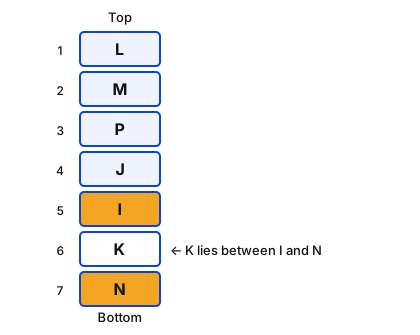
- Only L above M → L is 1st (top), M 2nd.
- Only P between M and J → P 3rd, J 4th.
- Only N below K → N 7th (bottom), K 6th; I is left for 5th.
- Between I (5th) and N (7th): only K → one box.
Trick: 'Only X above Y' means Y is 2nd from top; 'Only X below Y' means Y is 2nd from bottom.
Answer: (B) One
अवधारणा: 'केवल' वाले संकेतों से ऊपर और नीचे से स्थिति तय करें।
- केवल L, M के ऊपर → L पहला (सबसे ऊपर), M दूसरा।
- M और J के बीच केवल P → P तीसरा, J चौथा।
- K के नीचे केवल N → N सातवाँ, K छठा; I पाँचवाँ।
- I (5) और N (7) के बीच केवल K → एक बॉक्स।
ट्रिक: 'केवल X, Y के ऊपर' = Y ऊपर से दूसरा; 'केवल X, Y के नीचे' = Y नीचे से दूसरा।
उत्तर: (B) एक (One)
RRB NTPC Undergraduate CBT 1General Intelligence and ReasoningStacking ArrangementRRB NTPC Undergraduate CBT 1 2024 · 4 Sep Shift 3

