Q201.The product of two consecutive natural numbers is 30. The greater of the two numbers is:
दो क्रमागत प्राकृत संख्याओं का गुणनफल 30 है। दोनों संख्याओं में से बड़ी संख्या है:
- A12
- B3
- C6
- D24
Show answer
Concept: Consecutive natural numbers: .
- .
- Greater number = 6.
Trick: Take — the two numbers lie on either side: 5 and 6.
Answer: (C) 6
अवधारणा: क्रमागत प्राकृत संख्याएँ: ।
- ।
- बड़ी संख्या = 6।
ट्रिक: — दोनों संख्याएँ इसके दोनों ओर: 5 और 6।
उत्तर: (C) 6
RRB NTPC Undergraduate CBT 1MathematicsNumber SystemRRB NTPC Undergraduate CBT 1 2024 · 4 Sep Shift 3
Q202.Aryan has to reach Ahmedabad which is 977 km away in 11 hours. His starting speed for 4 hours was 39 km/hr. For the next 140 km his speed was 35 km/hr. By what speed he must travel now so as to reach Ahmedabad in the decided time of 11 hours?
आर्यन को 977 km दूर स्थित अहमदाबाद 11 घंटे में पहुँचना है। प्रारंभिक 4 घंटों में उसकी चाल 39 km/hr थी। अगले 140 km के लिए उसकी चाल 35 km/hr थी। निर्धारित 11 घंटे के समय में अहमदाबाद पहुँचने के लिए अब उसे किस चाल से यात्रा करनी होगी?
- A227 km/hr
- B231 km/hr
- C221 km/hr
- D229 km/hr
Show answer
Concept: Required speed = remaining distance ÷ remaining time.
- First part: km in 4 h.
- Next 140 km at 35 km/h → h.
- Used: h, km. Left: km in h.
- Speed .
Trick: Track both distance and time used so far in one line: (296 km, 8 h).
Answer: (A) 227 km/hr
अवधारणा: आवश्यक चाल = शेष दूरी ÷ शेष समय।
- पहला भाग: km, 4 घंटे में।
- अगले 140 km, 35 km/h से → घंटे।
- उपयोग: 8 घंटे, 296 km। शेष: km, 3 घंटे में।
- चाल ।
ट्रिक: अब तक की दूरी और समय एक साथ लिखें: (296 km, 8 घंटे)।
उत्तर: (A) 227 km/hr
RRB NTPC Undergraduate CBT 1MathematicsSpeed, Time and DistanceRRB NTPC Undergraduate CBT 1 2024 · 4 Sep Shift 3
Q203.Find the area of a triangle whose sides are of lengths 5 cm, 12 cm and 13 cm.
उस त्रिभुज का क्षेत्रफल ज्ञात कीजिए जिसकी भुजाओं की लंबाई 5 cm, 12 cm और 13 cm है।
- A32.5 cm2
- B78 cm2
- C30 cm2
- D60 cm2
Show answer
Concept: 5, 12, 13 is a Pythagorean triplet, so the triangle is right-angled; area .
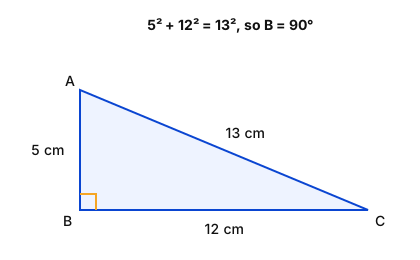
- → right angle between sides 5 and 12.
- Area .
Trick: Remember triplets (3,4,5), (5,12,13), (8,15,17), (7,24,25) — no Heron's formula needed.
Answer: (C)
अवधारणा: 5, 12, 13 पाइथागोरस त्रिक (Pythagorean triplet) है, अतः त्रिभुज समकोण है; क्षेत्रफल ।
- → 5 और 12 के बीच समकोण।
- क्षेत्रफल ।
ट्रिक: त्रिक याद रखें: (3,4,5), (5,12,13), (8,15,17), (7,24,25) — हीरोन सूत्र की ज़रूरत नहीं।
उत्तर: (C)
RRB NTPC Undergraduate CBT 1MathematicsMensuration – TriangleRRB NTPC Undergraduate CBT 1 2024 · 4 Sep Shift 3
Q204.Simplify: .
सरल कीजिए: ।
- A
- B
- C
- D
Show answer
Concept: Expand each bracket and combine like terms.
- .
- .
- Add: .
Trick: The terms cancel; just check the constant: (positive) → only option D.
Answer: (D)
अवधारणा: प्रत्येक कोष्ठक खोलें और समान पद जोड़ें।
- ।
- ।
- जोड़ें: ।
ट्रिक: पद कट जाते हैं; का गुणांक और अचर → विकल्प D।
उत्तर: (D)
RRB NTPC Undergraduate CBT 1MathematicsAlgebra – SimplificationRRB NTPC Undergraduate CBT 1 2024 · 4 Sep Shift 3
Q205.The LCM of the numbers 14.2 and 0.05 is:
संख्याओं 14.2 और 0.05 का ल.स.प. (LCM) है:
- A142
- B1.42
- C0.142
- D14.2
Show answer
Concept: Make decimal places equal, find the LCM of the whole numbers, then put back the decimal places.
- and → and (2 decimal places).
- LCM (as 1420 is a multiple of 5).
- LCM .
Trick: If the larger number is a multiple of the smaller, it is itself the LCM: .
Answer: (D) 14.2
अवधारणा: दशमलव स्थान बराबर करें, पूर्णांकों का LCM निकालें, फिर दशमलव वापस लगाएँ।
- और → और (2 दशमलव स्थान)।
- LCM।
- LCM ।
ट्रिक: यदि बड़ी संख्या छोटी की गुणज है तो वही LCM है: ।
उत्तर: (D) 14.2
RRB NTPC Undergraduate CBT 1MathematicsLCM of DecimalsRRB NTPC Undergraduate CBT 1 2024 · 4 Sep Shift 3
Q206.The marked price of a ceiling fan is ₹2,500. During off season, it is sold for ₹1,360. Find the discount percentage.
एक सीलिंग फैन का अंकित मूल्य ₹2,500 है। ऑफ-सीज़न के दौरान, इसे ₹1,360 में बेचा जाता है। छूट प्रतिशत ज्ञात कीजिए।
- A44.5%
- B45%
- C45.6%
- D42%
Show answer
Concept: .
- Discount ₹1,140.
- .
Trick: Divide by 25: .
Answer: (C) 45.6%
अवधारणा: ।
- छूट ₹1,140।
- ।
ट्रिक: 25 से भाग दें: ।
उत्तर: (C) 45.6%
RRB NTPC Undergraduate CBT 1MathematicsDiscountRRB NTPC Undergraduate CBT 1 2024 · 4 Sep Shift 3
Q207.The LCM of the numbers 10.8 and 0.06 is:
संख्याओं 10.8 और 0.06 का ल.स.प. (LCM) है:
- A108
- B1.08
- C10.8
- D0.108
Show answer
Concept: Equalise decimal places, take LCM of the integers, restore the decimal.
- and → and .
- LCM.
- LCM .
Trick: (whole number), so the larger number itself is the LCM.
Answer: (C) 10.8
अवधारणा: दशमलव स्थान बराबर करें, पूर्णांकों का LCM लें, फिर दशमलव लगाएँ।
- और → और ।
- LCM।
- LCM ।
ट्रिक: (पूर्ण संख्या), अतः बड़ी संख्या ही LCM है।
उत्तर: (C) 10.8
RRB NTPC Undergraduate CBT 1MathematicsLCM of DecimalsRRB NTPC Undergraduate CBT 1 2024 · 4 Sep Shift 3
Q208.The average runs scored by a batsman in 23 matches is 44. In the next 10 matches, the batsman scored an average of 14 runs. Find his average runs scored (rounded off to two decimal places) in all the 33 matches.
एक बल्लेबाज़ द्वारा 23 मैचों में बनाए गए रनों का औसत 44 है। अगले 10 मैचों में बल्लेबाज़ ने 14 रन का औसत बनाया। सभी 33 मैचों में उसके द्वारा बनाए गए रनों का औसत (दो दशमलव स्थानों तक पूर्णांकित) ज्ञात कीजिए।
- A36.91
- B33.91
- C35.91
- D34.91
Show answer
Concept: Overall average = total runs ÷ total matches.
- First 23 matches: runs.
- Next 10: runs.
- Average .
Trick: Deviation method: .
Answer: (D) 34.91
अवधारणा: कुल औसत = कुल रन ÷ कुल मैच।
- पहले 23 मैच: रन।
- अगले 10: रन।
- औसत ।
ट्रिक: विचलन विधि: ।
उत्तर: (D) 34.91
RRB NTPC Undergraduate CBT 1MathematicsAverageRRB NTPC Undergraduate CBT 1 2024 · 4 Sep Shift 3
Q209.The sum of all interior angles of a regular polygon is equal to twice the sum of all its exterior angles. The number of sides of the polygon is:
एक सम बहुभुज के सभी अंतः कोणों का योग उसके सभी बाह्य कोणों के योग के दोगुने के बराबर है। बहुभुज की भुजाओं की संख्या है:
- A6
- B4
- C3
- D8
Show answer
Concept: Sum of exterior angles of any polygon ; sum of interior angles .
- Interior sum .
- .
Trick: Interior sum = gives ; here → .
Answer: (A) 6
अवधारणा: किसी भी बहुभुज के बाह्य कोणों का योग ; अंतः कोणों का योग ।
- अंतः कोणों का योग ।
- ।
ट्रिक: अंतः योग हो तो ; यहाँ → ।
उत्तर: (A) 6
RRB NTPC Undergraduate CBT 1MathematicsPolygonsRRB NTPC Undergraduate CBT 1 2024 · 4 Sep Shift 3
Q210.If the radius of the base of a right circular cylinder is decreased by 19% and its height is increased by 122%, then what is the percentage increase (closest integer) in its volume?
यदि एक लंब वृत्तीय बेलन के आधार की त्रिज्या में 19% की कमी की जाती है और उसकी ऊँचाई में 122% की वृद्धि की जाती है, तो उसके आयतन में कितने प्रतिशत की वृद्धि (निकटतम पूर्णांक) होगी?
- A33%
- B40%
- C50%
- D46%
Show answer
Concept: ; new volume factor .
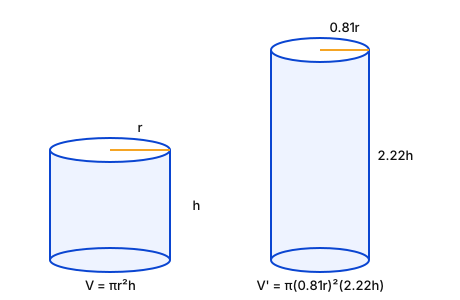
- Radius factor , height factor .
- .
- Increase .
Trick: Successive %: twice ; then .
Answer: (D) 46%
अवधारणा: ; नया आयतन गुणक ।
- त्रिज्या गुणक , ऊँचाई गुणक ।
- ।
- वृद्धि ।
ट्रिक: क्रमिक %: दो बार ; फिर ।
उत्तर: (D) 46%
RRB NTPC Undergraduate CBT 1MathematicsMensuration – CylinderRRB NTPC Undergraduate CBT 1 2024 · 4 Sep Shift 3
Q211.4 years ago, the age of a father was 33 years more than twice his son's age. After how many years, from now, will he be twice his son's age?
4 वर्ष पहले, एक पिता की आयु उसके पुत्र की आयु के दोगुने से 33 वर्ष अधिक थी। अब से कितने वर्ष बाद उसकी आयु उसके पुत्र की आयु की दोगुनी होगी?
- A29
- B28
- C34
- D25
Show answer
Concept: Form the equation from the past condition, then the future condition.
- Let present ages be father , son . Four years ago: .
- After years: .
- .
Trick: For "after how many years will he be twice", answer directly.
Answer: (A) years
अवधारणा: पहले भूतकाल की शर्त से, फिर भविष्य की शर्त से समीकरण बनाएँ।
- वर्तमान आयु पिता , पुत्र । 4 वर्ष पहले: ।
- वर्ष बाद: ।
- ।
ट्रिक: "कितने वर्ष बाद दुगुना" का उत्तर सीधे ।
उत्तर: (A) वर्ष
RRB NTPC Undergraduate CBT 1MathematicsProblems on agesRRB NTPC Undergraduate CBT 1 2024 · 4 Sep Shift 2
Q212.One diagonal and perimeter of a rhombus are 16 cm and 40 cm, respectively. Find the other diagonal.
एक समचतुर्भुज का एक विकर्ण और परिमाप क्रमशः 16 cm और 40 cm हैं। दूसरा विकर्ण ज्ञात कीजिए।
- A10 cm
- B12 cm
- C11 cm
- D14 cm
Show answer
Concept: Diagonals of a rhombus bisect each other at right angles; each side is the hypotenuse of a right triangle formed by half-diagonals.
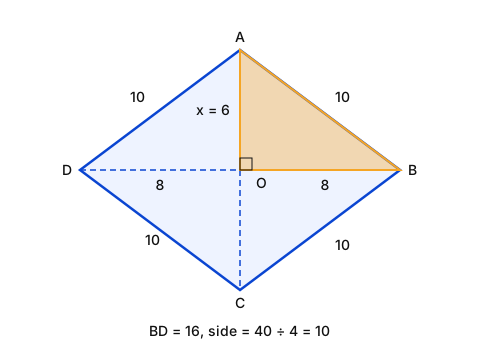
- Side ; half of given diagonal .
- Other half-diagonal .
- Other diagonal .
Trick: : .
Answer: (B)
अवधारणा: समचतुर्भुज के विकर्ण एक-दूसरे को समकोण पर समद्विभाजित करते हैं; प्रत्येक भुजा अर्ध-विकर्णों से बने समकोण त्रिभुज का कर्ण है।
- भुजा ; दिए विकर्ण का आधा ।
- दूसरा अर्ध-विकर्ण ।
- दूसरा विकर्ण ।
ट्रिक: : ।
उत्तर: (B)
RRB NTPC Undergraduate CBT 1MathematicsRhombusRRB NTPC Undergraduate CBT 1 2024 · 4 Sep Shift 2
Q213.A woman travels 432 km at 72 km/hr, a second distance of 275 km at 55 km/hr and a third distance of 680 km at 85 km/hr. Find her average speed for the whole journey (in km/hr).
एक महिला 432 km की दूरी 72 km/hr से, दूसरी दूरी 275 km, 55 km/hr से और तीसरी दूरी 680 km, 85 km/hr से तय करती है। पूरी यात्रा के लिए उसकी औसत चाल (km/hr में) ज्ञात कीजिए।
- A76
- B80
- C66
- D73
Show answer
Concept: Average speed = total distance ÷ total time (not the average of the speeds).
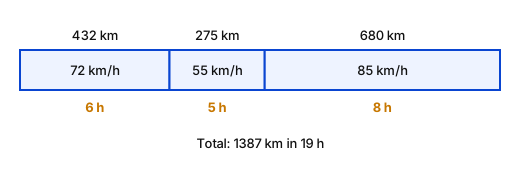
- Times: , , ; total .
- Total distance .
- Average speed .
Trick: Every distance here is an exact multiple of its speed – find hours first, then divide.
Answer: (D)
अवधारणा: औसत चाल = कुल दूरी ÷ कुल समय (चालों का औसत नहीं)।
- समय: , , ; कुल ।
- कुल दूरी ।
- औसत चाल ।
ट्रिक: यहाँ हर दूरी अपनी चाल का पूर्ण गुणज है – पहले घंटे निकालें, फिर भाग दें।
उत्तर: (D)
RRB NTPC Undergraduate CBT 1MathematicsAverage speedRRB NTPC Undergraduate CBT 1 2024 · 4 Sep Shift 2
Q214.The value of is _____.
का मान _____ है।
- A16.76
- B4.97
- C7.76
- D10.48
Show answer
Concept: Find each square root separately; for decimals, count decimal places in pairs.
- (since , four decimal places → two).
- (since ).
- .
Trick: Decimal places in the root = half the decimal places in the number.
Answer: (D)
अवधारणा: हर वर्गमूल अलग निकालें; दशमलव में अंकों को जोड़ों में गिनें।
- (, चार दशमलव स्थान → दो)।
- ()।
- ।
ट्रिक: वर्गमूल में दशमलव स्थान = संख्या के दशमलव स्थानों का आधा।
उत्तर: (D)
RRB NTPC Undergraduate CBT 1MathematicsSquare rootsRRB NTPC Undergraduate CBT 1 2024 · 4 Sep Shift 2
Q215.The marks scored by 10 students are given below.
10, 13, 17, 11, 11, 13, 14, 16, 13, 13
The mode of the data is:
10 विद्यार्थियों द्वारा प्राप्त अंक नीचे दिए गए हैं।
10, 13, 17, 11, 11, 13, 14, 16, 13, 13
आँकड़ों का बहुलक है:
- A13
- B11
- C17
- D10
Show answer
Concept: Mode is the value that occurs most often in the data.
- Frequencies: 10 → 1, 11 → 2, 13 → 4, 14 → 1, 16 → 1, 17 → 1.
- 13 occurs most (4 times), so mode = 13.
Trick: Sort the data first: 10, 11, 11, 13, 13, 13, 13, 14, 16, 17 – the longest run is the mode.
Answer: (A)
अवधारणा: बहुलक (mode) वह मान है जो आँकड़ों में सबसे अधिक बार आता है।
- बारंबारता: 10 → 1, 11 → 2, 13 → 4, 14 → 1, 16 → 1, 17 → 1।
- 13 सबसे अधिक (4 बार) आता है, अतः बहुलक = 13।
ट्रिक: पहले क्रम में लगाएँ: 10, 11, 11, 13, 13, 13, 13, 14, 16, 17 – सबसे लंबी पुनरावृत्ति ही बहुलक।
उत्तर: (A)
RRB NTPC Undergraduate CBT 1MathematicsModeRRB NTPC Undergraduate CBT 1 2024 · 4 Sep Shift 2
Q216.In △ABC, BD ⟂ AC at D and ∠DBC = 63°. E is a point on BC such that ∠CAE = 76°. What is the measure of ∠AEB?
△ABC में, BD ⟂ AC, D पर है और ∠DBC = 63° है। BC पर E एक ऐसा बिंदु है कि ∠CAE = 76° है। ∠AEB का माप क्या है?
- A91°
- B103°
- C105°
- D96°
Show answer
Concept: Use the angle-sum property of a triangle and the linear pair at E.
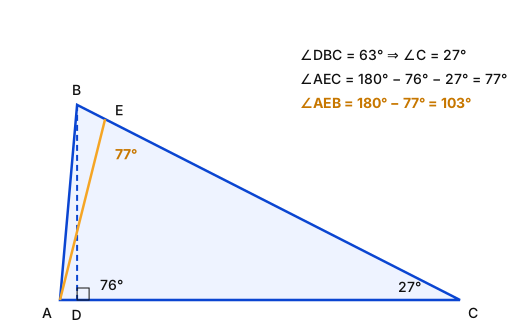
- In right : .
- In : .
- and form a linear pair: .
Trick: Exterior angle: .
Answer: (B)
अवधारणा: त्रिभुज के कोण-योग गुण और E पर रैखिक युग्म का प्रयोग करें।
- समकोण में: ।
- में: ।
- व रैखिक युग्म: ।
ट्रिक: बहिष्कोण: ।
उत्तर: (B)
RRB NTPC Undergraduate CBT 1MathematicsTriangles – anglesRRB NTPC Undergraduate CBT 1 2024 · 4 Sep Shift 2
Q217.Ayushi bought a toy for ₹461, decorated it at a cost of ₹15, and sold the toy for ₹918. Find the loss or gain percentage.
आयुषी ने एक खिलौना ₹461 में खरीदा, ₹15 की लागत से उसे सजाया और खिलौने को ₹918 में बेच दिया। हानि या लाभ प्रतिशत ज्ञात कीजिए।
- A loss हानि
- B loss हानि
- C profit लाभ
- D profit लाभ
Show answer
Concept: Extra expenses (decoration, repair, transport) are added to the cost price.
- Effective CP = ₹; SP = ₹.
- Profit = ₹.
- .
Trick: and – cancel 34 first.
Answer: (C) profit
अवधारणा: अतिरिक्त ख़र्च (सजावट, मरम्मत, ढुलाई) क्रय मूल्य में जोड़ा जाता है।
- प्रभावी क्रय मूल्य = ₹; विक्रय मूल्य = ₹।
- लाभ = ₹।
- ।
ट्रिक: और – पहले 34 काटें।
उत्तर: (C) लाभ
RRB NTPC Undergraduate CBT 1MathematicsProfit and lossRRB NTPC Undergraduate CBT 1 2024 · 4 Sep Shift 2
Q218.The simple interest on a certain sum for years at the rate of 3.6% per annum is ₹5,453.
What will be the amount payable on the same sum at the rate of 2.7% per annum simple interest in years?
एक निश्चित राशि पर वर्षों के लिए 3.6% वार्षिक दर से साधारण ब्याज ₹5,453 है।
उसी राशि पर 2.7% वार्षिक साधारण ब्याज की दर से वर्षों में देय मिश्रधन कितना होगा?
- A₹38,841
- B₹38,819
- C₹38,828
- D₹38,836
Show answer
Concept: ; first find the principal, then the new amount.
- , so .
- New ; SI .
- Amount .
Trick: Total SI % = rate × time; Amount .
Answer: (D) ₹38,836
अवधारणा: ; पहले मूलधन, फिर नई राशि निकालें।
- , अतः ।
- नया ; ब्याज ।
- मिश्रधन ।
ट्रिक: कुल ब्याज % = दर × समय; मिश्रधन ।
उत्तर: (D) ₹38,836
RRB NTPC Undergraduate CBT 1MathematicsSimple interestRRB NTPC Undergraduate CBT 1 2024 · 4 Sep Shift 2
Q219.Find the simple interest (in ₹) if a sum of ₹400 is borrowed for 5.5 years at 8% per annum rate of interest.
यदि ₹400 की राशि 8% वार्षिक ब्याज दर पर 5.5 वर्षों के लिए उधार ली जाती है, तो साधारण ब्याज (₹ में) ज्ञात कीजिए।
- A176
- B276
- C156
- D226
Show answer
Concept: .
- , , years.
- .
Trick: 1 year SI ; .
Answer: (A) ₹176
अवधारणा: ।
- , , वर्ष।
- ।
ट्रिक: 1 वर्ष का ब्याज ; ।
उत्तर: (A) ₹176
RRB NTPC Undergraduate CBT 1MathematicsSimple interestRRB NTPC Undergraduate CBT 1 2024 · 4 Sep Shift 2
Q220.The H.C.F. and the L.C.M. of two numbers are 2 and 410, respectively. If one of the numbers is 82, find the other one.
दो संख्याओं का म.स. (H.C.F.) और ल.स. (L.C.M.) क्रमशः 2 और 410 हैं। यदि उनमें से एक संख्या 82 है, तो दूसरी संख्या ज्ञात कीजिए।
- A54
- B93
- C10
- D11
Show answer
Concept: For two numbers: .
- .
- Check: , ✓.
Trick: Other number .
Answer: (C)
अवधारणा: दो संख्याओं के लिए: (product)।
- ।
- जाँच: , ✓।
ट्रिक: दूसरी संख्या ।
उत्तर: (C)
RRB NTPC Undergraduate CBT 1MathematicsHCF and LCMRRB NTPC Undergraduate CBT 1 2024 · 4 Sep Shift 2

