Q381.Seven people A, B, C, D, E, F and G are sitting in a row, facing the north. F sits sixth from the right end of the row. Only two people sit between E and F. A sits to the right of E but left of G. D sits third to the left of C. How many people sit to the right of B?
सात व्यक्ति A, B, C, D, E, F और G उत्तर की ओर मुख करके एक पंक्ति में बैठे हैं। F पंक्ति के दाएँ छोर से छठे स्थान पर बैठा है। E और F के बीच केवल दो व्यक्ति बैठे हैं। A, E के दाईं ओर लेकिन G के बाईं ओर बैठा है। D, C के बाईं ओर तीसरे स्थान पर बैठा है। B के दाईं ओर कितने व्यक्ति बैठे हैं?
- AThreeतीन
- BFourचार
- CTwoदो
- DFiveपाँच
Show answer
Concept: Seven seats numbered – from the left (all face north).
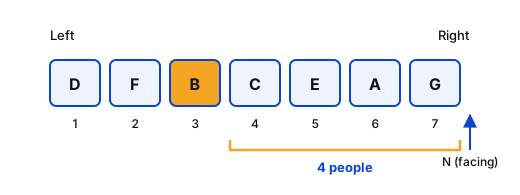
- F from right ⇒ seat ; two between E and F ⇒ E seat
- A right of E, left of G ⇒ A , G
- D third to the left of C, seats free ⇒ D , C , B
- Right of B: C, E, A, G ⇒
Trick: With seats, “ from right” from left.
Answer: (B) Four
अवधारणा: सात सीटें, बाएँ से – (सभी उत्तरमुखी)।
- F दाएँ से वाँ ⇒ सीट ; E और F के बीच दो ⇒ E सीट
- A, E के दाएँ और G के बाएँ ⇒ A , G
- D, C के तीसरे बाएँ; खाली सीट ⇒ D , C , B
- B के दाएँ: C, E, A, G ⇒
ट्रिक: सीटों में “दाएँ से वाँ” बाएँ से रा।
उत्तर: (B) चार
RRB NTPC Undergraduate CBT 1General Intelligence and ReasoningLinear seatingRRB NTPC Undergraduate CBT 1 2024 · 2 Sep Shift 3
Q382.In the following triads, each group of letters is related to the subsequent one following a certain logic. Select from the given options, the one which follows the same logic. SAVE - EASV - AVSE
CROW - WRCO - ROCW
निम्नलिखित त्रिकों में, अक्षरों का प्रत्येक समूह एक निश्चित तर्क का अनुसरण करते हुए अगले समूह से संबंधित है। दिए गए विकल्पों में से उसका चयन कीजिए जो समान तर्क का अनुसरण करता है। SAVE - EASV - AVSE
CROW - WRCO - ROCW
- AGROW - GORW - WORG
- BTERM - METR - RETM
- CDEWS - EDWS - SEWD
- DJUST - TUJS - USJT
Show answer
Concept: Number the letters and find the rearrangement in each step.
- SAVE → EASV: ; EASV → AVSE: of the new word
- CROW → WRCO → ROCW fits ✓
- JUST → TUJS () → USJT () ✓
Trick: Check the first step for all options: only JUST → TUJS keeps “U” in 2nd place with last letter first.
Answer: (D) JUST - TUJS - USJT
अवधारणा: अक्षरों को मानकर हर चरण की पुनर्व्यवस्था खोजें।
- SAVE → EASV: ; EASV → AVSE: नए शब्द का
- CROW → WRCO → ROCW में भी यही ✓
- JUST → TUJS () → USJT () ✓
ट्रिक: पहले चरण से ही जाँचें: केवल JUST → TUJS में अंतिम अक्षर पहले और दूसरा अक्षर वहीं।
उत्तर: (D) JUST - TUJS - USJT
RRB NTPC Undergraduate CBT 1General Intelligence and ReasoningLetter triadsRRB NTPC Undergraduate CBT 1 2024 · 2 Sep Shift 3
Q383.Seven boxes, A, B, C, D, E, F and G, are kept one over the other but not necessarily in the same order.
Only two boxes are kept between C and E. Only A is kept above B. No box is kept below E. F is kept at some place below D but at some place above G.
How many boxes are kept between A and G?
सात बॉक्स, A, B, C, D, E, F और G, एक के ऊपर एक रखे गए हैं, लेकिन आवश्यक नहीं कि इसी क्रम में हों।
C और E के बीच केवल दो बॉक्स रखे गए हैं। B के ऊपर केवल A रखा गया है। E के नीचे कोई बॉक्स नहीं रखा गया है। F, D के नीचे कहीं रखा गया है लेकिन G के ऊपर कहीं रखा गया है।
A और G के बीच कितने बॉक्स रखे गए हैं?
- A4
- B3
- C1
- D2
Show answer
Concept: Number positions (top) to (bottom) and place definite boxes first.
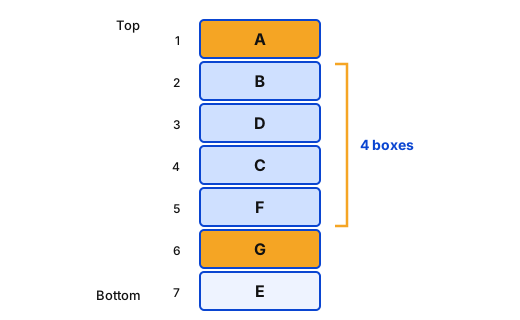
- No box below E ⇒ E at ; two between C and E ⇒ C at
- Only A above B ⇒ A , B
- D above F above G in ⇒ D , F , G
- Between A () and G (): B, D, C, F ⇒
Trick: “Only A above B” fixes the top two at once.
Answer: (A)
अवधारणा: स्थान (ऊपर) से (नीचे) मानें, पहले निश्चित बॉक्स रखें।
- E के नीचे कोई नहीं ⇒ E पर; C और E के बीच दो ⇒ C पर
- केवल A, B के ऊपर ⇒ A , B
- D, F के ऊपर; F, G के ऊपर; खाली ⇒ D , F , G
- A () और G () के बीच: B, D, C, F ⇒
ट्रिक: “केवल A, B के ऊपर” से ऊपर के दो स्थान तुरंत तय।
उत्तर: (A)
RRB NTPC Undergraduate CBT 1General Intelligence and ReasoningBox arrangementRRB NTPC Undergraduate CBT 1 2024 · 2 Sep Shift 3
Q384.In a certain code language, ‘MEAT’ is coded as ‘4257’ and ‘TURN’ is coded as ‘1365’. What is the code for ‘T’ in the given code language?
एक निश्चित कूट भाषा में, ‘MEAT’ को ‘4257’ के रूप में कूटबद्ध किया जाता है और ‘TURN’ को ‘1365’ के रूप में कूटबद्ध किया जाता है। दी गई कूट भाषा में ‘T’ के लिए कूट क्या है?
- A6
- B5
- C7
- D1
Show answer
Concept: The letter common to both words takes the code common to both codes.
- MEAT → 4, 2, 5, 7; TURN → 1, 3, 6, 5
- Common letter: T; common digit: 5 ⇒ T = 5
Trick: One common letter ↔ one common digit.
Answer: (B)
अवधारणा: दोनों शब्दों में सामान्य अक्षर का कोड दोनों कोडों में सामान्य अंक होता है।
- MEAT → 4, 2, 5, 7; TURN → 1, 3, 6, 5
- सामान्य अक्षर: T; सामान्य अंक: 5 ⇒ T = 5
ट्रिक: एक सामान्य अक्षर ↔ एक सामान्य अंक।
उत्तर: (B)
RRB NTPC Undergraduate CBT 1General Intelligence and ReasoningCoding–decodingRRB NTPC Undergraduate CBT 1 2024 · 2 Sep Shift 3
Q385.This question is based on five, four-digit numbers given below.
(Left) 4138 2345 6367 5353 1276 (Right)
(Example: 6975 – First digit = 6, second digit = 9, third digit = 7 and fourth digit = 5) (NOTE: All operations to be done from left to right.)
What will be the resultant if the first digit of the largest number is multiplied to the second digit of the smallest number?
यह प्रश्न नीचे दी गई पाँच, चार अंकों वाली संख्याओं पर आधारित है।
(बाएँ) 4138 2345 6367 5353 1276 (दाएँ)
(उदाहरण: 6975 – पहला अंक = 6, दूसरा अंक = 9, तीसरा अंक = 7 और चौथा अंक = 5) (नोट: सभी संक्रियाएँ बाएँ से दाएँ की जानी हैं।)
यदि सबसे बड़ी संख्या के पहले अंक को सबसे छोटी संख्या के दूसरे अंक से गुणा किया जाए, तो परिणाम क्या होगा?
- A12
- B17
- C14
- D15
Show answer
Concept: Identify the largest and smallest numbers, then pick the required digits.
- Largest ⇒ first digit
- Smallest ⇒ second digit
Trick: Compare first digits only: is largest, is smallest.
Answer: (A)
अवधारणा: सबसे बड़ी और सबसे छोटी संख्या पहचानें, फिर अंक चुनें।
- सबसे बड़ी ⇒ पहला अंक
- सबसे छोटी ⇒ दूसरा अंक
ट्रिक: केवल पहले अंक देखें: सबसे बड़ा, सबसे छोटा।
उत्तर: (A)
RRB NTPC Undergraduate CBT 1General Intelligence and ReasoningNumber puzzleRRB NTPC Undergraduate CBT 1 2024 · 2 Sep Shift 3
Q386.What will come in the place of the question mark (?) in the following equation, if ‘+’ and ‘×’ are interchanged, and ‘−’ and ‘÷’ are interchanged?
46 − 2 ÷ 10 + 3 × 24 = ?
यदि ‘+’ और ‘×’ को आपस में बदल दिया जाए, तथा ‘−’ और ‘÷’ को आपस में बदल दिया जाए, तो निम्नलिखित समीकरण में प्रश्नवाचक चिह्न (?) के स्थान पर क्या आएगा?
46 − 2 ÷ 10 + 3 × 24 = ?
- A12
- B17
- C22
- D28
Show answer
Concept: Swap the signs first, then apply BODMAS.
- Swap and :
Trick: Rewrite the full expression before calculating.
Answer: (B)
अवधारणा: पहले चिह्न बदलें, फिर BODMAS लगाएँ।
- और :
ट्रिक: गणना से पहले पूरा व्यंजक दोबारा लिखें।
उत्तर: (B)
RRB NTPC Undergraduate CBT 1General Intelligence and ReasoningSymbol interchangeRRB NTPC Undergraduate CBT 1 2024 · 2 Sep Shift 3
Q387.What should come in place of the question mark (?) in the given series?
288 233 183 138 98 ?
दी गई श्रृंखला में प्रश्नवाचक चिह्न (?) के स्थान पर क्या आना चाहिए?
288 233 183 138 98 ?
- A53
- B73
- C63
- D43
Show answer
Concept: Look at the differences between consecutive terms.
- Differences: (decreasing by )
- Next difference ⇒
Trick: Subtract multiples of going down: .
Answer: (C)
अवधारणा: क्रमागत पदों का अंतर देखें।
- अंतर: (हर बार कम)
- अगला अंतर ⇒
ट्रिक: के गुणज घटते क्रम में: ।
उत्तर: (C)
RRB NTPC Undergraduate CBT 1General Intelligence and ReasoningNumber seriesRRB NTPC Undergraduate CBT 1 2024 · 2 Sep Shift 3
Q388.Read the given statements and conclusions carefully. Assuming that the information given in the statements is true, even if it appears to be at variance with commonly known facts, decide which of the given conclusions logically follow(s) from the statements.
Statements:
All oranges are melons.
All grapes are oranges.
Conclusions:
(I) Some melons are oranges.
(II) All grapes are melons.
दिए गए कथनों और निष्कर्षों को ध्यानपूर्वक पढ़िए। यह मानते हुए कि कथनों में दी गई जानकारी सत्य है, भले ही वह सामान्यतः ज्ञात तथ्यों से भिन्न प्रतीत होती हो, निर्णय कीजिए कि दिए गए निष्कर्षों में से कौन-सा/से निष्कर्ष कथनों का तार्किक रूप से अनुसरण करता है/करते हैं।
कथन:
सभी संतरे, खरबूजे हैं।
सभी अंगूर, संतरे हैं।
निष्कर्ष:
(I) कुछ खरबूजे, संतरे हैं।
(II) सभी अंगूर, खरबूजे हैं।
- ABoth conclusions (I) and (II) follow.निष्कर्ष (I) और (II) दोनों अनुसरण करते हैं।
- BNeither conclusion (I) nor (II) follows.न तो निष्कर्ष (I) और न ही (II) अनुसरण करता है।
- COnly conclusion (II) follows.केवल निष्कर्ष (II) अनुसरण करता है।
- DOnly conclusion (I) follows.केवल निष्कर्ष (I) अनुसरण करता है।
Show answer
Concept: “All X are Y” puts circle X fully inside circle Y.
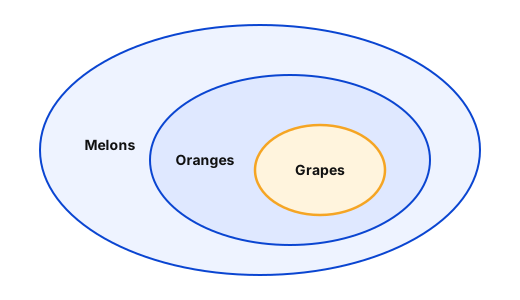
- Grapes ⊂ Oranges ⊂ Melons
- I: Oranges are inside Melons, so some melons are oranges ✓
- II: Grapes inside Oranges inside Melons ⇒ all grapes are melons ✓
Trick: All + All ⇒ All (chain), and “All A are B” always gives “Some B are A”.
Answer: (A) Both conclusions (I) and (II) follow
अवधारणा: “सभी X, Y हैं” का अर्थ X वृत्त पूरी तरह Y के भीतर।
- अंगूर ⊂ संतरे ⊂ खरबूजे
- I: संतरे, खरबूजों के भीतर ⇒ कुछ खरबूजे संतरे हैं ✓
- II: अंगूर ⊂ संतरे ⊂ खरबूजे ⇒ सभी अंगूर खरबूजे हैं ✓
ट्रिक: सभी + सभी ⇒ सभी (श्रृंखला); “सभी A, B हैं” से “कुछ B, A हैं” हमेशा।
उत्तर: (A) दोनों निष्कर्ष (I) और (II) अनुसरण करते हैं
RRB NTPC Undergraduate CBT 1General Intelligence and ReasoningSyllogismRRB NTPC Undergraduate CBT 1 2024 · 2 Sep Shift 3
Q389.1 is subtracted from each even digit of the number 95423671. Find the product of the digits that are third from the left and third from the right in the new number formed.
संख्या 95423671 के प्रत्येक सम अंक में से 1 घटाया जाता है। इस प्रकार बनी नई संख्या में बाएँ से तीसरे और दाएँ से तीसरे अंकों का गुणनफल ज्ञात कीजिए।
- A10
- B8
- C0
- D15
Show answer
Concept: Change only the even digits, then read positions from each end.
- 95423671: even digits become ⇒ 95313571
- Third from left ; third from right
- Product
Trick: Odd digits stay the same; only change.
Answer: (D)
अवधारणा: केवल सम अंक बदलें, फिर दोनों छोर से स्थान पढ़ें।
- 95423671: सम अंक बनते हैं ⇒ 95313571
- बाएँ से तीसरा ; दाएँ से तीसरा
- गुणनफल
ट्रिक: विषम अंक वही रहते हैं; केवल बदलते हैं।
उत्तर: (D)
RRB NTPC Undergraduate CBT 1General Intelligence and ReasoningDigit operationsRRB NTPC Undergraduate CBT 1 2024 · 2 Sep Shift 3
Q390.38 people are standing in a row facing North. Harman is 15th from the right end while Hinal is 13th from the left end. How many people are there between Harman and Hinal?
38 व्यक्ति उत्तर की ओर मुख करके एक पंक्ति में खड़े हैं। हरमन दाएँ छोर से 15वें स्थान पर है जबकि हिनल बाएँ छोर से 13वें स्थान पर है। हरमन और हिनल के बीच कितने व्यक्ति हैं?
- A8
- B9
- C10
- D7
Show answer
Concept: Convert both positions to the same end: from left .
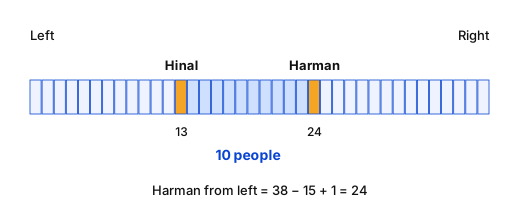
- Harman from left
- Hinal from left
- Between
Trick: Between two positions difference .
Answer: (C)
अवधारणा: दोनों स्थितियों को एक ही छोर से बदलें: बाएँ से ।
- हरमन बाएँ से
- हिनल बाएँ से
- बीच में
ट्रिक: दो स्थानों के बीच अंतर ।
उत्तर: (C)
RRB NTPC Undergraduate CBT 1General Intelligence and ReasoningRanking in a rowRRB NTPC Undergraduate CBT 1 2024 · 2 Sep Shift 3
Q391.In a certain code language, ‘SAID’ is coded as ‘3517’ and ‘AERO’ is coded as ‘2146’. What is the code for ‘A’ in the given code language?
एक निश्चित कूट भाषा में, ‘SAID’ को ‘3517’ के रूप में कूटबद्ध किया जाता है और ‘AERO’ को ‘2146’ के रूप में कूटबद्ध किया जाता है। दी गई कूट भाषा में ‘A’ के लिए कूट क्या है?
- A5
- B2
- C1
- D6
Show answer
Concept: A letter common to two words gets the digit common to both codes.
- SAID → 3517, AERO → 2146.
- Common letter: A; common digit: 1.
Trick: Match common letters with common digits.
Answer: (C) 1
अवधारणा: दो शब्दों में साझा अक्षर का कोड दोनों कोडों में साझा अंक होता है।
- SAID → 3517, AERO → 2146।
- साझा अक्षर A; साझा अंक 1।
ट्रिक: साझा अक्षर ↔ साझा अंक।
उत्तर: (C) 1
RRB NTPC Undergraduate CBT 1General Intelligence and ReasoningCoding-decoding – common letterRRB NTPC Undergraduate CBT 1 2024 · 2 Sep Shift 2
Q392.Seven boxes A, B, C, D, E, F and G are kept one over the other but not necessarily in the same order. Only two boxes are kept between E and B. Only A is kept above C. No box is kept below B. G is kept at some place below F but at some place above D. How many boxes are kept below F?
सात बक्से A, B, C, D, E, F और G एक के ऊपर एक रखे गए हैं, लेकिन यह आवश्यक नहीं है कि वे इसी क्रम में हों। E और B के बीच केवल दो बक्से रखे गए हैं। C के ऊपर केवल A रखा गया है। B के नीचे कोई बक्सा नहीं रखा गया है। G को F के नीचे किसी स्थान पर, लेकिन D के ऊपर किसी स्थान पर रखा गया है। F के नीचे कितने बक्से रखे गए हैं?
- A2
- B4
- C3
- D1
Show answer
Concept: Fix the certain positions first (top/bottom), then the relative clues.
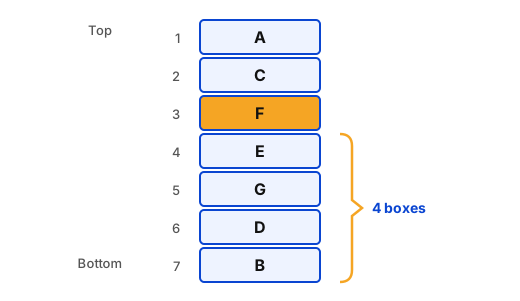
- No box below B → B at 7 (bottom). Two boxes between E and B → E at 4.
- Only A above C → A at 1, C at 2.
- F above G above D in places 3, 5, 6 → F 3, G 5, D 6.
- Below F: E, G, D, B → 4 boxes.
Trick: Start with words "only" and "no box below" – they fix exact positions.
Answer: (B) 4
अवधारणा: पहले निश्चित स्थान (ऊपर/नीचे) तय करें, फिर सापेक्ष संकेत।
- B के नीचे कोई नहीं → B स्थान 7 पर; E और B के बीच दो → E स्थान 4।
- केवल A, C के ऊपर → A 1, C 2।
- F, G के ऊपर, G, D के ऊपर → F 3, G 5, D 6।
- F के नीचे: E, G, D, B → 4 बॉक्स।
ट्रिक: "केवल" और "नीचे कोई नहीं" वाले संकेत पहले लगाएँ।
उत्तर: (B) 4
RRB NTPC Undergraduate CBT 1General Intelligence and ReasoningBox stacking puzzleRRB NTPC Undergraduate CBT 1 2024 · 2 Sep Shift 2
Q393.Based on the English alphabetical order, three of the following four letter-clusters are alike in a certain way and thus form a group. Which letter-cluster DOES NOT belong to that group?
(Note: The odd one out is not based on the number of consonants/vowels or their position in the letter-cluster.)
अंग्रेज़ी वर्णमाला क्रम के आधार पर, निम्नलिखित चार अक्षर-समूहों में से तीन किसी निश्चित प्रकार से एकसमान हैं और इस प्रकार एक समूह बनाते हैं। कौन-सा अक्षर-समूह उस समूह से संबंधित नहीं है?
(ध्यान दें: असंगत का निर्धारण व्यंजनों/स्वरों की संख्या या अक्षर-समूह में उनके स्थान के आधार पर नहीं है।)
- AKMH
- BIKE
- CGIC
- DMOI
Show answer
Concept: Check the gaps between letters using positions (A = 1 … Z = 26).
- IKE: I+2 = K, K−6 = E. GIC: G+2 = I, I−6 = C. MOI: M+2 = O, O−6 = I.
- KMH: K+2 = M, but M−5 = H (not −6).
Trick: Write the pattern of the first cluster and test the rest.
Answer: (A) KMH
अवधारणा: अक्षरों की स्थिति (A = 1 … Z = 26) से अंतर देखें।
- IKE, GIC, MOI: पहला +2, फिर −6।
- KMH: K+2 = M, पर M−5 = H (−6 नहीं)।
ट्रिक: एक समूह का पैटर्न लिखकर बाकी जाँचें।
उत्तर: (A) KMH
RRB NTPC Undergraduate CBT 1General Intelligence and ReasoningOdd one out – letter clustersRRB NTPC Undergraduate CBT 1 2024 · 2 Sep Shift 2
Q394.Read the given statement(s) and conclusions carefully. Assuming that the information given in the statements is true, even if it appears to be at variance with commonly known facts, decide which of the given conclusions logically follow(s) from the statement(s).
Statements:
Some Circular Saws are Trowels.
Some Trowels are Power Saws.
Conclusions:
I: Some Circular Saws are Power Saws.
II: No Circular Saws are Power Saws.
दिए गए कथनों और निष्कर्षों को ध्यानपूर्वक पढ़िए। यह मानते हुए कि कथनों में दी गई जानकारी सत्य है, भले ही वह सामान्यतः ज्ञात तथ्यों से भिन्न प्रतीत होती हो, निर्णय लीजिए कि दिए गए निष्कर्षों में से कौन-सा/से निष्कर्ष कथनों का तार्किक रूप से अनुसरण करता है/करते हैं।
कथन:
कुछ सर्कुलर सॉ (Circular Saws), ट्रॉवेल (Trowels) हैं।
कुछ ट्रॉवेल, पावर सॉ (Power Saws) हैं।
निष्कर्ष:
I: कुछ सर्कुलर सॉ, पावर सॉ हैं।
II: कोई सर्कुलर सॉ, पावर सॉ नहीं है।
- AOnly conclusion (I) follows.केवल निष्कर्ष (I) अनुसरण करता है।
- BNeither conclusion (I) nor (II) follows.न तो निष्कर्ष (I) और न ही (II) अनुसरण करता है।
- CBoth conclusions (I) and (II) follow.निष्कर्ष (I) और (II) दोनों अनुसरण करते हैं।
- DOnly conclusion (II) follows.केवल निष्कर्ष (II) अनुसरण करता है।
Show answer
Concept: Two "some" statements through a middle term give no definite link between the end terms.
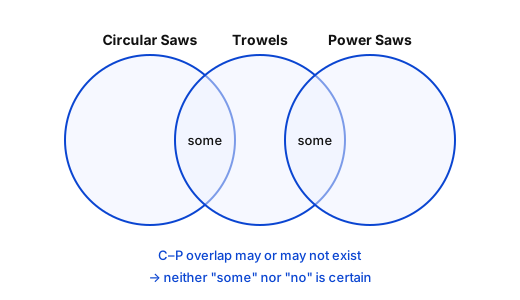
- Some Circular Saws are Trowels; some Trowels are Power Saws.
- Circular Saws and Power Saws may or may not overlap.
- So neither I ("some are") nor II ("none are") is certain.
Trick: Some + Some → no conclusion. I and II form an either-or pair, but "either-or" is not among the options, so neither follows definitely.
Answer: (B) Neither conclusion (I) nor (II) follows.
अवधारणा: मध्य पद से जुड़े दो "कुछ" कथनों से अंतिम पदों में कोई निश्चित संबंध नहीं बनता।
- कुछ Circular Saws, Trowels हैं; कुछ Trowels, Power Saws हैं।
- Circular Saws और Power Saws का मेल हो भी सकता है, नहीं भी।
- अतः I और II में से कोई भी निश्चित नहीं।
ट्रिक: कुछ + कुछ → कोई निष्कर्ष नहीं।
उत्तर: (B) न तो (I) और न ही (II) अनुसरण करता है।
RRB NTPC Undergraduate CBT 1General Intelligence and ReasoningSyllogismRRB NTPC Undergraduate CBT 1 2024 · 2 Sep Shift 2
Q395.Read the given statements and conclusions carefully. Assuming that the information given in the statements is true, even if it appears to be at variance with commonly known facts, decide which of the given conclusion(s) logically follow(s) from the statements.
Statements:
All soaps are gels.
All soaps are conditioners.
Conclusions:
(I) Some gels are conditioners.
(II) All conditioners are soaps.
दिए गए कथनों और निष्कर्षों को ध्यानपूर्वक पढ़िए। यह मानते हुए कि कथनों में दी गई जानकारी सत्य है, भले ही वह सामान्यतः ज्ञात तथ्यों से भिन्न प्रतीत होती हो, निर्णय लीजिए कि दिए गए निष्कर्षों में से कौन-सा/से निष्कर्ष कथनों का तार्किक रूप से अनुसरण करता है/करते हैं।
कथन:
सभी साबुन, जेल हैं।
सभी साबुन, कंडीशनर हैं।
निष्कर्ष:
(I) कुछ जेल, कंडीशनर हैं।
(II) सभी कंडीशनर, साबुन हैं।
- ABoth conclusions (I) and (II) follow.निष्कर्ष (I) और (II) दोनों अनुसरण करते हैं।
- BNeither conclusion (I) nor (II) follows.न तो निष्कर्ष (I) और न ही (II) अनुसरण करता है।
- COnly conclusion (II) follows.केवल निष्कर्ष (II) अनुसरण करता है।
- DOnly conclusion (I) follows.केवल निष्कर्ष (I) अनुसरण करता है।
Show answer
Concept: If all X are Y and all X are Z, then some Y are Z.
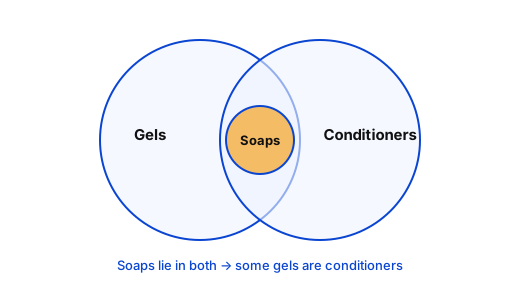
- Soaps lie inside Gels and inside Conditioners.
- So the soap region is common → Some gels are conditioners (I follows).
- Conditioners may contain more than soaps → II does not follow.
Trick: All + All with the same subject → "Some" conclusion between the two predicates.
Answer: (D) Only conclusion (I) follows.
अवधारणा: यदि सभी X, Y हैं और सभी X, Z हैं, तो कुछ Y, Z हैं।
- Soaps, Gels और Conditioners दोनों के अंदर।
- अतः कुछ Gels, Conditioners हैं (I सही)।
- सभी Conditioners, Soaps हों – आवश्यक नहीं (II गलत)।
ट्रिक: समान विषय वाले दो "सभी" → विधेयों में "कुछ" संबंध।
उत्तर: (D) केवल निष्कर्ष (I) अनुसरण करता है।
RRB NTPC Undergraduate CBT 1General Intelligence and ReasoningSyllogismRRB NTPC Undergraduate CBT 1 2024 · 2 Sep Shift 2
Q396.A, B, C, D, Q, R and S are sitting around a circular table, facing the centre of the table. Only two people sit between D and A, when counted from the left of A. Q sits third to the left of S. R sits to the immediate right of S. R sits second to the left of D. B is not an immediate neighbour of Q. Who sits third to the right of C?
A, B, C, D, Q, R और S एक वृत्ताकार मेज़ के चारों ओर मेज़ के केंद्र की ओर मुख करके बैठे हैं। A के बाएँ से गिनने पर, D और A के बीच केवल दो व्यक्ति बैठे हैं। Q, S के बाएँ से तीसरे स्थान पर बैठा है। R, S के ठीक दाएँ बैठा है। R, D के बाएँ से दूसरे स्थान पर बैठा है। B, Q का निकटतम पड़ोसी नहीं है। C के दाएँ से तीसरे स्थान पर कौन बैठा है?
- AD
- BS
- CR
- DA
Show answer
Concept: Facing the centre: left = clockwise, right = anticlockwise.
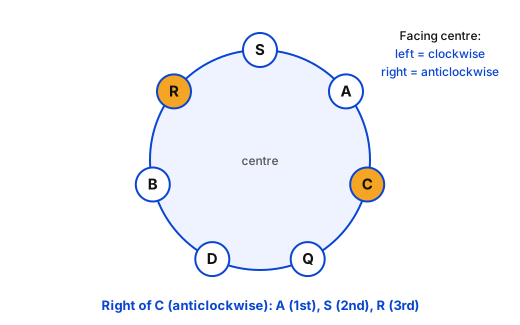
- Place S. R is immediate right of S; Q is 3rd to the left of S.
- R is 2nd to the left of D → D is 2nd to the right of R. A is 3rd to the left of D (two people between).
- Order clockwise: S, A, C/B, Q, D, B/C, R. B is not next to Q → B beside R, C beside A.
- Third to the right of C: A, S, R → R.
Trick: Fix a person who appears in most clues (S) and build around it.
Answer: (C) R
अवधारणा: केंद्र की ओर मुख: बायाँ = दक्षिणावर्त, दायाँ = वामावर्त।
- S रखें; R, S के ठीक दाएँ; Q, S के बाएँ तीसरा।
- R, D के बाएँ दूसरा → D, R के दाएँ दूसरा; A, D के बाएँ तीसरा।
- B, Q का पड़ोसी नहीं → B, R के पास; C, A के पास।
- C के दाएँ तीसरा: A, S, R → R।
ट्रिक: सबसे अधिक संकेतों वाले व्यक्ति (S) से शुरू करें।
उत्तर: (C) R
RRB NTPC Undergraduate CBT 1General Intelligence and ReasoningCircular seating arrangementRRB NTPC Undergraduate CBT 1 2024 · 2 Sep Shift 2
Q397.A, B, C, D, Q, R and S are sitting around a circular table, facing the centre of the table. B sits third to the left of Q. R sits second to the left of S. Q is an immediate neighbour of both A and R. C is not an immediate neighbour of B. How many people sit between D and R, when counted from the right of D?
A, B, C, D, Q, R और S एक वृत्ताकार मेज़ के चारों ओर मेज़ के केंद्र की ओर मुख करके बैठे हैं। B, Q के बाएँ से तीसरे स्थान पर बैठा है। R, S के बाएँ से दूसरे स्थान पर बैठा है। Q, A और R दोनों का निकटतम पड़ोसी है। C, B का निकटतम पड़ोसी नहीं है। D के दाएँ से गिनने पर, D और R के बीच कितने व्यक्ति बैठे हैं?
- AThreeतीन
- BOneएक
- CTwoदो
- DFourचार
Show answer
Concept: Facing the centre: left = clockwise, right = anticlockwise.
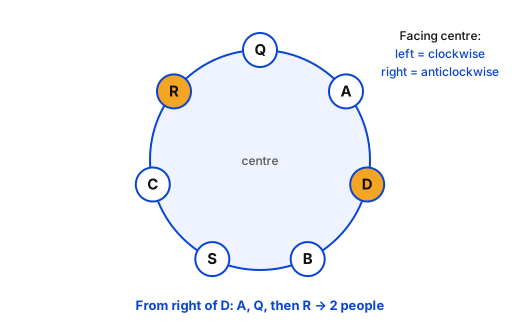
- Place Q; B is 3rd to the left of Q.
- Q sits between A and R. R is 2nd to the left of S: if R were on Q\'s left, S would clash with A, so R is on Q\'s right and A on Q\'s left.
- S is 2nd to the right of R. C, D fill the last two seats; C not next to B → D next to A.
- From the right of D: A, Q, then R → 2 people.
Trick: Test both sides for R; the wrong one causes a seat clash.
Answer: (C) Two
अवधारणा: केंद्र की ओर मुख: बायाँ = दक्षिणावर्त, दायाँ = वामावर्त।
- Q रखें; B, Q के बाएँ तीसरा।
- Q के दोनों ओर A और R; R को बाएँ रखने पर S व A टकराते हैं, अतः R दाएँ।
- S, R के दाएँ दूसरा; C, B का पड़ोसी नहीं → D, A के पास।
- D के दाएँ से: A, Q, फिर R → 2 व्यक्ति।
ट्रिक: R के दोनों विकल्प जाँचें; गलत वाले में टकराव होगा।
उत्तर: (C) दो
RRB NTPC Undergraduate CBT 1General Intelligence and ReasoningCircular seating arrangementRRB NTPC Undergraduate CBT 1 2024 · 2 Sep Shift 2
Q398.DREAM is related to IWJFR in a certain way based on the English alphabetical order. In the same way, FILED is related to KNQJI. To which of the given options is BLOWN related, following the same logic?
अंग्रेज़ी वर्णमाला क्रम के आधार पर, DREAM एक निश्चित प्रकार से IWJFR से संबंधित है। उसी प्रकार, FILED, KNQJI से संबंधित है। समान तर्क का अनुसरण करते हुए, BLOWN दिए गए विकल्पों में से किससे संबंधित है?
- AGQTBS
- BFPSAR
- CHRUCT
- DGRSCS
Show answer
Concept: Find the shift applied to each letter.
- DREAM → IWJFR: every letter +5 (D→I, R→W, E→J, A→F, M→R).
- FILED → KNQJI: again +5.
- BLOWN +5 → G, Q, T, B (W+5 wraps), S → GQTBS.
Trick: After Z, continue from A: W→X, Y, Z, A, B.
Answer: (A) GQTBS
अवधारणा: हर अक्षर पर लगाया गया अंतर खोजें।
- DREAM → IWJFR: हर अक्षर +5।
- FILED → KNQJI: +5।
- BLOWN +5 → GQTBS (W+5 = B)।
ट्रिक: Z के बाद फिर A से गिनें।
उत्तर: (A) GQTBS
RRB NTPC Undergraduate CBT 1General Intelligence and ReasoningLetter analogy – codingRRB NTPC Undergraduate CBT 1 2024 · 2 Sep Shift 2
Q399.Which of the following letter-number clusters will replace the question mark (?) in the given series to make it logically complete?
LOH19 MPI27 NQJ35 ORK43 ?
दी गई शृंखला को तार्किक रूप से पूर्ण करने के लिए निम्नलिखित में से कौन-सा अक्षर-संख्या समूह प्रश्न चिह्न (?) के स्थान पर आएगा?
LOH19 MPI27 NQJ35 ORK43 ?
- APSK50
- BPSL50
- CPSL51
- DPSK51
Show answer
Concept: Track each position separately.
- 1st letters: L, M, N, O → P. 2nd: O, P, Q, R → S. 3rd: H, I, J, K → L.
- Numbers: 19, 27, 35, 43 (+8) → 51.
Trick: Each letter +1, number +8.
Answer: (C) PSL51
अवधारणा: हर स्थान को अलग से देखें।
- पहला अक्षर L, M, N, O → P; दूसरा O, P, Q, R → S; तीसरा H, I, J, K → L।
- संख्या: +8 → 51।
ट्रिक: हर अक्षर +1, संख्या +8।
उत्तर: (C) PSL51
RRB NTPC Undergraduate CBT 1General Intelligence and ReasoningLetter-number seriesRRB NTPC Undergraduate CBT 1 2024 · 2 Sep Shift 2
Q400.Based on the English alphabetical order, three of the following four letter-clusters are alike in a certain way and thus form a group. Which letter-cluster DOES NOT belong to that group? (Note: The odd one out is not based on the number of consonants/vowels or their position in the letter-cluster.)
अंग्रेज़ी वर्णमाला क्रम के आधार पर, निम्नलिखित चार अक्षर-समूहों में से तीन किसी निश्चित प्रकार से एकसमान हैं और इस प्रकार एक समूह बनाते हैं। कौन-सा अक्षर-समूह उस समूह से संबंधित नहीं है? (ध्यान दें: असंगत का निर्धारण व्यंजनों/स्वरों की संख्या या अक्षर-समूह में उनके स्थान के आधार पर नहीं है।)
- AERM
- BBFJ
- CSWA
- DUYC
Show answer
Concept: Check the gaps between letters (A = 1 … Z = 26, wrapping after Z).
- BFJ: +4, +4. SWA: S+4 = W, W+4 = A. UYC: U+4 = Y, Y+4 = C.
- ERM: E+13 = R, R−5 = M → different.
Trick: Remember the wrap-around: W, X, Y, Z, A.
Answer: (A) ERM
अवधारणा: अक्षरों का अंतर देखें (Z के बाद A से)।
- BFJ, SWA, UYC: +4, +4।
- ERM: +13, −5 → अलग।
ट्रिक: Z के बाद A से गिनना न भूलें।
उत्तर: (A) ERM
RRB NTPC Undergraduate CBT 1General Intelligence and ReasoningOdd one out – letter clustersRRB NTPC Undergraduate CBT 1 2024 · 2 Sep Shift 2

