Q441.The HCF and the LCM of two numbers are 11 and 330, respectively. If one of the numbers is 66, find the other one.
दो संख्याओं का HCF और LCM क्रमशः 11 और 330 है। यदि उनमें से एक संख्या 66 है, तो दूसरी संख्या ज्ञात कीजिए।
- A44
- B55
- C66
- D121
Show answer
Concept: .
Trick: Other number must be a multiple of HCF 11 dividing 330 → 55.
Answer: (B) 55
अवधारणा: ।
ट्रिक: दूसरी संख्या 11 का गुणज और 330 का भाजक होगी → 55।
उत्तर: (B) 55
RRB NTPC Undergraduate CBT 1MathematicsHCF and LCMRRB NTPC Undergraduate CBT 1 2024 · 2 Sep Shift 1
Q442.Pipe P can fill part of a tank in 21 hours and pipe Q can fill part of the same tank in 16 hours. Both P and Q were kept open for 2 hours, then both were closed. Pipe R alone was then opened and it emptied the water in the tank in 3 hours. Pipes P, Q and R together can fill the empty tank in:
पाइप P एक टंकी का भाग 21 घंटे में भर सकता है और पाइप Q उसी टंकी का भाग 16 घंटे में भर सकता है। P और Q दोनों को 2 घंटे के लिए खुला रखा गया, फिर दोनों को बंद कर दिया गया। इसके बाद केवल पाइप R को खोला गया और उसने टंकी का पानी 3 घंटे में खाली कर दिया। पाइप P, Q और R एक साथ खाली टंकी को कितने समय में भर सकते हैं?
- A94 hours94 घंटे
- B89 hours89 घंटे
- C67 hours67 घंटे
- D84 hours84 घंटे
Show answer
Concept: Find each pipe's full-tank time, then add rates (emptying pipe negative).
- P: in 21 h → full in h; Q: in 16 h → h.
- In 2 h: tank filled.
- R empties in 3 h → empties full tank in 42 h.
- Together: → 84 h.
Trick: Take tank units: P = 3, Q = 3, R = −4 per hour → net 2 → h.
Answer: (D) 84 hours
अवधारणा: हर पाइप का पूरा टैंक भरने का समय निकालें, फिर दरें जोड़ें (खाली करने वाला ऋणात्मक)।
- P: 21 घंटे में → पूरा घंटे; Q: 16 घंटे में → घंटे।
- 2 घंटे में: भाग भरा।
- R 3 घंटे में खाली करता है → पूरा 42 घंटे में।
- साथ में: → 84 घंटे।
ट्रिक: टैंक इकाई: P = 3, Q = 3, R = −4 प्रति घंटा → शुद्ध 2 → घंटे।
उत्तर: (D) 84 घंटे
RRB NTPC Undergraduate CBT 1MathematicsPipes and CisternsRRB NTPC Undergraduate CBT 1 2024 · 2 Sep Shift 1
Q443.One side of a right-angled triangle is twice the other and the hypotenuse is 15 cm. Find the area (in cm2) of the triangle.
एक समकोण त्रिभुज की एक भुजा दूसरी भुजा की दोगुनी है और कर्ण 15 cm है। त्रिभुज का क्षेत्रफल (cm2 में) ज्ञात कीजिए।
- A70
- B60
- C45
- D80
Show answer
Concept: Pythagoras: ; area .
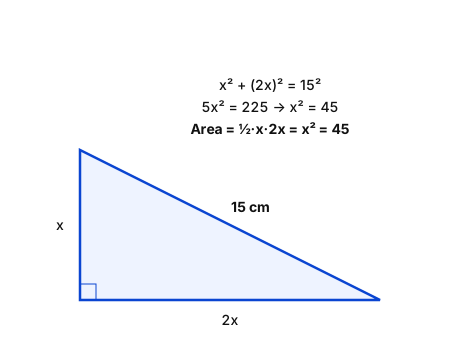
- Sides and :
- Area
Trick: No need to find – area equals directly.
Answer: (C) 45
अवधारणा: पाइथागोरस: ; क्षेत्रफल ।
- भुजाएँ और :
- क्षेत्रफल
ट्रिक: निकालने की जरूरत नहीं – क्षेत्रफल सीधे है।
उत्तर: (C) 45
RRB NTPC Undergraduate CBT 1MathematicsMensuration – Right TriangleRRB NTPC Undergraduate CBT 1 2024 · 2 Sep Shift 1
Q444.The value of is
का मान कितना है?
- A
- B
- C
- D
Show answer
Concept: Equal terms with opposite signs cancel; then simplify the complex fraction.
- and cancel.
Trick: Spot cancellations before computing.
Answer: (B)
अवधारणा: समान पद विपरीत चिह्न के साथ कट जाते हैं; फिर जटिल भिन्न सरल करें।
- और कट जाते हैं।
ट्रिक: गणना से पहले कटने वाले पद देखें।
उत्तर: (B)
RRB NTPC Undergraduate CBT 1MathematicsSimplification – FractionsRRB NTPC Undergraduate CBT 1 2024 · 2 Sep Shift 1
Q445.The average weight (in kg) of a family of five members whose weights are 40 kg, 49 kg, 56 kg, 76 kg and 38 kg is:
पाँच सदस्यों वाले एक परिवार, जिनके भार 40 kg, 49 kg, 56 kg, 76 kg और 38 kg हैं, का औसत भार (kg में) कितना है?
- A52.8
- B50.8
- C53.8
- D51.8
Show answer
Concept: .
- Sum
- Average
Trick: Assume 50: deviations sum → .
Answer: (D) 51.8
अवधारणा: ।
- योग
- औसत
ट्रिक: 50 मानें: विचलन का योग → ।
उत्तर: (D) 51.8
RRB NTPC Undergraduate CBT 1MathematicsAverageRRB NTPC Undergraduate CBT 1 2024 · 2 Sep Shift 1
Q446.M and N started a business. M invested ₹50,000 more than N for 3 months, while N invested for 7 months. M's share is ₹328 more than that of N, out of a total profit of ₹4,920. Find the capital contributed by M.
M और N ने एक व्यवसाय शुरू किया। M ने N से ₹50,000 अधिक 3 महीने के लिए निवेश किया, जबकि N ने 7 महीने के लिए निवेश किया। ₹4,920 के कुल लाभ में से M का हिस्सा N के हिस्से से ₹328 अधिक है। M द्वारा लगाई गई पूँजी ज्ञात कीजिए।
- A₹1,20,000
- B₹1,00,000
- C₹80,000
- D₹60,000
Show answer
Concept: Profit ratio = capital × time ratio.
- → ratio
- (capitals )
Trick: — divide both by 328 → .
Answer: (C) ₹80,000
अवधारणा: लाभ का अनुपात = पूँजी × समय का अनुपात।
- → अनुपात
- (पूँजी )
ट्रिक: — दोनों को 328 से भाग दें → ।
उत्तर: (C) ₹80,000
RRB NTPC Undergraduate CBT 1MathematicsPartnershipRRB NTPC Undergraduate CBT 1 2024 · 2 Sep Shift 1
Q447.50 glass bottles were purchased for ₹50, and 28 glass bottles broke in transit. The trader sold the remaining glass bottles at ₹5.80 each. Find his profit.
₹50 में 50 काँच की बोतलें खरीदी गईं, और परिवहन के दौरान 28 काँच की बोतलें टूट गईं। व्यापारी ने शेष काँच की बोतलों को ₹5.80 प्रति बोतल की दर से बेचा। उसका लाभ ज्ञात कीजिए।
- A₹68.50
- B₹76.60
- C₹75.30
- D₹77.60
Show answer
Concept: Profit = total SP − total CP (broken items give no revenue).
- Bottles left
- SP
- Profit
Trick: Cost stays ₹50 even though bottles broke.
Answer: (D) ₹77.60
अवधारणा: लाभ = कुल विक्रय मूल्य − कुल क्रय मूल्य (टूटी बोतलों से कोई आय नहीं)।
- बची बोतलें
- विक्रय मूल्य
- लाभ
ट्रिक: बोतलें टूटने पर भी लागत ₹50 ही रहती है।
उत्तर: (D) ₹77.60
RRB NTPC Undergraduate CBT 1MathematicsProfit and LossRRB NTPC Undergraduate CBT 1 2024 · 2 Sep Shift 1
Q448.The average runs scored by a batsman in 23 matches is 42. In the next 10 matches, the batsman scored an average of 13 runs. Find his average runs scored (rounded off to two decimals) in all the 33 matches.
एक बल्लेबाज़ द्वारा 23 मैचों में बनाए गए औसत रन 42 हैं। अगले 10 मैचों में, बल्लेबाज़ ने 13 रन का औसत बनाया। सभी 33 मैचों में उसके द्वारा बनाए गए औसत रन (दशमलव के दो स्थानों तक पूर्णांकित) ज्ञात कीजिए।
- A35.21
- B34.21
- C33.21
- D32.21
Show answer
Concept: Combined average .
- Runs in 23 matches
- Runs in 10 matches
- Average
Trick: Answer must lie between 13 and 42, nearer 42 (more matches) → only 33.21 fits the exact division.
Answer: (C) 33.21
अवधारणा: संयुक्त औसत ।
- 23 मैचों के रन
- 10 मैचों के रन
- औसत
ट्रिक: उत्तर 13 और 42 के बीच, 42 के निकट होगा।
उत्तर: (C) 33.21
RRB NTPC Undergraduate CBT 1MathematicsAverageRRB NTPC Undergraduate CBT 1 2024 · 2 Sep Shift 1
Q449.The value of is
का मान कितना है?
- A
- B
- C
- D
Show answer
Concept: Simplify the complex fraction and combine like fractions.
Trick: Group same-denominator fractions first.
Answer: (A)
अवधारणा: जटिल भिन्न सरल करें और समान हर वाली भिन्नें पहले जोड़ें।
ट्रिक: समान हर वाली भिन्नों को पहले मिलाएँ।
उत्तर: (A)
RRB NTPC Undergraduate CBT 1MathematicsSimplification – FractionsRRB NTPC Undergraduate CBT 1 2024 · 2 Sep Shift 1
Q450.The difference between an interior angle and exterior angle of a regular polygon is 120°. Find the number of sides of the polygon.
एक समबहुभुज के अंतः कोण और बाह्य कोण के बीच का अंतर 120° है। बहुभुज की भुजाओं की संख्या ज्ञात कीजिए।
- A15
- B12
- C14
- D10
Show answer
Concept: Interior + exterior ; number of sides .
Trick: Exterior .
Answer: (B) 12
अवधारणा: अंतः कोण + बाह्य कोण ; भुजाएँ ।
ट्रिक: बाह्य कोण ।
उत्तर: (B) 12
RRB NTPC Undergraduate CBT 1MathematicsPolygons – AnglesRRB NTPC Undergraduate CBT 1 2024 · 2 Sep Shift 1
Q451.Nikhil, Nidhi and Tejas invested ₹1,200, ₹1,070 and ₹1,310, respectively to start a business. If the profit at the end of the year is ₹1,790, what is Tejas's share of the profit?
निखिल, निधि और तेजस ने एक व्यवसाय शुरू करने के लिए क्रमशः ₹1,200, ₹1,070 और ₹1,310 का निवेश किया। यदि वर्ष के अंत में लाभ ₹1,790 है, तो लाभ में तेजस का हिस्सा कितना है?
- A₹654
- B₹657
- C₹658
- D₹655
Show answer
Concept: When all invest for the same time, profit is shared in the ratio of investments.
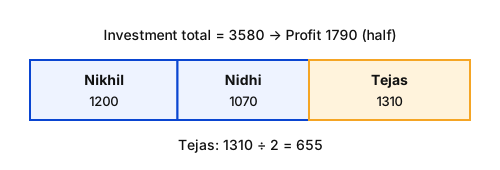
- Total investment .
- Profit , i.e. profit is exactly half of the investment.
- Tejas's share .
Trick: Spot that profit = half of total capital, so each share = half of own capital.
Answer: (D) ₹655
अवधारणा: समान अवधि के निवेश में लाभ निवेश के अनुपात में बँटता है।
- कुल निवेश ।
- लाभ , अर्थात लाभ कुल निवेश का ठीक आधा है।
- तेजस का हिस्सा ।
ट्रिक: लाभ = कुल पूँजी का आधा, तो हर हिस्सा = अपनी पूँजी का आधा।
उत्तर: (D) ₹655
RRB NTPC Undergraduate CBT 1MathematicsPartnershipRRB NTPC Undergraduate CBT 1 2024 · 1 Sep Shift 3
Q452.If , then the value of is:
यदि है, तो का मान है:
- A
- B
- C
- D
Show answer
Concept: Use and .
- .
- .
- , so the value is .
Trick: Put : , value ; only matches.
Answer: (D)
अवधारणा: और का प्रयोग करें।
- ।
- ।
- , अतः मान ।
ट्रिक: रखें: , मान ; केवल मिलता है।
उत्तर: (D)
RRB NTPC Undergraduate CBT 1MathematicsTrigonometric identitiesRRB NTPC Undergraduate CBT 1 2024 · 1 Sep Shift 3
Q453.A sum of money triples itself at a certain rate of compound interest in 17 years. In how many years will it amount to 81 times of itself?
कोई धनराशि चक्रवृद्धि ब्याज की एक निश्चित दर पर 17 वर्षों में स्वयं की तीन गुनी हो जाती है। कितने वर्षों में यह स्वयं की 81 गुनी हो जाएगी?
- A68 years68 वर्ष
- B59 years59 वर्ष
- C58 years58 वर्ष
- D64 years64 वर्ष
Show answer
Concept: Under compound interest, if a sum becomes times in years, it becomes times in years.
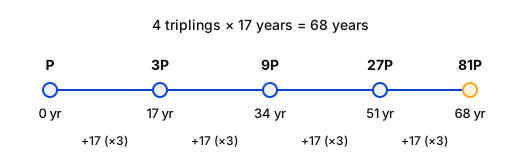
- 3 times in 17 years.
- , so the sum must triple 4 times.
- Time years.
Trick: Write the target as a power of the base multiple: .
Answer: (A) 68 years
अवधारणा: चक्रवृद्धि ब्याज में यदि राशि वर्ष में गुना होती है, तो वर्ष में गुना होती है।
- 17 वर्ष में 3 गुना।
- , अतः राशि को 4 बार तिगुना होना है।
- समय वर्ष।
ट्रिक: लक्ष्य को घात में लिखें: ।
उत्तर: (A) 68 वर्ष
RRB NTPC Undergraduate CBT 1MathematicsCompound interest – multiplesRRB NTPC Undergraduate CBT 1 2024 · 1 Sep Shift 3
Q454.The value of is
का मान है
- A38
- B50
- C51
- D44
Show answer
Concept: Evaluate powers and roots first, then add/subtract (BODMAS).
- , , .
- .
Trick: for positive – no need to square and root again.
Answer: (D) 44
अवधारणा: पहले घात और मूल निकालें, फिर जोड़-घटाव करें (BODMAS)।
- , , ।
- ।
ट्रिक: धनात्मक के लिए ।
उत्तर: (D) 44
RRB NTPC Undergraduate CBT 1MathematicsSimplification – squares and rootsRRB NTPC Undergraduate CBT 1 2024 · 1 Sep Shift 3
Q455.A shopkeeper offers the following discount scheme to his customers for the purchase of articles in his shop.
'Buy 20 and get 5 free'
Find the discount percentage offered.
एक दुकानदार अपनी दुकान में वस्तुओं की खरीद पर अपने ग्राहकों को निम्नलिखित छूट योजना प्रदान करता है।
'20 खरीदें और 5 मुफ़्त पाएँ'
प्रदान की गई छूट प्रतिशत ज्ञात कीजिए।
- A25%
- B30%
- C20%
- D32%
Show answer
Concept: In 'Buy get free', the customer pays for but receives articles.
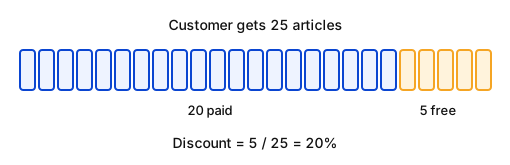
- Articles received ; articles free .
- .
Trick: – not (that gives the tempting 25%).
Answer: (C) 20%
अवधारणा: 'x खरीदें, y मुफ़्त' में ग्राहक का भुगतान करता है पर वस्तुएँ पाता है।
- प्राप्त वस्तुएँ ; मुफ़्त ।
- ।
ट्रिक: – नहीं (उससे भ्रामक 25% आता है)।
उत्तर: (C) 20%
RRB NTPC Undergraduate CBT 1MathematicsDiscount – buy x get y freeRRB NTPC Undergraduate CBT 1 2024 · 1 Sep Shift 3
Q456.Find the value of x satisfying: 5(5x2 − 5) − 5(5x2 + 7x − 2) = 14
निम्नलिखित को संतुष्ट करने वाला x का मान ज्ञात कीजिए: 5(5x2 − 5) − 5(5x2 + 7x − 2) = 14
- A
- B
- C
- D
Show answer
Concept: Expand the brackets; the terms cancel, leaving a linear equation.
- and .
- Difference: .
- .
Trick: Take 5 common: .
Answer: (A)
अवधारणा: कोष्ठक खोलें; वाले पद कट जाते हैं और रैखिक समीकरण बचता है।
- तथा ।
- अंतर: ।
- ।
ट्रिक: 5 उभयनिष्ठ लें: ।
उत्तर: (A)
RRB NTPC Undergraduate CBT 1MathematicsLinear equationsRRB NTPC Undergraduate CBT 1 2024 · 1 Sep Shift 3
Q457.The LCM of the numbers 2.8 and 0.217 is:
संख्याओं 2.8 और 0.217 का LCM (लघुत्तम समापवर्त्य) है:
- A0.868
- B8.68
- C868
- D86.8
Show answer
Concept: Make decimal places equal, find the LCM of the whole numbers, then put the decimal back.
- , .
- , .
- .
- LCM .
Trick: The LCM must be a multiple of 2.8: , and ✓.
Answer: (D) 86.8
अवधारणा: दशमलव स्थान बराबर करें, पूर्ण संख्याओं का LCM निकालें, फिर दशमलव वापस लगाएँ।
- , ।
- , ।
- ।
- LCM ।
ट्रिक: LCM, 2.8 का गुणज होगा: , तथा ✓।
उत्तर: (D) 86.8
RRB NTPC Undergraduate CBT 1MathematicsLCM of decimalsRRB NTPC Undergraduate CBT 1 2024 · 1 Sep Shift 3
Q458.If 4 times a son's age is added to his father's age, the sum is 100 years. If 2.5 times the father's age is added to the son's age, the sum is 97 years. What is the father's age (in years)?
यदि पुत्र की आयु के 4 गुने को उसके पिता की आयु में जोड़ा जाए, तो योगफल 100 वर्ष होता है। यदि पिता की आयु के 2.5 गुने को पुत्र की आयु में जोड़ा जाए, तो योगफल 97 वर्ष होता है। पिता की आयु (वर्षों में) कितनी है?
- A31
- B32
- C36
- D30
Show answer
Concept: Form two linear equations with son's age and father's age .
- … (i); … (ii).
- From (ii): . Put in (i): .
- (and ).
Trick: Check options in (i): ; then ✓.
Answer: (B) 32
अवधारणा: पुत्र की आयु और पिता की आयु लेकर दो रैखिक समीकरण बनाएँ।
- … (i); … (ii)।
- (ii) से ; (i) में रखने पर ।
- (तथा )।
ट्रिक: विकल्प जाँचें: ; फिर ✓।
उत्तर: (B) 32
RRB NTPC Undergraduate CBT 1MathematicsProblems on agesRRB NTPC Undergraduate CBT 1 2024 · 1 Sep Shift 3
Q459.4 men can complete a piece of work in 12 days, while 8 women can do it in 15 days. In how many days can 3 women and 2 men complete this work?
4 पुरुष किसी कार्य को 12 दिनों में पूरा कर सकते हैं, जबकि 8 महिलाएँ उसे 15 दिनों में पूरा कर सकती हैं। 3 महिलाएँ और 2 पुरुष मिलकर इस कार्य को कितने दिनों में पूरा कर सकते हैं?
- A19 days19 दिन
- B15 days15 दिन
- C11 days11 दिन
- D14 days14 दिन
Show answer
Concept: Convert everyone into one type of worker using total work (man-days = woman-days).
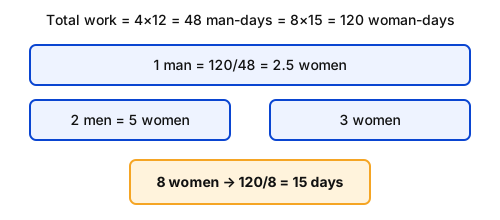
- Work man-days woman-days.
- So women; women.
- men women women; time days.
Trick: Equate 48 M = 120 W → M : W efficiency = 5 : 2.
Answer: (B) 15 days
अवधारणा: कुल कार्य (पुरुष-दिवस = महिला-दिवस) से सबको एक प्रकार के श्रमिक में बदलें।
- कार्य पुरुष-दिवस महिला-दिवस।
- अतः महिलाएँ; 2 पुरुष = 5 महिलाएँ।
- 2 पुरुष + 3 महिलाएँ = 8 महिलाएँ; समय दिन।
ट्रिक: 48 M = 120 W → पुरुष : महिला क्षमता = 5 : 2।
उत्तर: (B) 15 दिन
RRB NTPC Undergraduate CBT 1MathematicsTime and work – men and womenRRB NTPC Undergraduate CBT 1 2024 · 1 Sep Shift 3
Q460.Find the number of sides of a regular polygon, each of whose interior angles measures 162°.
उस सम बहुभुज की भुजाओं की संख्या ज्ञात कीजिए, जिसका प्रत्येक आंतरिक कोण 162° का है।
- A18
- B16
- C20
- D22
Show answer
Concept: For a regular polygon, exterior angle and interior + exterior .
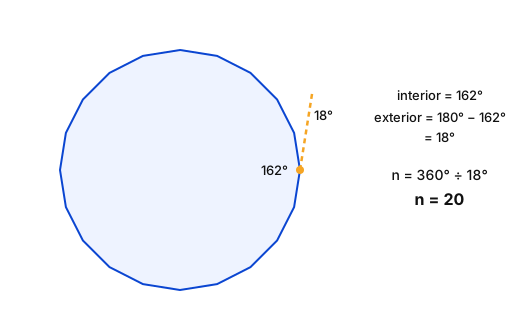
- Exterior angle .
- .
Trick: Always go via the exterior angle – it gives in one division.
Answer: (C) 20
अवधारणा: सम बहुभुज में बाह्य कोण तथा अंतः + बाह्य ।
- बाह्य कोण ।
- ।
ट्रिक: हमेशा बाह्य कोण से चलें – एक भाग में मिल जाता है।
उत्तर: (C) 20
RRB NTPC Undergraduate CBT 1MathematicsPolygons – anglesRRB NTPC Undergraduate CBT 1 2024 · 1 Sep Shift 3

