Q521.On a marked price of ₹5,000, a dealer offers successive discounts of 10% and 5%. Find the selling price.
₹5,000 के अंकित मूल्य पर एक व्यापारी 10% और 5% की क्रमिक छूट देता है। विक्रय मूल्य ज्ञात कीजिए।
- A₹4,320
- B₹4,250
- C₹4,280
- D₹4,275
Show answer
Concept: Successive discounts are applied one after another on the reduced price.
- After 10%:
- After 5%:
Trick: Net discount , so SP .
Answer: (D) ₹4,275
अवधारणा: क्रमिक छूट में दूसरी छूट घटे हुए मूल्य पर लगती है।
- 10% छूट के बाद:
- 5% छूट के बाद:
ट्रिक: कुल छूट , अतः विक्रय मूल्य ।
उत्तर: (D) ₹4,275
RRB NTPC Undergraduate CBT 1MathematicsSuccessive DiscountRRB NTPC Undergraduate CBT 1 2024 · 1 Sep Shift 1
Q522.The population of a district is 374000, out of which 165000 are males. 21% of the population is literate. If 40% males are literate, then what percentage of females are literate?
एक ज़िले की जनसंख्या 374000 है, जिसमें से 165000 पुरुष हैं। जनसंख्या का 21% साक्षर है। यदि 40% पुरुष साक्षर हैं, तो कितने प्रतिशत महिलाएँ साक्षर हैं?
- A8%
- B6%
- C7%
- D5%
Show answer
Concept: Total literates = male literates + female literates.
- Females
- Total literates
- Male literates
- Female literates ;
Trick: Always find the female base first; percentage is of females, not of total population.
Answer: (B)
अवधारणा: कुल साक्षर = साक्षर पुरुष + साक्षर महिलाएँ।
- महिलाएँ
- कुल साक्षर
- साक्षर पुरुष
- साक्षर महिलाएँ ;
ट्रिक: प्रतिशत महिलाओं की संख्या पर निकालें, कुल जनसंख्या पर नहीं।
उत्तर: (B)
RRB NTPC Undergraduate CBT 1MathematicsPercentage – LiteracyRRB NTPC Undergraduate CBT 1 2024 · 1 Sep Shift 1
Q523.Two pipes can fill a cistern, individually, in 16 minutes and 32 minutes, respectively. There is a pipe located at the bottom of the cistern to empty it. If all the three pipes are opened simultaneously, then the empty cistern gets filled in 12 minutes. How long will the pipe at the bottom of the tank take to empty the completely filled cistern if no other pipe is then open?
दो पाइप अलग-अलग किसी टंकी को क्रमशः 16 मिनट और 32 मिनट में भर सकते हैं। टंकी को खाली करने के लिए उसके तल पर एक पाइप लगा है। यदि तीनों पाइप एक साथ खोल दिए जाएँ, तो खाली टंकी 12 मिनट में भर जाती है। यदि कोई अन्य पाइप खुला न हो, तो टंकी के तल पर लगा पाइप पूरी भरी हुई टंकी को खाली करने में कितना समय लेगा?
- A192 minutes192 मिनट
- B144 minutes144 मिनट
- C160 minutes160 मिनट
- D96 minutes96 मिनट
Show answer
Concept: Work per minute: filling pipes add, the leak (outlet) subtracts.
- So minutes
Trick: LCM method: capacity units; A , B , together units/min ⇒ outlet unit/min ⇒ min.
Answer: (D) 96 minutes
अवधारणा: प्रति मिनट कार्य: भरने वाले पाइप जुड़ते हैं, खाली करने वाला घटता है।
- अतः मिनट
ट्रिक: LCM विधि: क्षमता इकाई; A , B , तीनों मिलकर इकाई/मिनट ⇒ निकास पाइप इकाई/मिनट ⇒ मिनट।
उत्तर: (D) 96 मिनट
RRB NTPC Undergraduate CBT 1MathematicsPipes and CisternRRB NTPC Undergraduate CBT 1 2024 · 1 Sep Shift 1
Q524.Find the mean proportional of 490 and 10.
490 और 10 का मध्यानुपाती ज्ञात कीजिए।
- A70
- B67
- C68
- D71
Show answer
Concept: Mean proportional of and is .
Trick: Check: (both equal 7).
Answer: (A)
अवधारणा: और का मध्यानुपाती होता है।
ट्रिक: जाँच: (दोनों )।
उत्तर: (A)
RRB NTPC Undergraduate CBT 1MathematicsMean ProportionalRRB NTPC Undergraduate CBT 1 2024 · 1 Sep Shift 1
Q525.Find the value of: [616 ÷ {26 + 9 × ( 5 − 7 )}].
मान ज्ञात कीजिए: [616 ÷ {26 + 9 × ( 5 − 7 )}]।
- A78
- B79
- C77
- D82
Show answer
Concept: Solve innermost bracket first, then × , then +, then ÷ outside.
Trick: Watch the negative sign: is , not .
Answer: (C)
अवधारणा: पहले सबसे अंदर का कोष्ठक, फिर गुणा, फिर जोड़, फिर बाहर का भाग।
ट्रिक: ऋण चिह्न का ध्यान रखें: है, नहीं।
उत्तर: (C)
RRB NTPC Undergraduate CBT 1MathematicsSimplification (BODMAS)RRB NTPC Undergraduate CBT 1 2024 · 1 Sep Shift 1
Q526.The average weight (in kg) of a family of five members, whose weights are 40 kg, 49 kg, 56 kg, 74 kg, and 39 kg, is:
पाँच सदस्यों वाले एक परिवार, जिनका भार 40 kg, 49 kg, 56 kg, 74 kg और 39 kg है, का औसत भार (kg में) है:
- A52.6
- B50.6
- C53.6
- D51.6
Show answer
Concept: Average = sum of observations ÷ number of observations.
- Sum
- Average
Trick: Assume mean : deviations sum to ; .
Answer: (D)
अवधारणा: औसत = प्रेक्षणों का योग ÷ प्रेक्षणों की संख्या।
- योग
- औसत
ट्रिक: माना औसत : विचलन का योग ; ।
उत्तर: (D)
RRB NTPC Undergraduate CBT 1MathematicsAverageRRB NTPC Undergraduate CBT 1 2024 · 1 Sep Shift 1
Q527.A, B and C started a business investing ₹1,340, ₹1,100 and ₹2,440, respectively. If B's share in the profit earned by them is ₹814, what is the difference in the profit (in ₹) earned by A and C?
A, B और C ने क्रमशः ₹1,340, ₹1,100 और ₹2,440 का निवेश करके एक व्यवसाय शुरू किया। यदि उनके द्वारा अर्जित लाभ में B का हिस्सा ₹814 है, तो A और C द्वारा अर्जित लाभ (₹ में) का अंतर क्या है?
- A₹811
- B₹815
- C₹816
- D₹814
Show answer
Concept: For equal time, profit is shared in the ratio of investments.
- Ratio
- B's 55 parts part
- C − A parts
Trick: C − A investment B's investment, so the profit difference equals B's share directly.
Answer: (D) ₹814
अवधारणा: समान समय के लिए लाभ निवेश के अनुपात में बँटता है।
- अनुपात
- B के 55 भाग भाग
- C − A भाग
ट्रिक: C और A के निवेश का अंतर B का निवेश, इसलिए लाभ का अंतर सीधे B के हिस्से के बराबर है।
उत्तर: (D) ₹814
RRB NTPC Undergraduate CBT 1MathematicsPartnershipRRB NTPC Undergraduate CBT 1 2024 · 1 Sep Shift 1
Q528.The sum of two numbers is 84 and their L.C.M. is 120. What are the two numbers?
दो संख्याओं का योग 84 है और उनका ल.स.प. (L.C.M.) 120 है। वे दो संख्याएँ कौन-सी हैं?
- A65, 19
- B60, 24
- C53, 31
- D58, 26
Show answer
Concept: Check options: sum must be 84 and LCM must be 120.
- All options sum to 84, so test LCM.
- LCM ✓
Trick: Both numbers must divide 120 – only 60 and 24 are factors of 120.
Answer: (B) 60, 24
अवधारणा: विकल्प जाँचें: योग 84 और LCM 120 होना चाहिए।
- सभी विकल्पों का योग 84 है, इसलिए LCM जाँचें।
- LCM ✓
ट्रिक: दोनों संख्याएँ 120 की गुणनखंड होनी चाहिए – केवल 60 और 24 ही 120 को विभाजित करती हैं।
उत्तर: (B) 60, 24
RRB NTPC Undergraduate CBT 1MathematicsLCM – Two NumbersRRB NTPC Undergraduate CBT 1 2024 · 1 Sep Shift 1
Q529.The LCM of the numbers 5.1 and 0.102 is:
संख्याओं 5.1 और 0.102 का ल.स.प. (LCM) है:
- A51
- B5.1
- C0.51
- D0.051
Show answer
Concept: Make decimal places equal, find LCM of the numbers without decimals, then put the decimal back.
- and → and (thousandths)
- , so LCM
- Restore 3 decimal places:
Trick: If one number is a multiple of the other, the larger is the LCM: .
Answer: (B)
अवधारणा: दशमलव स्थान बराबर करें, बिना दशमलव की संख्याओं का LCM लें, फिर दशमलव वापस लगाएँ।
- और → और (हज़ारवें भाग)
- , अतः LCM
- 3 दशमलव स्थान वापस:
ट्रिक: यदि एक संख्या दूसरी का गुणज है, तो बड़ी संख्या ही LCM है: ।
उत्तर: (B)
RRB NTPC Undergraduate CBT 1MathematicsLCM of DecimalsRRB NTPC Undergraduate CBT 1 2024 · 1 Sep Shift 1
Q530.The simple interest on a certain sum for years at the rate of 2.5% per annum is ₹8,400.
What will be the amount payable on the same sum at the rate of 8.1% per annum simple interest in years?
किसी निश्चित राशि पर 2.5% वार्षिक दर से वर्षों का साधारण ब्याज ₹8,400 है।
उसी राशि पर 8.1% वार्षिक साधारण ब्याज की दर से वर्षों में देय मिश्रधन कितना होगा?
- A₹1,46,429
- B₹1,46,416
- C₹1,46,420
- D₹1,46,404
Show answer
Concept: ; Amount = P + SI.
- New SI
- Amount
Trick: and – convert mixed fractions to decimals first.
Answer: (C) ₹1,46,420
अवधारणा: ; मिश्रधन = मूलधन + ब्याज।
- नया ब्याज
- मिश्रधन
ट्रिक: और – पहले मिश्र भिन्न को दशमलव में बदलें।
उत्तर: (C) ₹1,46,420
RRB NTPC Undergraduate CBT 1MathematicsSimple InterestRRB NTPC Undergraduate CBT 1 2024 · 1 Sep Shift 1
Q531.The average price of three items of furniture is ₹ 16860. If their prices are in the ratio 3:5:7, the price of the costliest item (in ₹) is
फ़र्नीचर की तीन वस्तुओं का औसत मूल्य ₹ 16860 है। यदि उनके मूल्य 3:5:7 के अनुपात में हैं, तो सबसे महँगी वस्तु का मूल्य (₹ में) है
- A23604
- B7868
- C10116
- D5620
Show answer
Concept: Total = average × count; split total in the given ratio.
- Total
- Ratio sum
- Costliest
Trick: Average of 15 parts over 3 items ⇒ 1 part ; .
Answer: (A) 23604
अवधारणा: कुल = औसत × संख्या; कुल को दिए अनुपात में बाँटें।
- कुल
- अनुपात योग
- सबसे महँगी
ट्रिक: 3 वस्तुओं में 15 भाग ⇒ 1 भाग ; ।
उत्तर: (A) 23604
RRB NTPC Undergraduate CBT 1MathematicsAverage and RatioRRB NTPC Undergraduate CBT 1 2024 · 1 Sep Shift 1
Q532.Amit bought some erasers at the rate of ₹150 a dozen. He sold them for ₹42 each. His profit percentage is ______%.
अमित ने ₹150 प्रति दर्जन की दर से कुछ रबड़ (erasers) खरीदे। उसने उन्हें ₹42 प्रति रबड़ की दर से बेचा। उसका लाभ प्रतिशत ______% है।
- A236
- B240
- C234
- D238
Show answer
Concept: per eraser.
- CP of one eraser
- SP , profit
Trick: Per dozen: CP , SP ; profit ; .
Answer: (A) 236
अवधारणा: प्रति रबड़ ।
- एक रबड़ का क्रय मूल्य
- विक्रय मूल्य , लाभ
ट्रिक: प्रति दर्जन: CP , SP ; लाभ ; ।
उत्तर: (A) 236
RRB NTPC Undergraduate CBT 1MathematicsProfit and LossRRB NTPC Undergraduate CBT 1 2024 · 1 Sep Shift 1
Q533.What is the area (rounded off to the nearest integer) of a triangle whose three sides measure 11 cm, 15 cm and 16 cm?
उस त्रिभुज का क्षेत्रफल (निकटतम पूर्णांक तक पूर्णांकित) क्या है, जिसकी तीनों भुजाओं की माप 11 cm, 15 cm और 16 cm है?
- A79 cm2
- B82 cm2
- C84 cm2
- D87 cm2
Show answer
Concept: Area , where .
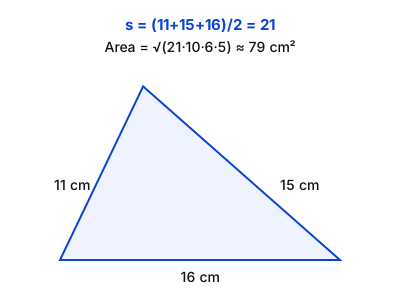
- Area
Trick: and ; is nearer , so the area rounds to 79.
Answer: (A)
अवधारणा: क्षेत्रफल , जहाँ ।
- क्षेत्रफल
ट्रिक: और ; , के अधिक पास है, अतः उत्तर 79।
उत्तर: (A)
RRB NTPC Undergraduate CBT 1MathematicsHeron's FormulaRRB NTPC Undergraduate CBT 1 2024 · 1 Sep Shift 1
Q534.In covering a distance of 60 km, Pranay takes 6 hours more than Aman. If Pranay doubles his speed, then he would take 9 hours less than Aman. Pranay's speed is:
60 km की दूरी तय करने में प्रणय, अमन से 6 घंटे अधिक लेता है। यदि प्रणय अपनी चाल दोगुनी कर दे, तो वह अमन से 9 घंटे कम लेगा। प्रणय की चाल है:
- A12 km/hr
- B2 km/hr
- C11 km/hr
- D9 km/hr
Show answer
Concept: Time . Let Pranay's speed , Aman's .
- … (1)
- … (2)
- Add:
Trick: Option check: ⇒ Pranay takes 30 h, Aman 24 h, doubled speed 15 h ✓.
Answer: (B)
अवधारणा: समय . प्रणय की चाल , अमन की ।
- … (1)
- … (2)
- जोड़ने पर:
ट्रिक: विकल्प जाँच: ⇒ प्रणय 30 घंटे, अमन 24 घंटे, दोगुनी चाल पर 15 घंटे ✓।
उत्तर: (B)
RRB NTPC Undergraduate CBT 1MathematicsSpeed, Time and DistanceRRB NTPC Undergraduate CBT 1 2024 · 1 Sep Shift 1
Q535.By how much is 65% of 55 greater than of 15?
55 का 65%, 15 के से कितना अधिक है?
- A26.75
- B23.75
- C29.75
- D27.75
Show answer
Concept: Find both values separately, then subtract.
- Difference
Trick: Quick: (60% plus 5%).
Answer: (C)
अवधारणा: दोनों मान अलग-अलग निकालें, फिर घटाएँ।
- अंतर
ट्रिक: – जल्दी गणना के लिए।
उत्तर: (C)
RRB NTPC Undergraduate CBT 1MathematicsPercentage and FractionsRRB NTPC Undergraduate CBT 1 2024 · 1 Sep Shift 1
Q536.5 years ago, the age of a father was 11 years more than twice his son's age. After how many years, from now, will he be twice his son's age?
5 वर्ष पहले, एक पिता की आयु उसके पुत्र की आयु के दोगुने से 11 वर्ष अधिक थी। अब से कितने वर्ष बाद उसकी आयु उसके पुत्र की आयु की दोगुनी होगी?
- A10
- B4
- C5
- D6
Show answer
Concept: Let present ages be father , son .
- After years:
Trick: Father is always '2S + 6'; the extra 6 is exactly the years needed to make it double.
Answer: (D) 6
अवधारणा: माना वर्तमान आयु पिता , पुत्र ।
- वर्ष बाद:
ट्रिक: पिता की आयु है; यही अतिरिक्त 6 वर्ष दोगुना होने के लिए चाहिए।
उत्तर: (D) 6
RRB NTPC Undergraduate CBT 1MathematicsProblems on AgesRRB NTPC Undergraduate CBT 1 2024 · 1 Sep Shift 1
Q537.Find the simple interest (in ₹) on ₹1,200 at an interest rate of 4% per month for 4 months.
₹1,200 पर 4% प्रति माह की ब्याज दर से 4 महीनों का साधारण ब्याज (₹ में) ज्ञात कीजिए।
- A₹16
- B₹32
- C₹36
- D₹192
Show answer
Concept: with R and T in the same unit (here months).
- per month, months
Trick: Rate is per month, so do not convert months into years.
Answer: (D) ₹192
अवधारणा: , जहाँ R और T एक ही इकाई में (यहाँ माह)।
- प्रति माह, माह
ट्रिक: दर प्रति माह है, इसलिए माह को वर्ष में न बदलें।
उत्तर: (D) ₹192
RRB NTPC Undergraduate CBT 1MathematicsSimple InterestRRB NTPC Undergraduate CBT 1 2024 · 1 Sep Shift 1
Q538.The product of two consecutive natural numbers is 600. The greater of the two numbers is:
दो क्रमागत प्राकृत संख्याओं का गुणनफल 600 है। दोनों संख्याओं में से बड़ी संख्या है:
- A31
- B25
- C40
- D16
Show answer
Concept: Product of consecutive numbers is just above .
- Try ✓
- Greater number
Trick: Take the square root and check the two integers around it.
Answer: (B) 25
अवधारणा: क्रमागत संख्याओं का गुणनफल , से थोड़ा अधिक होता है।
- ✓
- बड़ी संख्या
ट्रिक: वर्गमूल लेकर उसके आस-पास के दो पूर्णांक जाँचें।
उत्तर: (B) 25
RRB NTPC Undergraduate CBT 1MathematicsNumber SystemRRB NTPC Undergraduate CBT 1 2024 · 1 Sep Shift 1
Q539.A man riding on a bicycle at a speed of 24 km/hr crosses a bridge in 3.1 minutes. Find the length of the bridge.
24 km/hr की चाल से साइकिल चला रहा एक व्यक्ति एक पुल को 3.1 मिनट में पार करता है। पुल की लंबाई ज्ञात कीजिए।
- A0.34 km
- B1.24 km
- C0.62 km
- D1.64 km
Show answer
Concept: Distance = speed × time; the bicycle's length is negligible, so distance = bridge length.
- Length
Trick: per minute — multiply by minutes.
Answer: (B)
अवधारणा: दूरी = चाल × समय; साइकिल की लंबाई नगण्य है, अतः दूरी = पुल की लंबाई।
- लंबाई
ट्रिक: प्रति मिनट — मिनटों से गुणा करें।
उत्तर: (B)
RRB NTPC Undergraduate CBT 1MathematicsSpeed and DistanceRRB NTPC Undergraduate CBT 1 2024 · 1 Sep Shift 1
Q540.Pipe A can fill a tank in 20 hours, pipe B can fill the same tank in 25 hours and pipe C can fill the same tank in 10 hours. The time taken by them to fill the same tank if they operate together is::
पाइप A एक टंकी को 20 घंटे में भर सकता है, पाइप B उसी टंकी को 25 घंटे में भर सकता है और पाइप C उसी टंकी को 10 घंटे में भर सकता है। यदि वे एक साथ कार्य करें, तो उसी टंकी को भरने में उनके द्वारा लिया गया समय है::
- A hours घंटे
- B hours घंटे
- C hours घंटे
- D hours घंटे
Show answer
Concept: Rates add when pipes work together.
- Time hours
Trick: Capacity units (LCM); rates units/h ⇒ h.
Answer: (B) hours
अवधारणा: साथ में काम करने पर दरें जुड़ती हैं।
- समय घंटे
ट्रिक: क्षमता इकाई (LCM); दरें इकाई/घंटा ⇒ घंटे।
उत्तर: (B) घंटे
RRB NTPC Undergraduate CBT 1MathematicsPipes and CisternRRB NTPC Undergraduate CBT 1 2024 · 1 Sep Shift 1

