Q641.In △ABC, BD ⟂ AC at D and ∠DBC = 58°. E is a point on BC such that ∠CAE = 16°. What is the measure of ∠AEB?
△ABC में, BD ⟂ AC, D पर है और ∠DBC = 58° है। BC पर एक बिंदु E इस प्रकार है कि ∠CAE = 16° है। ∠AEB की माप क्या है?
- A42°
- B49°
- C52°
- D48°
Show answer
Concept: An exterior angle of a triangle equals the sum of the two opposite interior angles.
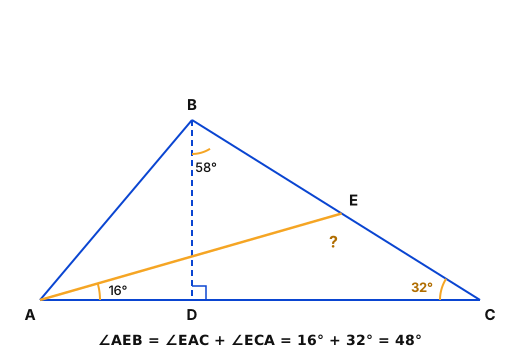
- In right : , so .
- In , is the exterior angle at E (since B, E, C are collinear).
- .
Trick: In a right triangle the two acute angles add to , so directly.
Answer: (D)
अवधारणा: त्रिभुज का बाह्य कोण = दोनों सम्मुख अंतः कोणों का योग।
- समकोण में , अतः ।
- B, E, C एक रेखा पर हैं, इसलिए , का E पर बाह्य कोण है।
- ।
ट्रिक: समकोण त्रिभुज में दोनों न्यून कोणों का योग होता है, अतः ।
उत्तर: (D)
RRB NTPC Undergraduate CBT 1MathematicsTriangles – exterior angleRRB NTPC Undergraduate CBT 1 2024 · 28 Aug Shift 3
Q642.What is the volume of a cylindrical container that has a base radius of 3.5 metres and a height of 5.2 metres?
एक बेलनाकार पात्र का आयतन क्या है, जिसके आधार की त्रिज्या 3.5 मीटर और ऊँचाई 5.2 मीटर है?
- A cubic metres घन मीटर
- B cubic metres घन मीटर
- C cubic metres घन मीटर
- D cubic metres घन मीटर
Show answer
Concept: Volume of a cylinder .
- , so .
- .
Trick: : and , total .
Answer: (C) cubic metres
अवधारणा: बेलन (cylinder) का आयतन ।
- , अतः ।
- ।
ट्रिक: और , कुल ।
उत्तर: (C) घन मीटर
RRB NTPC Undergraduate CBT 1MathematicsMensuration – cylinder volumeRRB NTPC Undergraduate CBT 1 2024 · 28 Aug Shift 3
Q643.Find the mean proportional of 96 and 54.
96 और 54 का मध्यानुपाती ज्ञात कीजिए।
- A71
- B69
- C75
- D72
Show answer
Concept: Mean proportional of and is .
- .
- .
Trick: , , so .
Answer: (D) 72
अवधारणा: और का मध्यानुपाती (mean proportional) होता है।
- ।
- ।
ट्रिक: , , अतः ।
उत्तर: (D) 72
RRB NTPC Undergraduate CBT 1MathematicsMean proportionalRRB NTPC Undergraduate CBT 1 2024 · 28 Aug Shift 3
Q644.The value of is:
का मान है:
- A16
- B31
- C23
- D26
Show answer
Concept: Evaluate powers and roots first, then add/subtract left to right.
- , , .
- .
Trick: for positive – no need to square 8.
Answer: (C) 23
अवधारणा: पहले घात और मूल हल करें, फिर बाएँ से दाएँ जोड़/घटाव।
- , , ।
- ।
ट्रिक: धनात्मक के लिए ।
उत्तर: (C) 23
RRB NTPC Undergraduate CBT 1MathematicsSimplification – powers and rootsRRB NTPC Undergraduate CBT 1 2024 · 28 Aug Shift 3
Q645.Pipe A can fill a tank in 11 hours, pipe B can fill the same tank in 24 hours and pipe C can fill the same tank in 19 hours. The time taken by them to fill the same tank if they operate together is::
पाइप A किसी टंकी को 11 घंटे में भर सकता है, पाइप B उसी टंकी को 24 घंटे में भर सकता है और पाइप C उसी टंकी को 19 घंटे में भर सकता है। यदि वे एक साथ कार्य करें, तो उसी टंकी को भरने में उनके द्वारा लिया गया समय है:
- A hours घंटे
- B hours घंटे
- C hours घंटे
- D hours घंटे
Show answer
Concept: Work per hour adds up: combined rate .
- LCM .
- Rate tank per hour.
- Time hours (since , remainder ).
Trick: Estimate: rate , so time h – only option (C) starts with 5.
Answer: (C) hours
अवधारणा: प्रति घंटे का काम जुड़ता है: संयुक्त दर ।
- LCM ।
- दर टंकी प्रति घंटा।
- समय घंटे (, शेष )।
ट्रिक: अनुमान: दर , अतः समय घंटे – केवल विकल्प (C) 5 से शुरू होता है।
उत्तर: (C) घंटे
RRB NTPC Undergraduate CBT 1MathematicsPipes and cisternsRRB NTPC Undergraduate CBT 1 2024 · 28 Aug Shift 3
Q646.A trader offers one kitchen set free with each kitchen set purchased at the marked price. If he still makes a profit of 20%, at what percentage above the cost price has the trader marked the kitchen set?
एक व्यापारी अंकित मूल्य पर खरीदे गए प्रत्येक किचन सेट के साथ एक किचन सेट मुफ़्त देता है। यदि फिर भी उसे 20% का लाभ होता है, तो व्यापारी ने किचन सेट का मूल्य क्रय मूल्य से कितने प्रतिशत अधिक अंकित किया है?
- A50%
- B150%
- C140%
- D40%
Show answer
Concept: In 'one free with one', the customer pays the marked price of 1 article but gets 2.
- Let CP of one set ; he gives 2 sets, so CP .
- Profit ⇒ SP .
- This SP is the marked price of one set: , i.e. above the CP of .
Trick: Mark-up .
Answer: (C)
अवधारणा: 'एक के साथ एक मुफ्त' में ग्राहक 1 वस्तु का अंकित मूल्य देता है पर 2 वस्तुएँ पाता है।
- एक सेट का क्रय मूल्य ; 2 सेट दिए, अतः क्रय मूल्य ।
- लाभ ⇒ विक्रय मूल्य ।
- यही एक सेट का अंकित मूल्य है: , यानी क्रय मूल्य से अधिक।
ट्रिक: मार्क-अप ।
उत्तर: (C)
RRB NTPC Undergraduate CBT 1MathematicsProfit and loss – buy one get one freeRRB NTPC Undergraduate CBT 1 2024 · 28 Aug Shift 3
Q647.The number 716710501 is divisible by which of the following?
संख्या 716710501 निम्नलिखित में से किससे विभाज्य है?
- A20
- B16
- C19
- D13
Show answer
Concept: Divisibility by 13 (also 7, 11): split into 3-digit groups from the right and take the alternating sum; if it is divisible by 13, so is the number.
- Groups: 716 | 710 | 501.
- Alternating sum ⇒ divisible by 13.
- Ends in 1 ⇒ not divisible by 20 or 16; leaves remainder 6.
Trick: An odd number can never be divisible by an even number like 16 or 20 – eliminate them at once.
Answer: (D) 13
अवधारणा: 13 (तथा 7, 11) से विभाज्यता: दाएँ से 3-3 अंकों के समूह बनाकर एकांतर योग लें; वह 13 से विभाज्य हो तो संख्या भी।
- समूह: 716 | 710 | 501।
- एकांतर योग ⇒ 13 से विभाज्य।
- अंतिम अंक 1 ⇒ 20 और 16 से विभाज्य नहीं; 19 से भाग देने पर शेष 6।
ट्रिक: विषम संख्या कभी 16 या 20 जैसी सम संख्या से विभाज्य नहीं होती – इन्हें तुरंत हटाएँ।
उत्तर: (D) 13
RRB NTPC Undergraduate CBT 1MathematicsDivisibility rulesRRB NTPC Undergraduate CBT 1 2024 · 28 Aug Shift 3
Q648.The number of prime numbers between 374 and 381, both included, is:
374 और 381 (दोनों सम्मिलित) के बीच अभाज्य संख्याओं की संख्या है:
- A2
- B3
- C4
- D1
Show answer
Concept: A prime has no divisor other than 1 and itself; test primes up to .
- Even numbers 374, 376, 378, 380 and 375 (ends in 5) are out.
- , – not prime.
- 379 is not divisible by 2, 3, 5, 7, 11, 13, 17, 19 ⇒ prime. Count .
Trick: Digit sum shows 381 is divisible by 3 instantly.
Answer: (D) 1
अवधारणा: अभाज्य संख्या का 1 और स्वयं के अलावा कोई भाजक नहीं; तक के अभाज्यों से जाँचें।
- सम संख्याएँ 374, 376, 378, 380 तथा 375 (अंत में 5) बाहर।
- , – अभाज्य नहीं।
- 379 किसी भी 2, 3, 5, 7, 11, 13, 17, 19 से विभाज्य नहीं ⇒ अभाज्य। गिनती ।
ट्रिक: अंकों का योग से 381 तुरंत 3 से विभाज्य दिखता है।
उत्तर: (D) 1
RRB NTPC Undergraduate CBT 1MathematicsPrime numbersRRB NTPC Undergraduate CBT 1 2024 · 28 Aug Shift 3
Q649.By how much is of 75 greater than of 45?
75 का , 45 के से कितना अधिक है?
- A19.75
- B18.75
- C15.75
- D21.75
Show answer
Concept: Find each quantity and subtract.
- of .
- of .
- Difference .
Trick: of 75 of 65 .
Answer: (D) 21.75
अवधारणा: दोनों मात्राएँ निकालकर घटाएँ।
- 75 का ।
- 45 का ।
- अंतर ।
ट्रिक: 75 का = 65 का ।
उत्तर: (D) 21.75
RRB NTPC Undergraduate CBT 1MathematicsPercentage and fractionsRRB NTPC Undergraduate CBT 1 2024 · 28 Aug Shift 3
Q650.By selling an article at of its actual selling price, Hitesh incurs a loss of 25%. If he sells it at 58% of its actual selling price, then the profit percentage is:
किसी वस्तु को उसके वास्तविक विक्रय मूल्य के पर बेचने पर हितेश को 25% की हानि होती है। यदि वह इसे इसके वास्तविक विक्रय मूल्य के 58% पर बेचता है, तो लाभ प्रतिशत है:
- A23.1%
- B23.7%
- C22.5%
- D21.8%
Show answer
Concept: Express CP in terms of the actual SP .
- gives loss ⇒ ⇒ .
- New SP .
- .
Trick: Take : CP , new SP ⇒ .
Answer: (D)
अवधारणा: क्रय मूल्य को वास्तविक विक्रय मूल्य के रूप में लिखें।
- पर हानि ⇒ ⇒ ।
- नया विक्रय मूल्य ।
- ।
ट्रिक: लें: CP , नया SP ⇒ ।
उत्तर: (D)
RRB NTPC Undergraduate CBT 1MathematicsProfit and lossRRB NTPC Undergraduate CBT 1 2024 · 28 Aug Shift 3
Q651.8 years ago, the age of a father was 20 years more than twice his son's age. After how many years, from now, will he be twice his son's age?
8 वर्ष पहले, एक पिता की आयु उसके पुत्र की आयु के दोगुने से 20 वर्ष अधिक थी। अब से कितने वर्ष बाद उसकी आयु उसके पुत्र की आयु की दोगुनी होगी?
- A8
- B12
- C16
- D7
Show answer
Concept: Form equations with present ages F (father) and S (son).
- 8 years ago: ⇒ .
- After years: ⇒ .
- years.
Trick: When 'twice + k' becomes 'exactly twice', the years needed equal the constant in (here 12).
Answer: (B) 12
अवधारणा: वर्तमान आयु पिता F तथा पुत्र S लेकर समीकरण बनाएँ।
- 8 वर्ष पहले: ⇒ ।
- वर्ष बाद: ⇒ ।
- वर्ष।
ट्रिक: हो तो ठीक दोगुना होने में वर्ष लगते हैं (यहाँ 12)।
उत्तर: (B) 12
RRB NTPC Undergraduate CBT 1MathematicsProblems on agesRRB NTPC Undergraduate CBT 1 2024 · 28 Aug Shift 3
Q652.The average weight of a family of five members whose weights are 40 kg, 49 kg, 56 kg, 75 kg and 37 kg is:
पाँच सदस्यों वाले एक परिवार, जिनके भार 40 kg, 49 kg, 56 kg, 75 kg और 37 kg हैं, का औसत भार है:
- A53.4 kg
- B50.4 kg
- C52.4 kg
- D51.4 kg
Show answer
Concept: Average .
- Sum .
- Average .
Trick: Assume 50: deviations sum to ; .
Answer: (D)
अवधारणा: औसत ।
- योग ।
- औसत ।
ट्रिक: 50 मानें: विचलन का योग ; ।
उत्तर: (D)
RRB NTPC Undergraduate CBT 1MathematicsAverageRRB NTPC Undergraduate CBT 1 2024 · 28 Aug Shift 3
Q653.Train A leaves station M at 6:30 AM and reaches station N at 3:30 PM on the same day. Train B leaves station N at 8:30 AM and reaches station M at 2:30 PM on the same day. Find the time when trains A and B meet.
ट्रेन A स्टेशन M से 6:30 AM पर चलती है और उसी दिन 3:30 PM पर स्टेशन N पहुँचती है। ट्रेन B स्टेशन N से 8:30 AM पर चलती है और उसी दिन 2:30 PM पर स्टेशन M पहुँचती है। वह समय ज्ञात कीजिए जब ट्रेन A और B मिलती हैं।
- A11:18 AM
- B12:18 PM
- C11:38 AM
- D11:08 AM
Show answer
Concept: Take the distance MN as 1 unit; speeds are fractions of MN per hour.
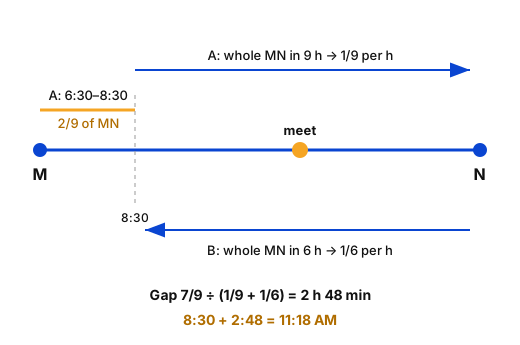
- A takes 9 h (6:30 AM–3:30 PM) ⇒ per h; B takes 6 h ⇒ per h.
- By 8:30 AM A has covered ; gap .
- Time to meet .
- Meeting time 8:30 AM 2 h 48 min 11:18 AM.
Trick: Take MN km (LCM of 9, 6): speeds 2 and 3; gap , relative speed ⇒ h.
Answer: (A) 11:18 AM
अवधारणा: दूरी MN को 1 इकाई मानें; गतियाँ MN के भिन्न प्रति घंटा।
- A को 9 घंटे लगते हैं ⇒ प्रति घंटा; B को 6 घंटे ⇒ प्रति घंटा।
- 8:30 AM तक A ने दूरी तय की; शेष ।
- मिलने का समय ।
- 8:30 AM 2 घंटे 48 मिनट 11:18 AM।
ट्रिक: MN km लें: गतियाँ 2 और 3; अंतर , सापेक्ष गति ⇒ घंटे।
उत्तर: (A) 11:18 AM
RRB NTPC Undergraduate CBT 1MathematicsTime and distance – trains meetingRRB NTPC Undergraduate CBT 1 2024 · 28 Aug Shift 3
Q654.A book is sold at three successive discounts of 8%, 4%, and 5%. If the marked price of the book is ₹3,125, find its net selling price.
एक पुस्तक को 8%, 4% और 5% की तीन क्रमिक छूटों पर बेचा जाता है। यदि पुस्तक का अंकित मूल्य ₹3,125 है, तो उसका निवल विक्रय मूल्य ज्ञात कीजिए।
- A₹2,622
- B₹2,492
- C₹2,594
- D₹2,465
Show answer
Concept: Apply each discount on the reduced price one after another.
- After : .
- After : .
- After : .
Trick: Start with the discount that gives a round number: first, then .
Answer: (A) ₹2,622
अवधारणा: हर छूट पिछले घटे हुए मूल्य पर लगाएँ।
- के बाद: ।
- के बाद: ।
- के बाद: ।
ट्रिक: क्रम बदलकर आसान करें: , फिर ।
उत्तर: (A) ₹2,622
RRB NTPC Undergraduate CBT 1MathematicsSuccessive discountsRRB NTPC Undergraduate CBT 1 2024 · 28 Aug Shift 3
Q655.Find the circumference (in m) of the largest circle that can be drawn completely inside a rectangle whose dimensions are given as 63 m and 116 m.
(Take .)
उस सबसे बड़े वृत्त की परिधि (m में) ज्ञात कीजिए जिसे 63 m और 116 m विमाओं वाले आयत के अंदर पूर्णतः खींचा जा सकता है।
( लीजिए।)
- A202
- B200
- C190
- D198
Show answer
Concept: The largest circle inside a rectangle has diameter equal to the shorter side.
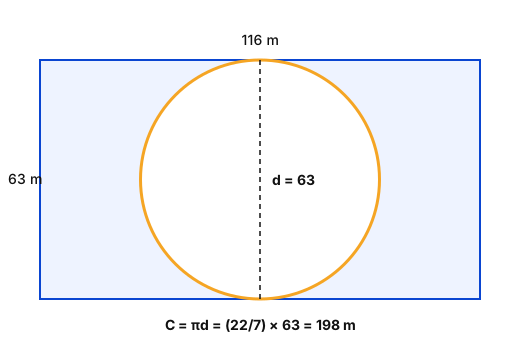
- Diameter .
- Circumference .
Trick: 63 is a multiple of 7 – a hint that 63 (not 116) is the diameter.
Answer: (D) 198
अवधारणा: आयत के अंदर सबसे बड़े वृत्त का व्यास छोटी भुजा के बराबर होता है।
- व्यास ।
- परिधि ।
ट्रिक: 63 सात का गुणज है – संकेत कि व्यास 63 है, 116 नहीं।
उत्तर: (D) 198
RRB NTPC Undergraduate CBT 1MathematicsMensuration – circle in rectangleRRB NTPC Undergraduate CBT 1 2024 · 28 Aug Shift 3
Q656.Pallavi bought a toy for ₹578, decorated it at a cost of ₹14 and sold the toy for ₹476. Find the loss or profit percentage.
पल्लवी ने ₹578 में एक खिलौना खरीदा, ₹14 की लागत से उसे सजाया और खिलौने को ₹476 में बेच दिया। हानि या लाभ प्रतिशत ज्ञात कीजिए।
- A profit लाभ
- B profit लाभ
- C loss हानि
- D loss हानि
Show answer
Concept: Overhead (decoration) is added to the cost price.
- CP ; SP ⇒ loss .
- .
Trick: SP CP, so it must be a loss – options (A) and (B) are out immediately.
Answer: (C) loss
अवधारणा: सजावट का खर्च क्रय मूल्य में जुड़ता है।
- क्रय मूल्य ; विक्रय मूल्य ⇒ हानि ।
- ।
ट्रिक: विक्रय मूल्य क्रय मूल्य, अतः हानि ही होगी – (A) और (B) तुरंत बाहर।
उत्तर: (C) हानि
RRB NTPC Undergraduate CBT 1MathematicsProfit and loss with overheadsRRB NTPC Undergraduate CBT 1 2024 · 28 Aug Shift 3
Q657.If the interest earned during the 2nd year on a certain sum is ₹6,534, and the rate of interest is 20% per annum compounded annually, then the sum is:
यदि किसी निश्चित राशि पर 2रे वर्ष के दौरान अर्जित ब्याज ₹6,534 है, और ब्याज दर 20% वार्षिक, वार्षिक रूप से चक्रवृद्धि है, तो राशि है:
- A₹28,030
- B₹27,630
- C₹28,205
- D₹27,225
Show answer
Concept: Interest of the 2nd year rate amount after 1 year .
- .
- .
Trick: 2nd-year CI – here of P.
Answer: (D) ₹27,225
अवधारणा: दूसरे वर्ष का ब्याज = पहले वर्ष के बाद की राशि पर ब्याज ।
- ।
- ।
ट्रिक: दूसरे वर्ष का CI – यहाँ P का ।
उत्तर: (D) ₹27,225
RRB NTPC Undergraduate CBT 1MathematicsCompound interest – interest of a particular yearRRB NTPC Undergraduate CBT 1 2024 · 28 Aug Shift 3
Q658.The current population of a town is 14,568. It increases by 25% and 60% in two successive years but decreases by 50% in the third year. What is the population of the town at the end of the third year?
एक कस्बे की वर्तमान जनसंख्या 14,568 है। यह दो क्रमिक वर्षों में 25% और 60% बढ़ती है, लेकिन तीसरे वर्ष में 50% घट जाती है। तीसरे वर्ष के अंत में कस्बे की जनसंख्या कितनी है?
- A14,568
- B14,563
- C14,565
- D14,573
Show answer
Concept: Multiply by each growth/decline factor in turn.
- Factor .
- , and .
- Population stays .
Trick: When the net factor is exactly 1, no calculation on the population is needed.
Answer: (A) 14,568
अवधारणा: हर वर्ष के गुणांक से क्रमशः गुणा करें।
- गुणांक ।
- , और ।
- जनसंख्या ही रहती है।
ट्रिक: कुल गुणांक 1 हो तो जनसंख्या पर गणना की आवश्यकता नहीं।
उत्तर: (A) 14,568
RRB NTPC Undergraduate CBT 1MathematicsPopulation – successive changeRRB NTPC Undergraduate CBT 1 2024 · 28 Aug Shift 3
Q659.X, Y and Z invest a sum in the ratio of 16 : 82 : 2, respectively. If they earned a total profit of ₹2,750 at the end of the year, then what is the difference between share of Y and Z?
X, Y और Z क्रमशः 16 : 82 : 2 के अनुपात में एक राशि का निवेश करते हैं। यदि वर्ष के अंत में उन्होंने कुल ₹2,750 का लाभ अर्जित किया, तो Y और Z के हिस्सों के बीच का अंतर कितना है?
- A₹2,200
- B₹2,159
- C₹2,191
- D₹2,122
Show answer
Concept: Profit is shared in the ratio of investment.
- Total parts ; one part .
- Y − Z .
Trick: Parts total 100, so the difference is simply of 2750.
Answer: (A) ₹2,200
अवधारणा: लाभ निवेश के अनुपात में बँटता है।
- कुल भाग ; एक भाग ।
- Y − Z ।
ट्रिक: कुल भाग 100 हैं, अतः अंतर = 2750 का ।
उत्तर: (A) ₹2,200
RRB NTPC Undergraduate CBT 1MathematicsPartnership – profit sharingRRB NTPC Undergraduate CBT 1 2024 · 28 Aug Shift 3
Q660.A man goes to Nagpur from Visakhapatnam at a speed of 3 km/hr and returns to Visakhapatnam at speed of 6 km/hr, through the same route. What is his average speed (in km/hr) of the entire journey?
एक व्यक्ति विशाखापत्तनम से नागपुर 3 km/hr की चाल से जाता है और उसी मार्ग से 6 km/hr की चाल से विशाखापत्तनम लौटता है। पूरी यात्रा में उसकी औसत चाल (km/hr में) कितनी है?
- A4
- B3
- C2
- D7
Show answer
Concept: For equal distances, average speed .
- , .
- Average speed .
Trick: Average speed for equal distances is always less than the simple mean () – choose 4.
Answer: (A) 4
अवधारणा: समान दूरी के लिए औसत गति ।
- , ।
- औसत गति ।
ट्रिक: समान दूरी पर औसत गति साधारण औसत () से कम होती है।
उत्तर: (A) 4
RRB NTPC Undergraduate CBT 1MathematicsAverage speedRRB NTPC Undergraduate CBT 1 2024 · 28 Aug Shift 3

