Q681.Refer to the following number and symbol series and answer the question that follows. Counting to be done from left to right only.
(Left) 3 4 7 # # # 5 * £ 8 2 £ & € 2 $ £ @ 3 # 7 & (Right)
How many such symbols are there each of which is immediately preceded by a number and also immediately followed by a symbol?
निम्नलिखित संख्या और प्रतीक शृंखला को देखिए और उसके बाद पूछे गए प्रश्न का उत्तर दीजिए। गिनती केवल बाएँ से दाएँ की जानी है।
(बाएँ) 3 4 7 # # # 5 * £ 8 2 £ & € 2 $ £ @ 3 # 7 & (दाएँ)
ऐसे कितने प्रतीक हैं जिनमें से प्रत्येक के ठीक पहले एक संख्या है और ठीक बाद भी एक प्रतीक है?
- A6
- B5
- C3
- D4
Show answer
Concept: Look for the pattern number – symbol – symbol.
- 7 # #
- 5 * £
- 2 £ &
- 2 $ £
- (3 # 7 fails: followed by a number; 7 & is at the end)
Trick: Scan only the symbols that come right after a number.
Answer: (D) 4
अवधारणा: पैटर्न संख्या – चिह्न – चिह्न खोजें।
- 7 # #
- 5 * £
- 2 £ &
- 2 $ £
- (3 # 7 नहीं: बाद में संख्या; 7 & अंत में है)
ट्रिक: केवल वे चिह्न देखें जो किसी संख्या के ठीक बाद आते हैं।
उत्तर: (D) 4
RRB NTPC Undergraduate CBT 1General Intelligence and ReasoningAlphanumeric SeriesRRB NTPC Undergraduate CBT 1 2024 · 28 Aug Shift 2
Q682.If 2 is added to each even digit and 1 is subtracted from each odd digit in the number 91526374, what will be the sum of second digit from left and third digit from right in the new number thus formed?
यदि संख्या 91526374 में प्रत्येक सम अंक में 2 जोड़ दिया जाए और प्रत्येक विषम अंक में से 1 घटा दिया जाए, तो इस प्रकार बनी नई संख्या में बाएँ से दूसरे अंक और दाएँ से तीसरे अंक का योग क्या होगा?
- A10
- B14
- C6
- D2
Show answer
Concept: Even digit +2, odd digit −1, then pick the asked positions.
- 91526374 → 8 0 4 4 8 2 6 6
- Second from left = 0
- Third from right = 2
- Sum
Trick: Only transform the digits at the positions you need: 2nd from left (1 → 0) and 3rd from right (3 → 2).
Answer: (D) 2
अवधारणा: सम अंक +2, विषम अंक −1, फिर पूछे गए स्थान चुनें।
- 91526374 → 8 0 4 4 8 2 6 6
- बाएँ से दूसरा = 0
- दाएँ से तीसरा = 2
- योग
ट्रिक: केवल ज़रूरी स्थानों के अंक बदलें: बाएँ से दूसरा (1 → 0), दाएँ से तीसरा (3 → 2)।
उत्तर: (D) 2
RRB NTPC Undergraduate CBT 1General Intelligence and ReasoningNumber OperationsRRB NTPC Undergraduate CBT 1 2024 · 28 Aug Shift 2
Q683.In the following triads, each group of letters is related to the subsequent one following a certain logic. Select from the given options, the one which follows the same logic. TOWN - NWTO - TWON
CLAW - WACL - CALW
निम्नलिखित त्रिकों में, अक्षरों का प्रत्येक समूह एक निश्चित तर्क का अनुसरण करते हुए अगले समूह से संबंधित है। दिए गए विकल्पों में से उस विकल्प का चयन कीजिए जो समान तर्क का अनुसरण करता है। TOWN - NWTO - TWON
CLAW - WACL - CALW
- APICK - KCPI - PCIK
- BROSE - RSOE - ESOR
- CFUME - UMFE - UMEF
- DHALF - FLHA - ALHF
Show answer
Concept: Number the letters of the first word 1-2-3-4 and find the order in the next two.
- TOWN (1234) → NWTO = 4-3-1-2 → TWON = 1-3-2-4
- CLAW → WACL (4312), CALW (1324) ✔
- PICK → KCPI (4312), PCIK (1324) ✔
Trick: Second word follows order 4-3-1-2; third word = first word with its middle two letters swapped.
Answer: (A) PICK - KCPI - PCIK
अवधारणा: पहले शब्द के अक्षरों को 1-2-3-4 क्रमांक दें और अगले दो शब्दों का क्रम देखें।
- TOWN (1234) → NWTO = 4-3-1-2 → TWON = 1-3-2-4
- CLAW → WACL (4312), CALW (1324) ✔
- PICK → KCPI (4312), PCIK (1324) ✔
ट्रिक: दूसरा शब्द 4-3-1-2; तीसरा = पहले शब्द के बीच के दो अक्षर आपस में बदलें।
उत्तर: (A) PICK - KCPI - PCIK
RRB NTPC Undergraduate CBT 1General Intelligence and ReasoningLetter RearrangementRRB NTPC Undergraduate CBT 1 2024 · 28 Aug Shift 2
Q684.Seven boxes L, M, N, O, P, Q and R are kept one over the other but not necessarily in the same order. M is kept fourth from the bottom. O is placed immediately below M. Q is placed immediately above R. P is the topmost box. M is placed immediately below L. Which box is placed at the bottom?
सात बक्से L, M, N, O, P, Q और R एक के ऊपर एक रखे गए हैं, लेकिन आवश्यक नहीं कि इसी क्रम में हों। M को नीचे से चौथे स्थान पर रखा गया है। O को M के ठीक नीचे रखा गया है। Q को R के ठीक ऊपर रखा गया है। P सबसे ऊपर वाला बक्सा है। M को L के ठीक नीचे रखा गया है। सबसे नीचे कौन-सा बक्सा रखा गया है?
- AO
- BR
- CL
- DQ
Show answer
Concept: Number positions 1 (bottom) to 7 (top).
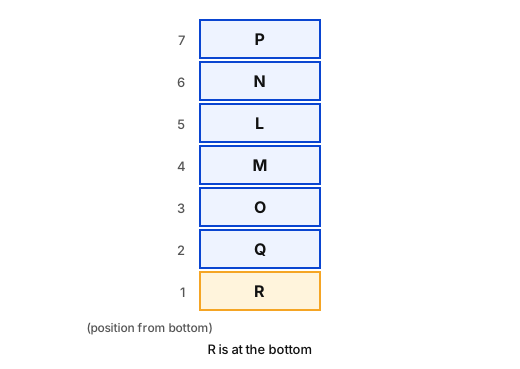
- M at 4; O just below → 3; L just above M → 5; P at 7
- Free: 1, 2, 6. Q just above R → R 1, Q 2
- N goes to 6; bottom box is R
Trick: Adjacent pairs (Q over R) can only go where two consecutive slots are free.
Answer: (B) R
अवधारणा: स्थान 1 (नीचे) से 7 (ऊपर) तक लें।
- M 4 पर; O ठीक नीचे → 3; L ठीक ऊपर → 5; P 7 पर
- खाली: 1, 2, 6। Q ठीक R के ऊपर → R 1, Q 2
- N 6 पर; सबसे नीचे R
ट्रिक: सटे जोड़े (Q, R के ऊपर) वहीं जाएँगे जहाँ दो लगातार स्थान खाली हों।
उत्तर: (B) R
RRB NTPC Undergraduate CBT 1General Intelligence and ReasoningBox ArrangementRRB NTPC Undergraduate CBT 1 2024 · 28 Aug Shift 2
Q685.Rishabh starts from Point A and drives 9 km towards west. He then takes a left turn, drives 8 km, turns left and drives 15 km. He then takes a right turn and drives 6 km. He takes a final right turn, drives 6 km and stops at Point P. How far (shortest distance) and towards which direction should he drive in order to reach Point A again? (All turns are 90° turns only unless specified.)
ऋषभ बिंदु A से चलना शुरू करता है और पश्चिम की ओर 9 km गाड़ी चलाता है। फिर वह बाएँ मुड़ता है, 8 km गाड़ी चलाता है, बाएँ मुड़ता है और 15 km गाड़ी चलाता है। फिर वह दाएँ मुड़ता है और 6 km गाड़ी चलाता है। वह अंतिम बार दाएँ मुड़ता है, 6 km गाड़ी चलाता है और बिंदु P पर रुक जाता है। बिंदु A पर फिर से पहुँचने के लिए उसे कितनी दूरी (न्यूनतम दूरी) तक और किस दिशा में गाड़ी चलानी चाहिए? (जब तक निर्दिष्ट न हो, सभी मोड़ केवल 90° के मोड़ हैं।)
- A16 km towards eastपूर्व की ओर 16 km
- B14 km towards northउत्तर की ओर 14 km
- C16 km towards westपश्चिम की ओर 16 km
- D14 km towards southदक्षिण की ओर 14 km
Show answer
Concept: Track coordinates with A at (0, 0).
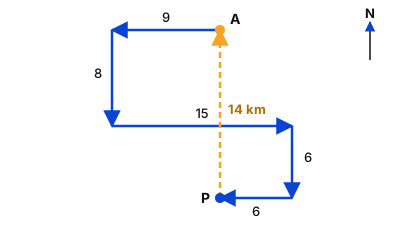
- West 9 → (−9, 0); left (south) 8 → (−9, −8)
- Left (east) 15 → (6, −8); right (south) 6 → (6, −14)
- Right (west) 6 → P = (0, −14)
- P is 14 km south of A → drive 14 km north
Trick: Net E–W: ; net N–S: .
Answer: (B) 14 km towards north
अवधारणा: A को (0, 0) लेकर निर्देशांक चलाएँ।
- पश्चिम 9 → (−9, 0); बाएँ (दक्षिण) 8 → (−9, −8)
- बाएँ (पूर्व) 15 → (6, −8); दाएँ (दक्षिण) 6 → (6, −14)
- दाएँ (पश्चिम) 6 → P = (0, −14)
- P, A से 14 km दक्षिण → 14 km उत्तर जाना होगा
ट्रिक: शुद्ध पूर्व–पश्चिम: ; उत्तर–दक्षिण: ।
उत्तर: (B) 14 km towards north
RRB NTPC Undergraduate CBT 1General Intelligence and ReasoningDirection and DistanceRRB NTPC Undergraduate CBT 1 2024 · 28 Aug Shift 2
Q686.What should come in place of the question mark (?) in the given series?
85 86 88 92 100 ?
दी गई शृंखला में प्रश्न चिह्न (?) के स्थान पर क्या आना चाहिए?
85 86 88 92 100 ?
- A118
- B117
- C116
- D115
Show answer
Concept: Differences double each time.
- Differences: 1, 2, 4, 8
- Next difference: 16
Trick: Gaps 1, 2, 4, 8 are powers of 2.
Answer: (C) 116
अवधारणा: अंतर हर बार दोगुना होता है।
- अंतर: 1, 2, 4, 8
- अगला अंतर: 16
ट्रिक: अंतर 1, 2, 4, 8 – 2 की घातें।
उत्तर: (C) 116
RRB NTPC Undergraduate CBT 1General Intelligence and ReasoningNumber SeriesRRB NTPC Undergraduate CBT 1 2024 · 28 Aug Shift 2
Q687.Mr. Into ranked 49th from the bottom and 56th from the top in his class. How many students are there in his class?
मिस्टर इंटो (Mr. Into) की अपनी कक्षा में नीचे से 49वीं और ऊपर से 56वीं रैंक है। उसकी कक्षा में कितने विद्यार्थी हैं?
- A105
- B103
- C104
- D107
Show answer
Concept: Total .
Yaad rakhein: Subtract 1 because the person is counted in both ranks.
Answer: (C) 104
अवधारणा: कुल ।
याद रखें: 1 घटाएँ क्योंकि व्यक्ति दोनों रैंक में गिना गया है।
उत्तर: (C) 104
RRB NTPC Undergraduate CBT 1General Intelligence and ReasoningRankingRRB NTPC Undergraduate CBT 1 2024 · 28 Aug Shift 2
Q688.Based on the English alphabetical order, three of the following four letter cluster pairs are alike in a certain way and thus form a group. Which is the one that DOES NOT belong to that group? (NOTE:The odd one out is not based on the number of
consonants/vowels or their position in the letter cluster.)
अंग्रेज़ी वर्णमाला क्रम के आधार पर, निम्नलिखित चार अक्षर-समूह युग्मों में से तीन किसी निश्चित प्रकार से एक समान हैं और इस प्रकार एक समूह बनाते हैं। कौन-सा युग्म उस समूह से संबंधित नहीं है? (ध्यान दें: असंगत युग्म, उस अक्षर-समूह में
व्यंजनों/स्वरों की संख्या या उनके स्थान पर आधारित नहीं है।)
- ATM-WR
- BOH-RN
- CNG-QL
- DJC-MH
Show answer
Concept: Compare 1st with 1st and 2nd with 2nd letter of each pair.
- TM-WR: T+3=W, M+5=R
- NG-QL: +3, +5; JC-MH: +3, +5
- OH-RN: O+3=R but H+6=N ✘
Trick: Write positions (H8 → N14) to catch the +6.
Answer: (B) OH-RN
अवधारणा: हर जोड़ी में पहले की पहले से, दूसरे की दूसरे से तुलना करें।
- TM-WR: T+3=W, M+5=R
- NG-QL: +3, +5; JC-MH: +3, +5
- OH-RN: O+3=R पर H+6=N ✘
ट्रिक: अक्षरों की स्थिति लिखें (H8 → N14) – +6 पकड़ में आएगा।
उत्तर: (B) OH-RN
RRB NTPC Undergraduate CBT 1General Intelligence and ReasoningLetter Analogy – Odd One OutRRB NTPC Undergraduate CBT 1 2024 · 28 Aug Shift 2
Q689.Read the given statements and conclusions carefully. Assuming that the information given in the statements is true, even if it appears to be at variance with commonly known facts, decide which of the given conclusions logically follow(s) from the statements.
Statements: Some notes are books. All books are tables.
Conclusion (I): Some notes are tables.
Conclusions (II): All tables are books.
दिए गए कथनों और निष्कर्षों को ध्यानपूर्वक पढ़िए। कथनों में दी गई जानकारी को सत्य मानते हुए, भले ही वह सामान्यतः ज्ञात तथ्यों से भिन्न प्रतीत होती हो, निर्णय कीजिए कि दिए गए निष्कर्षों में से कौन-सा/कौन-से निष्कर्ष तार्किक रूप से कथनों का अनुसरण करता है/करते हैं।
कथन: कुछ नोट, किताबें हैं। सभी किताबें, मेज़ें हैं।
निष्कर्ष (I): कुछ नोट, मेज़ें हैं।
निष्कर्ष (II): सभी मेज़ें, किताबें हैं।
- ANeither conclusion (I) nor (II) follows.न तो निष्कर्ष (I) और न ही (II) अनुसरण करता है।
- BOnly conclusion (II) follows.केवल निष्कर्ष (II) अनुसरण करता है।
- CBoth conclusions (I) and (II) follow.निष्कर्ष (I) और (II) दोनों अनुसरण करते हैं।
- DOnly conclusion (I) follows.केवल निष्कर्ष (I) अनुसरण करता है।
Show answer
Concept: Some A are B + All B are C ⇒ Some A are C.
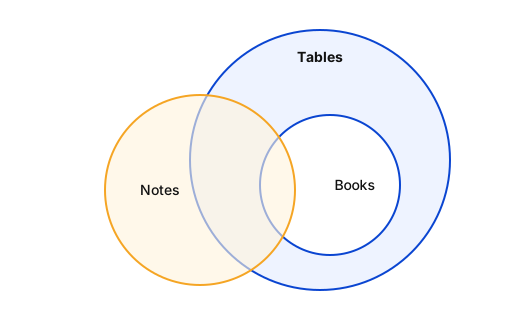
- Notes that are books lie inside tables → some notes are tables: (I) follows.
- Tables may contain things other than books → (II) does not follow.
Yaad rakhein: 'All B are C' never reverses to 'All C are B'.
Answer: (D) Only conclusion (I) follows.
अवधारणा: कुछ A, B हैं + सभी B, C हैं ⇒ कुछ A, C हैं।
- जो notes, books हैं वे tables के अंदर हैं → कुछ notes, tables हैं: (I) अनुसरण करता है।
- Tables में books के अलावा भी चीज़ें हो सकती हैं → (II) अनुसरण नहीं करता।
याद रखें: 'सभी B, C हैं' उलटकर 'सभी C, B हैं' नहीं बनता।
उत्तर: (D) Only conclusion (I) follows.
RRB NTPC Undergraduate CBT 1General Intelligence and ReasoningSyllogismRRB NTPC Undergraduate CBT 1 2024 · 28 Aug Shift 2
Q690.What should come in place of the question mark (?) in the given series?
3 12 30 57 93 ?
दी गई शृंखला में प्रश्न चिह्न (?) के स्थान पर क्या आना चाहिए?
3 12 30 57 93 ?
- A130
- B138
- C135
- D140
Show answer
Concept: Differences are multiples of 9.
- Differences: 9, 18, 27, 36
- Next difference: 45
Trick: Gaps → next .
Answer: (B) 138
अवधारणा: अंतर 9 के गुणज हैं।
- अंतर: 9, 18, 27, 36
- अगला अंतर: 45
ट्रिक: अंतर → अगला ।
उत्तर: (B) 138
RRB NTPC Undergraduate CBT 1General Intelligence and ReasoningNumber SeriesRRB NTPC Undergraduate CBT 1 2024 · 28 Aug Shift 2
Q691.What should come in place of the question mark (?) in the given series?
21 23 33 51 77 ?
दी गई श्रृंखला में प्रश्न चिह्न (?) के स्थान पर क्या आना चाहिए?
21 23 33 51 77 ?
- A131
- B111
- C112
- D140
Show answer
Concept: Look at the differences; they form an arithmetic pattern.
- Differences: (each +8).
- Next difference .
- .
Trick: Second-level difference constant (8) → AP of differences.
Answer: (B) 111
अवधारणा: अंतर देखें; वे समांतर श्रेणी में हैं।
- अंतर: (हर बार +8)।
- अगला अंतर ।
- ।
ट्रिक: अंतरों का अंतर स्थिर (8) है।
उत्तर: (B) 111
RRB NTPC Undergraduate CBT 1General Intelligence and ReasoningNumber SeriesRRB NTPC Undergraduate CBT 1 2024 · 28 Aug Shift 1
Q692.W is the daughter of A. A is the brother of K. K is the wife of E. E is the father of S. How is W related to S?
W, A की पुत्री है। A, K का भाई है। K, E की पत्नी है। E, S का पिता है। W का S से क्या संबंध है?
- AMother's sister's sonमाँ की बहन का पुत्र
- BMother's sister's daughterमाँ की बहन की पुत्री
- CMother's brother's daughterमाँ के भाई की पुत्री
- DMother's brother's sonमाँ के भाई का पुत्र
Show answer
Concept: Draw a family tree starting from S and move step by step.
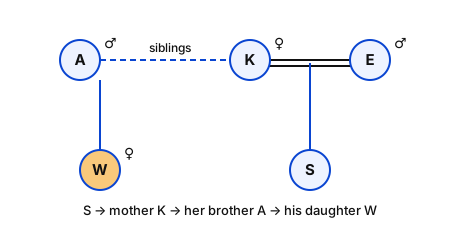
- E is S's father and K is E's wife → K is S's mother.
- A is K's brother → A is S's mother's brother (maternal uncle).
- W is A's daughter → W is S's mother's brother's daughter.
Trick: Trace the path from S: mother → brother → daughter.
Answer: (C) Mother's brother's daughter
अवधारणा: S से शुरू करके परिवार वृक्ष बनाएँ।
- E, S का पिता और K, E की पत्नी → K, S की माँ।
- A, K का भाई → S का मामा।
- W, A की बेटी → S की माँ के भाई की बेटी (ममेरी बहन)।
ट्रिक: S से रास्ता: माँ → भाई → बेटी।
उत्तर: (C) माँ के भाई की बेटी
RRB NTPC Undergraduate CBT 1General Intelligence and ReasoningBlood RelationsRRB NTPC Undergraduate CBT 1 2024 · 28 Aug Shift 1
Q693.Based on the English alphabetical order, three of the following four letter-clusters are alike in a certain way and thus form a group. Which letter-cluster DOES NOT belong to that group?
(Note: The odd one out is not based on the number of consonants/vowels or their position in the letter-cluster.)
अंग्रेज़ी वर्णमाला क्रम के आधार पर, निम्नलिखित चार अक्षर-समूहों में से तीन किसी निश्चित प्रकार से एक समान हैं और इस प्रकार एक समूह बनाते हैं। कौन-सा अक्षर-समूह उस समूह से संबंधित नहीं है?
(ध्यान दें: असंगत अक्षर-समूह, उस अक्षर-समूह में व्यंजनों/स्वरों की संख्या या उनके स्थान पर आधारित नहीं है।)
- AUWS
- BMOJ
- CSUP
- DPRM
Show answer
Concept: Convert letters to positions and compare the gaps.
- MOJ: 13, 15, 10 → +2, −5. SUP: 19, 21, 16 → +2, −5. PRM: 16, 18, 13 → +2, −5.
- UWS: 21, 23, 19 → +2, −4.
- UWS breaks the pattern.
Yaad rakhein: Keep EJOTY (5, 10, 15, 20, 25) in mind for quick letter positions.
Answer: (A) UWS
अवधारणा: अक्षरों को स्थानांक में बदलकर अंतर देखें।
- MOJ, SUP, PRM: +2, −5।
- UWS: 21, 23, 19 → +2, −4।
- UWS अलग है।
याद रखें: EJOTY (5, 10, 15, 20, 25) याद रखें।
उत्तर: (A) UWS
RRB NTPC Undergraduate CBT 1General Intelligence and ReasoningOdd One Out – LettersRRB NTPC Undergraduate CBT 1 2024 · 28 Aug Shift 1
Q694.Pranay starts from Point A and drives 7 km towards the south. He then takes a left turn and drives 6 km, then turns left and drives 12 km. He then takes a left turn and drives 10 km. He takes a final left turn, drives 5 km and stops at Point P. How far (shortest distance) and in which direction should he drive in order to reach Point A again? (All turns are 90-degree turns only unless specified.)
प्रणय बिंदु A से चलना प्रारंभ करता है और दक्षिण की ओर 7 km गाड़ी चलाता है। फिर वह बाएँ मुड़ता है और 6 km गाड़ी चलाता है, फिर बाएँ मुड़ता है और 12 km गाड़ी चलाता है। फिर वह बाएँ मुड़ता है और 10 km गाड़ी चलाता है। वह अंतिम बार बाएँ मुड़ता है, 5 km गाड़ी चलाता है और बिंदु P पर रुक जाता है। पुनः बिंदु A पर पहुँचने के लिए उसे कितनी दूरी (न्यूनतम दूरी) तक और किस दिशा में गाड़ी चलानी चाहिए? (जब तक निर्दिष्ट न हो, सभी मोड़ केवल 90 डिग्री के मोड़ हैं।)
- A4 km to the eastपूर्व की ओर 4 km
- B4 km to the westपश्चिम की ओर 4 km
- C5 km to the westपश्चिम की ओर 5 km
- D5 km to the eastपूर्व की ओर 5 km
Show answer
Concept: Plot each move on a grid (left turn when facing south = east, etc.).
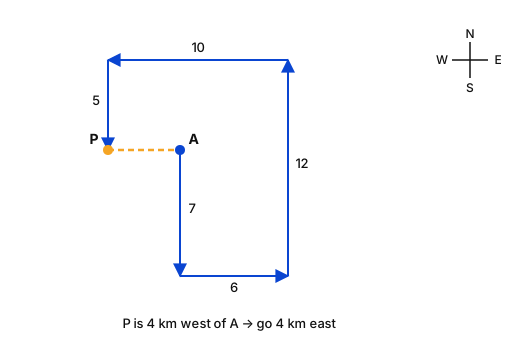
- A(0, 0) → 7 km south → left (east) 6 km → left (north) 12 km → left (west) 10 km → left (south) 5 km.
- Net east-west: → 4 km west of A. Net north-south: .
- P is 4 km west of A, so he must drive 4 km to the east.
Trick: Add the vertical moves and horizontal moves separately.
Answer: (A) 4 km to the east
अवधारणा: हर चाल को ग्रिड पर बनाएँ (दक्षिण की ओर मुख होने पर बायाँ = पूर्व)।
- A से 7 km दक्षिण → पूर्व 6 → उत्तर 12 → पश्चिम 10 → दक्षिण 5।
- पूर्व-पश्चिम: (4 km पश्चिम); उत्तर-दक्षिण: ।
- P, A से 4 km पश्चिम में है → 4 km पूर्व जाना होगा।
ट्रिक: ऊर्ध्व और क्षैतिज चालें अलग-अलग जोड़ें।
उत्तर: (A) 4 km पूर्व की ओर
RRB NTPC Undergraduate CBT 1General Intelligence and ReasoningDirection & DistanceRRB NTPC Undergraduate CBT 1 2024 · 28 Aug Shift 1
Q695.DACB is related to FCED in a certain way based on the English alphabetical order. In the same way, YVXW is related to AXZY. To which of the given options is VSUT related, following the same logic?
अंग्रेज़ी वर्णमाला क्रम के आधार पर DACB एक निश्चित प्रकार से FCED से संबंधित है। उसी प्रकार, YVXW, AXZY से संबंधित है। समान तर्क का अनुसरण करते हुए, VSUT दिए गए विकल्पों में से किससे संबंधित है?
- AXUWV
- BXUVV
- CXTVV
- DXVVE
Show answer
Concept: Find the shift applied to each letter.
- DACB → FCED: each letter +2.
- YVXW → AXZY: each +2 (Y+2 = A).
- VSUT → X U W V.
Trick: Same shift for all letters → shift the whole word.
Answer: (A) XUWV
अवधारणा: हर अक्षर पर लगा अंतर ज्ञात करें।
- DACB → FCED: हर अक्षर +2।
- YVXW → AXZY: +2।
- VSUT → XUWV।
ट्रिक: सभी अक्षरों पर समान अंतर → पूरा शब्द खिसकाएँ।
उत्तर: (A) XUWV
RRB NTPC Undergraduate CBT 1General Intelligence and ReasoningAnalogy – Letter CodingRRB NTPC Undergraduate CBT 1 2024 · 28 Aug Shift 1
Q696.Based on the English alphabetical order, three of the following four letter-clusters are alike in a certain way and thus form a group. Which letter-cluster DOES NOT belong to that group?
(Note: The odd one out is not based on the number of consonants/vowels or their position in the letter-cluster.)
अंग्रेज़ी वर्णमाला क्रम के आधार पर, निम्नलिखित चार अक्षर-समूहों में से तीन किसी निश्चित प्रकार से एक समान हैं और इस प्रकार एक समूह बनाते हैं। कौन-सा अक्षर-समूह उस समूह से संबंधित नहीं है?
(ध्यान दें: असंगत अक्षर-समूह, उस अक्षर-समूह में व्यंजनों/स्वरों की संख्या या उनके स्थान पर आधारित नहीं है।)
- ARMH
- BDYT
- CAVO
- DIDY
Show answer
Concept: Check the backward gaps between letters (cyclic alphabet).
- RMH: 18 → 13 → 8 (−5, −5). DYT: 4 → 25 → 20 (−5, −5). IDY: 9 → 4 → 25 (−5, −5).
- AVO: 1 → 22 → 15 is −5, then −7.
- AVO is the odd one.
Trick: Going back from A wraps to Z: A − 5 = V.
Answer: (C) AVO
अवधारणा: अक्षरों के पीछे की ओर अंतर देखें (चक्रीय वर्णमाला)।
- RMH, DYT, IDY: −5, −5।
- AVO: −5, फिर −7।
- AVO अलग है।
ट्रिक: A से पीछे जाने पर Z आता है: A − 5 = V।
उत्तर: (C) AVO
RRB NTPC Undergraduate CBT 1General Intelligence and ReasoningOdd One Out – LettersRRB NTPC Undergraduate CBT 1 2024 · 28 Aug Shift 1
Q697.Based on the English alphabetical order, three of the following four letter-clusters are alike in a certain way and thus form a group. Which letter-cluster DOES NOT belong to that group? (Note: The odd one out is not based on the number of consonants/vowels or their position in the letter-cluster.)
अंग्रेज़ी वर्णमाला क्रम के आधार पर, निम्नलिखित चार अक्षर-समूहों में से तीन किसी निश्चित प्रकार से एक समान हैं और इस प्रकार एक समूह बनाते हैं। कौन-सा अक्षर-समूह उस समूह से संबंधित नहीं है? (ध्यान दें: असंगत अक्षर-समूह, उस अक्षर-समूह में व्यंजनों/स्वरों की संख्या या उनके स्थान पर आधारित नहीं है।)
- AVZFM
- BPTZG
- CSWCI
- DIMSZ
Show answer
Concept: Find the gaps between consecutive letters (cyclic).
- VZFM: +4, +6, +7. PTZG: +4, +6, +7. IMSZ: +4, +6, +7.
- SWCI: S → W +4, W → C +6, C → I +6.
- SWCI differs.
Trick: Write positions once: V22 Z26 F6 M13 – the gaps make the rule clear.
Answer: (C) SWCI
अवधारणा: क्रमागत अक्षरों के बीच अंतर ज्ञात करें।
- VZFM, PTZG, IMSZ: +4, +6, +7।
- SWCI: +4, +6, +6।
- SWCI अलग है।
ट्रिक: स्थानांक लिखें – अंतर से नियम स्पष्ट होता है।
उत्तर: (C) SWCI
RRB NTPC Undergraduate CBT 1General Intelligence and ReasoningOdd One Out – LettersRRB NTPC Undergraduate CBT 1 2024 · 28 Aug Shift 1
Q698.Seven boxes, N, O, T, F, A, R and M, are kept one over the other but not necessarily in the same order. M is kept immediately above A. N is kept immediately above O. Only T is kept above F. Only two boxes are kept above M. N is not kept at third position from the bottom.
How many boxes are kept between R and T?
सात बक्से N, O, T, F, A, R और M एक के ऊपर एक रखे गए हैं, लेकिन यह आवश्यक नहीं है कि इसी क्रम में हों। M को A के ठीक ऊपर रखा गया है। N को O के ठीक ऊपर रखा गया है। F के ऊपर केवल T रखा गया है। M के ऊपर केवल दो बक्से रखे गए हैं। N को नीचे से तीसरे स्थान पर नहीं रखा गया है।
R और T के बीच कितने बक्से रखे गए हैं?
- AThreeतीन
- BOneएक
- CZeroशून्य
- DTwoदो
Show answer
Concept: Fix definite positions first (top = 1, bottom = 7).
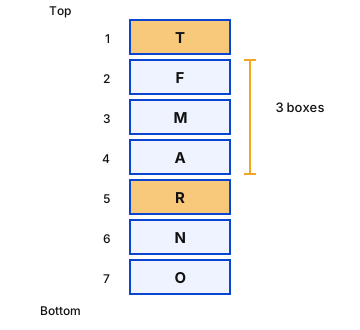
- Only T above F → T = 1, F = 2.
- Two boxes above M → M = 3, A = 4.
- N directly above O, N not at 5 (3rd from bottom) → N = 6, O = 7, so R = 5.
- Between R (5) and T (1): F, M, A → three boxes.
Trick: Start with 'only' and number-based clues; they lock positions.
Answer: (A) Three
अवधारणा: पहले निश्चित स्थान तय करें (ऊपर = 1, नीचे = 7)।
- केवल T, F के ऊपर → T = 1, F = 2।
- M के ऊपर दो → M = 3, A = 4।
- N ठीक O के ऊपर, N 5 पर नहीं → N = 6, O = 7, R = 5।
- R और T के बीच: F, M, A → तीन।
ट्रिक: 'केवल' और संख्या वाले संकेत पहले लगाएँ।
उत्तर: (A) तीन
RRB NTPC Undergraduate CBT 1General Intelligence and ReasoningPuzzle – Box StackingRRB NTPC Undergraduate CBT 1 2024 · 28 Aug Shift 1
Q699.If 1 is added to each odd digit and 2 is subtracted from each even digit in the number 7856413, what will be the sum of the digits which are third from the left and third from the right in the new number thus formed?
यदि संख्या 7856413 में प्रत्येक विषम अंक में 1 जोड़ दिया जाए और प्रत्येक सम अंक में से 2 घटा दिया जाए, तो इस प्रकार बनी नई संख्या में बाएँ से तीसरे और दाएँ से तीसरे अंकों का योग क्या होगा?
- A6
- B10
- C12
- D8
Show answer
Concept: Apply the rule digit by digit, then read the required positions.
- 7856413 → 7+1, 8−2, 5+1, 6−2, 4−2, 1+1, 3+1 = 8664224.
- Third from left ; third from right .
- Sum .
Trick: Write the new number fully before counting positions.
Answer: (D) 8
अवधारणा: नियम हर अंक पर लगाएँ, फिर स्थान पढ़ें।
- 7856413 → 8664224।
- बाएँ से तीसरा ; दाएँ से तीसरा ।
- योग ।
ट्रिक: स्थान गिनने से पहले पूरी नई संख्या लिखें।
उत्तर: (D) 8
RRB NTPC Undergraduate CBT 1General Intelligence and ReasoningDigit OperationsRRB NTPC Undergraduate CBT 1 2024 · 28 Aug Shift 1
Q700.What should come in place of the question mark (?) in the given series?
73 76 81 90 107 ?
दी गई श्रृंखला में प्रश्न चिह्न (?) के स्थान पर क्या आना चाहिए?
73 76 81 90 107 ?
- A139
- B123
- C155
- D140
Show answer
Concept: Differences grow in a pattern.
- Differences: .
- Each difference previous (or differences of differences doubling).
- Next difference → .
Trick: are .
Answer: (D) 140
अवधारणा: अंतर एक नियम से बढ़ते हैं।
- अंतर: ।
- अंतरों के अंतर (दोगुने) → अगला अंतर ।
- ।
ट्रिक: = ।
उत्तर: (D) 140
RRB NTPC Undergraduate CBT 1General Intelligence and ReasoningNumber SeriesRRB NTPC Undergraduate CBT 1 2024 · 28 Aug Shift 1

