Q801.In covering a distance of 156 km, Abhay takes 5 hours more than Sameer. If Abhay doubles his speed, then he would take 8 hours less than Sameer. Abhay's speed is:
156 km की दूरी तय करने में अभय, समीर से 5 घंटे अधिक लेता है। यदि अभय अपनी चाल दोगुनी कर दे, तो वह समीर से 8 घंटे कम लेगा। अभय की चाल है:
- A16 km/hr
- B1 km/hr
- C6 km/hr
- D7 km/hr
Show answer
Concept: Time . Let Abhay's speed be and Sameer's time be .
- … (1)
- With double speed: … (2)
- (1) − (2): .
- Check: Abhay 26 h, Sameer 21 h, doubled speed 13 h ✓.
Trick: Doubling speed halves the time: half of Abhay's time is saved, and that saving h, so full time h → .
Answer: (C) 6 km/hr
अवधारणा: समय । अभय की चाल तथा समीर का समय मानें।
- … (1)
- दोगुनी चाल: … (2)
- (1) − (2): ।
- जाँच: अभय 26 घंटे, समीर 21 घंटे, दोगुनी चाल पर 13 घंटे ✓।
ट्रिक: चाल दोगुनी → समय आधा; बचा समय घंटे = आधा समय, तो पूरा समय 26 घंटे → ।
उत्तर: (C) 6 km/hr
RRB NTPC Undergraduate CBT 1MathematicsSpeed, distance and timeRRB NTPC Undergraduate CBT 1 2024 · 22 Aug Shift 1
Q802.Evaluate: (-9) - (-60) ÷ (-10) + (-2) × 6
मान ज्ञात कीजिए: (-9) - (-60) ÷ (-10) + (-2) × 6
- A-27
- B-30
- C-26
- D-29
Show answer
Concept: BODMAS: do division and multiplication before addition and subtraction; watch the signs.
- .
- .
- .
Trick: Negative ÷ negative = positive; then simply add all negatives: .
Answer: (A) −27
अवधारणा: BODMAS: पहले भाग और गुणा, फिर जोड़-घटाव; चिह्नों का ध्यान रखें।
- ।
- ।
- ।
ट्रिक: ऋणात्मक ÷ ऋणात्मक = धनात्मक; फिर सभी ऋणात्मक जोड़ें: ।
उत्तर: (A) −27
RRB NTPC Undergraduate CBT 1MathematicsSimplification (BODMAS)RRB NTPC Undergraduate CBT 1 2024 · 22 Aug Shift 1
Q803.The product of two positive numbers is 10125. If the first number is five times the second number, then the sum of the two numbers is:
दो धनात्मक संख्याओं का गुणनफल 10125 है। यदि पहली संख्या, दूसरी संख्या की पाँच गुनी है, तो दोनों संख्याओं का योग है:
- A265
- B286
- C264
- D270
Show answer
Concept: Write both numbers in terms of one variable and use the product.
- Second , first .
- .
- Sum .
Trick: is worth remembering (also a year!).
Answer: (D) 270
अवधारणा: दोनों संख्याओं को एक चर में लिखकर गुणनफल का प्रयोग करें।
- दूसरी , पहली ।
- ।
- योग ।
ट्रिक: याद रखें।
उत्तर: (D) 270
RRB NTPC Undergraduate CBT 1MathematicsNumbersRRB NTPC Undergraduate CBT 1 2024 · 22 Aug Shift 1
Q804.If the interest earned during the 2nd year on a certain sum is ₹5,214, and the rate of interest is 10% per annum compounded annually, then the sum is:
यदि किसी निश्चित धनराशि पर 2रे वर्ष के दौरान अर्जित ब्याज ₹5,214 है, और ब्याज की दर 10% वार्षिक, वार्षिक रूप से चक्रवृद्धि है, तो धनराशि है:
- A₹47,755
- B₹46,650
- C₹47,320
- D₹47,400
Show answer
Concept: CI of the 2nd year = interest on (P + 1st year interest) .
- 2nd-year interest .
- .
Trick: At 10%, 1st year interest of P, 2nd year of P. So .
Answer: (D) ₹47,400
अवधारणा: दूसरे वर्ष का CI = (P + पहले वर्ष का ब्याज) पर ब्याज ।
- दूसरे वर्ष का ब्याज ।
- ।
ट्रिक: 10% पर पहले वर्ष ब्याज = P का 10%, दूसरे वर्ष = P का 11%; ।
उत्तर: (D) ₹47,400
RRB NTPC Undergraduate CBT 1MathematicsCompound interestRRB NTPC Undergraduate CBT 1 2024 · 22 Aug Shift 1
Q805.A trader claims to sell pulses at a profit of 3%, but also dishonestly uses a weight which is 15% less than what is mentioned on it. Find the total percentage of profit earned by the trader. (Round off the answer to the nearest whole number.)
एक व्यापारी 3% लाभ पर दालें बेचने का दावा करता है, परंतु साथ ही बेईमानी से ऐसे बाट का उपयोग करता है जो उस पर अंकित भार से 15% कम है। व्यापारी द्वारा अर्जित कुल लाभ प्रतिशत ज्ञात कीजिए। (उत्तर को निकटतम पूर्ण संख्या तक पूर्णांकित कीजिए।)
- A
- B
- C
- D
Show answer
Concept: With a false weight the trader gives only 85% of the goods but charges the price of 100%, plus 3% profit on that price.
- Cost of goods actually given (per unit of true price).
- Money received .
- Profit .
Trick: Profit .
Answer: (C)
अवधारणा: कम तौल से व्यापारी केवल 85% माल देता है पर दाम 100% का लेता है, और उस पर 3% लाभ भी।
- वास्तव में दिए माल का क्रय मूल्य ।
- प्राप्त राशि ।
- ।
ट्रिक: ।
उत्तर: (C)
RRB NTPC Undergraduate CBT 1MathematicsProfit and loss (false weight)RRB NTPC Undergraduate CBT 1 2024 · 22 Aug Shift 1
Q806.Kushal and Brijesh together invested ₹63,300 in a business. At the end of the year, out of a total profit of ₹17,600, Brijesh's share was ₹2,200. What was the difference between their investments?
कुशल और बृजेश ने मिलकर एक व्यवसाय में ₹63,300 का निवेश किया। वर्ष के अंत में, ₹17,600 के कुल लाभ में से बृजेश का हिस्सा ₹2,200 था। उनके निवेशों के बीच कितना अंतर था?
- A₹48,876
- B₹45,979
- C₹47,475
- D₹46,154
Show answer
Concept: For the same period, profit is shared in the ratio of investments.
- Brijesh's share of profit, so Kushal's .
- Investment ratio K : B ; total , so 1 part .
- Difference parts .
Trick: Difference .
Answer: (C) ₹47,475
अवधारणा: समान अवधि हो तो लाभ निवेश के अनुपात में बँटता है।
- बृजेश का हिस्सा , कुशल का ।
- निवेश अनुपात K : B ; 1 भाग ।
- अंतर भाग ।
ट्रिक: अंतर ।
उत्तर: (C) ₹47,475
RRB NTPC Undergraduate CBT 1MathematicsPartnershipRRB NTPC Undergraduate CBT 1 2024 · 22 Aug Shift 1
Q807.Pipe A can fill a tank in 13 hours, pipe B can fill the same tank in 29 hours and pipe C can fill the same tank in 10 hours. The time taken by them to fill the same tank if they operate together is::
पाइप A एक टंकी को 13 घंटे में भर सकता है, पाइप B उसी टंकी को 29 घंटे में भर सकता है और पाइप C उसी टंकी को 10 घंटे में भर सकता है। यदि वे एक साथ कार्य करें, तो उसी टंकी को भरने में उनके द्वारा लिया गया समय है:
- A hours घंटे
- B hours घंटे
- C hours घंटे
- D hours घंटे
Show answer
Concept: Pipes working together: add their one-hour work.
- .
- Time hours.
- , remainder , so time hours.
Trick: Estimate first: C alone takes 10 h, so together it must be well below 10 h; and , so only fits.
Answer: (C) hours
अवधारणा: साथ चलने पर एक घंटे का काम जोड़ें।
- ।
- समय घंटे।
- , शेष , अतः समय घंटे।
ट्रिक: अनुमान: अकेला C 10 घंटे लेता है, तो साथ में समय 10 से काफ़ी कम होगा; ।
उत्तर: (C) घंटे
RRB NTPC Undergraduate CBT 1MathematicsPipes and cisternsRRB NTPC Undergraduate CBT 1 2024 · 22 Aug Shift 1
Q808.The average runs scored by a batsman in 23 matches is 42. In the next 10 matches, the batsman scored an average of 14 runs. Find his average runs scored (rounded off to two decimal places) in all the 33 matches.
एक बल्लेबाज़ द्वारा 23 मैचों में बनाए गए रनों का औसत 42 है। अगले 10 मैचों में बल्लेबाज़ ने 14 रन का औसत बनाया। सभी 33 मैचों में उसके द्वारा बनाए गए रनों का औसत (दो दशमलव स्थानों तक पूर्णांकित) ज्ञात कीजिए।
- A33.52
- B32.52
- C35.52
- D34.52
Show answer
Concept: Overall average .
- Runs in 23 matches .
- Runs in next 10 .
- Average .
Trick: Deviation method: .
Answer: (A) 33.52
अवधारणा: कुल औसत ।
- 23 मैचों के रन ।
- अगले 10 के रन ।
- औसत ।
ट्रिक: विचलन विधि: ।
उत्तर: (A) 33.52
RRB NTPC Undergraduate CBT 1MathematicsAverageRRB NTPC Undergraduate CBT 1 2024 · 22 Aug Shift 1
Q809.The income of Raman is ₹60,500. He saves 26% of his income. If his income increases by 17% and expenditure increases by 50%, then his savings will:
रमन की आय ₹60,500 है। वह अपनी आय का 26% बचाता है। यदि उसकी आय में 17% की वृद्धि होती है और व्यय में 50% की वृद्धि होती है, तो उसकी बचत:
- Aincrease by ₹12,099₹12,099 बढ़ जाएगी
- Bdecrease by ₹12,095₹12,095 घट जाएगी
- Cdecrease by ₹12,100₹12,100 घट जाएगी
- Dincrease by ₹12,098₹12,098 बढ़ जाएगी
Show answer
Concept: Savings = Income − Expenditure; apply each percentage change to its own base.
- Savings of 60500 ; expenditure .
- New income ; new expenditure .
- New savings .
- Change → decrease of ₹12,100.
Trick: Change in savings = change in income − change in expenditure .
Answer: (C) decrease by ₹12,100
अवधारणा: बचत = आय − व्यय; हर प्रतिशत परिवर्तन अपने आधार पर लगाएँ।
- बचत का ; व्यय ।
- नई आय ; नया व्यय ।
- नई बचत ।
- परिवर्तन → ₹12,100 की कमी।
ट्रिक: बचत में बदलाव = आय में बदलाव − व्यय में बदलाव ।
उत्तर: (C) ₹12,100 की कमी (decrease by ₹12,100)
RRB NTPC Undergraduate CBT 1MathematicsIncome, expenditure and savingsRRB NTPC Undergraduate CBT 1 2024 · 22 Aug Shift 1
Q810.Mr. Sharma, Mr. Gupta and Ms. Sinha invested ₹4,000, ₹8,000 and ₹6,000, respectively, in a business. Mr. Sharma left the business after 6 months. If after 8 months, there was a gain of ₹34,000, then what will be the share of Mr. Gupta?
श्री शर्मा, श्री गुप्ता और सुश्री सिन्हा ने एक व्यवसाय में क्रमशः ₹4,000, ₹8,000 और ₹6,000 का निवेश किया। श्री शर्मा ने 6 माह बाद व्यवसाय छोड़ दिया। यदि 8 माह बाद ₹34,000 का लाभ हुआ, तो श्री गुप्ता का हिस्सा कितना होगा?
- A₹12,000
- B₹20,000
- C₹16,000
- D₹14,000
Show answer
Concept: Profit share ∝ investment × time.
- Sharma: ; Gupta: ; Sinha: .
- Ratio (total 17).
- Gupta's share .
Trick: Cancel the 1000s and common factors early: .
Answer: (C) ₹16,000
अवधारणा: लाभ का हिस्सा ∝ निवेश × समय।
- शर्मा: ; गुप्ता: ; सिन्हा: ।
- अनुपात (कुल 17)।
- गुप्ता का हिस्सा ।
ट्रिक: हज़ार हटाकर सरल करें: ।
उत्तर: (C) ₹16,000
RRB NTPC Undergraduate CBT 1MathematicsPartnershipRRB NTPC Undergraduate CBT 1 2024 · 22 Aug Shift 1
Q811.After allowing a discount of 28%, an article is available for ₹3,240. Its marked price is _______.
28% की छूट देने के बाद, एक वस्तु ₹3,240 में उपलब्ध है। इसका अंकित मूल्य _______ है।
- A₹4,147
- B₹4,450
- C₹4,332
- D₹4,500
Show answer
Concept: Selling price after discount .
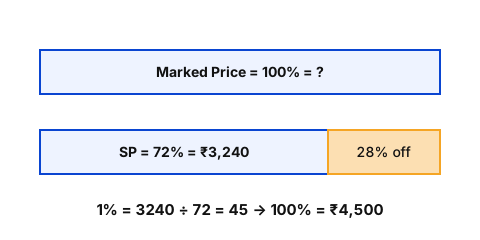
- After a discount, SP of MP.
- of MP ₹
- MP ₹
Trick: Check: of 4500 = 450; = 1260; ✓.
Answer: (D) ₹4,500
अवधारणा: छूट के बाद विक्रय मूल्य ।
- छूट के बाद SP MP का ।
- MP का ₹
- MP ₹
ट्रिक: जाँच: 4500 का = 1260; ✓।
उत्तर: (D) ₹4,500
RRB NTPC Undergraduate CBT 1MathematicsDiscountRRB NTPC Undergraduate CBT 1 2024 · 21 Aug Shift 3
Q812.If the 6-digit number N84M69 is divisible by 11, then which of the options below can give a possible correct relation between M and N?
यदि 6-अंकीय संख्या N84M69, 11 से विभाज्य है, तो नीचे दिए गए विकल्पों में से कौन-सा M और N के बीच एक संभावित सही संबंध दे सकता है?
- AM + N = 7
- BM - N = 1
- CM = N
- DM - N = -7
Show answer
Concept: A number is divisible by 11 if (sum of digits at odd places) (sum of digits at even places) is or a multiple of 11.
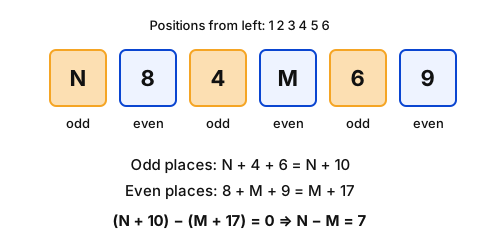
- Odd places: ; even places: .
- Difference: .
- , i.e. (e.g. : 984269 ).
- gives , not an option; is impossible for digits.
Trick: Write the digits with alternate and signs: .
Answer: (D)
अवधारणा: कोई संख्या 11 से विभाज्य है यदि (विषम स्थानों के अंकों का योग) (सम स्थानों के अंकों का योग) या 11 का गुणज हो।
- विषम स्थान: ; सम स्थान: ।
- अंतर: ।
- , अर्थात (जैसे : 984269 )।
- से मिलता है जो विकल्प में नहीं है; अंकों के लिए असंभव है।
ट्रिक: अंकों पर बारी-बारी से और लगाएँ: ।
उत्तर: (D)
RRB NTPC Undergraduate CBT 1MathematicsDivisibility by 11RRB NTPC Undergraduate CBT 1 2024 · 21 Aug Shift 3
Q813.Pipe A can fill a tank in 12 hours, pipe B can fill the same tank in 22 hours and pipe C can fill the same tank in 8 hours. The time taken by them to fill the same tank if they operate together is::
पाइप A एक टंकी को 12 घंटे में, पाइप B उसी टंकी को 22 घंटे में और पाइप C उसी टंकी को 8 घंटे में भर सकता है। यदि वे एक साथ कार्य करें, तो उसी टंकी को भरने में उनके द्वारा लिया गया समय है:
- A hours घंटे
- B hours घंटे
- C hours घंटे
- D hours घंटे
Show answer
Concept: Take tank capacity LCM of times; each pipe's efficiency .
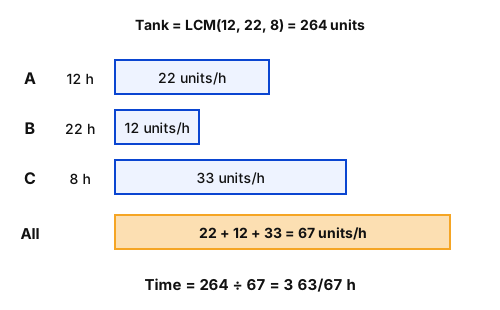
- LCM units.
- A , B , C units/h.
- Together units/h.
- Time hours.
Trick: All options end in ; only the whole part matters: , so it is 3.
Answer: (B) hours
अवधारणा: टंकी की क्षमता समयों का LCM लें; प्रत्येक पाइप की दक्षता ।
- LCM इकाई।
- A , B , C इकाई/घंटा।
- एक साथ इकाई/घंटा।
- समय घंटे।
ट्रिक: सभी विकल्पों में है; केवल पूर्णांक भाग देखें: , अतः 3।
उत्तर: (B) घंटे
RRB NTPC Undergraduate CBT 1MathematicsPipes and CisternsRRB NTPC Undergraduate CBT 1 2024 · 21 Aug Shift 3
Q814.A train that is 220 m long overtakes a man moving at a speed of 10 km/hr (in same direction) in 44 seconds. How much time (in seconds) will it take this train to completely cross another train of a length of 315 m, moving in the opposite direction at a speed of 79 km/hr?
220 m लंबी एक ट्रेन, 10 km/hr की चाल से (समान दिशा में) चल रहे एक व्यक्ति को 44 सेकंड में पार करती है। यह ट्रेन विपरीत दिशा में 79 km/hr की चाल से चल रही 315 m लंबी दूसरी ट्रेन को पूरी तरह पार करने में कितना समय (सेकंड में) लेगी?
- A14
- B32
- C28
- D18
Show answer
Concept: Same direction: relative speed difference; opposite direction: relative speed sum. .
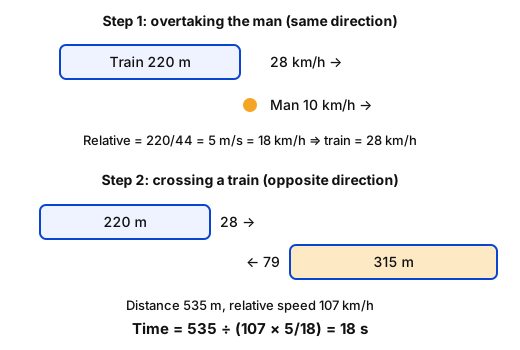
- Overtaking the man: relative speed .
- Train speed .
- Opposite train: relative speed ; distance .
- Time .
Trick: – the numbers are chosen to cancel neatly.
Answer: (D) 18
अवधारणा: समान दिशा: सापेक्ष चाल अंतर; विपरीत दिशा: सापेक्ष चाल योग। ।
- आदमी को पार करना: सापेक्ष चाल ।
- रेलगाड़ी की चाल ।
- विपरीत दिशा की रेलगाड़ी: सापेक्ष चाल ; दूरी ।
- समय ।
ट्रिक: – संख्याएँ आसानी से कट जाती हैं।
उत्तर: (D) 18
RRB NTPC Undergraduate CBT 1MathematicsTrains – Relative SpeedRRB NTPC Undergraduate CBT 1 2024 · 21 Aug Shift 3
Q815.A sum of ₹15,625 amounts to ₹24,389 in 3 years at a certain rate of interest per annum, compounded annually. The rate of interest per annum is:
₹15,625 की एक राशि, वार्षिक रूप से चक्रवृद्धि होने वाली एक निश्चित वार्षिक ब्याज दर पर 3 वर्षों में ₹24,389 हो जाती है। वार्षिक ब्याज दर है:
- A
- B
- C
- D
Show answer
Concept: .
- and , so .
- .
Trick: Know cubes up to 30: , . Rate .
Answer: (B)
अवधारणा: ।
- और , अतः ।
- ।
ट्रिक: 30 तक के घन याद रखें: , । दर ।
उत्तर: (B)
RRB NTPC Undergraduate CBT 1MathematicsCompound InterestRRB NTPC Undergraduate CBT 1 2024 · 21 Aug Shift 3
Q816.Find the value of [868 ÷ {26 + 6 × (3 − 7)}].
[868 ÷ {26 + 6 × (3 − 7)}] का मान ज्ञात कीजिए।
- A432
- B435
- C431
- D434
Show answer
Concept: BODMAS: solve innermost brackets first, then multiplication/division, then addition/subtraction.
Trick: Watch the negative sign: is , not .
Answer: (D) 434
अवधारणा: BODMAS: पहले सबसे भीतरी कोष्ठक, फिर गुणा/भाग, फिर जोड़/घटाव।
ट्रिक: ऋण चिह्न पर ध्यान दें: है, नहीं।
उत्तर: (D) 434
RRB NTPC Undergraduate CBT 1MathematicsSimplification (BODMAS)RRB NTPC Undergraduate CBT 1 2024 · 21 Aug Shift 3
Q817.Sapna invested ₹21,700 on simple interest, partly at 3% per annum and partly at 12% per annum. If she earns equal interests from the two investments after 7 years, then find the sum invested at 3% per annum (in ₹).
सपना ने ₹21,700 साधारण ब्याज पर निवेश किए, कुछ भाग 3% वार्षिक दर पर और कुछ भाग 12% वार्षिक दर पर। यदि 7 वर्षों के बाद उसे दोनों निवेशों से समान ब्याज प्राप्त होता है, तो 3% वार्षिक दर पर निवेश की गई राशि (₹ में) ज्ञात कीजिए।
- A17,360
- B17,357
- C17,361
- D17,358
Show answer
Concept: . Equal SI for the same time principal .
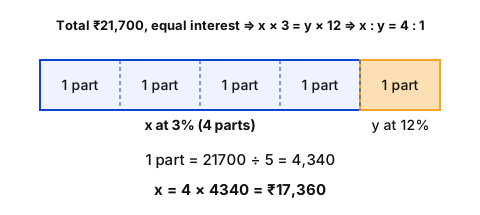
- Let at and at : .
- (5 parts in total).
- 1 part , so .
Trick: Equal interest: ratio of sums inverse ratio of rates .
Answer: (A) 17,360
अवधारणा: । समान समय में समान ब्याज मूलधन ।
- मान लें पर और पर : ।
- (कुल 5 भाग)।
- 1 भाग , अतः ।
ट्रिक: समान ब्याज: राशियों का अनुपात दरों का व्युत्क्रम अनुपात ।
उत्तर: (A) 17,360
RRB NTPC Undergraduate CBT 1MathematicsSimple InterestRRB NTPC Undergraduate CBT 1 2024 · 21 Aug Shift 3
Q818.Which of the following is the greatest number that, when dividing 183, 127 and 211, leaves the same remainder each time?
निम्नलिखित में से वह सबसे बड़ी संख्या कौन-सी है, जिससे 183, 127 और 211 को विभाजित करने पर प्रत्येक बार समान शेषफल प्राप्त होता है?
- A25
- B28
- C30
- D32
Show answer
Concept: If a number leaves the same remainder with , , , it divides their differences. Greatest such number HCF of the differences.
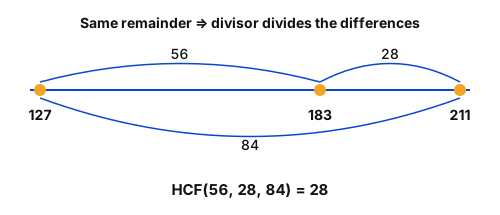
- Differences: , , .
- HCF.
- Check: , , – remainder 15 each time.
Trick: HCF of and is enough: HCF.
Answer: (B) 28
अवधारणा: यदि कोई संख्या , , में समान शेषफल छोड़ती है, तो वह उनके अंतरों को विभाजित करती है। सबसे बड़ी संख्या अंतरों का HCF।
- अंतर: , , ।
- HCF।
- जाँच: , , – हर बार शेषफल 15।
ट्रिक: दो अंतरों का HCF काफ़ी है: HCF।
उत्तर: (B) 28
RRB NTPC Undergraduate CBT 1MathematicsHCF – Same RemainderRRB NTPC Undergraduate CBT 1 2024 · 21 Aug Shift 3
Q819.Simplify:
सरल कीजिए:
- A
- B
- C
- D
Show answer
Concept: Use and .
Trick: Put : , and ✓.
Answer: (A)
अवधारणा: और का प्रयोग करें।
ट्रिक: रखें: , और ✓।
उत्तर: (A)
RRB NTPC Undergraduate CBT 1MathematicsTrigonometric IdentitiesRRB NTPC Undergraduate CBT 1 2024 · 21 Aug Shift 3
Q820.The product of two consecutive natural numbers is 182. The greater of the two numbers is:
दो क्रमागत प्राकृत संख्याओं का गुणनफल 182 है। दोनों में से बड़ी संख्या है:
- A14
- B26
- C7
- D27
Show answer
Concept: Product of consecutive numbers lies close to , so look near .
- , so try 13 and 14.
- ✓
- The greater number is 14.
Trick: Unit digit 2 comes from – so the numbers end in 3 and 4: 13, 14.
Answer: (A) 14
अवधारणा: क्रमागत संख्याओं का गुणनफल , के निकट होता है, अतः के पास देखें।
- , अतः 13 और 14 आज़माएँ।
- ✓
- बड़ी संख्या 14 है।
ट्रिक: इकाई अंक 2 = से – संख्याएँ 3 और 4 पर समाप्त: 13, 14।
उत्तर: (A) 14
RRB NTPC Undergraduate CBT 1MathematicsNumber SystemRRB NTPC Undergraduate CBT 1 2024 · 21 Aug Shift 3

