Q921.P, Q and R invest a sum in the ratio of 3 : 53 : 24, respectively. If they earned a total profit of ₹1,280 at the end of the year, then what is the difference between share of Q and R?
P, Q और R क्रमशः 3 : 53 : 24 के अनुपात में एक राशि निवेश करते हैं। यदि वर्ष के अंत में उन्होंने कुल ₹1,280 का लाभ अर्जित किया, तो Q और R के हिस्सों के बीच का अंतर कितना है?
- A₹533
- B₹464
- C₹417
- D₹570
Show answer
Concept: Profit is shared in the ratio of investments (same time).
- Total ratio parts; 1 part
- Difference of Q and R parts
Trick: Find the difference in parts first, multiply only once.
Answer: (B) ₹464
अवधारणा: समान समय के लिए लाभ निवेश के अनुपात में बँटता है।
- कुल अनुपात भाग; 1 भाग
- Q और R का अंतर भाग
ट्रिक: पहले भागों का अंतर निकालें, फिर एक ही बार गुणा करें।
उत्तर: (B) ₹464
RRB NTPC Undergraduate CBT 1MathematicsPartnershipRRB NTPC Undergraduate CBT 1 2024 · 20 Aug Shift 2
Q922.A shopkeeper bought an article for ₹576. At what price should he mark the article to earn a profit of 15% after allowing a discount of 4%?
एक दुकानदार ने ₹576 में एक वस्तु खरीदी। 4% की छूट देने के बाद 15% का लाभ अर्जित करने के लिए उसे वस्तु पर कितना मूल्य अंकित करना चाहिए?
- A₹636
- B₹690
- C₹685
- D₹639
Show answer
Concept: and .
Trick: Directly: (since ).
Answer: (B) ₹690
अवधारणा: तथा ।
ट्रिक: सीधे: (क्योंकि )।
उत्तर: (B) ₹690
RRB NTPC Undergraduate CBT 1MathematicsDiscount and Marked PriceRRB NTPC Undergraduate CBT 1 2024 · 20 Aug Shift 2
Q923.The population of a district is 373000, out of which 227000 are males. 69% of the population is literate. If 69% males are literate, then what percentage of females are literate?
एक ज़िले की जनसंख्या 373000 है, जिसमें से 227000 पुरुष हैं। जनसंख्या का 69% साक्षर है। यदि 69% पुरुष साक्षर हैं, तो कितने प्रतिशत महिलाएँ साक्षर हैं?
- A70%
- B69%
- C68%
- D67%
Show answer
Concept: If the whole and one part have the same rate, the other part must have that rate too.
- Females
- Literate total ; literate males
- Literate females →
Trick: Overall 69% and males 69% ⇒ females also 69% – no calculation needed.
Answer: (B) 69%
अवधारणा: यदि पूरे समूह और उसके एक भाग की दर समान है, तो दूसरे भाग की दर भी वही होगी।
- महिलाएँ
- कुल साक्षर ; साक्षर पुरुष
- साक्षर महिलाएँ →
ट्रिक: कुल 69% और पुरुष 69% ⇒ महिलाएँ भी 69% – गणना की ज़रूरत नहीं।
उत्तर: (B) 69%
RRB NTPC Undergraduate CBT 1MathematicsPercentageRRB NTPC Undergraduate CBT 1 2024 · 20 Aug Shift 2
Q924.The cost of 18 pens and 4 pencils is ₹200. If the cost of a pen decreases by ₹1 and the cost of a pencil increases by ₹3, then the cost of 19 pens and 3 pencils is ₹151. What is the original cost of 12 pens and 10 pencils?
18 पेन और 4 पेंसिलों का मूल्य ₹200 है। यदि एक पेन का मूल्य ₹1 कम हो जाए और एक पेंसिल का मूल्य ₹3 बढ़ जाए, तो 19 पेन और 3 पेंसिलों का मूल्य ₹151 है। 12 पेन और 10 पेंसिलों का मूल मूल्य कितना है?
- A₹430
- B₹434
- C₹429
- D₹433
Show answer
Concept: Form two equations in pen price and pencil price and solve.
- … (i)
- … (ii)
- (ii): ; (i): → , ,
Trick: Make the -coefficients equal (12) and subtract – one step gives .
Answer: (B) ₹434
अवधारणा: पेन का मूल्य और पेंसिल का मानकर दो समीकरण बनाएँ।
- … (i)
- … (ii)
- और → , ,
ट्रिक: के गुणांक बराबर (12) करके घटाएँ – एक ही चरण में मिल जाता है।
उत्तर: (B) ₹434
RRB NTPC Undergraduate CBT 1MathematicsLinear EquationsRRB NTPC Undergraduate CBT 1 2024 · 20 Aug Shift 2
Q925.If 77% of first number is equal to three-fourths of second number, what is the ratio of first number to the second number?
यदि पहली संख्या का 77%, दूसरी संख्या के तीन-चौथाई के बराबर है, तो पहली संख्या और दूसरी संख्या का अनुपात क्या है?
- A75 : 77
- B74 : 75
- C73 : 82
- D72 : 73
Show answer
Concept: If of A of B, then .
Trick: Write as 75% and simply swap: .
Answer: (A)
अवधारणा: यदि A का B का , तो ।
ट्रिक: को 75% लिखें और उलट दें: ।
उत्तर: (A)
RRB NTPC Undergraduate CBT 1MathematicsRatioRRB NTPC Undergraduate CBT 1 2024 · 20 Aug Shift 2
Q926.Find the value of [290 ÷ {17 + 7 × (2 − 3)}].
[290 ÷ {17 + 7 × (2 − 3)}] का मान ज्ञात कीजिए।
- A25
- B24
- C26
- D29
Show answer
Concept: Solve innermost bracket first, then multiplication, then addition, then division.
- ;
Trick: Order: ( ) → { } → [ ].
Answer: (D) 29
अवधारणा: पहले सबसे अंदर का कोष्ठक, फिर गुणा, फिर जोड़, फिर भाग।
- ;
ट्रिक: क्रम: ( ) → { } → [ ]।
उत्तर: (D) 29
RRB NTPC Undergraduate CBT 1MathematicsSimplification (BODMAS)RRB NTPC Undergraduate CBT 1 2024 · 20 Aug Shift 2
Q927.The value of is:
का मान है:
- A
- B
- C
- D
Show answer
Concept: Use and the standard result .
- Denominator .
- So .
- Expression
Trick: Test : numerator and denominator , so the value is 1.
Answer: (B) 1
अवधारणा: तथा मानक परिणाम का प्रयोग करें।
- हर ।
- अतः ।
- व्यंजक
ट्रिक: सुविधाजनक कोण (जैसे ) रखकर जाँचें – मान 1 ही आता है।
उत्तर: (B) 1
RRB NTPC Undergraduate CBT 1MathematicsTrigonometric IdentitiesRRB NTPC Undergraduate CBT 1 2024 · 20 Aug Shift 2
Q928.Two pipes can fill a cistern, individually, in 70 min and 30 min, respectively. There is a pipe located at the bottom of the cistern to empty it. If all the three pipes are opened simultaneously, then the empty cistern gets filled in 28 min. How long will the pipe at the bottom of the tank take to empty the completely filled cistern if no other pipe is then open?
दो पाइप एक टंकी को अलग-अलग क्रमशः 70 min और 30 min में भर सकते हैं। टंकी को खाली करने के लिए उसके तल में एक पाइप लगा है। यदि तीनों पाइप एक साथ खोल दिए जाएँ, तो खाली टंकी 28 min में भर जाती है। यदि कोई अन्य पाइप खुला न हो, तो तल में लगा पाइप पूरी भरी हुई टंकी को खाली करने में कितना समय लेगा?
- A80 min
- B84 min
- C81 min
- D67 min
Show answer
Concept: Net rate sum of filling rates − emptying rate (in tank per minute).
- LCM 420:
- → min
Trick: Take capacity units: fillers /min, net /min ⇒ leak /min ⇒ min.
Answer: (B) 84 min
अवधारणा: शुद्ध दर भरने वाले पाइपों की दरों का योग − खाली करने वाले की दर।
- LCM 420:
- → मिनट
ट्रिक: टंकी इकाई: भरने वाले /मिनट, शुद्ध /मिनट ⇒ निकास /मिनट ⇒ मिनट।
उत्तर: (B) 84 मिनट
RRB NTPC Undergraduate CBT 1MathematicsPipes and CisternRRB NTPC Undergraduate CBT 1 2024 · 20 Aug Shift 2
Q929.ABCD is a trapezium in which and . If and , then what is the measure of (in degree)?
ABCD एक समलंब है जिसमें और है। यदि और है, तो का माप (डिग्री में) क्या है?
- A
- B
- C
- D
Show answer
Concept: Angle sum of a triangle is ; with parallel lines, alternate angles are equal; equal sides face equal angles.
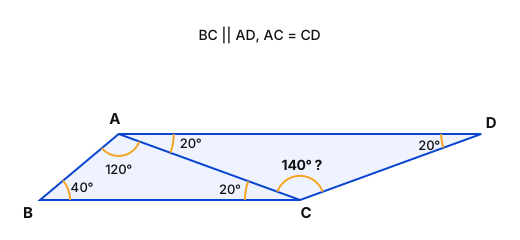
- In :
- ⇒ (alternate angles)
- ⇒
Trick: Isosceles triangle with base angle has apex angle .
Answer: (C)
अवधारणा: त्रिभुज के कोणों का योग ; समांतर रेखाओं में एकांतर कोण (alternate angles) बराबर; बराबर भुजाओं के सामने के कोण बराबर।
- में:
- ⇒ (एकांतर कोण)
- ⇒
ट्रिक: समद्विबाहु त्रिभुज में आधार कोण हो तो शीर्ष कोण ।
उत्तर: (C)
RRB NTPC Undergraduate CBT 1MathematicsGeometry – TrapeziumRRB NTPC Undergraduate CBT 1 2024 · 20 Aug Shift 2
Q930.5 years ago, the age of a father was 14 years more than twice his son's age. After how many years, from now, will he be twice his son's age?
5 वर्ष पहले, एक पिता की आयु उसके पुत्र की आयु के दोगुने से 14 वर्ष अधिक थी। अब से कितने वर्ष बाद उसकी आयु उसके पुत्र की आयु की दोगुनी होगी?
- A9
- B11
- C14
- D10
Show answer
Concept: Let present ages be father , son ; translate each statement into an equation.
- 5 years ago:
- After years:
Trick: Father is years more than twice the son now; that extra 9 disappears after exactly 9 years.
Answer: (A) 9
अवधारणा: वर्तमान आयु पिता , पुत्र मानें; हर कथन को समीकरण में बदलें।
- 5 वर्ष पहले:
- वर्ष बाद:
ट्रिक: पिता अभी पुत्र के दोगुने से 9 वर्ष अधिक हैं; यह अंतर ठीक 9 वर्ष बाद खत्म होगा।
उत्तर: (A) 9
RRB NTPC Undergraduate CBT 1MathematicsProblems on AgesRRB NTPC Undergraduate CBT 1 2024 · 20 Aug Shift 2
Q931.The number of prime numbers lying between 476 and 485, both included, is:
476 और 485 (दोनों को सम्मिलित करते हुए) के बीच स्थित अभाज्य संख्याओं की संख्या है:
- A2
- B1
- C4
- D6
Show answer
Concept: A prime has no divisor other than 1 and itself. To test , check primes up to ; here , so test 2, 3, 5, 7, 11, 13, 17, 19.
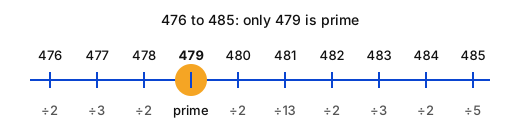
- Even numbers 476, 478, 480, 482, 484 and 485 (ends in 5) are out.
- , (digit sums 18 and 15).
- .
- 479 is not divisible by 2, 3, 5, 7, 11, 13, 17 or 19, so it is prime.
Trick: Strike out evens and multiples of 3 and 5 first; only 479 and 481 remain to test.
Answer: (B)
अवधारणा: अभाज्य संख्या का 1 और स्वयं के अलावा कोई भाजक नहीं होता। की जाँच हेतु तक के अभाज्यों से भाग दें; , अतः 2, 3, 5, 7, 11, 13, 17, 19 से जाँचें।
- सम संख्याएँ 476, 478, 480, 482, 484 और 485 (अंत में 5) बाहर।
- , (अंकों का योग 18 व 15)।
- ।
- 479 किसी भी 2, 3, 5, 7, 11, 13, 17, 19 से विभाज्य नहीं – अतः अभाज्य।
ट्रिक: पहले सम, 3 और 5 के गुणज काटें; केवल 479 और 481 जाँचने बचते हैं।
उत्तर: (B)
RRB NTPC Undergraduate CBT 1MathematicsPrime NumbersRRB NTPC Undergraduate CBT 1 2024 · 20 Aug Shift 1
Q932.A shopkeeper is given a 10% trade discount and a 5% scheme discount (free units). On purchasing 100 units priced at ₹50 each, what is the trade discount amount?
एक दुकानदार को 10% व्यापारिक छूट और 5% योजना छूट (मुफ़्त इकाइयाँ) दी जाती है। ₹50 प्रति इकाई मूल्य वाली 100 इकाइयाँ खरीदने पर व्यापारिक छूट की राशि कितनी है?
- A₹500
- B₹250
- C₹1,000
- D₹700
Show answer
Concept: Trade discount is a percentage reduction on the list price of the goods bought; a scheme discount given as free units does not change it.
- List price (₹).
- Trade discount (₹).
- The 5% free units are extra goods, so they are not part of this amount.
Trick: of any amount = move the decimal one place left: .
Answer: (A) ₹
अवधारणा: व्यापारिक छूट (trade discount) खरीदे गए माल के सूची मूल्य पर प्रतिशत कटौती है; मुफ्त इकाइयों वाली योजना छूट इसे नहीं बदलती।
- सूची मूल्य (₹)।
- व्यापारिक छूट (₹)।
- 5% मुफ्त इकाइयाँ अतिरिक्त माल हैं, इस राशि में शामिल नहीं।
ट्रिक: किसी राशि का = दशमलव एक स्थान बाएँ: ।
उत्तर: (A) ₹
RRB NTPC Undergraduate CBT 1MathematicsDiscountRRB NTPC Undergraduate CBT 1 2024 · 20 Aug Shift 1
Q933.5 men can complete a piece of work in 18 days, while 9 women can do it in 5 days. In how many days can 3 women and 3 men complete this work?
5 पुरुष किसी कार्य को 18 दिनों में पूरा कर सकते हैं, जबकि 9 महिलाएँ उसे 5 दिनों में कर सकती हैं। 3 महिलाएँ और 3 पुरुष मिलकर इस कार्य को कितने दिनों में पूरा कर सकते हैं?
- A5 days5 दिन
- B10 days10 दिन
- C7 days7 दिन
- D8 days8 दिन
Show answer
Concept: Work = (number of workers) (days). Take total work as a convenient number of units.
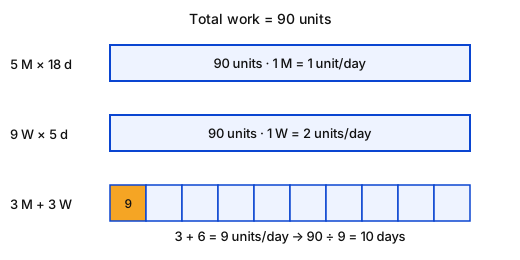
- Work man-days woman-days, so 1 man does 1 unit/day and 1 woman does 2 units/day (total 90 units).
- 3 men + 3 women units/day.
- Time days.
Trick: , so ; days.
Answer: (B) days
अवधारणा: कार्य = (कामगारों की संख्या) (दिन)। कुल कार्य को सुविधाजनक इकाइयों में लें।
- कार्य पुरुष-दिन महिला-दिन; अतः 1 पुरुष = 1 इकाई/दिन, 1 महिला = 2 इकाई/दिन (कुल 90 इकाई)।
- 3 पुरुष + 3 महिलाएँ इकाई/दिन।
- समय दिन।
ट्रिक: , अतः ; दिन।
उत्तर: (B) दिन
RRB NTPC Undergraduate CBT 1MathematicsTime and WorkRRB NTPC Undergraduate CBT 1 2024 · 20 Aug Shift 1
Q934.By how much is of greater than of ?
का , के से कितना अधिक है?
- A24.25
- B28.25
- C27.25
- D30.25
Show answer
Concept: Find each quantity separately and subtract: .
- Difference
Trick: (ends in 5: , then 25), so of .
Answer: (D)
अवधारणा: दोनों मात्राएँ अलग-अलग निकालकर घटाएँ: ।
- अंतर
ट्रिक: (5 पर समाप्त: , फिर 25), अतः 65 का ।
उत्तर: (D)
RRB NTPC Undergraduate CBT 1MathematicsPercentage and FractionsRRB NTPC Undergraduate CBT 1 2024 · 20 Aug Shift 1
Q935.A discount of 13% on the marked price of an article is allowed and then the article is sold for ₹348. The marked price of the article is:
किसी वस्तु के अंकित मूल्य पर 13% की छूट दी जाती है और फिर वस्तु ₹348 में बेची जाती है। वस्तु का अंकित मूल्य है:
- A₹392
- B₹420
- C₹380
- D₹400
Show answer
Concept: .
- After a discount, of MP.
- (₹).
Trick: , so MP .
Answer: (D) ₹
अवधारणा: ।
- छूट के बाद विक्रय मूल्य = अंकित मूल्य का ।
- (₹)।
ट्रिक: , अतः अंकित मूल्य ।
उत्तर: (D) ₹
RRB NTPC Undergraduate CBT 1MathematicsDiscountRRB NTPC Undergraduate CBT 1 2024 · 20 Aug Shift 1
Q936.If 36% of first number is equal to four-sevenths of second number, what is the ratio of first number to the second number?
यदि पहली संख्या का 36%, दूसरी संख्या के चार-सातवें भाग के बराबर है, तो पहली संख्या और दूसरी संख्या का अनुपात क्या है?
- A95 : 60
- B100 : 63
- C99 : 62
- D104 : 61
Show answer
Concept: If of equals a fraction of , write the equation and find .
- Divide by 4: , i.e. .
Trick: .
Answer: (B)
अवधारणा: यदि का , के किसी भिन्न के बराबर है, तो समीकरण बनाकर निकालें।
- 4 से भाग: , अर्थात ।
ट्रिक: ।
उत्तर: (B)
RRB NTPC Undergraduate CBT 1MathematicsRatio and PercentageRRB NTPC Undergraduate CBT 1 2024 · 20 Aug Shift 1
Q937.Kushal and Brijesh together invested ₹37,100 in a business. At the end of the year, out of a total profit of ₹12,000, Brijesh's share was ₹5,700. What was the difference between their investments?
कुशल और बृजेश ने मिलकर एक व्यवसाय में ₹37,100 का निवेश किया। वर्ष के अंत में, ₹12,000 के कुल लाभ में से बृजेश का हिस्सा ₹5,700 था। उनके निवेशों के बीच अंतर कितना था?
- A₹1,855
- B₹1,742
- C₹3,438
- D₹2,347
Show answer
Concept: For the same time period, profit is shared in the ratio of investments.
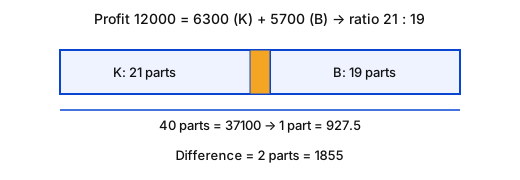
- Kushal's profit , so ratio .
- Total parts ↔ ₹37,100, so 1 part .
- Difference parts (₹).
Trick: Difference in investment .
Answer: (A) ₹
अवधारणा: समान अवधि के लिए लाभ निवेश के अनुपात में बँटता है।
- कुशल का लाभ , अतः अनुपात ।
- कुल भाग ↔ ₹37,100, अतः 1 भाग ।
- अंतर भाग (₹)।
ट्रिक: निवेश का अंतर ।
उत्तर: (A) ₹
RRB NTPC Undergraduate CBT 1MathematicsPartnershipRRB NTPC Undergraduate CBT 1 2024 · 20 Aug Shift 1
Q938.A trader claims to sell grains at a profit of 29%, but also dishonestly uses a weight which is 13% less than what is mentioned on it. Find the total percentage of profit earned by the trader. (Round off the answer to the nearest whole number.)
एक व्यापारी अनाज को 29% लाभ पर बेचने का दावा करता है, परंतु साथ ही बेईमानी से ऐसे बाट का उपयोग करता है जो उस पर अंकित भार से 13% कम है। व्यापारी द्वारा अर्जित कुल लाभ प्रतिशत ज्ञात कीजिए। (उत्तर को निकटतम पूर्ण संख्या तक पूर्णांकित कीजिए।)
- A
- B
- C
- D
Show answer
Concept: With a false weight, the trader gives less goods (cost) but charges the full price: .
- Let the goods marked 100 cost ₹100. He charges ₹129 (profit ).
- He actually gives only units, costing ₹87.
Trick: → profit .
Answer: (C)
अवधारणा: खोटे बाट से व्यापारी माल (लागत) कम देता है पर पूरा मूल्य लेता है: ।
- मान लें 100 इकाई माल की लागत ₹100; वह ₹129 लेता है (लाभ )।
- वास्तव में वह केवल इकाई देता है, लागत ₹87।
ट्रिक: → लाभ ।
उत्तर: (C)
RRB NTPC Undergraduate CBT 1MathematicsProfit and Loss – False WeightRRB NTPC Undergraduate CBT 1 2024 · 20 Aug Shift 1
Q939.The product of two consecutive natural numbers is 6. The greater of the two numbers is:
दो क्रमागत प्राकृत संख्याओं का गुणनफल 6 है। दोनों में से बड़ी संख्या है:
- A2
- B19
- C3
- D5
Show answer
Concept: Two consecutive natural numbers are and .
- (natural number).
- Numbers are 2 and 3; the greater is 3.
Trick: Check options: directly.
Answer: (C)
अवधारणा: दो क्रमागत प्राकृत संख्याएँ और होती हैं।
- (प्राकृत संख्या)।
- संख्याएँ 2 और 3; बड़ी संख्या 3।
ट्रिक: विकल्प जाँचें: सीधे।
उत्तर: (C)
RRB NTPC Undergraduate CBT 1MathematicsNumber SystemRRB NTPC Undergraduate CBT 1 2024 · 20 Aug Shift 1
Q940.The average of first 152 odd natural numbers, is:
प्रथम 152 विषम प्राकृत संख्याओं का औसत है:
- A152.5
- B153
- C152
- D151.5
Show answer
Concept: Sum of the first odd natural numbers , so their average .
- Sum of first 152 odd numbers .
- Average .
- Check: average .
Yaad rakhein: Average of first odd numbers ; of first even numbers .
Answer: (C)
अवधारणा: प्रथम विषम प्राकृत संख्याओं का योग , अतः औसत ।
- प्रथम 152 विषम संख्याओं का योग ।
- औसत ।
- जाँच: औसत (प्रथम + अंतिम का आधा)।
याद रखें: प्रथम विषम संख्याओं का औसत ; प्रथम सम संख्याओं का औसत ।
उत्तर: (C)
RRB NTPC Undergraduate CBT 1MathematicsAverageRRB NTPC Undergraduate CBT 1 2024 · 20 Aug Shift 1

