Q981.In a certain code language, ‘INKS’ is coded as ‘4628’ and ‘NEAR’ is coded as ‘1385’. What is the code for ‘N’ in the given code language?
एक निश्चित कूट भाषा में, ‘INKS’ को ‘4628’ लिखा जाता है और ‘NEAR’ को ‘1385’ लिखा जाता है। दी गई कूट भाषा में ‘N’ के लिए कूट क्या है?
- A5
- B8
- C6
- D1
Show answer
Concept: A letter common to both words takes the digit common to both codes.
- INKS → 4, 6, 2, 8; NEAR → 1, 3, 8, 5.
- Common letter: N. Common digit: 8.
- So N = 8.
Trick: One common letter ↔ one common digit — match them directly.
Answer: (B) 8
अवधारणा: दोनों शब्दों का समान अक्षर, दोनों कोडों के समान अंक से कोडित होता है।
- INKS → 4, 6, 2, 8; NEAR → 1, 3, 8, 5।
- समान अक्षर: N; समान अंक: 8।
- अतः N = 8।
ट्रिक: एक समान अक्षर ↔ एक समान अंक — सीधे मिलाएँ।
उत्तर: (B) 8
RRB NTPC Undergraduate CBT 1General Intelligence and ReasoningCoding–DecodingRRB NTPC Undergraduate CBT 1 2024 · 19 Aug Shift 3
Q982.What should come in place of the question mark (?) in the given series?
26, 21, 11, −4, −24, ?
दी गई श्रृंखला में प्रश्न चिह्न (?) के स्थान पर क्या आना चाहिए?
26, 21, 11, −4, −24, ?
- A−54
- B57
- C−49
- D49
Show answer
Concept: Differences decrease by multiples of 5.
- , , .
- .
- .
Trick: The series keeps falling, so the answer must be negative: only or ; the −25 step gives .
Answer: (C)
अवधारणा: अंतर 5 के गुणजों से घट रहे हैं।
- , , ।
- ।
- ।
ट्रिक: श्रृंखला घट रही है, उत्तर ऋणात्मक होगा: या ; −25 का कदम देता है।
उत्तर: (C)
RRB NTPC Undergraduate CBT 1General Intelligence and ReasoningNumber SeriesRRB NTPC Undergraduate CBT 1 2024 · 19 Aug Shift 3
Q983.Ajay starts from Point A and drives 11 km towards North. He then takes a right turn, drives 3 km, turns right and drives 12 km. He then takes a right turn and drives 6 km. He takes a final right turn, drives 1 km and stops at Point P. How far (shortest distance) and towards which direction should he drive in order to reach Point A again? (All turns are 90° turns only unless specified.)
अजय बिंदु A से चलना शुरू करता है और उत्तर की ओर 11 km गाड़ी चलाता है। फिर वह दाएँ मुड़ता है, 3 km गाड़ी चलाता है, दाएँ मुड़ता है और 12 km गाड़ी चलाता है। फिर वह दाएँ मुड़ता है और 6 km गाड़ी चलाता है। वह अंतिम बार दाएँ मुड़ता है, 1 km गाड़ी चलाता है और बिंदु P पर रुक जाता है। बिंदु A पर फिर से पहुँचने के लिए उसे कितनी दूरी (न्यूनतम दूरी) तक और किस दिशा में गाड़ी चलानी चाहिए? (जब तक निर्दिष्ट न किया जाए, सभी मोड़ केवल 90° के मोड़ हैं।)
- A3 km to westपश्चिम की ओर 3 km
- B4 km to eastपूर्व की ओर 4 km
- C3 km to eastपूर्व की ओर 3 km
- D4 km to westपश्चिम की ओर 4 km
Show answer
Concept: Track the path with coordinates (A at origin, North = +y, East = +x).
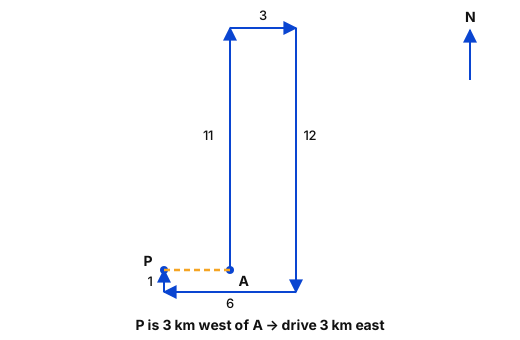
- North 11 → (0, 11); right = East 3 → (3, 11).
- Right = South 12 → (3, −1); right = West 6 → (−3, −1).
- Right = North 1 → P(−3, 0).
- P is 3 km west of A ⇒ drive 3 km to the east.
Trick: Net N–S: ; net E–W: (west). Go back opposite.
Answer: (C) 3 km to east
अवधारणा: निर्देशांकों से रास्ता देखें (A मूल बिंदु, उत्तर = +y, पूर्व = +x)।
- उत्तर 11 → (0, 11); दाएँ = पूर्व 3 → (3, 11)।
- दाएँ = दक्षिण 12 → (3, −1); दाएँ = पश्चिम 6 → (−3, −1)।
- दाएँ = उत्तर 1 → P(−3, 0)।
- P, A से 3 km पश्चिम ⇒ 3 km पूर्व की ओर जाना होगा।
ट्रिक: शुद्ध उत्तर–दक्षिण: ; पूर्व–पश्चिम: (पश्चिम)। वापसी उल्टी दिशा में।
उत्तर: (C) 3 km पूर्व की ओर
RRB NTPC Undergraduate CBT 1General Intelligence and ReasoningDirection and DistanceRRB NTPC Undergraduate CBT 1 2024 · 19 Aug Shift 3
Q984.Seven people, A, B, C, D, P, Q and R, are sitting in a row, facing north.
Only three people sit between A and C. Q sits to the immediate left of C. No one sits to the right of B. Only two people sit between B and Q. D sits to the immediate right of R. How many people sit between P and D?
सात व्यक्ति, A, B, C, D, P, Q और R, एक पंक्ति में उत्तर की ओर मुख करके बैठे हैं।
A और C के बीच केवल तीन व्यक्ति बैठे हैं। Q, C के ठीक बाएँ बैठा है। B के दाएँ कोई नहीं बैठा है। B और Q के बीच केवल दो व्यक्ति बैठे हैं। D, R के ठीक दाएँ बैठा है। P और D के बीच कितने व्यक्ति बैठे हैं?
- AThreeतीन
- BFourचार
- COneएक
- DTwoदो
Show answer
Concept: Fix the definite positions first (positions 1–7 from left; all face north).
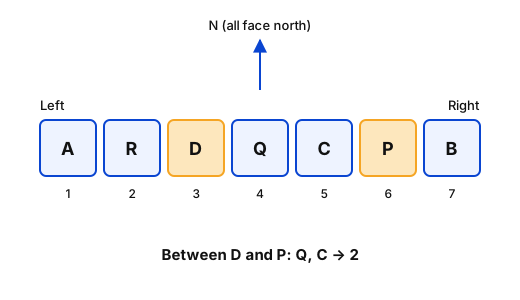
- No one right of B ⇒ B = 7. Two between B and Q ⇒ Q = 4.
- Q immediately left of C ⇒ C = 5. Three between A and C ⇒ A = 1.
- Left seats 2, 3, 6: R–D adjacent ⇒ R = 2, D = 3; P = 6.
- Between D (3) and P (6): Q, C ⇒ two.
Trick: Start with extreme-end clues ('no one to the right').
Answer: (D) Two
अवधारणा: पहले निश्चित स्थान तय करें (बाएँ से स्थान 1–7; सभी उत्तर की ओर मुख)।
- B के दाएँ कोई नहीं ⇒ B = 7; B और Q के बीच दो ⇒ Q = 4।
- Q, C के ठीक बाएँ ⇒ C = 5; A और C के बीच तीन ⇒ A = 1।
- बचे स्थान 2, 3, 6: R–D साथ ⇒ R = 2, D = 3; P = 6।
- D (3) और P (6) के बीच: Q, C ⇒ दो।
ट्रिक: सबसे पहले छोर वाले संकेत ('दाएँ कोई नहीं') लगाएँ।
उत्तर: (D) दो
RRB NTPC Undergraduate CBT 1General Intelligence and ReasoningLinear Seating ArrangementRRB NTPC Undergraduate CBT 1 2024 · 19 Aug Shift 3
Q985.Based on the English alphabetical order, three of the following four letter-clusters are alike in a certain way and thus form a group. Which letter-cluster DOES NOT belong to that group?
(Note: The odd one out is not based on the number of consonants/vowels or their position in the letter-cluster.)
अंग्रेज़ी वर्णमाला क्रम के आधार पर, निम्नलिखित चार अक्षर-समूहों में से तीन किसी निश्चित प्रकार से एकसमान हैं और इस प्रकार एक समूह बनाते हैं। कौन-सा अक्षर-समूह उस समूह से संबंधित नहीं है?
(नोट: असंगत अक्षर-समूह, उस अक्षर-समूह में व्यंजनों/स्वरों की संख्या या उनके स्थान पर आधारित नहीं है।)
- APTR
- BGKH
- CWAY
- DNRP
Show answer
Concept: Compare the gaps between letter positions.
- PTR: 16, 20, 18 → +4, −2. NRP: 14, 18, 16 → +4, −2.
- WAY: 23, 27 (A), 25 → +4, −2.
- GKH: 7, 11, 8 → +4, −3 ✘.
Trick: The 3rd letter is the 'middle' of the first two in three clusters (R between P and T); in GKH it is not.
Answer: (B) GKH
अवधारणा: अक्षरों के स्थानीय मानों के अंतर की तुलना करें।
- PTR: 16, 20, 18 → +4, −2; NRP: 14, 18, 16 → +4, −2।
- WAY: 23, 27 (A), 25 → +4, −2।
- GKH: 7, 11, 8 → +4, −3 ✘।
ट्रिक: तीन समूहों में तीसरा अक्षर पहले दो के ठीक बीच का है (P और T के बीच R); GKH में नहीं।
उत्तर: (B) GKH
RRB NTPC Undergraduate CBT 1General Intelligence and ReasoningOdd One Out – LettersRRB NTPC Undergraduate CBT 1 2024 · 19 Aug Shift 3
Q986.Which of the following letter-number clusters will replace the question mark (?) in the given series to make it logically complete?
BIP 104, ELS 97, HOV 90, KRY 83, NUB 76, ?
निम्नलिखित में से कौन-सा अक्षर-संख्या समूह दी गई श्रृंखला को तार्किक रूप से पूर्ण करने के लिए प्रश्न चिह्न (?) का स्थान लेगा?
BIP 104, ELS 97, HOV 90, KRY 83, NUB 76, ?
- AQKE 69
- BMXE 69
- CQYE 69
- DQXE 69
Show answer
Concept: Each letter moves +3; the number falls by 7.
- 1st letters: B, E, H, K, N, Q.
- 2nd letters: I, L, O, R, U, X; 3rd letters: P, S, V, Y, B, E (wraps after Z).
- Numbers: 104, 97, 90, 83, 76, 69.
Trick: All options end in 69 and three start with Q; U + 3 = X picks QXE.
Answer: (D) QXE 69
अवधारणा: हर अक्षर +3 खिसकता है; संख्या 7 घटती है।
- पहले अक्षर: B, E, H, K, N, Q।
- दूसरे अक्षर: I, L, O, R, U, X; तीसरे अक्षर: P, S, V, Y, B, E (Z के बाद फिर A से)।
- संख्याएँ: 104, 97, 90, 83, 76, 69।
ट्रिक: सभी विकल्पों में 69 है और तीन Q से शुरू; U + 3 = X से QXE तय।
उत्तर: (D) QXE 69
RRB NTPC Undergraduate CBT 1General Intelligence and ReasoningAlphanumeric SeriesRRB NTPC Undergraduate CBT 1 2024 · 19 Aug Shift 3
Q987.Seven people, I, J, K, L, U, V and W are sitting in a row, facing north.
Only three people sit between V and J. U sits to the immediate left of J. No one sits to the right of I. Only two people sit between I and U. W sits to the immediate right of L. How many people sit between K and W?
सात व्यक्ति, I, J, K, L, U, V और W, एक पंक्ति में उत्तर की ओर मुख करके बैठे हैं।
V और J के बीच केवल तीन व्यक्ति बैठे हैं। U, J के ठीक बाएँ बैठा है। I के दाएँ कोई नहीं बैठा है। I और U के बीच केवल दो व्यक्ति बैठे हैं। W, L के ठीक दाएँ बैठा है। K और W के बीच कितने व्यक्ति बैठे हैं?
- ATwoदो
- BThreeतीन
- CFourचार
- DOneएक
Show answer
Concept: Place people from the definite clues (positions 1–7 from left; all face north).
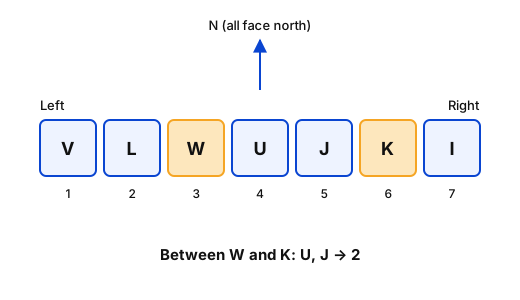
- No one right of I ⇒ I = 7. Two between I and U ⇒ U = 4.
- U immediately left of J ⇒ J = 5. Three between V and J ⇒ V = 1.
- Seats left: 2, 3, 6. L–W adjacent ⇒ L = 2, W = 3; K = 6.
- Between W (3) and K (6): U, J ⇒ two.
Trick: Same structure as the A–D puzzle: the adjacent pair must take seats 2–3.
Answer: (A) Two
अवधारणा: निश्चित संकेतों से लोगों को बैठाएँ (बाएँ से स्थान 1–7; सभी उत्तर की ओर मुख)।
- I के दाएँ कोई नहीं ⇒ I = 7; I और U के बीच दो ⇒ U = 4।
- U, J के ठीक बाएँ ⇒ J = 5; V और J के बीच तीन ⇒ V = 1।
- बचे स्थान 2, 3, 6: L–W साथ ⇒ L = 2, W = 3; K = 6।
- W (3) और K (6) के बीच: U, J ⇒ दो।
ट्रिक: साथ बैठने वाला जोड़ा केवल 2–3 स्थान ले सकता है, बचा स्थान 6 अपने आप तय।
उत्तर: (A) दो
RRB NTPC Undergraduate CBT 1General Intelligence and ReasoningLinear Seating ArrangementRRB NTPC Undergraduate CBT 1 2024 · 19 Aug Shift 3
Q988.If 2 is added to each odd digit and 1 is subtracted from each even digit in the number 7135682, then how many digits will appear more than once in the new number thus formed?
यदि संख्या 7135682 के प्रत्येक विषम अंक में 2 जोड़ दिया जाए और प्रत्येक सम अंक में से 1 घटा दिया जाए, तो इस प्रकार बनी नई संख्या में कितने अंक एक से अधिक बार आएँगे?
- AOneएक
- BTwoदो
- CThreeतीन
- DNoneकोई नहीं
Show answer
Concept: Apply +2 to odd digits and −1 to even digits, then count repeats.
- 7135682: 7→9, 1→3, 3→5, 5→7, 6→5, 8→7, 2→1.
- New number: 9 3 5 7 5 7 1.
- Repeated digits: 5 and 7 ⇒ two.
Trick: Even − 1 gives odd, so both rules create odd digits — watch for collisions (3→5 and 6→5; 5→7 and 8→7).
Answer: (B) Two
अवधारणा: विषम अंकों में +2 और सम अंकों में −1 करें, फिर दोहराव गिनें।
- 7135682: 7→9, 1→3, 3→5, 5→7, 6→5, 8→7, 2→1।
- नई संख्या: 9 3 5 7 5 7 1।
- दोहराए अंक: 5 और 7 ⇒ दो।
ट्रिक: दोनों नियमों से विषम अंक बनते हैं — टकराव देखें (3→5 और 6→5; 5→7 और 8→7)।
उत्तर: (B) दो
RRB NTPC Undergraduate CBT 1General Intelligence and ReasoningNumber OperationsRRB NTPC Undergraduate CBT 1 2024 · 19 Aug Shift 3
Q989.Mr. Tuff starts from Point A and drives 7 km towards the east. He then takes a left turn and drives 2 km, then turns left and drives 9 km. He then takes a left turn and drives 9 km. He takes a final left turn, drives 2 km and stops at Point P. How far (shortest distance) and in which direction should he drive in order to reach Point A again? (All turns are 90-degree turns only unless specified.)
मिस्टर टफ बिंदु A से चलना शुरू करते हैं और पूर्व की ओर 7 km गाड़ी चलाते हैं। फिर वे बाएँ मुड़ते हैं और 2 km गाड़ी चलाते हैं, फिर बाएँ मुड़ते हैं और 9 km गाड़ी चलाते हैं। फिर वे बाएँ मुड़ते हैं और 9 km गाड़ी चलाते हैं। वे अंतिम बार बाएँ मुड़ते हैं, 2 km गाड़ी चलाते हैं और बिंदु P पर रुक जाते हैं। बिंदु A पर फिर से पहुँचने के लिए उन्हें कितनी दूरी (न्यूनतम दूरी) तक और किस दिशा में गाड़ी चलानी चाहिए? (जब तक निर्दिष्ट न किया जाए, सभी मोड़ केवल 90 डिग्री के मोड़ हैं।)
- A8 km to the westपश्चिम की ओर 8 km
- B7 km to the northउत्तर की ओर 7 km
- C7 km to the southदक्षिण की ओर 7 km
- D6 km to the southदक्षिण की ओर 6 km
Show answer
Concept: Use coordinates (A at origin, East = +x, North = +y).
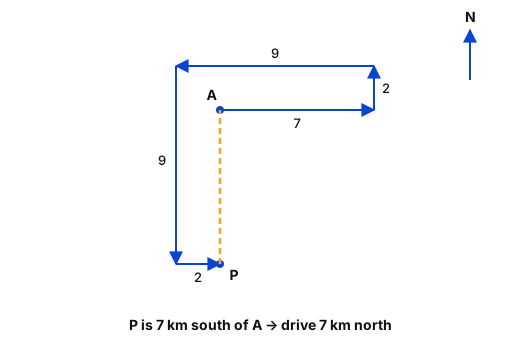
- East 7 → (7, 0); left = North 2 → (7, 2).
- Left = West 9 → (−2, 2); left = South 9 → (−2, −7).
- Left = East 2 → P(0, −7).
- P is 7 km south of A ⇒ drive 7 km to the north.
Trick: Net E–W: ; net N–S: (south). Return opposite.
Answer: (B) 7 km to the north
अवधारणा: निर्देशांक लें (A मूल बिंदु, पूर्व = +x, उत्तर = +y)।
- पूर्व 7 → (7, 0); बाएँ = उत्तर 2 → (7, 2)।
- बाएँ = पश्चिम 9 → (−2, 2); बाएँ = दक्षिण 9 → (−2, −7)।
- बाएँ = पूर्व 2 → P(0, −7)।
- P, A से 7 km दक्षिण ⇒ 7 km उत्तर की ओर जाना होगा।
ट्रिक: शुद्ध पूर्व–पश्चिम: ; उत्तर–दक्षिण: (दक्षिण)। वापसी उल्टी दिशा में।
उत्तर: (B) 7 km उत्तर की ओर
RRB NTPC Undergraduate CBT 1General Intelligence and ReasoningDirection and DistanceRRB NTPC Undergraduate CBT 1 2024 · 19 Aug Shift 3
Q990.Seven boxes A, B, C, D, E, F and G are kept one over the other but not necessarily in the same order. Only two boxes are kept below G. Only one box is kept above A. Only one box is kept between A and E. B is kept immediately above D. C is kept at some place below F. How many boxes are kept below A?
सात बक्से A, B, C, D, E, F और G एक के ऊपर एक रखे गए हैं, लेकिन आवश्यक नहीं कि इसी क्रम में हों। G के नीचे केवल दो बक्से रखे गए हैं। A के ऊपर केवल एक बक्सा रखा गया है। A और E के बीच केवल एक बक्सा रखा गया है। B, D के ठीक ऊपर रखा गया है। C, F के नीचे किसी स्थान पर रखा गया है। A के नीचे कितने बक्से रखे गए हैं?
- A5
- B3
- C4
- D2
Show answer
Concept: Number the positions 1 (top) to 7 (bottom) and place the fixed boxes first.
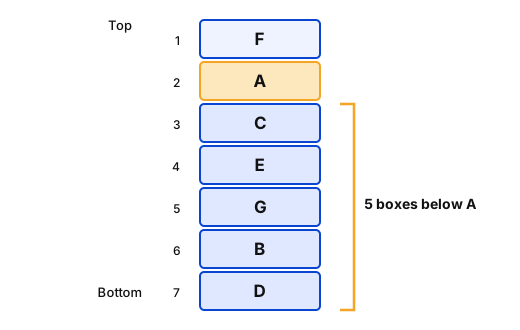
- Two boxes below G ⇒ G = 5. One box above A ⇒ A = 2.
- One box between A and E ⇒ E = 4.
- B immediately above D needs two free consecutive slots ⇒ B = 6, D = 7.
- C below F ⇒ F = 1, C = 3. Boxes below A: C, E, G, B, D = 5.
Trick: 'Only one box above A' ⇒ A is 2nd, so 7 − 2 = 5 boxes are below it at once.
Answer: (A) 5
अवधारणा: स्थान 1 (ऊपर) से 7 (नीचे) तक लें और पहले निश्चित बॉक्स रखें।
- G के नीचे दो बॉक्स ⇒ G = 5; A के ऊपर एक ⇒ A = 2।
- A और E के बीच एक ⇒ E = 4।
- B, D के ठीक ऊपर — लगातार दो खाली स्थान ⇒ B = 6, D = 7।
- C, F के नीचे ⇒ F = 1, C = 3। A के नीचे: C, E, G, B, D = 5।
ट्रिक: 'A के ऊपर केवल एक' ⇒ A दूसरे स्थान पर, अतः 7 − 2 = 5 बॉक्स नीचे — तुरंत।
उत्तर: (A) 5
RRB NTPC Undergraduate CBT 1General Intelligence and ReasoningBox Arrangement (Puzzle)RRB NTPC Undergraduate CBT 1 2024 · 19 Aug Shift 3
Q991.If 2 is added to each even digit and 4 is subtracted from each odd digit in the number 925746, what will be difference between the highest and second lowest digits thus formed?
यदि संख्या 925746 के प्रत्येक सम अंक में 2 जोड़ा जाए और प्रत्येक विषम अंक में से 4 घटाया जाए, तो इस प्रकार बने उच्चतम और दूसरे निम्नतम अंकों के बीच का अंतर क्या होगा?
- A5
- B4
- C6
- D7
Show answer
Concept: Change each digit by the given rule, then compare the new digits.
- 925746: odd digits 9, 5, 7 → → 5, 1, 3; even digits 2, 4, 6 → → 4, 6, 8.
- New number: 5 4 1 3 6 8.
- Highest digit ; digits in ascending order 1, 3, 4, … → second lowest .
- Difference .
Trick: Write the new digits in ascending order once – both 'highest' and 'second lowest' can be read off directly.
Answer: (A) 5
अवधारणा: दिए गए नियम से हर अंक बदलें, फिर नए अंकों की तुलना करें।
- 925746: विषम अंक 9, 5, 7 → → 5, 1, 3; सम अंक 2, 4, 6 → → 4, 6, 8।
- नई संख्या: 5 4 1 3 6 8।
- सबसे बड़ा अंक 8; आरोही क्रम 1, 3, 4, … → दूसरा सबसे छोटा 3।
- अंतर ।
ट्रिक: नए अंकों को एक बार आरोही क्रम में लिख लें – दोनों उत्तर सीधे मिल जाते हैं।
उत्तर: (A) 5
RRB NTPC Undergraduate CBT 1General Intelligence and ReasoningDigit OperationsRRB NTPC Undergraduate CBT 1 2024 · 19 Aug Shift 2
Q992.Refer to the following number and symbol series and answer the question that follows. Counting to be done from left to right only.
(Left) ^ > & 5 > ^ 3 6 < + $ % * % 7 1 % 2 + 2 1 (Right)
How many such symbols are there, each of which is immediately preceded by a number and also immediately followed by a number?
निम्नलिखित संख्या और प्रतीक श्रृंखला को देखिए और उसके बाद दिए गए प्रश्न का उत्तर दीजिए। गिनती केवल बाएँ से दाएँ की जानी है।
(बाएँ) ^ > & 5 > ^ 3 6 < + $ % * % 7 1 % 2 + 2 1 (दाएँ)
ऐसे कितने प्रतीक हैं, जिनमें से प्रत्येक के ठीक पहले एक संख्या है और ठीक बाद भी एक संख्या है?
- AOneएक
- BThreeतीन
- CNoneकोई नहीं
- DTwoदो
Show answer
Concept: Look for the pattern number – symbol – number (a symbol with a digit on both sides).
- Scan every symbol and check its left and right neighbours.
- '1 % 2' (near the right end): % has 1 before and 2 after ✔.
- '2 + 2': + has 2 before and 2 after ✔.
- Others fail, e.g. '5 > ' is followed by a symbol, '6 < +' is followed by a symbol, '7' and '1' are adjacent digits with no symbol between.
Trick: Only check symbols that sit right after a digit – this cuts the work in half.
Answer: (D) Two
अवधारणा: पैटर्न खोजें: संख्या – प्रतीक – संख्या (प्रतीक के दोनों ओर अंक)।
- हर प्रतीक के बाएँ और दाएँ पड़ोसी जाँचें।
- '1 % 2': % के पहले 1 और बाद में 2 ✔।
- '2 + 2': + के पहले 2 और बाद में 2 ✔।
- बाकी असफल, जैसे '5 >' के बाद प्रतीक है, '6 <' के बाद + है; '$ % *' में आस-पास अंक नहीं।
ट्रिक: केवल उन्हीं प्रतीकों को जाँचें जो किसी अंक के ठीक बाद आते हैं।
उत्तर: (D) दो (Two)
RRB NTPC Undergraduate CBT 1General Intelligence and ReasoningSymbol–Number SeriesRRB NTPC Undergraduate CBT 1 2024 · 19 Aug Shift 2
Q993.In a certain code language, ‘WHAT’ is coded as ‘3157’ and ‘HORN’ is coded as ‘2416’. What is the code for ‘H’ in the given code language?
एक निश्चित कूट भाषा में, ‘WHAT’ को ‘3157’ के रूप में और ‘HORN’ को ‘2416’ के रूप में कूटबद्ध किया जाता है। दी गई कूट भाषा में ‘H’ के लिए कूट क्या है?
- A2
- B6
- C1
- D5
Show answer
Concept: A letter common to two words takes the digit common to their codes.
- WHAT = 3157 and HORN = 2416.
- Common letter: H. Common digit: 1.
- So H = 1.
Trick: Match common letters with common digits – the positions inside the code do not matter.
Answer: (C) 1
अवधारणा: दो शब्दों में उभयनिष्ठ अक्षर का कोड उनके कोडों में उभयनिष्ठ अंक होता है।
- WHAT = 3157, HORN = 2416।
- उभयनिष्ठ अक्षर H, उभयनिष्ठ अंक 1।
- अतः H = 1।
ट्रिक: उभयनिष्ठ अक्षर ↔ उभयनिष्ठ अंक – कोड में स्थान मायने नहीं रखता।
उत्तर: (C) 1
RRB NTPC Undergraduate CBT 1General Intelligence and ReasoningCoding–DecodingRRB NTPC Undergraduate CBT 1 2024 · 19 Aug Shift 2
Q994.What should come in place of the question mark (?) in the given series based on the English alphabetical order?
UTP CBX KJF SRN ?
अंग्रेज़ी वर्णमाला क्रम के आधार पर दी गई श्रृंखला में प्रश्न चिह्न (?) के स्थान पर क्या आना चाहिए?
UTP CBX KJF SRN ?
- AVZA
- BAZV
- CAVZ
- DVAZ
Show answer
Concept: Track each position of the three-letter groups separately.
- 1st letters: U, C, K, S → each (U(21) + 8 = 29 → C) → next S(19) + 8 = 27 → A.
- 2nd letters: T, B, J, R → → R + 8 → Z.
- 3rd letters: P, X, F, N → → N + 8 → V.
- Next group: AZV.
Trick: Each group is (letter, letter − 1, letter − 5): A, Z, V fits (A − 1 = Z, A − 5 = V cyclically).
Answer: (B) AZV
अवधारणा: तीन अक्षरों वाले समूह के हर स्थान को अलग से देखें।
- पहला अक्षर: U, C, K, S → हर बार → S + 8 → A।
- दूसरा अक्षर: T, B, J, R → → Z।
- तीसरा अक्षर: P, X, F, N → → V।
- अगला समूह: AZV।
ट्रिक: हर समूह (अक्षर, अक्षर − 1, अक्षर − 5) है: A, Z, V।
उत्तर: (B) AZV
RRB NTPC Undergraduate CBT 1General Intelligence and ReasoningLetter SeriesRRB NTPC Undergraduate CBT 1 2024 · 19 Aug Shift 2
Q995.A, B, C, D, E, F and G are sitting around a circular table facing the centre.
Only two people sit between C and G when counted from the left of G. A sits third to the left of D. E sits to the immediate right of D. E sits second to the left of C. B is an immediate neighbour of A. How many people sit between B and E when counted from the right of B?
A, B, C, D, E, F और G एक वृत्ताकार मेज़ के चारों ओर केंद्र की ओर मुख करके बैठे हैं।
G के बाएँ से गिनने पर C और G के बीच केवल दो व्यक्ति बैठे हैं। A, D के बाएँ से तीसरे स्थान पर बैठा है। E, D के ठीक दाएँ बैठा है। E, C के बाएँ से दूसरे स्थान पर बैठा है। B, A का निकटतम पड़ोसी है। B के दाएँ से गिनने पर B और E के बीच कितने व्यक्ति बैठे हैं?
- A3
- B1
- C2
- D4
Show answer
Concept: Facing the centre, 'left' means clockwise and 'right' means anticlockwise.
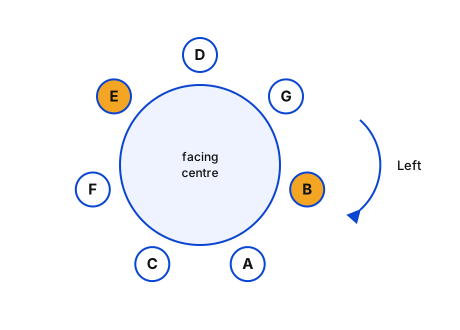
- Fix D. E is immediate right of D; A is third to the left of D.
- E is second to the left of C → C is two places to the right of E, i.e. opposite side next to A.
- Two people between G and C counted from G's left → G is immediate left of D.
- B neighbours A → B sits between G and A; F takes the last seat between C and E.
- From B going right: G, D, then E → 2 people between.
Trick: Draw the circle and mark left (clockwise) once with an arrow before placing anyone.
Answer: (C) 2
अवधारणा: केंद्र की ओर मुख होने पर 'बाएँ' = दक्षिणावर्त (clockwise), 'दाएँ' = वामावर्त।
- D को स्थिर करें। E, D के ठीक दाएँ; A, D के बाएँ तीसरे स्थान पर।
- E, C के बाएँ दूसरे स्थान पर → C, E से दाएँ दो स्थान पर, A के पास।
- G के बाएँ से गिनने पर G और C के बीच दो लोग → G, D के ठीक बाएँ।
- B, A का पड़ोसी → B, G और A के बीच; F, C और E के बीच।
- B के दाएँ से: G, D, फिर E → बीच में 2 लोग।
ट्रिक: पहले वृत्त बनाकर बाएँ (clockwise) दिशा का तीर लगा लें।
उत्तर: (C) 2
RRB NTPC Undergraduate CBT 1General Intelligence and ReasoningCircular Seating ArrangementRRB NTPC Undergraduate CBT 1 2024 · 19 Aug Shift 2
Q996.What will come in the place of the question mark (?) in the following equation, if ‘+’ and ‘÷’ are interchanged, and ‘−’ and ‘×’ are interchanged?
24 + 3 × 10 − 2 ÷ 41 = ?
यदि ‘+’ और ‘÷’ को आपस में बदल दिया जाए तथा ‘−’ और ‘×’ को आपस में बदल दिया जाए, तो निम्नलिखित समीकरण में प्रश्न चिह्न (?) के स्थान पर क्या आएगा?
24 + 3 × 10 − 2 ÷ 41 = ?
- A36
- B22
- C41
- D29
Show answer
Concept: Interchange the signs first, then solve using BODMAS.
- Swap + ↔ ÷ and − ↔ ×: .
- , .
- .
Trick: Rewrite the full expression with new signs before calculating – never swap in your head.
Answer: (D) 29
अवधारणा: पहले चिह्न बदलें, फिर BODMAS से हल करें।
- + ↔ ÷ और − ↔ × बदलकर: ।
- , ।
- ।
ट्रिक: नए चिह्नों के साथ पूरा व्यंजक दोबारा लिखें, फिर गणना करें।
उत्तर: (D) 29
RRB NTPC Undergraduate CBT 1General Intelligence and ReasoningMathematical OperationsRRB NTPC Undergraduate CBT 1 2024 · 19 Aug Shift 2
Q997.Based on the English alphabetical order, three of the following four letter-cluster pairs are alike in a certain way and thus form a group. Which letter-cluster pair DOES NOT belong to that group?
(Note: The odd one out is not based on the number of consonants/vowels or their position in the letter-cluster.)
अंग्रेज़ी वर्णमाला क्रम के आधार पर, निम्नलिखित चार अक्षर-समूह युग्मों में से तीन किसी निश्चित प्रकार से एक समान हैं और इस प्रकार एक समूह बनाते हैं। कौन-सा अक्षर-समूह युग्म उस समूह से संबंधित नहीं है?
(ध्यान दें: असंगत अक्षर-समूह, उस अक्षर-समूह में व्यंजनों/स्वरों की संख्या या उनके स्थान पर आधारित नहीं है।)
- ATQ−PM
- BZW−VS
- CNK−II
- DIF−EB
Show answer
Concept: Compare letter positions within and across each pair.
- TQ − PM: T(20) → Q(17) is ; P(16) → M(13) is .
- ZW − VS: , . IF − EB: , .
- NK − II: N(14) → K(11) is , but I(9) → I(9) is → breaks the pattern.
Trick: In each regular pair both clusters have a gap of 3, and the second cluster starts 4 letters before the first.
Answer: (C) NK − II
अवधारणा: हर युग्म के भीतर और बीच अक्षरों की स्थिति की तुलना करें।
- TQ − PM: (), ()।
- ZW − VS और IF − EB में भी , ।
- NK − II: () पर () → पैटर्न टूटता है।
ट्रिक: सही युग्मों में दोनों भागों का अंतर 3 है और दूसरा भाग पहले से 4 अक्षर पीछे शुरू होता है।
उत्तर: (C) NK − II
RRB NTPC Undergraduate CBT 1General Intelligence and ReasoningOdd One Out – Letter PairsRRB NTPC Undergraduate CBT 1 2024 · 19 Aug Shift 2
Q998.LEAV is related to SLHC in a certain way based on the English alphabetical order. In the same way, NGCX is related to UNJE. To which of the given options is IBXS related, following the same logic?
अंग्रेज़ी वर्णमाला क्रम के आधार पर LEAV एक निश्चित प्रकार से SLHC से संबंधित है। उसी प्रकार, NGCX, UNJE से संबंधित है। समान तर्क का अनुसरण करते हुए, IBXS दिए गए विकल्पों में से किससे संबंधित है?
- APIEZ
- BPZEW
- CPEZI
- DPIZE
Show answer
Concept: Find the shift for each letter from the example pairs.
- LEAV → SLHC: L + 7 = S, E + 7 = L, A + 7 = H, V + 7 = C.
- NGCX → UNJE also each.
- IBXS: I + 7 = P, B + 7 = I, X + 7 = E, S + 7 = Z → PIEZ.
Trick: Check only the first letter (I + 7 = P) and second (B + 7 = I) – option A alone starts with PI.
Answer: (A) PIEZ
अवधारणा: उदाहरण युग्मों से हर अक्षर का खिसकाव ज्ञात करें।
- LEAV → SLHC: हर अक्षर ।
- NGCX → UNJE भी ।
- IBXS: I + 7 = P, B + 7 = I, X + 7 = E, S + 7 = Z → PIEZ।
ट्रिक: केवल पहले दो अक्षर (PI) जाँचें – सिर्फ विकल्प A मेल खाता है।
उत्तर: (A) PIEZ
RRB NTPC Undergraduate CBT 1General Intelligence and ReasoningLetter AnalogyRRB NTPC Undergraduate CBT 1 2024 · 19 Aug Shift 2
Q999.In a certain code language,
A + B means ‘A is the brother of B’,
A @ B means ‘A is the wife of B’,
A ¥ B means ‘A is the son of B’ and
A ÷ B means ‘A is the father of B’.
How is D related to G if 'D ¥ O ÷ I + N @ G’?
एक निश्चित कूट भाषा में,
A + B का अर्थ है ‘A, B का भाई है’,
A @ B का अर्थ है ‘A, B की पत्नी है’,
A ¥ B का अर्थ है ‘A, B का पुत्र है’ और
A ÷ B का अर्थ है ‘A, B का पिता है’।
यदि 'D ¥ O ÷ I + N @ G' है, तो D का G से क्या संबंध है?
- AWife's brotherपत्नी का भाई
- BWife's brother's wifeपत्नी के भाई की पत्नी
- CWife's father's sisterपत्नी के पिता की बहन
- DWife's fatherपत्नी का पिता
Show answer
Concept: Decode each symbol one by one and build the family tree.
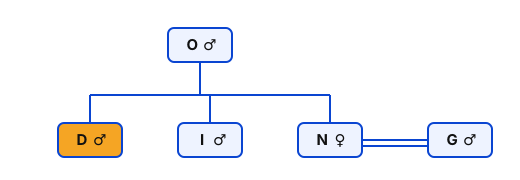
- D ¥ O: D is the son of O.
- O ÷ I: O is the father of I. I + N: I is the brother of N → N is also O's child.
- N @ G: N is the wife of G.
- D is a son of O, so D is N's brother; N is G's wife → D is G's wife's brother.
Trick: Read the chain from the person asked about (D) towards G and name each link.
Answer: (A) Wife's brother
अवधारणा: हर प्रतीक को एक-एक कर डिकोड करें और वंश वृक्ष बनाएँ।
- D ¥ O: D, O का पुत्र है।
- O ÷ I: O, I का पिता; I + N: I, N का भाई → N भी O की संतान।
- N @ G: N, G की पत्नी है।
- D, N का भाई है और N, G की पत्नी → D, G की पत्नी का भाई (साला) है।
ट्रिक: पूछे गए व्यक्ति (D) से G तक की कड़ी क्रम से पढ़ें।
उत्तर: (A) Wife's brother (पत्नी का भाई)
RRB NTPC Undergraduate CBT 1General Intelligence and ReasoningCoded Blood RelationsRRB NTPC Undergraduate CBT 1 2024 · 19 Aug Shift 2
Q1000.VALG is related to YYOE in a certain way based on the English alphabetical order. In the same way, BWRC is related to EUUA. To which of the given options is HSXY related, following the same logic?
अंग्रेज़ी वर्णमाला क्रम के आधार पर VALG एक निश्चित प्रकार से YYOE से संबंधित है। उसी प्रकार, BWRC, EUUA से संबंधित है। समान तर्क का अनुसरण करते हुए, HSXY दिए गए विकल्पों में से किससे संबंधित है?
- AKQAW
- BLQBW
- CLPZV
- DJRBU
Show answer
Concept: Find the shift of each letter position in the example pairs.
- VALG → YYOE: V + 3 = Y, A − 2 = Y, L + 3 = O, G − 2 = E.
- BWRC → EUUA: , , , ✔.
- HSXY: H + 3 = K, S − 2 = Q, X + 3 = A, Y − 2 = W → KQAW.
Trick: Alternating pattern ; wrap around Z → A when needed (X + 3 = A).
Answer: (A) KQAW
अवधारणा: उदाहरण युग्मों में हर अक्षर का खिसकाव ज्ञात करें।
- VALG → YYOE: , , , ।
- BWRC → EUUA में भी यही ✔।
- HSXY: K, Q, A, W → KQAW।
ट्रिक: एकांतर पैटर्न ; Z के बाद फिर A से गिनें (X + 3 = A)।
उत्तर: (A) KQAW
RRB NTPC Undergraduate CBT 1General Intelligence and ReasoningLetter AnalogyRRB NTPC Undergraduate CBT 1 2024 · 19 Aug Shift 2

