Q1021.Read the given statements and conclusions carefully. Assuming that the information given in the statements is true, even if it appears to be at variance with commonly known facts, decide which of the given conclusion(s) logically follow(s) from the statements.
Statements:
All mansions are flats.
All flats are buildings.
Conclusions:
(I) Some flats are mansions.
(II) All buildings are mansions.
दिए गए कथनों और निष्कर्षों को ध्यानपूर्वक पढ़िए। कथनों में दी गई जानकारी को सत्य मानते हुए, भले ही वह सामान्य रूप से ज्ञात तथ्यों से भिन्न प्रतीत होती हो, निर्णय लीजिए कि दिए गए निष्कर्षों में से कौन-सा/कौन-से निष्कर्ष कथनों का तार्किक रूप से अनुसरण करता है/करते हैं।
कथन:
सभी हवेलियाँ, फ़्लैट हैं।
सभी फ़्लैट, इमारतें हैं।
निष्कर्ष:
(I) कुछ फ़्लैट, हवेलियाँ हैं।
(II) सभी इमारतें, हवेलियाँ हैं।
- AOnly conclusion (I) follows.केवल निष्कर्ष (I) अनुसरण करता है।
- BNeither conclusion (I) nor (II) follows.न तो निष्कर्ष (I) और न ही (II) अनुसरण करता है।
- CBoth conclusions (I) and (II) follow.निष्कर्ष (I) और (II) दोनों अनुसरण करते हैं।
- DOnly conclusion (II) follows.केवल निष्कर्ष (II) अनुसरण करता है।
Show answer
Concept: Draw the possible Venn diagram; a conclusion follows only if it is true in every case.
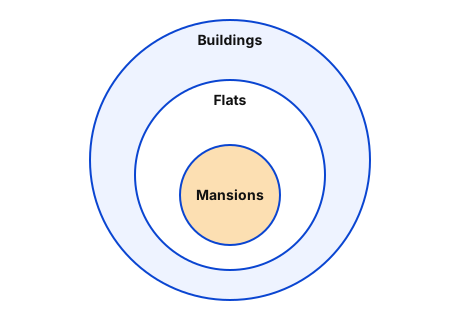
- All mansions are flats ⇒ mansions lie inside flats, so some flats are mansions – (I) follows.
- Buildings may contain much more than mansions, so "All buildings are mansions" is not certain – (II) fails.
Trick: "All A are B" always gives "Some B are A" (conversion).
Answer: (A) Only conclusion (I) follows.
अवधारणा: संभव वेन आरेख बनाएँ; निष्कर्ष तभी सही है जब हर स्थिति में सत्य हो।
- सभी हवेलियाँ (mansions) फ्लैट हैं ⇒ हवेलियाँ फ्लैट के अंदर, अतः कुछ फ्लैट हवेलियाँ हैं – (I) सही।
- इमारतें (buildings) हवेलियों से बहुत अधिक हो सकती हैं, अतः "सभी इमारतें हवेलियाँ हैं" निश्चित नहीं – (II) गलत।
याद रखें: "सभी A, B हैं" से हमेशा "कुछ B, A हैं" निकलता है।
उत्तर: (A) केवल निष्कर्ष (I) अनुसरण करता है।
RRB NTPC Undergraduate CBT 1General Intelligence and ReasoningSyllogismRRB NTPC Undergraduate CBT 1 2024 · 19 Aug Shift 1
Q1022.Which of the following letter-number clusters will replace the question mark (?) in the given series to make it logically complete?
EBF 11, JGK 17, OLP 23, TQU 29, ?
निम्नलिखित में से कौन-सा अक्षर-संख्या समूह दी गई श्रृंखला में प्रश्न चिह्न (?) के स्थान पर आकर उसे तार्किक रूप से पूर्ण करेगा?
EBF 11, JGK 17, OLP 23, TQU 29, ?
- AYUV 35
- BWUZ 35
- CYVZ 35
- DWVZ 24
Show answer
Concept: Check each letter position and the number separately.
- 1st letters: E, J, O, T → +5 → Y.
- 2nd letters: B, G, L, Q → +5 → V.
- 3rd letters: F, K, P, U → +5 → Z.
- Numbers: 11, 17, 23, 29 → +6 → 35.
Trick: All three letters move +5 together, so the answer must be Y?Z – only YVZ fits.
Answer: (C) YVZ 35
अवधारणा: प्रत्येक अक्षर-स्थान और संख्या को अलग से जाँचें।
- पहले अक्षर: E, J, O, T → +5 → Y।
- दूसरे अक्षर: B, G, L, Q → +5 → V।
- तीसरे अक्षर: F, K, P, U → +5 → Z।
- संख्याएँ: 11, 17, 23, 29 → +6 → 35।
ट्रिक: तीनों अक्षर +5 चलते हैं, अतः Y_Z वाला विकल्प – केवल YVZ।
उत्तर: (C) YVZ 35
RRB NTPC Undergraduate CBT 1General Intelligence and ReasoningLetter-Number SeriesRRB NTPC Undergraduate CBT 1 2024 · 19 Aug Shift 1
Q1023.What should come in place of the question mark (?) in the given series?
103, 1000, 9970, 99670, 996670, ?
दी गई श्रृंखला में प्रश्न चिह्न (?) के स्थान पर क्या आना चाहिए?
103, 1000, 9970, 99670, 996670, ?
- A9999670
- B9966667
- C9966670
- D9996670
Show answer
Concept: Each term = previous term × 10 − 30.
- ; .
- ; .
- Next .
Trick: Each step adds one more 6 before "70": 9970, 99670, 996670 → 9966670.
Answer: (C) 9966670
अवधारणा: प्रत्येक पद = पिछला पद × 10 − 30।
- ; ।
- ; ।
- अगला ।
ट्रिक: हर बार "70" से पहले एक 6 बढ़ता है: 996670 → 9966670।
उत्तर: (C) 9966670
RRB NTPC Undergraduate CBT 1General Intelligence and ReasoningNumber SeriesRRB NTPC Undergraduate CBT 1 2024 · 19 Aug Shift 1
Q1024.BGSN is related to XLOS in a certain way based on the English alphabetical order. In the same way, TQKX is related to PVGC. To which of the given options is LACH related, following the same logic?
अंग्रेज़ी वर्णमाला क्रम के आधार पर BGSN एक निश्चित प्रकार से XLOS से संबंधित है। उसी प्रकार TQKX, PVGC से संबंधित है। समान तर्क का अनुसरण करते हुए LACH दिए गए विकल्पों में से किससे संबंधित है?
- AGEZN
- BHFYM
- CFGXO
- DGFYL
Show answer
Concept: Find the shift of each letter position.
- BGSN → XLOS: B−4=X, G+5=L, S−4=O, N+5=S.
- TQKX → PVGC follows −4, +5, −4, +5 (X+5 wraps to C).
- LACH: L−4=H, A+5=F, C−4=Y, H+5=M → HFYM.
Trick: Pattern −4, +5, −4, +5; wrap around Z→A when needed.
Answer: (B) HFYM
अवधारणा: हर अक्षर-स्थान का खिसकाव (shift) ज्ञात करें।
- BGSN → XLOS: B−4=X, G+5=L, S−4=O, N+5=S।
- TQKX → PVGC भी −4, +5, −4, +5 (X+5 घूमकर C)।
- LACH: L−4=H, A+5=F, C−4=Y, H+5=M → HFYM।
ट्रिक: पैटर्न −4, +5, −4, +5; Z के बाद फिर A से गिनें।
उत्तर: (B) HFYM
RRB NTPC Undergraduate CBT 1General Intelligence and ReasoningLetter AnalogyRRB NTPC Undergraduate CBT 1 2024 · 19 Aug Shift 1
Q1025.What will come in the place of the question mark (?) in the following equation, if ‘+’ and ‘÷’ are interchanged and ‘−’ and ‘×’ are interchanged?
80 × 16 − 2 ÷ 12 + 4 = ?
यदि ‘+’ और ‘÷’ को आपस में बदल दिया जाए तथा ‘−’ और ‘×’ को आपस में बदल दिया जाए, तो निम्नलिखित समीकरण में प्रश्न चिह्न (?) के स्थान पर क्या आएगा?
80 × 16 − 2 ÷ 12 + 4 = ?
- A55
- B59
- C47
- D51
Show answer
Concept: Interchange the signs first, then apply BODMAS.
- After swapping: .
- .
Trick: Rewrite the whole expression with new signs before calculating – avoids sign errors.
Answer: (D) 51
अवधारणा: पहले चिह्न बदलें, फिर BODMAS लगाएँ।
- बदलने के बाद: ।
- ।
ट्रिक: गणना से पहले पूरा व्यंजक नए चिह्नों के साथ लिखें।
उत्तर: (D) 51
RRB NTPC Undergraduate CBT 1General Intelligence and ReasoningMathematical OperationsRRB NTPC Undergraduate CBT 1 2024 · 19 Aug Shift 1
Q1026.Each of the digits in the number 7312648 is arranged in the ascending order from left to right. What will be the sum of the digits that are second from the left and second from the right in the new number thus formed?
संख्या 7312648 के प्रत्येक अंक को बाएँ से दाएँ आरोही क्रम में व्यवस्थित किया जाता है। इस प्रकार बनी नई संख्या में बाएँ से दूसरे और दाएँ से दूसरे अंकों का योग क्या होगा?
- A11
- B5
- C7
- D9
Show answer
Concept: Arrange the digits in ascending order and read the required positions.
- 7312648 → 1234678.
- 2nd from left = 2; 2nd from right = 7.
- Sum .
Trick: In ascending order, 2nd from left = 2nd smallest, 2nd from right = 2nd largest digit.
Answer: (D) 9
अवधारणा: अंकों को आरोही क्रम में लगाकर आवश्यक स्थान पढ़ें।
- 7312648 → 1234678।
- बाएँ से दूसरा = 2; दाएँ से दूसरा = 7।
- योग ।
ट्रिक: आरोही क्रम में बाएँ से दूसरा = दूसरा सबसे छोटा, दाएँ से दूसरा = दूसरा सबसे बड़ा अंक।
उत्तर: (D) 9
RRB NTPC Undergraduate CBT 1General Intelligence and ReasoningDigit ArrangementRRB NTPC Undergraduate CBT 1 2024 · 19 Aug Shift 1
Q1027.Read the given statements and conclusions carefully. Assuming that the information given in the statements is true, even if it appears to be at variance with commonly known facts, decide which of the given conclusion(s) logically follow(s) from the statements.
Statements: All crows are sparrows. No crow is a pigeon.
Conclusions (I): No sparrow is a pigeon.
Conclusions (II): Some pigeons are crows.
दिए गए कथनों और निष्कर्षों को ध्यानपूर्वक पढ़िए। कथनों में दी गई जानकारी को सत्य मानते हुए, भले ही वह सामान्य रूप से ज्ञात तथ्यों से भिन्न प्रतीत होती हो, निर्णय लीजिए कि दिए गए निष्कर्षों में से कौन-सा/कौन-से निष्कर्ष कथनों का तार्किक रूप से अनुसरण करता है/करते हैं।
कथन: सभी कौवे, गौरैया हैं। कोई कौवा, कबूतर नहीं है।
निष्कर्ष (I): कोई गौरैया, कबूतर नहीं है।
निष्कर्ष (II): कुछ कबूतर, कौवे हैं।
- ANeither conclusion (I) nor (II) follows.न तो निष्कर्ष (I) और न ही (II) अनुसरण करता है।
- BOnly conclusion (II) follows.केवल निष्कर्ष (II) अनुसरण करता है।
- CBoth conclusions (I) and (II) follow.निष्कर्ष (I) और (II) दोनों अनुसरण करते हैं।
- DOnly conclusion (I) follows.केवल निष्कर्ष (I) अनुसरण करता है।
Show answer
Concept: Draw the Venn diagram; test each conclusion against all possible cases.
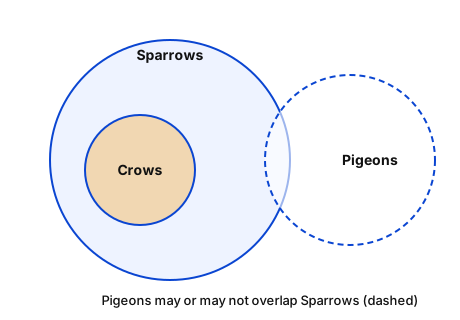
- Crows lie inside sparrows; pigeons are outside crows but may overlap the rest of sparrows.
- (I) "No sparrow is a pigeon" – not certain (overlap possible).
- (II) "Some pigeons are crows" – contradicts "No crow is a pigeon".
Trick: A "No" statement can never give a "Some" conclusion between the same two terms.
Answer: (A) Neither conclusion (I) nor (II) follows.
अवधारणा: वेन आरेख बनाएँ; हर संभव स्थिति में निष्कर्ष जाँचें।
- कौवे (crows) गौरैया (sparrows) के अंदर; कबूतर (pigeons) कौवों से बाहर, पर शेष गौरैया से मिल सकते हैं।
- (I) "कोई गौरैया कबूतर नहीं" – निश्चित नहीं।
- (II) "कुछ कबूतर कौवे हैं" – "कोई कौवा कबूतर नहीं" के विपरीत।
याद रखें: "कोई नहीं" वाले कथन से उन्हीं दो पदों के बीच "कुछ" निष्कर्ष कभी नहीं निकलता।
उत्तर: (A) न तो (I) और न ही (II) अनुसरण करता है।
RRB NTPC Undergraduate CBT 1General Intelligence and ReasoningSyllogismRRB NTPC Undergraduate CBT 1 2024 · 19 Aug Shift 1
Q1028.Town Q is to the south of Town R. Town S is to the east of Town R. Town T is to the north of Town S. Town U is to the east of Town T. Town V is to the north-east of Town U. What is the position of Town V with respect to Town Q?
नगर Q, नगर R के दक्षिण में है। नगर S, नगर R के पूर्व में है। नगर T, नगर S के उत्तर में है। नगर U, नगर T के पूर्व में है। नगर V, नगर U के उत्तर-पूर्व में है। नगर Q के सापेक्ष नगर V की स्थिति क्या है?
- ASouth-westदक्षिण-पश्चिम
- BNorth-eastउत्तर-पूर्व
- CSouth-eastदक्षिण-पूर्व
- DSouthदक्षिण
Show answer
Concept: Place the towns step by step on a grid with North up.
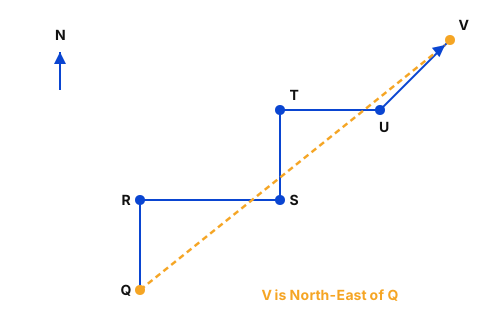
- Take R as origin; Q is below R; S is right of R.
- T is above S, U right of T, V up-right of U.
- V lies both to the east and to the north of Q, so V is North-East of Q.
Trick: Net movement from Q: eastward (S, U, V) and northward (R, T, V) ⇒ North-East.
Answer: (B) North-east
अवधारणा: उत्तर को ऊपर रखकर कस्बों को क्रम से ग्रिड पर रखें।
- R मूल बिंदु; Q, R के नीचे (दक्षिण); S, R के दाएँ (पूर्व)।
- T, S के उत्तर, U, T के पूर्व, V, U के उत्तर-पूर्व।
- V, Q से पूर्व और उत्तर दोनों ओर है, अतः उत्तर-पूर्व।
ट्रिक: Q से कुल चाल: पूर्व की ओर और उत्तर की ओर ⇒ उत्तर-पूर्व।
उत्तर: (B) उत्तर-पूर्व (North-east)
RRB NTPC Undergraduate CBT 1General Intelligence and ReasoningDirection SenseRRB NTPC Undergraduate CBT 1 2024 · 19 Aug Shift 1
Q1029.Seven people A, B, C, D, E, F and G are sitting in a row, facing the north. Only three people sit to the left of D. B sits third to the left of D. F sits to the right of A but left of D. E sits to the right of C but left of G. How many people sit to the right of F?
सात व्यक्ति A, B, C, D, E, F और G उत्तर की ओर मुख करके एक पंक्ति में बैठे हैं। D के बाईं ओर केवल तीन व्यक्ति बैठे हैं। B, D के बाईं ओर तीसरे स्थान पर बैठा है। F, A के दाईं ओर लेकिन D के बाईं ओर बैठा है। E, C के दाईं ओर लेकिन G के बाईं ओर बैठा है। F के दाईं ओर कितने व्यक्ति बैठे हैं?
- AFiveपाँच
- BThreeतीन
- CFourचार
- DTwoदो
Show answer
Concept: Fix the definite positions first, then place the others.
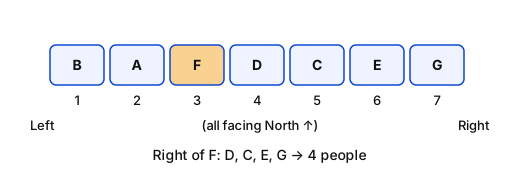
- Three people left of D ⇒ D at 4th; B third to left of D ⇒ B at 1st.
- F right of A and left of D ⇒ A 2nd, F 3rd.
- C, E, G in 5–7 with C < E < G ⇒ C 5th, E 6th, G 7th.
- Right of F: D, C, E, G = 4 people.
Trick: People to the right of position in a row of 7 .
Answer: (C) Four
अवधारणा: पहले निश्चित स्थान तय करें, फिर बाकी लोगों को रखें।
- D के बाएँ तीन लोग ⇒ D चौथे; B, D के तीसरे बाएँ ⇒ B पहले।
- F, A के दाएँ और D के बाएँ ⇒ A दूसरे, F तीसरे।
- C, E, G स्थान 5–7 में क्रम से ⇒ C 5, E 6, G 7।
- F के दाएँ: D, C, E, G = 4 लोग।
ट्रिक: 7 की पंक्ति में स्थान के दाएँ लोग।
उत्तर: (C) चार
RRB NTPC Undergraduate CBT 1General Intelligence and ReasoningLinear Seating ArrangementRRB NTPC Undergraduate CBT 1 2024 · 19 Aug Shift 1
Q1030.What should come in place of the question mark (?) in the given series?
10, 30, 90, 270, ?, 2430
दी गई श्रृंखला में प्रश्न चिह्न (?) के स्थान पर क्या आना चाहिए?
10, 30, 90, 270, ?, 2430
- A1080
- B540
- C810
- D720
Show answer
Concept: Each term is 3 times the previous term.
- , , .
- ; check ✓.
Trick: Verify with the term after the blank: .
Answer: (C) 810
अवधारणा: प्रत्येक पद पिछले पद का 3 गुना है।
- , , ।
- ; जाँच ✓।
ट्रिक: रिक्त के बाद वाले पद से जाँचें: ।
उत्तर: (C) 810
RRB NTPC Undergraduate CBT 1General Intelligence and ReasoningNumber SeriesRRB NTPC Undergraduate CBT 1 2024 · 19 Aug Shift 1
Q1031.Refer to the following number and symbol series and answer the question that follows. Counting to be done from left to right only.
(Left) € 5 & % 2 7 5 & % 7 8 @ 9 5 $ & # $ @ 2 9 © (Right)
How many such symbols are there each of which is immediately preceded by a number and also immediately followed by a symbol?
निम्नलिखित संख्या और प्रतीक श्रृंखला को देखिए और उसके बाद दिए गए प्रश्न का उत्तर दीजिए। गिनती केवल बाएँ से दाएँ की जानी है।
(बाएँ) € 5 & % 2 7 5 & % 7 8 @ 9 5 $ & # $ @ 2 9 © (दाएँ)
ऐसे कितने प्रतीक हैं जिनमें से प्रत्येक के ठीक पहले एक संख्या है और ठीक बाद भी एक प्रतीक है?
- A2
- B5
- C3
- D4
Show answer
Concept: Look for the pattern Number – Symbol – Symbol, with the middle symbol counted.
- 5 & % → & counts.
- 5 & % (second time) → & counts.
- 5 $ & → $ counts.
- 8 @ 9 fails (followed by a number); © is last (nothing follows).
Trick: Scan only symbols with a digit just before them, then check the next element.
Answer: (C) 3
अवधारणा: पैटर्न संख्या – प्रतीक – प्रतीक खोजें; बीच वाला प्रतीक गिनें।
- 5 & % → & गिना।
- 5 & % (दूसरी बार) → & गिना।
- 5 $ & → $ गिना।
- 8 @ 9 नहीं (बाद में संख्या); © अंतिम है।
ट्रिक: केवल उन प्रतीकों को देखें जिनके ठीक पहले अंक हो, फिर अगला तत्व जाँचें।
उत्तर: (C) 3
RRB NTPC Undergraduate CBT 1General Intelligence and ReasoningSymbol-Number SeriesRRB NTPC Undergraduate CBT 1 2024 · 19 Aug Shift 1
Q1032.Select the pair that follows the same pattern as that followed by the two pairs given below. Both pairs follow the same pattern.
WUP : YYS
OPU : QTX
उस युग्म का चयन कीजिए जो उसी पैटर्न का अनुसरण करता है जिसका अनुसरण नीचे दिए गए दो युग्म करते हैं। दोनों युग्म समान पैटर्न का अनुसरण करते हैं।
WUP : YYS
OPU : QTX
- APUX : RYZ
- BRUV : TYZ
- CXQO : ZTS
- DUQQ : WUT
Show answer
Concept: Find the letter-wise shift in the given pairs.
- WUP → YYS: +2, +4, +3; OPU → QTX: +2, +4, +3.
- UQQ → WUT: U+2=W, Q+4=U, Q+3=T ✓.
- Others fail, e.g. PUX → RYZ: X+3 = A, not Z.
Trick: Check the third letter first (+3) – it quickly rules out options.
Answer: (D) UQQ : WUT
अवधारणा: दिए गए युग्मों में हर अक्षर का खिसकाव (shift) निकालें।
- WUP → YYS: +2, +4, +3; OPU → QTX: +2, +4, +3।
- UQQ → WUT: U+2=W, Q+4=U, Q+3=T ✓।
- अन्य गलत, जैसे PUX → RYZ: X+3 = A, Z नहीं।
ट्रिक: पहले तीसरा अक्षर (+3) जाँचें – विकल्प तुरंत हटते हैं।
उत्तर: (D) UQQ : WUT
RRB NTPC Undergraduate CBT 1General Intelligence and ReasoningLetter Pair AnalogyRRB NTPC Undergraduate CBT 1 2024 · 19 Aug Shift 1
Q1033.In a row of 46 people facing the north, Lalita sits 17th from the left end. If only 15 people sit to the right of Damini, then how many people sit between Damini and Lalita?
उत्तर की ओर मुख करके बैठे 46 व्यक्तियों की एक पंक्ति में, ललिता बाएँ छोर से 17वें स्थान पर बैठी है। यदि दामिनी के दाईं ओर केवल 15 व्यक्ति बैठे हैं, तो दामिनी और ललिता के बीच कितने व्यक्ति बैठे हैं?
- A15
- B13
- C16
- D17
Show answer
Concept: Convert both positions to the same end (left).
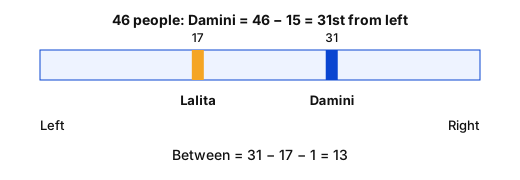
- 15 people right of Damini ⇒ Damini is st from left.
- Lalita is 17th from left.
- Between them .
Trick: People between two positions from the same end difference .
Answer: (B) 13
अवधारणा: दोनों स्थानों को एक ही छोर (बाएँ) से बदलें।
- दामिनी के दाएँ 15 लोग ⇒ दामिनी बाएँ से वें।
- ललिता बाएँ से 17वें।
- बीच में ।
ट्रिक: एक ही छोर से दो स्थानों के बीच लोग अंतर ।
उत्तर: (B) 13
RRB NTPC Undergraduate CBT 1General Intelligence and ReasoningRanking and PositionRRB NTPC Undergraduate CBT 1 2024 · 19 Aug Shift 1
Q1034.Select the set in which the numbers are related in the same way as are the numbers of the following sets.
(NOTE: Operations should be performed on the whole numbers, without breaking down the numbers into their constituent digits. E.g. 13 – Operations on 13 such as adding to/subtracting from/multiplying with 13 can be performed. Breaking down 13 into 1 and 3 and then performing mathematical operations on 1 and 3 is not allowed.)
(32, 497, 23)
(20, −19, 1)
उस समुच्चय का चयन कीजिए जिसमें संख्याएँ उसी प्रकार संबंधित हैं जिस प्रकार निम्नलिखित समुच्चयों की संख्याएँ संबंधित हैं।
(ध्यान दें: संक्रियाएँ संख्याओं को उनके घटक अंकों में विभाजित किए बिना, पूर्ण संख्याओं पर की जानी चाहिए। उदाहरण के लिए, 13 – 13 पर की जाने वाली संक्रियाएँ, जैसे 13 में जोड़ना/13 में से घटाना/13 से गुणा करना आदि की जा सकती हैं। 13 को 1 और 3 में विभाजित करके फिर 1 और 3 पर गणितीय संक्रियाएँ करने की अनुमति नहीं है।)
(32, 497, 23)
(20, −19, 1)
- A(18, −17, 2)
- B(21, 40, 8)
- C(3, 3, 3)
- D(3, 222, 15)
Show answer
Concept: Relate the middle number to the outer numbers.
- : .
- : .
- Rule: middle third first. : ✓.
Trick: A negative middle number hints at subtraction; check (A): .
Answer: (D) (3, 222, 15)
अवधारणा: बीच की संख्या को बाहरी संख्याओं से जोड़ें।
- : ।
- : ।
- नियम: बीच तीसरी पहली। : ✓।
ट्रिक: बीच में ऋणात्मक संख्या घटाव का संकेत देती है; (A) जाँचें: ।
उत्तर: (D) (3, 222, 15)
RRB NTPC Undergraduate CBT 1General Intelligence and ReasoningNumber Set AnalogyRRB NTPC Undergraduate CBT 1 2024 · 19 Aug Shift 1
Q1035.Shruti starts from point A and runs 2 km west. She then takes a left turn and runs 1 km. She takes a left turn again and runs 7 km. She then takes a final left turn and runs 1 km to reach a point B. How far (shortest distance) and towards which direction should she run in order to reach point A again? (All turns are 90 degrees turns only unless specified.)
श्रुति बिंदु A से चलना प्रारंभ करती है और 2 km पश्चिम की ओर दौड़ती है। फिर वह बाएँ मुड़ती है और 1 km दौड़ती है। वह फिर से बाएँ मुड़ती है और 7 km दौड़ती है। फिर वह अंतिम बार बाएँ मुड़ती है और 1 km दौड़कर बिंदु B पर पहुँचती है। पुनः बिंदु A पर पहुँचने के लिए उसे कितनी दूर (न्यूनतम दूरी) और किस दिशा में दौड़ना चाहिए? (जब तक निर्दिष्ट न किया जाए, सभी मोड़ केवल 90 डिग्री के मोड़ हैं।)
- A5 km west5 km पश्चिम
- B2 km west2 km पश्चिम
- C5 km east5 km पूर्व
- D7 km east7 km पूर्व
Show answer
Concept: Track the facing direction after each left turn and add the displacements.
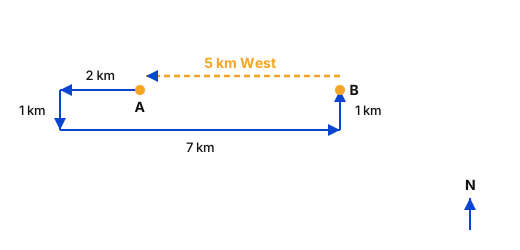
- West 2 km; left (South) 1 km; left (East) 7 km; left (North) 1 km.
- North–south: . East–west: km east.
- B is 5 km east of A, so she must run 5 km west.
Trick: Three left turns: W → S → E → N. The two 1 km legs cancel.
Answer: (A) 5 km west
अवधारणा: हर बाएँ मोड़ के बाद दिशा देखें और विस्थापन जोड़ें।
- पश्चिम 2 km; बाएँ (दक्षिण) 1 km; बाएँ (पूर्व) 7 km; बाएँ (उत्तर) 1 km।
- उत्तर–दक्षिण: । पूर्व–पश्चिम: km पूर्व।
- B, A से 5 km पूर्व है, अतः उसे 5 km पश्चिम दौड़ना होगा।
ट्रिक: तीन बाएँ मोड़: W → S → E → N। दोनों 1 km वाले भाग कट जाते हैं।
उत्तर: (A) 5 km पश्चिम
RRB NTPC Undergraduate CBT 1General Intelligence and ReasoningDirection and DistanceRRB NTPC Undergraduate CBT 1 2024 · 19 Aug Shift 1
Q1036.AWER is related to HDLY in a certain way based on the English alphabetical order. In the same way, CYGT is related to JFNA. To which of the given options is XTBO related, following the same logic?
अंग्रेज़ी वर्णमाला क्रम के आधार पर AWER एक निश्चित प्रकार से HDLY से संबंधित है। उसी प्रकार CYGT, JFNA से संबंधित है। समान तर्क का अनुसरण करते हुए XTBO दिए गए विकल्पों में से किससे संबंधित है?
- AEVIA
- BEAIV
- CEAVI
- DEVAI
Show answer
Concept: Find the shift for each letter.
- AWER → HDLY: every letter +7 (W+7 wraps to D).
- CYGT → JFNA: again +7.
- XTBO: X+7=E, T+7=A, B+7=I, O+7=V → EAIV.
Trick: +7 with wrap-around: after Z continue from A.
Answer: (B) EAIV
अवधारणा: हर अक्षर का खिसकाव (shift) निकालें।
- AWER → HDLY: हर अक्षर +7 (W+7 घूमकर D)।
- CYGT → JFNA: फिर +7।
- XTBO: X+7=E, T+7=A, B+7=I, O+7=V → EAIV।
ट्रिक: +7, Z के बाद फिर A से गिनें।
उत्तर: (B) EAIV
RRB NTPC Undergraduate CBT 1General Intelligence and ReasoningLetter AnalogyRRB NTPC Undergraduate CBT 1 2024 · 19 Aug Shift 1
Q1037.Which of the following letter-number clusters will replace the question mark (?) in the given series to make it logically complete?
WIX 15 TKV 12 QMT 9 NOR 6 ?
निम्नलिखित में से कौन-सा अक्षर-संख्या समूह दी गई श्रृंखला में प्रश्न चिह्न (?) के स्थान पर आकर उसे तार्किक रूप से पूर्ण करेगा?
WIX 15 TKV 12 QMT 9 NOR 6 ?
- AKGS 1
- BQKJ 4
- CKQP 3
- DPKG 2
Show answer
Concept: Check each letter position and the number separately.
- 1st letters: W, T, Q, N → −3 → K.
- 2nd letters: I, K, M, O → +2 → Q.
- 3rd letters: X, V, T, R → −2 → P.
- Numbers: 15, 12, 9, 6 → −3 → 3.
Trick: Only one option starts with K and ends with 3.
Answer: (C) KQP 3
अवधारणा: प्रत्येक अक्षर-स्थान और संख्या को अलग से जाँचें।
- पहले अक्षर: W, T, Q, N → −3 → K।
- दूसरे अक्षर: I, K, M, O → +2 → Q।
- तीसरे अक्षर: X, V, T, R → −2 → P।
- संख्याएँ: 15, 12, 9, 6 → −3 → 3।
ट्रिक: संख्या −3 से 3; केवल KQP 3 फिट।
उत्तर: (C) KQP 3
RRB NTPC Undergraduate CBT 1General Intelligence and ReasoningLetter-Number SeriesRRB NTPC Undergraduate CBT 1 2024 · 19 Aug Shift 1
Q1038.Based on the English alphabetical order, three of the following four letter-clusters are alike in a certain way and thus form a group. Which letter-cluster DOES NOT belong to that group?
(Note: The odd one out is not based on the number of consonants/vowels or their position in the letter-cluster.)
अंग्रेज़ी वर्णमाला क्रम के आधार पर, निम्नलिखित चार अक्षर-समूहों में से तीन किसी निश्चित प्रकार से एकसमान हैं और इस प्रकार एक समूह बनाते हैं। कौन-सा अक्षर-समूह उस समूह से संबंधित नहीं है?
(ध्यान दें: असंगत अक्षर-समूह, उस अक्षर-समूह में व्यंजनों/स्वरों की संख्या या उनकी स्थिति पर आधारित नहीं है।)
- ANRM
- BRVQ
- CLPJ
- DUYT
Show answer
Concept: Check the gaps between consecutive letters.
- NRM: +4, −5; RVQ: +4, −5; UYT: +4, −5.
- LPJ: +4, −6 → different.
Trick: Pattern: 3rd letter is just before the 1st letter (N→M, R→Q, U→T) – L→J breaks it.
Answer: (C) LPJ
अवधारणा: लगातार अक्षरों के बीच अंतर जाँचें।
- NRM: +4, −5; RVQ: +4, −5; UYT: +4, −5।
- LPJ: +4, −6 → भिन्न।
ट्रिक: तीसरा अक्षर पहले अक्षर से ठीक पहले वाला है (N→M, R→Q, U→T) – L→J अलग।
उत्तर: (C) LPJ
RRB NTPC Undergraduate CBT 1General Intelligence and ReasoningOdd One Out – LettersRRB NTPC Undergraduate CBT 1 2024 · 19 Aug Shift 1
Q1039.If 1 is subtracted from each even digit of the number 36719542, find the sum of the digits that are repeated more than once in the new number formed.
यदि संख्या 36719542 के प्रत्येक सम अंक में से 1 घटा दिया जाए, तो इस प्रकार बनी नई संख्या में एक से अधिक बार आने वाले अंकों का योग ज्ञात कीजिए।
- A4
- B6
- C8
- D9
Show answer
Concept: Change only even digits, then find repeated digits.
- 36719542: even digits 6, 4, 2 → 5, 3, 1.
- New number: 35719531.
- Repeated digits: 3, 5, 1 (each twice). Sum .
Trick: Add each repeated digit once, not every occurrence.
Answer: (D) 9
अवधारणा: केवल सम अंक बदलें, फिर दोहराए गए अंक खोजें।
- 36719542: सम अंक 6, 4, 2 → 5, 3, 1।
- नई संख्या: 35719531।
- दोहराए अंक: 3, 5, 1 (दो-दो बार)। योग ।
ट्रिक: दोहराए गए अंक को एक ही बार जोड़ें।
उत्तर: (D) 9
RRB NTPC Undergraduate CBT 1General Intelligence and ReasoningNumber OperationsRRB NTPC Undergraduate CBT 1 2024 · 19 Aug Shift 1
Q1040.Based on the English alphabetical order, three of the following four letter-clusters are alike in a certain way and thus form a group. Which letter-cluster DOES NOT belong to that group?
(Note: The odd one out is not based on the number of consonants/vowels or their position in the letter-cluster.)
अंग्रेज़ी वर्णमाला क्रम के आधार पर, निम्नलिखित चार अक्षर-समूहों में से तीन किसी निश्चित प्रकार से एकसमान हैं और इस प्रकार एक समूह बनाते हैं। कौन-सा अक्षर-समूह उस समूह से संबंधित नहीं है?
(ध्यान दें: असंगत अक्षर-समूह, उस अक्षर-समूह में व्यंजनों/स्वरों की संख्या या उनकी स्थिति पर आधारित नहीं है।)
- AAGB
- BIOK
- CEKF
- DCID
Show answer
Concept: Check the gaps between consecutive letters.
- AGB: +6, −5; EKF: +6, −5; CID: +6, −5.
- IOK: +6, −4 → different.
Trick: In the group the 3rd letter is next to the 1st (A→B, E→F, C→D); I→K breaks it.
Answer: (B) IOK
अवधारणा: लगातार अक्षरों के बीच अंतर जाँचें।
- AGB: +6, −5; EKF: +6, −5; CID: +6, −5।
- IOK: +6, −4 → भिन्न।
ट्रिक: तीसरा अक्षर पहले का अगला है (A→B, E→F, C→D); I→K अलग।
उत्तर: (B) IOK
RRB NTPC Undergraduate CBT 1General Intelligence and ReasoningOdd One Out – LettersRRB NTPC Undergraduate CBT 1 2024 · 19 Aug Shift 1

