Q1041.If 1 is added to each even digit and 2 is subtracted from each odd digit in the number 6274385, which of the following digits will be third from the right in the new number thus formed?
यदि संख्या 6274385 में प्रत्येक सम अंक में 1 जोड़ दिया जाए और प्रत्येक विषम अंक में से 2 घटा दिया जाए, तो इस प्रकार बनी नई संख्या में दाएँ से तीसरा अंक निम्नलिखित में से कौन-सा होगा?
- A3
- B9
- C5
- D1
Show answer
Concept: Apply +1 to even digits and −2 to odd digits, digit by digit.
- 6274385 → 6+1, 2+1, 7−2, 4+1, 3−2, 8+1, 5−2.
- New number: 7355193.
- Third from right: 1.
Trick: Only the third-from-right digit is needed: original digit 3 (odd) → .
Answer: (D) 1
अवधारणा: सम अंकों में +1 और विषम अंकों में −2 करें।
- 6274385 → 6+1, 2+1, 7−2, 4+1, 3−2, 8+1, 5−2।
- नई संख्या: 7355193।
- दाएँ से तीसरा: 1।
ट्रिक: केवल दाएँ से तीसरा अंक चाहिए: मूल अंक 3 (विषम) → ।
उत्तर: (D) 1
RRB NTPC Undergraduate CBT 1General Intelligence and ReasoningNumber OperationsRRB NTPC Undergraduate CBT 1 2024 · 19 Aug Shift 1
Q1042.In a certain code language, ‘LACE’ is coded as ‘5689’ and ‘LEAK’ is coded as ‘5786’. What is the code for ‘K’ in that language?
एक निश्चित कूट भाषा में, ‘LACE’ को ‘5689’ के रूप में कूटबद्ध किया जाता है और ‘LEAK’ को ‘5786’ के रूप में कूटबद्ध किया जाता है। उस भाषा में ‘K’ के लिए कूट क्या है?
- A6
- B5
- C7
- D8
Show answer
Concept: Common letters take the common digits (positions are jumbled).
- LACE = {5, 6, 8, 9}; LEAK = {5, 7, 8, 6}.
- Common letters L, A, E ↔ common digits 5, 6, 8.
- So C = 9 and K = 7.
Trick: The letter present in only one word takes the digit present in only that code.
Answer: (C) 7
अवधारणा: समान अक्षरों को समान अंक मिलते हैं (क्रम बदला हुआ)।
- LACE = {5, 6, 8, 9}; LEAK = {5, 7, 8, 6}।
- समान अक्षर L, A, E ↔ समान अंक 5, 6, 8।
- अतः C = 9 और K = 7।
ट्रिक: जो अक्षर केवल एक शब्द में है, उसे वही अंक मिलेगा जो केवल उसी कोड में है।
उत्तर: (C) 7
RRB NTPC Undergraduate CBT 1General Intelligence and ReasoningCoding-DecodingRRB NTPC Undergraduate CBT 1 2024 · 19 Aug Shift 1
Q1043.In a row of people all facing North, Nima is 17th from the left end. Dina is 27th from the left end. Dina is exactly between Nima and Uma. If Uma is 13th from the right end of the line, how many people are there in the row?
उत्तर की ओर मुख किए हुए व्यक्तियों की एक पंक्ति में, नीमा बाएँ छोर से 17वें स्थान पर है। दीना बाएँ छोर से 27वें स्थान पर है। दीना, नीमा और उमा के ठीक बीच में है। यदि उमा पंक्ति के दाएँ छोर से 13वें स्थान पर है, तो पंक्ति में कितने व्यक्ति हैं?
- A49
- B47
- C48
- D50
Show answer
Concept: Dina is midway, so Uma is as far beyond Dina as Nima is before her.
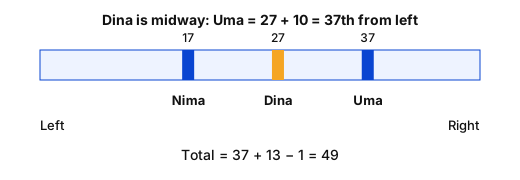
- Nima 17th, Dina 27th from left ⇒ gap 10.
- Uma th from left.
- Uma is 13th from right ⇒ total .
Trick: Total = position from left + position from right − 1.
Answer: (A) 49
अवधारणा: दीना बीच में है, अतः उमा दीना से उतनी ही आगे है जितनी नीमा पीछे।
- नीमा 17वें, दीना 27वें (बाएँ से) ⇒ अंतर 10।
- उमा वें बाएँ से।
- उमा दाएँ से 13वें ⇒ कुल ।
ट्रिक: कुल = बाएँ से स्थान + दाएँ से स्थान − 1।
उत्तर: (A) 49
RRB NTPC Undergraduate CBT 1General Intelligence and ReasoningRanking and PositionRRB NTPC Undergraduate CBT 1 2024 · 19 Aug Shift 1
Q1044.Refer to the following number and symbol series and answer the question that follows. Counting to be done from left to right only.
(Left) 9 @ # 8 £ 4 & $ 7 2 * 5 Ω % 6 1 % & 3 (Right)
How many such symbols are there, each of which is immediately preceded by a number and also immediately followed by another number?
निम्नलिखित संख्या और प्रतीक श्रृंखला को देखिए और उसके बाद दिए गए प्रश्न का उत्तर दीजिए। गिनती केवल बाएँ से दाएँ की जानी है।
(बाएँ) 9 @ # 8 £ 4 & $ 7 2 * 5 Ω % 6 1 % & 3 (दाएँ)
ऐसे कितने प्रतीक हैं जिनमें से प्रत्येक के ठीक पहले एक संख्या है और ठीक बाद भी एक अन्य संख्या है?
- AMore than twoदो से अधिक
- BOneएक
- CTwoदो
- DNoneएक भी नहीं
Show answer
Concept: Find the pattern Number – Symbol – Number.
- 8 £ 4 → £ counts.
- 2 * 5 → * counts.
- Others fail: 9 @ #, 4 & $, 5 Ω %, 1 % &.
Trick: Look only at symbols standing alone between two digits.
Answer: (C) Two
अवधारणा: पैटर्न संख्या – प्रतीक – संख्या खोजें।
- 8 £ 4 → £ गिना।
- 2 * 5 → * गिना।
- अन्य नहीं: 9 @ #, 4 & $, 5 Ω %, 1 % &।
ट्रिक: केवल वे प्रतीक देखें जो दो अंकों के बीच अकेले हों।
उत्तर: (C) दो
RRB NTPC Undergraduate CBT 1General Intelligence and ReasoningSymbol-Number SeriesRRB NTPC Undergraduate CBT 1 2024 · 19 Aug Shift 1
Q1045.In a certain code language, ‘DUAL’ is coded as ‘4629’ and ‘ARCS’ is coded as ‘1435’. What is the code for ‘A’ in the given code language?
एक निश्चित कूट भाषा में, ‘DUAL’ को ‘4629’ के रूप में कूटबद्ध किया जाता है और ‘ARCS’ को ‘1435’ के रूप में कूटबद्ध किया जाता है। दी गई कूट भाषा में ‘A’ के लिए कूट क्या है?
- A1
- B4
- C2
- D5
Show answer
Concept: The only common letter takes the only common digit.
- DUAL and ARCS share only the letter A.
- 4629 and 1435 share only the digit 4.
- So A = 4.
Trick: One common letter ↔ one common digit.
Answer: (B) 4
अवधारणा: एकमात्र समान अक्षर को एकमात्र समान अंक मिलता है।
- DUAL और ARCS में केवल A समान है।
- 4629 और 1435 में केवल 4 समान है।
- अतः A = 4।
ट्रिक: एक समान अक्षर ↔ एक समान अंक।
उत्तर: (B) 4
RRB NTPC Undergraduate CBT 1General Intelligence and ReasoningCoding-DecodingRRB NTPC Undergraduate CBT 1 2024 · 19 Aug Shift 1
Q1046.Based on the English alphabetical order, three of the following four letter-clusters are alike in a certain way and thus form a group. Which letter-cluster DOES NOT belong to that group?
(Note: The odd one out is not based on the number of consonants/vowels or their position in the letter-cluster.)
अंग्रेज़ी वर्णमाला क्रम के आधार पर, निम्नलिखित चार अक्षर-समूहों में से तीन किसी निश्चित प्रकार से एकसमान हैं और इस प्रकार एक समूह बनाते हैं। कौन-सा अक्षर-समूह उस समूह से संबंधित नहीं है?
(ध्यान दें: असंगत अक्षर-समूह, उस अक्षर-समूह में व्यंजनों/स्वरों की संख्या या उनकी स्थिति पर आधारित नहीं है।)
- AXRY
- BTNV
- CRLT
- DVPX
Show answer
Concept: Check the gaps between consecutive letters.
- TNV: −6, +8; RLT: −6, +8; VPX: −6, +8.
- XRY: −6, +7 → different.
Trick: In the group the 3rd letter is two ahead of the 1st (T→V, R→T, V→X); X→Y breaks it.
Answer: (A) XRY
अवधारणा: लगातार अक्षरों के बीच अंतर जाँचें।
- TNV: −6, +8; RLT: −6, +8; VPX: −6, +8।
- XRY: −6, +7 → भिन्न।
ट्रिक: तीसरा अक्षर पहले से दो आगे है (T→V, R→T, V→X); X→Y अलग।
उत्तर: (A) XRY
RRB NTPC Undergraduate CBT 1General Intelligence and ReasoningOdd One Out – LettersRRB NTPC Undergraduate CBT 1 2024 · 19 Aug Shift 1
Q1047.In a row of 42 people facing north, Soma is 17th from the right end. If Amit sits 9th to the left of Soma, what is Amit’s position from the left end of the line?
उत्तर की ओर मुख करके बैठे 42 व्यक्तियों की एक पंक्ति में, सोमा दाएँ छोर से 17वें स्थान पर है। यदि अमित, सोमा के बाईं ओर 9वें स्थान पर बैठा है, तो पंक्ति के बाएँ छोर से अमित का स्थान क्या है?
- A19th19वाँ
- B17th17वाँ
- C16th16वाँ
- D18th18वाँ
Show answer
Concept: Convert position from right to position from left.
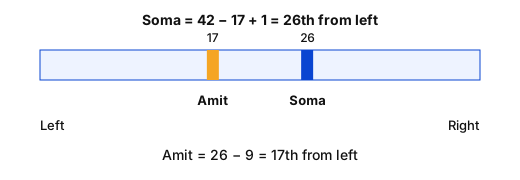
- Soma from left th.
- Amit is 9th to the left ⇒ th from left.
Trick: Left position = Total − Right position + 1.
Answer: (B) 17th
अवधारणा: दाएँ से स्थान को बाएँ से स्थान में बदलें।
- सोमा बाएँ से वें।
- अमित 9 स्थान बाएँ ⇒ वें बाएँ से।
ट्रिक: बाएँ से स्थान = कुल − दाएँ से स्थान + 1।
उत्तर: (B) 17वाँ
RRB NTPC Undergraduate CBT 1General Intelligence and ReasoningRanking and PositionRRB NTPC Undergraduate CBT 1 2024 · 19 Aug Shift 1
Q1048.Seven people, I, J, K, L, M, N and O, are sitting in a row, facing north. Only three people sit to the left of M. Only I sits to the right of O. Only three people sit between O and N. J sits at some place to the left of K but at some place to the right of L. How many people sit between L and K?
सात व्यक्ति I, J, K, L, M, N और O उत्तर की ओर मुख करके एक पंक्ति में बैठे हैं। M के बाईं ओर केवल तीन व्यक्ति बैठे हैं। O के दाईं ओर केवल I बैठा है। O और N के बीच केवल तीन व्यक्ति बैठे हैं। J, K के बाईं ओर कहीं बैठा है लेकिन L के दाईं ओर कहीं बैठा है। L और K के बीच कितने व्यक्ति बैठे हैं?
- AThreeतीन
- BTwoदो
- COneएक
- DFourचार
Show answer
Concept: Fix definite positions first.
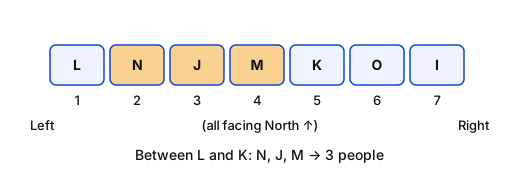
- Three to the left of M ⇒ M 4th.
- Only I right of O ⇒ O 6th, I 7th.
- Three between O and N ⇒ N 2nd.
- L, J, K in 1, 3, 5 with L < J < K ⇒ L 1st, J 3rd, K 5th. Between L and K: N, J, M = 3.
Trick: Persons between positions 1 and 5 .
Answer: (A) Three
अवधारणा: पहले निश्चित स्थान तय करें।
- M के बाएँ तीन लोग ⇒ M चौथे।
- O के दाएँ केवल I ⇒ O 6, I 7।
- O और N के बीच तीन ⇒ N 2।
- L, J, K स्थान 1, 3, 5 में (L, J, K क्रम) ⇒ L 1, J 3, K 5। L और K के बीच: N, J, M = 3।
ट्रिक: स्थान 1 और 5 के बीच लोग।
उत्तर: (A) तीन
RRB NTPC Undergraduate CBT 1General Intelligence and ReasoningLinear Seating ArrangementRRB NTPC Undergraduate CBT 1 2024 · 19 Aug Shift 1
Q1049.A is the brother of H. H is the mother of R. R is the son of M. G is the mother of M. How is A related to M?
A, H का भाई है। H, R की माता है। R, M का पुत्र है। G, M की माता है। A का M से क्या संबंध है?
- ASon's sonपुत्र का पुत्र
- BWife's brotherपत्नी का भाई
- CSon's wife's brotherपुत्र की पत्नी का भाई
- DSon's wife's fatherपुत्र की पत्नी का पिता
Show answer
Concept: Draw the family tree from the given statements.
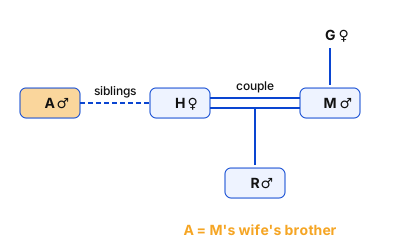
- H is the mother of R, and R is the son of M ⇒ M is R's father, H's husband.
- A is H's brother ⇒ A is M's wife's brother (brother-in-law).
- G (M's mother) is extra information.
Trick: Mother of the child + other parent ⇒ couple; link through the wife.
Answer: (B) Wife's brother
अवधारणा: दिए गए कथनों से वंश-वृक्ष (family tree) बनाएँ।
- H, R की माँ है और R, M का पुत्र है ⇒ M, R का पिता और H का पति।
- A, H का भाई ⇒ A, M की पत्नी का भाई (साला)।
- G (M की माँ) अतिरिक्त जानकारी है।
ट्रिक: बच्चे की माँ + दूसरा अभिभावक ⇒ पति-पत्नी; पत्नी के माध्यम से संबंध जोड़ें।
उत्तर: (B) पत्नी का भाई (Wife's brother)
RRB NTPC Undergraduate CBT 1General Intelligence and ReasoningBlood RelationsRRB NTPC Undergraduate CBT 1 2024 · 19 Aug Shift 1
Q1050.What should come in place of the question mark (?) in the given series?
318 263 213 168 128 ?
दी गई श्रृंखला में प्रश्न चिह्न (?) के स्थान पर क्या आना चाहिए?
318 263 213 168 128 ?
- A106
- B65
- C93
- D79
Show answer
Concept: Look at the differences between consecutive terms.
- , , , .
- Differences fall by 5 ⇒ next difference 35.
- .
Trick: Differences 55, 50, 45, 40, 35 – an arithmetic pattern.
Answer: (C) 93
अवधारणा: लगातार पदों के बीच अंतर देखें।
- , , , ।
- अंतर 5-5 घटते हैं ⇒ अगला अंतर 35।
- ।
ट्रिक: अंतर 55, 50, 45, 40, 35 – समांतर पैटर्न।
उत्तर: (C) 93
RRB NTPC Undergraduate CBT 1General Intelligence and ReasoningNumber SeriesRRB NTPC Undergraduate CBT 1 2024 · 19 Aug Shift 1
Q1051.Select the pair that follows the same pattern as that followed by the two pairs given below. Both pairs follow the same pattern.
CSL : FPG
KGX : NDS
उस युग्म का चयन कीजिए जो उसी पैटर्न का अनुसरण करता है जिसका अनुसरण नीचे दिए गए दो युग्मों द्वारा किया जाता है। दोनों युग्म एक ही पैटर्न का अनुसरण करते हैं।
CSL : FPG
KGX : NDS
- AMMX : PQS
- BDJF : GGA
- CJKY : MMT
- DNGN : QJJ
Show answer
Concept: Find the position change of each letter.
- CSL → FPG: C+3=F, S−3=P, L−5=G.
- KGX → NDS: K+3=N, G−3=D, X−5=S.
- DJF: D+3=G, J−3=G, F−5=A → GGA ✓.
Trick: Check only the first letter (+3) to drop options, then verify the rest.
Answer: (B) DJF : GGA
अवधारणा: हर अक्षर का स्थान परिवर्तन देखें।
- CSL → FPG: +3, −3, −5।
- KGX → NDS: +3, −3, −5।
- DJF: G, G, A → GGA ✓।
ट्रिक: पहले केवल पहला अक्षर (+3) जाँचें, फिर बाकी।
उत्तर: (B) DJF : GGA
RRB NTPC Undergraduate CBT 1General Intelligence and ReasoningLetter AnalogyRRB NTPC Undergraduate CBT 1 2024 · 18 Aug Shift 3
Q1052.KHIG is related to HEFD in a certain way based on the English alphabetical order. In the same way, DABZ is related to AXYW. To which of the given options is BYZX related, following the same logic?
अंग्रेज़ी वर्णमाला क्रम के आधार पर KHIG एक निश्चित प्रकार से HEFD से संबंधित है। उसी प्रकार DABZ, AXYW से संबंधित है। समान तर्क का अनुसरण करते हुए, BYZX दिए गए विकल्पों में से किससे संबंधित है?
- AYVVU
- BYWVD
- CYVWU
- DYUVU
Show answer
Concept: Each letter moves back by 3.
- KHIG → HEFD: each −3.
- DABZ → AXYW: each −3 (A−3=X wraps around).
- BYZX → B−3=Y, Y−3=V, Z−3=W, X−3=U → YVWU.
Trick: Backward wrap: A−3 = X, B−3 = Y.
Answer: (C) YVWU
अवधारणा: हर अक्षर 3 पीछे जाता है।
- KHIG → HEFD: −3।
- DABZ → AXYW: −3।
- BYZX → YVWU।
ट्रिक: पीछे घूमना: A−3 = X, B−3 = Y।
उत्तर: (C) YVWU
RRB NTPC Undergraduate CBT 1General Intelligence and ReasoningLetter AnalogyRRB NTPC Undergraduate CBT 1 2024 · 18 Aug Shift 3
Q1053.Based on the English alphabetical order, three of the following four letter-clusters are alike in a certain way and thus form a group. Which letter-cluster DOES NOT belong to that group?
(Note: The odd one out is not based on the number of consonants/vowels or their position in the letter-cluster.)
अंग्रेज़ी वर्णमाला क्रम के आधार पर, निम्नलिखित चार अक्षर-समूहों में से तीन किसी निश्चित प्रकार से एकसमान हैं और इस प्रकार एक समूह बनाते हैं। कौन-सा अक्षर-समूह उस समूह से संबंधित नहीं है?
(ध्यान दें: असंगत अक्षर-समूह, उस अक्षर-समूह में व्यंजनों/स्वरों की संख्या या उनके स्थान पर आधारित नहीं है।)
- ALID
- BROK
- CMJF
- DFCY
Show answer
Concept: Find the gaps between consecutive letters (positions).
- ROK: 18, 15, 11 → −3, −4.
- MJF: 13, 10, 6 → −3, −4.
- FCY: 6, 3, 25 → −3, −4 (C−4 wraps to Y).
- LID: 12, 9, 4 → −3, −5 ✗.
Trick: Remember wrap-around: C − 4 = Y.
Answer: (A) LID
अवधारणा: अक्षरों के बीच अंतर देखें।
- ROK: −3, −4।
- MJF: −3, −4।
- FCY: −3, −4 (C−4 = Y)।
- LID: −3, −5 ✗।
ट्रिक: चक्र में घूमना याद रखें: C − 4 = Y।
उत्तर: (A) LID
RRB NTPC Undergraduate CBT 1General Intelligence and ReasoningOdd One Out – LettersRRB NTPC Undergraduate CBT 1 2024 · 18 Aug Shift 3
Q1054.Seven boxes T, U, V, W, X, Y and D are kept one over the other but not necessarily in the same order. Only two boxes are kept below W. Only one box is kept above Y. Only one box is kept between Y and U. T is kept immediately above X. D is kept at some place below V. How many boxes are kept between V and T?
सात डिब्बे T, U, V, W, X, Y और D एक के ऊपर एक रखे गए हैं, लेकिन आवश्यक नहीं कि इसी क्रम में हों। W के नीचे केवल दो डिब्बे रखे गए हैं। Y के ऊपर केवल एक डिब्बा रखा गया है। Y और U के बीच केवल एक डिब्बा रखा गया है। T, X के ठीक ऊपर रखा गया है। D, V के नीचे किसी स्थान पर रखा गया है। V और T के बीच कितने डिब्बे रखे गए हैं?
- ATwoदो
- BOneएक
- CFourचार
- DThreeतीन
Show answer
Concept: Number positions 1 (bottom) to 7 (top) and fix definite clues first.
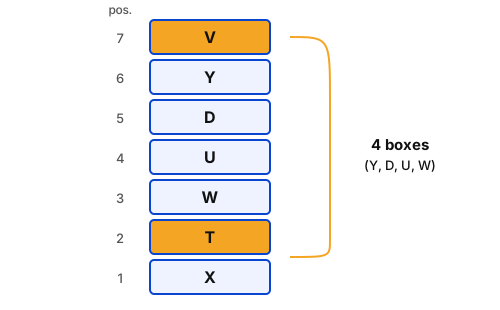
- Two boxes below W → W = 3. One box above Y → Y = 6.
- One box between Y and U → U = 4.
- T immediately above X: only free pair is X = 1, T = 2.
- D below V → D = 5, V = 7. Between V (7) and T (2): Y, D, U, W = 4.
Trick: Fixed-count clues (“only two below”) give exact positions – place them first.
Answer: (C) Four
अवधारणा: स्थान 1 (नीचे) से 7 (ऊपर) तक लें, पहले निश्चित संकेत लगाएँ।
- W के नीचे दो → W = 3; Y के ऊपर एक → Y = 6।
- Y और U के बीच एक → U = 4।
- T, X के ठीक ऊपर → X = 1, T = 2।
- D, V के नीचे → D = 5, V = 7। V और T के बीच: Y, D, U, W = 4।
ट्रिक: “केवल दो नीचे” जैसे संकेत सीधा स्थान देते हैं।
उत्तर: (C) चार
RRB NTPC Undergraduate CBT 1General Intelligence and ReasoningVertical ArrangementRRB NTPC Undergraduate CBT 1 2024 · 18 Aug Shift 3
Q1055.What should come in place of the question mark (?) in the given series?
61 60 56 47 31 ?
दी गई श्रृंखला में प्रश्न चिह्न (?) के स्थान पर क्या आना चाहिए?
61 60 56 47 31 ?
- A6
- B14
- C28
- D9
Show answer
Concept: Differences are perfect squares.
- .
- Next: .
Trick: Subtracted terms .
Answer: (A) 6
अवधारणा: अंतर पूर्ण वर्ग हैं।
- ।
- अगला: ।
ट्रिक: घटाए गए पद
उत्तर: (A) 6
RRB NTPC Undergraduate CBT 1General Intelligence and ReasoningNumber SeriesRRB NTPC Undergraduate CBT 1 2024 · 18 Aug Shift 3
Q1056.In a certain code language, ‘keep your goal’ is coded as ‘yt ru kj’ and ‘mind your business’ is coded as ‘kj gb mi’. How is ‘your’ coded in the given language?
एक निश्चित कूट भाषा में, ‘keep your goal’ को ‘yt ru kj’ के रूप में कूटबद्ध किया जाता है और ‘mind your business’ को ‘kj gb mi’ के रूप में कूटबद्ध किया जाता है। दी गई भाषा में ‘your’ को किस प्रकार कूटबद्ध किया जाता है?
- Akj
- Bmi
- Cru
- Dyt
Show answer
Concept: A word common to two sentences has the code common to both.
- ‘your’ is common to ‘keep your goal’ and ‘mind your business’.
- Common code in ‘yt ru kj’ and ‘kj gb mi’ is ‘kj’.
Trick: Common word ↔ common code.
Answer: (A) kj
अवधारणा: दोनों वाक्यों में समान शब्द का कोड भी समान होता है।
- ‘your’ दोनों वाक्यों में है।
- दोनों कोड में समान ‘kj’ है।
ट्रिक: समान शब्द ↔ समान कोड।
उत्तर: (A) kj
RRB NTPC Undergraduate CBT 1General Intelligence and ReasoningCoding-DecodingRRB NTPC Undergraduate CBT 1 2024 · 18 Aug Shift 3
Q1057.This question is based on five, four-digit numbers given below.
(Left) 1338 2325 3627 5513 1764 (Right)
(Example: 6975 – First digit = 6, second digit = 9, third digit = 7 and fourth digit = 5) (NOTE: All operations to be done from left to right.)
If all the digits in each number are reversed, then what will be the resultant if the second digit of the second largest number is multiplied to the second digit of the smallest number?
यह प्रश्न नीचे दी गई चार अंकों वाली पाँच संख्याओं पर आधारित है।
(बाएँ) 1338 2325 3627 5513 1764 (दाएँ)
(उदाहरण: 6975 – पहला अंक = 6, दूसरा अंक = 9, तीसरा अंक = 7 और चौथा अंक = 5) (ध्यान दें: सभी संक्रियाएँ बाएँ से दाएँ की जानी हैं।)
यदि प्रत्येक संख्या के सभी अंकों को उलट दिया जाए, तो दूसरी सबसे बड़ी संख्या के दूसरे अंक को सबसे छोटी संख्या के दूसरे अंक से गुणा करने पर परिणाम क्या होगा?
- A3
- B2
- C1
- D4
Show answer
Concept: Reverse each number, arrange, then pick the asked digits.
- Reversed: 8331, 5232, 7263, 3155, 4671.
- Ascending: 3155 < 4671 < 5232 < 7263 < 8331.
- Second largest 7263 → second digit 2; smallest 3155 → second digit 1.
- .
Trick: Order changes after reversal – re-sort before choosing.
Answer: (B) 2
अवधारणा: संख्याओं को उलटें, क्रम में रखें, फिर अंक चुनें।
- उलटी: 8331, 5232, 7263, 3155, 4671।
- आरोही: 3155, 4671, 5232, 7263, 8331।
- दूसरी सबसे बड़ी 7263 → दूसरा अंक 2; सबसे छोटी 3155 → 1।
- ।
ट्रिक: उलटने के बाद क्रम बदल जाता है।
उत्तर: (B) 2
RRB NTPC Undergraduate CBT 1General Intelligence and ReasoningNumber OperationsRRB NTPC Undergraduate CBT 1 2024 · 18 Aug Shift 3
Q1058.Read the given statements and conclusions carefully. Assuming that the information given in the statements is true, even if it appears to be at variance with commonly known facts, decide which of the given conclusion(s) logically follow(s) from the statements.
Statements: All pencils are erasers. Some erasers are crayons.
Conclusions (I): Some pencils are crayons.
Conclusions (II): Some erasers are pencils.
दिए गए कथनों और निष्कर्षों को ध्यानपूर्वक पढ़िए। कथनों में दी गई जानकारी को सत्य मानते हुए, भले ही वह सामान्यतः ज्ञात तथ्यों से भिन्न प्रतीत होती हो, निर्णय लीजिए कि दिए गए निष्कर्षों में से कौन-सा/कौन-से निष्कर्ष कथनों का तार्किक रूप से अनुसरण करता है/करते हैं।
कथन: सभी पेंसिलें, रबड़ हैं। कुछ रबड़, क्रेयॉन हैं।
निष्कर्ष (I): कुछ पेंसिलें, क्रेयॉन हैं।
निष्कर्ष (II): कुछ रबड़, पेंसिलें हैं।
- AOnly conclusion (II) follows.केवल निष्कर्ष (II) अनुसरण करता है।
- BBoth conclusions (I) and (II) follow.निष्कर्ष (I) और (II) दोनों अनुसरण करते हैं।
- COnly conclusion (I) follows.केवल निष्कर्ष (I) अनुसरण करता है।
- DNeither conclusion (I) nor (II) follows.न तो निष्कर्ष (I) और न ही (II) अनुसरण करता है।
Show answer
Concept: Draw the minimum possible Venn diagram.
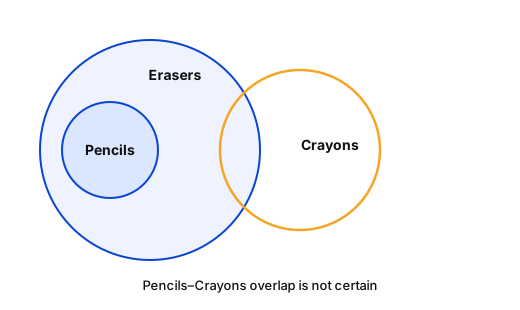
- All pencils are erasers → Pencils circle lies inside Erasers.
- Some erasers are crayons: Crayons may touch Erasers away from Pencils → I (Some pencils are crayons) is not certain.
- Since all pencils are erasers, some erasers are pencils → II follows.
Trick: “All A are B” always gives “Some B are A”.
Answer: (A) Only conclusion (II) follows.
अवधारणा: न्यूनतम वेन आरेख बनाएँ।
- सभी पेंसिल इरेज़र हैं → Pencils, Erasers के अंदर।
- कुछ इरेज़र क्रेयॉन हैं: क्रेयॉन पेंसिल से अलग भाग में हो सकते हैं → I निश्चित नहीं।
- सभी पेंसिल इरेज़र हैं → कुछ इरेज़र पेंसिल हैं → II सही।
ट्रिक: “सभी A, B हैं” से “कुछ B, A हैं” हमेशा निकलता है।
उत्तर: (A) केवल निष्कर्ष (II) अनुसरण करता है।
RRB NTPC Undergraduate CBT 1General Intelligence and ReasoningSyllogismRRB NTPC Undergraduate CBT 1 2024 · 18 Aug Shift 3
Q1059.Select the pair that follows the same pattern as that followed by the two set of pairs given below. Both pairs follow the same pattern.
ITM : LSO
SSV : VRX
उस युग्म का चयन कीजिए जो उसी पैटर्न का अनुसरण करता है जिसका अनुसरण नीचे दिए गए युग्मों के दो समूहों द्वारा किया जाता है। दोनों युग्म एक ही पैटर्न का अनुसरण करते हैं।
ITM : LSO
SSV : VRX
- ASUK : VTL
- BTNN : WMP
- CWQJ : ZRL
- DFTF : ISI
Show answer
Concept: Find the shift of each letter.
- ITM → LSO: +3, −1, +2.
- SSV → VRX: +3, −1, +2.
- TNN → T+3=W, N−1=M, N+2=P → WMP ✓.
Trick: Check the middle letter (−1) first – it eliminates most options.
Answer: (B) TNN : WMP
अवधारणा: हर अक्षर का परिवर्तन देखें।
- ITM → LSO: +3, −1, +2।
- SSV → VRX: +3, −1, +2।
- TNN → WMP ✓।
ट्रिक: पहले बीच का अक्षर (−1) जाँचें।
उत्तर: (B) TNN : WMP
RRB NTPC Undergraduate CBT 1General Intelligence and ReasoningLetter AnalogyRRB NTPC Undergraduate CBT 1 2024 · 18 Aug Shift 3
Q1060.Sheghal ranked 33rd from the top and 18th from the bottom in his class. How many students are there in his class?
शेघल अपनी कक्षा में ऊपर से 33वें और नीचे से 18वें स्थान पर है। उसकी कक्षा में कितने विद्यार्थी हैं?
- A50
- B53
- C51
- D52
Show answer
Concept: Total = rank from top + rank from bottom − 1.
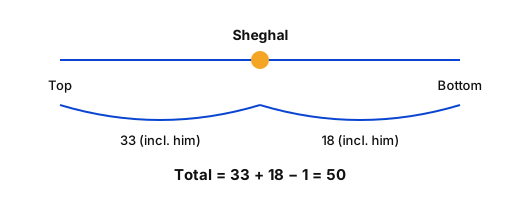
- .
Trick: Subtract 1 because the person is counted in both ranks.
Answer: (A) 50
अवधारणा: कुल = ऊपर से रैंक + नीचे से रैंक − 1।
- ।
ट्रिक: व्यक्ति दोनों ओर गिना जाता है, इसलिए 1 घटाएँ।
उत्तर: (A) 50
RRB NTPC Undergraduate CBT 1General Intelligence and ReasoningRankingRRB NTPC Undergraduate CBT 1 2024 · 18 Aug Shift 3

