Q1101.Based on the English alphabetical order, three of the following four letter-clusters are alike in a certain way and thus form a group. Which letter-cluster does NOT belong to that group? (Note: The odd letter-cluster is not based on the number of consonants/vowels or their position in the letter-cluster.)
अंग्रेज़ी वर्णमाला क्रम के आधार पर, निम्नलिखित चार अक्षर-समूहों में से तीन किसी निश्चित प्रकार से एकसमान हैं और इस प्रकार एक समूह बनाते हैं। कौन-सा अक्षर-समूह उस समूह से संबंधित नहीं है? (ध्यान दें: असंगत अक्षर-समूह, उस अक्षर-समूह में व्यंजनों/स्वरों की संख्या या उनके स्थान पर आधारित नहीं है।)
- ABZX
- BHFD
- CTRP
- DYOU
Show answer
Concept: Check the step between consecutive letters.
- BZX: B−2=Z (wrap), Z−2=X.
- HFD and TRP: .
- YOU: Y−10=O, O+6=U – odd one.
Trick: Pattern ; YOU only looks like a word.
Answer: (D) YOU
अवधारणा: क्रमागत अक्षरों का अंतर देखें।
- BZX: B−2=Z (A के बाद Z), Z−2=X।
- HFD और TRP: ।
- YOU: Y−10=O, O+6=U – विषम।
ट्रिक: पैटर्न ; YOU केवल अर्थपूर्ण शब्द जैसा दिखता है।
उत्तर: (D) YOU
RRB NTPC Undergraduate CBT 1General Intelligence and ReasoningOdd letter clusterRRB NTPC Undergraduate CBT 1 2024 · 18 Aug Shift 2
Q1102.Based on the English alphabetical order, what should come in place of the question mark (?) in the given series?
VOR TMP RKN PIL ?
अंग्रेज़ी वर्णमाला क्रम के आधार पर, दी गई श्रृंखला में प्रश्न चिह्न (?) के स्थान पर क्या आना चाहिए?
VOR TMP RKN PIL ?
- ANHJ
- BNGJ
- CNGI
- DNHI
Show answer
Concept: Track each letter position separately.
- 1st: V, T, R, P → N ().
- 2nd: O, M, K, I → G ().
- 3rd: R, P, N, L → J ().
Trick: Every position moves back by 2.
Answer: (B) NGJ
अवधारणा: हर स्थान के अक्षर अलग-अलग देखें।
- पहला: V, T, R, P → N ()।
- दूसरा: O, M, K, I → G ()।
- तीसरा: R, P, N, L → J ()।
ट्रिक: हर स्थान 2 पीछे जाता है।
उत्तर: (B) NGJ
RRB NTPC Undergraduate CBT 1General Intelligence and ReasoningLetter seriesRRB NTPC Undergraduate CBT 1 2024 · 18 Aug Shift 2
Q1103.Select the number from among the given options that can replace the question mark (?) in the following series.
174 152 134 120 110 ?
दिए गए विकल्पों में से उस संख्या का चयन कीजिए जो निम्नलिखित श्रृंखला में प्रश्न चिह्न (?) को प्रतिस्थापित कर सकती है।
174 152 134 120 110 ?
- A90
- B94
- C104
- D100
Show answer
Concept: Look at the differences.
- Differences: (shrinking by ).
- Next difference : .
Trick: Differences form an AP with step .
Answer: (C)
अवधारणा: अंतर देखें।
- अंतर: (हर बार कम)।
- अगला अंतर : ।
ट्रिक: अंतर के चरण वाली समांतर श्रेणी में हैं।
उत्तर: (C)
RRB NTPC Undergraduate CBT 1General Intelligence and ReasoningNumber seriesRRB NTPC Undergraduate CBT 1 2024 · 18 Aug Shift 2
Q1104.What should come in place of the question mark (?) in the given series?
93 108 131 162 201 ?
दी गई श्रृंखला में प्रश्न चिह्न (?) के स्थान पर क्या आना चाहिए?
93 108 131 162 201 ?
- A235
- B241
- C228
- D248
Show answer
Concept: Look at the differences.
- Differences: (increase by ).
- Next difference : .
Trick: Second differences constant ().
Answer: (D)
अवधारणा: अंतर देखें।
- अंतर: (हर बार अधिक)।
- अगला अंतर : ।
ट्रिक: दूसरे क्रम के अंतर स्थिर ()।
उत्तर: (D)
RRB NTPC Undergraduate CBT 1General Intelligence and ReasoningNumber seriesRRB NTPC Undergraduate CBT 1 2024 · 18 Aug Shift 2
Q1105.Seven boxes A, B, C, D, K, L and O are kept one above the other but not necessarily in the same order. Only four boxes are kept between B and D. Only C is kept above B. Only two boxes are kept between L and O. A is kept immediately above K. O is not kept immediately above A.
Which box is kept fourth from the top?
सात बक्से A, B, C, D, K, L और O एक के ऊपर एक रखे गए हैं, लेकिन जरूरी नहीं कि इसी क्रम में हों। B और D के बीच केवल चार बक्से रखे गए हैं। केवल C को B के ऊपर रखा गया है। L और O के बीच केवल दो बक्से रखे गए हैं। A को K के ठीक ऊपर रखा गया है। O को A के ठीक ऊपर नहीं रखा गया है।
ऊपर से चौथे स्थान पर कौन-सा बक्सा रखा गया है?
- AC
- BA
- CD
- DL
Show answer
Concept: Place the boxes with fixed positions first.
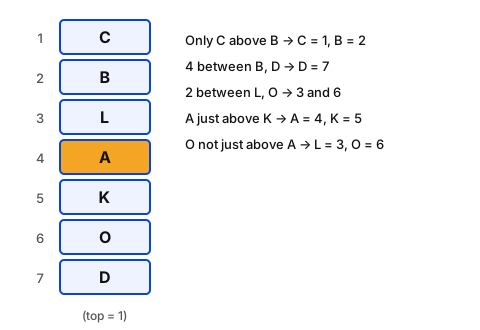
- Only C above B ⇒ C = 1st, B = 2nd.
- Four boxes between B and D ⇒ D = 7th.
- L and O with two between must take 3rd and 6th; A, K (A just above K) take 4th, 5th.
- O not just above A ⇒ O ≠ 3rd ⇒ L = 3rd, O = 6th. 4th from top = A.
Trick: Gaps like "four between" in a 7-stack almost fix the position at once.
Answer: (B) A
अवधारणा: पहले निश्चित स्थान वाले बॉक्स रखें।
- केवल C, B के ऊपर ⇒ C = 1, B = 2।
- B और D के बीच चार ⇒ D = 7।
- L और O (बीच में दो) – स्थान 3 और 6; A, K (A ठीक K के ऊपर) – स्थान 4, 5।
- O ठीक A के ऊपर नहीं ⇒ O ≠ 3 ⇒ L = 3, O = 6। ऊपर से चौथा = A।
ट्रिक: 7 के ढेर में "बीच में चार" जैसा अंतर स्थान लगभग तुरंत तय कर देता है।
उत्तर: (B) A
RRB NTPC Undergraduate CBT 1General Intelligence and ReasoningBox arrangementRRB NTPC Undergraduate CBT 1 2024 · 18 Aug Shift 2
Q1106.In a certain code language,
A + B means 'A is the son of B',
A – B means 'A is the sister of B',
A x B means 'A is the wife of B' and
A ÷ B means 'A is the father of B'.
If 'Q ÷ E + R – C x D', then how is Q related to D?
एक निश्चित कूट भाषा में,
A + B का अर्थ है 'A, B का पुत्र है',
A – B का अर्थ है 'A, B की बहन है',
A x B का अर्थ है 'A, B की पत्नी है' और
A ÷ B का अर्थ है 'A, B का पिता है'।
यदि 'Q ÷ E + R – C x D' है, तो Q का D से क्या संबंध है?
- ASonपुत्र
- BWife's sister's husbandपत्नी की बहन का पति
- CSister's husbandबहन का पति
- DHusbandपति
Show answer
Concept: Decode each symbol and draw the family tree.
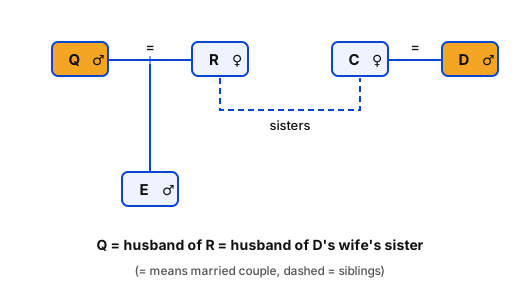
- Q ÷ E: Q is the father of E. E + R: E is the son of R ⇒ R is the mother, so Q is R's husband.
- R – C: R is the sister of C. C × D: C is the wife of D.
- So Q is the husband of the sister of D's wife.
Trick: R must be female (sister), so Q and R are E's parents.
Answer: (B) Wife's sister's husband
अवधारणा: हर चिह्न का अर्थ निकालकर परिवार-वृक्ष बनाएँ।
- Q ÷ E: Q, E का पिता। E + R: E, R का पुत्र ⇒ R माँ, अतः Q, R का पति।
- R – C: R, C की बहन। C × D: C, D की पत्नी।
- अतः Q, D की पत्नी की बहन का पति है।
ट्रिक: R बहन है (स्त्री), अतः Q और R, E के माता-पिता हैं।
उत्तर: (B) पत्नी की बहन का पति
RRB NTPC Undergraduate CBT 1General Intelligence and ReasoningBlood relations (coded)RRB NTPC Undergraduate CBT 1 2024 · 18 Aug Shift 2
Q1107.Navjot is 15th from the bottom and 19th from the top in his class. How many students are there in his class?
नवजोत अपनी कक्षा में नीचे से 15वें और ऊपर से 19वें स्थान पर है। उसकी कक्षा में कितने विद्यार्थी हैं?
- A31
- B33
- C32
- D34
Show answer
Concept: Total rank from top rank from bottom .
- .
Trick: Subtract because the person is counted twice.
Answer: (B)
अवधारणा: कुल ऊपर से स्थान नीचे से स्थान ।
- ।
ट्रिक: घटाएँ क्योंकि वह व्यक्ति दो बार गिना गया।
उत्तर: (B)
RRB NTPC Undergraduate CBT 1General Intelligence and ReasoningRankingRRB NTPC Undergraduate CBT 1 2024 · 18 Aug Shift 2
Q1108.Select the set in which the numbers are related in the same way as are the numbers of the following sets.
(NOTE: Operations should be performed on the whole numbers, without breaking down the numbers into their constituent digits. E.g. 13 – Operations on 13 such as adding /subtracting /multiplying etc. to 13 can be performed. Breaking down 13 into 1 and 3 and then performing mathematical operations on 1 and 3 is not allowed.)
(92, 6, 552)
(98, 5, 490)
उस समुच्चय का चयन कीजिए जिसमें संख्याएँ उसी प्रकार संबंधित हैं जिस प्रकार निम्नलिखित समुच्चयों की संख्याएँ संबंधित हैं।
(ध्यान दें: संख्याओं को उनके घटक अंकों में तोड़े बिना, पूर्ण संख्याओं पर संक्रियाएँ की जानी चाहिए। उदाहरण के लिए 13 – 13 पर संक्रियाएँ जैसे 13 में जोड़ना/घटाना/गुणा करना आदि किया जा सकता है। 13 को 1 और 3 में तोड़ना और फिर 1 और 3 पर गणितीय संक्रियाएँ करना वर्जित है।)
(92, 6, 552)
(98, 5, 490)
- A(52, 8, 438)
- B(46, 9, 405)
- C(48, 6, 478)
- D(84, 7, 588)
Show answer
Concept: Find how the third number comes from the first two.
- ; – third first second.
- (A) ✗; (B) ✗; (C) ✗.
- (D) ✓.
Trick: Check the last digit first: ends in – matches .
Answer: (D) (84, 7, 588)
अवधारणा: तीसरी संख्या पहली दो से कैसे बनती है, देखें।
- ; – तीसरी पहली दूसरी।
- (A) ✗; (B) ✗; (C) ✗।
- (D) ✓।
ट्रिक: पहले इकाई अंक जाँचें: का इकाई अंक – से मेल।
उत्तर: (D) (84, 7, 588)
RRB NTPC Undergraduate CBT 1General Intelligence and ReasoningNumber triadsRRB NTPC Undergraduate CBT 1 2024 · 18 Aug Shift 2
Q1109.If 'A' stands for '÷', 'B' stands for '×', 'C' stands for '+' and 'D' stands for '−', what will come in place of the question mark (?) in the following equation?
44 D 9 B 6 C 52 A 4 = ?
यदि 'A' का अर्थ '÷', 'B' का अर्थ '×', 'C' का अर्थ '+' और 'D' का अर्थ '−' है, तो निम्नलिखित समीकरण में प्रश्न चिह्न (?) के स्थान पर क्या आएगा?
44 D 9 B 6 C 52 A 4 = ?
- A3
- B14
- C21
- D8
Show answer
Concept: Substitute the letters with signs, then apply BODMAS.
- .
- , .
- .
Trick: Do × and ÷ first, then + and − left to right.
Answer: (A)
अवधारणा: अक्षरों के स्थान पर चिह्न रखें, फिर BODMAS लगाएँ।
- ।
- , ।
- ।
ट्रिक: पहले × और ÷, फिर + और − बाएँ से दाएँ।
उत्तर: (A)
RRB NTPC Undergraduate CBT 1General Intelligence and ReasoningMathematical operationsRRB NTPC Undergraduate CBT 1 2024 · 18 Aug Shift 2
Q1110.Read the given statements and conclusions carefully. Assuming that the information given in the statements is true, even if it appears to be at variance with commonly known facts, decide which of the given conclusions logically follow(s) from the statements.
Statements:
All bears are ants.
No bear is a horse.
Conclusions:
(I) No ant is a horse.
(II) No horse is a bear.
दिए गए कथनों और निष्कर्षों को ध्यानपूर्वक पढ़िए। यह मानते हुए कि कथनों में दी गई जानकारी सत्य है, भले ही वह सामान्य रूप से ज्ञात तथ्यों से भिन्न प्रतीत होती हो, निर्णय कीजिए कि दिए गए निष्कर्षों में से कौन-सा/से निष्कर्ष कथनों का तार्किक रूप से अनुसरण करता है/करते हैं।
कथन:
सभी भालू, चींटियाँ हैं।
कोई भालू, घोड़ा नहीं है।
निष्कर्ष:
(I) कोई चींटी, घोड़ा नहीं है।
(II) कोई घोड़ा, भालू नहीं है।
- AOnly conclusion (II) follows.केवल निष्कर्ष (II) अनुसरण करता है।
- BBoth conclusions (I) and (II) follow.निष्कर्ष (I) और (II) दोनों अनुसरण करते हैं।
- COnly conclusion (I) follows.केवल निष्कर्ष (I) अनुसरण करता है।
- DNeither conclusion (I) nor (II) follows.न तो निष्कर्ष (I) और न ही (II) अनुसरण करता है।
Show answer
Concept: Draw the Venn diagram; a conclusion follows only if true in every possible diagram.
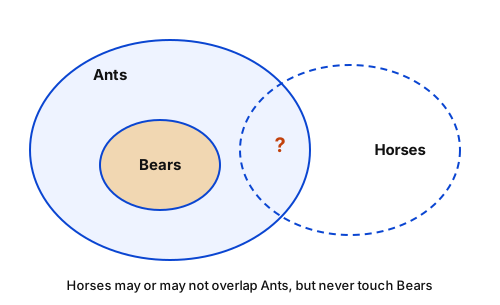
- Bears lie fully inside Ants; Horses lie outside Bears.
- (I) Horses may still overlap the Ants outside Bears – "No ant is horse" is not certain ✗.
- (II) "No bear is horse" converts to "No horse is bear" ✓.
Trick: "No A is B" can always be reversed to "No B is A".
Answer: (A) Only conclusion (II) follows
अवधारणा: वेन आरेख बनाएँ; निष्कर्ष तभी सही जब हर संभव आरेख में सत्य हो।
- भालू पूरी तरह चींटियों के अंदर; घोड़े भालुओं के बाहर।
- (I) घोड़े, भालुओं के बाहर वाली चींटियों से मिल सकते हैं – "कोई चींटी घोड़ा नहीं" निश्चित नहीं ✗।
- (II) "कोई भालू घोड़ा नहीं" का उलटा "कोई घोड़ा भालू नहीं" ✓।
ट्रिक: "कोई A, B नहीं" को हमेशा "कोई B, A नहीं" में बदल सकते हैं।
उत्तर: (A) केवल निष्कर्ष (II) अनुसरण करता है
RRB NTPC Undergraduate CBT 1General Intelligence and ReasoningSyllogismRRB NTPC Undergraduate CBT 1 2024 · 18 Aug Shift 2
Q1111.Select the pair that follows the same pattern as that followed by the two set of pairs given below. Both pairs follow the same pattern.
PFI : NGE
GKJ : ELF
उस युग्म का चयन कीजिए जो उसी पैटर्न का अनुसरण करता है जिसका अनुसरण नीचे दिए गए दो युग्मों द्वारा किया जाता है। दोनों युग्म एक ही पैटर्न का अनुसरण करते हैं।
PFI : NGE
GKJ : ELF
- AEEI : CGE
- BIDO : GEK
- CNCH : LDE
- DRNQ : PON
Show answer
Concept: Find the letter-shift pattern.
- PFI → NGE: , ,
- GKJ → ELF: ✓
- IDO → GEK: , , ✓
Trick: Check only the first letter (−2) to drop options, then verify the rest.
Answer: (B) IDO : GEK
अवधारणा: अक्षरों का खिसकाव (shift) पैटर्न देखें।
- PFI → NGE:
- GKJ → ELF: ✓
- IDO → GEK: ✓
ट्रिक: पहले अक्षर () से विकल्प छाँटें, फिर बाकी जाँचें।
उत्तर: (B) IDO : GEK
RRB NTPC Undergraduate CBT 1General Intelligence and ReasoningLetter analogyRRB NTPC Undergraduate CBT 1 2024 · 18 Aug Shift 1
Q1112.Based on the English alphabetical order, three of the following four letter-clusters are alike in a certain way and thus form a group. Which letter-cluster DOES NOT belong to that group?
(Note: The odd one out is not based on the number of consonants/vowels or their position in the letter-cluster.)
अंग्रेज़ी वर्णमाला क्रम के आधार पर, निम्नलिखित चार अक्षर-समूहों में से तीन किसी निश्चित प्रकार से एकसमान हैं और इस प्रकार एक समूह बनाते हैं। कौन-सा अक्षर-समूह उस समूह से संबंधित नहीं है?
(नोट: असंगत अक्षर-समूह, व्यंजनों/स्वरों की संख्या या अक्षर-समूह में उनके स्थान पर आधारित नहीं है।)
- AJCH
- BUNR
- CNGL
- DQJO
Show answer
Concept: Check gaps between consecutive letters.
- JCH: , ; NGL: ; QJO:
- UNR: , but ✗
Trick: Pattern is ; UNR breaks it with .
Answer: (B) UNR
अवधारणा: क्रमागत अक्षरों का अंतर देखें।
- JCH, NGL, QJO:
- UNR: , पर ✗
ट्रिक: पैटर्न ; UNR में है।
उत्तर: (B) UNR
RRB NTPC Undergraduate CBT 1General Intelligence and ReasoningOdd one out – lettersRRB NTPC Undergraduate CBT 1 2024 · 18 Aug Shift 1
Q1113.Aditya ranked 34th from the top and 44th from the bottom in his class. How many students are there in his class?
आदित्य अपनी कक्षा में ऊपर से 34वें और नीचे से 44वें स्थान पर है। उसकी कक्षा में कितने विद्यार्थी हैं?
- A76
- B78
- C77
- D79
Show answer
Concept: Total rank from top rank from bottom .
- Total
Yaad rakhein: The person is counted twice, so subtract 1.
Answer: (C) 77
अवधारणा: कुल ऊपर से रैंक नीचे से रैंक ।
- कुल
याद रखें: व्यक्ति दो बार गिना जाता है, इसलिए 1 घटाएँ।
उत्तर: (C) 77
RRB NTPC Undergraduate CBT 1General Intelligence and ReasoningRankingRRB NTPC Undergraduate CBT 1 2024 · 18 Aug Shift 1
Q1114.What should come in place of the question mark (?) in the given series?
451 450 442 415 351 ?
दी गई श्रृंखला में प्रश्न चिह्न (?) के स्थान पर क्या आना चाहिए?
451 450 442 415 351 ?
- A226
- B228
- C236
- D232
Show answer
Concept: Differences are cubes.
- , , ,
- Next:
Trick: Differences 1, 8, 27, 64 → cubes; next is 125.
Answer: (A) 226
अवधारणा: अंतर घन (cubes) संख्याएँ हैं।
- अगला:
ट्रिक: अंतर 1, 8, 27, 64 → घन; अगला 125।
उत्तर: (A) 226
RRB NTPC Undergraduate CBT 1General Intelligence and ReasoningNumber seriesRRB NTPC Undergraduate CBT 1 2024 · 18 Aug Shift 1
Q1115.Pratik ranked 14th from the bottom and 27th from the top in his class. How many students are there in his class?
प्रतीक अपनी कक्षा में नीचे से 14वें और ऊपर से 27वें स्थान पर है। उसकी कक्षा में कितने विद्यार्थी हैं?
- A39
- B38
- C37
- D40
Show answer
Concept: Total rank from top rank from bottom .
- Total
Yaad rakhein: Never forget the ; 41 is the common trap.
Answer: (D) 40
अवधारणा: कुल ऊपर से रैंक नीचे से रैंक ।
- कुल
याद रखें: कभी न भूलें।
उत्तर: (D) 40
RRB NTPC Undergraduate CBT 1General Intelligence and ReasoningRankingRRB NTPC Undergraduate CBT 1 2024 · 18 Aug Shift 1
Q1116.Based on the English alphabetical order, three of the following four letter-clusters are alike in a certain way and thus form a group. Which letter-cluster DOES NOT belong to that group?
(Note: The odd one out is not based on the number of consonants/vowels or their position in the letter-cluster.)
अंग्रेज़ी वर्णमाला क्रम के आधार पर, निम्नलिखित चार अक्षर-समूहों में से तीन किसी निश्चित प्रकार से एकसमान हैं और इस प्रकार एक समूह बनाते हैं। कौन-सा अक्षर-समूह उस समूह से संबंधित नहीं है?
(नोट: असंगत अक्षर-समूह, व्यंजनों/स्वरों की संख्या या अक्षर-समूह में उनके स्थान पर आधारित नहीं है।)
- AGNJ
- BDKG
- CRYV
- DAHD
Show answer
Concept: Check gaps between consecutive letters.
- GNJ: , ; DKG: ; AHD:
- RYV: , but ✗
Trick: Pattern ; RYV has .
Answer: (C) RYV
अवधारणा: क्रमागत अक्षरों का अंतर देखें।
- GNJ, DKG, AHD:
- RYV: , पर ✗
ट्रिक: पैटर्न ; RYV में ।
उत्तर: (C) RYV
RRB NTPC Undergraduate CBT 1General Intelligence and ReasoningOdd one out – lettersRRB NTPC Undergraduate CBT 1 2024 · 18 Aug Shift 1
Q1117.What should come in place of the question mark (?) in the given series based on the English alphabetical order?
YCS KOE WAQ IMC ?
अंग्रेज़ी वर्णमाला क्रम के आधार पर दी गई श्रृंखला में प्रश्न चिह्न (?) के स्थान पर क्या आना चाहिए?
YCS KOE WAQ IMC ?
- AYUO
- BYOU
- CUYO
- DUOY
Show answer
Concept: Each letter position moves (cyclic).
- 1st:
- 2nd:
- 3rd:
- Next term: UYO
Trick: on a 26-letter cycle; (K).
Answer: (C) UYO
अवधारणा: हर स्थान का अक्षर (चक्रीय) बढ़ता है।
- पहला:
- दूसरा:
- तीसरा:
- अगला पद: UYO
ट्रिक: 26 से अधिक हो तो 26 घटाएँ: (K)।
उत्तर: (C) UYO
RRB NTPC Undergraduate CBT 1General Intelligence and ReasoningAlphabet seriesRRB NTPC Undergraduate CBT 1 2024 · 18 Aug Shift 1
Q1118.Read the given statements and conclusions carefully. Assuming that the information given in the statements is true, even if it appears to be at variance with commonly known facts, decide which of the given conclusions logically follow(s) from the statements.
Statements: Some trees are chisels. Some chisels are graphs.
Conclusions (I): Some trees are graphs.
Conclusions (II): All graphs are chisels.
दिए गए कथनों और निष्कर्षों को ध्यानपूर्वक पढ़िए। यह मानते हुए कि कथनों में दी गई जानकारी सत्य है, भले ही वह सामान्यतः ज्ञात तथ्यों से भिन्न प्रतीत होती हो, निर्णय कीजिए कि दिए गए निष्कर्षों में से कौन-सा/से निष्कर्ष तार्किक रूप से कथनों का अनुसरण करता है/करते हैं।
कथन: कुछ पेड़, छेनियाँ हैं। कुछ छेनियाँ, ग्राफ़ हैं।
निष्कर्ष (I): कुछ पेड़, ग्राफ़ हैं।
निष्कर्ष (II): सभी ग्राफ़, छेनियाँ हैं।
- ANeither conclusion (I) nor (II) follows.न तो निष्कर्ष (I) और न ही (II) अनुसरण करता है।
- BBoth conclusions (I) and (II) follow.निष्कर्ष (I) और (II) दोनों अनुसरण करते हैं।
- COnly conclusion (II) follows.केवल निष्कर्ष (II) अनुसरण करता है।
- DOnly conclusion (I) follows.केवल निष्कर्ष (I) अनुसरण करता है।
Show answer
Concept: Two 'some' statements give no definite link between the end terms.
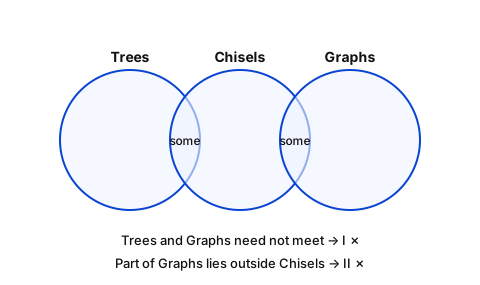
- Trees–Chisels overlap, Chisels–Graphs overlap; Trees and Graphs may not meet → I does not follow
- 'Some chisels are graphs' cannot become 'All graphs are chisels' → II does not follow
Trick: Some + Some = no conclusion.
Answer: (A) Neither conclusion (I) nor (II) follows.
अवधारणा: दो 'कुछ' कथनों से अंतिम पदों में निश्चित संबंध नहीं बनता।
- Trees और Graphs का मिलना आवश्यक नहीं → I अनुसरण नहीं करता
- 'कुछ chisels graphs हैं' से 'सभी graphs chisels हैं' नहीं निकलता → II नहीं
ट्रिक: कुछ + कुछ = कोई निष्कर्ष नहीं।
उत्तर: (A) न (I) न (II) अनुसरण करता है।
RRB NTPC Undergraduate CBT 1General Intelligence and ReasoningSyllogismRRB NTPC Undergraduate CBT 1 2024 · 18 Aug Shift 1
Q1119.If + means −, − means ×, × means ÷ and ÷ means +, then what will come in place of the question mark (?) in the following equation?
17 ÷ 44 × 4 + 6 − 4 = ?
यदि + का अर्थ −, − का अर्थ ×, × का अर्थ ÷ और ÷ का अर्थ + है, तो निम्नलिखित समीकरण में प्रश्न चिह्न (?) के स्थान पर क्या आएगा?
17 ÷ 44 × 4 + 6 − 4 = ?
- A4
- B17
- C9
- D24
Show answer
Concept: Replace symbols, then apply BODMAS.
Trick: Do the swap carefully sign by sign before calculating.
Answer: (A) 4
अवधारणा: चिह्न बदलकर BODMAS लगाएँ।
ट्रिक: गणना से पहले हर चिह्न ध्यान से बदलें।
उत्तर: (A) 4
RRB NTPC Undergraduate CBT 1General Intelligence and ReasoningMathematical operationsRRB NTPC Undergraduate CBT 1 2024 · 18 Aug Shift 1
Q1120.Six passengers L, M, N, P, Q and R are sitting on a bench in a straight line. They all are facing towards the north. M is sitting immediately between L and R. Q is sitting at the extreme right end of line. M is sitting second to the left of Q. R is sitting to the immediate left of Q. P is not an immediate neighbour of L. Who is sitting to the immediate left of L?
छह यात्री L, M, N, P, Q और R एक सीधी पंक्ति में एक बेंच पर बैठे हैं। उन सभी का मुख उत्तर की ओर है। M, L और R के ठीक बीच में बैठा है। Q पंक्ति के दाएँ छोर पर बैठा है। M, Q के बाएँ से दूसरे स्थान पर बैठा है। R, Q के ठीक बाएँ बैठा है। P, L का निकटतम पड़ोसी नहीं है। L के ठीक बाएँ कौन बैठा है?
- AN
- BR
- CP
- DM
Show answer
Concept: Fix the extreme position first, all face North (left = our left).
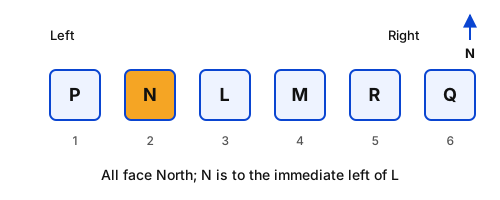
- Q at extreme right (6); R immediate left of Q (5); M second left of Q (4)
- M between L and R → L at 3
- P not next to L → P at 1, N at 2
- Order: P N L M R Q → immediate left of L is N
Trick: Start with 'extreme end' clues — they anchor the row.
Answer: (A) N
अवधारणा: पहले छोर वाला व्यक्ति रखें; सब उत्तर की ओर मुख, बायाँ = हमारा बायाँ।
- Q दाएँ छोर (6); R, Q के तुरंत बाएँ (5); M, Q के दूसरे बाएँ (4)
- M, L और R के बीच → L (3)
- P, L का पड़ोसी नहीं → P (1), N (2)
- क्रम: P N L M R Q → L के तुरंत बाएँ N
ट्रिक: 'छोर' वाले संकेत से शुरुआत करें।
उत्तर: (A) N
RRB NTPC Undergraduate CBT 1General Intelligence and ReasoningLinear seating arrangementRRB NTPC Undergraduate CBT 1 2024 · 18 Aug Shift 1

