Q1201.Refer to the following number and symbol series and answer the question that follows. Counting to be done from left to right only.
(Left) @ + 1 < 9 6 9 2 % \ $ \ + 2 & $ 3 2 ^ 9 9 (Right)
How many such numbers are there that are immediately preceded by a symbol and immediately followed by another number?
निम्नलिखित संख्या और प्रतीक श्रृंखला को देखिए और उसके बाद दिए गए प्रश्न का उत्तर दीजिए। गणना केवल बाएँ से दाएँ की जानी है।
(बाएँ) @ + 1 < 9 6 9 2 % \ $ \ + 2 & $ 3 2 ^ 9 9 (दाएँ)
ऐसी कितनी संख्याएँ हैं जिनके ठीक पहले एक प्रतीक है और ठीक बाद एक अन्य संख्या है?
- AThreeतीन
- BOneएक
- CTwoदो
- DFourचार
Show answer
Concept: Check each number: the element just before must be a symbol and the element just after must be a number.
- Series: @ + 1 < 9 6 9 2 % \ $ \ + 2 & $ 3 2 ^ 9 9.
- 1: before “+”, after “<” (symbol) ✗. 9 (after “<”): followed by 6 ✓.
- 2 (after “+”): followed by “&” ✗. 3 (after “$”): followed by 2 ✓.
- 9 (after “^”): followed by 9 ✓. Total = 3.
Trick: Scan only numbers that come right after a symbol, then look one step right.
Answer: (A) Three
अवधारणा: हर संख्या जाँचें: ठीक पहले प्रतीक हो और ठीक बाद संख्या हो।
- श्रृंखला: @ + 1 < 9 6 9 2 % \ $ \ + 2 & $ 3 2 ^ 9 9।
- 1: पहले “+”, बाद में “<” (प्रतीक) ✗। 9 (“<” के बाद): बाद में 6 ✓।
- 2 (“+” के बाद): बाद में “&” ✗। 3 (“$” के बाद): बाद में 2 ✓।
- 9 (“^” के बाद): बाद में 9 ✓। कुल = 3।
ट्रिक: केवल प्रतीक के ठीक बाद आने वाली संख्याएँ देखें, फिर उनके दाएँ एक कदम देखें।
उत्तर: (A) तीन
RRB NTPC Undergraduate CBT 1General Intelligence and ReasoningNumber-Symbol SeriesRRB NTPC Undergraduate CBT 1 2024 · 14 Aug Shift 1
Q1202.If + means −, − means ×, × means ÷ and ÷ means +, then what will come in place of the question mark (?) in the following equation?
75 × 5 + 11 − 2 ÷ 18 = ?
यदि + का अर्थ −, − का अर्थ ×, × का अर्थ ÷ और ÷ का अर्थ + है, तो निम्नलिखित समीकरण में प्रश्न चिह्न (?) के स्थान पर क्या आएगा?
75 × 5 + 11 − 2 ÷ 18 = ?
- A21
- B17
- C26
- D11
Show answer
Concept: Replace the signs as given, then apply BODMAS.
- becomes .
- .
- .
Trick: Write the converted expression fully before calculating — most errors come from mixing old and new signs.
Answer: (D) 11
अवधारणा: दिए अनुसार चिह्न बदलें, फिर BODMAS लगाएँ।
- बनता है ।
- ।
- ।
ट्रिक: गणना से पहले बदला हुआ व्यंजक पूरा लिख लें — अधिकतर गलतियाँ पुराने-नए चिह्न मिलाने से होती हैं।
उत्तर: (D) 11
RRB NTPC Undergraduate CBT 1General Intelligence and ReasoningMathematical OperationsRRB NTPC Undergraduate CBT 1 2024 · 14 Aug Shift 1
Q1203.Based on the English alphabetical order, three of the following four letter-cluster pairs are alike in a certain way and thus form a group. Which is the letter-cluster pair that DOES NOT belong to that group?
(Note: The odd one out is not based on the number of consonants/vowels or their position in the letter-cluster.)
अंग्रेज़ी वर्णमाला क्रम के आधार पर, निम्नलिखित चार अक्षर-समूह युग्मों में से तीन किसी निश्चित प्रकार से एकसमान हैं और इस प्रकार एक समूह बनाते हैं। वह अक्षर-समूह युग्म कौन-सा है जो उस समूह से संबंधित नहीं है?
(ध्यान दें: असंगत का चयन व्यंजनों/स्वरों की संख्या या अक्षर-समूह में उनकी स्थिति पर आधारित नहीं है।)
- AKE-MF
- BEY-GZ
- CYS-AT
- DPJ-RI
Show answer
Concept: Compare the first letters and the second letters of the two clusters separately (positions: A = 1 … Z = 26).
- KE-MF: K→M (+2), E→F (+1). EY-GZ: E→G (+2), Y→Z (+1).
- YS-AT: Y→A (+2, wrapping), S→T (+1).
- PJ-RI: P→R (+2) but J→I (−1) → odd.
Trick: Pattern “+2, +1” — the pair breaking it in any one letter is the odd one.
Answer: (D) PJ-RI
अवधारणा: दोनों समूहों के पहले अक्षरों और दूसरे अक्षरों की अलग-अलग तुलना करें (A = 1 … Z = 26)।
- KE-MF: K→M (+2), E→F (+1)। EY-GZ: E→G (+2), Y→Z (+1)।
- YS-AT: Y→A (+2, चक्रीय), S→T (+1)।
- PJ-RI: P→R (+2) पर J→I (−1) → विषम।
ट्रिक: पैटर्न “+2, +1” — जो जोड़ा किसी एक अक्षर में इसे तोड़े, वही विषम।
उत्तर: (D) PJ-RI
RRB NTPC Undergraduate CBT 1General Intelligence and ReasoningLetter-Cluster Odd One OutRRB NTPC Undergraduate CBT 1 2024 · 14 Aug Shift 1
Q1204.A is the brother of S. S is the daughter of L. L is married to K. K is the daughter of D. D is the father of P. P is the sister of R. R is married to N. How is D related to S?
A, S का भाई है। S, L की पुत्री है। L का विवाह K से हुआ है। K, D की पुत्री है। D, P का पिता है। P, R की बहन है। R का विवाह N से हुआ है। D का S से क्या संबंध है?
- AFather's brotherपिता का भाई
- BFatherपिता
- CMother's fatherमाता का पिता
- DFather's fatherपिता का पिता
Show answer
Concept: Fix genders first: a “daughter” is female; the spouse of a female is male.
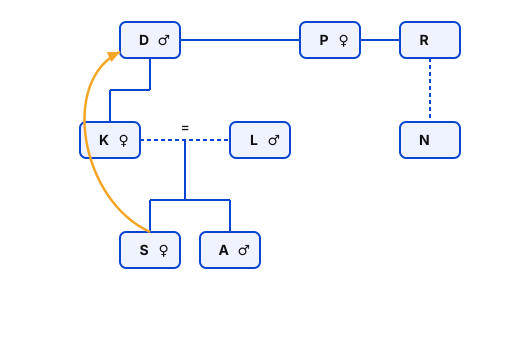
- S is the daughter of L; L is married to K, and K is a daughter (female) → K is S’s mother, L is S’s father.
- K is the daughter of D, and D is a father (male).
- So D is the father of S’s mother.
Trick: Draw generations in rows: D → K → S; going up through the mother gives “mother’s father”.
Answer: (C) Mother’s father
अवधारणा: पहले लिंग तय करें: “बेटी” स्त्री है; स्त्री का जीवनसाथी पुरुष है।
- S, L की बेटी है; L का विवाह K से, और K बेटी (स्त्री) है → K, S की माँ और L, S के पिता।
- K, D की बेटी है, और D पिता (पुरुष) है।
- अतः D, S की माँ के पिता (नाना) हैं।
ट्रिक: पीढ़ियाँ पंक्तियों में बनाएँ: D → K → S; माँ के रास्ते ऊपर जाने पर “माँ के पिता”।
उत्तर: (C) माँ के पिता (Mother’s father)
RRB NTPC Undergraduate CBT 1General Intelligence and ReasoningBlood RelationRRB NTPC Undergraduate CBT 1 2024 · 14 Aug Shift 1
Q1205.Each of the digits in the number 5341289 is arranged in ascending order from left to right. The position(s) of how many digits will remain unchanged as compared to that in the original number?
संख्या 5341289 के प्रत्येक अंक को बाएँ से दाएँ आरोही क्रम में व्यवस्थित किया जाता है। मूल संख्या की तुलना में कितने अंकों का स्थान अपरिवर्तित रहेगा?
- ATwoदो
- BOneएक
- CNoneकोई नहीं
- DThreeतीन
Show answer
Concept: Sort the digits and compare position by position.
- Original: 5 3 4 1 2 8 9.
- Ascending: 1 2 3 4 5 8 9.
- Same place: 8 (6th) and 9 (7th) → two digits.
Trick: Write both numbers one under the other and tick the matching columns.
Answer: (A) Two
अवधारणा: अंकों को क्रम में लगाकर हर स्थान की तुलना करें।
- मूल: 5 3 4 1 2 8 9।
- आरोही: 1 2 3 4 5 8 9।
- समान स्थान: 8 (6वाँ) और 9 (7वाँ) → दो अंक।
ट्रिक: दोनों संख्याएँ एक के नीचे एक लिखें और मिलते स्तंभों पर निशान लगाएँ।
उत्तर: (A) दो
RRB NTPC Undergraduate CBT 1General Intelligence and ReasoningDigit ArrangementRRB NTPC Undergraduate CBT 1 2024 · 14 Aug Shift 1
Q1206.What should come in place of the question mark (?) in the given series?
108 122 139 159 182 208 ?
दी गई श्रृंखला में प्रश्न चिह्न (?) के स्थान पर क्या आना चाहिए?
108 122 139 159 182 208 ?
- A222
- B237
- C229
- D248
Show answer
Concept: Look at the differences between consecutive terms.
- Differences: — increasing by 3.
- Next difference .
- .
Trick: When first differences grow steadily, add the next difference.
Answer: (B) 237
अवधारणा: क्रमागत पदों का अंतर देखें।
- अंतर: — हर बार 3 अधिक।
- अगला अंतर ।
- ।
ट्रिक: जब पहला अंतर समान रूप से बढ़े, तो अगला अंतर जोड़ें।
उत्तर: (B) 237
RRB NTPC Undergraduate CBT 1General Intelligence and ReasoningNumber SeriesRRB NTPC Undergraduate CBT 1 2024 · 14 Aug Shift 1
Q1207.Select the set in which the numbers are related in the same way as are the numbers of the following sets.
(Note: Operations should be performed on the whole numbers, without breaking down the numbers into their constituent digits. E.g., 13 – Operations on 13 such as
adding/subtracting/multiplying to 13 can be performed. Breaking down 13 into 1 and 3 and then performing mathematical operations on 1 and 3 is not allowed.)
(19, 31, 55)
(14, 26, 50)
उस समुच्चय का चयन कीजिए जिसमें संख्याएँ उसी प्रकार संबंधित हैं जिस प्रकार निम्नलिखित समुच्चयों की संख्याएँ संबंधित हैं।
(ध्यान दें: संक्रियाएँ पूर्ण संख्याओं पर की जानी चाहिए, संख्याओं को उनके घटक अंकों में विभाजित किए बिना। उदाहरण के लिए, 13 – 13 पर संक्रियाएँ जैसे
13 में जोड़ना/घटाना/गुणा करना किया जा सकता है। 13 को 1 और 3 में विभाजित करना और फिर 1 और 3 पर गणितीय संक्रियाएँ करना वर्जित है।)
(19, 31, 55)
(14, 26, 50)
- A(48, 60, 84)
- B(18, 32, 54)
- C(15, 30, 45)
- D(13, 26, 43)
Show answer
Concept: Find how the 2nd and 3rd numbers come from the 1st.
- : , . : , .
- : , ✓.
- : ✗; : ✗; : ✗.
Trick: Rule: second = first + 12, third = second + 24.
Answer: (A)
अवधारणा: देखें दूसरी और तीसरी संख्या पहली से कैसे बनती है।
- : , । : , ।
- : , ✓।
- : ✗; : ✗; : ✗।
ट्रिक: नियम: दूसरी = पहली + 12, तीसरी = दूसरी + 24।
उत्तर: (A)
RRB NTPC Undergraduate CBT 1General Intelligence and ReasoningNumber TriadsRRB NTPC Undergraduate CBT 1 2024 · 14 Aug Shift 1
Q1208.If ‘+’ means ‘subtraction’, ‘−’ means ‘multiplication’, ‘×’ means ‘division’ and ‘÷’ means ‘addition’, then what will come in place of the question mark (?) in the following equation?
64 × 8 + 6 − 6 ÷ 33 = ?
यदि '+' का अर्थ 'घटाना', '−' का अर्थ 'गुणा करना', '×' का अर्थ 'भाग देना' और '÷' का अर्थ 'जोड़ना' है, तो निम्नलिखित समीकरण में प्रश्न चिह्न (?) के स्थान पर क्या आएगा?
64 × 8 + 6 − 6 ÷ 33 = ?
- A20
- B5
- C10
- D15
Show answer
Concept: Replace the signs as given, then apply BODMAS.
- becomes .
- .
- .
Trick: Do ÷ and × first, then + and − from left to right.
Answer: (B) 5
अवधारणा: दिए अनुसार चिह्न बदलें, फिर BODMAS लगाएँ।
- बनता है ।
- ।
- ।
ट्रिक: पहले ÷ और ×, फिर बाएँ से दाएँ + और −।
उत्तर: (B) 5
RRB NTPC Undergraduate CBT 1General Intelligence and ReasoningMathematical OperationsRRB NTPC Undergraduate CBT 1 2024 · 14 Aug Shift 1
Q1209.What should come in place of the question mark (?) in the following series?
2 6 12 20 ?
निम्नलिखित श्रृंखला में प्रश्न चिह्न (?) के स्थान पर क्या आना चाहिए?
2 6 12 20 ?
- A40
- B35
- C30
- D25
Show answer
Concept: Terms are of the form .
- , , , .
- Next .
Trick: Differences 4, 6, 8 → next 10: .
Answer: (C) 30
अवधारणा: पद के रूप में हैं।
- , , , ।
- अगला ।
ट्रिक: अंतर 4, 6, 8 → अगला 10: ।
उत्तर: (C) 30
RRB NTPC Undergraduate CBT 1General Intelligence and ReasoningNumber SeriesRRB NTPC Undergraduate CBT 1 2024 · 14 Aug Shift 1
Q1210.What should come in place of the question mark (?) in the given series based on the English alphabetical order?
WRM RMH MHC HCX ?
अंग्रेज़ी वर्णमाला क्रम के आधार पर दी गई श्रृंखला में प्रश्न चिह्न (?) के स्थान पर क्या आना चाहिए?
WRM RMH MHC HCX ?
- ACXD
- BCDX
- CCXS
- DCSX
Show answer
Concept: Each cluster moves 5 letters back (W = 23, R = 18, M = 13 …).
- WRM: W → R → M (each −5). Next cluster starts with the 2nd letter of the previous one.
- RMH, MHC, HCX (C − 5 = X, wrapping).
- Next: C, X, X − 5 = S → CXS.
Trick: Each term = previous term shifted one place left + a new letter 5 steps back.
Answer: (C) CXS
अवधारणा: हर समूह में अक्षर 5 पीछे जाते हैं (W = 23, R = 18, M = 13 …)।
- WRM: W → R → M (हर बार −5)। अगला समूह पिछले के दूसरे अक्षर से शुरू होता है।
- RMH, MHC, HCX (C − 5 = X, चक्रीय)।
- अगला: C, X, X − 5 = S → CXS।
ट्रिक: हर पद = पिछला पद एक स्थान बाएँ खिसका + 5 पीछे का नया अक्षर।
उत्तर: (C) CXS
RRB NTPC Undergraduate CBT 1General Intelligence and ReasoningAlphabet SeriesRRB NTPC Undergraduate CBT 1 2024 · 14 Aug Shift 1
Q1211.In the following triads, each group of letters is related to the subsequent one following a certain logic. Select from the given options, the one which follows the same logic. LIVE – ELVI – LEIV
HANG – GHNA – HGAN
निम्नलिखित त्रिकों में, अक्षरों का प्रत्येक समूह एक निश्चित तर्क का अनुसरण करते हुए अपने बाद वाले समूह से संबंधित है। दिए गए विकल्पों में से उस विकल्प का चयन कीजिए जो उसी तर्क का अनुसरण करता है। LIVE – ELVI – LEIV
HANG – GHNA – HGAN
- APORT – TPOR – ORTP
- BREDS – ERDS – SEDR
- CDUSK – KDSU – DKUS
- DPAIN – NPIA – PANI
Show answer
Concept: Track positions: LIVE = 1 2 3 4.
- LIVE → ELVI = positions 4 1 3 2. ELVI → LEIV = swap 1st–2nd and 3rd–4th.
- Check HANG → GHNA (4 1 3 2) → HGAN (swap pairs) ✓.
- DUSK → KDSU (4 1 3 2) → DKUS (swap pairs) ✓. Others fail, e.g. PORT → TPOR is not 4 1 3 2 (should be TPRO).
Trick: Write the position code “4132” then “swap pairs” and test each option.
Answer: (C) DUSK – KDSU – DKUS
अवधारणा: स्थान ट्रैक करें: LIVE = 1 2 3 4।
- LIVE → ELVI = स्थान 4 1 3 2। ELVI → LEIV = 1–2 और 3–4 की अदला-बदली।
- जाँच HANG → GHNA (4 1 3 2) → HGAN (जोड़ों की अदला-बदली) ✓।
- DUSK → KDSU (4 1 3 2) → DKUS (जोड़ों की अदला-बदली) ✓। अन्य असफल, जैसे PORT → TPOR, 4 1 3 2 नहीं (TPRO होना चाहिए)।
ट्रिक: स्थान कोड “4132” फिर “जोड़ों की अदला-बदली” लिखें और हर विकल्प जाँचें।
उत्तर: (C) DUSK – KDSU – DKUS
RRB NTPC Undergraduate CBT 1General Intelligence and ReasoningLetter RearrangementRRB NTPC Undergraduate CBT 1 2024 · 14 Aug Shift 1
Q1212.Select the pair that follows the same pattern as that followed by the two pairs given below. Both pairs follow the same pattern.
ERT : FSV
RDX : SEZ
उस युग्म का चयन कीजिए जो उसी पैटर्न का अनुसरण करता है जिसका अनुसरण नीचे दिए गए दो युग्म करते हैं। दोनों युग्म एक ही पैटर्न का अनुसरण करते हैं।
ERT : FSV
RDX : SEZ
- ADUC : EVD
- BUHS : VIU
- CEOC : FPF
- DIOP : JPS
Show answer
Concept: Find the shift of each letter: ERT → FSV.
- E→F (+1), R→S (+1), T→V (+2). RDX → SEZ follows +1, +1, +2.
- UHS → VIU: +1, +1, +2 ✓.
- DUC → EVD ends +1 ✗; EOC → FPF ends +3 ✗; IOP → JPS ends +3 ✗.
Trick: First two letters match in all options; just check the third letter for +2.
Answer: (B) UHS : VIU
अवधारणा: हर अक्षर का खिसकाव देखें: ERT → FSV।
- E→F (+1), R→S (+1), T→V (+2)। RDX → SEZ भी +1, +1, +2।
- UHS → VIU: +1, +1, +2 ✓।
- DUC → EVD अंत +1 ✗; EOC → FPF अंत +3 ✗; IOP → JPS अंत +3 ✗।
ट्रिक: सभी विकल्पों में पहले दो अक्षर मिलते हैं; केवल तीसरे अक्षर में +2 देखें।
उत्तर: (B) UHS : VIU
RRB NTPC Undergraduate CBT 1General Intelligence and ReasoningLetter AnalogyRRB NTPC Undergraduate CBT 1 2024 · 14 Aug Shift 1
Q1213.HDLI is related to FBJG in a certain way based on the English alphabetical order. In the same way, KGOL is related to IEMJ. To which of the given options is NJRO related, following the same logic?
अंग्रेज़ी वर्णमाला क्रम के आधार पर HDLI एक निश्चित प्रकार से FBJG से संबंधित है। उसी प्रकार, KGOL, IEMJ से संबंधित है। समान तर्क का अनुसरण करते हुए, NJRO दिए गए विकल्पों में से किससे संबंधित है?
- ALHPM
- BLHMP
- CHLPM
- DHLMP
Show answer
Concept: Find the shift for each letter.
- HDLI → FBJG: each letter −2. KGOL → IEMJ: each −2.
- NJRO → N−2 = L, J−2 = H, R−2 = P, O−2 = M.
- Code = LHPM.
Trick: Same shift for all letters — move each 2 steps back.
Answer: (A) LHPM
अवधारणा: हर अक्षर का खिसकाव देखें।
- HDLI → FBJG: हर अक्षर −2। KGOL → IEMJ: हर अक्षर −2।
- NJRO → N−2 = L, J−2 = H, R−2 = P, O−2 = M।
- कोड = LHPM।
ट्रिक: सभी अक्षरों का खिसकाव समान — हर अक्षर 2 पीछे।
उत्तर: (A) LHPM
RRB NTPC Undergraduate CBT 1General Intelligence and ReasoningLetter CodingRRB NTPC Undergraduate CBT 1 2024 · 14 Aug Shift 1
Q1214.Based on the English alphabetical order, three of the following four letter-clusters are alike in a certain way and thus form a group. Which letter-cluster DOES NOT belong to that group? (Note: The odd one out is not based on the number of consonants/vowels or their position in the letter-cluster.)
अंग्रेज़ी वर्णमाला क्रम के आधार पर, निम्नलिखित चार अक्षर-समूहों में से तीन किसी निश्चित प्रकार से एकसमान हैं और इस प्रकार एक समूह बनाते हैं। कौन-सा अक्षर-समूह उस समूह से संबंधित नहीं है? (ध्यान दें: असंगत का चयन व्यंजनों/स्वरों की संख्या या अक्षर-समूह में उनकी स्थिति पर आधारित नहीं है।)
- ASXR
- BLQK
- CNSL
- DQVP
Show answer
Concept: Relate the 2nd and 3rd letters to the 1st letter.
- SXR: S+5 = X, S−1 = R. LQK: L+5 = Q, L−1 = K. QVP: Q+5 = V, Q−1 = P.
- NSL: N+5 = S, but N−2 = L ✗.
Trick: The pattern “+5, −1 from the first letter” fails only in NSL.
Answer: (C) NSL
अवधारणा: दूसरे और तीसरे अक्षर को पहले अक्षर से जोड़ें।
- SXR: S+5 = X, S−1 = R। LQK: L+5 = Q, L−1 = K। QVP: Q+5 = V, Q−1 = P।
- NSL: N+5 = S, पर N−2 = L ✗।
ट्रिक: पैटर्न “पहले अक्षर से +5, −1” केवल NSL में टूटता है।
उत्तर: (C) NSL
RRB NTPC Undergraduate CBT 1General Intelligence and ReasoningLetter-Cluster Odd One OutRRB NTPC Undergraduate CBT 1 2024 · 14 Aug Shift 1
Q1215.Gautam starts from Point A and drives 9 km towards south. He then takes a right turn, drives 4 km, turns right and drives 11 km. He then takes a right turn and drives 6 km. He takes a final right turn, drives 2 km and stops at Point P. How far (shortest distance) and towards which direction should he drive in order to reach Point A again? (All turns are 90° turns only unless specified.)
गौतम बिंदु A से चलना शुरू करता है और दक्षिण की ओर 9 km गाड़ी चलाता है। फिर वह दाएँ मुड़ता है, 4 km गाड़ी चलाता है, दाएँ मुड़ता है और 11 km गाड़ी चलाता है। फिर वह दाएँ मुड़ता है और 6 km गाड़ी चलाता है। वह अंतिम बार दाएँ मुड़ता है, 2 km गाड़ी चलाता है और बिंदु P पर रुक जाता है। बिंदु A पर फिर से पहुँचने के लिए उसे कितनी दूर (न्यूनतम दूरी) और किस दिशा में गाड़ी चलानी चाहिए? (जब तक निर्दिष्ट न हो, सभी मोड़ केवल 90° के मोड़ हैं।)
- A2 km to eastपूर्व की ओर 2 km
- B2 km to westपश्चिम की ओर 2 km
- C3 km to westपश्चिम की ओर 3 km
- D3 km to eastपूर्व की ओर 3 km
Show answer
Concept: Track the position on a grid, taking A as origin (East +x, North +y).
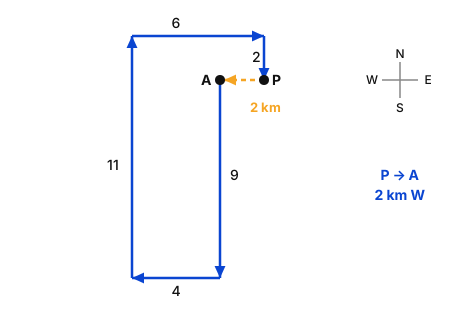
- 9 km south → (0, −9). Right (facing south → west) 4 km → (−4, −9).
- Right → north 11 km → (−4, 2). Right → east 6 km → (2, 2).
- Right → south 2 km → P = (2, 0). A is 2 km to the west of P.
Trick: Net N–S: ; net E–W: (east) → return 2 km west.
Answer: (B) 2 km to west
अवधारणा: A को मूल बिंदु मानकर ग्रिड पर स्थिति ट्रैक करें (पूर्व +x, उत्तर +y)।
- 9 km दक्षिण → (0, −9)। दाएँ (दक्षिण की ओर मुख → पश्चिम) 4 km → (−4, −9)।
- दाएँ → उत्तर 11 km → (−4, 2)। दाएँ → पूर्व 6 km → (2, 2)।
- दाएँ → दक्षिण 2 km → P = (2, 0)। A, P से 2 km पश्चिम में है।
ट्रिक: कुल उत्तर–दक्षिण: ; कुल पूर्व–पश्चिम: (पूर्व) → 2 km पश्चिम लौटें।
उत्तर: (B) 2 km पश्चिम
RRB NTPC Undergraduate CBT 1General Intelligence and ReasoningDirection and DistanceRRB NTPC Undergraduate CBT 1 2024 · 14 Aug Shift 1
Q1216.Which of the following letter-number clusters will replace the question mark (?) in the given series to make it logically complete?
ZY 43 VU 40 RQ 35 NM 28 ?
निम्नलिखित में से कौन-सा अक्षर-संख्या समूह दी गई श्रृंखला में प्रश्न चिह्न (?) को प्रतिस्थापित करके उसे तार्किक रूप से पूर्ण करेगा?
ZY 43 VU 40 RQ 35 NM 28 ?
- AJI 19
- BJI 18
- CKJ 18
- DKJ 19
Show answer
Concept: Treat the letter pairs and the numbers as two separate series.
- Letters: ZY, VU, RQ, NM → each pair moves 4 back → JI.
- Numbers: 43, 40, 35, 28 → differences → next .
- → JI 19.
Trick: Odd-number differences (3, 5, 7, 9) are a common pattern.
Answer: (A) JI 19
अवधारणा: अक्षर-जोड़े और संख्याओं को दो अलग श्रृंखलाएँ मानें।
- अक्षर: ZY, VU, RQ, NM → हर जोड़ा 4 पीछे → JI।
- संख्याएँ: 43, 40, 35, 28 → अंतर → अगला ।
- → JI 19।
ट्रिक: विषम संख्याओं का अंतर (3, 5, 7, 9) आम पैटर्न है।
उत्तर: (A) JI 19
RRB NTPC Undergraduate CBT 1General Intelligence and ReasoningLetter-Number SeriesRRB NTPC Undergraduate CBT 1 2024 · 14 Aug Shift 1
Q1217.Seven boxes A, B, C, D, E, F and G are kept one over the other but not necessarily in the same order. G is kept immediately above F. C is kept immediately above A. Only E is kept above B. Only two boxes are kept above G. C is not kept at the third position from the bottom. How many boxes are kept above B?
सात बक्से A, B, C, D, E, F और G एक के ऊपर एक रखे गए हैं, लेकिन आवश्यक नहीं कि इसी क्रम में हों। G को F के ठीक ऊपर रखा गया है। C को A के ठीक ऊपर रखा गया है। B के ऊपर केवल E रखा गया है। G के ऊपर केवल दो बक्से रखे गए हैं। C को नीचे से तीसरे स्थान पर नहीं रखा गया है। B के ऊपर कितने बक्से रखे गए हैं?
- A1
- B4
- C3
- D2
Show answer
Concept: Number positions 1 (top) to 7 (bottom) and place fixed clues first.
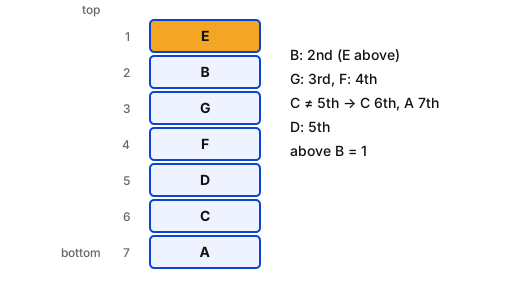
- Only E above B → E = 1, B = 2. Two boxes above G → G = 3; F immediately below → F = 4.
- C immediately above A in 5–6 or 6–7; C ≠ 5th (3rd from bottom) → C = 6, A = 7, D = 5.
- Boxes above B: only E → 1.
Trick: “Only X above Y” fixes both: X at top, Y second.
Answer: (A) 1
अवधारणा: स्थान 1 (ऊपर) से 7 (नीचे) तक मानें और पहले निश्चित सूचनाएँ लगाएँ।
- केवल E, B के ऊपर → E = 1, B = 2। G के ऊपर दो बॉक्स → G = 3; F ठीक नीचे → F = 4।
- C ठीक A के ऊपर, 5–6 या 6–7 में; C 5वें (नीचे से तीसरे) पर नहीं → C = 6, A = 7, D = 5।
- B के ऊपर: केवल E → 1।
ट्रिक: “केवल X, Y के ऊपर” से दोनों तय: X सबसे ऊपर, Y दूसरे।
उत्तर: (A) 1
RRB NTPC Undergraduate CBT 1General Intelligence and ReasoningBox ArrangementRRB NTPC Undergraduate CBT 1 2024 · 14 Aug Shift 1
Q1218.Read the given statement(s) and conclusions carefully. Assuming that the information given in the statement(s) is true, even if it appears to be at variance with commonly known facts, decide which of the given conclusions logically follow(s) from the statement(s).
Statements:
All buckets are mugs.
All mugs are cans.
Conclusions:
(I) Some cans are mugs.
(II) All buckets are cans.
दिए गए कथन/कथनों और निष्कर्षों को ध्यानपूर्वक पढ़िए। यह मानते हुए कि कथन/कथनों में दी गई जानकारी सत्य है, भले ही वह सामान्यतः ज्ञात तथ्यों से भिन्न प्रतीत होती हो, निर्णय कीजिए कि दिए गए निष्कर्षों में से कौन-सा/कौन-से निष्कर्ष तार्किक रूप से कथन/कथनों का अनुसरण करता है/करते हैं।
कथन:
सभी बाल्टियाँ, मग हैं।
सभी मग, डिब्बे हैं।
निष्कर्ष:
(I) कुछ डिब्बे, मग हैं।
(II) सभी बाल्टियाँ, डिब्बे हैं।
- ANeither conclusion (I) nor (II) follows.न तो निष्कर्ष (I) और न ही (II) अनुसरण करता है।
- BBoth conclusions (I) and (II) follow.निष्कर्ष (I) और (II) दोनों अनुसरण करते हैं।
- COnly conclusion (I) follows.केवल निष्कर्ष (I) अनुसरण करता है।
- DOnly conclusion (II) follows.केवल निष्कर्ष (II) अनुसरण करता है।
Show answer
Concept: Draw nested circles: Buckets inside Mugs inside Cans.
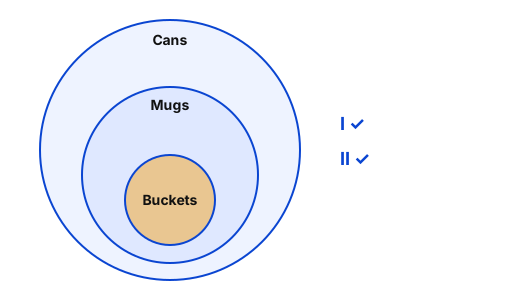
- All mugs are cans → some cans are mugs (conversion of “All”) → I follows.
- All buckets are mugs + all mugs are cans → all buckets are cans → II follows.
Trick: All A are B + All B are C ⇒ All A are C; and “All B are C” ⇒ “Some C are B”.
Answer: (B) Both conclusions (I) and (II) follow.
अवधारणा: नेस्टेड वृत्त बनाएँ: बाल्टियाँ (Buckets) मग (Mugs) के अंदर, मग डिब्बों (Cans) के अंदर।
- सभी मग डिब्बे हैं → कुछ डिब्बे मग हैं (“सभी” का परिवर्तन) → I अनुसरण करता है।
- सभी बाल्टियाँ मग + सभी मग डिब्बे → सभी बाल्टियाँ डिब्बे → II अनुसरण करता है।
ट्रिक: सभी A, B + सभी B, C ⇒ सभी A, C; और “सभी B, C” ⇒ “कुछ C, B”।
उत्तर: (B) निष्कर्ष (I) और (II) दोनों अनुसरण करते हैं।
RRB NTPC Undergraduate CBT 1General Intelligence and ReasoningSyllogismRRB NTPC Undergraduate CBT 1 2024 · 14 Aug Shift 1
Q1219.This question is based on the five, three-digit numbers given below.
(Left) 629 189 586 643 746 (Right)
(Example- 697 – First digit = 6, second digit = 9 and third digit = 7)
(NOTE: All operations to be done from left to right.)
If 2 is added to the first digit of every number, in how many numbers thus formed will the first digit be exactly divisible by the second digit?
यह प्रश्न नीचे दी गई तीन अंकों वाली पाँच संख्याओं पर आधारित है।
(बाएँ) 629 189 586 643 746 (दाएँ)
(उदाहरण- 697 – पहला अंक = 6, दूसरा अंक = 9 और तीसरा अंक = 7)
(ध्यान दें: सभी संक्रियाएँ बाएँ से दाएँ की जानी हैं।)
यदि प्रत्येक संख्या के पहले अंक में 2 जोड़ दिया जाए, तो इस प्रकार बनी कितनी संख्याओं में पहला अंक दूसरे अंक से पूर्णतः विभाज्य होगा?
- AThreeतीन
- BNoneकोई नहीं
- CTwoदो
- DOneएक
Show answer
Concept: Add 2 to the first digit only, then test first digit ÷ second digit.
- 629 → 829: ✓. 189 → 389: 3 not divisible by 8 ✗.
- 586 → 786: 7 not divisible by 8 ✗. 643 → 843: ✓.
- 746 → 946: 9 not divisible by 4 ✗. Total = 2.
Trick: Only the first digit changes; the second digit stays as given.
Answer: (C) Two
अवधारणा: केवल पहले अंक में 2 जोड़ें, फिर पहला अंक ÷ दूसरा अंक जाँचें।
- 629 → 829: ✓। 189 → 389: 3, 8 से विभाज्य नहीं ✗।
- 586 → 786: 7, 8 से विभाज्य नहीं ✗। 643 → 843: ✓।
- 746 → 946: 9, 4 से विभाज्य नहीं ✗। कुल = 2।
ट्रिक: केवल पहला अंक बदलता है; दूसरा अंक वही रहता है।
उत्तर: (C) दो
RRB NTPC Undergraduate CBT 1General Intelligence and ReasoningThree-Digit Number PuzzleRRB NTPC Undergraduate CBT 1 2024 · 14 Aug Shift 1
Q1220.In a certain code language, ‘BORN’ is coded as ‘3257’ and ‘RIPE’ is coded as ‘6142’. What is the code for ‘R’ in the given code language?
एक निश्चित कूट भाषा में, 'BORN' को '3257' और 'RIPE' को '6142' के रूप में कूटबद्ध किया जाता है। दी गई कूट भाषा में 'R' के लिए कूट क्या है?
- A5
- B6
- C4
- D2
Show answer
Concept: A letter common to both words takes the digit common to both codes.
- BORN = {3, 2, 5, 7}; RIPE = {6, 1, 4, 2}.
- Common letter: R; common digit: 2.
- So R = 2.
Trick: Common letter ↔ common digit (order in the code does not matter).
Answer: (D) 2
अवधारणा: दोनों शब्दों में समान अक्षर का कोड, दोनों कोडों का समान अंक होता है।
- BORN = {3, 2, 5, 7}; RIPE = {6, 1, 4, 2}।
- समान अक्षर: R; समान अंक: 2।
- अतः R = 2।
ट्रिक: समान अक्षर ↔ समान अंक (कोड में क्रम मायने नहीं रखता)।
उत्तर: (D) 2
RRB NTPC Undergraduate CBT 1General Intelligence and ReasoningCoding-DecodingRRB NTPC Undergraduate CBT 1 2024 · 14 Aug Shift 1

