Q1281.9 years ago, the age of a father was 25 years more than twice his son's age. After how many years, from now, will he be twice his son's age?
9 वर्ष पहले, एक पिता की आयु उसके पुत्र की आयु के दोगुने से 25 वर्ष अधिक थी। अब से कितने वर्ष बाद उसकी आयु उसके पुत्र की आयु की दोगुनी होगी?
- A21
- B18
- C19
- D16
Show answer
Concept: Form an equation from the past condition, then use it for the future condition.
- Let present ages be F and S. → .
- After years: → .
- years.
Trick: 'Twice' condition: the gap shrinks by 1 each year. 9 years ago was 25; now it is , so after 16 years it becomes 0.
Answer: (D) 16
अवधारणा: भूतकाल की शर्त से समीकरण बनाएँ, फिर भविष्य की शर्त में प्रयोग करें।
- वर्तमान आयु F तथा S। → ।
- वर्ष बाद: → ।
- वर्ष।
ट्रिक: का अंतर हर वर्ष 1 घटता है: 9 वर्ष पहले 25, अब ; अतः 16 वर्ष बाद यह शून्य होगा।
उत्तर: (D) 16
RRB NTPC Undergraduate CBT 1MathematicsProblems on agesRRB NTPC Undergraduate CBT 1 2024 · 13 Aug Shift 2
Q1282.The total surface area of a cube having side 74 cm is:
74 cm भुजा वाले घन का कुल पृष्ठीय क्षेत्रफल है:
- A32856 cm2
- B32896 cm2
- C32857 cm2
- D32846 cm2
Show answer
Concept: Total surface area of a cube .
- .
- .
Trick: Unit digit: ends in 6, ends in 6 → options ending in 6: 32856, 32896, 32846; , .
Answer: (A)
अवधारणा: घन का संपूर्ण पृष्ठीय क्षेत्रफल ।
- ।
- ।
ट्रिक: इकाई अंक: का अंतिम अंक 6, का भी 6; फिर से पुष्टि करें।
उत्तर: (A)
RRB NTPC Undergraduate CBT 1MathematicsSurface area of cubeRRB NTPC Undergraduate CBT 1 2024 · 13 Aug Shift 2
Q1283.The average of first 171 even numbers is
प्रथम 171 सम संख्याओं का औसत है
- A172
- B173
- C172.5
- D171.5
Show answer
Concept: Sum of first even numbers , so their average .
- Here .
- Sum .
- Average .
Yaad rakhein: Average of first even numbers ; of first odd numbers ; of first natural numbers .
Answer: (A) 172
अवधारणा: प्रथम सम संख्याओं का योग , अतः औसत ।
- यहाँ ।
- योग ।
- औसत ।
याद रखें: प्रथम सम संख्याओं का औसत ; विषम संख्याओं का ; प्राकृत संख्याओं का ।
उत्तर: (A) 172
RRB NTPC Undergraduate CBT 1MathematicsAverage of even numbersRRB NTPC Undergraduate CBT 1 2024 · 13 Aug Shift 2
Q1284.The average weight (in kg) of a family of five members whose weights are 40 kg, 49 kg, 56 kg, 76 kg and 35 kg is:
पाँच सदस्यों वाले एक परिवार, जिनके भार 40 kg, 49 kg, 56 kg, 76 kg और 35 kg हैं, का औसत भार (kg में) है:
- A53.2
- B52.2
- C50.2
- D51.2
Show answer
Concept: .
- Sum .
- Average .
Trick: Take 50 as base: deviations total ; .
Answer: (D) 51.2
अवधारणा: ।
- योग ।
- औसत ।
ट्रिक: 50 को आधार मानें: विचलन का योग ; ।
उत्तर: (D) 51.2
RRB NTPC Undergraduate CBT 1MathematicsAverageRRB NTPC Undergraduate CBT 1 2024 · 13 Aug Shift 2
Q1285.Simplify: x(3x - 7) + 7(x2 -4) + 18
सरल कीजिए: x(3x - 7) + 7(x2 -4) + 18
- A10x2 - 7x - 10
- B-10x2 -7x -10
- C10x2 - 7x + 10
- D-10x2 -7x + 10
Show answer
Concept: Expand each bracket and combine like terms.
- .
- .
- Total .
Trick: Check with : , and ✓.
Answer: (A)
अवधारणा: प्रत्येक कोष्ठक खोलकर समान पदों को जोड़ें।
- ।
- ।
- कुल ।
ट्रिक: रखकर जाँचें: तथा ✓।
उत्तर: (A)
RRB NTPC Undergraduate CBT 1MathematicsAlgebraic simplificationRRB NTPC Undergraduate CBT 1 2024 · 13 Aug Shift 2
Q1286.A number, when increased by 60%, gives 3580. The number is:
एक संख्या में 60% की वृद्धि करने पर 3580 प्राप्त होता है। वह संख्या है:
- A4475
- B6712.5
- C2237.5
- D1118.75
Show answer
Concept: If a number is increased by , new value .
- .
- .
Trick: , so and .
Answer: (C) 2237.5
अवधारणा: किसी संख्या में वृद्धि पर नया मान ।
- ।
- ।
ट्रिक: , तो और ।
उत्तर: (C) 2237.5
RRB NTPC Undergraduate CBT 1MathematicsPercentageRRB NTPC Undergraduate CBT 1 2024 · 13 Aug Shift 2
Q1287.By selling 6 buttons for a rupee, a man loses 45%. To gain 10% how many must he sell for a rupee?
एक रुपये में 6 बटन बेचने पर एक व्यक्ति को 45% की हानि होती है। 10% लाभ प्राप्त करने के लिए उसे एक रुपये में कितने बटन बेचने चाहिए?
- A2
- B4
- C3
- D5
Show answer
Concept: For a fixed amount (₹1), number of articles sold is inversely proportional to the SP percentage.
- At 45% loss, SP of CP; at 10% gain, SP of CP.
- Number sold per rupee : .
- .
Trick: → → .
Answer: (C) 3
अवधारणा: निश्चित राशि (₹1) में बेची गई वस्तुओं की संख्या, विक्रय मूल्य प्रतिशत के व्युत्क्रमानुपाती होती है।
- 45% हानि पर SP CP; 10% लाभ पर SP CP।
- ।
- ।
ट्रिक: → → ।
उत्तर: (C) 3
RRB NTPC Undergraduate CBT 1MathematicsProfit and loss (articles per rupee)RRB NTPC Undergraduate CBT 1 2024 · 13 Aug Shift 2
Q1288.A, B and C started a business investing ₹610, ₹630 and ₹1,450, respectively. If B's share in the profit earned by them is ₹591. what is the difference in the profit (in ₹) earned by A and C?
A, B और C ने क्रमशः ₹610, ₹630 और ₹1,450 का निवेश करके एक व्यवसाय शुरू किया। यदि उनके द्वारा अर्जित लाभ में B का हिस्सा ₹591 है, तो A और C द्वारा अर्जित लाभ (₹ में) में कितना अंतर है?
- A₹785
- B₹786
- C₹791
- D₹788
Show answer
Concept: For the same time period, profit is shared in the ratio of investments.
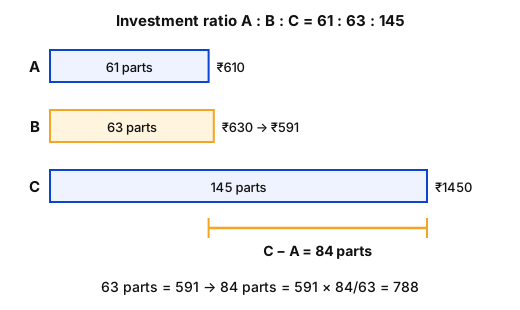
- .
- B's 63 parts → 1 part .
- C − A parts.
- Difference .
Trick: , so the difference is simply of B's share: .
Answer: (D) ₹788
अवधारणा: समान अवधि हो तो लाभ निवेश के अनुपात में बँटता है।
- ।
- B के 63 भाग → 1 भाग ।
- C − A भाग।
- अंतर ।
ट्रिक: , अतः अंतर = B के हिस्से का ।
उत्तर: (D) ₹788
RRB NTPC Undergraduate CBT 1MathematicsPartnershipRRB NTPC Undergraduate CBT 1 2024 · 13 Aug Shift 2
Q1289.A man goes to Indore from Bhopal at a speed of 12 km/hr and returns to Bhopal at speed of 24 km/hr, through the same route. What is his average speed (in km/hr) of the entire journey?
एक व्यक्ति भोपाल से इंदौर 12 km/hr की चाल से जाता है और उसी मार्ग से 24 km/hr की चाल से भोपाल लौटता है। संपूर्ण यात्रा में उसकी औसत चाल (km/hr में) क्या है?
- A12
- B21
- C16
- D11
Show answer
Concept: When equal distances are covered at speeds and , average speed .
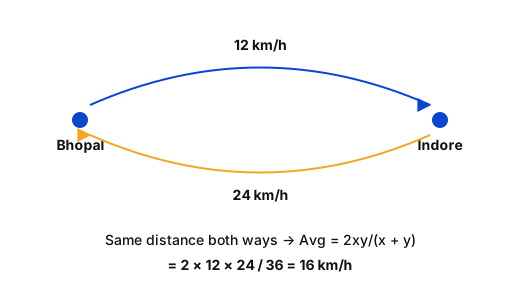
- , .
- Average .
- .
Trick: Assume distance 24 km: time h for 48 km → .
Answer: (C) 16
अवधारणा: समान दूरी और चाल से तय हो तो औसत चाल ।
- , ।
- औसत ।
- ।
ट्रिक: दूरी 24 km मानें: समय घंटे, कुल दूरी 48 km → ।
उत्तर: (C) 16
RRB NTPC Undergraduate CBT 1MathematicsAverage speedRRB NTPC Undergraduate CBT 1 2024 · 13 Aug Shift 2
Q1290.The number of prime numbers lying between 411 and 424, both included, is:
411 और 424 (दोनों सम्मिलित) के बीच स्थित अभाज्य संख्याओं की संख्या है:
- A4
- B3
- C2
- D5
Show answer
Concept: A number is prime if no prime up to its square root divides it (, so test 2, 3, 5, 7, 11, 13, 17, 19).
- Odd numbers 411–423: 411 (), 413 (), 415 (), 417 (), 423 () are composite.
- 419 and 421 have no prime factor up to 19 → prime.
- So there are 2 primes.
Trick: Even numbers and those ending in 5 go out instantly; only test the rest with digit-sum (3), 7, 11, 13, 17, 19.
Answer: (C) 2
अवधारणा: कोई संख्या अभाज्य है यदि उसके वर्गमूल तक की कोई अभाज्य संख्या उसे न विभाजित करे ()।
- विषम संख्याएँ: 411 (), 413 (), 415 (), 417 (), 423 () – भाज्य।
- 419 और 421 का 19 तक कोई अभाज्य गुणनखंड नहीं → अभाज्य।
- अतः कुल 2 अभाज्य संख्याएँ।
ट्रिक: सम संख्याएँ और 5 पर समाप्त होने वाली तुरंत हटाएँ; बाकी को 3, 7, 11, 13, 17, 19 से जाँचें।
उत्तर: (C) 2
RRB NTPC Undergraduate CBT 1MathematicsPrime numbersRRB NTPC Undergraduate CBT 1 2024 · 13 Aug Shift 2
Q1291.The number of prime numbers lying between 476 and 491, both included, is:
476 और 491 (दोनों सहित) के बीच स्थित अभाज्य संख्याओं की संख्या है:
- A4
- B2
- C5
- D3
Show answer
Concept: Test only odd numbers not ending in 5, using primes up to (2, 3, 5, 7, 11, 13, 17, 19).
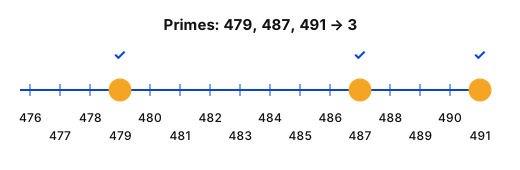
- Odd candidates: 477, 479, 481, 483, 487, 489, 491.
- , , , → composite.
- 479, 487 and 491 have no factor up to 22 → prime.
Trick: Strike out multiples of 3 by digit sum first, then test 7, 11, 13 only for the rest.
Answer: (D) 3
अवधारणा: केवल विषम और 5 पर न खत्म होने वाली संख्याएँ जाँचें, तक के अभाज्यों (2, 3, 5, 7, 11, 13, 17, 19) से।
- विषम संख्याएँ: 477, 479, 481, 483, 487, 489, 491।
- , , , → भाज्य।
- 479, 487, 491 का 22 तक कोई गुणनखंड नहीं → अभाज्य।
ट्रिक: पहले अंकों के योग से 3 के गुणज हटाएँ, फिर बाकी पर 7, 11, 13 जाँचें।
उत्तर: (D) 3
RRB NTPC Undergraduate CBT 1MathematicsNumber System – Prime NumbersRRB NTPC Undergraduate CBT 1 2024 · 13 Aug Shift 1
Q1292.A bus travelling at 75 km/hr completes a journey in 17 hours. What should be its speed to cover the same distance in 5 hours?
75 km/hr की चाल से चलने वाली एक बस किसी यात्रा को 17 घंटे में पूरा करती है। समान दूरी को 5 घंटे में तय करने के लिए उसकी चाल कितनी होनी चाहिए?
- A255 km/hr
- B264 km/hr
- C261 km/hr
- D247 km/hr
Show answer
Concept: For a fixed distance, speed is inversely proportional to time: .
- Distance .
- Required speed .
Trick: .
Answer: (A)
अवधारणा: निश्चित दूरी के लिए चाल समय के व्युत्क्रमानुपाती है: ।
- दूरी ।
- आवश्यक चाल ।
ट्रिक: ।
उत्तर: (A)
RRB NTPC Undergraduate CBT 1MathematicsSpeed, Time and DistanceRRB NTPC Undergraduate CBT 1 2024 · 13 Aug Shift 1
Q1293.Find the value of 48−17÷ 4812× 48−13.
48−17÷ 4812× 48−13 का मान ज्ञात कीजिए।
- A48−34
- B48−37
- C48−35
- D48−42
Show answer
Concept: Same base: and ; work left to right.
- .
- .
Trick: Add powers being multiplied, subtract powers being divided: .
Answer: (D)
अवधारणा: समान आधार: और ; बाएँ से दाएँ हल करें।
- ।
- ।
ट्रिक: गुणा में घात जोड़ें, भाग में घटाएँ: ।
उत्तर: (D)
RRB NTPC Undergraduate CBT 1MathematicsIndices / ExponentsRRB NTPC Undergraduate CBT 1 2024 · 13 Aug Shift 1
Q1294.Sneha, Yash and Rohan invested ₹1,090, ₹1,170 and ₹1,340, respectively to start a business. If the profit at the end of the year is ₹1,620, what is Rohan's share of the profit?
स्नेहा, यश और रोहन ने एक व्यवसाय शुरू करने के लिए क्रमशः ₹1,090, ₹1,170 और ₹1,340 का निवेश किया। यदि वर्ष के अंत में लाभ ₹1,620 है, तो लाभ में रोहन का हिस्सा कितना है?
- A₹603
- B₹605
- C₹606
- D₹602
Show answer
Concept: When time is equal, profit is shared in the ratio of investments.
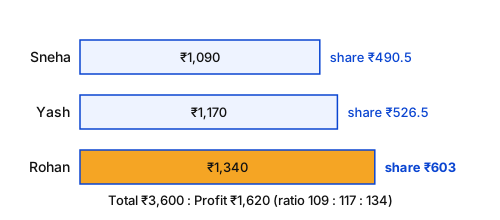
- Ratio ; total parts.
- 1 part .
- Rohan's share rupees.
Trick: Profit is 45% of total capital (₹1,620 of ₹3,600), so Rohan gets .
Answer: (A) ₹603
अवधारणा: समय बराबर हो तो लाभ निवेश के अनुपात में बँटता है।
- अनुपात ; कुल भाग।
- 1 भाग ।
- रोहन का हिस्सा रुपये।
ट्रिक: लाभ कुल पूँजी (₹3,600) का 45% है, अतः रोहन को ।
उत्तर: (A) ₹603
RRB NTPC Undergraduate CBT 1MathematicsPartnershipRRB NTPC Undergraduate CBT 1 2024 · 13 Aug Shift 1
Q1295.The number 587407 is divisible by which of the following?
संख्या 587407 निम्नलिखित में से किससे विभाज्य है?
- A34
- B43
- C41
- D47
Show answer
Concept: Divide by each option (or use factor rules); only an exact quotient works.
- 34 = 2 × 17 needs an even number – 587407 is odd → no.
- exactly ().
- leaves remainder 17; leaves remainder 33.
Trick: Eliminate even divisors instantly for an odd number; then test the rest.
Answer: (C) 41
अवधारणा: प्रत्येक विकल्प से भाग दें; केवल पूर्ण भागफल वाला सही।
- 34 = 2 × 17 के लिए संख्या सम होनी चाहिए – 587407 विषम है → नहीं।
- पूर्णतः ()।
- का शेष 17; का शेष 33।
ट्रिक: विषम संख्या के लिए सम भाजक तुरंत हटाएँ, फिर बाकी जाँचें।
उत्तर: (C) 41
RRB NTPC Undergraduate CBT 1MathematicsNumber System – DivisibilityRRB NTPC Undergraduate CBT 1 2024 · 13 Aug Shift 1
Q1296.On a marked price, the difference between the selling prices with a single discount of 40% and two successive discounts of 15% and 20% is ₹400, then find the marked price (in ₹).
किसी अंकित मूल्य पर, 40% की एकल छूट और 15% तथा 20% की दो क्रमिक छूटों के साथ विक्रय मूल्यों का अंतर ₹400 है, तो अंकित मूल्य (₹ में) ज्ञात कीजिए।
- A₹5,150
- B₹4,900
- C₹5,000
- D₹4,950
Show answer
Concept: Successive discounts and equal a single discount of .
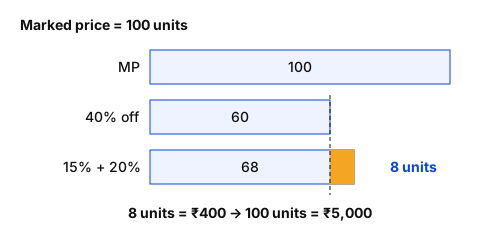
- 15% and 20% → , so SP of MP.
- Single 40% → SP of MP.
- Difference of MP → MP .
Trick: Take MP = 100: SPs are 60 and 68 → 8 units = ₹400.
Answer: (C) ₹5,000
अवधारणा: क्रमागत बट्टे और = एकल बट्टा ।
- 15% और 20% → , अतः SP MP का ।
- एकल 40% → SP MP का ।
- अंतर MP का → MP ।
ट्रिक: MP = 100 लें: SP 60 और 68 → 8 इकाई = ₹400।
उत्तर: (C) ₹5,000
RRB NTPC Undergraduate CBT 1MathematicsDiscount – Successive DiscountsRRB NTPC Undergraduate CBT 1 2024 · 13 Aug Shift 1
Q1297.Find the volume of the cylinder whose height and radius are 7 cm and 3 cm, respectively (use ).
उस बेलन का आयतन ज्ञात कीजिए जिसकी ऊँचाई और त्रिज्या क्रमशः 7 cm और 3 cm हैं ( का प्रयोग कीजिए)।
- A193.58 cm3
- B190.01 cm3
- C195.68 cm3
- D197.82 cm3
Show answer
Concept: Volume of a cylinder .
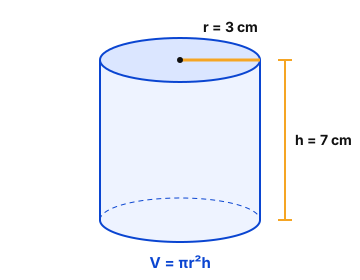
- , , .
- .
- .
Trick: : , → .
Answer: (D)
अवधारणा: बेलन का आयतन ।
- , , ।
- ।
- ।
ट्रिक: , → ।
उत्तर: (D)
RRB NTPC Undergraduate CBT 1MathematicsMensuration – CylinderRRB NTPC Undergraduate CBT 1 2024 · 13 Aug Shift 1
Q1298.By selling 6 articles for a rupee, a man loses 30%. To gain 40% how many must he sell for a rupee?
एक रुपये में 6 वस्तुएँ बेचने पर एक व्यक्ति को 30% की हानि होती है। 40% लाभ प्राप्त करने के लिए उसे एक रुपये में कितनी वस्तुएँ बेचनी चाहिए?
- A5
- B4
- C2
- D3
Show answer
Concept: For the same money (₹1), the number of articles sold is inversely proportional to the SP per article: .
- .
- → .
Trick: Loss 30% → 70; gain 40% → 140 = double, so articles become half: .
Answer: (D) 3
अवधारणा: निश्चित विक्रय मूल्य (₹1) पर: ।
- ।
- → ।
ट्रिक: हानि 30% → 70; लाभ 40% → 140 = दोगुना, अतः वस्तुएँ आधी: ।
उत्तर: (D) 3
RRB NTPC Undergraduate CBT 1MathematicsProfit and LossRRB NTPC Undergraduate CBT 1 2024 · 13 Aug Shift 1
Q1299.The marks scored by 10 students are given below.
19, 14, 11, 20, 18, 17, 14, 10, 11, 11
The mode of the given data is:
10 विद्यार्थियों द्वारा प्राप्त अंक नीचे दिए गए हैं।
19, 14, 11, 20, 18, 17, 14, 10, 11, 11
दिए गए आँकड़ों का बहुलक (mode) है:
- A19
- B14
- C11
- D20
Show answer
Concept: Mode is the value that occurs most often.
- Frequencies: 10→1, 11→3, 14→2, 17→1, 18→1, 19→1, 20→1.
- 11 occurs 3 times – the highest frequency.
Trick: Sort first: 10, 11, 11, 11, 14, 14, … – the longest run is the mode.
Answer: (C) 11
अवधारणा: बहुलक (mode) वह मान है जो सबसे अधिक बार आता है।
- बारंबारता: 10→1, 11→3, 14→2, 17→1, 18→1, 19→1, 20→1।
- 11 तीन बार आता है – सर्वाधिक।
ट्रिक: क्रम में लगाएँ: 10, 11, 11, 11, 14, 14, … – सबसे लंबी श्रृंखला = बहुलक।
उत्तर: (C) 11
RRB NTPC Undergraduate CBT 1MathematicsStatistics – ModeRRB NTPC Undergraduate CBT 1 2024 · 13 Aug Shift 1
Q1300.Shivam got an increase of 4% in his sales amount in the first year and 25% in the second year; also with this, his current sales are ₹1,40,400, what was his sales (in ₹) two years ago?
शिवम की बिक्री राशि में पहले वर्ष 4% और दूसरे वर्ष 25% की वृद्धि हुई; इसके साथ, उसकी वर्तमान बिक्री ₹1,40,400 है, तो दो वर्ष पहले उसकी बिक्री (₹ में) कितनी थी?
- A₹88,000
- B₹1,12,320
- C₹1,35,000
- D₹1,08,000
Show answer
Concept: Successive increases multiply: final .
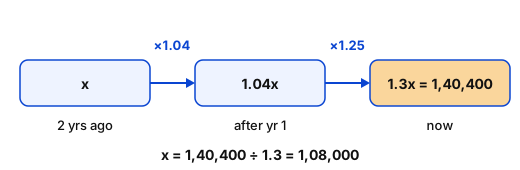
- .
- → .
- Sales two years ago = ₹1,08,000.
Trick: then → net rise.
Answer: (D) ₹1,08,000
अवधारणा: क्रमागत वृद्धि गुणा होती है: अंतिम ।
- ।
- → ।
- दो वर्ष पहले बिक्री = ₹1,08,000।
ट्रिक: फिर → कुल वृद्धि।
उत्तर: (D) ₹1,08,000
RRB NTPC Undergraduate CBT 1MathematicsPercentage – Successive IncreaseRRB NTPC Undergraduate CBT 1 2024 · 13 Aug Shift 1

