Q1341.A company earns a profit (in ₹) that is distributed among the company's three partners in the ratio of 5 : 8 : 17. If the difference between the smallest and the largest shares is ₹78,106, the total profit (in ₹) of the company is:
एक कंपनी लाभ (₹ में) अर्जित करती है जिसे कंपनी के तीन साझेदारों के बीच 5 : 8 : 17 के अनुपात में वितरित किया जाता है। यदि सबसे छोटे और सबसे बड़े हिस्सों के बीच का अंतर ₹78,106 है, तो कंपनी का कुल लाभ (₹ में) है:
- A1,95,278
- B1,95,361
- C1,95,302
- D1,95,265
Show answer
Concept: The difference of ratio terms equals the given difference; scale up to the total.
- Ratio , total parts.
- Largest − smallest parts
- Total
Trick: – multiply the difference by 2.5 directly.
Answer: (D) ₹1,95,265
अवधारणा: अनुपात के पदों का अंतर दिए गए अंतर के बराबर रखकर कुल निकालें।
- अनुपात , कुल भाग
- सबसे बड़ा − सबसे छोटा भाग
- कुल
ट्रिक: – अंतर को सीधे 2.5 से गुणा करें।
उत्तर: (D) ₹1,95,265
RRB NTPC Undergraduate CBT 1MathematicsRatio – partnership sharesRRB NTPC Undergraduate CBT 1 2024 · 12 Aug Shift 3
Q1342.A man driving a car at a speed of 54 km/hr crosses a bridge in 1.7 minutes. Find the length of the bridge.
54 km/hr की चाल से कार चला रहा एक व्यक्ति 1.7 मिनट में एक पुल पार करता है। पुल की लंबाई ज्ञात कीजिए।
- A2.58 km
- B2.13 km
- C1.53 km
- D0.92 km
Show answer
Concept: Distance = Speed × Time (convert the units first).
- Length
Trick: , so .
Answer: (C) 1.53 km
अवधारणा: दूरी = चाल × समय (पहले इकाइयाँ बदलें)।
- पुल की लंबाई
ट्रिक: , अतः
उत्तर: (C) 1.53 km
RRB NTPC Undergraduate CBT 1MathematicsSpeed, time and distanceRRB NTPC Undergraduate CBT 1 2024 · 12 Aug Shift 3
Q1343.Two cubes of edge 5 cm are joined to form a cuboid. Find the total surface area of the cuboid.
5 cm किनारे वाले दो घनों को जोड़कर एक घनाभ बनाया जाता है। घनाभ का कुल पृष्ठीय क्षेत्रफल ज्ञात कीजिए।
- A25 cm2
- B250 cm2
- C100 cm2
- D125 cm2
Show answer
Concept: Two equal cubes joined face to face form a cuboid ; .
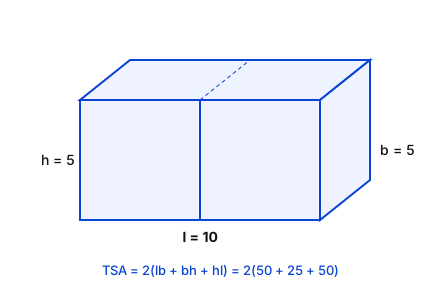
- , , (cm)
Trick: Two cubes have 12 faces; joining hides 2, so TSA .
Answer: (B)
अवधारणा: दो समान घनों को जोड़ने पर का घनाभ बनता है;
- , , (cm)
ट्रिक: दो घनों के 12 फलक; जोड़ने पर 2 छिप जाते हैं, अतः TSA
उत्तर: (B)
RRB NTPC Undergraduate CBT 1MathematicsSurface area of cuboidRRB NTPC Undergraduate CBT 1 2024 · 12 Aug Shift 3
Q1344.Pipe P can fill part of a tank in 24 hours, and pipe Q can fill part of the same tank in 16 hours. Both P and Q were kept open for 4 hours, then both were closed. Pipe R alone was then opened and it emptied the water in the tank in 5 hours. Pipes P, Q and R together can fill the empty tank in:
पाइप P किसी टंकी के भाग को 24 घंटे में भर सकता है, और पाइप Q उसी टंकी के भाग को 16 घंटे में भर सकता है। P और Q दोनों को 4 घंटे तक खुला रखा गया, फिर दोनों को बंद कर दिया गया। इसके बाद केवल पाइप R को खोला गया और उसने टंकी का पानी 5 घंटे में खाली कर दिया। पाइप P, Q और R एक साथ खाली टंकी को कितने समय में भर सकते हैं?
- A72 hours72 घंटे
- B62 hours62 घंटे
- C88 hours88 घंटे
- D79 hours79 घंटे
Show answer
Concept: Convert each pipe to "tank per hour"; filling pipes are +, emptying pipes are −.
- P fills in 24 h → full tank in ; Q: in 16 h → .
- In 4 h, P + Q fill of the tank.
- R empties in 5 h → R empties a full tank in .
- Together: →
Trick: LCM 72 as capacity: P = 2, Q = 3, R = −4 units/h; net unit/h → 72 h.
Answer: (A) 72 hours
अवधारणा: हर नल का "प्रति घंटा कार्य" निकालें; भरने वाला +, खाली करने वाला −।
- P, भाग 24 घंटे में → पूरी टंकी ; Q: भाग 16 घंटे में →
- 4 घंटे में P + Q: भाग
- R, भाग 5 घंटे में खाली करता है → पूरी टंकी में।
- तीनों साथ: →
ट्रिक: क्षमता = LCM 72 इकाई: P = 2, Q = 3, R = −4 इकाई/घंटा; कुल 1 इकाई/घंटा → 72 घंटे।
उत्तर: (A) 72 hours
RRB NTPC Undergraduate CBT 1MathematicsPipes and cisternsRRB NTPC Undergraduate CBT 1 2024 · 12 Aug Shift 3
Q1345.Find the mean proportional between 19 and 76.
19 और 76 का मध्यानुपाती ज्ञात कीजिए।
- A36
- B37
- C38
- D39
Show answer
Concept: Mean proportional of and .
Trick: , so the answer is without multiplying out.
Answer: (C) 38
अवधारणा: और का मध्यानुपाती
ट्रिक: , इसलिए उत्तर सीधे ।
उत्तर: (C) 38
RRB NTPC Undergraduate CBT 1MathematicsMean proportionalRRB NTPC Undergraduate CBT 1 2024 · 12 Aug Shift 3
Q1346.What smallest number should be added to 16809 so that the sum is completely divisible by 41?
16809 में कौन-सी सबसे छोटी संख्या जोड़ी जाए ताकि योगफल 41 से पूर्णतः विभाज्य हो?
- A3
- B2
- C1
- D4
Show answer
Concept: Number to add divisor − remainder.
- , so remainder .
- Number to add
Trick: Look for a round multiple near the number: is just 1 more.
Answer: (C) 1
अवधारणा: जोड़ी जाने वाली संख्या भाजक − शेषफल
- , अतः शेषफल
- जोड़ें
ट्रिक: पास का गोल गुणज देखें: , जो केवल 1 अधिक है।
उत्तर: (C) 1
RRB NTPC Undergraduate CBT 1MathematicsDivisibility – least number to addRRB NTPC Undergraduate CBT 1 2024 · 12 Aug Shift 3
Q1347.The selling price of 16 books is equal to the cost price of 8 books. Find the loss or gain percentage.
16 पुस्तकों का विक्रय मूल्य 8 पुस्तकों के क्रय मूल्य के बराबर है। हानि या लाभ प्रतिशत ज्ञात कीजिए।
- A gain लाभ
- B50% gain50% लाभ
- C50% loss50% हानि
- D loss हानि
Show answer
Concept: If SP of items = CP of items, then .
- SP < CP → loss.
Trick: (negative = loss).
Answer: (C) loss
अवधारणा: यदि वस्तुओं का SP = वस्तुओं का CP, तो
- SP < CP → हानि
ट्रिक: (ऋणात्मक = हानि)।
उत्तर: (C) हानि
RRB NTPC Undergraduate CBT 1MathematicsProfit and loss – SP of n vs CP of mRRB NTPC Undergraduate CBT 1 2024 · 12 Aug Shift 3
Q1348.Find the simple interest (in ₹) if a sum of ₹400 is borrowed for 5.5 years at 4% per annum rate of interest.
यदि ₹400 की राशि 4% वार्षिक ब्याज दर पर 5.5 वर्षों के लिए उधार ली जाती है, तो साधारण ब्याज (₹ में) ज्ञात कीजिए।
- A68
- B138
- C88
- D188
Show answer
Concept:
Trick: of 400 = 16 per year; .
Answer: (C) 88
अवधारणा:
ट्रिक: 400 का = 16 प्रति वर्ष;
उत्तर: (C) 88
RRB NTPC Undergraduate CBT 1MathematicsSimple interestRRB NTPC Undergraduate CBT 1 2024 · 12 Aug Shift 3
Q1349.What is the equivalent single discount for successive discounts of 20% and 10%?
20% और 10% की क्रमिक छूटों के समतुल्य एकल छूट कितनी है?
- A27%
- B25%
- C30%
- D28%
Show answer
Concept: Equivalent discount of and .
Trick: On ₹100: after → 80; after → 72; total discount .
Answer: (D)
अवधारणा: और की समतुल्य छूट
ट्रिक: ₹100 पर: के बाद 80; के बाद 72; कुल छूट ।
उत्तर: (D)
RRB NTPC Undergraduate CBT 1MathematicsSuccessive discountsRRB NTPC Undergraduate CBT 1 2024 · 12 Aug Shift 3
Q1350.A can lay railway track between two given stations in 17 days and B can do the same job in 16 days. With the help of C, they did the job in 4 days only. Then, C alone can do the job in
A दो दिए गए स्टेशनों के बीच रेलवे ट्रैक 17 दिनों में बिछा सकता है और B वही कार्य 16 दिनों में कर सकता है। C की सहायता से, उन्होंने वह कार्य केवल 4 दिनों में पूरा किया। तो, C अकेले वह कार्य कितने दिनों में कर सकता है?
- A days दिन
- B days दिन
- C days दिन
- D days दिन
Show answer
Concept: One day's work of C .
- LCM of 4, 17, 16 .
- C alone days
Trick: Total work 272 units: A = 16, B = 17, all = 68 units/day → C units/day.
Answer: (B) days
अवधारणा: C का एक दिन का कार्य
- 4, 17, 16 का LCM
- C अकेला दिन
ट्रिक: कुल कार्य 272 इकाई: A = 16, B = 17, तीनों = 68 इकाई/दिन → C = 35 इकाई/दिन।
उत्तर: (B) दिन
RRB NTPC Undergraduate CBT 1MathematicsTime and work – finding third workerRRB NTPC Undergraduate CBT 1 2024 · 12 Aug Shift 3
Q1351.The population of a district is 328000, out of which 164000 are males. 24% of the population is literate. If 34% males are literate, then what percentage of females are literate?
एक ज़िले की जनसंख्या 328000 है, जिसमें से 164000 पुरुष हैं। जनसंख्या का 24% साक्षर है। यदि 34% पुरुष साक्षर हैं, तो कितने प्रतिशत महिलाएँ साक्षर हैं?
- A13%
- B11%
- C17%
- D14%
Show answer
Concept: Total literates = male literates + female literates.
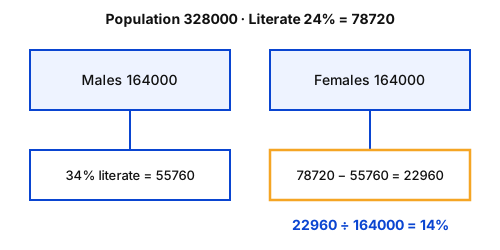
- Females .
- Total literates .
- Male literates .
- Female literates , so .
Trick: Males = females (half each), so average rule: .
Answer: (D)
अवधारणा: कुल साक्षर = साक्षर पुरुष + साक्षर महिलाएँ।
- महिलाएँ ।
- कुल साक्षर ।
- साक्षर पुरुष ।
- साक्षर महिलाएँ , अतः ।
ट्रिक: पुरुष = महिलाएँ (आधे-आधे), इसलिए औसत: ।
उत्तर: (D)
RRB NTPC Undergraduate CBT 1MathematicsPercentageRRB NTPC Undergraduate CBT 1 2024 · 12 Aug Shift 2
Q1352.If the 6-digit number N75M52 is divisible by 11, then which of the options below can give a possible correct relation between M and N?
यदि 6-अंकीय संख्या N75M52, 11 से विभाज्य है, तो नीचे दिए गए विकल्पों में से कौन-सा M और N के बीच संभावित सही संबंध दे सकता है?
- AM = N
- BM - N = 1
- CM + N = -1
- DM - N = 5
Show answer
Concept: A number is divisible by 11 if (sum of digits at odd places) − (sum of digits at even places) is or a multiple of .
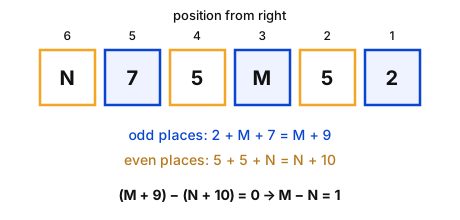
- N75M52 from the right: odd places ; even places .
- Odd sum , even sum .
- Difference .
- For divisibility, (e.g. : ).
Trick: Alternate signs from the right: .
Answer: (B)
अवधारणा: कोई संख्या 11 से विभाज्य है यदि (विषम स्थानों के अंकों का योग) − (सम स्थानों के अंकों का योग) या का गुणज हो।
- N75M52 में दाएँ से: विषम स्थान ; सम स्थान ।
- विषम योग , सम योग ।
- अंतर ।
- विभाज्यता के लिए (जैसे : )।
ट्रिक: दाएँ से बारी-बारी चिह्न: ।
उत्तर: (B)
RRB NTPC Undergraduate CBT 1MathematicsDivisibility rulesRRB NTPC Undergraduate CBT 1 2024 · 12 Aug Shift 2
Q1353.A number, when decreased by 6%, gives 3760. The number is:
एक संख्या को 6% घटाने पर 3760 प्राप्त होता है। वह संख्या है:
- A2000
- B4000
- C12000
- D8000
Show answer
Concept: Decreasing a number by leaves of it.
- .
- .
- .
Trick: , so the number is . Check: of , .
Answer: (B)
अवधारणा: किसी संख्या को घटाने पर उसका बचता है।
- ।
- ।
- ।
ट्रिक: , अतः संख्या । जाँच: का , ।
उत्तर: (B)
RRB NTPC Undergraduate CBT 1MathematicsPercentageRRB NTPC Undergraduate CBT 1 2024 · 12 Aug Shift 2
Q1354.If the third proportional of 9 and 60 be x, then what is the value of x?
यदि 9 और 60 का तृतीयानुपाती x है, तो x का मान क्या है?
- A398
- B400
- C402
- D401
Show answer
Concept: The third proportional of and satisfies , i.e. .
- .
- .
- .
Trick: Third proportional .
Answer: (B)
अवधारणा: और का तृतीयानुपाती हो तो , यानी ।
- ।
- ।
- ।
ट्रिक: ।
उत्तर: (B)
RRB NTPC Undergraduate CBT 1MathematicsRatio and proportionRRB NTPC Undergraduate CBT 1 2024 · 12 Aug Shift 2
Q1355.The product of two consecutive natural numbers is 552. The greater of the two numbers is:
दो क्रमागत प्राकृत संख्याओं का गुणनफल 552 है। दोनों में से बड़ी संख्या है:
- A24
- B18
- C15
- D27
Show answer
Concept: For consecutive numbers , is close to .
- , so try and .
- . ✓
- Greater number .
Trick: Unit digit 2 needs ends like or ; near only fits.
Answer: (A)
अवधारणा: क्रमागत संख्याओं के लिए , तो लगभग होता है।
- , अतः और जाँचें।
- ✓
- बड़ी संख्या ।
ट्रिक: इकाई अंक 2 के लिए या जैसे अंत; के पास केवल ।
उत्तर: (A)
RRB NTPC Undergraduate CBT 1MathematicsNumber systemRRB NTPC Undergraduate CBT 1 2024 · 12 Aug Shift 2
Q1356.Which of the following numbers divides 6,30,605?
निम्नलिखित में से कौन-सी संख्या 6,30,605 को विभाजित करती है?
- A3
- B5
- C7
- D14
Show answer
Concept: Use quick divisibility tests on .
- By 5: last digit is → divisible ✓.
- By 3: digit sum , not a multiple of → no.
- By 14: an odd number cannot be divisible by (even). By 7: → no.
Trick: Last digit 0 or 5 → divisible by 5 at a glance.
Answer: (B)
अवधारणा: पर विभाज्यता के नियम लगाएँ।
- 5 से: अंतिम अंक है → विभाज्य ✓।
- 3 से: अंकों का योग , का गुणज नहीं → नहीं।
- 14 से: विषम संख्या (सम) से विभाज्य नहीं। 7 से: → नहीं।
ट्रिक: अंतिम अंक 0 या 5 → तुरंत 5 से विभाज्य।
उत्तर: (B)
RRB NTPC Undergraduate CBT 1MathematicsDivisibility rulesRRB NTPC Undergraduate CBT 1 2024 · 12 Aug Shift 2
Q1357.What is the perimeter of an equilateral triangle with side 13 cm?
13 cm भुजा वाले एक समबाहु त्रिभुज का परिमाप क्या है?
- A52 cm
- B39 cm
- C40 cm
- D26 cm
Show answer
Concept: All three sides of an equilateral triangle are equal, so perimeter .
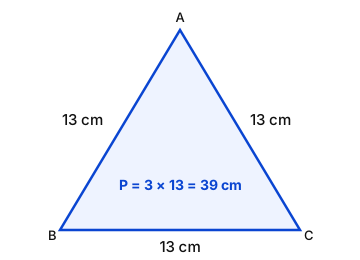
- Side .
- Perimeter .
Trick: Equilateral: ; square: .
Answer: (B)
अवधारणा: समबाहु त्रिभुज की तीनों भुजाएँ बराबर होती हैं, अतः परिमाप ।
- भुजा ।
- परिमाप ।
ट्रिक: समबाहु त्रिभुज: ; वर्ग: ।
उत्तर: (B)
RRB NTPC Undergraduate CBT 1MathematicsMensuration – triangleRRB NTPC Undergraduate CBT 1 2024 · 12 Aug Shift 2
Q1358.The LCM of 33 × 82 × 13, 32 × 132 × 16 and 83 × 132 × 162 is:
33 × 82 × 13, 32 × 132 × 16 और 83 × 132 × 162 का LCM है:
- A33 × 83 × 132 × 162
- B33 × 82 × 132 × 16
- C32 × 83 × 13 × 162
- D32 × 82 × 132 × 163
Show answer
Concept: LCM = product of each factor with its highest power appearing in the numbers.
- Highest power of : ; of : ; of : ; of : .
- So LCM .
- Check with primes: -powers are ; highest – same result.
Trick: LCM → highest powers; HCF → lowest powers.
Answer: (A)
अवधारणा: LCM = प्रत्येक गुणनखंड की संख्याओं में आने वाली सबसे बड़ी घात का गुणनफल।
- की सबसे बड़ी घात ; की ; की ; की ।
- अतः LCM ।
- अभाज्य रूप से जाँच: की घातें ; सबसे बड़ी – वही उत्तर।
ट्रिक: LCM → सबसे बड़ी घातें; HCF → सबसे छोटी घातें।
उत्तर: (A)
RRB NTPC Undergraduate CBT 1MathematicsLCMRRB NTPC Undergraduate CBT 1 2024 · 12 Aug Shift 2
Q1359.The number 253118139 is divisible by which of the following?
संख्या 253118139 निम्नलिखित में से किससे विभाज्य है?
- A3
- B12
- C5
- D8
Show answer
Concept: Apply divisibility tests to .
- By 3: digit sum , a multiple of → divisible ✓.
- By 5: last digit → no. By 8: last three digits not divisible by → no.
- By 12: needs divisibility by 4 and 3; the number is odd → no.
Trick: Odd number → straight away not divisible by 8 or 12.
Answer: (A)
अवधारणा: पर विभाज्यता के नियम लगाएँ।
- 3 से: अंकों का योग , का गुणज → विभाज्य ✓।
- 5 से: अंतिम अंक → नहीं। 8 से: अंतिम तीन अंक , से विभाज्य नहीं → नहीं।
- 12 से: 4 और 3 दोनों से विभाज्यता चाहिए; संख्या विषम है → नहीं।
ट्रिक: विषम संख्या → 8 या 12 से सीधे विभाज्य नहीं।
उत्तर: (A)
RRB NTPC Undergraduate CBT 1MathematicsDivisibility rulesRRB NTPC Undergraduate CBT 1 2024 · 12 Aug Shift 2
Q1360.The average of first 169 even numbers is
प्रथम 169 सम संख्याओं का औसत है
- A170
- B171
- C169.5
- D170.5
Show answer
Concept: Sum of first even numbers , so their average .
- First 169 even numbers: .
- Average .
- Also, average .
Trick: Average of first even numbers ; of first odd numbers .
Answer: (A)
अवधारणा: पहली सम संख्याओं का योग , अतः औसत ।
- पहली 169 सम संख्याएँ: ।
- औसत ।
- या, ।
ट्रिक: पहली सम संख्याओं का औसत ; पहली विषम संख्याओं का ।
उत्तर: (A)
RRB NTPC Undergraduate CBT 1MathematicsAverageRRB NTPC Undergraduate CBT 1 2024 · 12 Aug Shift 2

