Q1381.Town H is to the east of town R and to the north of town D. Town E is southeast of town H. In which direction is town D with respect to town R?
नगर H, नगर R के पूर्व में और नगर D के उत्तर में है। नगर E, नगर H के दक्षिण-पूर्व में है। नगर R के सापेक्ष नगर D किस दिशा में है?
- ASoutheastदक्षिण-पूर्व
- BSouthwestदक्षिण-पश्चिम
- CNorthउत्तर
- DWestपश्चिम
Show answer
Concept: Place the towns on a grid from the given relations.
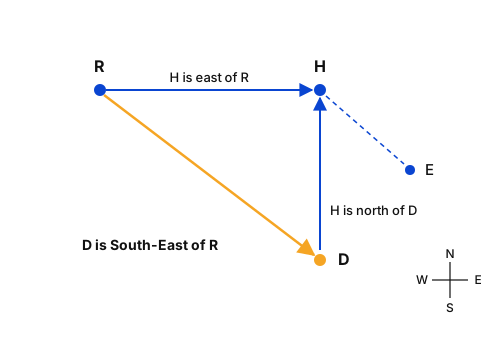
- H is east of R → H on R's right
- D is south of H → D is below H
- So D is to the east and to the south of R → South-East (E is not needed)
Trick: East + South together = South-East.
Answer: (A) Southeast
अवधारणा: दिए गए संबंधों से नगरों को ग्रिड पर रखें।
- H, R के पूर्व में
- D, H के दक्षिण में (H, D के उत्तर में)
- अतः D, R के पूर्व और दक्षिण दोनों में → दक्षिण-पूर्व (E की जरूरत नहीं)
ट्रिक: पूर्व + दक्षिण = दक्षिण-पूर्व।
उत्तर: (A) दक्षिण-पूर्व (Southeast)
RRB NTPC Undergraduate CBT 1General Intelligence and ReasoningDirection SenseRRB NTPC Undergraduate CBT 1 2024 · 12 Aug Shift 1
Q1382.Refer to the following number and symbol series and answer the question that follows. Counting to be done from left to right only.
(Left) > 5 * \ + 9 & 6 # 6 4 $ & / @ # $ & 8 3 < (Right)
How many such symbols are there that are immediately preceded by a number and also immediately followed by another symbol?
निम्नलिखित संख्या और प्रतीक श्रृंखला का संदर्भ लीजिए और उसके बाद दिए गए प्रश्न का उत्तर दीजिए। गिनती केवल बाएँ से दाएँ की जानी है।
(बाएँ) > 5 * \ + 9 & 6 # 6 4 $ & / @ # $ & 8 3 < (दाएँ)
ऐसे कितने प्रतीक हैं जिनके ठीक पहले एक संख्या है और ठीक बाद एक अन्य प्रतीक भी है?
- AFourचार
- BTwoदो
- COneएक
- DThreeतीन
Show answer
Concept: Check every symbol: the element just before must be a number and the one just after must be a symbol.
- 5 * \ → * qualifies
- 4 $ & → $ qualifies
- Others fail: 9 & 6, 6 # 6 (followed by numbers); 3 < has nothing after it
Trick: Scan for the pattern number-symbol-symbol only.
Answer: (B) Two
अवधारणा: हर प्रतीक जाँचें: ठीक पहले संख्या और ठीक बाद प्रतीक होना चाहिए।
- 5 * \ → * सही
- 4 $ & → $ सही
- बाकी नहीं: 9 & 6, 6 # 6 (बाद में संख्या); 3 < के बाद कुछ नहीं
ट्रिक: केवल संख्या-प्रतीक-प्रतीक पैटर्न खोजें।
उत्तर: (B) दो (Two)
RRB NTPC Undergraduate CBT 1General Intelligence and ReasoningSymbol-Number SeriesRRB NTPC Undergraduate CBT 1 2024 · 12 Aug Shift 1
Q1383.A, B, C, D, Q, R and S are sitting around a circular table, facing the centre of the table. Q sits to the immediate right of D. Only three people sit between Q and S, when counted from the left of Q. Only three people sit between D and C. A sits to the immediate right of R. How many people sit between D and R, when counted from the right of R?
A, B, C, D, Q, R और S एक वृत्ताकार मेज़ के चारों ओर मेज़ के केंद्र की ओर मुख करके बैठे हैं। Q, D के ठीक दाएँ बैठा है। Q के बाएँ से गिनने पर, Q और S के बीच केवल तीन व्यक्ति बैठे हैं। D और C के बीच केवल तीन व्यक्ति बैठे हैं। A, R के ठीक दाएँ बैठा है। R के दाएँ से गिनने पर, D और R के बीच कितने व्यक्ति बैठे हैं?
- AOneएक
- BFourचार
- CThreeतीन
- DTwoदो
Show answer
Concept: Facing the centre: right = anticlockwise, left = clockwise.
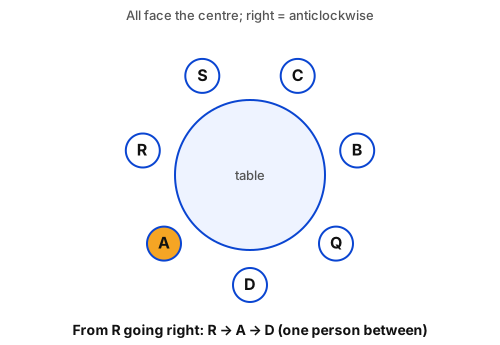
- Q is immediately right of D; going left (clockwise) from Q, three people sit before S
- Three people between D and C; one such seat is S's, so C sits next to S
- A is immediately right of R → R and A take the two seats left after D, i.e. order to the right: D, Q, B, C, S, R, A
- From R going right: R → A → D → one person (A) between
Trick: Always draw the circle and mark right/left as anticlockwise/clockwise first.
Answer: (A) One
अवधारणा: केंद्र की ओर मुख: दायाँ = वामावर्त (anticlockwise), बायाँ = दक्षिणावर्त।
- Q, D के ठीक दाएँ; Q के बाएँ गिनने पर तीन व्यक्तियों के बाद S
- D और C के बीच तीन व्यक्ति → C, S के बगल में
- A, R के ठीक दाएँ → दाएँ क्रम: D, Q, B, C, S, R, A
- R के दाएँ से: R → A → D → बीच में एक (A)
ट्रिक: पहले वृत्त बनाकर दायाँ/बायाँ दिशा तय करें।
उत्तर: (A) एक (One)
RRB NTPC Undergraduate CBT 1General Intelligence and ReasoningCircular Seating ArrangementRRB NTPC Undergraduate CBT 1 2024 · 12 Aug Shift 1
Q1384.In the following triads, each group of letters is related to the subsequent one following a certain logic. Select from the given options, the one which follows the same logic. JUNK - UJNK - KUJN
LACK - ALCK - KALC
निम्नलिखित त्रिकों में, अक्षरों का प्रत्येक समूह एक निश्चित तर्क का अनुसरण करते हुए अगले समूह से संबंधित है। दिए गए विकल्पों में से उस विकल्प का चयन कीजिए जो समान तर्क का अनुसरण करता है। JUNK - UJNK - KUJN
LACK - ALCK - KALC
- ABUNS - UBNS - SUNB
- BMOST - OMST - OSTM
- CFROM - RFOM - MRFO
- DMOCK - MCOK - KCOM
Show answer
Concept: Step 1: swap the first two letters. Step 2: move the last letter to the front.
- JUNK → UJNK → KUJN; LACK → ALCK → KALC
- FROM → RFOM → MRFO ✓
- BUNS → UBNS should give SUBN, not SUNB; MOST → OMST should give TOMS
Trick: Check both steps on every option; most options break at step 2.
Answer: (C) FROM - RFOM - MRFO
अवधारणा: चरण 1: पहले दो अक्षर अदला-बदली। चरण 2: अंतिम अक्षर आगे लाएँ।
- JUNK → UJNK → KUJN; LACK → ALCK → KALC
- FROM → RFOM → MRFO ✓
- BUNS → UBNS से SUBN बनना चाहिए, SUNB नहीं
ट्रिक: हर विकल्प पर दोनों चरण जाँचें।
उत्तर: (C) FROM - RFOM - MRFO
RRB NTPC Undergraduate CBT 1General Intelligence and ReasoningLetter Analogy (Triads)RRB NTPC Undergraduate CBT 1 2024 · 12 Aug Shift 1
Q1385.If + means −, − means ×, × means ÷ and ÷ means +, then what will come in place of the question mark (?) in the following equation?
51 + 8 − 8 ÷ 80 × 4 = ?
यदि + का अर्थ −, − का अर्थ ×, × का अर्थ ÷ और ÷ का अर्थ + है, तो निम्नलिखित समीकरण में प्रश्न चिह्न (?) के स्थान पर क्या आएगा?
51 + 8 − 8 ÷ 80 × 4 = ?
- A26
- B20
- C14
- D7
Show answer
Concept: Replace the symbols, then apply BODMAS.
- becomes
Trick: Do the symbol swap on paper first; never compute with the printed signs.
Answer: (D) 7
अवधारणा: चिह्न बदलें, फिर BODMAS लगाएँ।
ट्रिक: पहले चिह्न बदलकर लिखें, फिर गणना करें।
उत्तर: (D) 7
RRB NTPC Undergraduate CBT 1General Intelligence and ReasoningMathematical OperationsRRB NTPC Undergraduate CBT 1 2024 · 12 Aug Shift 1
Q1386.Based on the English alphabetical order, three of the following four letter-clusters are alike in a certain way and thus form a group. Which letter-cluster DOES NOT belong to that group? (Note: The odd one out is not based on the number of consonants/vowels or their position in the letter-cluster.)
अंग्रेज़ी वर्णमाला क्रम के आधार पर, निम्नलिखित चार अक्षर-समूहों में से तीन किसी निश्चित प्रकार से एकसमान हैं और इस प्रकार एक समूह बनाते हैं। कौन-सा अक्षर-समूह उस समूह से संबंधित नहीं है? (ध्यान दें: असंगत अक्षर-समूह, उस अक्षर-समूह में व्यंजनों/स्वरों की संख्या या उनके स्थान पर आधारित नहीं है।)
- AOJR
- BJEM
- CGBI
- DLGO
Show answer
Concept: Find the position gaps between consecutive letters.
- OJR: ; JEM: ; LGO:
- GBI: G → B is but B → I is
- So GBI is odd
Trick: Write letter positions (O = 15, J = 10, R = 18) to see gaps quickly.
Answer: (C) GBI
अवधारणा: क्रमागत अक्षरों के स्थानीय अंतर देखें।
- OJR: ; JEM: ; LGO:
- GBI: G → B , पर B → I
- अतः GBI भिन्न
ट्रिक: अक्षरों के स्थान (O = 15, J = 10, R = 18) लिखकर अंतर देखें।
उत्तर: (C) GBI
RRB NTPC Undergraduate CBT 1General Intelligence and ReasoningOdd One Out (Letters)RRB NTPC Undergraduate CBT 1 2024 · 12 Aug Shift 1
Q1387.What should come in place of the question mark (?) in the given series?
90 90 91 95 104 ?
दी गई श्रृंखला में प्रश्न चिह्न (?) के स्थान पर क्या आना चाहिए?
90 90 91 95 104 ?
- A122
- B120
- C121
- D119
Show answer
Concept: Differences are perfect squares.
- , , ,
Trick: Differences 0, 1, 4, 9, 16 → squares of 0, 1, 2, 3, 4.
Answer: (B) 120
अवधारणा: अंतर पूर्ण वर्ग हैं।
- , , ,
ट्रिक: अंतर 0, 1, 4, 9, 16 → 0 से 4 तक के वर्ग।
उत्तर: (B) 120
RRB NTPC Undergraduate CBT 1General Intelligence and ReasoningNumber SeriesRRB NTPC Undergraduate CBT 1 2024 · 12 Aug Shift 1
Q1388.In a certain code language, ‘EARS’ is coded as ‘4259’ and ‘SARI’ is coded as ‘9725’. What is the code for ‘I’ in the given code language?
एक निश्चित कूट भाषा में, ‘EARS’ को ‘4259’ और ‘SARI’ को ‘9725’ के रूप में कूटबद्ध किया जाता है। दी गई कूट भाषा में ‘I’ का कूट क्या है?
- A5
- B9
- C2
- D7
Show answer
Concept: Letters common to both words share the common digits.
- EARS = 4259, SARI = 9725
- Common letters S, A, R ↔ common digits 2, 5, 9
- Left: E = 4 and I = 7
Trick: Cancel common letters with common digits; what remains pairs up.
Answer: (D) 7
अवधारणा: दोनों शब्दों के समान अक्षरों के कोड भी समान अंक होंगे।
- EARS = 4259, SARI = 9725
- समान अक्षर S, A, R ↔ समान अंक 2, 5, 9
- बचे: E = 4 और I = 7
ट्रिक: समान अक्षर-अंक हटाएँ; जो बचे वही जोड़ी है।
उत्तर: (D) 7
RRB NTPC Undergraduate CBT 1General Intelligence and ReasoningCoding-DecodingRRB NTPC Undergraduate CBT 1 2024 · 12 Aug Shift 1
Q1389.Seven boxes A, B, C, D, E, F and G are kept one over the other but not necessarily in the same order. Only three boxes are kept below F. Only two boxes are kept between F and A. Only D is kept immediately above B. C is kept at some place below G and at some place above E. How many boxes are kept between B and F?
सात बक्से A, B, C, D, E, F और G एक के ऊपर एक रखे गए हैं, लेकिन आवश्यक नहीं कि इसी क्रम में हों। F के नीचे केवल तीन बक्से रखे गए हैं। F और A के बीच केवल दो बक्से रखे गए हैं। B के ठीक ऊपर केवल D रखा गया है। C, G के नीचे किसी स्थान पर और E के ऊपर किसी स्थान पर रखा गया है। B और F के बीच कितने बक्से रखे गए हैं?
- A4
- B1
- C2
- D3
Show answer
Concept: Number the positions 1 (bottom) to 7 (top), fix the certain boxes first, then check whether the clues give one unique stack.
- Three boxes below F F = 4. Two boxes between F and A A = 1 or 7.
- D is immediately above B, and E is below C which is below G.
- Several stacks satisfy every clue (bottom to top): A, B, D, F, E, C, G gives 1 box between B and F; B, D, E, F, C, G, A gives 2; A, E, C, F, B, D, G gives 0.
- Options 1 and 2 are both possible, so the answer is not unique as printed.
Note: In "how many" arrangement questions, try to build a second valid stack; if it gives a different count, the answer is not unique. In the exam, every candidate gets full marks (bonus) for such a question.
Answer: Bonus – no option is correct as printed; full marks to all.
अवधारणा: स्थानों को 1 (सबसे नीचे) से 7 (सबसे ऊपर) तक क्रमांकित करें, पहले निश्चित बॉक्स रखें, फिर देखें कि शर्तों से एक ही व्यवस्था बनती है या नहीं।
- F के नीचे तीन बॉक्स F = 4। F और A के बीच दो बॉक्स A = 1 या 7।
- D, B के ठीक ऊपर है; E, C के नीचे और C, G के नीचे है।
- कई व्यवस्थाएँ सभी शर्तें पूरी करती हैं (नीचे से ऊपर): A, B, D, F, E, C, G में B और F के बीच 1 बॉक्स; B, D, E, F, C, G, A में 2; A, E, C, F, B, D, G में 0।
- विकल्प 1 और 2 दोनों संभव हैं, इसलिए छपे प्रश्न का उत्तर अद्वितीय नहीं है।
नोट: "कितने" वाले व्यवस्था-प्रश्न में दूसरी मान्य व्यवस्था बनाकर देखें; अलग गिनती आए तो उत्तर अद्वितीय नहीं। परीक्षा में ऐसे प्रश्न पर सभी अभ्यर्थियों को पूरे अंक (बोनस) दिए जाते हैं।
उत्तर: बोनस – छपे प्रश्न के अनुसार कोई विकल्प सही नहीं; सभी को पूरे अंक।
RRB NTPC Undergraduate CBT 1General Intelligence and ReasoningBox ArrangementRRB NTPC Undergraduate CBT 1 2024 · 12 Aug Shift 1
Q1390.Based on the English alphabetical order, three of the following four letter-clusters are alike in a certain way and thus form a group. Which letter-cluster DOES NOT belong to that group?
(Note: The odd one out is not based on the number of consonants/vowels or their position in the letter-cluster.)
अंग्रेज़ी वर्णमाला क्रम के आधार पर, निम्नलिखित चार अक्षर-समूहों में से तीन किसी निश्चित प्रकार से एकसमान हैं और इस प्रकार एक समूह बनाते हैं। कौन-सा अक्षर-समूह उस समूह से संबंधित नहीं है?
(ध्यान दें: असंगत अक्षर-समूह, उस अक्षर-समूह में व्यंजनों/स्वरों की संख्या या उनके स्थान पर आधारित नहीं है।)
- ALNH
- BGIC
- CEGB
- DIKE
Show answer
Concept: Check the gaps between consecutive letters.
- LNH: ; GIC: ; IKE:
- EGB: E → G , G → B
- So EGB is odd
Trick: Use positions: E = 5, G = 7, B = 2.
Answer: (C) EGB
अवधारणा: क्रमागत अक्षरों के अंतर देखें।
- LNH: ; GIC: ; IKE:
- EGB: E → G , G → B
- अतः EGB भिन्न
ट्रिक: स्थान: E = 5, G = 7, B = 2।
उत्तर: (C) EGB
RRB NTPC Undergraduate CBT 1General Intelligence and ReasoningOdd One Out (Letters)RRB NTPC Undergraduate CBT 1 2024 · 12 Aug Shift 1
Q1391.If + means −, − means ×, × means ÷, ÷ means +, then what will come in place of the question mark (?) in the following equation?
18 − 2 + 48 × 4 ÷ 21 = ?
यदि + का अर्थ −, − का अर्थ ×, × का अर्थ ÷, ÷ का अर्थ + है, तो निम्नलिखित समीकरण में प्रश्न चिह्न (?) के स्थान पर क्या आएगा?
18 − 2 + 48 × 4 ÷ 21 = ?
- A35
- B45
- C30
- D40
Show answer
Concept: Replace the symbols, then apply BODMAS.
Trick: Do × and ÷ first, then + and − from left to right.
Answer: (B) 45
अवधारणा: चिह्न बदलें, फिर BODMAS लगाएँ।
ट्रिक: गुणा-भाग पहले, फिर जोड़-घटाव।
उत्तर: (B) 45
RRB NTPC Undergraduate CBT 1General Intelligence and ReasoningMathematical OperationsRRB NTPC Undergraduate CBT 1 2024 · 12 Aug Shift 1
Q1392.Read the given statements and conclusions carefully. Assuming that the information given in the statements is true, even if it appears to be at variance with commonly known facts, decide which of the given conclusion(s) logically follow(s) from the statements.
Statements: All cars are buses. Some cars are trucks.
Conclusions (I): Some trucks are cars.
Conclusions (II): Some buses are cars.
दिए गए कथनों और निष्कर्षों को ध्यानपूर्वक पढ़िए। यह मानते हुए कि कथनों में दी गई जानकारी सत्य है, भले ही वह सामान्यतः ज्ञात तथ्यों से भिन्न प्रतीत होती हो, निर्णय लीजिए कि दिए गए निष्कर्षों में से कौन-सा/कौन-से निष्कर्ष तार्किक रूप से कथनों का अनुसरण करता है/करते हैं।
कथन: सभी कारें, बसें हैं। कुछ कारें, ट्रक हैं।
निष्कर्ष (I): कुछ ट्रक, कारें हैं।
निष्कर्ष (II): कुछ बसें, कारें हैं।
- ANeither conclusion (I) nor (II) follows.न तो निष्कर्ष (I) और न ही (II) अनुसरण करता है।
- BOnly conclusion (I) follows.केवल निष्कर्ष (I) अनुसरण करता है।
- COnly conclusion (II) follows.केवल निष्कर्ष (II) अनुसरण करता है।
- DBoth conclusions (I) and (II) follow.निष्कर्ष (I) और (II) दोनों अनुसरण करते हैं।
Show answer
Concept: A particular statement can be reversed; 'All A are B' gives 'Some B are A'.
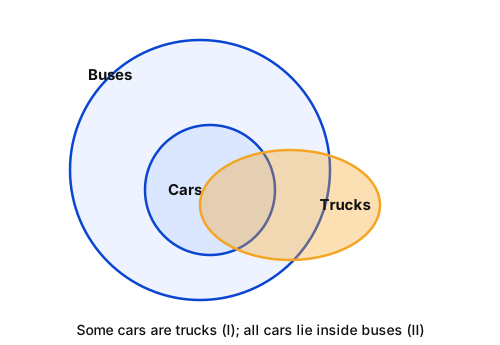
- Some cars are trucks → Some trucks are cars: (I) follows
- All cars are buses → Some buses are cars: (II) follows
Yaad rakhein: Conversion: 'Some A are B' ⇔ 'Some B are A' is always valid.
Answer: (D) Both conclusions (I) and (II) follow.
अवधारणा: विशेष कथन उलटा जा सकता है; 'सभी A, B हैं' से 'कुछ B, A हैं' निकलता है।
- कुछ कारें ट्रक हैं → कुछ ट्रक कारें हैं: (I) सही
- सभी कारें बसें हैं → कुछ बसें कारें हैं: (II) सही
याद रखें: रूपांतरण: 'कुछ A, B हैं' ⇔ 'कुछ B, A हैं' हमेशा सही।
उत्तर: (D) दोनों निष्कर्ष (I) और (II) अनुसरण करते हैं।
RRB NTPC Undergraduate CBT 1General Intelligence and ReasoningSyllogismRRB NTPC Undergraduate CBT 1 2024 · 12 Aug Shift 1
Q1393.In the following triads, each group of letters is related to the subsequent one following a certain logic. Select from the given options, the one which follows the same logic. COME - OCME - EOCM
NEAT - ENAT - TENA
निम्नलिखित त्रिकों में, अक्षरों का प्रत्येक समूह एक निश्चित तर्क का अनुसरण करते हुए अगले समूह से संबंधित है। दिए गए विकल्पों में से उस विकल्प का चयन कीजिए जो समान तर्क का अनुसरण करता है। COME - OCME - EOCM
NEAT - ENAT - TENA
- ASANK - ASNK - KASN
- BGONE - OGNE - EONG
- CDOST - DSOT - TSOD
- DHEAT - EHAT - EATH
Show answer
Concept: Step 1: swap the first two letters. Step 2: move the last letter to the front.
- COME → OCME → EOCM; NEAT → ENAT → TENA
- SANK → ASNK → KASN ✓
- GONE → OGNE should give EOGN; HEAT → EHAT should give TEHA
Trick: Check step 2 carefully – the rest of the word keeps its order.
Answer: (A) SANK - ASNK - KASN
अवधारणा: चरण 1: पहले दो अक्षर अदला-बदली। चरण 2: अंतिम अक्षर आगे।
- COME → OCME → EOCM; NEAT → ENAT → TENA
- SANK → ASNK → KASN ✓
- GONE → OGNE से EOGN बनना चाहिए
ट्रिक: चरण 2 में बाकी अक्षरों का क्रम न बदलें।
उत्तर: (A) SANK - ASNK - KASN
RRB NTPC Undergraduate CBT 1General Intelligence and ReasoningLetter Analogy (Triads)RRB NTPC Undergraduate CBT 1 2024 · 12 Aug Shift 1
Q1394.Select the set in which the numbers are related in the same way as are the numbers of the following sets.
(NOTE: Operations should be performed on the whole numbers, without breaking down the numbers into their constituent digits. E.g. 13 – Operations on 13 such as adding to/subtracting from/multiplying with 13 can be performed. Breaking down 13 into 1 and 3 and then performing mathematical operations on 1 and 3 is not allowed.)
(38, 12, 456)
(44, 11, 484)
उस समुच्चय का चयन कीजिए जिसमें संख्याएँ उसी प्रकार संबंधित हैं, जिस प्रकार निम्नलिखित समुच्चयों की संख्याएँ संबंधित हैं।
(ध्यान दें: संख्याओं को उनके घटक अंकों में विभाजित किए बिना, पूर्ण संख्याओं पर संक्रियाएँ की जानी चाहिए। उदाहरण के लिए, 13 – 13 पर संक्रियाएँ जैसे 13 में जोड़ना/घटाना/गुणा करना आदि की जा सकती हैं। 13 को 1 और 3 में विभाजित करके फिर 1 और 3 पर गणितीय संक्रियाएँ करने की अनुमति नहीं है।)
(38, 12, 456)
(44, 11, 484)
- A(67, 5, 365)
- B(38, 8, 304)
- C(61, 4, 254)
- D(43, 6, 278)
Show answer
Concept: Third number = first × second.
- ,
- ✓
- , , ✗
Trick: Unit digits: → 4 matches 304.
Answer: (B) (38, 8, 304)
अवधारणा: तीसरी संख्या = पहली × दूसरी।
- ,
- ✓
- , , ✗
ट्रिक: इकाई अंक: → 4, जो 304 से मेल खाता है।
उत्तर: (B) (38, 8, 304)
RRB NTPC Undergraduate CBT 1General Intelligence and ReasoningNumber AnalogyRRB NTPC Undergraduate CBT 1 2024 · 12 Aug Shift 1
Q1395.Harry starts from Point A and drives 1 km towards the south. He then takes a right turn and drives 7 km, then turns right and drives 8 km. He then takes a right turn and drives 15 km. He takes a final right turn, drives 7 km and stops at Point P. How far (shortest distance) and in which direction should he drive in order to reach Point A again? (All turns are 90-degree turns only unless specified.)
हैरी बिंदु A से चलना शुरू करता है और दक्षिण की ओर 1 km गाड़ी चलाता है। फिर वह दाएँ मुड़ता है और 7 km गाड़ी चलाता है, फिर दाएँ मुड़ता है और 8 km गाड़ी चलाता है। फिर वह दाएँ मुड़ता है और 15 km गाड़ी चलाता है। वह अंतिम बार दाएँ मुड़ता है, 7 km गाड़ी चलाता है और बिंदु P पर रुक जाता है। फिर से बिंदु A तक पहुँचने के लिए उसे कितनी दूरी (न्यूनतम दूरी) और किस दिशा में गाड़ी चलानी चाहिए? (जब तक निर्दिष्ट न हो, सभी मोड़ केवल 90 डिग्री के मोड़ हैं।)
- A8 km to the westपश्चिम की ओर 8 km
- B10 km to the westपश्चिम की ओर 10 km
- C9 km to the westपश्चिम की ओर 9 km
- D5 km to the westपश्चिम की ओर 5 km
Show answer
Concept: Track net horizontal and vertical movement.
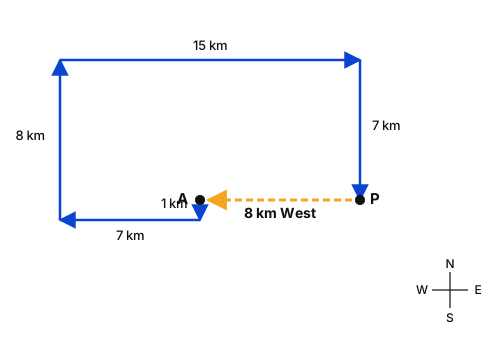
- South 1, right → West 7, right → North 8, right → East 15, right → South 7
- Vertical:
- Horizontal: km East
- P is 8 km east of A → drive 8 km to the West
Trick: Net zero vertical means the answer is a pure East/West distance.
Answer: (A) 8 km to the west
अवधारणा: कुल क्षैतिज और ऊर्ध्वाधर विस्थापन निकालें।
- दक्षिण 1, दाएँ → पश्चिम 7, दाएँ → उत्तर 8, दाएँ → पूर्व 15, दाएँ → दक्षिण 7
- ऊर्ध्वाधर:
- क्षैतिज: km पूर्व
- P, A से 8 km पूर्व → 8 km पश्चिम जाना होगा
ट्रिक: ऊर्ध्वाधर शून्य हो तो उत्तर केवल पूर्व/पश्चिम दूरी है।
उत्तर: (A) 8 km पश्चिम
RRB NTPC Undergraduate CBT 1General Intelligence and ReasoningDirection and DistanceRRB NTPC Undergraduate CBT 1 2024 · 12 Aug Shift 1
Q1396.Seven boxes U, V, W, X, E, F and G are kept one over the other but not necessarily in the same order.
Only two boxes are kept between V and X. Only W is kept above F. No box is kept below X. E is kept at some place below G but at some place above U. Which box is kept third above U?
सात बक्से U, V, W, X, E, F और G एक के ऊपर एक रखे गए हैं, लेकिन आवश्यक नहीं कि इसी क्रम में हों।
V और X के बीच केवल दो बक्से रखे गए हैं। F के ऊपर केवल W रखा गया है। X के नीचे कोई बक्सा नहीं रखा गया है। E, G के नीचे किसी स्थान पर लेकिन U के ऊपर किसी स्थान पर रखा गया है। U से तीसरे स्थान ऊपर कौन-सा बक्सा रखा गया है?
- AX
- BG
- CE
- DW
Show answer
Concept: Number positions 1 (bottom) to 7 (top).
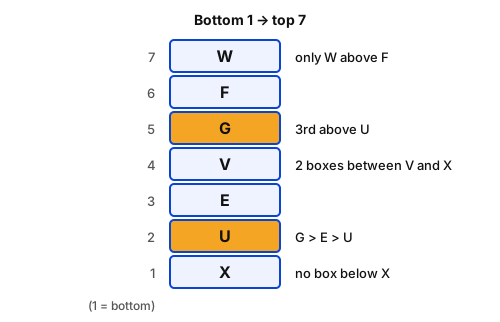
- No box below X → X = 1; two between V and X → V = 4
- Only W above F → W = 7, F = 6
- G above E above U in 2, 3, 5 → U = 2, E = 3, G = 5
- Third above U (2) is position 5 → G
Trick: 'No box below' = bottom; 'only one above' = second from top.
Answer: (B) G
अवधारणा: स्थान 1 (नीचे) से 7 (ऊपर) मानें।
- X के नीचे कोई नहीं → X = 1; V और X के बीच दो → V = 4
- केवल W, F के ऊपर → W = 7, F = 6
- G > E > U, स्थान 2, 3, 5 में → U = 2, E = 3, G = 5
- U (2) से तीसरा ऊपर = स्थान 5 → G
ट्रिक: 'नीचे कोई नहीं' = सबसे नीचे; 'केवल एक ऊपर' = ऊपर से दूसरा।
उत्तर: (B) G
RRB NTPC Undergraduate CBT 1General Intelligence and ReasoningBox ArrangementRRB NTPC Undergraduate CBT 1 2024 · 12 Aug Shift 1
Q1397.Read the given statements and conclusions carefully. Assuming that the information given in the statements is true, even if it appears to be at variance with commonly known facts, decide which of the given conclusion(s) logically follow(s) from the statements.
Statements:
All trams are cows.
No cow is a bun.
Conclusions:
(I): No tram is a bun.
(II): Some buns are cows.
दिए गए कथनों और निष्कर्षों को ध्यानपूर्वक पढ़िए। यह मानते हुए कि कथनों में दी गई जानकारी सत्य है, भले ही वह सामान्यतः ज्ञात तथ्यों से भिन्न प्रतीत होती हो, निर्णय लीजिए कि दिए गए निष्कर्षों में से कौन-सा/कौन-से निष्कर्ष तार्किक रूप से कथनों का अनुसरण करता है/करते हैं।
कथन:
सभी ट्राम, गायें हैं।
कोई गाय, बन नहीं है।
निष्कर्ष:
(I): कोई ट्राम, बन नहीं है।
(II): कुछ बन, गायें हैं।
- ABoth conclusions (I) and (II) follow.निष्कर्ष (I) और (II) दोनों अनुसरण करते हैं।
- BOnly conclusion (II) follows.केवल निष्कर्ष (II) अनुसरण करता है।
- CNeither conclusion (I) nor (II) follows.न तो निष्कर्ष (I) और न ही (II) अनुसरण करता है।
- DOnly conclusion (I) follows.केवल निष्कर्ष (I) अनुसरण करता है।
Show answer
Concept: All A are B + No B is C ⇒ No A is C.
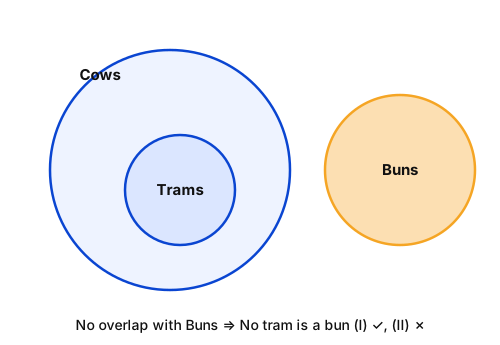
- Trams lie fully inside cows; cows and buns do not meet
- So no tram is a bun → (I) follows
- No cow is a bun means some buns are cows is false → (II) does not follow
Yaad rakhein: 'All + No' always gives a definite 'No' conclusion.
Answer: (D) Only conclusion (I) follows.
अवधारणा: सभी A, B हैं + कोई B, C नहीं ⇒ कोई A, C नहीं।
- ट्राम पूरी तरह गायों में; गाय और बन अलग
- अतः कोई ट्राम बन नहीं → (I) सही
- कोई गाय बन नहीं, तो 'कुछ बन गाय हैं' गलत → (II) नहीं
याद रखें: 'सभी + कोई नहीं' से निश्चित 'कोई नहीं' निष्कर्ष मिलता है।
उत्तर: (D) केवल निष्कर्ष (I) अनुसरण करता है।
RRB NTPC Undergraduate CBT 1General Intelligence and ReasoningSyllogismRRB NTPC Undergraduate CBT 1 2024 · 12 Aug Shift 1
Q1398.SWER is related to GKSF in a certain way based on the English alphabetical order. In the same way, WAIV is related to KOWJ. To which of the given options is MQYL related, following the same logic?
अंग्रेज़ी वर्णमाला क्रम के आधार पर SWER एक निश्चित प्रकार से GKSF से संबंधित है। उसी प्रकार, WAIV, KOWJ से संबंधित है। समान तर्क का अनुसरण करते हुए, MQYL दिए गए विकल्पों में से किससे संबंधित है?
- AAEMZ
- BAEMU
- CAZEM
- DAZME
Show answer
Concept: Each letter moves back 12 places (same as forward 14).
- S → G, W → K, E → S, R → F: each
- Check WAIV → KOWJ: W → K, A → O, I → W, V → J ✓
- MQYL: M → A, Q → E, Y → M, L → Z
Trick: = in a 26-letter cycle; L(12) → Z.
Answer: (A) AEMZ
अवधारणा: हर अक्षर 12 स्थान पीछे (= 14 आगे) जाता है।
- S → G, W → K, E → S, R → F: प्रत्येक
- WAIV → KOWJ से जाँच ✓
- MQYL: M → A, Q → E, Y → M, L → Z
ट्रिक: 26 अक्षरों के चक्र में = ; L(12) → Z।
उत्तर: (A) AEMZ
RRB NTPC Undergraduate CBT 1General Intelligence and ReasoningLetter AnalogyRRB NTPC Undergraduate CBT 1 2024 · 12 Aug Shift 1
Q1399.Each of the digits in the number 19758436 is arranged in descending order from left to right. The position(s) of how many digits will remain unchanged as compared to that in the original number?
संख्या 19758436 के प्रत्येक अंक को बाएँ से दाएँ अवरोही क्रम में व्यवस्थित किया जाता है। मूल संख्या की तुलना में कितने अंकों का स्थान अपरिवर्तित रहेगा?
- ATwoदो
- BNoneकोई नहीं
- CThreeतीन
- DOneएक
Show answer
Concept: Write the new number under the old one and compare place by place.
- Original: 1 9 7 5 8 4 3 6
- Descending: 9 8 7 6 5 4 3 1
- Same positions: 3rd (7), 6th (4), 7th (3) → three digits
Trick: Compare column-wise; do not just count common digits.
Answer: (C) Three
अवधारणा: नई संख्या पुरानी के नीचे लिखकर हर स्थान मिलाएँ।
- मूल: 1 9 7 5 8 4 3 6
- अवरोही: 9 8 7 6 5 4 3 1
- समान स्थान: 3रा (7), 6ठा (4), 7वाँ (3) → तीन अंक
ट्रिक: स्तंभवार तुलना करें।
उत्तर: (C) तीन (Three)
RRB NTPC Undergraduate CBT 1General Intelligence and ReasoningDigit ArrangementRRB NTPC Undergraduate CBT 1 2024 · 12 Aug Shift 1
Q1400.Each of the digits in the number 8934612 is arranged in ascending order from left to right. What will be the sum of the digits that are second from the left and second from the right in the new number thus formed?
संख्या 8934612 के प्रत्येक अंक को बाएँ से दाएँ आरोही क्रम में व्यवस्थित किया जाता है। इस प्रकार बनी नई संख्या में बाएँ से दूसरे और दाएँ से दूसरे अंकों का योग क्या होगा?
- A6
- B10
- C7
- D8
Show answer
Concept: Arrange the digits in ascending order.
- 8934612 → 1 2 3 4 6 8 9
- Second from left = 2, second from right = 8
- Sum
Trick: In ascending order, second from left = second smallest, second from right = second largest.
Answer: (B) 10
अवधारणा: अंकों को आरोही क्रम में लगाएँ।
- 8934612 → 1 2 3 4 6 8 9
- बाएँ से दूसरा = 2, दाएँ से दूसरा = 8
- योग
ट्रिक: आरोही क्रम में बाएँ से दूसरा = दूसरा सबसे छोटा, दाएँ से दूसरा = दूसरा सबसे बड़ा।
उत्तर: (B) 10
RRB NTPC Undergraduate CBT 1General Intelligence and ReasoningDigit ArrangementRRB NTPC Undergraduate CBT 1 2024 · 12 Aug Shift 1

