Q1401.Which of the following numbers divides 81,42,42,541?
निम्नलिखित में से कौन-सी संख्या 81,42,42,541 को विभाजित करती है?
- A7
- B12
- C8
- D15
Show answer
Concept: Divisibility by 7 (also 11, 13): make 3-digit groups from the right and take the alternating sum.
- The number is odd and ends in 1 → not divisible by 8, 12 or 15
- Groups from the right: 814 | 242 | 541 →
- → divisible by 7; indeed
Trick: Last digit 1 kills every even option and 15 instantly; only 7 remains.
Answer: (A) 7
अवधारणा: 7 (और 11, 13) की विभाज्यता: दाएँ से 3-3 अंकों के समूह बनाकर एकांतर योग लें।
- संख्या विषम है और 1 पर समाप्त → 8, 12, 15 से विभाज्य नहीं
- समूह 814 | 242 | 541 →
- → 7 से विभाज्य;
ट्रिक: अंतिम अंक 1 से सभी सम विकल्प और 15 तुरंत बाहर; केवल 7 बचता है।
उत्तर: (A) 7
RRB NTPC Undergraduate CBT 1MathematicsDivisibilityRRB NTPC Undergraduate CBT 1 2024 · 12 Aug Shift 1
Q1402.In covering a distance of 30 km, Anmol takes 7 hours more than Nikhil. If Anmol doubles his speed, then he would take 8 hours less than Nikhil. Anmol's speed is:
30 km की दूरी तय करने में अनमोल, निखिल से 7 घंटे अधिक लेता है। यदि अनमोल अपनी चाल दोगुनी कर दे, तो वह निखिल से 8 घंटे कम लेगा। अनमोल की चाल है:
- A7 km/hr
- B1 km/hr
- C6 km/hr
- D3 km/hr
Show answer
Concept: Time ; doubling speed halves the time.
- Let Anmol's time be ; then = Nikhil's time
- With double speed Anmol takes
- h
- Speed
Trick: The gap h equals half of Anmol's time.
Answer: (B) 1 km/hr
अवधारणा: समय ; चाल दोगुनी करने पर समय आधा।
- अनमोल का समय ; निखिल का
- दोगुनी चाल पर
- घंटे
- चाल
ट्रिक: दोनों अंतर का योग घंटे = अनमोल के समय का आधा।
उत्तर: (B) 1 km/hr
RRB NTPC Undergraduate CBT 1MathematicsSpeed, Time and DistanceRRB NTPC Undergraduate CBT 1 2024 · 12 Aug Shift 1
Q1403.The current population of a town is 12,500. It increases by 52% and 30% in two successive years but decreases by 15% in the third year. What is the population of the town at the end of the third year?
एक कस्बे की वर्तमान जनसंख्या 12,500 है। यह दो क्रमिक वर्षों में 52% और 30% बढ़ती है, लेकिन तीसरे वर्ष में 15% घट जाती है। तीसरे वर्ष के अंत में कस्बे की जनसंख्या कितनी है?
- A20,995
- B20,991
- C20,990
- D20,998
Show answer
Concept: Successive % changes multiply: for each year.
Trick: Last digit check: only an answer ending in 5 can come from multiplying by 0.85 here.
Answer: (A) 20,995
अवधारणा: क्रमागत प्रतिशत परिवर्तन गुणा होते हैं: हर वर्ष ।
ट्रिक: इकाई अंक जाँच: यहाँ 0.85 से गुणा पर अंत में 5 ही आता है।
उत्तर: (A) 20,995
RRB NTPC Undergraduate CBT 1MathematicsPopulation GrowthRRB NTPC Undergraduate CBT 1 2024 · 12 Aug Shift 1
Q1404.The product of two consecutive natural numbers is 702. The greater of the two numbers is:
दो क्रमागत प्राकृत संख्याओं का गुणनफल 702 है। दोनों संख्याओं में से बड़ी संख्या है:
- A26
- B27
- C38
- D24
Show answer
Concept: Consecutive numbers lie close to .
- Greater number
Trick: Unit digit: ends in 2, matching 702.
Answer: (B) 27
अवधारणा: क्रमागत संख्याएँ के पास होंगी।
- बड़ी संख्या
ट्रिक: इकाई अंक: → 2, जो 702 से मेल खाता है।
उत्तर: (B) 27
RRB NTPC Undergraduate CBT 1MathematicsNumber SystemRRB NTPC Undergraduate CBT 1 2024 · 12 Aug Shift 1
Q1405.The LCM of the numbers 12.8 and 0.004 is:
संख्याओं 12.8 और 0.004 का LCM है:
- A128
- B0.128
- C1.28
- D12.8
Show answer
Concept: Make decimal places equal, take LCM of the whole numbers, then put the decimal back.
- and → 12800 and 4 (thousandths)
- LCM(12800, 4)
- Answer
Trick: 12.8 is itself a multiple of 0.004 (), so LCM = 12.8.
Answer: (D) 12.8
अवधारणा: दशमलव स्थान बराबर करें, पूर्ण संख्याओं का LCM लें, फिर दशमलव वापस लगाएँ।
- और → 12800 और 4
- LCM(12800, 4)
- उत्तर
ट्रिक: 12.8 स्वयं 0.004 का गुणज है (), अतः LCM = 12.8।
उत्तर: (D) 12.8
RRB NTPC Undergraduate CBT 1MathematicsLCM of DecimalsRRB NTPC Undergraduate CBT 1 2024 · 12 Aug Shift 1
Q1406.A retailer offers the following discount scheme to his customers for the purchase of articles.
'Buy 30 and get 10 free'
Find the discount percentage offered.
एक खुदरा विक्रेता अपने ग्राहकों को वस्तुओं की खरीद पर निम्नलिखित छूट योजना प्रदान करता है।
'30 खरीदें और 10 मुफ़्त पाएँ'
प्रदान की गई छूट का प्रतिशत ज्ञात कीजिए।
- A26%
- B25%
- C30%
- D28%
Show answer
Concept: Discount% .
- Customer gets articles, pays for 30
- Discount
Trick: Divide by items received (40), not items bought (30) – 33% is the trap.
Answer: (B) 25%
अवधारणा: छूट% ।
- ग्राहक को वस्तुएँ मिलती हैं, भुगतान 30 का
- छूट
ट्रिक: मिली वस्तुओं (40) से भाग दें, खरीदी (30) से नहीं।
उत्तर: (B) 25%
RRB NTPC Undergraduate CBT 1MathematicsDiscountRRB NTPC Undergraduate CBT 1 2024 · 12 Aug Shift 1
Q1407.Find the value of x satisfying: 5(2x2 − 7) − 2(5x2 + 8x − 2) = 12
x का वह मान ज्ञात कीजिए जो निम्नलिखित को संतुष्ट करता है: 5(2x2 − 7) − 2(5x2 + 8x − 2) = 12
- A
- B
- C
- D
Show answer
Concept: Expand; the terms cancel, leaving a linear equation.
Trick: Watch the sign: .
Answer: (A)
अवधारणा: विस्तार करें; वाले पद कट जाते हैं, रैखिक समीकरण बचता है।
ट्रिक: चिह्न ध्यान दें: ।
उत्तर: (A)
RRB NTPC Undergraduate CBT 1MathematicsLinear EquationsRRB NTPC Undergraduate CBT 1 2024 · 12 Aug Shift 1
Q1408.₹12,300 were divided among A, B and C such that 3 times the share of A = 6 times the share of B = 2 times the share of C. Find the share of A.
₹12,300 को A, B और C के बीच इस प्रकार विभाजित किया गया कि A के हिस्से का 3 गुना = B के हिस्से का 6 गुना = C के हिस्से का 2 गुना। A का हिस्सा ज्ञात कीजिए।
- A₹4,100
- B₹3,915
- C₹4,063
- D₹3,924
Show answer
Concept: If , then .
- Multiply by 6:
- Total parts
Trick: Shares are inversely proportional to the multipliers 3, 6, 2.
Answer: (A) ₹4,100
अवधारणा: यदि तो ।
- 6 से गुणा:
- कुल भाग
ट्रिक: हिस्से गुणकों 3, 6, 2 के व्युत्क्रमानुपाती होते हैं।
उत्तर: (A) ₹4,100
RRB NTPC Undergraduate CBT 1MathematicsRatio and ProportionRRB NTPC Undergraduate CBT 1 2024 · 12 Aug Shift 1
Q1409.Find the value of 50−6÷ 5018× 50−5.
50−6÷ 5018× 50−5 का मान ज्ञात कीजिए।
- A50−19
- B50−29
- C50−36
- D50−32
Show answer
Concept: and (left to right).
Trick: Exponent .
Answer: (B)
अवधारणा: , (बाएँ से दाएँ)।
ट्रिक: घात ।
उत्तर: (B)
RRB NTPC Undergraduate CBT 1MathematicsIndicesRRB NTPC Undergraduate CBT 1 2024 · 12 Aug Shift 1
Q1410.Find the median of 26, 13, 14, 15, 8, 36, 23, 35 and 50.
26, 13, 14, 15, 8, 36, 23, 35 और 50 की माध्यिका ज्ञात कीजिए।
- A35
- B23
- C26
- D50
Show answer
Concept: Median = middle value after arranging in order; for odd it is the th value.
- Order: 8, 13, 14, 15, 23, 26, 35, 36, 50
- → th value
- 5th value
Trick: Always sort first – 26 (the 5th value as printed) is the trap.
Answer: (B) 23
अवधारणा: माध्यिका = क्रम में लगाने के बाद बीच का मान; विषम हो तो वाँ पद।
- क्रम: 8, 13, 14, 15, 23, 26, 35, 36, 50
- → वाँ पद
- 5वाँ पद
ट्रिक: पहले क्रम में लगाएँ – दिए क्रम का 5वाँ पद 26 जाल है।
उत्तर: (B) 23
RRB NTPC Undergraduate CBT 1MathematicsMedianRRB NTPC Undergraduate CBT 1 2024 · 12 Aug Shift 1
Q1411.If the 6-digit number N29M11 is divisible by 11, then which of the options below can give a possible correct relation between M and N?
यदि 6-अंकीय संख्या N29M11, 11 से विभाज्य है, तो नीचे दिए गए विकल्पों में से कौन-सा विकल्प M और N के बीच संभावित सही संबंध दे सकता है?
- AM - N = 7
- BM = N
- CM - N = 1
- DM + N = -7
Show answer
Concept: A number is divisible by 11 if (sum of digits at odd places) − (sum of digits at even places) is or a multiple of .
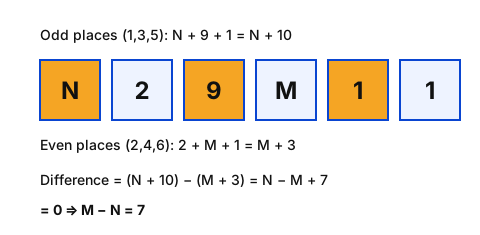
- Odd places of N29M11: .
- Even places: .
- Difference .
- Setting it gives (e.g. : ).
Trick: Write or ; only is in the options.
Answer: (A)
अवधारणा: कोई संख्या 11 से विभाज्य है यदि (विषम स्थानों के अंकों का योग) − (सम स्थानों के अंकों का योग) या का गुणज हो।
- N29M11 के विषम स्थान: ।
- सम स्थान: ।
- अंतर ।
- इसे रखने पर (जैसे : )।
ट्रिक: या लिखें; विकल्पों में केवल है।
उत्तर: (A)
RRB NTPC Undergraduate CBT 1MathematicsDivisibility by 11RRB NTPC Undergraduate CBT 1 2024 · 11 Aug Shift 3
Q1412.A cylinder has its radius reduced by 20% while its height is increased by 40%. What is the percentage change in its volume?
एक बेलन की त्रिज्या में 20% की कमी की जाती है, जबकि उसकी ऊँचाई में 40% की वृद्धि की जाती है। उसके आयतन में कितने प्रतिशत का परिवर्तन होगा?
- A10.4% decrease10.4% कमी
- BNo increase or decreaseन कोई वृद्धि, न कोई कमी
- C14.2% increase14.2% वृद्धि
- D12% increase12% वृद्धि
Show answer
Concept: , so .
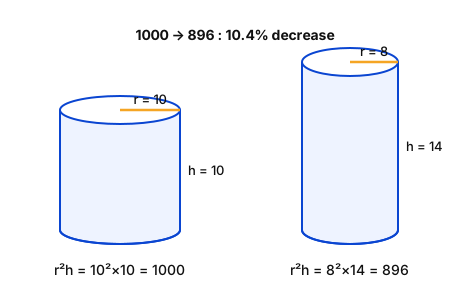
- Take , : .
- New ( less), new ( more): .
- Change , i.e. a decrease.
Trick: Multiply factors: ⇒ decrease.
Answer: (A) decrease
अवधारणा: , अतः ।
- , लें: ।
- नया ( कम), नया ( अधिक): ।
- परिवर्तन , अर्थात कमी।
ट्रिक: गुणक गुणा करें: ⇒ कमी।
उत्तर: (A) कमी
RRB NTPC Undergraduate CBT 1MathematicsVolume of cylinderRRB NTPC Undergraduate CBT 1 2024 · 11 Aug Shift 3
Q1413.The average of first 154 even numbers is
प्रथम 154 सम संख्याओं का औसत है
- A156
- B154.5
- C155
- D155.5
Show answer
Concept: Sum of the first even numbers , so their average .
- Here .
- Sum .
- Average .
Trick: Average of first even numbers ; of first odd numbers .
Answer: (C)
अवधारणा: प्रथम सम संख्याओं का योग , अतः औसत ।
- यहाँ ।
- योग ।
- औसत ।
ट्रिक: प्रथम सम संख्याओं का औसत ; प्रथम विषम संख्याओं का ।
उत्तर: (C)
RRB NTPC Undergraduate CBT 1MathematicsAverageRRB NTPC Undergraduate CBT 1 2024 · 11 Aug Shift 3
Q1414.By availing two successive discounts of 20% and 10%, a customer got a discount of ₹23,800. Determine the marked price of the item.
20% और 10% की दो क्रमिक छूटों का लाभ उठाकर, एक ग्राहक को ₹23,800 की छूट मिली। वस्तु का अंकित मूल्य ज्ञात कीजिए।
- A₹75,000
- B₹80,000
- C₹90,000
- D₹85,000
Show answer
Concept: Two successive discounts and equal a single discount of .
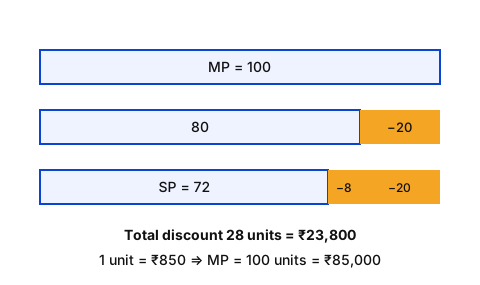
- Net discount .
- of MP = ₹23,800.
- MP , i.e. ₹85,000.
Trick: Take MP : , discount units.
Answer: (D) ₹85,000
अवधारणा: दो क्रमागत छूट और = एकल छूट ।
- कुल छूट ।
- अंकित मूल्य का = ₹23,800।
- अंकित मूल्य , अर्थात ₹85,000।
ट्रिक: अंकित मूल्य लें: , छूट इकाई।
उत्तर: (D) ₹85,000
RRB NTPC Undergraduate CBT 1MathematicsSuccessive discountsRRB NTPC Undergraduate CBT 1 2024 · 11 Aug Shift 3
Q1415.Given that , and , then the value of is close to:
दिया गया है कि , और , तो का मान लगभग है:
- A12.9
- B11.74
- C12.45
- D14.16
Show answer
Concept: If the bases are equal, the exponents can be equated: .
- .
- .
- So ⇒ .
Trick: directly.
Answer: (A)
अवधारणा: आधार समान हों तो घातांक बराबर किए जा सकते हैं: ।
- ।
- ।
- अतः ⇒ ।
ट्रिक: सीधे ।
उत्तर: (A)
RRB NTPC Undergraduate CBT 1MathematicsIndicesRRB NTPC Undergraduate CBT 1 2024 · 11 Aug Shift 3
Q1416.4 years ago, the age of a father was 37 years more than twice his son's age. After how many years, from now, will he be twice his son's age?
4 वर्ष पहले, एक पिता की आयु उसके पुत्र की आयु के दोगुने से 37 वर्ष अधिक थी। अब से कितने वर्ष बाद, उसकी आयु उसके पुत्र की आयु की दोगुनी होगी?
- A31
- B33
- C30
- D35
Show answer
Concept: Write present ages as (father) and (son) and convert each statement into an equation.
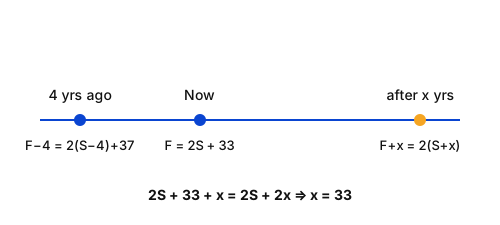
- 4 years ago: ⇒ .
- After years: .
- ⇒ .
Trick: The extra '' over twice the son's age vanishes after years.
Answer: (B)
अवधारणा: वर्तमान आयु पिता और पुत्र मानें और हर कथन को समीकरण में बदलें।
- 4 वर्ष पहले: ⇒ ।
- वर्ष बाद: ।
- ⇒ ।
ट्रिक: पुत्र की दुगुनी आयु से अतिरिक्त '', वर्ष बाद समाप्त हो जाता है।
उत्तर: (B)
RRB NTPC Undergraduate CBT 1MathematicsProblems on agesRRB NTPC Undergraduate CBT 1 2024 · 11 Aug Shift 3
Q1417.ABCD is a quadrilateral in which AB ∥ DC, and E and F are the mid points of the diagonals AC and BD, respectively. If AB = 45 cm, BC = 96 cm, DC = 53 cm, and AD = 37 cm, then what is the length (in cm) of EF?
ABCD एक चतुर्भुज है जिसमें AB ∥ DC है, और E तथा F क्रमशः विकर्णों AC और BD के मध्य-बिंदु हैं। यदि AB = 45 cm, BC = 96 cm, DC = 53 cm और AD = 37 cm है, तो EF की लंबाई (cm में) क्या है?
- A4
- B3
- C7
- D5
Show answer
Concept: In a trapezium, the segment joining the midpoints of the diagonals is parallel to the bases and equals half their difference: .
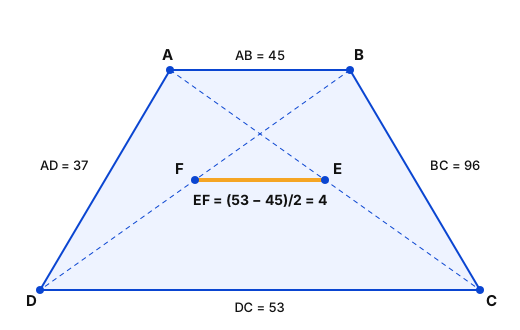
- Let the midline through E and F be drawn parallel to AB and DC.
- In midpoint segment = ; in midpoint segment = ; on the same line their difference is .
- . (BC and AD are not needed.)
Trick: Midpoints of diagonals → half the difference; median → half the sum.
Answer: (A)
अवधारणा: समलंब में विकर्णों के मध्य-बिंदुओं को मिलाने वाला रेखाखंड आधारों के समांतर होता है और उनके अंतर का आधा होता है: ।
- E और F से होकर AB व DC के समांतर मध्य-रेखा लें।
- में मध्य-बिंदु रेखाखंड ; में ; एक ही रेखा पर इनका अंतर है।
- । (BC और AD की आवश्यकता नहीं।)
ट्रिक: विकर्णों के मध्य-बिंदु → अंतर का आधा; मध्य-रेखा → योग का आधा।
उत्तर: (A)
RRB NTPC Undergraduate CBT 1MathematicsTrapezium – midpoints of diagonalsRRB NTPC Undergraduate CBT 1 2024 · 11 Aug Shift 3
Q1418.Mohan and Nishant start a business. Mohan invests ₹89,000 more than Nishant for 3 months and Nishant invests for 2 months. Mohan's share is ₹1,070 more than that of Nishant, out of a total profit of ₹4,280. Find the capital contributed by Mohan.
मोहन और निशांत एक व्यवसाय शुरू करते हैं। मोहन, निशांत से ₹89,000 अधिक राशि 3 महीने के लिए निवेश करता है और निशांत 2 महीने के लिए निवेश करता है। ₹4,280 के कुल लाभ में से मोहन का हिस्सा निशांत के हिस्से से ₹1,070 अधिक है। मोहन द्वारा लगाई गई पूँजी ज्ञात कीजिए।
- A₹8,60,000
- B₹8,10,000
- C₹8,90,000
- D₹8,20,000
Show answer
Concept: Profit is shared in the ratio of .
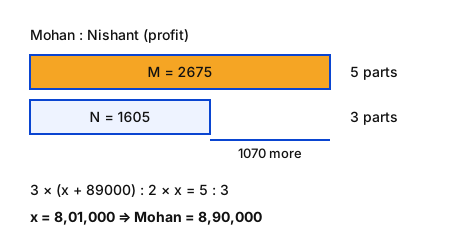
- Mohan + Nishant = 4280 and Mohan − Nishant = 1070 ⇒ Mohan = 2675, Nishant = 1605; ratio .
- Let Nishant's capital be ; Mohan's .
- ⇒ ⇒ .
- Mohan's capital , i.e. ₹8,90,000.
Trick: First turn the profit sum and difference into a ratio (), then use capital × time.
Answer: (C) ₹8,90,000
अवधारणा: लाभ के अनुपात में बँटता है।
- मोहन + निशांत = 4280 और मोहन − निशांत = 1070 ⇒ मोहन = 2675, निशांत = 1605; अनुपात ।
- निशांत की पूँजी मानें; मोहन की ।
- ⇒ ⇒ ।
- मोहन की पूँजी , अर्थात ₹8,90,000।
ट्रिक: पहले लाभ के योग व अंतर से अनुपात () निकालें, फिर पूँजी × समय लगाएँ।
उत्तर: (C) ₹8,90,000
RRB NTPC Undergraduate CBT 1MathematicsPartnershipRRB NTPC Undergraduate CBT 1 2024 · 11 Aug Shift 3
Q1419.A number, when increased by 100%, gives 2800. The number is:
एक संख्या में 100% की वृद्धि करने पर 2800 प्राप्त होता है। वह संख्या है:
- A1400
- B2800
- C700
- D4200
Show answer
Concept: Increasing a number by doubles it: new value .
- .
- .
- Check: .
Trick: = double, so halve the result.
Answer: (A)
अवधारणा: किसी संख्या को बढ़ाने पर वह दुगुनी हो जाती है: नया मान ।
- ।
- ।
- जाँच: ।
ट्रिक: = दुगुना, अतः परिणाम का आधा लें।
उत्तर: (A)
RRB NTPC Undergraduate CBT 1MathematicsPercentageRRB NTPC Undergraduate CBT 1 2024 · 11 Aug Shift 3
Q1420.Simplify x(7x − 4) + 2(x2 − 2) + 11.
x(7x − 4) + 2(x2 − 2) + 11 को सरल कीजिए।
- A9x2 − 4x + 7
- B9x2 − 4x − 7
- C−9x2 − 4x − 7
- D−9x2 − 4x + 7
Show answer
Concept: Expand the brackets and then combine like terms.
- .
- .
- Sum : .
Trick: Put : expression , and ✓.
Answer: (A)
अवधारणा: कोष्ठक खोलें और फिर समान पदों को जोड़ें।
- ।
- ।
- योग : ।
ट्रिक: रखें: व्यंजक , और ✓।
उत्तर: (A)
RRB NTPC Undergraduate CBT 1MathematicsAlgebraic simplificationRRB NTPC Undergraduate CBT 1 2024 · 11 Aug Shift 3

