Q1421.Simplify:
सरल कीजिए:
- A
- B
- C
- D
Show answer
Concept: Use , i.e. .
- Take LCM :
- Numerator , so the value is .
Trick: Put : . Only option (D) matches.
Answer: (D)
अवधारणा: का प्रयोग करें, अर्थात् ।
- LCM लें:
- अंश , अतः मान है।
ट्रिक: रखें: । केवल विकल्प (D) मेल खाता है।
उत्तर: (D)
RRB NTPC Undergraduate CBT 1MathematicsTrigonometric identitiesRRB NTPC Undergraduate CBT 1 2024 · 11 Aug Shift 3
Q1422.Find the simple interest (in ₹) on ₹4,000 at 7.5% per annum rate of interest deposited on 12 February 2024 and withdrawn on 13 April 2024.
12 फरवरी 2024 को जमा की गई और 13 अप्रैल 2024 को निकाली गई ₹4,000 की राशि पर 7.5% वार्षिक ब्याज दर से साधारण ब्याज (₹ में) ज्ञात कीजिए।
- A51
- B49
- C48
- D50
Show answer
Concept: , with T in years = days/366 (2024 is a leap year). The deposit day is not counted, the withdrawal day is.
- Days: Feb , March , April → days
- year
Trick: Count one of the two end dates only. days of a leap year year exactly.
Answer: (D) ₹50
अवधारणा: , जहाँ T (वर्ष) दिन/366 (2024 लीप वर्ष है)। जमा वाला दिन नहीं गिनते, निकासी वाला दिन गिनते हैं।
- दिन: फ़रवरी , मार्च , अप्रैल → दिन
- वर्ष
ट्रिक: दोनों सिरों में से केवल एक दिन गिनें। लीप वर्ष के दिन वर्ष।
उत्तर: (D) ₹50
RRB NTPC Undergraduate CBT 1MathematicsSimple interest (days)RRB NTPC Undergraduate CBT 1 2024 · 11 Aug Shift 3
Q1423.Evaluate 1822.
1822 का मान ज्ञात कीजिए।
- A33084
- B33074
- C33094
- D33124
Show answer
Concept: .
Trick: Use and add to get 33124 directly.
Answer: (D) 33124
अवधारणा: ।
ट्रिक: में जोड़ दें — सीधे 33124।
उत्तर: (D) 33124
RRB NTPC Undergraduate CBT 1MathematicsSquaresRRB NTPC Undergraduate CBT 1 2024 · 11 Aug Shift 3
Q1424.The population of a district is 356000, out of which 178000 are males. 39% of the population is literate. If 59% males are literate, then what percentage of females are literate?
एक ज़िले की जनसंख्या 356000 है, जिसमें से 178000 पुरुष हैं। जनसंख्या का 39% साक्षर है। यदि 59% पुरुष साक्षर हैं, तो कितने प्रतिशत महिलाएँ साक्षर हैं?
- A16%
- B17%
- C21%
- D19%
Show answer
Concept: Total literates = male literates + female literates.
- Total literates
- Male literates
- Females ; female literates
Trick: Males = females (half each), so average: .
Answer: (D) 19%
अवधारणा: कुल साक्षर = साक्षर पुरुष + साक्षर महिलाएँ।
- कुल साक्षर
- साक्षर पुरुष
- महिलाएँ ; साक्षर महिलाएँ
ट्रिक: पुरुष = महिलाएँ (आधे-आधे), इसलिए औसत: ।
उत्तर: (D) 19%
RRB NTPC Undergraduate CBT 1MathematicsPercentage (literacy)RRB NTPC Undergraduate CBT 1 2024 · 11 Aug Shift 3
Q1425.An amount of ₹638 is divided among three persons in the ratio of 5 : 17 : 7. The difference between the largest and the smallest shares (in ₹) in the distribution is:
₹638 की राशि को तीन व्यक्तियों में 5 : 17 : 7 के अनुपात में बाँटा जाता है। इस वितरण में सबसे बड़े और सबसे छोटे हिस्से (₹ में) के बीच का अंतर है:
- A331
- B264
- C170
- D190
Show answer
Concept: Share .
- Sum of parts ; one part
- Largest − smallest parts
Trick: Find value of 1 part first, then multiply by the difference of ratio terms.
Answer: (B) ₹264
अवधारणा: हिस्सा ।
- भागों का योग ; 1 भाग
- सबसे बड़ा − सबसे छोटा भाग
ट्रिक: पहले 1 भाग का मान निकालें, फिर अनुपात-पदों के अंतर से गुणा करें।
उत्तर: (B) ₹264
RRB NTPC Undergraduate CBT 1MathematicsRatio and proportionRRB NTPC Undergraduate CBT 1 2024 · 11 Aug Shift 3
Q1426.The number of prime numbers lying between 393 and 401, both included, is:
393 और 401 (दोनों सम्मिलित) के बीच स्थित अभाज्य संख्याओं की संख्या है:
- A1
- B3
- C7
- D2
Show answer
Concept: A number is prime if no prime divides it (, test 2, 3, 5, 7, 11, 13, 17, 19).
- Even numbers (394, 396, 398, 400) and 395 (by 5) are out
- 393 , 399 → not prime
- 397 and 401 are not divisible by 7, 11, 13, 17, 19 → prime
Trick: Between consecutive odd numbers here, strike out multiples of 3 and 5 first; only 397, 401 survive.
Answer: (D) 2
अवधारणा: संख्या अभाज्य है यदि तक की कोई अभाज्य संख्या उसे न विभाजित करे ()।
- सम संख्याएँ (394, 396, 398, 400) और 395 (5 से) बाहर
- 393 , 399 → अभाज्य नहीं
- 397 और 401 किसी भी 7, 11, 13, 17, 19 से विभाज्य नहीं → अभाज्य
ट्रिक: पहले 3 और 5 के गुणज काटें; केवल 397 और 401 बचते हैं।
उत्तर: (D) 2
RRB NTPC Undergraduate CBT 1MathematicsPrime numbersRRB NTPC Undergraduate CBT 1 2024 · 11 Aug Shift 3
Q1427.The number 956169 is divisible by which of the following?
संख्या 956169 निम्नलिखित में से किससे विभाज्य है?
- A3
- B12
- C2
- D4
Show answer
Concept: Divisible by 3 if digit sum is divisible by 3; by 2, 4 or 12 the number must be even.
- Digit sum , divisible by 3 ✓
- Last digit 9 is odd → not divisible by 2, 4 or 12
Trick: An odd number can never be divisible by any even number.
Answer: (A) 3
अवधारणा: अंकों का योग 3 से विभाज्य हो तो संख्या 3 से विभाज्य; 2, 4 या 12 के लिए संख्या सम होनी चाहिए।
- अंकों का योग , 3 से विभाज्य ✓
- अंतिम अंक 9 विषम है → 2, 4, 12 से विभाज्य नहीं
ट्रिक: विषम संख्या किसी भी सम संख्या से विभाज्य नहीं होती।
उत्तर: (A) 3
RRB NTPC Undergraduate CBT 1MathematicsDivisibility rulesRRB NTPC Undergraduate CBT 1 2024 · 11 Aug Shift 3
Q1428.The sum of the squares of two consecutive even natural numbers is 1460. The sum of the numbers is:
दो क्रमागत सम प्राकृत संख्याओं के वर्गों का योग 1460 है। संख्याओं का योग है:
- A56
- B58
- C54
- D60
Show answer
Concept: Two consecutive even numbers: and .
- Numbers 26 and 28: ✓; sum
Trick: , so the numbers sit around 27: 26 and 28.
Answer: (C) 54
अवधारणा: दो क्रमागत सम संख्याएँ: और ।
- संख्याएँ 26 और 28: ✓; योग
ट्रिक: , अतः संख्याएँ 27 के आस-पास: 26 और 28।
उत्तर: (C) 54
RRB NTPC Undergraduate CBT 1MathematicsNumber system (squares)RRB NTPC Undergraduate CBT 1 2024 · 11 Aug Shift 3
Q1429.If 40% of first number is equal to two-sevenths of second number, what is the ratio of first number to the second number?
यदि पहली संख्या का 40%, दूसरी संख्या के दो-सातवें भाग के बराबर है, तो पहली संख्या और दूसरी संख्या का अनुपात क्या है?
- A5 : 7
- B4 : 8
- C1 : 9
- D8 : 4
Show answer
Concept: If , then .
Trick: Cancel the common 2 in and : ratio is directly.
Answer: (A)
अवधारणा: यदि , तो ।
ट्रिक: और में 2 कट जाता है — अनुपात सीधे ।
उत्तर: (A)
RRB NTPC Undergraduate CBT 1MathematicsRatioRRB NTPC Undergraduate CBT 1 2024 · 11 Aug Shift 3
Q1430.An article is marked at ₹4,000. Two successive discounts of 25% and 20% are given. What is the final price?
एक वस्तु का अंकित मूल्य ₹4,000 है। 25% और 20% की दो क्रमिक छूटें दी जाती हैं। अंतिम मूल्य क्या है?
- A₹2,500
- B₹2,400
- C₹2,560
- D₹2,600
Show answer
Concept: Final price .
- After 25%:
- After 20%:
Trick: Net discount ; of 4000 .
Answer: (B) ₹2,400
अवधारणा: अंतिम मूल्य ।
- 25% के बाद:
- 20% के बाद:
ट्रिक: कुल छूट ; 4000 का ।
उत्तर: (B) ₹2,400
RRB NTPC Undergraduate CBT 1MathematicsSuccessive discountsRRB NTPC Undergraduate CBT 1 2024 · 11 Aug Shift 3
Q1431.A cylindrical rod has an outer curved surface area of 2200 cm2. If the length of the rod is 16 cm, then the outer radius (in cm) of the rod, correct to two places of decimal, is:
(Take )
एक बेलनाकार छड़ का बाहरी वक्र पृष्ठीय क्षेत्रफल 2200 cm2 है। यदि छड़ की लंबाई 16 cm है, तो दशमलव के दो स्थानों तक सही, छड़ की बाहरी त्रिज्या (cm में) है:
( लीजिए)
- A23.95
- B21.88
- C23.29
- D21.09
Show answer
Concept: Curved surface area of a cylinder .
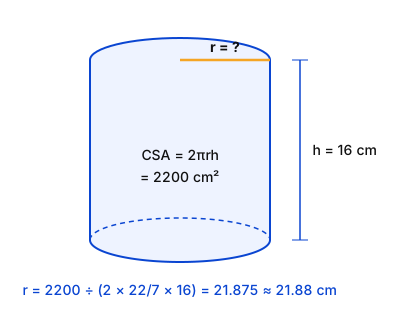
Trick: : , and → 21.88.
Answer: (B) 21.88
अवधारणा: बेलन का वक्र पृष्ठीय क्षेत्रफल ।
ट्रिक: , और → 21.88।
उत्तर: (B) 21.88
RRB NTPC Undergraduate CBT 1MathematicsMensuration – cylinderRRB NTPC Undergraduate CBT 1 2024 · 11 Aug Shift 3
Q1432.A man walks to a viewpoint and returns to the starting point by his car maintaining constant speed and thus takes a total time of 5 hours 30 minutes. He would have gained 3 hours by driving both ways. How long would it have taken for him to walk both ways with same walking speed?
एक व्यक्ति एक दर्शनीय स्थल तक पैदल जाता है और स्थिर चाल बनाए रखते हुए अपनी कार से प्रारंभिक बिंदु पर वापस लौटता है और इस प्रकार कुल 5 घंटे 30 मिनट का समय लेता है। यदि वह दोनों ओर कार से जाता, तो उसके 3 घंटे बच जाते। समान पैदल चाल से दोनों ओर पैदल चलने में उसे कितना समय लगता?
- A7 hours 15 minutes7 घंटे 15 मिनट
- B8 hours 30 minutes8 घंटे 30 मिनट
- C8 hours 45 minutes8 घंटे 45 मिनट
- D9 hours 30 minutes9 घंटे 30 मिनट
Show answer
Concept: Walk one way + drive one way = 5.5 h; drive both ways = 5.5 − 3 = 2.5 h.
- One-way drive h
- One-way walk h
- Walk both ways h h min
Trick: Walk both ways h.
Answer: (B) 8 hours 30 minutes
अवधारणा: एक ओर पैदल + एक ओर कार = 5.5 घंटे; दोनों ओर कार = 5.5 − 3 = 2.5 घंटे।
- एक ओर कार घंटे
- एक ओर पैदल घंटे
- दोनों ओर पैदल घंटे घंटे मिनट
ट्रिक: दोनों ओर पैदल घंटे।
उत्तर: (B) 8 घंटे 30 मिनट
RRB NTPC Undergraduate CBT 1MathematicsTime and distanceRRB NTPC Undergraduate CBT 1 2024 · 11 Aug Shift 3
Q1433.The selling price of 50 books is equal to the cost price of 19 books. Find the loss or gain percentage.
50 पुस्तकों का विक्रय मूल्य 19 पुस्तकों के क्रय मूल्य के बराबर है। हानि या लाभ प्रतिशत ज्ञात कीजिए।
- A gain लाभ
- B62% gain62% लाभ
- C62% loss62% हानि
- D loss हानि
Show answer
Concept: If SP of articles = CP of articles and , it is a loss of .
- Let CP of 1 book = ₹1 → SP of 50 books = ₹19, CP of 50 books = ₹50
- Loss
- Loss%
Trick: SP side has more items (50 > 19) → loss; divide by the SP-side count (50).
Answer: (C) 62% loss
अवधारणा: यदि वस्तुओं का विक्रय मूल्य वस्तुओं का क्रय मूल्य और , तो हानि ।
- 1 पुस्तक का CP = ₹1 → 50 पुस्तकों का SP = ₹19, CP = ₹50
- हानि
- हानि%
ट्रिक: SP वाली ओर अधिक वस्तुएँ (50 > 19) → हानि; 50 से भाग दें।
उत्तर: (C) 62% हानि
RRB NTPC Undergraduate CBT 1MathematicsProfit and lossRRB NTPC Undergraduate CBT 1 2024 · 11 Aug Shift 3
Q1434.The average weight (in kg) of a family of five members whose weights are 40 kg, 49 kg, 56 kg, 74 kg and 36 kg is:
पाँच सदस्यों वाले एक परिवार, जिनका भार 40 kg, 49 kg, 56 kg, 74 kg और 36 kg है, का औसत भार (kg में) है:
- A52
- B50
- C51
- D53
Show answer
Concept: Average .
- Sum
- Average
Trick: Take 50 as base: deviations sum to → .
Answer: (C) 51
अवधारणा: औसत ।
- योग
- औसत
ट्रिक: 50 को आधार लें: विचलन का योग → ।
उत्तर: (C) 51
RRB NTPC Undergraduate CBT 1MathematicsAverageRRB NTPC Undergraduate CBT 1 2024 · 11 Aug Shift 3
Q1435.The number 861616843 is divisible by which of the following?
संख्या 861616843 निम्नलिखित में से किससे विभाज्य है?
- A43
- B36
- C50
- D47
Show answer
Concept: Rule out options by quick tests, then divide.
- Odd number → not divisible by 36 or 50 (50 needs last digit 0)
- : exactly
- (Check 47: remainder is not 0.)
Trick: Break it: ; remainder part .
Answer: (A) 43
अवधारणा: त्वरित परीक्षणों से विकल्प हटाएँ, फिर भाग दें।
- विषम संख्या → 36 या 50 से विभाज्य नहीं
- : पूर्णतः
- (47 से भाग देने पर शेष 0 नहीं आता।)
ट्रिक: तोड़ें: ; बचा भाग ।
उत्तर: (A) 43
RRB NTPC Undergraduate CBT 1MathematicsDivisibilityRRB NTPC Undergraduate CBT 1 2024 · 11 Aug Shift 3
Q1436.Find the simple interest (in ₹) if a sum of ₹400 is borrowed for 5.5 years at 16% per annum rate of interest.
यदि ₹400 की राशि 16% वार्षिक ब्याज दर पर 5.5 वर्ष के लिए उधार ली जाती है, तो साधारण ब्याज (₹ में) ज्ञात कीजिए।
- A452
- B402
- C352
- D332
Show answer
Concept: .
Trick: Interest per year ; years → .
Answer: (C) ₹352
अवधारणा: ।
ट्रिक: प्रति वर्ष ब्याज ; वर्ष → ।
उत्तर: (C) ₹352
RRB NTPC Undergraduate CBT 1MathematicsSimple interestRRB NTPC Undergraduate CBT 1 2024 · 11 Aug Shift 3
Q1437.Lokesh and Manoj can complete a certain piece of work in 11 and 15 days, respectively. They started to work together, and after 5 days, Manoj left. In how many days will Lokesh complete the remaining work?
लोकेश और मनोज एक निश्चित कार्य को क्रमशः 11 और 15 दिनों में पूरा कर सकते हैं। उन्होंने एक साथ कार्य करना शुरू किया, और 5 दिनों के बाद मनोज ने कार्य छोड़ दिया। लोकेश शेष कार्य को कितने दिनों में पूरा करेगा?
- A
- B
- C
- D
Show answer
Concept: Take total work = LCM of days; efficiency = work ÷ days.
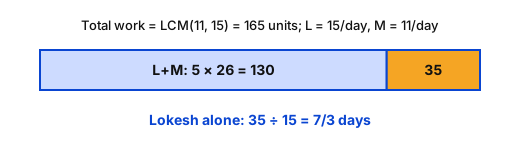
- Work ; Lokesh /day, Manoj /day
- 5 days together:
- Left ; Lokesh alone days
Trick: Fraction way: ; remaining .
Answer: (A)
अवधारणा: कुल कार्य = दिनों का LCM; दक्षता = कार्य ÷ दिन।
- कार्य ; लोकेश /दिन, मनोज /दिन
- 5 दिन साथ:
- शेष ; लोकेश अकेले दिन
ट्रिक: भिन्न से: ; शेष ।
उत्तर: (A)
RRB NTPC Undergraduate CBT 1MathematicsTime and workRRB NTPC Undergraduate CBT 1 2024 · 11 Aug Shift 3
Q1438.Pipe A can fill a tank in 11 hours, pipe B can fill the same tank in 26 hours and pipe C can fill the same tank in 12 hours. The time taken by them to fill the same tank if they operate together is::
पाइप A एक टंकी को 11 घंटे में भर सकता है, पाइप B उसी टंकी को 26 घंटे में भर सकता है और पाइप C उसी टंकी को 12 घंटे में भर सकता है। यदि वे एक साथ कार्य करें, तो उसी टंकी को भरने में उनके द्वारा लिया गया समय है::
- A hours घंटे
- B hours घंटे
- C hours घंटे
- D hours घंटे
Show answer
Concept: Together time .
- LCM units
- Per hour: A , B , C → total
- Time hours
Trick: Time must be less than the fastest pipe (11 h) alone and roughly , so only option (D).
Answer: (D) hours
अवधारणा: एक साथ समय ।
- LCM इकाई
- प्रति घंटा: A , B , C → कुल
- समय घंटे
ट्रिक: समय सबसे तेज़ पाइप (11 घंटे) से कम होगा और लगभग 4.7 — केवल (D)।
उत्तर: (D) घंटे
RRB NTPC Undergraduate CBT 1MathematicsPipes and cisternsRRB NTPC Undergraduate CBT 1 2024 · 11 Aug Shift 3
Q1439.Yash travels 252 km at 63 km/hr, the next 891 km at 99 km/hr and the next 183 km at 61 km/hr. What is his average speed (in km/hr) for the whole journey? (Round off your answer to two decimal places)
यश 252 km की दूरी 63 km/hr की चाल से, अगली 891 km की दूरी 99 km/hr की चाल से और अगली 183 km की दूरी 61 km/hr की चाल से तय करता है। पूरी यात्रा के लिए उसकी औसत चाल (km/hr में) क्या है? (अपने उत्तर को दशमलव के दो स्थानों तक पूर्णांकित कीजिए)
- A88.59
- B84.55
- C82.88
- D79.83
Show answer
Concept: Average speed .
- Times: , , → total h
- Distance km
- Average
Trick: Never average the speeds directly; each leg here divides exactly, so add times.
Answer: (C) 82.88
अवधारणा: औसत चाल ।
- समय: , , → कुल घंटे
- दूरी km
- औसत
ट्रिक: चालों का सीधा औसत कभी न लें; समय जोड़ें।
उत्तर: (C) 82.88
RRB NTPC Undergraduate CBT 1MathematicsAverage speedRRB NTPC Undergraduate CBT 1 2024 · 11 Aug Shift 3
Q1440.Himanshi bought a toy for ₹199, decorated it at a cost of ₹9, and sold the toy for ₹231. Find the loss or gain percentage.
हिमांशी ने ₹199 में एक खिलौना खरीदा, ₹9 की लागत से उसे सजाया और खिलौने को ₹231 में बेच दिया। हानि या लाभ प्रतिशत ज्ञात कीजिए।
- A loss हानि
- B loss हानि
- C profit लाभ
- D575% profit575% लाभ
Show answer
Concept: Extra expenses (overheads) are added to CP; Profit% .
- Effective CP ; SP
- Profit
- Profit%
Trick: Always add repair/decoration cost to CP before finding profit%.
Answer: (C) profit
अवधारणा: अतिरिक्त खर्च CP में जुड़ता है; लाभ% ।
- प्रभावी CP ; SP
- लाभ
- लाभ%
ट्रिक: सजावट/मरम्मत खर्च हमेशा CP में जोड़ें।
उत्तर: (C) लाभ
RRB NTPC Undergraduate CBT 1MathematicsProfit and lossRRB NTPC Undergraduate CBT 1 2024 · 11 Aug Shift 3

