Q1441.Based on the English alphabetical order, three of the following four letter-cluster pairs are alike in a certain way and thus form a group. Which letter-cluster pair DOES NOT belong to that group?
(Note: The odd one out is not based on the number of consonants/vowels or their position in the letter-cluster.)
अंग्रेज़ी वर्णमाला क्रम के आधार पर, निम्नलिखित चार अक्षर-समूह युग्मों में से तीन किसी निश्चित प्रकार से एकसमान हैं और इस प्रकार एक समूह बनाते हैं। कौन-सा अक्षर-समूह युग्म उस समूह से संबंधित नहीं है?
(ध्यान दें: असंगत अक्षर-समूह, उस अक्षर-समूह में व्यंजनों/स्वरों की संख्या या उनके स्थान पर आधारित नहीं है।)
- AUQ-VR
- BQM-RO
- CSO-TQ
- DWS-XU
Show answer
Concept: Compare each letter of the first cluster with the matching letter of the second cluster.
- QM-RO: Q+1=R, M+2=O. SO-TQ: S+1=T, O+2=Q. WS-XU: W+1=X, S+2=U.
- UQ-VR: U+1=V but Q+1=R (not +2).
Trick: In the three alike pairs the first letters differ by 4 in cluster 1 and by 3 in cluster 2; in UQ-VR both differ by 4.
Answer: (A) UQ-VR
अवधारणा: पहले समूह के प्रत्येक अक्षर की तुलना दूसरे समूह के संगत अक्षर से करें।
- QM-RO: Q+1=R, M+2=O। SO-TQ: S+1=T, O+2=Q। WS-XU: W+1=X, S+2=U।
- UQ-VR: U+1=V परंतु Q+1=R (+2 नहीं)।
ट्रिक: समान युग्मों में पहले समूह के अक्षरों में अंतर 4 और दूसरे में 3 है; UQ-VR में दोनों में 4।
उत्तर: (A) UQ-VR
RRB NTPC Undergraduate CBT 1General Intelligence and ReasoningOdd One Out – Letter PairsRRB NTPC Undergraduate CBT 1 2024 · 11 Aug Shift 2
Q1442.Read the given statements and conclusions carefully. Assuming that the information given in the statements is true, even if it appears to be at variance with commonly known facts, decide which of the given conclusions logically follow(s) from the statements.
Statements:
Some marks are tattoo.
No tattoo is a painting.
Conclusions:
(I): Some marks are painting.
(II): Some tattoo are mark.
दिए गए कथनों और निष्कर्षों को ध्यानपूर्वक पढ़िए। यह मानते हुए कि कथनों में दी गई जानकारी सत्य है, भले ही वह सामान्य रूप से ज्ञात तथ्यों से भिन्न प्रतीत होती हो, निर्णय कीजिए कि दिए गए निष्कर्षों में से कौन-सा/कौन-से निष्कर्ष तार्किक रूप से कथनों का अनुसरण करता है/करते हैं।
कथन:
कुछ निशान, टैटू हैं।
कोई टैटू, पेंटिंग नहीं है।
निष्कर्ष:
(I): कुछ निशान, पेंटिंग हैं।
(II): कुछ टैटू, निशान हैं।
- ANeither conclusion (I) nor (II) follows.न तो निष्कर्ष (I) और न ही (II) अनुसरण करता है।
- BBoth conclusions (I) and (II) follow.निष्कर्ष (I) और (II) दोनों अनुसरण करते हैं।
- COnly conclusion (I) follows.केवल निष्कर्ष (I) अनुसरण करता है।
- DOnly conclusion (II) follows.केवल निष्कर्ष (II) अनुसरण करता है।
Show answer
Concept: Draw the least-overlap Venn diagram; a conclusion follows only if it is true in every possible diagram.
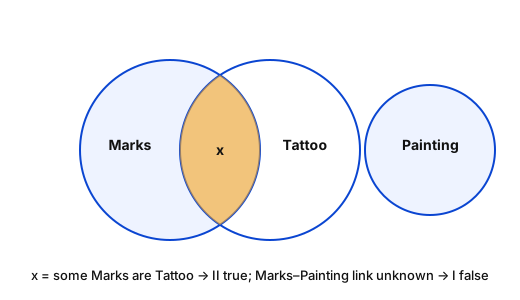
- I: Marks touch Painting only through possibility – no definite link, so “Some marks are painting” does not follow.
- II: “Some marks are tattoo” converts to “Some tattoo are mark” – follows.
Yaad rakhein: “Some A are B” always gives “Some B are A”.
Answer: (D) Only conclusion (II) follows.
अवधारणा: न्यूनतम ओवरलैप वाला वेन आरेख बनाएँ; निष्कर्ष तभी सही है जब हर संभव आरेख में सत्य हो।
- I: Marks और Painting के बीच कोई निश्चित संबंध नहीं, अतः “कुछ marks, painting हैं” नहीं निकलता।
- II: “कुछ marks, tattoo हैं” का रूपांतरण “कुछ tattoo, mark हैं” – निकलता है।
याद रखें: “कुछ A, B हैं” से हमेशा “कुछ B, A हैं” मिलता है।
उत्तर: (D) केवल निष्कर्ष (II) निकलता है।
RRB NTPC Undergraduate CBT 1General Intelligence and ReasoningSyllogismRRB NTPC Undergraduate CBT 1 2024 · 11 Aug Shift 2
Q1443.In a certain code language, ‘DRUM’ is coded as ‘2194’ and ‘CURD’ is coded as ‘4592’. What is the code for ‘C’ in the given code language?
एक निश्चित कूट भाषा में, ‘DRUM’ को ‘2194’ के रूप में कूटबद्ध किया जाता है और ‘CURD’ को ‘4592’ के रूप में कूटबद्ध किया जाता है। उस कूट भाषा में ‘C’ के लिए कूट क्या है?
- A2
- B5
- C9
- D4
Show answer
Concept: Common letters in two words get the common digits.
- DRUM = 2194, CURD = 4592.
- Common letters D, R, U ↔ common digits 2, 9, 4.
- Left: M (DRUM) = 1 and C (CURD) = 5.
Trick: Strike out the shared letters and shared digits – the leftover pair gives the answer.
Answer: (B) 5
अवधारणा: दो शब्दों के उभयनिष्ठ अक्षरों को उभयनिष्ठ अंक मिलते हैं।
- DRUM = 2194, CURD = 4592।
- उभयनिष्ठ अक्षर D, R, U ↔ उभयनिष्ठ अंक 2, 9, 4।
- शेष: M (DRUM) = 1 और C (CURD) = 5।
ट्रिक: साझा अक्षर और साझा अंक काट दें – बचा हुआ जोड़ा उत्तर देता है।
उत्तर: (B) 5
RRB NTPC Undergraduate CBT 1General Intelligence and ReasoningCoding-DecodingRRB NTPC Undergraduate CBT 1 2024 · 11 Aug Shift 2
Q1444.What should come in place of the question mark (?) in the given series?
316 288 262 238 216 ?
दी गई श्रृंखला में प्रश्न चिह्न (?) के स्थान पर क्या आना चाहिए?
316 288 262 238 216 ?
- A185
- B205
- C196
- D172
Show answer
Concept: Check the differences between consecutive terms.
- , , ,
- Next difference 20:
Trick: Subtractions decrease by 2 each time: 28, 26, 24, 22, 20.
Answer: (C) 196
अवधारणा: क्रमागत पदों का अंतर देखें।
- , , ,
- अगला अंतर 20:
ट्रिक: घटाई जाने वाली संख्या हर बार 2 कम: 28, 26, 24, 22, 20।
उत्तर: (C) 196
RRB NTPC Undergraduate CBT 1General Intelligence and ReasoningNumber SeriesRRB NTPC Undergraduate CBT 1 2024 · 11 Aug Shift 2
Q1445.In a row of people all facing north, Mukul is 5th from the right end. Alok is 10th from the right end. Alok is exactly between Mukul and Rohan. If Rohan is 6th from the left end of the line, how many people are there in the row?
उत्तर की ओर मुख करके खड़े लोगों की एक पंक्ति में, मुकुल दाएँ छोर से 5वें स्थान पर है। आलोक दाएँ छोर से 10वें स्थान पर है। आलोक, मुकुल और रोहन के ठीक बीच में है। यदि रोहन पंक्ति के बाएँ छोर से 6ठे स्थान पर है, तो पंक्ति में कितने लोग हैं?
- A20
- B23
- C26
- D24
Show answer
Concept: Total (position from right) (position from left) for the same person.
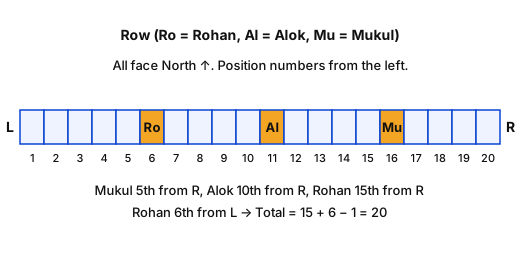
- Mukul 5th, Alok 10th from right; Alok is exactly in the middle → Rohan is th from right.
- Rohan is 6th from left.
- Total
Trick: The gap Mukul→Alok (5 places) repeats Alok→Rohan.
Answer: (A) 20
अवधारणा: एक ही व्यक्ति के लिए कुल (दाएँ से स्थान) (बाएँ से स्थान) ।
- मुकुल दाएँ से 5वाँ, आलोक 10वाँ; आलोक ठीक बीच में → रोहन दाएँ से वाँ।
- रोहन बाएँ से 6वाँ।
- कुल
ट्रिक: मुकुल→आलोक का अंतर (5 स्थान) आलोक→रोहन में दोहराएँ।
उत्तर: (A) 20
RRB NTPC Undergraduate CBT 1General Intelligence and ReasoningRanking and OrderRRB NTPC Undergraduate CBT 1 2024 · 11 Aug Shift 2
Q1446.What should come in place of the question mark (?) in the given series?
7 10 16 28 52 ?
दी गई श्रृंखला में प्रश्न चिह्न (?) के स्थान पर क्या आना चाहिए?
7 10 16 28 52 ?
- A99
- B104
- C100
- D102
Show answer
Concept: Differences form a doubling pattern.
- Differences: 3, 6, 12, 24 (each ×2).
- Next difference →
Trick: Each term : .
Answer: (C) 100
अवधारणा: अंतर दोगुने होते जाते हैं।
- अंतर: 3, 6, 12, 24 (हर बार ×2)।
- अगला अंतर →
ट्रिक: हर पद : ।
उत्तर: (C) 100
RRB NTPC Undergraduate CBT 1General Intelligence and ReasoningNumber SeriesRRB NTPC Undergraduate CBT 1 2024 · 11 Aug Shift 2
Q1447.In a certain code language, ‘TALK’ is coded as ‘5327’ and ‘LINE’ is coded as ‘6143’. What is the code for ‘L’ in the given code language?
एक निश्चित कूट भाषा में, ‘TALK’ को ‘5327’ के रूप में कूटबद्ध किया जाता है और ‘LINE’ को ‘6143’ के रूप में कूटबद्ध किया जाता है। उस कूट भाषा में ‘L’ के लिए कूट क्या है?
- A2
- B6
- C4
- D3
Show answer
Concept: The only letter common to both words takes the only digit common to both codes.
- TALK = 5327, LINE = 6143.
- Common letter: L. Common digit: 3.
- So L = 3.
Trick: One common letter ↔ one common digit – no need to decode the rest.
Answer: (D) 3
अवधारणा: दोनों शब्दों में एकमात्र उभयनिष्ठ अक्षर को दोनों कोडों का एकमात्र उभयनिष्ठ अंक मिलता है।
- TALK = 5327, LINE = 6143।
- उभयनिष्ठ अक्षर: L। उभयनिष्ठ अंक: 3।
- अतः L = 3।
ट्रिक: एक साझा अक्षर ↔ एक साझा अंक – बाकी डिकोड करने की आवश्यकता नहीं।
उत्तर: (D) 3
RRB NTPC Undergraduate CBT 1General Intelligence and ReasoningCoding-DecodingRRB NTPC Undergraduate CBT 1 2024 · 11 Aug Shift 2
Q1448.If ‘P’ stands for ‘×’, ‘Q’ stands for ‘÷’, ‘R’ stands for ‘−’ and ‘S’ stands for ‘+’, then what will come in place of the question mark (?) in the following equation?
(63 P 2) R (24 P 3) S (98 Q 2) R (48 Q 3) R 3 = ?
यदि ‘P’ का अर्थ ‘×’, ‘Q’ का अर्थ ‘÷’, ‘R’ का अर्थ ‘−’ और ‘S’ का अर्थ ‘+’ है, तो निम्नलिखित समीकरण में प्रश्न चिह्न (?) के स्थान पर क्या आएगा?
(63 P 2) R (24 P 3) S (98 Q 2) R (48 Q 3) R 3 = ?
- A98
- B84
- C122
- D104
Show answer
Concept: Replace the letters by signs, then follow BODMAS.
Trick: Brackets first: 126, 72, 49, 16 – then add/subtract left to right.
Answer: (B) 84
अवधारणा: अक्षरों के स्थान पर चिह्न रखें, फिर BODMAS लगाएँ।
ट्रिक: पहले कोष्ठक: 126, 72, 49, 16 – फिर बाएँ से दाएँ जोड़-घटाव।
उत्तर: (B) 84
RRB NTPC Undergraduate CBT 1General Intelligence and ReasoningMathematical OperationsRRB NTPC Undergraduate CBT 1 2024 · 11 Aug Shift 2
Q1449.In the following triads, each group of letters is related to the subsequent one following a certain logic. Select from the given options, the one which follows the same logic. SAIN - ANIS - NIAS
COIN - ONIC - NIOC
निम्नलिखित त्रिकों में, अक्षरों का प्रत्येक समूह एक निश्चित तर्क के आधार पर अगले समूह से संबंधित है। दिए गए विकल्पों में से उस विकल्प का चयन कीजिए जो समान तर्क का अनुसरण करता है। SAIN - ANIS - NIAS
COIN - ONIC - NIOC
- AYOUR - YUOR - RUOY
- BMACE - AMCE - EACM
- CMILE - IELM - ELIM
- DFEAT - EFAT - TEAF
Show answer
Concept: Find the position rule from 1st to 2nd cluster and from 1st to 3rd cluster.
- SAIN → ANIS: letters in order 2, 4, 3, 1 (A N I S). COIN → ONIC: same.
- 3rd cluster = 1st written in reverse: SAIN → NIAS, COIN → NIOC.
- MILE → (2,4,3,1) IELM; reverse → ELIM. Matches option C.
Trick: First check the easy rule (3rd = reverse of 1st): only MILE-ELIM and YOUR-RUOY pass; then the middle term decides.
Answer: (C) MILE - IELM - ELIM
अवधारणा: पहले से दूसरे और पहले से तीसरे समूह तक स्थान का नियम खोजें।
- SAIN → ANIS: अक्षर क्रम 2, 4, 3, 1 (A N I S)। COIN → ONIC: वही।
- तीसरा समूह = पहले का उल्टा: SAIN → NIAS, COIN → NIOC।
- MILE → (2,4,3,1) IELM; उल्टा → ELIM। विकल्प C से मेल।
ट्रिक: पहले आसान नियम (तीसरा = पहले का उल्टा) जाँचें: केवल MILE-ELIM और YOUR-RUOY बचते हैं; फिर बीच का पद निर्णय करता है।
उत्तर: (C) MILE - IELM - ELIM
RRB NTPC Undergraduate CBT 1General Intelligence and ReasoningLetter Analogy (Triads)RRB NTPC Undergraduate CBT 1 2024 · 11 Aug Shift 2
Q1450.Refer to the following number, symbol series and answer the question. Counting to be done from left to right only.
(Left) 9 8 6 1 & & 2 ^ ^ $ $ > 5 ^ 6 ^ 4 & # 6 @ (Right)
How many such symbols are there each of which is immediately preceded by a number and also immediately followed by another symbol?
निम्नलिखित संख्या, प्रतीक श्रृंखला को देखिए और प्रश्न का उत्तर दीजिए। गिनती केवल बाएँ से दाएँ की जानी है।
(बाएँ) 9 8 6 1 & & 2 ^ ^ $ $ > 5 ^ 6 ^ 4 & # 6 @ (दाएँ)
ऐसे कितने प्रतीक हैं जिनमें से प्रत्येक के ठीक पहले एक संख्या है और ठीक बाद एक अन्य प्रतीक भी है?
- ATwoदो
- BOneएक
- CFourचार
- DThreeतीन
Show answer
Concept: Look for the pattern Number – Symbol – Symbol and count the middle symbols.
- 1 & & → ✓
- 2 ^ ^ → ✓
- 4 & # → ✓
- 5 ^ 6, 6 ^ 4 → followed by a number ✗; 6 @ → nothing after ✗.
Trick: Scan only the numbers and look at the next two positions – faster than checking every symbol.
Answer: (D) Three
अवधारणा: संख्या – प्रतीक – प्रतीक का पैटर्न खोजें और बीच के प्रतीक गिनें।
- 1 & & → ✓
- 2 ^ ^ → ✓
- 4 & # → ✓
- 5 ^ 6, 6 ^ 4 → बाद में संख्या ✗; 6 @ → बाद में कुछ नहीं ✗।
ट्रिक: केवल संख्याओं को देखें और उनके अगले दो स्थान जाँचें – हर प्रतीक जाँचने से तेज़।
उत्तर: (D) तीन (Three)
RRB NTPC Undergraduate CBT 1General Intelligence and ReasoningNumber-Symbol SeriesRRB NTPC Undergraduate CBT 1 2024 · 11 Aug Shift 2
Q1451.If 1 is added to each odd digit and 4 is subtracted from each even digit in the number 6854376, which of the following digits will be third from the right?
यदि संख्या 6854376 में प्रत्येक विषम अंक में 1 जोड़ दिया जाए और प्रत्येक सम अंक में से 4 घटा दिया जाए, तो निम्नलिखित में से कौन-सा अंक दाएँ से तीसरा होगा?
- A6
- B4
- C0
- D8
Show answer
Concept: Change each digit as per its odd/even nature, then read the position.
- 6854376: 6→2, 8→4, 5→6, 4→0, 3→4, 7→8, 6→2.
- New number: 2460482.
- Third from right: 2 (1st), 8 (2nd), 4 (3rd).
Trick: Only the 3rd digit from right matters: it is 3 (odd) → .
Answer: (B) 4
अवधारणा: प्रत्येक अंक को विषम/सम के अनुसार बदलें, फिर स्थान पढ़ें।
- 6854376: 6→2, 8→4, 5→6, 4→0, 3→4, 7→8, 6→2।
- नई संख्या: 2460482।
- दाएँ से तीसरा: 2 (पहला), 8 (दूसरा), 4 (तीसरा)।
ट्रिक: केवल दाएँ से तीसरा अंक देखें: वह 3 (विषम) है → ।
उत्तर: (B) 4
RRB NTPC Undergraduate CBT 1General Intelligence and ReasoningDigit OperationsRRB NTPC Undergraduate CBT 1 2024 · 11 Aug Shift 2
Q1452.B starts from Point A and drives 16 km towards the south. He then takes a right turn and drives 12 km, then turns right and drives 19 km. He then takes a right turn and drives 21 km. He takes a final right turn, drives 3 km and stops at Point P. How far (shortest distance) and in which direction should he drive in order to reach Point A again? (All turns are 90-degree turns only unless specified.)
B बिंदु A से चलना शुरू करता है और दक्षिण की ओर 16 km गाड़ी चलाता है। फिर वह दाएँ मुड़ता है और 12 km गाड़ी चलाता है, फिर दाएँ मुड़ता है और 19 km गाड़ी चलाता है। फिर वह दाएँ मुड़ता है और 21 km गाड़ी चलाता है। वह अंतिम बार दाएँ मुड़ता है, 3 km गाड़ी चलाता है और बिंदु P पर रुक जाता है। बिंदु A पर फिर से पहुँचने के लिए उसे कितनी दूरी (न्यूनतम दूरी) तक और किस दिशा में गाड़ी चलानी चाहिए? (जब तक निर्दिष्ट न हो, सभी मोड़ केवल 90 डिग्री के मोड़ हैं।)
- A4 km to the northउत्तर की ओर 4 km
- B7 km to the eastपूर्व की ओर 7 km
- C9 km to the westपश्चिम की ओर 9 km
- D5 km to the westपश्चिम की ओर 5 km
Show answer
Concept: Trace the path on axes (A at origin); net east-west and north-south displacements give the answer.
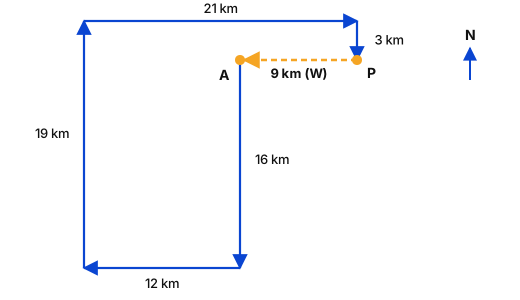
- South 16 → right (west) 12 → right (north) 19 → right (east) 21 → right (south) 3.
- North-south: ; east-west: km east.
- P is 9 km east of A → drive 9 km to the west.
Trick: Vertical net 0 means A and P are on one horizontal line – just subtract the horizontal moves.
Answer: (C) 9 km to the west
अवधारणा: A को मूल बिंदु मानकर मार्ग बनाएँ; पूर्व-पश्चिम और उत्तर-दक्षिण का शुद्ध विस्थापन उत्तर देता है।
- दक्षिण 16 → दाएँ (पश्चिम) 12 → दाएँ (उत्तर) 19 → दाएँ (पूर्व) 21 → दाएँ (दक्षिण) 3।
- उत्तर-दक्षिण: ; पूर्व-पश्चिम: km पूर्व।
- P, A से 9 km पूर्व में है → 9 km पश्चिम की ओर जाना होगा।
ट्रिक: ऊर्ध्वाधर शुद्ध 0 है, यानी A और P एक ही क्षैतिज रेखा पर – केवल क्षैतिज दूरियाँ घटाएँ।
उत्तर: (C) 9 km पश्चिम की ओर
RRB NTPC Undergraduate CBT 1General Intelligence and ReasoningDirection and DistanceRRB NTPC Undergraduate CBT 1 2024 · 11 Aug Shift 2
Q1453.BSWK is related to GXTH in a certain way based on the English alphabetical order. In the same way, LCQE is related to QHNB. To which of the given options is VMKY related, following the same logic?
अंग्रेज़ी वर्णमाला क्रम के आधार पर BSWK एक निश्चित प्रकार से GXTH से संबंधित है। उसी प्रकार, LCQE, QHNB से संबंधित है। समान तर्क का अनुसरण करते हुए, VMKY दिए गए विकल्पों में से किससे संबंधित है?
- AAQIW
- BBSGV
- CARHV
- DZRFU
Show answer
Concept: Find the shift of each letter position.
- BSWK → GXTH: B+5=G, S+5=X, W−3=T, K−3=H.
- LCQE → QHNB: L+5=Q, C+5=H, Q−3=N, E−3=B ✓.
- VMKY: V+5=A, M+5=R, K−3=H, Y−3=V → ARHV.
Trick: Pattern is (+5, +5, −3, −3); wrap around after Z (V+5 → A).
Answer: (C) ARHV
अवधारणा: हर अक्षर का स्थानीय खिसकाव (shift) ज्ञात करें।
- BSWK → GXTH: B+5=G, S+5=X, W−3=T, K−3=H।
- LCQE → QHNB: L+5=Q, C+5=H, Q−3=N, E−3=B ✓।
- VMKY: V+5=A, M+5=R, K−3=H, Y−3=V → ARHV।
ट्रिक: पैटर्न (+5, +5, −3, −3); Z के बाद फिर A से गिनें (V+5 → A)।
उत्तर: (C) ARHV
RRB NTPC Undergraduate CBT 1General Intelligence and ReasoningLetter AnalogyRRB NTPC Undergraduate CBT 1 2024 · 11 Aug Shift 2
Q1454.In a row of 49 students facing north, Amir is 22nd from the right end. If Tarun is 23rd to the left of Amir, what is Tarun's position from the left end of the line?
उत्तर की ओर मुख किए हुए 49 विद्यार्थियों की एक पंक्ति में, आमिर दाएँ छोर से 22वें स्थान पर है। यदि तरुण, आमिर के बाईं ओर 23वें स्थान पर है, तो पंक्ति के बाएँ छोर से तरुण का स्थान क्या है?
- A3rd3रा
- B5th5वाँ
- C4th4था
- D6th6ठा
Show answer
Concept: Position from left .
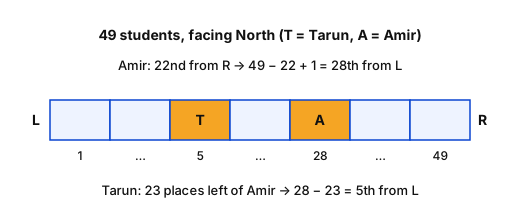
- Amir from left th.
- Tarun is 23 places to the left → th from left.
Trick: Convert everything to one end first, then move left/right.
Answer: (B) 5th
अवधारणा: बाएँ से स्थान ।
- आमिर बाएँ से वाँ।
- तरुण 23 स्थान बाईं ओर → बाएँ से वाँ।
ट्रिक: पहले सब कुछ एक ही छोर से बदलें, फिर बाएँ/दाएँ चलें।
उत्तर: (B) 5वाँ
RRB NTPC Undergraduate CBT 1General Intelligence and ReasoningRanking and OrderRRB NTPC Undergraduate CBT 1 2024 · 11 Aug Shift 2
Q1455.Read the given statements and conclusions carefully. Assuming that the information given in the statements is true, even if it appears to be at variance with commonly known facts, decide which of the given conclusion(s) logically follow(s) from the statements.
Statements:
All sharks are salmons.
Some salmons are tunas.
Conclusions:
I. Some sharks are tunas.
II. No tunas are sharks.
दिए गए कथनों और निष्कर्षों को ध्यानपूर्वक पढ़िए। यह मानते हुए कि कथनों में दी गई जानकारी सत्य है, भले ही वह सामान्य रूप से ज्ञात तथ्यों से भिन्न प्रतीत होती हो, निर्णय कीजिए कि दिए गए निष्कर्षों में से कौन-सा/कौन-से निष्कर्ष तार्किक रूप से कथनों का अनुसरण करता है/करते हैं।
कथन:
सभी शार्क, सैल्मन हैं।
कुछ सैल्मन, टूना हैं।
निष्कर्ष:
I. कुछ शार्क, टूना हैं।
II. कोई टूना, शार्क नहीं है।
- ANeither conclusion (I) nor (II) follows.न तो निष्कर्ष (I) और न ही (II) अनुसरण करता है।
- BBoth conclusions (I) and (II) follow.निष्कर्ष (I) और (II) दोनों अनुसरण करते हैं।
- COnly conclusion (II) follows.केवल निष्कर्ष (II) अनुसरण करता है।
- DOnly conclusion (I) follows.केवल निष्कर्ष (I) अनुसरण करता है।
Show answer
Concept: A conclusion follows only if it is true in every possible Venn diagram.
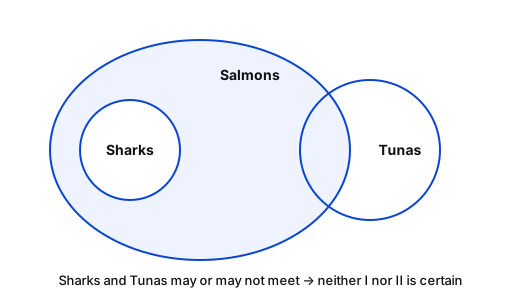
- Sharks lie inside Salmons; Tunas overlap Salmons, but may or may not touch Sharks.
- I (Some sharks are tunas) – only possible, not certain ✗.
- II (No tunas are sharks) – also only possible ✗.
Yaad rakhein: I and II form an either-or pair, but when “Either I or II” is not offered, the answer is “Neither follows”.
Answer: (A) Neither conclusion (I) nor (II) follows.
अवधारणा: निष्कर्ष तभी निकलता है जब वह हर संभव वेन आरेख में सत्य हो।
- Sharks, Salmons के अंदर हैं; Tunas, Salmons से मिलते हैं, पर Sharks से मिल भी सकते हैं, नहीं भी।
- I (कुछ sharks, tunas हैं) – केवल संभव, निश्चित नहीं ✗।
- II (कोई tuna, shark नहीं) – यह भी केवल संभव ✗।
याद रखें: I और II “या तो-या” युग्म बनाते हैं, पर यह विकल्प न हो तो उत्तर “कोई नहीं निकलता”।
उत्तर: (A) न तो निष्कर्ष (I) और न ही (II) निकलता है।
RRB NTPC Undergraduate CBT 1General Intelligence and ReasoningSyllogismRRB NTPC Undergraduate CBT 1 2024 · 11 Aug Shift 2
Q1456.Seven boxes A, B, C, D, E, F and G are kept one over the other but not necessarily in the same order. Only B is kept above C. Only two boxes are kept between C and A. Only E is kept below F. G is not kept immediately above A. How many boxes are kept below A?
सात बक्से A, B, C, D, E, F और G एक के ऊपर एक रखे गए हैं, परंतु आवश्यक नहीं कि इसी क्रम में हों। केवल B को C के ऊपर रखा गया है। C और A के बीच केवल दो बक्से रखे गए हैं। केवल E को F के नीचे रखा गया है। G को A के ठीक ऊपर नहीं रखा गया है। A के नीचे कितने बक्से रखे गए हैं?
- A1
- B3
- C2
- D4
Show answer
Concept: Number positions 7 (top) to 1 (bottom) and fix the definite clues first.
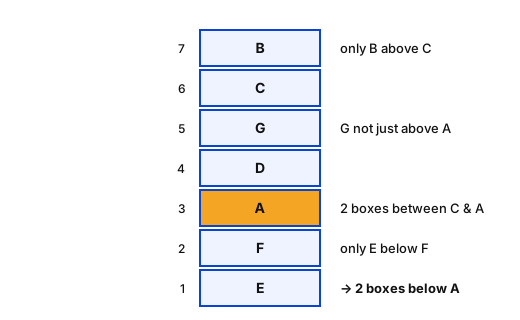
- Only B above C → B = 7, C = 6. Only E below F → E = 1, F = 2.
- Two boxes between C (6) and A → A = 3.
- G not immediately above A → G ≠ 4, so G = 5, D = 4.
- Below A: F and E → 2 boxes.
Trick: “Only X above Y” fixes the top two; “Only X below Y” fixes the bottom two.
Answer: (C) 2
अवधारणा: स्थान 7 (ऊपर) से 1 (नीचे) तक मानें और पहले निश्चित संकेत रखें।
- केवल B, C के ऊपर → B = 7, C = 6। केवल E, F के नीचे → E = 1, F = 2।
- C (6) और A के बीच दो बॉक्स → A = 3।
- G, A के ठीक ऊपर नहीं → G ≠ 4, अतः G = 5, D = 4।
- A के नीचे: F और E → 2 बॉक्स।
ट्रिक: “केवल X, Y के ऊपर” से ऊपर के दो स्थान; “केवल X, Y के नीचे” से नीचे के दो स्थान तय होते हैं।
उत्तर: (C) 2
RRB NTPC Undergraduate CBT 1General Intelligence and ReasoningBox ArrangementRRB NTPC Undergraduate CBT 1 2024 · 11 Aug Shift 2
Q1457.If + means ‘subtraction’, − means ‘division’, ÷ means ‘multiplication’, × means ‘addition’, then what will come in place of the question mark (?) in the following equation? 49 − 1 × 480 + 40 ÷ 6 = ?
यदि + का अर्थ ‘घटाना’, − का अर्थ ‘भाग देना’, ÷ का अर्थ ‘गुणा करना’, × का अर्थ ‘जोड़ना’ है, तो निम्नलिखित समीकरण में प्रश्न चिह्न (?) के स्थान पर क्या आएगा? 49 − 1 × 480 + 40 ÷ 6 = ?
- A291
- B289
- C292
- D290
Show answer
Concept: Replace the signs as told, then apply BODMAS.
Trick: Write the new expression first, never compute with the old signs.
Answer: (B) 289
अवधारणा: बताए अनुसार चिह्न बदलें, फिर BODMAS लगाएँ।
ट्रिक: पहले नया व्यंजक लिखें, पुराने चिह्नों से कभी गणना न करें।
उत्तर: (B) 289
RRB NTPC Undergraduate CBT 1General Intelligence and ReasoningMathematical OperationsRRB NTPC Undergraduate CBT 1 2024 · 11 Aug Shift 2
Q1458.In a certain code language,
'A = B' means ‘A is the mother of B’,
'A $ B' means ‘A is the brother of B’,
'A @ B' means ‘A is the wife of B’ and
'A * B' means ‘A is the father of B’.
How is W related to R if W = A $ C @ D * R?
एक निश्चित कूट भाषा में,
'A = B' का अर्थ है ‘A, B की माँ है’,
'A $ B' का अर्थ है ‘A, B का भाई है’,
'A @ B' का अर्थ है ‘A, B की पत्नी है’ और
'A * B' का अर्थ है ‘A, B का पिता है’।
यदि W = A $ C @ D * R है, तो W, R से किस प्रकार संबंधित है?
- AMother's motherमाँ की माँ
- BMother's sisterमाँ की बहन
- CSisterबहन
- DMotherमाँ
Show answer
Concept: Decode each symbol one by one and build a family tree.
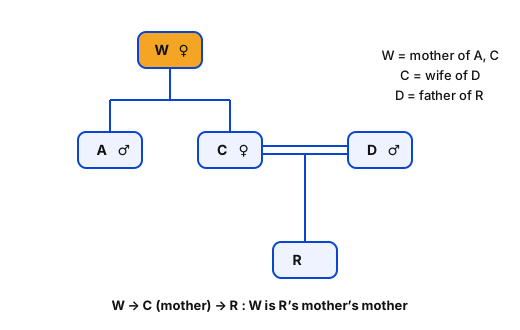
- W = A: W is mother of A. A $ C: A is brother of C → W is mother of C too.
- C @ D: C is wife of D. D * R: D is father of R → C is mother of R.
- W is the mother of R’s mother.
Trick: Follow the chain W → C → R: mother → mother = mother’s mother.
Answer: (A) Mother’s mother
अवधारणा: हर चिह्न को एक-एक करके डिकोड करें और वंश-वृक्ष बनाएँ।
- W = A: W, A की माँ। A $ C: A, C का भाई → W, C की भी माँ।
- C @ D: C, D की पत्नी। D * R: D, R का पिता → C, R की माँ।
- W, R की माँ की माँ है।
ट्रिक: श्रृंखला W → C → R: माँ → माँ = नानी (माँ की माँ)।
उत्तर: (A) माँ की माँ (Mother’s mother)
RRB NTPC Undergraduate CBT 1General Intelligence and ReasoningCoded Blood RelationsRRB NTPC Undergraduate CBT 1 2024 · 11 Aug Shift 2
Q1459.Which of the following letter-number clusters will replace the question mark (?) in the given series to make it logically complete?
FIB27 GJC38 HKD49 ILE60 ?
निम्नलिखित में से कौन-सा अक्षर-संख्या समूह दी गई श्रृंखला में प्रश्न चिह्न (?) के स्थान पर आकर उसे तार्किक रूप से पूर्ण करेगा?
FIB27 GJC38 HKD49 ILE60 ?
- AJMF71
- BJME70
- CJME71
- DJMF70
Show answer
Concept: Treat each position of the cluster as a separate series.
- 1st letters: F, G, H, I → J. 2nd letters: I, J, K, L → M.
- 3rd letters: B, C, D, E → F.
- Numbers: 27, 38, 49, 60 (+11) → 71.
Trick: Every part moves +1 (letters) or +11 (number) → JMF71.
Answer: (A) JMF71
अवधारणा: समूह के हर स्थान को अलग श्रृंखला मानें।
- पहले अक्षर: F, G, H, I → J। दूसरे अक्षर: I, J, K, L → M।
- तीसरे अक्षर: B, C, D, E → F।
- संख्याएँ: 27, 38, 49, 60 (+11) → 71।
ट्रिक: हर भाग +1 (अक्षर) या +11 (संख्या) बढ़ता है → JMF71।
उत्तर: (A) JMF71
RRB NTPC Undergraduate CBT 1General Intelligence and ReasoningAlpha-Numeric SeriesRRB NTPC Undergraduate CBT 1 2024 · 11 Aug Shift 2
Q1460.Seven people, I, J, K, L, M, N and O, are sitting in a row, facing north. No one sits to the right of K. Only three people sit between K and J. Only two people sit between J and I. L sits third to the left of O. M sits to the immediate right of O. How many people sit between N and I?
सात व्यक्ति, I, J, K, L, M, N और O, उत्तर की ओर मुख करके एक पंक्ति में बैठे हैं। K के दाईं ओर कोई नहीं बैठा है। K और J के बीच केवल तीन व्यक्ति बैठे हैं। J और I के बीच केवल दो व्यक्ति बैठे हैं। L, O के बाईं ओर तीसरे स्थान पर बैठा है। M, O के ठीक दाईं ओर बैठा है। N और I के बीच कितने व्यक्ति बैठे हैं?
- AThreeतीन
- BOneएक
- CFourचार
- DTwoदो
Show answer
Concept: Number seats 1 (left) to 7 (right) for people facing north; place fixed people first.
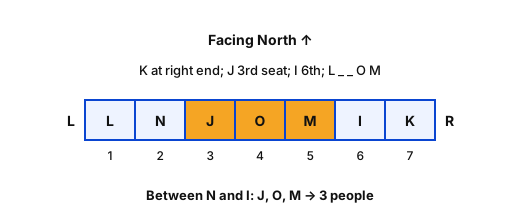
- No one right of K → K = 7. Three between K and J → J = 3.
- Two between J and I → I = 6.
- Free seats 1, 2, 4, 5: O and M adjacent with L three left of O → O = 4, M = 5, L = 1, N = 2.
- Between N (2) and I (6): J, O, M = 3.
Trick: “No one to the right” = right end seat; start from there.
Answer: (A) Three
अवधारणा: उत्तर की ओर मुख वाले लोगों के लिए सीट 1 (बाएँ) से 7 (दाएँ) तक लें; पहले निश्चित लोगों को रखें।
- K के दाएँ कोई नहीं → K = 7। K और J के बीच तीन → J = 3।
- J और I के बीच दो → I = 6।
- खाली सीटें 1, 2, 4, 5: O और M साथ, L, O के तीसरे बाएँ → O = 4, M = 5, L = 1, N = 2।
- N (2) और I (6) के बीच: J, O, M = 3।
ट्रिक: “दाएँ कोई नहीं” = दायाँ छोर; वहीं से शुरू करें।
उत्तर: (A) तीन (Three)
RRB NTPC Undergraduate CBT 1General Intelligence and ReasoningLinear Seating ArrangementRRB NTPC Undergraduate CBT 1 2024 · 11 Aug Shift 2

