Q1461.A jacket is marked at ₹8,000. The shopkeeper offers a 30% discount on the marked price. After the discount, a 12% sales tax is added on the discounted price. What is the final price of the jacket?
एक जैकेट का अंकित मूल्य ₹8,000 है। दुकानदार अंकित मूल्य पर 30% की छूट देता है। छूट के बाद, छूट वाले मूल्य पर 12% बिक्री कर जोड़ा जाता है। जैकेट का अंतिम मूल्य क्या है?
- A₹6,440
- B₹7,248
- C₹6,240
- D₹6,272
Show answer
Concept: Apply successive percentage changes as multipliers.
- After 30% discount:
- Add 12% tax:
Trick: Net factor → .
Answer: (D) ₹6,272
अवधारणा: क्रमागत प्रतिशत परिवर्तनों को गुणक की तरह लगाएँ।
- 30% छूट के बाद:
- 12% कर जोड़ें:
ट्रिक: कुल गुणक → ।
उत्तर: (D) ₹6,272
RRB NTPC Undergraduate CBT 1MathematicsDiscount and TaxRRB NTPC Undergraduate CBT 1 2024 · 11 Aug Shift 2
Q1462.Find the value of .
का मान ज्ञात कीजिए।
- A
- B
- C
- D
Show answer
Concept: and .
Trick: Put : first part undefined, so try : = ✓.
Answer: (A)
अवधारणा: तथा ।
ट्रिक: रखें: = ✓।
उत्तर: (A)
RRB NTPC Undergraduate CBT 1MathematicsTrigonometric IdentitiesRRB NTPC Undergraduate CBT 1 2024 · 11 Aug Shift 2
Q1463.The perimeter of a square is 248 m. Its area (in m2) is:
एक वर्ग का परिमाप 248 m है। इसका क्षेत्रफल (m2 में) है:
- A3848
- B3816
- C3840
- D3844
Show answer
Concept: Square: perimeter , area .
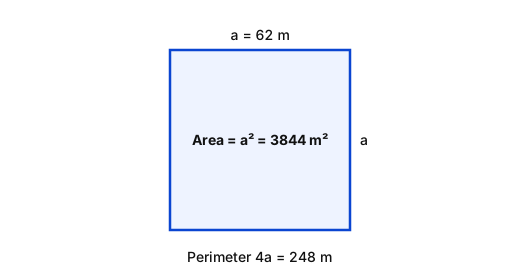
- m
- Area
Trick: ; a square of a number ending in 2 must end in 4.
Answer: (D) 3844
अवधारणा: वर्ग: परिमाप , क्षेत्रफल ।
- m
- क्षेत्रफल
ट्रिक: ।
उत्तर: (D) 3844
RRB NTPC Undergraduate CBT 1MathematicsMensuration – SquareRRB NTPC Undergraduate CBT 1 2024 · 11 Aug Shift 2
Q1464.Manoj, Swati and Rahul invested ₹1,020, ₹1,440 and ₹1,230, respectively to start a business. If the profit at the end of the year is ₹1,260, what is Rahul's share of the profit?
मनोज, स्वाति और राहुल ने एक व्यवसाय शुरू करने के लिए क्रमशः ₹1,020, ₹1,440 और ₹1,230 का निवेश किया। यदि वर्ष के अंत में लाभ ₹1,260 है, तो लाभ में राहुल का हिस्सा कितना है?
- A₹420
- B₹423
- C₹421
- D₹422
Show answer
Concept: For equal time, profit is shared in the ratio of investments.
- , sum .
- Rahul’s share
Trick: is exactly one-third of the total → share .
Answer: (A) ₹420
अवधारणा: समान समय के लिए लाभ निवेश के अनुपात में बँटता है।
- , योग ।
- राहुल का हिस्सा
ट्रिक: कुल का ठीक एक-तिहाई है → हिस्सा ।
उत्तर: (A) ₹420
RRB NTPC Undergraduate CBT 1MathematicsPartnershipRRB NTPC Undergraduate CBT 1 2024 · 11 Aug Shift 2
Q1465.The average weight (in kg) of a family of five members whose weights are 40 kg, 49 kg, 56 kg, 73 kg and 39 kg is:
पाँच सदस्यों वाले एक परिवार, जिनके भार 40 kg, 49 kg, 56 kg, 73 kg और 39 kg हैं, का औसत भार (kg में) है:
- A51.4
- B53.4
- C52.4
- D50.4
Show answer
Concept: Average .
- Sum
- Average kg
Trick: Deviations from 50: → total → .
Answer: (A) 51.4
अवधारणा: ।
- योग
- औसत kg
ट्रिक: 50 से विचलन: → कुल → ।
उत्तर: (A) 51.4
RRB NTPC Undergraduate CBT 1MathematicsAverageRRB NTPC Undergraduate CBT 1 2024 · 11 Aug Shift 2
Q1466.A number when increased by 100% gives 2700. The number is:
एक संख्या में 100% की वृद्धि करने पर 2700 प्राप्त होता है। वह संख्या है:
- A1350
- B2700
- C4050
- D675
Show answer
Concept: Increasing by 100% means the number becomes double.
Trick: +100% = ×2, so just halve the result.
Answer: (A) 1350
अवधारणा: 100% बढ़ाने का अर्थ है संख्या दोगुनी हो जाना।
ट्रिक: +100% = ×2, अतः परिणाम का आधा करें।
उत्तर: (A) 1350
RRB NTPC Undergraduate CBT 1MathematicsPercentageRRB NTPC Undergraduate CBT 1 2024 · 11 Aug Shift 2
Q1467.The selling price of 50 books is equal to the cost price of 5 books. Find the loss or gain percentage.
50 पुस्तकों का विक्रय मूल्य 5 पुस्तकों के क्रय मूल्य के बराबर है। हानि या लाभ प्रतिशत ज्ञात कीजिए।
- A90% loss90% हानि
- B90% gain90% लाभ
- C loss हानि
- D gain लाभ
Show answer
Concept: If SP of x articles = CP of y articles, then (when ).
- SP of 50 = CP of 5; let CP of 1 book = ₹1 → CP of 50 = ₹50, SP of 50 = ₹5.
- Loss →
Trick: ; SP is smaller than CP, so it is a loss.
Answer: (A) 90% loss
अवधारणा: यदि x वस्तुओं का SP = y वस्तुओं का CP, तो (जब )।
- 50 का SP = 5 का CP; 1 पुस्तक का CP = ₹1 मानें → 50 का CP = ₹50, 50 का SP = ₹5।
- हानि →
ट्रिक: ; SP, CP से कम है, अतः हानि।
उत्तर: (A) 90% हानि (loss)
RRB NTPC Undergraduate CBT 1MathematicsProfit and LossRRB NTPC Undergraduate CBT 1 2024 · 11 Aug Shift 2
Q1468.Which of the following numbers divides 15,99,16,901?
निम्नलिखित में से कौन-सी संख्या 15,99,16,901 को विभाजित करती है?
- A25
- B19
- C28
- D18
Show answer
Concept: Eliminate using quick rules, then check the remaining divisor.
- Ends in 1 → not divisible by 25; odd → not by 28 or 18.
- exactly ().
Trick: Odd number → all even divisors out; 25 needs the last two digits 00, 25, 50 or 75. Only 19 remains.
Answer: (B) 19
अवधारणा: त्वरित नियमों से विकल्प हटाएँ, फिर बचे भाजक की जाँच करें।
- अंत में 1 → 25 से विभाज्य नहीं; विषम → 28 या 18 से नहीं।
- पूर्ण ()।
ट्रिक: विषम संख्या → सभी सम भाजक बाहर; 25 के लिए अंतिम दो अंक 00, 25, 50 या 75 चाहिए। केवल 19 बचता है।
उत्तर: (B) 19
RRB NTPC Undergraduate CBT 1MathematicsDivisibilityRRB NTPC Undergraduate CBT 1 2024 · 11 Aug Shift 2
Q1469.M and N start a business. M invests ₹70,000 more than N for 3 months and N invests for 5 months. M's share is ₹288 more than that of N, out of a total profit of ₹4,896. Find the capital contributed by M.
M और N एक व्यवसाय शुरू करते हैं। M, N से ₹70,000 अधिक 3 महीने के लिए निवेश करता है और N, 5 महीने के लिए निवेश करता है। ₹4,896 के कुल लाभ में से M का हिस्सा N के हिस्से से ₹288 अधिक है। M द्वारा लगाई गई पूँजी ज्ञात कीजिए।
- A₹1,50,000
- B₹1,40,000
- C₹1,80,000
- D₹1,60,000
Show answer
Concept: Profit ratio = (capital × time) ratio.
- , → M’s share , N’s share ; ratio .
- Let N’s capital :
- M’s capital
Trick: Check option (A): ✓.
Answer: (A) ₹1,50,000
अवधारणा: लाभ का अनुपात = (पूँजी × समय) का अनुपात।
- , → M का हिस्सा , N का ; अनुपात ।
- N की पूँजी :
- M की पूँजी
ट्रिक: विकल्प (A) जाँचें: ✓।
उत्तर: (A) ₹1,50,000
RRB NTPC Undergraduate CBT 1MathematicsPartnershipRRB NTPC Undergraduate CBT 1 2024 · 11 Aug Shift 2
Q1470.The LCM of 33 × 82 × 14, 32 × 142 × 19 and 83 × 142 × 192 is:
33 × 82 × 14, 32 × 142 × 19 और 83 × 142 × 192 का LCM (लघुत्तम समापवर्त्य) है:
- A33 × 82 × 142 × 19
- B32 × 82 × 142 × 193
- C32 × 83 × 14 × 192
- D33 × 83 × 142 × 192
Show answer
Concept: LCM takes the highest power of each factor appearing in the numbers.
- Highest power of 3: ; of 8: .
- Highest power of 14: ; of 19: .
- LCM (in primes – the same value).
Trick: LCM = highest powers, HCF = lowest powers – only option D has every highest power.
Answer: (D)
अवधारणा: LCM में प्रत्येक गुणनखंड की सबसे बड़ी घात ली जाती है।
- 3 की अधिकतम घात: ; 8 की: ।
- 14 की अधिकतम घात: ; 19 की: ।
- LCM (अभाज्य रूप – मान वही)।
याद रखें: LCM = अधिकतम घातें, HCF = न्यूनतम घातें – केवल विकल्प D में सभी अधिकतम घातें हैं।
उत्तर: (D)
RRB NTPC Undergraduate CBT 1MathematicsLCMRRB NTPC Undergraduate CBT 1 2024 · 11 Aug Shift 2
Q1471.The cost of 2 pens and 19 pencils is ₹118. If the price of a pen decreases by ₹5 and the price of a pencil increases by ₹4, the cost of 5 pens and 8 pencils is ₹144. What is the actual cost of 14 pens and 6 pencils?
2 पेन और 19 पेंसिलों का मूल्य ₹118 है। यदि एक पेन का मूल्य ₹5 कम हो जाए और एक पेंसिल का मूल्य ₹4 बढ़ जाए, तो 5 पेन और 8 पेंसिलों का मूल्य ₹144 होता है। 14 पेन और 6 पेंसिलों का वास्तविक मूल्य कितना है?
- A₹318
- B₹314
- C₹319
- D₹321
Show answer
Concept: Form two linear equations in the price of a pen and a pencil and solve them.
- ...(i)
- New prices: ...(ii)
- (i) − (ii): , so
- Required cost
Trick: Since must be even, is even; try : and ✔.
Answer: (A) ₹318
अवधारणा: पेन का मूल्य और पेंसिल का मानकर दो रैखिक समीकरण बनाएँ और हल करें।
- ...(i)
- नए मूल्य: ...(ii)
- (i) − (ii): , अतः
- अभीष्ट मूल्य
ट्रिक: सम होना चाहिए, अतः सम; रखें: और ✔।
उत्तर: (A) ₹318
RRB NTPC Undergraduate CBT 1MathematicsLinear equationsRRB NTPC Undergraduate CBT 1 2024 · 11 Aug Shift 1
Q1472.The HCF and LCM of two numbers are 91 and 546 respectively. If one number is 182, find the other number.
दो संख्याओं का HCF और LCM क्रमशः 91 और 546 है। यदि एक संख्या 182 है, तो दूसरी संख्या ज्ञात कीजिए।
- A273
- B91
- C364
- D182
Show answer
Concept: For two numbers: .
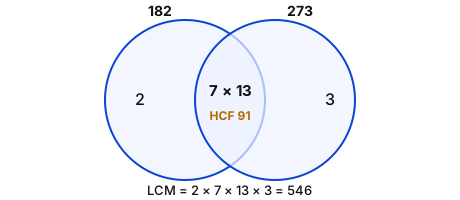
- Check: , → HCF , LCM ✔
Trick: Both numbers are multiples of the HCF: , so other (since ).
Answer: (A) 273
अवधारणा: दो संख्याओं के लिए: ।
- जाँच: , → HCF , LCM ✔
ट्रिक: दोनों संख्याएँ HCF की गुणज हैं: , अतः दूसरी (क्योंकि )।
उत्तर: (A) 273
RRB NTPC Undergraduate CBT 1MathematicsHCF and LCMRRB NTPC Undergraduate CBT 1 2024 · 11 Aug Shift 1
Q1473.When a number is increased by 60%, it becomes 3550. What is the number?
जब किसी संख्या में 60% की वृद्धि की जाती है, तो वह 3550 हो जाती है। वह संख्या क्या है?
- A2218.75
- B6656.25
- C4437.5
- D1109.375
Show answer
Concept: If a number is increased by , new value .
Trick: increase = multiply by ; reverse by multiplying with .
Answer: (A) 2218.75
अवधारणा: यदि संख्या में वृद्धि हो, तो नया मान ।
ट्रिक: वृद्धि = से गुणा; उल्टा करने के लिए से गुणा।
उत्तर: (A) 2218.75
RRB NTPC Undergraduate CBT 1MathematicsPercentage increaseRRB NTPC Undergraduate CBT 1 2024 · 11 Aug Shift 1
Q1474.A dishonest trader claims to sell rice at a profit of 39%, but uses a weight that is 17% less than the marked value while selling. What is the trader's overall profit percentage? (rounded to the nearest whole number)
एक बेईमान व्यापारी 39% के लाभ पर चावल बेचने का दावा करता है, लेकिन बेचते समय अंकित मान से 17% कम भार वाले बाट का उपयोग करता है। व्यापारी का कुल लाभ प्रतिशत कितना है? (निकटतम पूर्ण संख्या तक पूर्णांकित)
- A
- B
- C
- D
Show answer
Concept: A dishonest seller gains twice: on the marked-up price and on the short weight. .
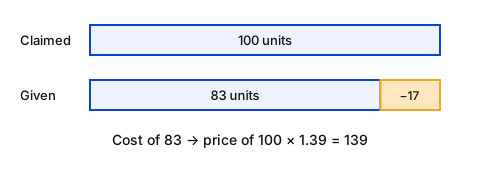
- Let cost of 1 unit = ₹1. He claims 100 units and charges .
- He actually gives units, costing ₹83.
Trick: → about .
Answer: (C)
अवधारणा: बेईमान विक्रेता दो बार लाभ कमाता है: बढ़े मूल्य से और कम तौल से। ।
- 1 इकाई का क्रय मूल्य ₹1 मानें। वह 100 इकाई बताकर लेता है।
- वह वास्तव में इकाई देता है, जिसकी लागत ₹83 है।
ट्रिक: → लगभग ।
उत्तर: (C)
RRB NTPC Undergraduate CBT 1MathematicsProfit and loss – faulty weightsRRB NTPC Undergraduate CBT 1 2024 · 11 Aug Shift 1
Q1475.What is the value of ?
का मान क्या है?
- A1.54
- B14.54
- C12.19
- D17.15
Show answer
Concept: Take the square root of each term separately, then add/subtract.
Trick: Decimal places in a square root = half of those in the number: has 4 places → root has 2.
Answer: (D) 17.15
अवधारणा: प्रत्येक पद का वर्गमूल अलग-अलग निकालें, फिर जोड़ें/घटाएँ।
ट्रिक: वर्गमूल में दशमलव स्थान संख्या के आधे होते हैं: में 4 स्थान → मूल में 2।
उत्तर: (D) 17.15
RRB NTPC Undergraduate CBT 1MathematicsSquare rootsRRB NTPC Undergraduate CBT 1 2024 · 11 Aug Shift 1
Q1476.What is the largest number that divides 527 and 632 leaving remainders 7 and 8 respectively?
वह सबसे बड़ी संख्या कौन-सी है जिससे 527 और 632 को विभाजित करने पर क्रमशः 7 और 8 शेषफल प्राप्त होते हैं?
- A102
- B104
- C112
- D98
Show answer
Concept: If a number leaves remainders on dividing , then .
- and
- ,
- Check: , ✔ (and )
Trick: ; the HCF must divide this difference, and 104 itself divides both → answer 104.
Answer: (B) 104
अवधारणा: यदि संख्या से को भाग देने पर शेष बचें, तो ।
- और
- ,
- जाँच: , ✔
ट्रिक: ; HCF इस अंतर को विभाजित करता है, और 104 दोनों को विभाजित करता है → उत्तर 104।
उत्तर: (B) 104
RRB NTPC Undergraduate CBT 1MathematicsHCF – remaindersRRB NTPC Undergraduate CBT 1 2024 · 11 Aug Shift 1
Q1477.₹74,000 is divided among A, B and C in such a way that 9 times A's share = 3 times B's share = 7 times C's share. What is A's share?
₹74,000 को A, B और C में इस प्रकार बाँटा जाता है कि A के हिस्से का 9 गुना = B के हिस्से का 3 गुना = C के हिस्से का 7 गुना है। A का हिस्सा कितना है?
- A₹14,194
- B₹13,816
- C₹14,000
- D₹13,865
Show answer
Concept: If , then ; multiply by LCM of .
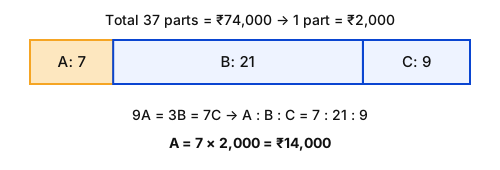
- Total parts
- 1 part
Trick: The share is inversely proportional to the multiplier: smallest multiplier 3 (B) gets the largest share.
Answer: (C) ₹14,000
अवधारणा: यदि , तो ; के LCM से गुणा करें।
- कुल भाग
- 1 भाग
ट्रिक: हिस्सा गुणक के व्युत्क्रमानुपाती है: सबसे छोटा गुणक 3 (B) → सबसे बड़ा हिस्सा।
उत्तर: (C) ₹14,000
RRB NTPC Undergraduate CBT 1MathematicsRatio and proportionRRB NTPC Undergraduate CBT 1 2024 · 11 Aug Shift 1
Q1478.Simplify.
सरल कीजिए।
- A
- B
- C
- D
Show answer
Concept: Expand each bracket, then combine like terms.
- Sum:
Trick: Put : expression ; option (B) gives ✔.
Answer: (B)
अवधारणा: प्रत्येक कोष्ठक खोलें, फिर समान पदों को जोड़ें।
- योग:
ट्रिक: रखें: व्यंजक ; विकल्प (B) ✔।
उत्तर: (B)
RRB NTPC Undergraduate CBT 1MathematicsAlgebraic simplificationRRB NTPC Undergraduate CBT 1 2024 · 11 Aug Shift 1
Q1479.How many prime numbers are there between 466 and 476 (both numbers included)?
466 और 476 के बीच (दोनों संख्याओं सहित) कितनी अभाज्य संख्याएँ हैं?
- A1
- B2
- C3
- D5
Show answer
Concept: To test for primality, check divisibility by primes up to . Here , so test 2, 3, 5, 7, 11, 13, 17, 19.
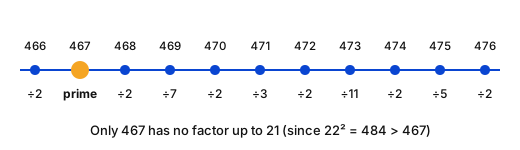
- Even numbers 466, 468, 470, 472, 474, 476 are out; 475 ends in 5.
- , ,
- 467 is not divisible by 2, 3, 5, 7, 11, 13, 17 or 19 → prime.
- So only one prime: 467.
Trick: Between consecutive odd numbers, quickly test 3 (digit sum), 7 and 11 (alternating sum) first – they remove most candidates.
Answer: (A) 1
अवधारणा: के अभाज्य होने की जाँच के लिए तक के अभाज्यों से भाग दें। यहाँ , अतः 2, 3, 5, 7, 11, 13, 17, 19 जाँचें।
- सम संख्याएँ 466, 468, 470, 472, 474, 476 बाहर; 475 के अंत में 5 है।
- , ,
- 467 किसी भी 2, 3, 5, 7, 11, 13, 17, 19 से विभाज्य नहीं → अभाज्य।
- अतः केवल एक अभाज्य: 467।
ट्रिक: पहले 3 (अंकों का योग), 7 और 11 (एकांतर योग) जाँचें – अधिकांश संख्याएँ यहीं कट जाती हैं।
उत्तर: (A) 1
RRB NTPC Undergraduate CBT 1MathematicsPrime numbersRRB NTPC Undergraduate CBT 1 2024 · 11 Aug Shift 1
Q1480.79 plates were bought for ₹79 and 13 plates broke during transportation. The trader sold each of the remaining plates at ₹5.90. Find the trader's profit.
₹79 में 79 प्लेटें खरीदी गईं और परिवहन के दौरान 13 प्लेटें टूट गईं। व्यापारी ने शेष प्रत्येक प्लेट ₹5.90 में बेची। व्यापारी का लाभ ज्ञात कीजिए।
- A₹314.90
- B₹305.40
- C₹316.40
- D₹310.40
Show answer
Concept: ; broken plates add to cost but give no revenue.
- CP of 79 plates = ₹79
- Plates left
- SP
- Profit
Trick: .
Answer: (D) ₹310.40
अवधारणा: ; टूटी प्लेटें लागत में जुड़ती हैं पर आय नहीं देतीं।
- 79 प्लेटों का क्रय मूल्य = ₹79
- बची प्लेटें
- विक्रय मूल्य
- लाभ
ट्रिक: ।
उत्तर: (D) ₹310.40
RRB NTPC Undergraduate CBT 1MathematicsProfit and lossRRB NTPC Undergraduate CBT 1 2024 · 11 Aug Shift 1

