Q1501.Each of the digits in the number 71642938 is arranged in ascending order from left to right. The position of how many digits will remain unchanged as compared to that in the original number?
संख्या 71642938 के प्रत्येक अंक को बाएँ से दाएँ आरोही क्रम में व्यवस्थित किया जाता है। मूल संख्या की तुलना में कितने अंकों का स्थान अपरिवर्तित रहेगा?
- ANoneकोई नहीं
- BTwoदो
- COneएक
- DThreeतीन
Show answer
Concept: Rearrange the digits and compare position by position.
- Original: 7 1 6 4 2 9 3 8
- Ascending: 1 2 3 4 6 7 8 9
- Only the 4th position (digit 4) is the same.
Trick: Write both rows one under the other and tick matches.
Answer: (C) One
अवधारणा: अंकों को क्रम में लगाकर स्थान-दर-स्थान तुलना करें।
- मूल: 7 1 6 4 2 9 3 8
- आरोही: 1 2 3 4 6 7 8 9
- केवल चौथा स्थान (अंक 4) समान है।
ट्रिक: दोनों पंक्तियाँ एक के नीचे एक लिखें और मिलान देखें।
उत्तर: (C) एक
RRB NTPC Undergraduate CBT 1General Intelligence and ReasoningDigit arrangementRRB NTPC Undergraduate CBT 1 2024 · 8 Aug Shift 3
Q1502.A, B, C, D, E, F and G are sitting around a circular table facing the centre. B sits third to the right of E. F sits to the immediate left of B. C is the immediate neighbour of A and B. G is not the immediate neighbour of F. How many people sit between D and G when counted from the left of G?
A, B, C, D, E, F और G एक वृत्ताकार मेज़ के चारों ओर केंद्र की ओर मुख करके बैठे हैं। B, E के दाएँ से तीसरे स्थान पर बैठा है। F, B के ठीक बाएँ बैठा है। C, A और B दोनों का निकटतम पड़ोसी है। G, F का निकटतम पड़ोसी नहीं है। G के बाएँ से गिनने पर D और G के बीच कितने व्यक्ति बैठे हैं?
- AFourचार
- BTwoदो
- CFiveपाँच
- DThreeतीन
Show answer
Concept: Facing the centre, right = anticlockwise and left = clockwise.
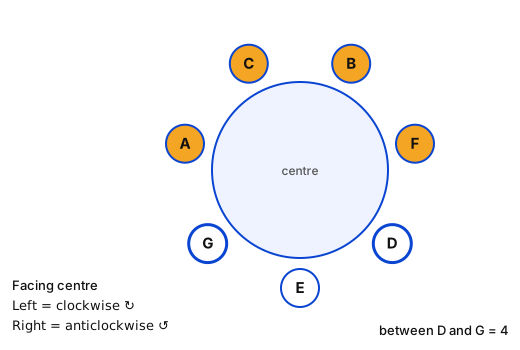
- Fix E; B is 3rd to the right of E; F is immediate left of B.
- C sits next to B (other side from F) and A next to C.
- Two seats remain beside E; G cannot be next to F, so D is between E and F and G is between A and E.
- Going left from G: A, C, B, F, then D → 4 people between.
Trick: Place the most fixed clue (B from E) first.
Answer: (A) Four
अवधारणा: केंद्र की ओर मुख हो तो दायाँ = वामावर्त (anticlockwise), बायाँ = दक्षिणावर्त (clockwise)।
- E को रखें; B, E के दाएँ तीसरे स्थान पर; F, B के ठीक बाएँ।
- C, B के दूसरी ओर और A, C के पास।
- E के दोनों ओर दो स्थान बचे; G, F के पास नहीं, अतः D, E और F के बीच तथा G, A और E के बीच।
- G के बाएँ से गिनें: A, C, B, F, फिर D → बीच में 4 लोग।
ट्रिक: सबसे पक्की शर्त (E से B) पहले लगाएँ।
उत्तर: (A) चार
RRB NTPC Undergraduate CBT 1General Intelligence and ReasoningCircular seating arrangementRRB NTPC Undergraduate CBT 1 2024 · 8 Aug Shift 3
Q1503.What will come in place of the question mark (?) in the following equation, if ‘+’ and ‘×’ are interchanged and ‘−’ and ‘÷’ are interchanged?
38 ÷ 7 + 5 × 20 − 4 = ?
यदि ‘+’ और ‘×’ को आपस में बदल दिया जाए तथा ‘−’ और ‘÷’ को आपस में बदल दिया जाए, तो निम्नलिखित समीकरण में प्रश्न चिह्न (?) के स्थान पर क्या आएगा?
38 ÷ 7 + 5 × 20 − 4 = ?
- A22
- B27
- C8
- D15
Show answer
Concept: Swap the signs as told, then apply BODMAS.
- Swap + ↔ × and − ↔ ÷: .
Trick: Rewrite the whole expression first, then calculate.
Answer: (C) 8
अवधारणा: बताए अनुसार चिह्न बदलें, फिर BODMAS लगाएँ।
- + ↔ × और − ↔ ÷: ।
ट्रिक: पहले पूरा व्यंजक दोबारा लिखें, फिर हल करें।
उत्तर: (C) 8
RRB NTPC Undergraduate CBT 1General Intelligence and ReasoningMathematical operationsRRB NTPC Undergraduate CBT 1 2024 · 8 Aug Shift 3
Q1504.In a certain code language,
A + B means ‘A is the daughter of B’,
A – B means ‘A is the wife of B’,
A x B means ‘A is the father of B’ and
A ÷ B means ‘A is the brother of B’.
How is A related to S if ‘A + E – F x N ÷ S’?
एक निश्चित कूट भाषा में,
A + B का अर्थ है ‘A, B की पुत्री है’,
A – B का अर्थ है ‘A, B की पत्नी है’,
A x B का अर्थ है ‘A, B का पिता है’ और
A ÷ B का अर्थ है ‘A, B का भाई है’।
यदि ‘A + E – F x N ÷ S’ है, तो A का S से क्या संबंध है?
- AFather's sisterपिता की बहन
- BMother's motherमाता की माता
- CFather's motherपिता की माता
- DSisterबहन
Show answer
Concept: Decode each symbol and build a family tree.
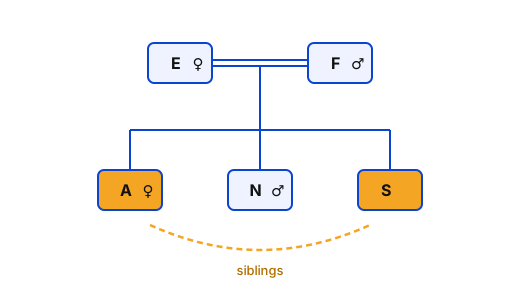
- A + E: A is the daughter of E. E − F: E is the wife of F.
- F × N: F is the father of N. N ÷ S: N is the brother of S.
- A, N and S are all children of E and F; A is female → A is the sister of S.
Trick: Mark gender as soon as a relation reveals it (daughter → female).
Answer: (D) Sister
अवधारणा: हर चिह्न का अर्थ लगाकर वंश-वृक्ष बनाएँ।
- A + E: A, E की बेटी। E − F: E, F की पत्नी।
- F × N: F, N का पिता। N ÷ S: N, S का भाई।
- A, N, S तीनों E और F की संतान; A स्त्री है → A, S की बहन।
ट्रिक: संबंध से लिंग पता चलते ही लिख लें (बेटी → स्त्री)।
उत्तर: (D) बहन
RRB NTPC Undergraduate CBT 1General Intelligence and ReasoningCoded blood relationsRRB NTPC Undergraduate CBT 1 2024 · 8 Aug Shift 3
Q1505.If 2 is added to each even digit and 2 is added to each odd digit in the number 7145362, what will be the sum of the last two and first two digits in the new number thus formed?
यदि संख्या 7145362 में प्रत्येक सम अंक में 2 जोड़ा जाए और प्रत्येक विषम अंक में 2 जोड़ा जाए, तो इस प्रकार बनी नई संख्या के अंतिम दो और पहले दो अंकों का योग क्या होगा?
- A25
- B24
- C26
- D27
Show answer
Concept: Here 2 is added to every digit (even and odd).
- 7145362 → 9 3 6 7 5 8 4.
- First two: ; last two: .
- Sum .
Trick: Only the four end digits matter: .
Answer: (B) 24
अवधारणा: यहाँ हर अंक (सम और विषम) में 2 जोड़ना है।
- 7145362 → 9 3 6 7 5 8 4।
- पहले दो: ; अंतिम दो: ।
- योग ।
ट्रिक: केवल किनारे के चार अंक: ।
उत्तर: (B) 24
RRB NTPC Undergraduate CBT 1General Intelligence and ReasoningNumber operationsRRB NTPC Undergraduate CBT 1 2024 · 8 Aug Shift 3
Q1506.Read the given statements and conclusions carefully. Assuming that the information given in the statements is true, even if it appears to be at variance with commonly known facts, decide which of the given conclusion(s) logically follow(s) from the statements.
Statements:
All physicists are chemists.
No chemists are biologists.
Conclusions:
I. No biologists are physicists.
II. Some biologists are physicists.
दिए गए कथनों और निष्कर्षों को ध्यानपूर्वक पढ़िए। कथनों में दी गई जानकारी को सत्य मानते हुए, भले ही वह सामान्यतः ज्ञात तथ्यों से भिन्न प्रतीत होती हो, निर्णय कीजिए कि दिए गए निष्कर्षों में से कौन-सा/कौन-से निष्कर्ष कथनों का तार्किक रूप से अनुसरण करता है/करते हैं।
कथन:
सभी भौतिक विज्ञानी, रसायनज्ञ हैं।
कोई भी रसायनज्ञ, जीवविज्ञानी नहीं है।
निष्कर्ष:
I. कोई भी जीवविज्ञानी, भौतिक विज्ञानी नहीं है।
II. कुछ जीवविज्ञानी, भौतिक विज्ञानी हैं।
- AOnly conclusion (II) follows.केवल निष्कर्ष (II) अनुसरण करता है।
- BNeither conclusion (I) nor (II) follows.न तो निष्कर्ष (I) और न ही (II) अनुसरण करता है।
- COnly conclusion (I) follows.केवल निष्कर्ष (I) अनुसरण करता है।
- DBoth conclusions (I) and (II) follow.दोनों निष्कर्ष (I) और (II) अनुसरण करते हैं।
Show answer
Concept: Draw the least-overlap Venn diagram.
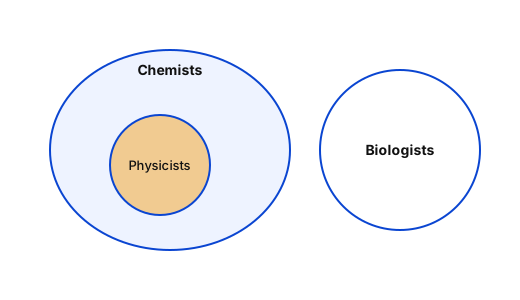
- All physicists lie inside chemists.
- Chemists and biologists do not touch, so physicists cannot touch biologists.
- I: No biologist is a physicist – true. II: Some biologists are physicists – false.
Yaad rakhein: All A are B + No B is C → No A is C (and No C is A).
Answer: (C) Only conclusion (I) follows.
अवधारणा: न्यूनतम ओवरलैप वाला वेन आरेख बनाएँ।
- सभी physicists, chemists के अंदर हैं।
- Chemists और biologists अलग हैं, अतः physicists भी biologists से अलग।
- I: कोई biologist, physicist नहीं – सत्य। II: कुछ biologists, physicists हैं – असत्य।
याद रखें: सभी A, B हैं + कोई B, C नहीं → कोई A, C नहीं।
उत्तर: (C) केवल निष्कर्ष (I) अनुसरण करता है।
RRB NTPC Undergraduate CBT 1General Intelligence and ReasoningSyllogismRRB NTPC Undergraduate CBT 1 2024 · 8 Aug Shift 3
Q1507.If ‘+’ and ‘÷’ are interchanged and ‘−’ and ‘×’ are interchanged, what will come in place of the question mark (?) in the following equation?
21 ÷ 57 − 3 × 8 + 4 = ?
यदि ‘+’ और ‘÷’ को आपस में बदल दिया जाए तथा ‘−’ और ‘×’ को आपस में बदल दिया जाए, तो निम्नलिखित समीकरण में प्रश्न चिह्न (?) के स्थान पर क्या आएगा?
21 ÷ 57 − 3 × 8 + 4 = ?
- A56
- B23
- C45
- D34
Show answer
Concept: Swap the signs as told (, ), then simplify using BODMAS (÷ and × before + and −).
- The equation printed in the paper is .
- After interchanging: .
- .
- .
- The value is not among the options (56, 23, 45, 34), so no option is correct.
Note: Always apply the interchange first, then BODMAS. In the exam, every candidate gets full marks (bonus) for such a question.
Answer: Bonus – no option is correct as printed; full marks to all.
अवधारणा: बताए अनुसार चिह्न बदलें (, ), फिर BODMAS (पहले ÷ और ×, फिर + और −) से हल करें।
- प्रश्नपत्र में छपा समीकरण है।
- चिह्न बदलने पर: ।
- ।
- ।
- मान विकल्पों (56, 23, 45, 34) में नहीं है, अतः कोई विकल्प सही नहीं।
नोट: पहले चिह्न बदलें, फिर BODMAS लगाएँ। परीक्षा में ऐसे प्रश्न पर सभी अभ्यर्थियों को पूरे अंक (बोनस) दिए जाते हैं।
उत्तर: बोनस – छपे प्रश्न के अनुसार कोई विकल्प सही नहीं; सभी को पूरे अंक।
RRB NTPC Undergraduate CBT 1General Intelligence and ReasoningMathematical OperationsRRB NTPC Undergraduate CBT 1 2024 · 8 Aug Shift 3
Q1508.In a certain code language, ‘MADE’ is coded as ‘4172’ and ‘HAME’ is coded as ‘2475’. What is the code for ‘H’ in the given code language?
एक निश्चित कूट भाषा में, ‘MADE’ को ‘4172’ के रूप में कूटबद्ध किया जाता है और ‘HAME’ को ‘2475’ के रूप में कूटबद्ध किया जाता है। उसी कूट भाषा में ‘H’ के लिए कूट क्या है?
- A7
- B4
- C5
- D2
Show answer
Concept: Common letters in two words share the common codes.
- MADE → {4,1,7,2}; HAME → {2,4,7,5}.
- Common letters M, A, E ↔ common codes 4, 7, 2.
- Left over in HAME: H ↔ 5 (and D ↔ 1 in MADE).
Trick: Unique letter ↔ unique code.
Answer: (C) 5
अवधारणा: दो शब्दों के उभयनिष्ठ अक्षरों के कोड भी उभयनिष्ठ होते हैं।
- MADE → {4,1,7,2}; HAME → {2,4,7,5}।
- उभयनिष्ठ अक्षर M, A, E ↔ उभयनिष्ठ कोड 4, 7, 2।
- HAME में बचा H ↔ 5 (MADE में D ↔ 1)।
ट्रिक: अकेला अक्षर ↔ अकेला कोड।
उत्तर: (C) 5
RRB NTPC Undergraduate CBT 1General Intelligence and ReasoningCoding-decodingRRB NTPC Undergraduate CBT 1 2024 · 8 Aug Shift 3
Q1509.What should come in place of the question mark (?) in the given series?
27 35 51 75 107 ?
दी गई श्रृंखला में प्रश्न चिह्न (?) के स्थान पर क्या आना चाहिए?
27 35 51 75 107 ?
- A125
- B147
- C148
- D174
Show answer
Concept: Look at the differences.
- Differences: – multiples of 8.
- Next difference .
- .
Trick: Difference series .
Answer: (B) 147
अवधारणा: अंतर देखें।
- अंतर: – 8 के गुणज।
- अगला अंतर ।
- ।
ट्रिक: अंतर श्रृंखला ।
उत्तर: (B) 147
RRB NTPC Undergraduate CBT 1General Intelligence and ReasoningNumber seriesRRB NTPC Undergraduate CBT 1 2024 · 8 Aug Shift 3
Q1510.In a certain code language, ‘ALPS’ is coded as ‘3257’ and ‘PUNE’ is coded as ‘1346’. What is the code for ‘P’ in the given code language?
एक निश्चित कूट भाषा में, ‘ALPS’ को ‘3257’ के रूप में कूटबद्ध किया जाता है और ‘PUNE’ को ‘1346’ के रूप में कूटबद्ध किया जाता है। उसी कूट भाषा में ‘P’ के लिए कूट क्या है?
- A1
- B5
- C7
- D3
Show answer
Concept: The letter common to both words gets the code common to both.
- ALPS → {3,2,5,7}; PUNE → {1,3,4,6}.
- Only common letter: P. Only common digit: 3.
- So P = 3.
Trick: One common letter ↔ one common digit.
Answer: (D) 3
अवधारणा: दोनों शब्दों में उभयनिष्ठ अक्षर का कोड भी उभयनिष्ठ।
- ALPS → {3,2,5,7}; PUNE → {1,3,4,6}।
- उभयनिष्ठ अक्षर केवल P; उभयनिष्ठ अंक केवल 3।
- अतः P = 3।
ट्रिक: एक उभयनिष्ठ अक्षर ↔ एक उभयनिष्ठ अंक।
उत्तर: (D) 3
RRB NTPC Undergraduate CBT 1General Intelligence and ReasoningCoding-decodingRRB NTPC Undergraduate CBT 1 2024 · 8 Aug Shift 3
Q1511.Refer to the following number and symbol series and answer the question that follows. Counting to be done from left to right only.
(Note: all numbers are single digit numbers only.)
(Left) 1 & 9 6 > 7 5 * 7 + 5 ^ 7 0 * 4 % $ (Right)
How many such symbols are there, each of which is immediately preceded by a number and also immediately followed by a number?
निम्नलिखित संख्या और प्रतीक श्रृंखला का संदर्भ लीजिए और उसके बाद दिए गए प्रश्न का उत्तर दीजिए। गणना केवल बाएँ से दाएँ की जानी है।
(नोट: सभी संख्याएँ केवल एक अंक वाली संख्याएँ हैं।)
(बाएँ) 1 & 9 6 > 7 5 * 7 + 5 ^ 7 0 * 4 % $ (दाएँ)
ऐसे कितने प्रतीक हैं, जिनमें से प्रत्येक के ठीक पहले एक संख्या है और ठीक बाद भी एक संख्या है?
- ANineनौ
- BSixछह
- CEightआठ
- DSevenसात
Show answer
Concept: Check each symbol's left and right neighbours.
- Number–symbol–number: 1 & 9, 6 > 7, 5 * 7, 7 + 5, 5 ^ 7, 0 * 4 → 6 cases.
- % is followed by $ (a symbol), so it does not count; $ is the last item.
Trick: Scan only the symbols and look one step either side.
Answer: (B) Six
अवधारणा: हर प्रतीक के बाएँ और दाएँ पड़ोसी देखें।
- संख्या–प्रतीक–संख्या: 1 & 9, 6 > 7, 5 * 7, 7 + 5, 5 ^ 7, 0 * 4 → 6।
- % के बाद $ (प्रतीक) है, अतः नहीं गिना; $ अंतिम है।
ट्रिक: केवल प्रतीकों पर रुककर दोनों ओर देखें।
उत्तर: (B) छह
RRB NTPC Undergraduate CBT 1General Intelligence and ReasoningSymbol-number seriesRRB NTPC Undergraduate CBT 1 2024 · 8 Aug Shift 3
Q1512.Seven boxes A, B, C, D, E, F and G are kept one over the other but not necessarily in the same order. Only three boxes are kept above A. Only one box is kept between F and A. Only three boxes are kept between F and E. E is kept at some place above A. B is kept immediately below E. G is kept at one of the places above D. C is not kept immediately above or below F. How many boxes are kept above B?
सात बक्से A, B, C, D, E, F और G एक के ऊपर एक रखे गए हैं, लेकिन ज़रूरी नहीं कि इसी क्रम में हों। A के ऊपर केवल तीन बक्से रखे गए हैं। F और A के बीच केवल एक बक्सा रखा गया है। F और E के बीच केवल तीन बक्से रखे गए हैं। E, A के ऊपर किसी स्थान पर रखा गया है। B, E के ठीक नीचे रखा गया है। G, D के ऊपर किसी एक स्थान पर रखा गया है। C, F के ठीक ऊपर या ठीक नीचे नहीं रखा गया है। B के ऊपर कितने बक्से रखे गए हैं?
- A4
- B1
- C3
- D2
Show answer
Concept: Number positions 1 (top) to 7 (bottom) and place fixed clues first.
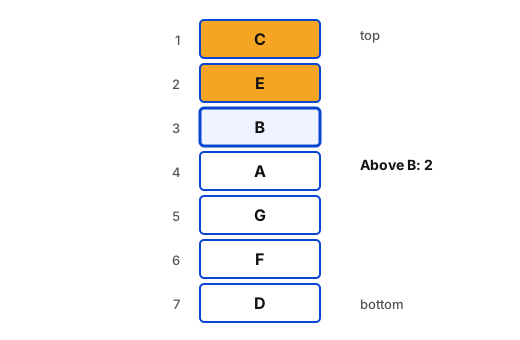
- Three above A → A at 4. One box between F and A → F at 2 or 6.
- Three between F and E with E above A → F at 6, E at 2; B just below E → B at 3.
- C not next to F (5, 7) → C at 1; G above D → G at 5, D at 7.
- Above B: C and E → 2 boxes.
Trick: Test both F positions; only one fits E above A.
Answer: (D) 2
अवधारणा: स्थान 1 (ऊपर) से 7 (नीचे) तक मानें और पक्की शर्तें पहले लगाएँ।
- A के ऊपर तीन → A स्थान 4 पर। F और A के बीच एक → F, 2 या 6 पर।
- F और E के बीच तीन व E, A के ऊपर → F 6 पर, E 2 पर; B, E के ठीक नीचे → 3।
- C, F के पास (5, 7) नहीं → C 1 पर; G, D के ऊपर → G 5, D 7।
- B के ऊपर: C और E → 2 बॉक्स।
ट्रिक: F के दोनों स्थान जाँचें; केवल एक में E, A के ऊपर आता है।
उत्तर: (D) 2
RRB NTPC Undergraduate CBT 1General Intelligence and ReasoningBox arrangementRRB NTPC Undergraduate CBT 1 2024 · 8 Aug Shift 3
Q1513.Which of the following letter-number clusters will replace the question mark (?) in the given series to make it logically complete?
LDH 14, NFJ 17, PHL 20, RJN 23, ?
निम्नलिखित में से कौन-सा अक्षर-संख्या समूह दी गई श्रृंखला में प्रश्न चिह्न (?) का स्थान लेकर उसे तार्किक रूप से पूर्ण करेगा?
LDH 14, NFJ 17, PHL 20, RJN 23, ?
- ATLP 26
- BRTS 26
- CRTQ 27
- DTMQ 27
Show answer
Concept: Track each letter position and the number separately.
- 1st letter: L, N, P, R → +2 → T.
- 2nd: D, F, H, J → L; 3rd: H, J, L, N → P.
- Number: 14, 17, 20, 23 → +3 → 26.
Trick: All letters +2, number +3.
Answer: (A) TLP 26
अवधारणा: हर अक्षर-स्थान और संख्या को अलग-अलग देखें।
- पहला अक्षर: L, N, P, R → +2 → T।
- दूसरा: D, F, H, J → L; तीसरा: H, J, L, N → P।
- संख्या: 14, 17, 20, 23 → +3 → 26।
ट्रिक: सभी अक्षर +2, संख्या +3।
उत्तर: (A) TLP 26
RRB NTPC Undergraduate CBT 1General Intelligence and ReasoningLetter-number seriesRRB NTPC Undergraduate CBT 1 2024 · 8 Aug Shift 3
Q1514.Based on the English alphabetical order, three of the following four letter-cluster pairs are alike in a certain way and thus form a group. Which letter-cluster pair DOES NOT belong to that group?
(Note: The odd one out is not based on the number of consonants/vowels or their position in the letter-cluster.)
अंग्रेज़ी वर्णमाला क्रम के आधार पर, निम्नलिखित चार अक्षर-समूह युग्मों में से तीन किसी निश्चित प्रकार से एकसमान हैं और इस प्रकार एक समूह बनाते हैं। कौन-सा अक्षर-समूह युग्म उस समूह से संबंधित नहीं है?
(नोट: असंगत, अक्षर-समूह में व्यंजनों/स्वरों की संख्या या उनके स्थान पर आधारित नहीं है।)
- AMP-GK
- BPS-JM
- CJM-DH
- DTW-NR
Show answer
Concept: Compare the gaps inside each cluster and between the clusters.
- MP-GK: M→P +3, G→K +4, M→G −6.
- JM-DH: +3, +4, −6. TW-NR: +3, +4, −6.
- PS-JM: P→S +3, J→M +3 (not +4) → odd.
Yaad rakhein: Position values: J=10, M=13, P=16, S=19.
Answer: (B) PS-JM
अवधारणा: हर समूह के अंदर और दोनों समूहों के बीच अंतर देखें।
- MP-GK: M→P +3, G→K +4, M→G −6।
- JM-DH: +3, +4, −6। TW-NR: +3, +4, −6।
- PS-JM: P→S +3, J→M +3 (+4 नहीं) → विषम।
याद रखें: स्थान मान: J=10, M=13, P=16, S=19।
उत्तर: (B) PS-JM
RRB NTPC Undergraduate CBT 1General Intelligence and ReasoningOdd one out – letter pairsRRB NTPC Undergraduate CBT 1 2024 · 8 Aug Shift 3
Q1515.Which of the following letter-number clusters will replace the question mark (?) in the given series to make it logically complete?
LIF 13, DAX 24, VSP 46, NKH 90, FCZ 178, ?
निम्नलिखित में से कौन-सा अक्षर-संख्या समूह दी गई श्रृंखला में प्रश्न चिह्न (?) का स्थान लेकर उसे तार्किक रूप से पूर्ण करेगा?
LIF 13, DAX 24, VSP 46, NKH 90, FCZ 178, ?
- AXUR 351
- BXUR 354
- CXUM 354
- DUUR 354
Show answer
Concept: Each letter moves back 8 (cyclic); the number follows .
- 1st letters: L, D, V, N, F → → X.
- 2nd: I, A, S, K, C → U; 3rd: F, X, P, H, Z → R.
- Numbers: , , … .
Trick: Within each cluster letters also step −3 (X, U, R), which quickly rules out XUM and UUR.
Answer: (B) XUR 354
अवधारणा: हर अक्षर 8 पीछे (चक्रीय) जाता है; संख्या के नियम से।
- पहले अक्षर: L, D, V, N, F → → X।
- दूसरे: I, A, S, K, C → U; तीसरे: F, X, P, H, Z → R।
- संख्याएँ: , … ।
ट्रिक: हर समूह के अंदर अक्षर −3 (X, U, R) – इससे XUM और UUR तुरंत हटते हैं।
उत्तर: (B) XUR 354
RRB NTPC Undergraduate CBT 1General Intelligence and ReasoningLetter-number seriesRRB NTPC Undergraduate CBT 1 2024 · 8 Aug Shift 3
Q1516.This question is based on the five, three-digit numbers given below.
(Left) 267 513 671 895 729 (Right)
(Example: 697 – First digit = 6, second digit = 9 and third digit = 7)
(NOTE: All operations to be done from left to right.)
If the digits of each number are added and their respective resultants are arranged in the ascending order, what is the number placed 4th from the right end?
यह प्रश्न नीचे दी गई पाँच, तीन-अंकीय संख्याओं पर आधारित है।
(बाएँ) 267 513 671 895 729 (दाएँ)
(उदाहरण: 697 – पहला अंक = 6, दूसरा अंक = 9 और तीसरा अंक = 7)
(नोट: सभी संक्रियाएँ बाएँ से दाएँ की जानी हैं।)
यदि प्रत्येक संख्या के अंकों को जोड़ा जाए और उनके संबंधित परिणामों को आरोही क्रम में व्यवस्थित किया जाए, तो दाएँ छोर से 4था स्थान पर कौन-सी संख्या होगी?
- A18
- B15
- C14
- D9
Show answer
Concept: Find each digit sum, arrange, then count from the right.
- 267 → 15, 513 → 9, 671 → 14, 895 → 22, 729 → 18.
- Ascending: 9, 14, 15, 18, 22.
- 4th from the right = 2nd from the left = 14.
Trick: In 5 items, th from right th from left.
Answer: (C) 14
अवधारणा: हर संख्या के अंकों का योग निकालें, क्रम में लगाएँ, फिर दाएँ से गिनें।
- 267 → 15, 513 → 9, 671 → 14, 895 → 22, 729 → 18।
- आरोही: 9, 14, 15, 18, 22।
- दाएँ से चौथा = बाएँ से दूसरा = 14।
ट्रिक: 5 वस्तुओं में दाएँ से वाँ = बाएँ से वाँ।
उत्तर: (C) 14
RRB NTPC Undergraduate CBT 1General Intelligence and ReasoningNumber operationsRRB NTPC Undergraduate CBT 1 2024 · 8 Aug Shift 3
Q1517.RUTW is related to TWVY in a certain way based on the English alphabetical order. In the same way, MPOR is related to ORQT. To which of the given options is VYXA related, following the same logic?
अंग्रेज़ी वर्णमाला क्रम के आधार पर RUTW एक निश्चित प्रकार से TWVY से संबंधित है। उसी प्रकार, MPOR, ORQT से संबंधित है। उसी तर्क का अनुसरण करते हुए, VYXA दिए गए विकल्पों में से किससे संबंधित है?
- AXAZC
- BXZYC
- CXBYE
- DXAYC
Show answer
Concept: Find the letter shift from the example pairs.
- RUTW → TWVY: each letter +2. MPOR → ORQT: +2.
- VYXA +2 → X, A, Z, C.
Yaad rakhein: Y +2 → A (wrap after Z).
Answer: (A) XAZC
अवधारणा: उदाहरणों से अक्षरों का खिसकाव ज्ञात करें।
- RUTW → TWVY: हर अक्षर +2। MPOR → ORQT: +2।
- VYXA +2 → X, A, Z, C।
याद रखें: Y +2 → A (Z के बाद फिर A)।
उत्तर: (A) XAZC
RRB NTPC Undergraduate CBT 1General Intelligence and ReasoningLetter analogyRRB NTPC Undergraduate CBT 1 2024 · 8 Aug Shift 3
Q1518.Shyam starts from Point A and drives 12 km towards east. He then takes a right turn, drives 7 km, turns right and drives 5 km. He then takes a left turn and drives 9 km. He takes a final right turn, drives 7 km and stops at Point P. How far (shortest distance) and towards which direction should he drive in order to reach Point A again? (All turns are 90° turns only unless specified.)
श्याम बिंदु A से चलना शुरू करता है और पूर्व की ओर 12 km गाड़ी चलाता है। फिर वह दाएँ मुड़ता है, 7 km गाड़ी चलाता है, दाएँ मुड़ता है और 5 km गाड़ी चलाता है। फिर वह बाएँ मुड़ता है और 9 km गाड़ी चलाता है। वह अंतिम बार दाएँ मुड़ता है, 7 km गाड़ी चलाता है और बिंदु P पर रुक जाता है। बिंदु A पर पुनः पहुँचने के लिए उसे कितनी दूर (न्यूनतम दूरी) और किस दिशा में गाड़ी चलानी चाहिए? (जब तक निर्दिष्ट न हो, सभी मोड़ केवल 90° के मोड़ हैं।)
- A19 km towards eastपूर्व की ओर 19 km
- B16 km towards northउत्तर की ओर 16 km
- C19 km towards northउत्तर की ओर 19 km
- D16 km towards southदक्षिण की ओर 16 km
Show answer
Concept: Trace the path on axes (east +x, north +y).
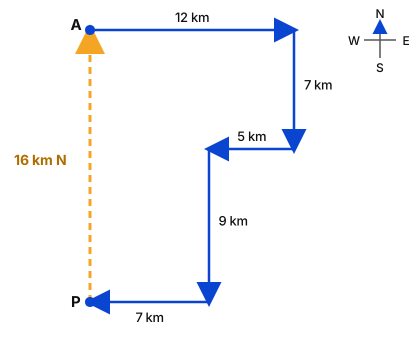
- 12 km east → (12, 0); right (south) 7 → (12, −7).
- Right (west) 5 → (7, −7); left (south) 9 → (7, −16).
- Right (west) 7 → P(0, −16), directly south of A.
- To return: 16 km towards north.
Trick: East total ; south total .
Answer: (B) 16 km towards north
अवधारणा: रास्ते को अक्षों पर बनाएँ (पूर्व +x, उत्तर +y)।
- 12 km पूर्व → (12, 0); दाएँ (दक्षिण) 7 → (12, −7)।
- दाएँ (पश्चिम) 5 → (7, −7); बाएँ (दक्षिण) 9 → (7, −16)।
- दाएँ (पश्चिम) 7 → P(0, −16), A के ठीक दक्षिण।
- वापस जाने हेतु: 16 km उत्तर की ओर।
ट्रिक: पूर्व कुल ; दक्षिण कुल ।
उत्तर: (B) 16 km उत्तर की ओर
RRB NTPC Undergraduate CBT 1General Intelligence and ReasoningDirection and distanceRRB NTPC Undergraduate CBT 1 2024 · 8 Aug Shift 3
Q1519.Seven boxes A, B, C, D, E, F and G are kept one over the other but not necessarily in the same order. Only two boxes are kept between G and A. Only F is kept above B. No box is kept below A. E is kept at some place below C but at some place above D. How many boxes are kept between D and F?
सात बक्से A, B, C, D, E, F और G एक के ऊपर एक रखे गए हैं, लेकिन ज़रूरी नहीं कि इसी क्रम में हों। G और A के बीच केवल दो बक्से रखे गए हैं। B के ऊपर केवल F रखा गया है। A के नीचे कोई बक्सा नहीं रखा गया है। E, C के नीचे किसी स्थान पर लेकिन D के ऊपर किसी स्थान पर रखा गया है। D और F के बीच कितने बक्से रखे गए हैं?
- AOneएक
- BThreeतीन
- CTwoदो
- DFourचार
Show answer
Concept: Number positions 1 (top) to 7 (bottom).
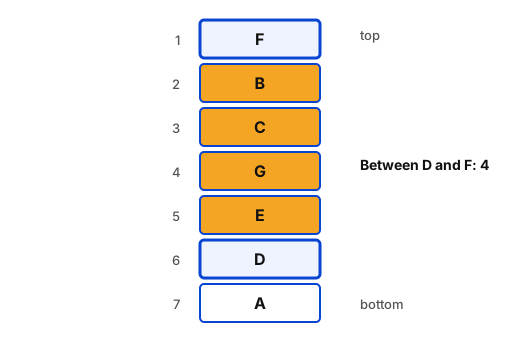
- No box below A → A at 7; two between G and A → G at 4.
- Only F above B → F at 1, B at 2.
- C above E above D in the free places 3, 5, 6 → C 3, E 5, D 6.
- Between D (6) and F (1): B, C, G, E → 4.
Trick: 'Only F above B' fixes both top places at once.
Answer: (D) Four
अवधारणा: स्थान 1 (ऊपर) से 7 (नीचे) मानें।
- A के नीचे कोई नहीं → A 7 पर; G और A के बीच दो → G 4 पर।
- B के ऊपर केवल F → F 1, B 2।
- खाली 3, 5, 6 में C, E, D (ऊपर से) → C 3, E 5, D 6।
- D (6) और F (1) के बीच: B, C, G, E → 4।
ट्रिक: 'B के ऊपर केवल F' से ऊपर के दोनों स्थान तय।
उत्तर: (D) चार
RRB NTPC Undergraduate CBT 1General Intelligence and ReasoningBox arrangementRRB NTPC Undergraduate CBT 1 2024 · 8 Aug Shift 3
Q1520.Select the pair that follows the same pattern as that followed by the two pairs given below. Both pairs follow the same pattern.
ACF : CEH
PET : RGV
उस युग्म का चयन कीजिए जो उसी पैटर्न का अनुसरण करता है जिसका अनुसरण नीचे दिए गए दो युग्म करते हैं। दोनों युग्म एक ही पैटर्न का अनुसरण करते हैं।
ACF : CEH
PET : RGV
- AXVN : ZXP
- BWDX : ZFY
- CQTP : SUW
- DSAD : TBO
Show answer
Concept: Find the shift of each letter in the example pairs.
- ACF → CEH and PET → RGV: every letter +2.
- XVN +2 → ZXP ✓.
- WDX → YFZ (not ZFY); QTP → SVR; SAD → UCF – others fail.
Trick: Check just the first letter (+2) to eliminate fast.
Answer: (A) XVN : ZXP
अवधारणा: उदाहरण युग्मों में हर अक्षर का खिसकाव देखें।
- ACF → CEH और PET → RGV: हर अक्षर +2।
- XVN +2 → ZXP ✓।
- WDX → YFZ (ZFY नहीं); QTP → SVR; SAD → UCF – बाकी गलत।
ट्रिक: केवल पहला अक्षर (+2) देखकर जल्दी हटाएँ।
उत्तर: (A) XVN : ZXP
RRB NTPC Undergraduate CBT 1General Intelligence and ReasoningLetter analogyRRB NTPC Undergraduate CBT 1 2024 · 8 Aug Shift 3

